Recognition: 2 theorem links
· Lean TheoremData-Driven Constraints on Magnetar Population: No Evidence for a Distinct White Dwarf Channel
Pith reviewed 2026-05-10 18:13 UTC · model grok-4.3
The pith
Magnetar data fit a single neutron-star population without needing a white-dwarf channel.
A machine-rendered reading of the paper's core claim, the machinery that carries it, and where it could break.
Core claim
The observed magnetar sample is consistent with a single, predominantly neutron-star population. Exploratory machine-learning diagnostics reveal reproducible sub-structure in which X-ray luminosity, spin-down rate, and temperature are the dominant predictors, yet Bayesian model comparison shows no statistically significant preference for a two-population mixture. A handful of low spin-down sources receive intermediate posterior membership probabilities, indicating that they are better interpreted as transitional or outlying objects than as members of a clearly distinct white-dwarf class.
What carries the argument
Hierarchical Bayesian mixture model with covariate-dependent mixing fractions that links spin parameters to magnetic-field distributions.
If this is right
- The bulk of the magnetar population can be modeled without invoking white-dwarf progenitors.
- Low spin-down sources are better viewed as outliers or transitional objects inside the neutron-star framework.
- Population synthesis calculations should focus on neutron-star formation channels with allowance for rare deviations.
- Newly discovered magnetars can be tested against the single-population baseline rather than automatically assigned to a separate class.
Where Pith is reading between the lines
- Theoretical work on magnetic-field generation can concentrate on neutron-star mechanisms rather than white-dwarf alternatives.
- The same mixture-model approach could be applied to other compact-object samples to search for hidden subpopulations.
- Individual anomalous sources may mark evolutionary stages rather than evidence for a second formation channel.
Load-bearing premise
The chosen observables and the hierarchical Bayesian mixture model are sufficient to detect a distinct white-dwarf population if one exists in the data.
What would settle it
A statistically significant preference for the two-component model or a clear bimodal distribution in posterior membership probabilities when additional magnetars are added to the sample.
Figures


read the original abstract
Magnetars are usually interpreted as highly magnetized neutron stars, yet a small subset of low spin-down sources has motivated alternative scenarios involving highly magnetized white dwarfs. We test whether the observed magnetar sample is consistent with a single neutron-star population or whether the data favor an additional compact-object channel. We combine exploratory machine-learning diagnostics with hierarchical Bayesian population modeling. First, we apply principal component analysis and K-means clustering in $(P,\dot{P},L_X)$ space, and then train a Random Forest classifier with leave-one-out cross-validation to identify the observables driving the empirical split. We subsequently construct a hierarchical Bayesian mixture model that links spin parameters to magnetic-field distributions through covariate-dependent mixing fractions. Posterior inference is performed with Hamiltonian Monte Carlo, and predictive performance is assessed with Pareto-smoothed importance sampling leave-one-out cross-validation. The exploratory analysis reveals a reproducible sub-structure: the Random Forest reaches $>95\%$ LOOCV accuracy, with $L_X$, $\dot{P}$, and $kT$ emerging as the dominant predictors. However, the Bayesian comparison shows no statistically significant preference for a two-population model. Instead, a few low spin-down sources receive intermediate posterior membership probabilities, indicating that they are better interpreted as transitional or outlying objects than as members of a clearly distinct class. Overall, current data do not require a separate white-dwarf magnetar population. The main result is therefore conservative but strong: the observed sample is adequately described by a predominantly neutron-star population, while still allowing physically interesting deviations in specific sources.
Editorial analysis
A structured set of objections, weighed in public.
Referee Report
Summary. The paper combines exploratory machine learning (PCA, K-means clustering, and Random Forest classification with LOOCV) on magnetar observables (P, Pdot, L_X, kT) with a hierarchical Bayesian mixture model that incorporates covariate-dependent mixing fractions and magnetic-field distributions. The ML step identifies reproducible sub-structure with >95% LOOCV accuracy driven by L_X, Pdot, and kT, but the Bayesian model comparison via PSIS-LOO and HMC finds no statistically significant preference for a two-population model over a single neutron-star population; a few low spin-down sources receive only intermediate membership probabilities and are interpreted as transitional outliers.
Significance. If the central claim holds after addressing power and specification details, the work provides a data-driven constraint on magnetar formation channels, indicating that current observations are adequately described by a predominantly neutron-star population without requiring a distinct white-dwarf channel. This has implications for compact-object demographics and high-B field evolution, while explicitly allowing for physically interesting deviations in specific sources. The integration of ML diagnostics with hierarchical Bayesian inference and proper cross-validation is a methodological strength.
major comments (2)
- [Bayesian population modeling section] The hierarchical Bayesian mixture model (described after the exploratory ML analysis) does not report a simulation-based power analysis or sensitivity study to quantify its ability to detect a minority white-dwarf subpopulation given the small sample size, potential overlap in (P, Pdot, L_X, kT) distributions, and flexible covariate-dependent mixing fractions. This is load-bearing for the central claim that the data 'do not require' a separate channel, as a genuine minority population could be absorbed without triggering model preference or high membership probabilities.
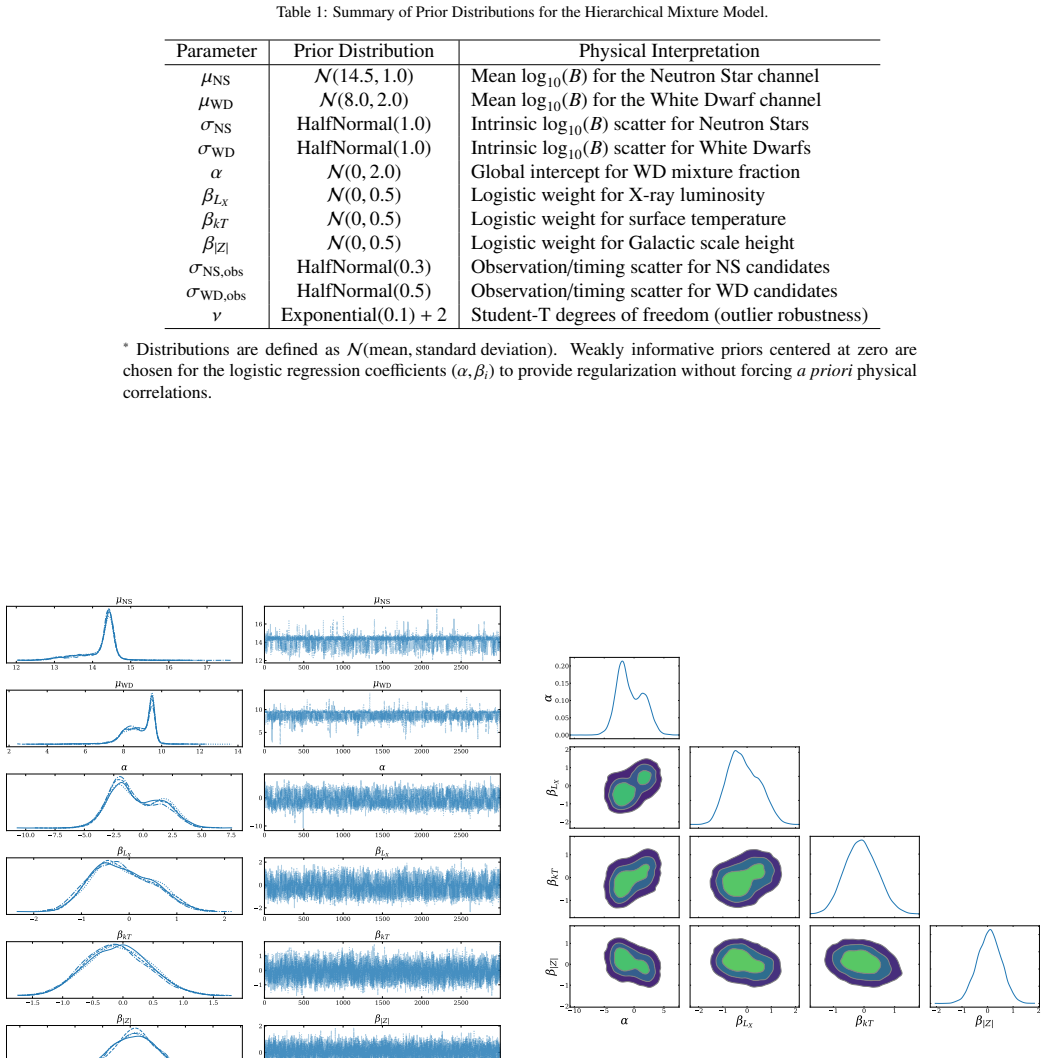
- [hierarchical Bayesian mixture model] The abstract and model description invoke 'covariate-dependent mixing fractions' and 'parameters of magnetic-field distributions' but provide no explicit prior specifications, hyperprior choices, or exact functional form linking spin parameters to the mixing weights. Without these, it is difficult to assess whether the lack of two-population preference is robust or sensitive to prior assumptions.
minor comments (2)
- Notation for the observables (e.g., consistent use of Pdot vs. dot{P}) and membership probability symbols should be standardized across the ML and Bayesian sections for clarity.
- [exploratory machine-learning diagnostics] The Random Forest feature importance results (L_X, Pdot, kT dominant) would benefit from a table or figure showing the exact ranking and LOOCV confusion matrix to allow direct comparison with the Bayesian membership probabilities.
Simulated Author's Rebuttal
We thank the referee for the constructive and detailed report, which correctly identifies methodological strengths while raising important points about robustness. We address each major comment below and commit to revisions that will strengthen the manuscript without altering its central conclusions.
read point-by-point responses
-
Referee: [Bayesian population modeling section] The hierarchical Bayesian mixture model (described after the exploratory ML analysis) does not report a simulation-based power analysis or sensitivity study to quantify its ability to detect a minority white-dwarf subpopulation given the small sample size, potential overlap in (P, Pdot, L_X, kT) distributions, and flexible covariate-dependent mixing fractions. This is load-bearing for the central claim that the data 'do not require' a separate channel, as a genuine minority population could be absorbed without triggering model preference or high membership probabilities.
Authors: We agree that an explicit power analysis is needed to support the interpretation that the data do not require a separate channel. In the revised manuscript we will add a dedicated simulation study: synthetic catalogs will be generated from a two-population model with minority fractions ranging from 5% to 25%, varying degrees of overlap in the (P, Pdot, L_X, kT) space, and the same covariate-dependent mixing structure. We will then re-run the full inference pipeline and report the recovered posterior odds, membership probabilities, and PSIS-LOO differences. This will quantify the model's ability to detect a minority component under the observed sample size and will be presented as a new subsection in the methods and results. revision: yes
-
Referee: [hierarchical Bayesian mixture model] The abstract and model description invoke 'covariate-dependent mixing fractions' and 'parameters of magnetic-field distributions' but provide no explicit prior specifications, hyperprior choices, or exact functional form linking spin parameters to the mixing weights. Without these, it is difficult to assess whether the lack of two-population preference is robust or sensitive to prior assumptions.
Authors: The functional form and priors are implemented in the accompanying code but were not stated with sufficient detail in the main text. We will expand the hierarchical Bayesian mixture model section to include: (i) the exact link function logit(π_i) = β_0 + β_1 log P_i + β_2 log Pdot_i, (ii) the prior β ~ Normal(0, σ_β) with σ_β ~ HalfNormal(1), (iii) the magnetic-field distribution parameters (log B ~ Normal(μ_B, σ_B)) with hyperpriors μ_B ~ Normal(14, 1) and σ_B ~ HalfNormal(1), and (iv) a brief prior-sensitivity check using alternative hyperprior scales. These additions will be placed in the main text with a pointer to the full Stan model in the supplement. revision: yes
Circularity Check
No circularity: standard statistical model comparison on observed magnetar data
full rationale
The paper's derivation consists of two independent stages: (1) exploratory unsupervised and supervised ML (PCA, K-means, Random Forest with LOOCV) applied to the (P, Pdot, L_X, kT) observables to detect empirical sub-structure, and (2) a hierarchical Bayesian mixture model with covariate-dependent mixing fractions, fitted via HMC and evaluated with PSIS-LOOCV. The central claim—that the data show no statistically significant preference for a two-population model—is the direct numerical output of the Bayesian model comparison and posterior membership probabilities, not a quantity that reduces to the inputs by definition or by renaming a fitted parameter as a prediction. No self-citations, uniqueness theorems, or ansatzes appear in the load-bearing steps. The analysis is therefore self-contained against the observed sample and external statistical benchmarks.
Axiom & Free-Parameter Ledger
free parameters (2)
- covariate-dependent mixing fractions
- parameters of magnetic-field distributions
axioms (1)
- domain assumption The observables P, Pdot, L_X and kT contain sufficient information to distinguish population membership if distinct channels exist.
Lean theorems connected to this paper
-
IndisputableMonolith/Foundation/AbsoluteFloorClosure.leanreality_from_one_distinction unclearThe exploratory analysis reveals a reproducible sub-structure: the Random Forest reaches >95% LOOCV accuracy, with LX, Pdot, and kT emerging as the dominant predictors.
Reference graph
Works this paper leans on
-
[1]
write newline
" write newline "" before.all 'output.state := FUNCTION n.dashify 't := "" t empty not t #1 #1 substring "-" = t #1 #2 substring "--" = not "--" * t #2 global.max substring 't := t #1 #1 substring "-" = "-" * t #2 global.max substring 't := while if t #1 #1 substring * t #2 global.max substring 't := if while FUNCTION word.in bbl.in ":" * " " * FUNCTION f...
-
[2]
author Abril-Pla , O. , author Andreani, V. , author Carroll, C. , author Dong, L. , author Fonnesbeck, C.J. , author Kochurov, M. , author Kumar, R. , author Lao, J. , author Luhmann, C.C. , author Martin, O.A. , author Osthege, M. , author Vieira, R. , author Wiecki, T. , author Zinkov, R. , year 2023 . title PyMC : A modern, and comprehensive probabili...
-
[3]
author Chimanski, E.V. , author Lobato, R.V. , author Goncalves, A.R. , author Bertulani, C.A. , year 2023 . title Bayesian exploration of phenomenological eos of neutron/hybrid stars with recent observations . journal Particles volume 6 , pages 198--216 . :10.3390/particles6010011
-
[4]
author Coelho, J.G. , author Malheiro, M. , year 2014 . title Magnetic dipole moment of soft gamma-ray repeaters and anomalous X-ray pulsars described as massive and magnetic white dwarfs . journal Publ. Astron. Soc. Jap. volume 66 , pages 14 . :10.1093/pasj/pst014, http://arxiv.org/abs/1211.6078 arXiv:1211.6078
-
[5]
author Dong, X. , author Shen, H. , author Hu, J. , author Zhang, Y. , year 2025 . title Equation of state for neutron stars with speed of sound constraints via bayesian inference . journal Phys. Rev. D volume 112 , pages 063043 . :10.1103/hlgb-47pj
-
[6]
author Duane, S. , author Kennedy, A.D. , author Pendleton, B.J. , author Roweth, D. , year 1987 . title Hybrid Monte Carlo . journal Physics Letters B volume 195 , pages 216--222 . :10.1016/0370-2693(87)91197-X
-
[7]
author Esposito, P. , author Rea, N. , author Israel, G.L. , year 2020 . title Magnetars: A Short Review and Some Sparse Considerations , in: editor Belloni, T.M. , editor M \'e ndez, M. , editor Zhang, C. (Eds.), booktitle Astrophys. Space Sci . Libr . . publisher Springer , address Berlin, Heidelberg . volume volume 461 , pp. pages 97--142 . :10.1007/97...
-
[8]
author Fujimoto, Y. , author Fukushima, K. , author Kamata, S. , author Murase, K. , year 2024 . title Uncertainty quantification in the machine-learning inference from neutron star probability distribution to the equation of state . journal Phys. Rev. D volume 110 , pages 034035 . :10.1103/PhysRevD.110.034035
-
[9]
author Gelman, A. , author Carlin, J.B. , author Stern, H.S. , author Rubin, D.B. , year 1995 . title Bayesian Data Analysis . publisher Chapman and Hall/CRC , address New York . :10.1201/9780429258411
-
[10]
author Gelman, A. , author Hwang, J. , author Vehtari, A. , year 2014 . title Understanding predictive information criteria for Bayesian models . journal Statistics and Computing volume 24 , pages 997--1016 . :10.1007/s11222-013-9416-2
-
[11]
author Halkidi, M. , author Batistakis, Y. , author Vazirgiannis, M. , year 2001 . title On Clustering Validation Techniques . journal Journal of Intelligent Information Systems volume 17 , pages 107--145 . :10.1023/A:1012801612483
-
[12]
author Ho, T.K. , year 1995 . title Random decision forests , in: booktitle Proceedings of 3rd International Conference on Document Analysis and Recognition , pp. pages 278--282 vol.1 . :10.1109/ICDAR.1995.598994
-
[13]
, year 2013
author Jolliffe, I.T. , year 2013 . title Principal Component Analysis . publisher Springer Science & Business Media
2013
-
[14]
author Kaspi, V.M. , author Beloborodov, A.M. , year 2017 . title Magnetars . journal Annual Review of Astronomy and Astrophysics volume 55 , pages 261--301 . :10.1146/annurev-astro-081915-023329, http://arxiv.org/abs/1703.00068 arXiv:1703.00068
-
[15]
author Li, J.J. , author Sedrakian, A. , year 2025 . title Bayesian inferences on covariant density functionals from multimessenger astrophysical data: The impacts of likelihood functions of low density matter constraints . journal Phys. Rev. C volume 112 , pages 015802 . :10.1103/c1k3-k4l5
-
[16]
author Li, J.J. , author Tian, Y. , author Sedrakian, A. , year 2025 . title Bayesian inferences on covariant density functionals from multimessenger astrophysical data: Nucleonic models . journal Phys. Rev. C volume 111 , pages 055804 . :10.1103/PhysRevC.111.055804
-
[17]
author Linde, Y. , author Buzo, A. , author Gray, R. , year 1980 . title An Algorithm for Vector Quantizer Design . journal IEEE Transactions on Communications volume 28 , pages 84--95 . :10.1109/TCOM.1980.1094577
-
[18]
Least Squares Quantization in PCM,
author Lloyd, S. , year 1982 . title Least squares quantization in PCM . journal IEEE Transactions on Information Theory volume 28 , pages 129--137 . :10.1109/TIT.1982.1056489
-
[19]
author Lobato, R.V. , author Chimanski, E.V. , author Bertulani, C.A. , year 2022 a. title Cluster Structures with Machine Learning Support in Neutron Star M-R relations . journal Journal of Physics: Conference Series volume 2340 , pages 012014 . :10.1088/1742-6596/2340/1/012014, http://arxiv.org/abs/2204.01183 arXiv:2204.01183
-
[20]
author Lobato, R.V. , author Chimanski, E.V. , author Bertulani, C.A. , year 2022 b. title Unsupervised machine learning correlations in eos of neutron stars . journal arXiv e-prints http://arxiv.org/abs/2202.13940 arXiv:2202.13940
-
[21]
author Lobato, R.V. , author Malheiro, M. , author Coelho, J.G. , year 2016 . title Magnetars and white dwarf pulsars . journal International Journal of Modern Physics D volume 25 , pages 1641025 . :10.1142/S021827181641025X, http://arxiv.org/abs/1603.00870 arXiv:1603.00870
-
[22]
author Malheiro, M. , author Rueda, J.A. , author Ruffini, R. , year 2012 . title SGRs and AXPs as Rotation-Powered Massive White Dwarfs . journal Publications of the Astronomical Society of Japan volume 64 . :10.1093/pasj/64.3.56
-
[23]
2008, A&A Rv, 15, 225, doi: 10.1007/s00159-008-0011-z
author Mereghetti, S. , year 2008 . title The strongest cosmic magnets: Soft gamma-ray repeaters and anomalous X-ray pulsars . journal The Astronomy and Astrophysics Review volume 15 , pages 225--287 . :10.1007/s00159-008-0011-z
-
[24]
author Mereghetti, S. , author Pons, J. , author Melatos, A. , year 2015 . title Magnetars: Properties , Origin and Evolution . journal Space Sci. Rev. volume 191 , pages 315--338 . :10.1007/s11214-015-0146-y, http://arxiv.org/abs/1503.06313 arXiv:1503.06313
-
[25]
author Mukhopadhyay, B. , author Rao, A.R. , year 2016 . title Soft gamma-ray repeaters and anomalous X-ray pulsars as highly magnetized white dwarfs . journal Journal of Cosmology and Astroparticle Physics volume 05 , pages 007 . :10.1088/1475-7516/2016/05/007, http://arxiv.org/abs/1603.00575 arXiv:1603.00575
-
[26]
2025, Classical and Quantum Gravity, 42, 205008, doi: 10.1088/1361-6382/ae1094
author Ng, S. , author Legred, I. , author Suleiman, L. , author Landry, P. , author Traylor, L. , author Read, J. , year 2025 . title Inferring the neutron star equation of state with nuclear-physics informed semiparametric models . journal Classical and Quantum Gravity volume 42 , pages 205008 . :10.1088/1361-6382/ae1094
-
[27]
The McGill Magnetar Catalog.ApJ Suppl
author Olausen, S.A. , author Kaspi, V.M. , year 2014 . title The McGill Magnetar Catalog . journal The Astrophysical Journal Supplement Series volume 212 , pages 6 . :10.1088/0067-0049/212/1/6, http://arxiv.org/abs/1309.4167 arXiv:1309.4167
-
[28]
author Papigkiotis, G. , author Vardakas, G. , author Likas, A. , author Stergioulas, N. , year 2025 . title Universal description of a neutron star's surface and its key global properties: A machine learning approach for nonrotating and rapidly rotating stellar models . journal Phys. Rev. D volume 111 , pages 083056 . :10.1103/PhysRevD.111.083056
-
[29]
author Rea, N. , author Esposito, P. , author Turolla, R. , author Israel, G.L. , author Zane, S. , author Stella, L. , author Mereghetti, S. , author Tiengo, A. , author G \"o tz, D. , author G \"o g \"u s , E. , author Kouveliotou, C. , year 2010 . title A Low-Magnetic-Field Soft Gamma Repeater . journal Science volume 330 , pages 944 . :10.1126/science...
-
[30]
author Rea, N. , author Israel, G.L. , author Esposito, P. , author Pons, J.A. , author Camero-Arranz , A. , author Mignani, R.P. , author Turolla, R. , author Zane, S. , author Burgay, M. , author Possenti, A. , author Campana, S. , author Enoto, T. , author Gehrels, N. , author G \"o g \"u s , E. , author G \"o tz, D. , author Kouveliotou, C. , author M...
-
[31]
o g \"u s , E. , author Caliandro, G.A. , author Kouveliotou, C. , author G \
author Rea, N. , author Israel, G.L. , author Pons, J.A. , author Turolla, R. , author Vigan \`o , D. , author Zane, S. , author Esposito, P. , author Perna, R. , author Papitto, A. , author Terreran, G. , author Tiengo, A. , author Salvetti, D. , author Girart, J.M. , author Palau, A. , author Possenti, A. , author Burgay, M. , author G \"o g \"u s , E. ...
-
[32]
author Stergioulas, N. , year 2024 . title Machine learning applications in gravitational wave astronomy . journal arXiv e-prints http://arxiv.org/abs/2401.07406 arXiv:2401.07406
-
[33]
Magnetars: the physics behind observations
author Turolla, R. , author Zane, S. , author Watts, A.L. , year 2015 . title Magnetars: The physics behind observations. A review . journal Reports on Progress in Physics volume 78 , pages 116901 . :10.1088/0034-4885/78/11/116901
-
[34]
author Vats, D. , author Knudson, C. , year 2021 . title Revisiting the Gelman -- Rubin Diagnostic . journal Statistical Science volume 36 , pages 518--529 . :10.1214/20-STS812
-
[35]
Statistics and Computing , author =
author Vehtari, A. , author Gelman, A. , author Gabry, J. , year 2017 . title Practical Bayesian model evaluation using leave-one-out cross-validation and WAIC . journal Statistics and Computing volume 27 , pages 1413--1432 . :10.1007/s11222-016-9696-4
-
[36]
author Zhou, K. , author Wang, L. , author Pang, L.G. , author Shi, S. , year 2024 . title Exploring qcd matter in extreme conditions with machine learning . journal Progress in Particle and Nuclear Physics volume 135 , pages 104084 . :10.1016/j.ppnp.2023.104084
-
[37]
2015, , 579, A101
Aladro, R., Martín, S., Riquelme, D., et al. 2015, , 579, A101
2015
discussion (0)
Sign in with ORCID, Apple, or X to comment. Anyone can read and Pith papers without signing in.