Recognition: 2 theorem links
· Lean TheoremDirectional Andreev-Reflection Signatures of Inter-Orbital Pairing in Sr₂RuO₄
Pith reviewed 2026-05-10 18:06 UTC · model grok-4.3
The pith
Inter-orbital pairing in Sr₂RuO₄ reverses the usual directional anisotropy of Andreev bound states.
A machine-rendered reading of the paper's core claim, the machinery that carries it, and where it could break.
Core claim
The central claim is that the anomalous anisotropy arises from the inter-orbital character of the superconducting pairing. Both even- and odd-parity inter-orbital channels generate robust surface Andreev bound states while suppressing planar edge modes and can produce a horizontal line node. Edge- and surface-sensitive spectroscopy reveals pronounced in-gap features at out-of-plane surfaces and reduced intensity at in-plane edges, consistent with calculations that incorporate the material's interface properties.
What carries the argument
Inter-orbital pairing channels within the superconducting order parameter, which dictate direction-dependent formation of Andreev bound states.
If this is right
- The superconducting order parameter must contain substantial inter-orbital components to match the directional spectral signatures.
- A horizontal line node becomes possible in the gap structure.
- Surface-sensitive measurements gain priority over edge measurements for identifying pairing symmetry in this system.
- The conventional paradigm linking in-plane edge states to unconventional superconductivity requires modification for multi-orbital materials.
Where Pith is reading between the lines
- The same inter-orbital mechanism could resolve similar directional anomalies reported in other layered multi-orbital superconductors.
- Varying surface termination in future experiments would provide a direct test of whether orbital mixing controls the bound-state intensity.
- Confirmation would narrow the range of viable single-orbital models for the pairing in Sr₂RuO₄.
- Interface effects are incorporated in the model without extra parameters, implying they are secondary to the bulk pairing character.
Load-bearing premise
The observed in-gap spectral features are Andreev bound states produced by the bulk pairing symmetry rather than by interface reconstructions or disorder.
What would settle it
Absence of strong in-gap states at out-of-plane surfaces in samples with different surface preparations or interface conditions would contradict the inter-orbital pairing explanation.
Figures


read the original abstract
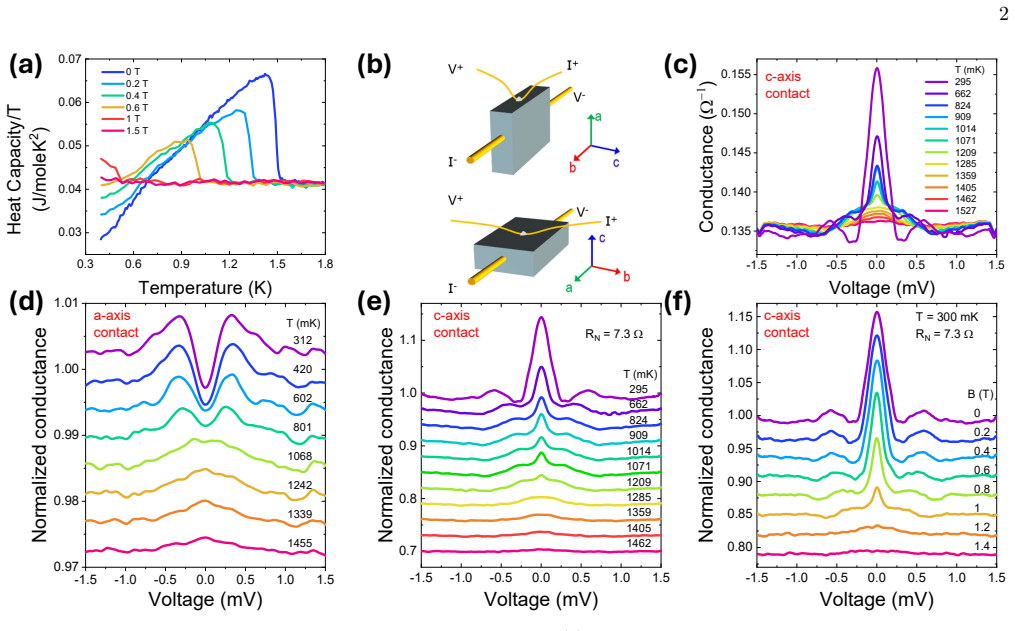
Unconventional superconductivity in quasi--two-dimensional systems is commonly identified through the emergence of Andreev bound states (ABS) at in-plane edges, while surfaces perpendicular to out-of-plane direction remain fully gapped due to weak interlayer coherence. This directional anisotropy has long served as a key paradigm for constraining pairing symmetries. Here, we show that Sr$_2$RuO$_4$ exhibits a striking reversal of this behavior. Using edge- and surface-sensitive spectroscopy, we observe pronounced in-gap ABS at surfaces perpendicular to the out-of-plane direction, whereas in-plane edges exhibit a reduced intensity of the in-gap spectral features. We show that this anomalous anisotropy can arise from the inter-orbital character of the superconducting pairing. Both even- and odd-parity inter-orbital pairing channels naturally generate robust surface ABS while suppressing planar edge modes and can also provide a mechanism for the appearance of a horizontal line node. Supported by \textit{ab initio} and model calculations, including Sr$_2$RuO$_4$/Ag interface reconstructions, our results highlight the possible role of inter-orbital correlations in shaping the spectroscopic response and provide constraints on the structure of the superconducting order parameter in Sr$_2$RuO$_4$.
Editorial analysis
A structured set of objections, weighed in public.
Referee Report
Summary. The manuscript reports a reversal of the conventional directional anisotropy of Andreev bound states (ABS) in Sr₂RuO₄: pronounced in-gap spectral features are observed at surfaces perpendicular to the c-axis, while in-plane edges show reduced in-gap intensity. This is interpreted as arising from the inter-orbital character of the superconducting pairing, with both even- and odd-parity inter-orbital channels naturally producing robust surface ABS, suppressing planar edge modes, and offering a mechanism for a horizontal line node. The interpretation is supported by edge- and surface-sensitive spectroscopy together with ab initio and model calculations that incorporate Sr₂RuO₄/Ag interface reconstructions.
Significance. If the attribution to bulk inter-orbital pairing holds, the result supplies new spectroscopic constraints on the order parameter of Sr₂RuO₄ and underscores the importance of inter-orbital correlations in quasi-2D unconventional superconductors. The inclusion of ab initio interface modeling is a constructive element that moves beyond purely phenomenological treatments.
major comments (2)
- [ab initio and model calculations section] The central claim that the observed out-of-plane in-gap states are bulk Andreev bound states generated by inter-orbital pairing (rather than Sr₂RuO₄/Ag interface artifacts, disorder, or proximity effects) is load-bearing. The ab initio interface calculations are invoked to support this distinction, yet the manuscript does not quantify uncertainties in orbital hybridization or demonstrate that alternative extrinsic mechanisms are excluded by the data.
- [model calculations] The model calculations that map even- and odd-parity inter-orbital pairing channels onto the directional selectivity of ABS and the horizontal line node must show explicitly that the predicted anisotropy is robust and independent of any fitted parameters or normalizations used to match the spectra; otherwise the mapping risks circularity with the target observation.
minor comments (2)
- Notation for the even- and odd-parity inter-orbital channels should be defined consistently in the text and figures to avoid ambiguity when comparing to prior literature on Sr₂RuO₄ pairing symmetries.
- [experimental methods] The experimental spectra would benefit from explicit error bars, sample details, and a clear statement of how background subtraction or normalization was performed.
Simulated Author's Rebuttal
We thank the referee for the positive assessment of our work and the constructive comments on the ab initio and model calculations. We address each major comment below and have revised the manuscript to incorporate additional analyses that strengthen the distinction between bulk inter-orbital pairing effects and possible extrinsic contributions.
read point-by-point responses
-
Referee: [ab initio and model calculations section] The central claim that the observed out-of-plane in-gap states are bulk Andreev bound states generated by inter-orbital pairing (rather than Sr₂RuO₄/Ag interface artifacts, disorder, or proximity effects) is load-bearing. The ab initio interface calculations are invoked to support this distinction, yet the manuscript does not quantify uncertainties in orbital hybridization or demonstrate that alternative extrinsic mechanisms are excluded by the data.
Authors: We agree that quantifying uncertainties and explicitly ruling out extrinsic mechanisms is necessary for the central claim. In the revised manuscript we have added a sensitivity analysis of the DFT interface calculations, varying orbital hybridization strengths over the range permitted by the reconstructed Sr₂RuO₄/Ag energetics; the surface ABS remain robust across this interval, with error bars now shown on the relevant spectral features. We further compare calculated spectra for conventional intra-orbital pairing, which fails to generate the observed out-of-plane in-gap intensity, and demonstrate that isotropic proximity-induced pairing or disorder broadening cannot reproduce the measured directional anisotropy (strong surface states, suppressed edge states). These comparisons are now presented in the main text and supplementary material. revision: yes
-
Referee: [model calculations] The model calculations that map even- and odd-parity inter-orbital pairing channels onto the directional selectivity of ABS and the horizontal line node must show explicitly that the predicted anisotropy is robust and independent of any fitted parameters or normalizations used to match the spectra; otherwise the mapping risks circularity with the target observation.
Authors: We acknowledge the risk of circularity and have revised the model section accordingly. The anisotropy and horizontal line node are general topological consequences of the orbital-selective pairing terms in the tight-binding Hamiltonian. In the revised version we include an explicit parameter scan (now in the supplementary information) in which the relative amplitudes of even- and odd-parity inter-orbital components, the overall pairing scale, and spectral normalizations are varied over more than an order of magnitude. The reversal of directional selectivity and the horizontal line node persist throughout the scanned range, confirming that these features are structural properties of the inter-orbital channels rather than artifacts of specific fitting choices. revision: yes
Circularity Check
No circularity: ab initio and model calculations provide independent support for the inter-orbital pairing interpretation
full rationale
The paper's central derivation attributes the observed reversal of ABS anisotropy (robust out-of-plane surface states, suppressed in-plane edges) to even- and odd-parity inter-orbital pairing channels, which are shown via ab initio interface modeling and separate model calculations to naturally generate these features plus a possible horizontal line node. No quoted step reduces a claimed prediction to a fitted parameter by construction, nor does any load-bearing premise collapse to a self-citation chain or self-defined ansatz. The ab initio component supplies external grounding independent of the target spectra, and the model results are presented as demonstrations of natural consequences rather than tautological fits. The derivation chain therefore remains self-contained against external benchmarks.
Axiom & Free-Parameter Ledger
axioms (1)
- domain assumption Observed in-gap states at out-of-plane surfaces are Andreev bound states generated by the superconducting order parameter rather than interface-specific effects.
Lean theorems connected to this paper
-
IndisputableMonolith/Foundation/RealityFromDistinction.leanreality_from_one_distinction unclear?
unclearRelation between the paper passage and the cited Recognition theorem.
We employ an ab initio-based microscopic theory... Kohn-Sham-Dirac-Bogoliubov-de Gennes... inter-orbital Eg and A1u pairings... effective model with Δ = Δ0 sin(kz)
-
IndisputableMonolith/Cost/FunctionalEquation.leanwashburn_uniqueness_aczel unclear?
unclearRelation between the paper passage and the cited Recognition theorem.
inter-orbital pairing... horizontal line node... surface Andreev bound states
What do these tags mean?
- matches
- The paper's claim is directly supported by a theorem in the formal canon.
- supports
- The theorem supports part of the paper's argument, but the paper may add assumptions or extra steps.
- extends
- The paper goes beyond the formal theorem; the theorem is a base layer rather than the whole result.
- uses
- The paper appears to rely on the theorem as machinery.
- contradicts
- The paper's claim conflicts with a theorem or certificate in the canon.
- unclear
- Pith found a possible connection, but the passage is too broad, indirect, or ambiguous to say the theorem truly supports the claim.
Forward citations
Cited by 1 Pith paper
-
Transverse Magnetic Response from Orbitally Polarized Cooper Pairs in Elemental Superconductors
Strained vanadium and niobium host orbitally polarized Cooper pairs that generate a transverse orbital magnetization perpendicular to an in-plane magnetic field.
Reference graph
Works this paper leans on
-
[1]
Sigrist and K
M. Sigrist and K. Ueda, Phenomenological theory of un- conventional superconductivity, Rev. Mod. Phys.63, 239 (1991)
1991
-
[2]
C. C. Tsuei and J. R. Kirtley, Pairing symmetry in cuprate superconductors, Rev. Mod. Phys.72, 969 (2000)
2000
-
[3]
Kashiwaya and Y
S. Kashiwaya and Y. Tanaka, Tunnelling effects on sur- faceboundstatesinunconventionalsuperconductors,Re- ports on Progress in Physics63, 1641 (2000)
2000
-
[4]
Hu, Midgap surface states as a novel signature for d 2 xa-x 2 b-wave superconductivity, Phys
C.-R. Hu, Midgap surface states as a novel signature for d 2 xa-x 2 b-wave superconductivity, Phys. Rev. Lett.72, 1526 (1994)
1994
-
[5]
Tanaka and S
Y. Tanaka and S. Kashiwaya, Theory of tunneling spec- troscopy ofd-wave superconductors, Phys. Rev. Lett.74, 3451 (1995)
1995
-
[6]
A. Y. Kitaev, Unpaired Majorana fermions in quantum wires, Physics-Uspekhi44, 131 (2001)
2001
-
[7]
Qi and S.-C
X.-L. Qi and S.-C. Zhang, Topological insulators and su- perconductors, Rev. Mod. Phys.83, 1057 (2011)
2011
-
[8]
Sato and Y
M. Sato and Y. Ando, Topological superconductors: a re- view, Reports on Progress in Physics80, 076501 (2017)
2017
-
[9]
Tanaka, M
Y. Tanaka, M. Sato, and N. Nagaosa, Symmetry and topology in superconductors –odd-frequency pairing and edge states–, Journal of the Physical Society of Japan81, 011013 (2012)
2012
-
[10]
Tanaka, S
Y. Tanaka, S. Tamura, and J. Cayao, Theory of Ma- jorana zero modes in unconventional superconductors, Progress of Theoretical and Experimental Physics2024, 08C105 (2024), https://academic.oup.com/ptep/article- pdf/2024/8/08C105/58919082/ptae065.pdf
2024
-
[11]
D. A. Ivanov, Non-abelian statistics of half-quantum vor- tices inp-wave superconductors, Phys. Rev. Lett.86, 268 (2001)
2001
-
[12]
Sato, Non-abelian statistics of axion strings, Physics Letters B575, 126 (2003)
M. Sato, Non-abelian statistics of axion strings, Physics Letters B575, 126 (2003)
2003
-
[13]
Nayak, S
C. Nayak, S. H. Simon, A. Stern, M. Freedman, and S. Das Sarma, Non-abelian anyons and topological quan- tum computation, Rev. Mod. Phys.80, 1083 (2008)
2008
-
[14]
J. D. Sau, R. M. Lutchyn, S. Tewari, and S. Das Sarma, Generic new platform for topological quantum compu- tation using semiconductor heterostructures, Phys. Rev. Lett.104, 040502 (2010)
2010
-
[15]
Alicea, Y
J. Alicea, Y. Oreg, G. Refael, F. von Oppen, and M. P. A. Fisher, Non-abelian statistics and topological quantum information processing in 1d wire networks, Na- ture Physics7, 412 (2011)
2011
-
[16]
Kashiwaya, Y
S. Kashiwaya, Y. Tanaka, M. Koyanagi, H. Takashima, and K. Kajimura, Origin of zero-bias conductance peaks in high-T c superconductors, Phys. Rev. B51, 1350 (1995)
1995
-
[17]
L. Alff, H. Takashima, S. Kashiwaya, N. Terada, H. Ihara, Y. Tanaka, M. Koyanagi, and K. Kajimura, Spatially continuous zero-bias conductance peak on (110) YBa2Cu3O7−δ surfaces, Phys. Rev. B55, R14757 (1997)
1997
-
[18]
Lesueur, L
J. Lesueur, L. Greene, W. Feldmann, and A. Inam, Zero bias anomalies in YBa2Cu3O7 tunnel junctions, Physica C: Superconductivity191, 325 (1992)
1992
-
[19]
Covington, M
M. Covington, M. Aprili, E. Paraoanu, L. H. Greene, F. Xu, J. Zhu, and C. A. Mirkin, Observation of surface- induced broken time-reversal symmetry in YBa2Cu3O7 tunnel junctions, Phys. Rev. Lett.79, 277 (1997)
1997
-
[20]
J. Y. T. Wei, N.-C. Yeh, D. F. Garrigus, and M. Strasik, Directional tunneling and andreev reflec- tion on YBa2Cu3O7−δ single crystals: Predominance of d-wave pairing symmetry verified with the generalized blonder, tinkham, and klapwijk theory, Phys. Rev. Lett. 81, 2542 (1998)
1998
-
[21]
Balci, and R
A.Biswas, P.Fournier, M.M.Qazilbash, V.N.Smolyani- nova, H. Balci, and R. L. Greene, Evidence of ad- tos-wave pairing symmetry transition in the electron- doped cuprate superconductor Pr 2−xCexCuO4, Phys. Rev. Lett.88, 207004 (2002)
2002
-
[22]
Kashiwaya, H
S. Kashiwaya, H. Kashiwaya, H. Kambara, T. Furuta, H. Yaguchi, Y. Tanaka, and Y. Maeno, Edge states of Sr2RuO4 detected by in-plane tunneling spectroscopy, Phys. Rev. Lett.107, 077003 (2011)
2011
-
[23]
Petrovic, and J
P.M.C.Rourke, M.A.Tanatar, C.S.Turel, J.Berdeklis, C. Petrovic, and J. Y. T. Wei, Spectroscopic evidence for multiple order parameter components in the heavy fermion superconductor CeCoIn5, Phys. Rev. Lett.94, 107005 (2005)
2005
-
[24]
Daghero, M
D. Daghero, M. Tortello, G. Ummarino, J.-C. Griveau, E. Colineau, R. Eloirdi, A. Shick, J. Kolorenc, A. Licht- enstein, and R. Caciuffo, Strong-coupling d-wave super- conductivity in PuCoGa5 probed by point-contact spec- troscopy, Nat. Commun.3, 786 (2012)
2012
-
[25]
Wälti, H
C. Wälti, H. R. Ott, Z. Fisk, and J. L. Smith, Spectro- scopic evidence for unconventional superconductivity in UBe13, Phys. Rev. Lett.84, 5616 (2000)
2000
-
[26]
Z. Liu, M. Chen, Y. Xiang, X. Chen, H. Yang, T. Liu, Q.- G. Mu, K. Zhao, Z.-A. Ren, and H.-H. Wen, Multiband superconductivity and possible nodal gap in RbCr3As3 revealed by andreev reflection and single-particle tunnel- ing measurements, Phys. Rev. B100, 094511 (2019)
2019
-
[27]
W. Zhu, R. Song, J. Huang, Q.-W. Wang, Y. Cao, R. Zhai, Q. Bian, Z. Shao, H. Jing, L. Zhu, Y. Hou, Y.-H. Gao, S. Li, F. Zheng, P. Zhang, M. Pan, J. Liu, G. Qu, Y. Gu, H. Zhang, Q. Dong, Y. Huang, X. Yuan, J. He, G. Li, T. Qian, G. Chen, S.-C. Li, M. Pan, and Q.-K. Xue, Intrinsic surface p-wave superconductivity in layered ausn4, Nature Communications14, 7...
2023
-
[28]
R. Yano, S. Nagasaka, N. Matsubara, K. Saigusa, T. Tanda, S. Ito, A. Yamakage, Y. Okamoto, K. Tak- enaka, and S. Kashiwaya, Evidence of unconven- tional superconductivity on the surface of the nodal semimetal CaAg1−xPdxP, Nature Communications14, 6817 (2023)
2023
-
[29]
H. Yoon, Y. S. Eo, J. Park, J. A. Horn, R. G. Dorman, S. R. Saha, I. M. Hayes, I. Takeuchi, P. M. Brydon, and J. Paglione, Probing p-wave superconductivity in UTe2 via point-contact junctions, npj Quantum Mater.9, 91 (2024)
2024
-
[30]
S. Wang, K. Zhussupbekov, J. P. Carroll, B. Hu, X. Liu, E. Pangburn, A. Crepieux, C. Pepin, C. Broyles, S. Ran, N. P. Butch, S. Saha, J. Paglione, C. Bena, J. C. S. Davis, and Q. Gu, Odd-parity quasiparticle interference in the superconductive surface state of UTe2, Nature Physics 9 21, 1555 (2025)
2025
- [31]
-
[32]
Maeno, H
Y. Maeno, H. Hashimoto, K. Yoshida, S. Nishizaki, T. Fujita, J. G. Bednorz, and F. Lichtenberg, Supercon- ductivity in a layered perovskite without copper, Nature 372, 532 (1994)
1994
-
[33]
S. A. Kivelson, A. C. Yuan, B. Ramshaw, and R. Thomale, A proposal for reconciling diverse experi- mentsonthesuperconductingstateinsr 2ruo4,npjQuan- tum Materials5, 43 (2020)
2020
-
[34]
Maeno, S
Y. Maeno, S. Yonezawa, and A. Ramires, Still mystery after all these years-unconventional superconductivity of Sr2RuO4, J. Phys. Soc. Jpn.93, 062001 (2024)
2024
-
[35]
Maeno, A
Y. Maeno, A. Ikeda, and G. Mattoni, Thirty years of puzzling superconductivity in Sr2RuO4, Nat. Phys.20, 1712 (2024)
2024
-
[36]
Pustogow, Y
A. Pustogow, Y. Luo, A. Chronister, Y.-S. Su, D.Sokolov, F.Jerzembeck, A.P.Mackenzie, C.W.Hicks, N. Kikugawa, S. Raghu,et al., Constraints on the super- conducting order parameter in Sr2RuO4 from oxygen-17 nuclear magnetic resonance, Nature574, 72 (2019)
2019
-
[37]
G. M. Luke, Y. Fudamoto, K. M. Kojima, M. I. Larkin, J. Merrin, B. Nachumi, Y. J. Uemura, Y. Maeno, Z. Q. Mao, Y. Mori, H. Nakamura, and M. Sigrist, Time-reversal symmetry-breaking superconductivity in Sr2RuO4, Nature394, 558 (1998)
1998
-
[38]
J. Xia, Y. Maeno, P. T. Beyersdorf, M. M. Fejer, and A. Kapitulnik, High resolution polar kerr effect measure- ments of Sr2RuO4: Evidence for broken time-reversal symmetry in the superconducting state, Phys. Rev. Lett. 97, 167002 (2006)
2006
-
[39]
Benhabib, C
S. Benhabib, C. Lupien, I. Paul, L. Berges, M. Dion, M. Nardone, A. Zitouni, Z. Q. Mao, Y. Maeno, A. Georges, L. Taillefer, and C. Proust, Ultrasound ev- idence for a two-component superconducting order pa- rameter in Sr2RuO4, Nature Physics17, 194 (2021)
2021
- [40]
-
[41]
Y.-S. Li, N. Kikugawa, D. A. Sokolov, F. Jerzembeck, A. S. Gibbs, Y. Maeno, C. W. Hicks, J. Schmalian, M. Nicklas, and A. P. Mackenzie, High-sensitivity heat- capacity measurements on Sr2RuO4 under uniaxial pres- sure, Proceedings of the National Academy of Sciences 118, 10.1073/pnas.2020492118 (2021)
-
[42]
Y.-S. Li, M. Garst, J. Schmalian, S. Ghosh, N. Kikugawa, D. A. Sokolov, C. W. Hicks, F. Jerzembeck, M. S. Ikeda, Z. Hu, B. J. Ramshaw, A. W. Rost, M. Nicklas, and A.P.Mackenzie,Elastocaloricdeterminationofthephase diagram of Sr2RuO4, Nature607, 276 (2022)
2022
-
[43]
Mazzola, W
F. Mazzola, W. Brzezicki, M. T. Mercaldo, A. Guarino, C. Bigi, J. A. Miwa, D. De Fazio, A. Crepaldi, J. Fu- jii, G. Rossi, P. Orgiani, S. K. Chaluvadi, S. P. Chalil, G. Panaccione, A. Jana, V. Polewczyk, I. Vobornik, C. Kim, F. Miletto-Granozio, R. Fittipaldi, C. Ortix, M. Cuoco, and A. Vecchione, Signatures of a surface spin–orbital chiral metal, Nature6...
2024
-
[44]
Fittipaldi, R
R. Fittipaldi, R. Hartmann, M. T. Mercaldo, S. Komori, A. Bjørlig, W. Kyung, Y. Yasui, T. Miyoshi, L. A. B. Olde Olthof, C. M. Palomares Garcia, V. Granata, I. Keren, W. Higemoto, A. Suter, T. Prokscha, A. Ro- mano, C. Noce, C. Kim, Y. Maeno, E. Scheer, B. Kalisky, J. W. A. Robinson, M. Cuoco, Z. Salman, A. Vec- chione, and A. Di Bernardo, Unveiling uncon...
2021
-
[45]
Shiroka, R
T. Shiroka, R. Fittipaldi, M. Cuoco, R. De Renzi, Y. Maeno, R. J. Lycett, S. Ramos, E. M. Forgan, C. Baines, A. Rost, V. Granata, and A. Vecchione,µsr studies of superconductivity in eutectically grown mixed ruthenates, Phys. Rev. B85, 134527 (2012)
2012
-
[46]
Y. Wu, D. Huang, H. Zhang, A. Guarino, R. Fittipaldi, C. Ma, W. Hu, C. Niu, Z. Wang, W. Yu, Y. Yerin, A. Vecchione, Y. Liu, M. Cuoco, H. Guo, and J. Shen, Disorder-inducedpronouncedmagnetoresistivehysteresis in Josephson junctions, Phys. Rev. B111, 134513 (2025)
2025
-
[47]
Izawa, H
K. Izawa, H. Takahashi, H. Yamaguchi, Y. Matsuda, M. Suzuki, T. Sasaki, T. Fukase, Y. Yoshida, R. Settai, and Y. Onuki, Superconducting gap structure of spin- triplet superconductor Sr2RuO4 studied by thermal con- ductivity, Phys. Rev. Lett.86, 2653 (2001)
2001
-
[48]
Deguchi, Z
K. Deguchi, Z. Q. Mao, H. Yaguchi, and Y. Maeno, Gap structure of the spin-triplet superconductor Sr2RuO4 de- termined from the field-orientation dependence of the specific heat, Phys. Rev. Lett.92, 047002 (2004)
2004
-
[49]
K. Iida, M. Kofu, K. Suzuki, N. Murai, S. Ohira- Kawamura, R. Kajimoto, Y. Inamura, M. Ishikado, S. Hasegawa, T. Masuda, Y. Yoshida, K. Kaku- rai, K. Machida, and S. Lee, Horizontal line nodes in Sr 2RuO4 proved by spin resonance, Journal of the Physical Society of Japan89, 053702 (2020), https://doi.org/10.7566/JPSJ.89.053702
-
[50]
Hassinger, P
E. Hassinger, P. Bourgeois-Hope, H. Taniguchi, S. René de Cotret, G. Grissonnanche, M. S. Anwar, Y. Maeno, N. Doiron-Leyraud, and L. Taillefer, Verti- cal line nodes in the superconducting gap structure of Sr2RuO4, Phys. Rev. X7, 011032 (2017)
2017
-
[51]
T. C. Wu, H. K. Pal, P. Hosur, and M. S. Foster, Power- law temperature dependence of the penetration depth in a topological superconductor due to surface states, Phys. Rev. Lett.124, 067001 (2020)
2020
-
[52]
J. F. Landaeta, K. Semeniuk, J. Aretz, K. R. Shirer, D. A. Sokolov, N. Kikugawa, Y. Maeno, I. Bonalde, J. Schmalian, A. P. Mackenzie, and E. Hassinger, Evi- dence for vertical line nodes in Sr2RuO4 from nonlocal electrodynamics, Phys. Rev. B110, L100503 (2024)
2024
-
[53]
Laube, G
F. Laube, G. Goll, H. v. Löhneysen, M. Fogelström, and F. Lichtenberg, Spin-Triplet superconductivity in Sr2RuO4 probed by Andreev reflection, Phys. Rev. Lett. 84, 1595 (2000)
2000
-
[54]
K. Yada, A. A. Golubov, Y. Tanaka, and S. Kashi- waya, Microscopic theory of tunneling spectroscopy in Sr2RuO4, Journal of the Physical Society of Japan83, 074706 (2014), https://doi.org/10.7566/JPSJ.83.074706
-
[55]
P. J. Curran, V. V. Khotkevych, S. J. Bending, A. S. Gibbs, S. L. Lee, and A. P. Mackenzie, Vortex imag- ing and vortex lattice transitions in superconduct- ing Sr 2RuO4 single crystals, Physical Review B84, 10.1103/physrevb.84.104507 (2011)
-
[56]
J. S. Bobowski, N. Kikugawa, T. Miyoshi, H. Suwa, H.-s. Xu, S. Yonezawa, D. A. Sokolov, A. P. Mackenzie, and Y. Maeno, Improved single-crystal growth of Sr2RuO4, Condensed Matter4, 6 (2019). 10
2019
-
[57]
Nishizaki, Y
S. Nishizaki, Y. Maeno, and Z. Mao, Changes in the su- perconducting state of Sr2RuO4 under magnetic fields probed by specific heat, Journal of the Physical Society of Japan69, 572 (2000)
2000
-
[58]
Stuhlhofer, Präzises Orientieren und Trennen von Einkristallen, (2002), technical report on high-precision crystal alignment and cutting
B. Stuhlhofer, Präzises Orientieren und Trennen von Einkristallen, (2002), technical report on high-precision crystal alignment and cutting
2002
-
[59]
D.DagheroandR.S.Gonnelli,Probingmultibandsuper- conductivity by point-contact spectroscopy, Supercon- ductor Science and Technology23, 043001 (2010)
2010
-
[60]
Daghero, M
D. Daghero, M. Tortello, G. A. Ummarino, and R. S. Gonnelli, Directional point-contact Andreev-reflection spectroscopy of Fe-based superconductors: Fermi surface topology, gap symmetry, and electron-boson interaction, Reports on Progress in Physics74, 124509 (2011)
2011
-
[61]
M. Tortello, D. Daghero, G. A. Ummarino, V. A. Stepanov, J. Jiang, J. D. Weiss, E. E. Hellstrom, and R. S. Gonnelli, Multigap superconductivity and strong electron-boson coupling in Fe-Based supercon- ductors: A point-contact Andreev-reflection study of Ba(Fe1−xCox)2As2 single crystals, Physical Review Let- ters105, 10.1103/physrevlett.105.237002 (2010)
-
[62]
Lichtenberg, Probing superconductivity in Sr2RuO4 by point-contact spectroscopy, Physica B: Condensed Matter284-288, 537 (2000)
M.Fogelström, F.Laube, G.Goll, H.vonLöhneysen,and F. Lichtenberg, Probing superconductivity in Sr2RuO4 by point-contact spectroscopy, Physica B: Condensed Matter284-288, 537 (2000)
2000
-
[63]
Raychaudhuri and S
P. Raychaudhuri and S. Mukhopadhyay, Private commu- nication, unpublished
-
[64]
H. Wang, W. Lou, J. Luo, J. Wei, Y. Liu, J. E. Ort- mann, and Z. Q. Mao, Enhanced superconductivity at the interface ofW/Sr 2RuO4 point contacts, Phys. Rev. B91, 184514 (2015)
2015
-
[65]
Ramires and M
A. Ramires and M. Sigrist, Superconducting order pa- rameter of Sr2RuO4: A microscopic perspective, Phys. Rev. B100, 104501 (2019)
2019
-
[66]
H. G. Suh, H. Menke, P. M. R. Brydon, C. Timm, A. Ramires, and D. F. Agterberg, Stabilizing even-parity chiral superconductivity in Sr2RuO4, Phys. Rev. Res.2, 032023 (2020)
2020
-
[67]
Fukaya, S
Y. Fukaya, S. Tamura, K. Yada, Y. Tanaka, P. Gentile, and M. Cuoco, Interorbital topological superconductiv- ity in spin-orbit coupled superconductors with inversion symmetry breaking, Phys. Rev. B97, 174522 (2018)
2018
-
[68]
Fukaya, S
Y. Fukaya, S. Tamura, K. Yada, Y. Tanaka, P. Gentile, and M. Cuoco, Spin-orbital hallmarks of unconventional superconductors without inversion symmetry, Phys. Rev. B100, 104524 (2019)
2019
-
[69]
Capelle and E
K. Capelle and E. K. U. Gross, Relativistic framework for microscopic theories of superconductivity. I. The Dirac equation for superconductors, Phys. Rev. B59, 7140 (1999)
1999
-
[70]
Csire, A
G. Csire, A. Deák, B. Nyári, H. Ebert, J. F. Annett, and B. Újfalussy, Relativistic spin-polarized KKR theory for superconducting heterostructures: Oscillating order parameter in the Au layer of Nb/Au/Fe trilayers, Phys. Rev. B97, 024514 (2018)
2018
-
[71]
Suderow, V
H. Suderow, V. Crespo, I. Guillamon, S. Vieira, F. Ser- vant, P. Lejay, J. P. Brison, and J. Flouquet, A nodeless superconducting gap in Sr2RuO4 from tunneling spec- troscopy, New Journal of Physics11, 093004 (2009)
2009
-
[73]
S. Ando, S. Ikegaya, S. Tamura, Y. Tanaka, and K. Yada, Surface state of the interorbital pairing state in thesr 2ruo4 superconductor, Phys. Rev. B106, 214520 (2022)
2022
-
[74]
Autieri, G
C. Autieri, G. Cuono, D. Chakraborty, P. Gentile, and A. M. Black-Schaffer, Conditions for orbital-selective al- termagnetism insr 2ruo4: Tight-binding model, similari- ties with cuprates, and implications for superconductiv- ity, Phys. Rev. B112, 014412 (2025)
2025
-
[75]
A. Ramires, From pure to mixed: Altermagnets as in- trinsic symmetry-breaking indicators, arXiv , 2502.19162 (2025)
-
[76]
Umerski, Closed-form solutions to surface Green’s functions, Phys
A. Umerski, Closed-form solutions to surface Green’s functions, Phys. Rev. B55, 5266 (1997)
1997
-
[77]
Takagi, S
D. Takagi, S. Tamura, and Y. Tanaka, Odd-frequency pairing and proximity effect in Kitaev chain systems in- cluding a topological critical point, Phys. Rev. B101, 024509 (2020)
2020
-
[78]
G. E. Blonder, M. Tinkham, and T. M. Klapwijk, Tran- sition from metallic to tunneling regimes in supercon- ducting microconstrictions: Excess current, charge im- balance, and supercurrent conversion, Phys. Rev. B25, 4515 (1982)
1982
-
[79]
Yamashiro, Y
M. Yamashiro, Y. Tanaka, and S. Kashiwaya, Theory of tunneling spectroscopy in superconducting Sr2RuO4, Phys. Rev. B56, 7847 (1997)
1997
-
[80]
I. A. Firmo, S. Lederer, C. Lupien, A. P. Mackenzie, J. C. Davis, and S. A. Kivelson, Evidence from tunnel- ing spectroscopy for a quasi-one-dimensional origin of superconductivity in Sr2RuO4, Physical Review B88, 10.1103/physrevb.88.134521 (2013)
-
[81]
Pleceník, M
A. Pleceník, M. Grajcar, i. c. v. Beňačka, P. Seidel, and A. Pfuch, Finite-quasiparticle-lifetime effects in the dif- ferential conductance of Bi2Sr2CaCu2Oy/Au junctions, Phys. Rev. B49, 10016 (1994)
1994
discussion (0)
Sign in with ORCID, Apple, or X to comment. Anyone can read and Pith papers without signing in.