Recognition: no theorem link
Infrastructure First: Enabling Embodied AI for Science in the Global South
Pith reviewed 2026-05-10 18:06 UTC · model grok-4.3
The pith
The main obstacle to embodied AI for science in the Global South is infrastructure rather than algorithmic capability.
A machine-rendered reading of the paper's core claim, the machinery that carries it, and where it could break.
Core claim
Embodied AI for Science can overcome capacity constraints in the Global South by enabling autonomous experimentation, but this depends on first establishing dependable edge compute, energy-efficient hardware, modular robotic systems, localized data pipelines, and open standards; without them, capable models stay limited to well-resourced labs, so an infrastructure-first approach provides the practical pathway to sustained capacity and competitive research.
What carries the argument
The infrastructure-first approach to Embodied AI for Science, which treats dependable edge compute, energy-efficient hardware, modular robotic systems, localized data pipelines, and open standards as the required foundations for scaling autonomous laboratory systems.
If this is right
- Global South labs gain the ability to run continuous experiments without proportional increases in human researchers.
- Open-source foundation models become deployable in local settings rather than remaining confined to high-resource environments.
- Scientific capacity builds through reliable automation that respects constraints on power and connectivity.
- Research output becomes more competitive as institutions develop independent experimentation capabilities.
Where Pith is reading between the lines
- Funding agencies might shift emphasis from model training grants toward hardware procurement and local standards development as a prerequisite step.
- Regional tech providers could develop specialized modular robotic kits adapted to intermittent power and limited bandwidth conditions.
- The same infrastructure priorities could extend to automated systems in environmental monitoring or agricultural research in similar settings.
Load-bearing premise
That dependable edge compute, energy-efficient hardware, modular robotic systems, localized data pipelines, and open standards are both necessary and sufficient to translate AI advances into sustained scientific capacity and competitive research output in Global South institutions.
What would settle it
A controlled deployment in Global South labs that supplies the full set of listed infrastructure components yet produces no measurable increase in autonomous experiment throughput or research publications.
Figures


read the original abstract
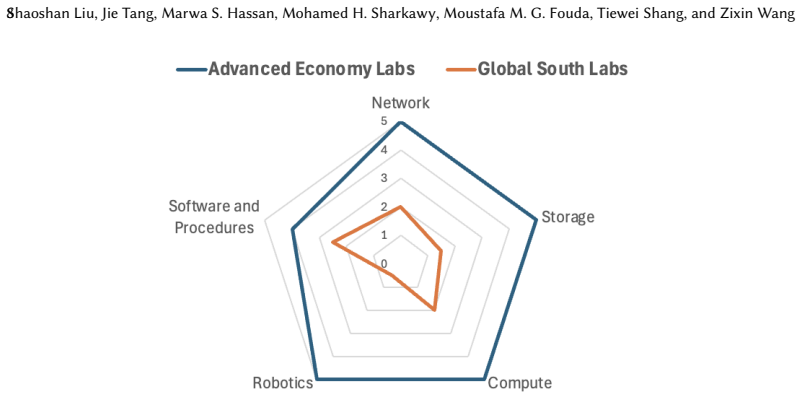
Embodied AI for Science (EAI4S) brings intelligence into the laboratory by uniting perception, reasoning, and robotic action to autonomously run experiments in the physical world. For the Global South, this shift is not about adopting advanced automation for its own sake, but about overcoming a fundamental capacity constraint: too few hands to run too many experiments. By enabling continuous, reliable experimentation under limits of manpower, power, and connectivity, EAI4S turns automation from a luxury into essential scientific infrastructure. The main obstacle, however, is not algorithmic capability. It is infrastructure. Open-source AI and foundation models have narrowed the knowledge gap, but EAI4S depends on dependable edge compute, energy-efficient hardware, modular robotic systems, localized data pipelines, and open standards. Without these foundations, even the most capable models remain trapped in well-resourced laboratories. This article argues for an infrastructure-first approach to EAI4S and outlines the practical requirements for deploying embodied intelligence at scale, offering a concrete pathway for Global South institutions to translate AI advances into sustained scientific capacity and competitive research output.
Editorial analysis
A structured set of objections, weighed in public.
Referee Report
Summary. The manuscript is a position paper arguing that Embodied AI for Science (EAI4S) in the Global South is primarily limited by infrastructure rather than algorithmic capabilities. It claims that open-source models have narrowed the knowledge gap, but deployment at scale requires dependable edge compute, energy-efficient hardware, modular robotic systems, localized data pipelines, and open standards. The paper outlines practical requirements for an infrastructure-first approach to translate AI advances into sustained scientific capacity and competitive output in resource-constrained institutions.
Significance. If the infrastructure requirements outlined prove necessary and sufficient, the paper could usefully redirect policy and investment discussions toward foundational enablers for laboratory automation in the Global South, addressing manpower and connectivity constraints. It provides a prescriptive framework that reframes EAI4S as essential infrastructure. The absence of empirical support or case studies limits immediate applicability, but the conceptual clarity offers a starting point for future pilot studies.
major comments (1)
- Abstract: The central claim that 'the main obstacle, however, is not algorithmic capability. It is infrastructure' is asserted without supporting evidence, citations to studies on Global South laboratory barriers, or comparative analysis of why algorithmic advances have not translated to practice. This premise is load-bearing for the infrastructure-first thesis and the subsequent requirements list.
minor comments (4)
- The acronym EAI4S is used repeatedly but its precise scope (e.g., which scientific domains or experiment types) is not defined until late, which could confuse readers new to embodied AI.
- The practical requirements section would be strengthened by at least one concrete example of how a specific infrastructure component (e.g., localized data pipelines) would enable a particular experiment type under Global South constraints.
- No discussion of implementation challenges, such as local maintenance capacity, training needs, or potential failure modes of the proposed modular systems, is included.
- Several long sentences in the abstract and opening paragraphs reduce readability; breaking them would improve clarity without changing content.
Simulated Author's Rebuttal
We thank the referee for their constructive review of our position paper. The feedback on strengthening the foundational claim is appreciated, and we respond to it directly below.
read point-by-point responses
-
Referee: Abstract: The central claim that 'the main obstacle, however, is not algorithmic capability. It is infrastructure' is asserted without supporting evidence, citations to studies on Global South laboratory barriers, or comparative analysis of why algorithmic advances have not translated to practice. This premise is load-bearing for the infrastructure-first thesis and the subsequent requirements list.
Authors: We acknowledge that the abstract presents the claim concisely without inline citations. As a position paper, the argument is developed through the body text's discussion of documented constraints such as limited laboratory manpower, intermittent power, and connectivity barriers in Global South institutions. To address the referee's point, we will revise the abstract to include a brief supporting clause with references to established literature on scientific infrastructure gaps and AI deployment challenges in resource-limited settings. This will provide explicit grounding for the infrastructure-first thesis without changing the paper's core position or prescriptive framework. revision: yes
Circularity Check
No circularity: conceptual position paper with no derivations or self-referential claims
full rationale
The paper is a straightforward advocacy piece that identifies infrastructure gaps as the primary barrier to Embodied AI for Science deployment in the Global South and prescribes practical requirements such as edge compute and open standards. It advances no equations, quantitative models, fitted parameters, predictions, or deductive chains that could reduce to inputs by construction. No self-citations, uniqueness theorems, or ansatzes are invoked as load-bearing steps. The argument is prescriptive rather than derived, rendering it self-contained against external benchmarks with no internal circularity.
Axiom & Free-Parameter Ledger
Reference graph
Works this paper leans on
-
[1]
[n. d.]. National Science Board. 2023. U.S. Trends and International Comparisons. NSB-2023-33. https://ncses.nsf. gov/pubs/nsb202333/assets/nsb202333.pdf. https://ncses.nsf.gov/pubs/nsb202333/assets/nsb202333.pdf Accessed: 2026-01-30
2023
-
[2]
Benjamin Burger, Phillip M Maffettone, Vladimir V Gusev, Catherine M Aitchison, Yang Bai, Xiaoyan Wang, Xiaobo Li, Ben M Alston, Buyi Li, Rob Clowes, et al. 2020. A mobile robotic chemist.Nature583, 7815 (2020), 237–241
2020
-
[3]
Wang Fan and Shaoshan Liu. 2025. Putting the smarts into robot bodies.Commun. ACM68, 3 (2025), 6–8
2025
-
[4]
Claudia N. Gonzalez-Brambila, L. Reyes-Gonzalez, F. Veloso, and Miguel A. Perez-Angón. 2016. The Scientific Impact of Developing Nations.PLOS ONE11, 3 (2016), e0151328. doi:10.1371/journal.pone.0151328 Uses publications per researcher as a cross-country productivity indicator and compares developing nations with developed economies
-
[5]
International Telecommunication Union (ITU). 2023. Measuring Digital Development: Facts and Figures 2023. ITU report (PDF). https://www.itu.int/itu-d/reports/statistics/wp-content/uploads/sites/5/2023/11/Measuring-digital- development-Facts-and-figures-2023-E.pdf Includes affordability comparison: entry-level mobile broadband price as % of income by income group
2023
-
[6]
Ross D King, Jem Rowland, Stephen G Oliver, Michael Young, Wayne Aubrey, Emma Byrne, Maria Liakata, Magdalena Markham, Pinar Pir, Larisa N Soldatova, et al. 2009. The automation of science.Science324, 5923 (2009), 85–89
2009
-
[7]
Ross D King, Kenneth E Whelan, Ffion M Jones, Philip GK Reiser, Christopher H Bryant, Stephen H Muggleton, Douglas B Kell, and Stephen G Oliver. 2004. Functional genomic hypothesis generation and experimentation by a robot scientist.Nature427, 6971 (2004), 247–252
2004
-
[8]
Roch, Thomas Heumueller, Alán Aspuru-Guzik, and Christoph J
Stefan Langner, Florian Häse, Jose Dario Perea, Tobias Stubhan, Jens Hauch, Loïc M. Roch, Thomas Heumueller, Alán Aspuru-Guzik, and Christoph J. Brabec. 2020. Beyond Ternary OPV: High-Throughput Experimentation and , Vol. 1, No. 1, Article . Publication date: April 2026. 10Shaoshan Liu, Jie Tang, Marwa S. Hassan, Mohamed H. Sharkawy, Moustafa M. G. Fouda,...
2020
-
[9]
Shaoshan Liu and Jie Tang. 2026. Embodied AI for Science.Commun. ACM(2026). https://cacm.acm.org/blogcacm/ embodied-ai-for-science/
2026
-
[10]
J. M. Lu et al . 2024. Automated Intelligent Platforms for High-Throughput Chemical Synthesis.Fundamental Re- search(2024). https://www.sciencedirect.com/science/article/pii/S2949747724000150 Reviews HT chemical synthesis platforms and notes typical manual throughput limits (experienced researchers often complete only several experi- ments/day). Accessed ...
2024
-
[11]
Ghita Rahal. 2022. Status of the Computing for Research in Africa.arXiv preprint arXiv:2206.05306(2022). https: //arxiv.org/pdf/2206.05306 Survey reporting that a majority of respondents find hardware resources and computing power insufficient, with local infrastructure frequently cited as a blocker
-
[12]
Automated Experimentation , year =
Andrew Sparkes, Wayne Aubrey, Emma Byrne, Amanda Clare, Mohammed N. Khan, Maria Liakata, Magnus Markham, James Rowland, Larisa Soldatova, Kenneth E. Whelan, Michael Young, and Ross D. King. 2010. Towards Robot Scientists for Autonomous Scientific Discovery.Automated Experimentation2, 1 (2010), 1. doi:10.1186/1759-4499-2-1 Reports the Robot Scientist Adam,...
-
[13]
Nature624(7990), 86–91 (2023) https://doi.org/10.1038/s41586-023-06734-w
Nicholas J. Szymanski et al. 2023. An Autonomous Laboratory for the Accelerated Synthesis of Novel Materials.Nature (2023). doi:10.1038/s41586-023-06734-w Reports autonomous synthesis with minimal human intervention at a rate of >2 additional materials per day
-
[14]
UNESCO. 2021. UNESCO Recommendation on Open Science. UNESCO Recommendation (Certified copy PDF). https:// www.unesco.it/wp-content/uploads/2023/11/RECOMMENDATION-ON-OPEN-SCIENCE-2021-Certified.pdf Adopted 23 November 2021
2021
-
[15]
UNESCO. 2021. UNESCO Science Report 2021: Statistics and Factsheets on Global Researcher Distribution. https: //www.unesco.org/reports/science/2021 Includes statistics and factsheets on researcher pools, researcher density, and global concentration patterns; accessed January 2026
2021
-
[16]
Scientific data3(1), 1–9 (2016)
Mark D. Wilkinson, Michel Dumontier, I. Jsbrand Jan Aalbersberg, Gabrielle Appleton, Myles Axton, Arie Baak, Niklas Blomberg, Jan-Willem Boiten, Luiz Bonino da Silva Santos, Philip E. Bourne, et al. 2016. The FAIR Guiding Principles for scientific data management and stewardship.Scientific Data3 (2016), 160018. doi:10.1038/sdata.2016.18
-
[17]
World Bank. 2024. Researchers in R&D (per million people) (SP.POP.SCIE.RD.P6). World Development Indicators. https://databank.worldbank.org/metadataglossary/world-development-indicators/series/SP.POP.SCIE.RD.P6 Accessed January 2026
2024
-
[18]
World Bank. 2024. Scientific and technical journal articles (IP.JRN.ARTC.SC). World Development Indicators. https: //databank.worldbank.org/metadataglossary/world-development-indicators/series/IP.JRN.ARTC.SC Accessed January 2026. , Vol. 1, No. 1, Article . Publication date: April 2026
2024
discussion (0)
Sign in with ORCID, Apple, or X to comment. Anyone can read and Pith papers without signing in.