Recognition: no theorem link
Telecom World Models: Unifying Digital Twins, Foundation Models, and Predictive Planning for 6G
Pith reviewed 2026-05-10 18:23 UTC · model grok-4.3
The pith
A Telecom World Model decomposes networks into controllable and external worlds to enable action-conditioned KPI predictions and planning for 6G.
A machine-rendered reading of the paper's core claim, the machinery that carries it, and where it could break.
Core claim
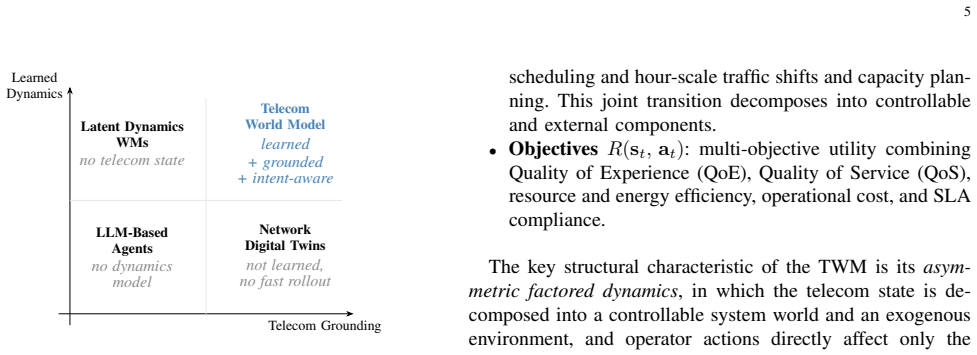
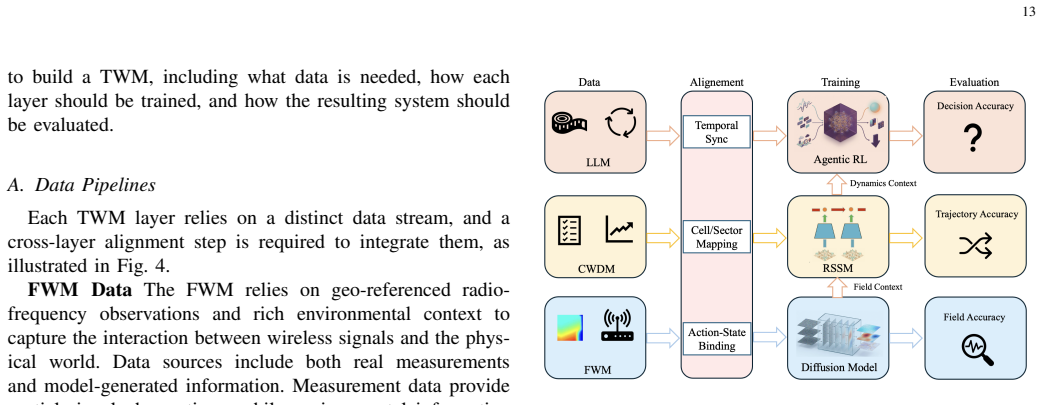
The central claim is that telecom system dynamics can be modeled through the Telecom World Model architecture, which decomposes the problem into a controllable system world of operator-configurable settings and an external world of propagation, mobility, traffic, and failures. A three-layer structure then supplies field-level spatial prediction, action-conditioned KPI trajectory forecasting, and foundation-model intent translation, jointly delivering state grounding, fast roll-outs, calibrated uncertainty, multi-timescale dynamics, model-based planning, and LLM-integrated guardrails. The network-slicing proof-of-concept demonstrates that the full pipeline outperforms single-world baselines.
What carries the argument
The three-layer Telecom World Model architecture, which separates controllable operator settings from external dynamics to learn and roll out action effects on system performance.
If this is right
- The model supports rapid simulation of how operator actions change key performance indicators without running full physics-based simulators.
- Calibrated uncertainty estimates allow planners to choose actions that remain reliable under variability in traffic or channel conditions.
- Multi-timescale modeling captures both immediate effects and longer-term evolution of network states in one framework.
- Foundation-model guardrails translate high-level intents into safe, executable control sequences while the dynamics layers handle the physics.
- In network slicing the combined layers produce KPI trajectory forecasts that match reality more closely than isolated digital-twin or language-model baselines.
Where Pith is reading between the lines
- The same decomposition could be applied to other 6G control loops such as dynamic beam management or edge-resource allocation to test whether the accuracy gains generalize.
- Online updates from live telemetry streams might allow the world model to adapt continuously rather than relying on offline training alone.
- Hybrid versions that inject known physics equations into the learned layers could reduce data requirements while preserving uncertainty calibration.
Load-bearing premise
Telecom dynamics can be decomposed into controllable and external components and learned through the three-layer architecture to produce accurate, calibrated predictions usable for real 6G planning.
What would settle it
In a live or emulated network-slicing deployment, compare the full TWM pipeline's predicted KPI trajectories against ground-truth measurements across varied action sequences and timescales; if the predictions are no more accurate than single-world baselines or if uncertainty intervals fail to contain observed values at the claimed rate, the claim is falsified.
Figures



read the original abstract
The integration of machine learning tools into telecom networks, has led to two prevailing paradigms, namely, language-based systems, such as Large Language Models (LLMs), and physics-based systems, such as Digital Twins (DTs). While LLM-based approaches enable flexible interaction and automation, they lack explicit representations of network dynamics. DTs, in contrast, offer a high-fidelity network simulation, but remain scenario-specific and are not designed for learning or decision-making under uncertainty. This gap becomes critical for 6G systems, where decisions must take into account the evolving network states, uncertainty, and the cascading effects of control actions across multiple layers. In this article, we introduce the {Telecom World Model}~(TWM) concept, an architecture for learned, action-conditioned, uncertainty-aware modeling of telecom system dynamics. We decompose the problem into two interacting worlds, a controllable system world consisting of operator-configurable settings and an external world that captures propagation, mobility, traffic, and failures. We propose a three-layer architecture, comprising a field world model for spatial environment prediction, a control/dynamics world model for action-conditioned Key Performance Indicator (KPI) trajectory prediction, and a telecom foundation model layer for intent translation and orchestration. We showcase a comparative analysis between existing paradigms, which demonstrates that TWM jointly provides telecom state grounding, fast action-conditioned roll-outs, calibrated uncertainty, multi-timescale dynamics, model-based planning, and LLM-integrated guardrails. Furthermore, we present a proof-of-concept on network slicing to validate the proposed architecture, showing that the full three-layer pipeline outperforms single-world baselines and accurately predicts KPI trajectories.
Editorial analysis
A structured set of objections, weighed in public.
Referee Report
Summary. The manuscript introduces the Telecom World Model (TWM) concept as an architecture for learned, action-conditioned, uncertainty-aware modeling of telecom system dynamics in 6G networks. It decomposes the problem into a controllable system world (operator-configurable settings) and an external world (propagation, mobility, traffic, failures), proposing a three-layer architecture: a field world model for spatial environment prediction, a control/dynamics world model for action-conditioned KPI trajectory prediction, and a telecom foundation model for intent translation and orchestration. The paper presents a comparative analysis of existing paradigms (LLMs and digital twins) and a proof-of-concept on network slicing claiming that the full three-layer pipeline outperforms single-world baselines and accurately predicts KPI trajectories.
Significance. If the architecture and PoC results hold under rigorous validation, TWM could meaningfully bridge the gap between physics-based digital twins and language-based foundation models by enabling fast roll-outs, calibrated uncertainty, multi-timescale dynamics, model-based planning, and LLM guardrails. This would represent a substantive contribution to predictive network management for 6G, particularly if the decomposition into controllable/external worlds proves separable and learnable at scale.
major comments (2)
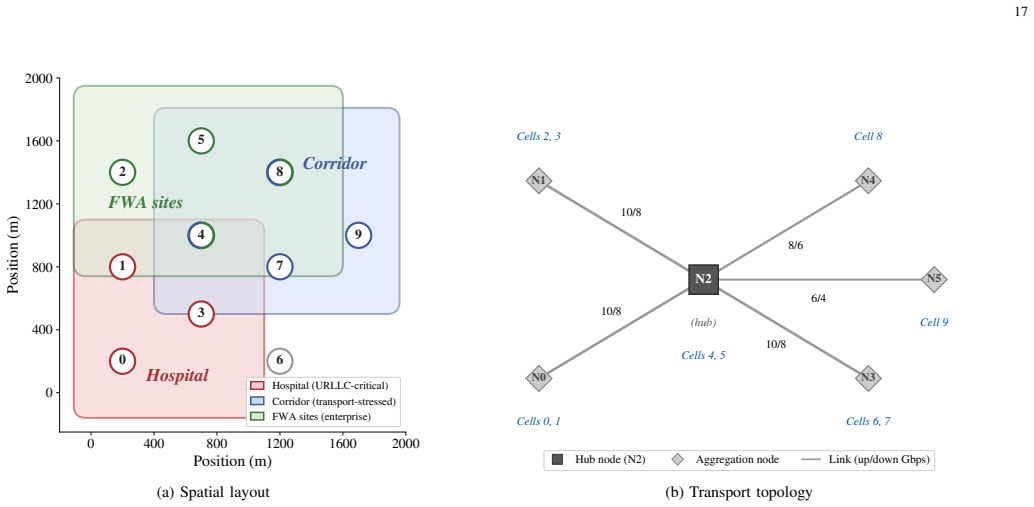
- [proof-of-concept on network slicing] Proof-of-concept on network slicing: the claim that the full three-layer pipeline outperforms single-world baselines and accurately predicts KPI trajectories is asserted without reporting of experimental details, including datasets, specific quantitative metrics (e.g., prediction error, proper scoring rules for uncertainty calibration), baselines, error bars, or confirmation that all three layers (including the foundation model for intent translation) were active. This gap prevents assessment of whether the results support the full set of asserted properties such as calibrated uncertainty and multi-timescale dynamics.
- [three-layer architecture description] The separability assumption underlying the controllable/external world decomposition is central to the architecture but remains high-level; no explicit learning procedures, training objectives, or validation that the decomposition yields accurate action-conditioned predictions are provided to substantiate that the three-layer design delivers the claimed advantages over existing paradigms.
minor comments (1)
- [abstract] The abstract contains LaTeX-style braces around 'Telecom World Model' that appear to be a formatting artifact and should be cleaned for readability.
Simulated Author's Rebuttal
Thank you for the constructive and insightful review. We address each major comment point-by-point below and will revise the manuscript to incorporate the requested details, thereby strengthening the presentation of the proof-of-concept and architecture.
read point-by-point responses
-
Referee: Proof-of-concept on network slicing: the claim that the full three-layer pipeline outperforms single-world baselines and accurately predicts KPI trajectories is asserted without reporting of experimental details, including datasets, specific quantitative metrics (e.g., prediction error, proper scoring rules for uncertainty calibration), baselines, error bars, or confirmation that all three layers (including the foundation model for intent translation) were active. This gap prevents assessment of whether the results support the full set of asserted properties such as calibrated uncertainty and multi-timescale dynamics.
Authors: We acknowledge that the current manuscript presents the network slicing proof-of-concept at a high level to illustrate the overall architecture, without the granular experimental details needed for full reproducibility and assessment. In the revised version, we will expand the relevant section to report: the specific dataset (synthetic traces generated from a 6G network simulator incorporating realistic mobility, traffic, and propagation models); quantitative metrics including RMSE and MAE for KPI trajectory prediction error, CRPS and calibration error for uncertainty quantification; the full set of baselines (single-layer field model, dynamics model alone, LLM-only predictor, and physics-based DT); error bars and statistical significance from multiple independent runs; and explicit confirmation that the complete three-layer pipeline was active, with the foundation model performing intent-to-action translation. These additions will directly support evaluation of calibrated uncertainty and multi-timescale dynamics. revision: yes
-
Referee: The separability assumption underlying the controllable/external world decomposition is central to the architecture but remains high-level; no explicit learning procedures, training objectives, or validation that the decomposition yields accurate action-conditioned predictions are provided to substantiate that the three-layer design delivers the claimed advantages over existing paradigms.
Authors: The controllable/external world decomposition is motivated by the fundamental distinction in telecom systems between operator actions and exogenous dynamics, but we agree the manuscript leaves the learning and validation aspects at a conceptual level. In revision, we will add a dedicated subsection on implementation details, including: training objectives for the field world model (supervised spatial prediction loss on environmental data), the control/dynamics model (action-conditioned sequence prediction with combined regression and uncertainty losses, e.g., via probabilistic outputs), and the foundation model (fine-tuning for intent parsing and orchestration); explicit learning procedures such as end-to-end or staged training; and validation methods (e.g., held-out trajectory testing and ablation studies confirming improved action-conditioned accuracy and separability benefits over monolithic baselines). This will more rigorously substantiate the claimed advantages. revision: yes
Circularity Check
Conceptual architecture proposal with empirical PoC shows no derivation circularity
full rationale
The paper is a forward-looking conceptual framework introducing the TWM architecture, its decomposition into controllable/external worlds, and a three-layer structure (field world model, control/dynamics world model, telecom foundation model). The central claims rest on this proposed unification and a network-slicing proof-of-concept that reports outperformance over baselines plus KPI trajectory prediction. No equations, fitted parameters, or mathematical derivations appear that reduce predictions to inputs by construction. No self-citations serve as load-bearing uniqueness theorems, no ansatzes are smuggled, and no known results are merely renamed. The work is self-contained as an architectural proposal whose validation is empirical rather than tautological.
Axiom & Free-Parameter Ledger
axioms (1)
- domain assumption Telecom networks can be decomposed into a controllable system world of operator settings and an external world of propagation, mobility, traffic, and failures.
invented entities (1)
-
Telecom World Model (TWM)
no independent evidence
Reference graph
Works this paper leans on
-
[1]
Language Models are Few-Shot Learners,
T. B. Brownet al., “Language Models are Few-Shot Learners,” in Advances in Neural Information Processing Systems (NeurIPS), 2020
2020
-
[2]
G. Comaniciet al., “Gemini 2.5: Pushing the frontier with advanced reasoning, multimodality, long context, and next generation agentic capabilities,”arXiv preprint arXiv:2507.06261, 2025
work page internal anchor Pith review Pith/arXiv arXiv 2025
-
[3]
Large language models for networking: Applications, enabling techniques, and challenges,
Z. Zhanget al., “Large Language Models for Networking: Appli- cations, Challenges, and the ChatNet Framework,”arXiv preprint arXiv:2311.17474, 2023
-
[4]
Large Generative AI Models for Telecom: The Next Big Thing?
L. Bariah, Q. Zhao, H. Zou, Y . Tian, F. Bader, and M. Debbah, “Large Generative AI Models for Telecom: The Next Big Thing?”IEEE Communications Magazine, vol. 62, no. 11, pp. 84–90, 2024
2024
-
[5]
TelecomGPT: A Framework to Build Telecom-Specific Large Language Models,
H. Zou, Q. Zhao, Y . Tian, L. Bariah, F. Bader, T. Lestable, and M. Debbah, “TelecomGPT: A Framework to Build Telecom-Specific Large Language Models,”IEEE Transactions on Machine Learning in Communications and Networking, vol. 3, pp. 948–975, 2025
2025
-
[6]
Large language models in 6g from standard to on-device networks,
H. Zou, Q. Zhao, S. Lasaulceet al., “Large language models in 6g from standard to on-device networks,”Nature Reviews Electrical Engineering, vol. 3, pp. 123–134, 2026
2026
-
[7]
Mastering diverse control tasks through world models,
D. Hafner, J. Pasukonis, J. Ba, and T. Lillicrap, “Mastering diverse control tasks through world models,”Nature, vol. 640, no. 7839, pp. 647–653, 2025
2025
-
[8]
Sora: Creating video from text,
OpenAI, “Sora: Creating video from text,” OpenAI Blog, 2024
2024
-
[9]
A Path Towards Autonomous Machine Intelligence,
Y . LeCun, “A Path Towards Autonomous Machine Intelligence,” Courant Institute of Mathematical Sciences, New York University, Tech. Rep., 2022, version 0.9.2, OpenReview preprint
2022
-
[10]
Single and Multi-Agent Deep Reinforce- ment Learning for AI-Enabled Wireless Networks: A Tutorial,
A. Feriani and E. Hossain, “Single and Multi-Agent Deep Reinforce- ment Learning for AI-Enabled Wireless Networks: A Tutorial,”IEEE Communications Surveys & Tutorials, vol. 23, no. 2, pp. 1226–1252, 2021
2021
-
[11]
Model-based deep reinforcement learning framework for channel access in wireless networks,
J. I. Park, J. B. Chae, and K. W. Choi, “Model-based deep reinforcement learning framework for channel access in wireless networks,”IEEE Internet of Things Journal, vol. 11, no. 6, pp. 10 150–10 167, 2024
2024
-
[12]
MobiWorld: World Models for Mobile Wireless Network,
H. Chai, Y . Yuan, and Y . Li, “MobiWorld: World Models for Mobile Wireless Network,”arXiv preprint arXiv:2507.09462, 2025
-
[13]
Wireless Large AI Model: Shaping the AI-Native Future of 6G and Beyond
F. Zhuet al., “Wireless large ai model: Shaping the ai-native future of 6g and beyond,”arXiv preprint arXiv:2504.14653, 2025
work page internal anchor Pith review Pith/arXiv arXiv 2025
-
[14]
A. Shahidet al., “Large-scale AI in telecom: Charting the roadmap for innovation, scalability, and enhanced digital experiences,”arXiv preprint arXiv:2503.04184, 2025
-
[15]
Recurrent World Models Facilitate Policy Evolution,
D. Ha and J. Schmidhuber, “Recurrent World Models Facilitate Policy Evolution,” inAdvances in Neural Information Processing Systems (NeurIPS), 2018
2018
-
[16]
Learning Latent Dynamics for Planning from Pixels,
D. Hafner, T. Lillicrap, I. Fischer, R. Villegas, D. Ha, H. Lee, and J. Davidson, “Learning Latent Dynamics for Planning from Pixels,” in International Conference on Machine Learning (ICML), 2019. 19
2019
-
[17]
Dream to Control: Learning Behaviors by Latent Imagination,
D. Hafner, T. Lillicrap, J. Ba, and M. Norouzi, “Dream to Control: Learning Behaviors by Latent Imagination,” inInternational Conference on Learning Representations (ICLR), 2020
2020
-
[18]
Mastering Atari, Go, Chess and Shogi by Planning with a Learned Model,
J. Schrittwieser, I. Antonoglou, T. Hubert, K. Simonyan, L. Sifre, S. Schmitt, A. Guez, E. Lockhart, D. Hassabis, T. Graepel, T. Lillicrap, and D. Silver, “Mastering Atari, Go, Chess and Shogi by Planning with a Learned Model,”Nature, vol. 588, pp. 604–609, 2020
2020
-
[19]
Transformers are Sample- Efficient World Models,
V . Micheli, E. Alonso, and F. Fleuret, “Transformers are Sample- Efficient World Models,” inInternational Conference on Learning Representations (ICLR), 2023
2023
-
[20]
Temporal Difference Learning for Model Predictive Control,
N. A. Hansen, H. Su, and X. Wang, “Temporal Difference Learning for Model Predictive Control,” inProceedings of the 39th International Conference on Machine Learning (ICML), vol. 162, 2022, pp. 8387– 8406
2022
-
[21]
Stochastic Video Generation with a Learned Prior,
E. Denton and R. Fergus, “Stochastic Video Generation with a Learned Prior,” inInternational Conference on Machine Learning (ICML), 2018
2018
-
[22]
Learning Interactive Real-World Simulators,
S. Yang, Y . Du, K. Ghasemipour, J. Tompson, L. Kaelbling, D. Schuur- mans, and P. Abbeel, “Learning Interactive Real-World Simulators,” in International Conference on Learning Representations (ICLR), 2024
2024
-
[23]
Genie: Generative Interactive Environments,
J. Bruce, M. D. Dennis, A. Edwards, J. Parker-Holder, Y . Shi, E. Hughes, M. Laiet al., “Genie: Generative Interactive Environments,” inProceed- ings of the 41st International Conference on Machine Learning (ICML), vol. 235, 2024, pp. 4603–4623
2024
-
[24]
Diffusion models are real-time game engines
D. Valevski, Y . Leviathan, M. Arar, and S. Fruchter, “Diffusion Models Are Real-Time Game Engines,”arXiv preprint arXiv:2408.14837, 2024
-
[25]
Revisiting Feature Prediction for Learning Visual Representations from Video,
A. Bardes, Q. Garrido, J. Ponce, X. Chen, M. G. Rabbat, Y . LeCun, M. Assran, and N. Ballas, “Revisiting Feature Prediction for Learning Visual Representations from Video,”Transactions on Machine Learning Research, 2024
2024
-
[26]
3D-VLA: A 3D Vision-Language-Action Generative World Model,
H. Zhen, X. Qiu, P. Chen, J. Yang, X. Yan, Y . Du, Y . Hong, and C. Gan, “3D-VLA: A 3D Vision-Language-Action Generative World Model,” in Proceedings of the 41st International Conference on Machine Learning (ICML), vol. 235. PMLR, 2024, pp. 61 229–61 245
2024
-
[27]
WorldVLA: Towards Autoregressive Action World Model
J. Cen, C. Yu, H. Yuan, Y . Jiang, S. Huang, J. Guo, X. Li, Y . Song, H. Luo, F. Wang, D. Zhao, and H. Chen, “WorldVLA: Towards Autoregressive Action World Model,”arXiv preprint arXiv:2506.21539, 2025
work page internal anchor Pith review arXiv 2025
-
[28]
OccWorld: Learning a 3D Occupancy World Model for Autonomous Driving,
W. Zheng, W. Chen, Y . Huang, B. Zhang, Y . Duan, and J. Lu, “OccWorld: Learning a 3D Occupancy World Model for Autonomous Driving,” inEuropean Conference on Computer Vision (ECCV), 2024, pp. 55–72
2024
-
[29]
A. Chen, W. Zheng, Y . Wang, X. Zhang, K. Zhan, P. Jia, K. Keutzer, and S. Zhang, “GeoDrive: 3D Geometry-Informed Driving World Model with Precise Action Control,”arXiv preprint arXiv:2505.22421, 2025
-
[30]
Recommendation ITU-T Y .3090: Digital twin network – Re- quirements and architecture,
ITU-T, “Recommendation ITU-T Y .3090: Digital twin network – Re- quirements and architecture,” International Telecommunication Union, 2022
2022
-
[31]
Digital- Twin-Enabled 6G: Vision, Architectural Trends, and Future Directions,
L. U. Khan, W. Saad, D. Niyato, Z. Han, and C. S. Hong, “Digital- Twin-Enabled 6G: Vision, Architectural Trends, and Future Directions,” IEEE Communications Magazine, vol. 60, no. 1, pp. 74–80, 2022
2022
-
[32]
Network Digital Twin: Context, Enabling Tech- nologies, and Opportunities,
P. Almasanet al., “Network Digital Twin: Context, Enabling Tech- nologies, and Opportunities,”IEEE Communications Magazine, vol. 60, no. 11, pp. 22–27, 2022
2022
-
[33]
Digital Twin of Wireless Systems: Overview, Taxonomy, Challenges, and Opportunities,
L. U. Khan, Z. Han, W. Saad, E. Hossain, M. Guizani, and C. S. Hong, “Digital Twin of Wireless Systems: Overview, Taxonomy, Challenges, and Opportunities,”IEEE Communications Surveys & Tutorials, vol. 24, no. 4, pp. 2230–2254, 2022
2022
-
[34]
Large Language Model (LLM) for Telecommunications: A Comprehensive Survey on Principles, Key Techniques, and Opportu- nities,
H. Zhouet al., “Large Language Model (LLM) for Telecommunications: A Comprehensive Survey on Principles, Key Techniques, and Opportu- nities,”IEEE Communications Surveys & Tutorials, vol. 27, no. 3, pp. 1955–2005, 2025
1955
-
[35]
NetGPT: An AI-Native Network Architecture for Provisioning Beyond Personalized Generative Services,
Y . Chen, R. Li, Z. Zhao, C. Peng, J. Wu, E. Hossain, and H. Zhang, “NetGPT: An AI-Native Network Architecture for Provisioning Beyond Personalized Generative Services,”IEEE Network, vol. 38, no. 6, pp. 404–413, 2024
2024
-
[36]
WirelessLLM: Empowering large language models towards wireless intelligence,
J. Shaoet al., “WirelessLLM: Empowering Large Language Models Towards Wireless Intelligence,”arXiv preprint arXiv:2405.17053, 2024
-
[37]
RF-GPT: Teaching AI to see the wireless world,
H. Zou, Y . Tian, B. Wang, L. Bariah, S. Lasaulce, C. Huang, and M. Debbah, “RF-GPT: Teaching AI to See the Wireless World,”arXiv preprint arXiv:2602.14833, 2026
-
[38]
G. O. Boateng, H. Sami, A. Alaghaet al., “A Survey on Large Lan- guage Models for Communication, Network, and Service Management: Application Insights, Challenges, and Future Directions,”arXiv preprint arXiv:2412.19823, 2024
-
[39]
6g comprehensive intelligence: Network operations and optimization based on large language models,
S. Long, F. Tang, Y . Li, T. Tan, Z. Jin, M. Zhao, and N. Kato, “6g comprehensive intelligence: Network operations and optimization based on large language models,”IEEE Network, vol. 39, no. 4, pp. 192–201, 2025
2025
-
[40]
Large language models for wireless communications: From adaptation to autonomy,
L. Liang, H. Ye, Y . Sheng, O. Wang, J. Wang, S. Jin, and G. Y . Li, “Large language models for wireless communications: From adaptation to autonomy,”IEEE Communications Magazine, 2026
2026
-
[41]
TeleQnA: A Benchmark Dataset to Assess Large Language Models Telecommunications Knowledge,
A. Maatouk, F. Ayed, N. Piovesan, A. De Domenico, M. Debbah, and Z.-Q. Luo, “TeleQnA: A Benchmark Dataset to Assess Large Language Models Telecommunications Knowledge,”IEEE Network, 2024
2024
-
[42]
Learning Optimal Resource Allocations in Wireless Systems,
M. Eisen, C. Zhang, L. F. O. Chamon, D. D. Lee, and A. Ribeiro, “Learning Optimal Resource Allocations in Wireless Systems,”IEEE Transactions on Signal Processing, vol. 67, no. 10, pp. 2775–2790, 2019
2019
-
[43]
Learning latent multi- modal dynamics for optimized resource planning,
C. Bou Chaaya, A. M. Girgis, and M. Bennis, “Learning latent multi- modal dynamics for optimized resource planning,”IEEE Transactions on Wireless Communications, vol. 25, pp. 9591–9607, 2026
2026
-
[44]
Radiounet: Fast radio map estimation with convolutional neural networks,
R. Levie, C ¸ . Yapar, G. Kutyniok, and G. Caire, “Radiounet: Fast radio map estimation with convolutional neural networks,”IEEE Transactions on Wireless Communications, vol. 20, no. 6, pp. 4001–4015, 2021
2021
-
[45]
PMNet: Robust Pathloss Map Prediction via Supervised Learning,
J.-H. Lee, O. G. Serbetci, D. P. Selvam, and A. F. Molisch, “PMNet: Robust Pathloss Map Prediction via Supervised Learning,” inIEEE Global Communications Conference (GLOBECOM), 2023
2023
-
[46]
Deep Completion Autoencoders for Radio Map Estimation,
Y . Teganya and D. Romero, “Deep Completion Autoencoders for Radio Map Estimation,”IEEE Transactions on Wireless Communications, vol. 21, no. 3, pp. 1710–1724, 2022
2022
-
[47]
WiNeRT: Towards Neural Ray Tracing for Wireless Channel Modelling and Differentiable Simulations,
T. Orekondy, P. Kumar, S. Kadambi, H. Ye, J. Soriaga, and A. Be- hboodi, “WiNeRT: Towards Neural Ray Tracing for Wireless Channel Modelling and Differentiable Simulations,” inInternational Conference on Learning Representations (ICLR), 2023
2023
-
[48]
RouteNet- Erlang: A Graph Neural Network for Network Performance Evaluation,
M. Ferriol-Galm ´es, K. Rusek, J. Su ´arez-Varela, S. Xiao, X. Shi, X. Cheng, B. Wu, P. Barlet-Ros, and A. Cabellos-Aparicio, “RouteNet- Erlang: A Graph Neural Network for Network Performance Evaluation,” inIEEE INFOCOM 2022-IEEE Conference on Computer Communica- tions, 2022, pp. 2018–2027
2022
-
[49]
Sionna: An Open-Source Library for Next-Generation Physical Layer Research,
J. Hoydis, S. Cammerer, F. A. Aoudia, A. Vem, N. Binder, G. Marcus, and A. Keller, “Sionna: An open-source library for next-generation physical layer research,”arXiv preprint arXiv:2203.11854, 2022
-
[50]
Sionna rt: Differentiable ray tracing for radio propagation modeling,
J. Hoydis, F. A ¨ıt Aoudia, S. Cammerer, M. Nimier-David, N. Binder, G. Marcus, and A. Keller, “Sionna rt: Differentiable ray tracing for radio propagation modeling,” in2023 IEEE Globecom Workshops (GC Wkshps). IEEE, 2023, pp. 317–321
2023
-
[51]
F. A. Aoudia, J. Hoydis, M. Nimier-David, B. Nicolet, S. Cam- merer, and A. Keller, “Sionna rt: Technical report,”arXiv preprint arXiv:2504.21719, 2025
-
[52]
Aerial omniverse digital twin,
NVIDIA, “Aerial omniverse digital twin,” Apr. 2026, [Online]. Avail- able: https://docs.nvidia.com/aerial/aerial-dt/. [Accessed: Apr. 7, 2026]
2026
-
[53]
Deepverse 6g: A framework for synthetic multi-modal sensing and communication datasets,
U. Demirhan, A. Taha, and A. Alkhateeb, “Deepverse 6g: A framework for synthetic multi-modal sensing and communication datasets,”arXiv preprint, 2022
2022
-
[54]
Safeslice: Enabling sla-compliant o-ran slicing via safe deep reinforcement learning,
A. M. Nagib, H. Abou-Zeid, and H. S. Hassanein, “SafeSlice: Enabling SLA-compliant O-RAN slicing via safe deep reinforcement learning,” arXiv preprint arXiv:2503.12753, 2025
-
[55]
Flexible RAN slicing in open RAN with constrained multi-agent reinforcement learning,
M. Zangooei, M. Golkarifard, M. Rouili, N. Saha, and R. Boutaba, “Flexible RAN slicing in open RAN with constrained multi-agent reinforcement learning,”IEEE Journal on Selected Areas in Commu- nications, vol. 42, no. 2, pp. 280–294, 2024
2024
-
[56]
R. Barker, W. Saad, C. G. Brinton, and N. Soltani, “REAL: Re- inforcement learning-enabled xapps for experimental closed-loop op- timization in O-RAN with OSC RIC and srsRAN,”arXiv preprint arXiv:2502.00715, 2025
-
[57]
ORANSlice: An open-source 5g network slicing platform for O-RAN,
H. Cheng, R. Ravindran, M. Polese, J. Black, T. Melodia, and D. Villa, “ORANSlice: An open-source 5g network slicing platform for O-RAN,” inProceedings of the ACM MobiCom Workshop on Open RAN, 2024
2024
-
[58]
Intelligent closed-loop RAN control with xapps in OpenRAN Gym,
L. Bonati, M. Polese, S. D’Oro, S. Basagni, and T. Melodia, “Intelligent closed-loop RAN control with xapps in OpenRAN Gym,” inIEEE European Wireless Conference, 2023
2023
-
[59]
Dynamic programming for pomdps using a factored state representation,
E. A. Hansen and Z. Feng, “Dynamic programming for pomdps using a factored state representation,” inProceedings of the Fifth International Conference on Artificial Intelligence Planning Systems, 2000, pp. 130– 139
2000
-
[60]
Reading radio from camera: Visually-grounded, lightweight, and interpretable RSSI prediction,
S. Yan, T. Hu, B. Mefgouda, S. Lasaulce, and M. Debbah, “Reading radio from camera: Visually-grounded, lightweight, and interpretable rssi prediction,”arXiv preprint arXiv:2510.25936, 2025
-
[61]
MIMO Channel Estimation Using Score- Based Generative Models,
M. Arvinte and J. I. Tamir, “MIMO Channel Estimation Using Score- Based Generative Models,”IEEE Transactions on Wireless Communi- cations, vol. 22, no. 6, pp. 3698–3713, 2023
2023
-
[62]
Generative diffusion models for high dimensional channel estimation,
X. Zhou, L. Liang, J. Zhang, P. Jiang, Y . Li, and S. Jin, “Generative diffusion models for high dimensional channel estimation,”IEEE Trans- 20 actions on Wireless Communications, vol. 24, no. 7, pp. 5840–5854, 2025
2025
-
[63]
Generative diffusion receivers: Achieving pilot-efficient mimo-ofdm communications,
Y . Yang, O. Alhussein, A. H. Arani, Z. Zhang, and M. Debbah, “Generative diffusion receivers: Achieving pilot-efficient mimo-ofdm communications,”IEEE Transactions on Network Science and Engi- neering, vol. 13, pp. 6721–6736, 2026
2026
-
[64]
Y . Yang, S. Yan, W. Zhou, B. Mefgouda, R. Li, Z. Zhang, and M. Debbah, “Diffusion models for wireless transceivers: From pilot- efficient channel estimation to AI-native 6G receivers,”arXiv preprint arXiv:2510.24495, 2025
-
[65]
A. Yanget al., “Qwen2. 5 technical report,”arXiv preprint arXiv:2412.15115, 2024
work page internal anchor Pith review Pith/arXiv arXiv 2024
discussion (0)
Sign in with ORCID, Apple, or X to comment. Anyone can read and Pith papers without signing in.