Recognition: no theorem link
Low-redshift-agnostic BAO Constraints on Binned Dark-energy Density Evolution from DESI DR1 and DR2
Pith reviewed 2026-05-10 18:21 UTC · model grok-4.3
The pith
A linear compression of BAO distances removes the low-redshift transverse mode to produce nearly uncorrelated constraints on binned dark-energy density evolution above the first node.
A machine-rendered reading of the paper's core claim, the machinery that carries it, and where it could break.
Core claim
The authors replace the standard set of transverse BAO distances D_M/r_d with adjacent increments ΔD_M/r_d while retaining the radial distances D_H/r_d. Because the mapping is linear, the covariance matrix transforms exactly. This compression deliberately removes one absolute transverse-distance mode below the first BAO node and preserves the remaining information needed to reconstruct the expansion history above that node. Applied to the DESI DR1 and DR2 anisotropic BAO data, the procedure yields almost uncorrelated constraints on the piecewise-constant interval parameters X_j for the normalized dark-energy density. All bins are consistent with X=1 within current uncertainties, providing a低
What carries the argument
The linear replacement of absolute transverse comoving distances D_M/r_d by adjacent increments ΔD_M/r_d, while retaining radial distances D_H/r_d, to remove the low-redshift transverse mode.
If this is right
- Each X_j interval is constrained mainly by BAO information from its own redshift range.
- The compressed likelihood acts as a conservative band-power-like estimate of dark-energy evolution.
- One nonlocal transverse mode and stronger global assumptions are deliberately projected out or marginalized over.
- The resulting X_j constraints serve as a low-redshift-agnostic BAO baseline rather than a fully prior-free reconstruction.
- All current bins remain consistent with constant dark-energy density (X=1).
Where Pith is reading between the lines
- The same differencing approach could be applied to other distance indicators such as supernovae to isolate high-redshift signals in a comparable way.
- If future surveys detect a deviation from X=1 in a specific bin using this method, it would point to evolving dark energy without contamination from low-redshift assumptions.
- The technique underscores how careful data compression can reduce reliance on global priors when testing for time-varying dark energy.
Load-bearing premise
The linear compression removes only the unwanted low-redshift transverse mode while preserving all information relevant to reconstructing the expansion history above the first node, and broad external priors on bin-local matter-density and distance-scale parameters introduce no bias into the X_j constraints.
What would settle it
A future data set in which the compressed X_j constraints become strongly correlated or one bin deviates significantly from unity while a standard full-analysis reconstruction of the same data remains consistent with X=1 would indicate that the compression has either lost relevant information or introduced bias.
Figures

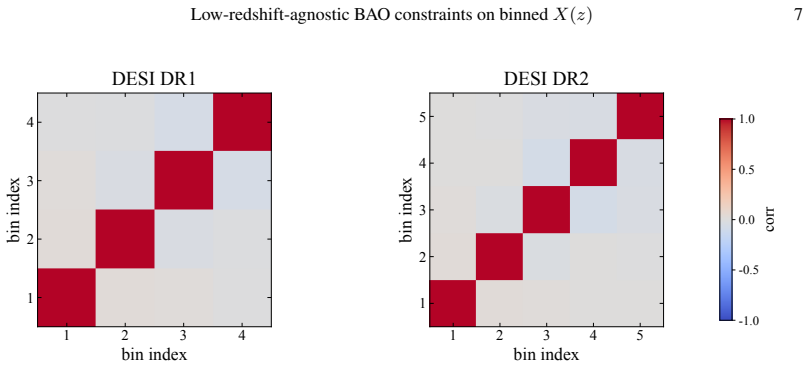
read the original abstract
We present a low-redshift-agnostic compression of anisotropic baryon acoustic oscillation (BAO) distances to constrain the normalized dark-energy density evolution, $X(z)\equiv \rho_{\rm DE}(z)/\rho_{\rm DE}(0)$, above the lowest BAO redshift node $z_1$. Standard BAO summaries include the transverse comoving distance $D_{\rm M}/r_{\rm d}$, which depends on the integral of $H^{-1}(z)$ from $z=0$ to $z$ and therefore mixes the expansion history at $z<z_1$ with the higher-redshift signal. We instead replace the set $D_{\rm M}(z_i)/r_{\rm d}$ by adjacent increments $\Delta D_{\rm M}(z_i,z_{i+1})/r_{\rm d}$ while retaining the radial distances $D_{\rm H}(z_i)/r_{\rm d}$. The mapping is linear, so the covariance propagates exactly. This compression intentionally removes one absolute transverse-distance mode, namely the additive contribution to $D_{\rm M}/r_{\rm d}$ below the first BAO node, and preserves the remaining information relevant to reconstructing the expansion history above $z_1$. Applied to DESI DR1 and DR2 anisotropic BAO measurements, the method yields almost uncorrelated constraints on piecewise-constant interval parameters $X_j$. In this sense, the compressed likelihood provides a conservative band-power-like estimate of dark-energy evolution: each interval is constrained mainly by BAO information from its own redshift range, while one nonlocal transverse mode and stronger global assumptions are deliberately projected out or marginalized over. Because our baseline analysis also marginalizes over bin-local matter-density and distance-scale parameters with broad external priors, the resulting $X_j$ constraints should be interpreted as a low-redshift-agnostic BAO baseline rather than as a fully prior-free reconstruction. All bins are consistent with $X=1$ within current uncertainties.
Editorial analysis
A structured set of objections, weighed in public.
Referee Report
Summary. The manuscript introduces a low-redshift-agnostic compression technique for anisotropic BAO data from DESI DR1 and DR2. By replacing the transverse comoving distances D_M(z_i)/r_d with their adjacent increments ΔD_M(z_i, z_{i+1})/r_d while retaining the radial distances D_H(z_i)/r_d, the method removes the integral contribution from z=0 to z1, allowing constraints on the binned dark-energy density evolution X(z) = ρ_DE(z)/ρ_DE(0) above z1 without assumptions on the low-redshift expansion history. The linear nature of the mapping ensures exact covariance propagation. The resulting constraints on the piecewise-constant X_j parameters are nearly uncorrelated, and all bins are found to be consistent with X=1 within uncertainties after marginalizing over bin-local matter-density and distance-scale parameters using broad priors. The approach is framed as providing a conservative baseline estimate rather than a fully prior-free reconstruction.
Significance. If the central claims hold, the work provides a useful conservative tool for obtaining nearly uncorrelated, band-power-like constraints on dark-energy evolution directly from BAO data. The exact linear transformation guarantees algebraic covariance propagation without approximation, and the explicit framing as a low-redshift-agnostic baseline (with broad marginalization) makes the results interpretable and reproducible. This could serve as a standard reference method for future DESI and similar surveys when testing deviations from X=1 in a manner that deliberately projects out nonlocal low-z modes.
minor comments (3)
- The abstract states that the method 'yields almost uncorrelated constraints' on X_j, but the manuscript should include the numerical correlation matrix (or its off-diagonal elements) for the DESI DR1+DR2 application to allow readers to assess the degree of uncorrelatedness quantitatively.
- The specific redshift bin boundaries for the piecewise-constant X_j intervals and the exact BAO redshift nodes z_i from DESI DR1/DR2 used in the analysis should be listed explicitly (e.g., in a table) to ensure full reproducibility of the compressed likelihood.
- A brief quantitative comparison between the compressed X_j constraints and those obtained from the standard (uncompressed) BAO likelihood would help illustrate the information loss from removing the single transverse mode and strengthen the 'conservative baseline' interpretation.
Simulated Author's Rebuttal
We thank the referee for their positive and accurate summary of our manuscript, which correctly captures the low-redshift-agnostic BAO compression technique, the linear mapping, and the conservative framing of the resulting X(z) constraints. We appreciate the recognition of the method's utility as a reference approach for future surveys. No major comments were provided in the report.
Circularity Check
No significant circularity in the derivation chain
full rationale
The paper defines a fixed linear compression that replaces the set of transverse distances D_M(z_i)/r_d with adjacent increments ΔD_M(z_i, z_{i+1})/r_d while retaining the radial distances D_H(z_i)/r_d. This mapping is algebraic and independent of the target piecewise-constant dark-energy parameters X_j; the covariance is propagated exactly by matrix multiplication. Constraints on the X_j are then obtained by fitting the compressed DESI DR1/DR2 data while marginalizing over bin-local matter-density and distance-scale nuisance parameters using explicit broad external priors. No load-bearing step reduces the claimed X_j constraints to the inputs by construction, no self-citation is invoked to justify uniqueness or an ansatz, and the result is presented as a conservative baseline rather than a tautological prediction. The derivation is therefore self-contained against external data.
Axiom & Free-Parameter Ledger
free parameters (2)
- bin-local matter-density parameters
- distance-scale parameters
axioms (2)
- domain assumption BAO distances serve as a standard ruler whose radial and transverse components can be separated
- domain assumption Dark-energy density evolution can be represented as piecewise constant in chosen redshift intervals
Forward citations
Cited by 1 Pith paper
-
Do equation of state parametrizations of dark energy faithfully capture the dynamics of the late universe?
Node-based reconstruction of cosmic expansion prefers stronger deceleration at z≈1.7 than smooth DE EoS parametrizations, isolating z~1.5-2 as a window where the latter may compress localized kinematic features permit...
Reference graph
Works this paper leans on
-
[1]
, " * write output.state after.block = add.period write newline
ENTRY address archivePrefix author booktitle chapter doi edition editor eprint howpublished institution journal key month number organization pages publisher school series title misctitle type volume year version url label extra.label sort.label short.list INTEGERS output.state before.all mid.sentence after.sentence after.block FUNCTION init.state.consts ...
-
[2]
write newline
" write newline "" before.all 'output.state := FUNCTION format.url url empty "" new.block "" url * "" * if FUNCTION format.eprint eprint empty "" archivePrefix empty "" archivePrefix "arXiv" = new.block " " eprint * " " * new.block " " eprint * " " * if if if FUNCTION format.doi doi empty "" " " doi * " " * if FUNCTION format.pid doi empty eprint empty ur...
-
[3]
NzXeT Ky 9w^
thebibliography [1] 20pt to REFERENCES 6pt =0pt \@twocolumntrue 12pt -12pt 10pt plus 3pt =0pt =0pt =1pt plus 1pt =0pt =0pt -12pt =13pt plus 1pt =20pt =13pt plus 1pt \@M =10000 =-1.0em =0pt =0pt 0pt =0pt =1.0em @enumiv\@empty 10000 10000 `\.\@m \@noitemerr \@latex@warning Empty `thebibliography' environment \@ifnextchar \@reference \@latexerr Missing key o...
2017
-
[4]
Data Release 1 of the Dark Energy Spectroscopic Instrument
Abdul Karim, M., et al. 2025 a , arXiv:2503.14745
work page internal anchor Pith review arXiv 2025
-
[5]
DESI DR2 Results I: Baryon Acoustic Oscillations from the Lyman Alpha Forest
Abdul Karim, M., et al. 2025 b , arXiv:2503.14739
-
[6]
DESI DR2 Results II: Measurements of Baryon Acoustic Oscillations and Cosmological Constraints
Abdul Karim, M., et al. 2025 c , arXiv:2503.14738
work page Pith review arXiv 2025
-
[7]
G., et al
Adame, A. G., et al. 2025 a , JCAP, 04, 012
2025
-
[8]
G., et al
Adame, A. G., et al. 2025 b , JCAP, 01, 124
2025
-
[9]
2020, Astron
Aghanim, N., et al. 2020, Astron. Astrophys., 641, A6, [Erratum: Astron. Astrophys. 652, C4 (2021)]
2020
-
[10]
The DESI Experiment Part I: Science,Targeting, and Survey Design
DESI Collaboration . 2016, arXiv:1611.00036
work page internal anchor Pith review arXiv 2016
-
[11]
2022, Astron
DESI Collaboration . 2022, Astron. J., 164, 207
2022
-
[12]
J., & Hu, W
Eisenstein, D. J., & Hu, W. 1998, Astrophys. J., 496, 605
1998
-
[13]
J., Zehavi, I., Hogg, D
Eisenstein, D. J., Zehavi, I., Hogg, D. W., et al. 2005, Astrophys. J., 633, 560
2005
-
[14]
2025, Nature Astron., 9, 1879, [Erratum: Nature Astron
Gu, G., et al. 2025, Nature Astron., 9, 1879, [Erratum: Nature Astron. 9, 1898 (2025)]
2025
-
[15]
2005, Phys
Huterer, D., & Cooray, A. 2005, Phys. Rev. D, 71, 023506
2005
-
[16]
2003, Phys
Huterer, D., & Starkman, G. 2003, Phys. Rev. Lett., 90, 031301
2003
-
[17]
2025, Phys
Lodha, K., et al. 2025, Phys. Rev. D, 112, 083511
2025
-
[18]
2004, Phys
Wang, Y., & Tegmark, M. 2004, Phys. Rev. Lett., 92, 241302
2004
-
[19]
write newline
" write newline "" before.all 'output.state := FUNCTION format.archive archivePrefix empty "" archivePrefix ":" * if FUNCTION format.primaryClass primaryClass empty "" " [" primaryClass * "]" * if FUNCTION format.eprint eprint empty pages empty not booktitle empty not or or "" archive empty ", " * format.archive * eprint * "" ", " * format.archive * eprin...
discussion (0)
Sign in with ORCID, Apple, or X to comment. Anyone can read and Pith papers without signing in.