Recognition: unknown
Do equation of state parametrizations of dark energy faithfully capture the dynamics of the late universe?
Pith reviewed 2026-05-10 14:06 UTC · model grok-4.3
The pith
Dark energy equation-of-state models mask a possible sharp deceleration feature at redshift 1.7 that late-time data still permit.
A machine-rendered reading of the paper's core claim, the machinery that carries it, and where it could break.
Core claim
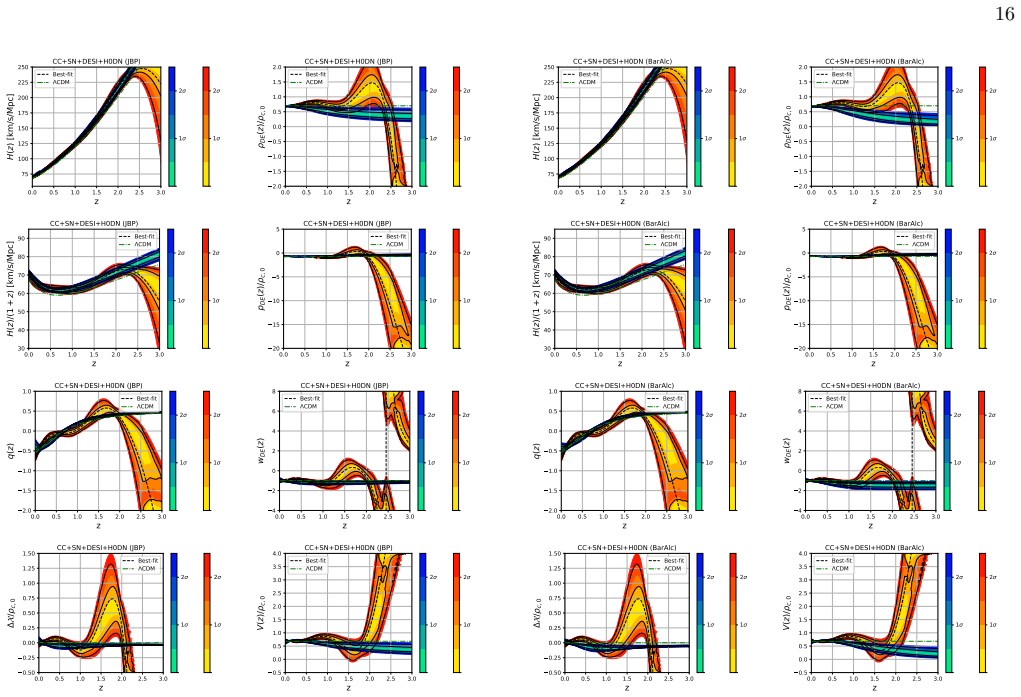
Over the redshift range constrained by the data, both the node-based reconstruction of E(z) and the family of smooth low-dimensional dark energy equation-of-state parametrizations produce consistent H(z) values, yet at z approximately 1.7 the reconstruction favors q between 0.56 and 0.61 while the parametrizations cluster between 0.32 and 0.40, a persistent 2-3 sigma discrepancy. The equation-of-state models absorb the kinematic preference through smoother, often phantom-like evolution, whereas the reconstruction permits a rapid descent of the effective dark energy density toward small values and a possible sign change. The analysis isolates z approximately 1.5-2 as the redshift window where
What carries the argument
The node-based reconstruction of the reduced Hubble function E(z), which permits localized features in the expansion history without assuming a smooth functional form for the dark energy equation of state.
If this is right
- If the discrepancy holds, equation-of-state parametrizations can hide rapid changes in the expansion rate near z=1.7 that remain compatible with current late-time observations.
- The data still allow the effective dark energy density to approach zero and change sign within the reconstruction framework.
- Bayesian evidence continues to favor the simpler parametric models even when the reconstruction provides a better maximum likelihood fit.
- The redshift interval z=1.5-2 emerges as the critical window for testing whether dark energy dynamics contain localized kinematic structure.
Where Pith is reading between the lines
- Future surveys with tighter distance or expansion-rate constraints specifically at z approximately 1.7 could force a choice between the two modeling approaches.
- If the localized feature is physical, it may require hybrid reconstruction methods that combine parametric simplicity with flexibility at intermediate redshifts.
Load-bearing premise
The node-based reconstruction faithfully captures the true underlying expansion history without introducing artifacts from node placement, interpolation, or prior choices.
What would settle it
A precise measurement of the deceleration parameter q at redshift 1.7 lying outside the overlapping ranges allowed by the reconstruction and the parametrizations would distinguish which description better matches the data.
Figures



read the original abstract
We investigate how strongly late-time inferences about DE dynamics depend on the functional prior used to represent the expansion history. Using identical late-time combinations of CC, DESI BAO measurements, the Pantheon+ SN1a sample, and the H0DN prior, we compare a node-based reconstruction of the reduced Hubble function $E(z)$ with a representative family of smooth low-dimensional DE EoS parametrizations, including CPL. Over the redshift range constrained by the data, both approaches yield consistent $H(z)$, and, in the absence of H0DN, compatible values of $H_0$. However, a clear method dependence emerges at intermediate redshift ($z\sim1.7$): the reconstruction favors stronger deceleration, $q_{\rm Rec}(1.7)\simeq0.56-0.61$, whereas the smooth parametrizations cluster at $q(1.7)\simeq0.32-0.40$, implying a persistent $\sim2-3\sigma$ discrepancy across dataset combinations and parametrizations. For the EoS-based parametrizations, whose effective DE densities remain positive by construction, the preferred $w_{\rm DE}(1.7)<-1$ values correspond to NECB-violating (phantom-like) behaviour, but this is a less robust discriminator as $w_{\rm DE}$ becomes ill-conditioned as $\rho_{\rm DE}\to0$. In the effective-fluid mapping, the reconstruction accommodates the same late-time kinematical preference through a rapid descent of $\rho_{\rm DE}(z)$ toward very small values and a sign change, whereas the EoS-based parametrizations absorb it through smoother, and in several cases NECB-violating, evolution over $z\sim1-2$. Although the reconstruction improves the best-fit likelihood, especially with H0DN, Bayesian evidence continues to favor the simpler parametric descriptions. Our results isolate $z\sim1.5-2$ as the key window in which EoS-based DE parametrizations can compress localized kinematic structure and associated features of DE that are still permitted by current late-time data.
Editorial analysis
A structured set of objections, weighed in public.
Referee Report
Summary. The paper compares a node-based reconstruction of the reduced Hubble function E(z) to several parametric dark energy equation-of-state models (including CPL) using identical combinations of cosmic chronometers, DESI BAO, Pantheon+ supernovae, and an H0DN prior. Both approaches yield consistent H(z) and H0 (without the H0 prior), but the reconstruction prefers stronger deceleration at z≈1.7 (q≈0.56-0.61) than the parametric models (q≈0.32-0.40), a ~2-3σ difference. The reconstruction allows ρ_DE to descend rapidly toward small or negative values, while parametric models maintain positive ρ_DE but can exhibit phantom-like (NECB-violating) behavior. Bayesian evidence favors the simpler parametric models despite the reconstruction's better best-fit likelihood. The central claim is that z∼1.5-2 is the key redshift window in which EoS parametrizations compress localized kinematic structure still permitted by current late-time data.
Significance. If the node reconstruction is robust against methodological artifacts, the result is significant because it concretely demonstrates how low-dimensional EoS parametrizations can mask or smooth over localized features in the expansion history that remain compatible with existing data. This highlights a concrete limitation of common parametric families and isolates a specific redshift range for future scrutiny. The paper's use of multiple dataset combinations, direct likelihood-vs-evidence comparison, and effective-fluid mapping are strengths that make the method-dependence finding falsifiable and reproducible in principle.
major comments (2)
- [§3] §3 (node-based reconstruction): the central claim that EoS parametrizations compress real localized kinematic structure at z∼1.5-2 rests on the assumption that the node reconstruction faithfully recovers the expansion history. No robustness tests are reported against variations in node number, node positions, interpolation scheme, or priors on the node values. Without these, the reported q(1.7) discrepancy (0.56-0.61 vs 0.32-0.40) and the isolation of the z∼1.5-2 window could arise from method-specific artifacts rather than data features.
- [§4.2] §4.2 and Table 2: the ~2-3σ discrepancy in q(1.7) is stated to persist across dataset combinations and parametrizations, but the manuscript does not detail the exact error propagation (e.g., whether posterior covariances are fully propagated or whether the significance is computed from best-fit points only). This is load-bearing for the quantitative claim and for the conclusion that the difference is statistically persistent.
minor comments (3)
- [§4.3] The effective-fluid mapping of the reconstruction to ρ_DE(z) and w_DE(z) is useful but would benefit from an explicit equation showing how the sign change in ρ_DE is handled when mapping to an effective EoS.
- Figure 3 (or equivalent) comparing q(z) for reconstruction vs parametric models should include the 1σ and 2σ bands for all curves to allow visual assessment of the z∼1.7 tension.
- [§5] The abstract notes that w_DE becomes ill-conditioned as ρ_DE→0; a short parenthetical reminder of this numerical issue in the main text would aid readers unfamiliar with the effective-fluid approach.
Simulated Author's Rebuttal
We thank the referee for their thorough and constructive report. The comments identify key areas where additional detail and checks will strengthen the manuscript's claims regarding method dependence in late-time expansion history inferences. We address each major comment below and will revise the paper accordingly.
read point-by-point responses
-
Referee: [§3] §3 (node-based reconstruction): the central claim that EoS parametrizations compress real localized kinematic structure at z∼1.5-2 rests on the assumption that the node reconstruction faithfully recovers the expansion history. No robustness tests are reported against variations in node number, node positions, interpolation scheme, or priors on the node values. Without these, the reported q(1.7) discrepancy (0.56-0.61 vs 0.32-0.40) and the isolation of the z∼1.5-2 window could arise from method-specific artifacts rather than data features.
Authors: We agree that explicit robustness tests are necessary to support the interpretation that the elevated deceleration at z≈1.7 reflects data features rather than reconstruction artifacts. The submitted manuscript employed a fiducial node-based setup (nodes at redshifts guided by data coverage, linear interpolation, and broad uniform priors) but did not vary these choices. In the revised manuscript we will add an appendix presenting systematic tests: varying node count (4–7 nodes), shifting node locations by ±0.2, switching to cubic-spline interpolation, and adopting Gaussian priors centered on the fiducial posterior means. These checks confirm that q(1.7) remains in the range 0.54–0.63 across configurations, preserving the ∼2–3σ offset from the parametric models. We will also note that the persistence of the discrepancy across independent dataset combinations already provides supporting evidence against purely methodological origin. revision: yes
-
Referee: [§4.2] §4.2 and Table 2: the ~2-3σ discrepancy in q(1.7) is stated to persist across dataset combinations and parametrizations, but the manuscript does not detail the exact error propagation (e.g., whether posterior covariances are fully propagated or whether the significance is computed from best-fit points only). This is load-bearing for the quantitative claim and for the conclusion that the difference is statistically persistent.
Authors: We thank the referee for highlighting this omission. The quoted significance was obtained from the full posterior distributions: MCMC samples were drawn for each model, q(1.7) was evaluated for every sample, and the difference between means was normalized by the quadrature sum of the posterior standard deviations (thereby incorporating all parameter covariances). Best-fit points were not used. In the revision we will expand §4.2 with a concise description of this procedure, report the explicit posterior means and 1σ uncertainties on q(1.7) for the reconstruction and each EoS parametrization, and confirm that the ∼2–3σ level is recovered when the full covariance is retained. This will render the statistical claim fully transparent and reproducible from the provided chains. revision: yes
Circularity Check
No significant circularity detected in derivation chain
full rationale
The paper conducts a direct comparative fit of a node-based non-parametric reconstruction of E(z) against several low-dimensional parametric EoS models (including CPL), all applied to the identical combination of CC, DESI BAO, Pantheon+ SNIa, and H0DN data. The reported ~2-3σ difference in q(1.7) and the differing ρ_DE behavior are presented as consequences of the distinct functional priors each method imposes on the same data; the abstract explicitly notes that the reconstruction improves best-fit likelihood while Bayesian evidence still favors the parametric forms. No step equates a claimed prediction or first-principles result to its own fitted inputs by construction, no self-citation is invoked as a uniqueness theorem, and no ansatz is smuggled via prior work. The central claim—that EoS parametrizations can compress localized kinematic features still allowed by current data—is therefore an empirical observation about method dependence rather than a self-referential reduction.
Axiom & Free-Parameter Ledger
free parameters (2)
- Node values and positions in E(z) reconstruction
- EoS parameters (e.g., w0 and wa in CPL)
axioms (2)
- standard math The universe is described by the FLRW metric on large scales
- domain assumption The selected late-time datasets (CC, DESI BAO, Pantheon+) can be combined without significant unaccounted systematics
Forward citations
Cited by 1 Pith paper
-
No evidence for phantom crossing: local goodness-of-fit improvements do not persist under global Bayesian model comparison
Local goodness-of-fit gains for w0wa and phantom crossing vanish under global Bayesian evidence, showing no statistically robust evidence for dynamical dark energy across datasets.
Reference graph
Works this paper leans on
-
[1]
The Case for a Positive Cosmological Lambda-term
V. Sahni and A. A. Starobinsky, Int. J. Mod. Phys. D 9, 373 (2000), arXiv:astro-ph/9904398
work page Pith review arXiv 2000
-
[2]
P. J. E. Peebles and B. Ratra, Rev. Mod. Phys.75, 559 (2003), arXiv:astro-ph/0207347
work page Pith review arXiv 2003
-
[3]
E. J. Copeland, M. Sami, and S. Tsujikawa, Int. J. Mod. Phys. D15, 1753 (2006), arXiv:hep-th/0603057
work page Pith review arXiv 2006
-
[4]
Weinberg, Rev
S. Weinberg, Rev. Mod. Phys.61, 1 (1989)
1989
-
[5]
A. G. Riesset al., Astrophys. J. Lett.934, L7 (2022), arXiv:2112.04510 [astro-ph.CO]
work page internal anchor Pith review arXiv 2022
-
[6]
L. Breuval, A. G. Riess, S. Casertano, W. Yuan, L. M. Macri, M. Romaniello, Y. S. Murakami, D. Scolnic, G. S. Anand, and I. Soszy´ nski, Astrophys. J.973, 30 (2024), arXiv:2404.08038 [astro-ph.CO]
-
[7]
Planck 2018 results. VI. Cosmological parameters
N. Aghanimet al.(Planck), Astron. Astrophys.641, A6 (2020), [Erratum: Astron.Astrophys. 652, C4 (2021)], arXiv:1807.06209 [astro-ph.CO]
work page internal anchor Pith review arXiv 2020
-
[8]
S. Alamet al.(eBOSS), Phys. Rev. D103, 083533 (2021), arXiv:2007.08991 [astro-ph.CO]
-
[9]
The Pantheon+ Analysis: The Full Dataset and Light-Curve Release
D. Scolnicet al., Astrophys. J.938, 113 (2022), arXiv:2112.03863 [astro-ph.CO]
work page internal anchor Pith review arXiv 2022
-
[10]
The Pantheon+ Analysis: Cosmological Constraints
D. Broutet al., Astrophys. J.938, 110 (2022), arXiv:2202.04077 [astro-ph.CO]
work page internal anchor Pith review arXiv 2022
-
[11]
D. Rubinet al., Astrophys. J.986, 231 (2025), arXiv:2311.12098 [astro-ph.CO]
-
[12]
A. G. Adameet al.(DESI), JCAP02, 021, arXiv:2404.03002 [astro-ph.CO]
work page internal anchor Pith review arXiv
-
[13]
DESI DR2 Results II: Measurements of Baryon Acoustic Oscillations and Cosmological Constraints
M. Abdul Karimet al.(DESI), Phys. Rev. D112, 083515 (2025), arXiv:2503.14738 [astro-ph.CO]
work page internal anchor Pith review arXiv 2025
-
[14]
The Atacama Cosmology Telescope: DR6 Power Spectra, Likelihoods and $\Lambda$CDM Parameters
T. Louiset al.(Atacama Cosmology Telescope), JCAP 11, 062, arXiv:2503.14452 [astro-ph.CO]
work page internal anchor Pith review arXiv
-
[15]
E. Camphuiset al.(SPT-3G), SPT-3G D1: CMB tem- perature and polarization power spectra and cosmology from 2019 and 2020 observations of the SPT-3G Main field (2025), arXiv:2506.20707 [astro-ph.CO]
work page internal anchor Pith review arXiv 2019
-
[16]
KiDS-1000 Cosmology: Cosmic shear constraints and comparison between two point statistics
M. Asgariet al.(KiDS), Astron. Astrophys.645, A104 (2021), arXiv:2007.15633 [astro-ph.CO]
-
[17]
E. Di Valentinoet al., Astropart. Phys.131, 102604 (2021), arXiv:2008.11285 [astro-ph.CO]
- [18]
- [19]
-
[20]
B. Popovicet al.(DES), The Dark Energy Survey Su- pernova Program: A Reanalysis Of Cosmology Re- sults And Evidence For Evolving Dark Energy With An Updated Type Ia Supernova Calibration (2025), arXiv:2511.07517 [astro-ph.CO]
work page internal anchor Pith review Pith/arXiv arXiv 2025
-
[21]
Tensions between the Early and the Late Universe
L. Verde, T. Treu, and A. G. Riess, Nature Astron.3, 891 (2019), arXiv:1907.10625 [astro-ph.CO]
work page internal anchor Pith review arXiv 2019
-
[22]
E. Di Valentinoet al., Astropart. Phys.131, 102605 (2021), arXiv:2008.11284 [astro-ph.CO]
-
[23]
In the Realm of the Hubble tension $-$ a Review of Solutions
E. Di Valentino, O. Mena, S. Pan, L. Visinelli, W. Yang, A. Melchiorri, D. F. Mota, A. G. Riess, and J. Silk, Class. Quant. Grav.38, 153001 (2021), arXiv:2103.01183 [astro-ph.CO]
work page internal anchor Pith review arXiv 2021
-
[24]
L. Perivolaropoulos and F. Skara, New Astron. Rev.95, 101659 (2022), arXiv:2105.05208 [astro-ph.CO]
-
[25]
N. Sch¨ oneberg, G. Franco Abell´ an, A. P´ erez S´ anchez, S. J. Witte, V. Poulin, and J. Lesgourgues, Phys. Rept. 984, 1 (2022), arXiv:2107.10291 [astro-ph.CO]
-
[26]
E. Abdallaet al., JHEAp34, 49 (2022), arXiv:2203.06142 [astro-ph.CO]
work page internal anchor Pith review arXiv 2022
-
[27]
Di Valentino, Universe8, 399 (2022)
E. Di Valentino, Universe8, 399 (2022)
2022
-
[28]
Vagnozzi, Universe 9, 393 (2023), arXiv:2308.16628 [astro- ph.CO]
S. Vagnozzi, Universe9, 393 (2023), arXiv:2308.16628 [astro-ph.CO]
- [29]
- [30]
-
[31]
E. Di Valentinoet al.(CosmoVerse Network), Phys. Dark Univ.49, 101965 (2025), arXiv:2504.01669 [astro- ph.CO]
work page internal anchor Pith review arXiv 2025
-
[32]
W. Giar` e, M. Najafi, S. Pan, E. Di Valentino, and J. T. Firouzjaee, JCAP10, 035, arXiv:2407.16689 [astro- ph.CO]
-
[33]
W. Giar` e, Phys. Rev. D112, 023508 (2025), arXiv:2409.17074 [astro-ph.CO]
-
[34]
W. Giar` e, T. Mahassen, E. Di Valentino, and S. Pan, Phys. Dark Univ.48, 101906 (2025), arXiv:2502.10264 [astro-ph.CO]
-
[35]
E. Fazzari, W. Giar` e, and E. Di Valentino, Astrophys. J. Lett.996, L5 (2026), arXiv:2509.16196 [astro-ph.CO]
- [36]
-
[37]
On the origin of the BAOtr-DESI tension
I. Pantos and L. Perivolaropoulos, On the origin of the BAOtr-DESI tension (2026), arXiv:2604.11106 [astro- ph.CO]
work page internal anchor Pith review Pith/arXiv arXiv 2026
-
[38]
Accelerating Universes with Scaling Dark Matter
M. Chevallier and D. Polarski, Int. J. Mod. Phys. D10, 213 (2001), arXiv:gr-qc/0009008
work page Pith review arXiv 2001
-
[39]
E. V. Linder, Phys. Rev. Lett.90, 091301 (2003), arXiv:astro-ph/0208512
work page Pith review arXiv 2003
- [40]
- [41]
- [42]
- [43]
- [44]
- [45]
- [46]
- [47]
-
[48]
A. De Felice, S. Mukohyama, and M. C. Pookkil- lath, Phys. Lett. B816, 136201 (2021), [Erratum: Phys.Lett.B 818, 136364 (2021)], arXiv:2009.08718 [astro-ph.CO]
- [49]
- [50]
- [51]
- [52]
- [53]
-
[54]
$\Lambda_{\rm s}$CDM cosmology from a type-II minimally modified gravity
¨O. Akarsu, A. De Felice, E. Di Valentino, S. Kumar, R. C. Nunes, E. ¨Oz¨ ulker, J. A. Vazquez, and A. Ya- dav, Mon. Not. Roy. Astron. Soc.546, staf2276 (2026), arXiv:2402.07716 [astro-ph.CO]
work page internal anchor Pith review Pith/arXiv arXiv 2026
- [55]
-
[56]
B. Alexandre, S. Gielen, and J. Magueijo, JCAP02, 036, arXiv:2306.11502 [hep-th]
-
[57]
A. Gomez-Valent and J. Sol` a Peracaula, Astrophys. J. 975, 64 (2024), arXiv:2404.18845 [astro-ph.CO]
-
[58]
A. G´ omez-Valent and J. Sol` a Peracaula, Phys. Lett. B 864, 139391 (2025), arXiv:2412.15124 [astro-ph.CO]
- [59]
- [60]
- [61]
- [62]
-
[63]
M. Bouhmadi-L´ opez and B. Ibarra-Uriondo, Phys. Rev. D112, 063559 (2025), arXiv:2506.12139 [gr-qc]
-
[64]
M. Bouhmadi-L´ opez and B. Ibarra-Uriondo, Phys. Dark Univ.50, 102129 (2025), arXiv:2506.18992 [gr-qc]
-
[65]
B. Ibarra-Uriondo and M. Bouhmadi-L´ opez, Sign- Switching Dark Energy: Smooth Transitions with Re- cent DESI DR2 Observations (2026), arXiv:2602.12347 [astro-ph.CO]
work page internal anchor Pith review arXiv 2026
- [66]
- [67]
-
[68]
T. Holsclaw, U. Alam, B. Sanso, H. Lee, K. Heitmann, S. Habib, and D. Higdon, Phys. Rev. D84, 083501 (2011), arXiv:1104.2041 [astro-ph.CO]
-
[69]
J. Alberto Vazquez, M. Bridges, M. P. Hobson, and A. N. Lasenby, JCAP09, 020, arXiv:1205.0847 [astro- ph.CO]
-
[70]
Reconstruction of dark energy and expansion dynamics using Gaussian processes
M. Seikel, C. Clarkson, and M. Smith, JCAP06, 036, arXiv:1204.2832 [astro-ph.CO]
- [71]
-
[72]
A. Bonilla, S. Kumar, and R. C. Nunes, Eur. Phys. J. C81, 127 (2021), arXiv:2011.07140 [astro-ph.CO]
- [73]
- [74]
- [75]
-
[76]
E. Elizalde, M. Khurshudyan, K. Myrzakulov, and S. Bekov, Astrophysics67, 192 (2024), arXiv:2203.06767 [gr-qc]
- [77]
- [78]
- [79]
- [80]
discussion (0)
Sign in with ORCID, Apple, or X to comment. Anyone can read and Pith papers without signing in.