Recognition: 2 theorem links
· Lean TheoremVulGD: A LLM-Powered Dynamic Open-Access Vulnerability Graph Database
Pith reviewed 2026-05-10 17:59 UTC · model grok-4.3
The pith
VulGD is a dynamic open-access graph database that aggregates vulnerability data and uses LLM embeddings to enhance risk assessment and threat prioritization.
A machine-rendered reading of the paper's core claim, the machinery that carries it, and where it could break.
Core claim
VulGD continuously aggregates cybersecurity data from authoritative repositories into a graph structure, offers unified access through a web interface and public API for interactive exploration, and incorporates LLM embeddings to enrich vulnerability descriptions, thereby facilitating more accurate risk assessment and threat prioritization.
What carries the argument
LLM embeddings that enrich vulnerability description representations within the dynamic graph database.
If this is right
- Provides real-time multi-source data integration without requiring complex user setup.
- Enables both expert and non-expert users to perform interactive graph exploration and automated data access.
- Supports improved vulnerability risk assessment through enriched representations.
- Aids in threat prioritization for cybersecurity decision-making.
- Serves as an extensible platform open to public use.
Where Pith is reading between the lines
- The approach could be applied to integrate additional data sources like exploit databases or reports on emerging threats.
- Combining graph traversals with embedding similarity searches might reveal hidden patterns in vulnerability chains.
- If scaled, it might influence how organizations standardize vulnerability data exchange beyond current formats.
- This suggests a shift toward hybrid graph-semantic systems for other domains involving interconnected risks.
Load-bearing premise
The assumption that LLM embeddings will lead to more accurate vulnerability risk assessment and threat prioritization, since the paper provides no validation metrics or comparisons to support this improvement.
What would settle it
A study that measures and compares the precision of risk scores or prioritization rankings derived from VulGD against those from standard relational databases or graph systems without LLM embeddings would test the central claim.
Figures



read the original abstract
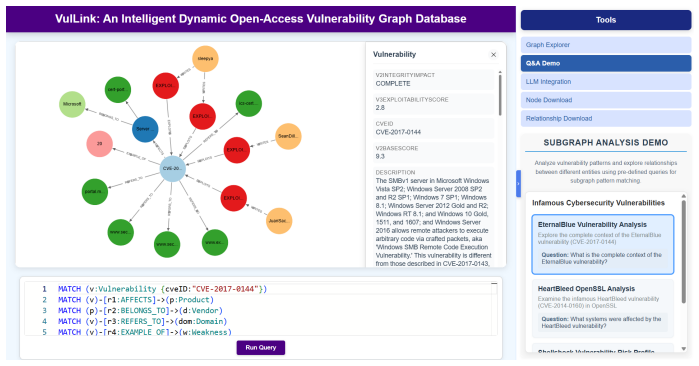
Software vulnerabilities continue to pose significant threats to modern information systems, requiring a timely and accurate risk assessment. Public repositories, such as the National Vulnerability Database and CVE details, are regularly updated, but predominantly utilize relational data models that lack native support for representing complex, interconnected structures. To address this, recent research has proposed graph-based vulnerability models. However, these systems often require complex setup procedures, lack real-time multi-source integration, and offer limited accessibility for direct data retrieval and analysis. We present VulGD, a dynamic open-access vulnerability graph database that continuously aggregates cybersecurity data from authoritative repositories. Designed for both expert and non-expert users, VulGD provides a unified web interface and a public API for interactive graph exploration and automated data access. Additionally, VulGD integrates embeddings from large language models (LLMs) to enrich vulnerability description representations, facilitating more accurate vulnerability risk assessment and threat prioritization. VulGD represents a practical and extensible platform for cybersecurity research and decision-making. The live system is publicly accessible at http://34.129.186.158/.
Editorial analysis
A structured set of objections, weighed in public.
Referee Report
Summary. The manuscript presents VulGD, a dynamic open-access vulnerability graph database that continuously aggregates data from sources such as the National Vulnerability Database and CVE repositories. It offers a unified web interface and public API for interactive graph exploration and automated access, while integrating LLM embeddings to enrich vulnerability description representations and thereby facilitate more accurate risk assessment and threat prioritization. The system is positioned as practical, extensible, and publicly accessible via a provided URL.
Significance. If the described integration and accessibility features operate as claimed, VulGD could serve as a convenient platform for cybersecurity researchers and practitioners seeking graph-based vulnerability data. The combination of relational-to-graph conversion with LLM embeddings has conceptual appeal for semantic enrichment. However, the absence of any empirical validation means the claimed accuracy improvements remain unproven and the overall significance for advancing risk assessment is limited to the utility of the data aggregation and interface alone.
major comments (1)
- [Abstract] Abstract: The central claim that LLM embeddings 'facilitate more accurate vulnerability risk assessment and threat prioritization' is presented without any quantitative evaluation, baseline comparisons, metrics (e.g., precision/recall on prioritization tasks), or ablation studies. This assumption is load-bearing for the paper's 'LLM-Powered' framing and differentiator from prior graph-based vulnerability models, yet the manuscript supplies only a system description.
Simulated Author's Rebuttal
We thank the referee for the constructive feedback on our manuscript. We agree that the abstract claim regarding LLM embeddings requires qualification, as the work is primarily a system description. We address the comment below and will revise accordingly.
read point-by-point responses
-
Referee: [Abstract] Abstract: The central claim that LLM embeddings 'facilitate more accurate vulnerability risk assessment and threat prioritization' is presented without any quantitative evaluation, baseline comparisons, metrics (e.g., precision/recall on prioritization tasks), or ablation studies. This assumption is load-bearing for the paper's 'LLM-Powered' framing and differentiator from prior graph-based vulnerability models, yet the manuscript supplies only a system description.
Authors: We acknowledge that the manuscript provides a system description without quantitative experiments, ablation studies, or task-specific metrics to substantiate improvements in risk assessment accuracy. The LLM integration is presented as a feature for semantic enrichment of vulnerability descriptions via embeddings, drawing on established NLP techniques, rather than as a fully evaluated component. To address this, we will revise the abstract to replace the phrasing 'facilitating more accurate vulnerability risk assessment and threat prioritization' with 'providing enriched representations to support vulnerability risk assessment and threat prioritization.' We will also add a brief discussion section clarifying the conceptual motivation, citing related work on LLM embeddings in cybersecurity, and explicitly noting that empirical validation of downstream task performance is left for future work. This maintains the 'LLM-Powered' framing as descriptive of the architecture while removing unsupported performance claims. revision: yes
Circularity Check
No circularity: descriptive system paper without derivations or fitted claims
full rationale
The manuscript presents VulGD as a constructed platform for aggregating vulnerability data with LLM embeddings for enrichment. No equations, predictions, fitted parameters, or derivation chains exist. The LLM integration is described as a design choice to 'enrich vulnerability description representations' without any reduction to prior results by construction, self-citation load-bearing, or renaming of known patterns. Claims about improved accuracy are stated as intended benefits but rest on untested assumptions rather than circular logic. This is a standard descriptive systems paper whose central content is independent of any self-referential inputs.
Axiom & Free-Parameter Ledger
axioms (1)
- domain assumption LLM embeddings improve accuracy of vulnerability risk assessment
Lean theorems connected to this paper
-
IndisputableMonolith/Cost/FunctionalEquation.leanwashburn_uniqueness_aczel unclear?
unclearRelation between the paper passage and the cited Recognition theorem.
VulGD integrates embeddings from large language models (LLMs) to enrich vulnerability description representations, facilitating more accurate vulnerability risk assessment and threat prioritization.
-
IndisputableMonolith/Foundation/AlexanderDuality.leanalexander_duality_circle_linking unclear?
unclearRelation between the paper passage and the cited Recognition theorem.
The VulGD graph schema directly adopts the comprehensive open-source VulKG framework... Neo4j-based property graph database
What do these tags mean?
- matches
- The paper's claim is directly supported by a theorem in the formal canon.
- supports
- The theorem supports part of the paper's argument, but the paper may add assumptions or extra steps.
- extends
- The paper goes beyond the formal theorem; the theorem is a base layer rather than the whole result.
- uses
- The paper appears to rely on the theorem as machinery.
- contradicts
- The paper's claim conflicts with a theorem or certificate in the canon.
- unclear
- Pith found a possible connection, but the passage is too broad, indirect, or ambiguous to say the theorem truly supports the claim.
Reference graph
Works this paper leans on
-
[1]
J. Yin, M. Tang, J. Cao, M. You, H. Wang, Cybersecurity applications in software: data-driven software vulnerability assessment and management, in: Emerging trends in cybersecurity applications, Springer, 2022, pp. 371– 389
2022
-
[2]
National Cyber Security Centre, MOVEit vulnerability and data ex- tortion incident,https://www.ncsc.gov.uk/information/moveit- vulnerability(n.d.)
-
[3]
News.com.au, Aussie superannuation funds hit in ma- jor cyberattack,https://www.news.com.au/national/aussie- superannuation-funds-hit-in-major-cyberattack/news-story/ a39634e07fe0c8b9458d472888311abd(2025)
2025
-
[4]
X. Sun, Z. Wang, Intelligent association of CVE vulnerabilities based on chain reasoning, in: Advances in Artificial Intelligence, Big Data and Al- gorithms, Vol. 373 of Frontiers in Artificial Intelligence and Applications, IOS Press, 2023, pp. 28–34.doi:10.3233/FAIA230788. URLhttps://ebooks.iospress.nl/volumearticle/65409 19
-
[5]
H. N. Security, Vulnerability management complexity hinders security ef- forts (2025). URLhttps://www.helpnetsecurity.com/2025/01/16/vulnerability- management-complexity/
2025
-
[6]
T. Geras, T. Schreck, The "big beast to tackle": Practices in quality as- surance for cyber threat intelligence, in: Proceedings of the 27th Interna- tional Symposium on Research in Attacks, Intrusions and Defenses, RAID ’24, Association for Computing Machinery, New York, NY, USA, 2024, p. 337–352.doi:10.1145/3678890.3678903. URLhttps://doi.org/10.1145/36...
-
[7]
E.Kiesling, A.Ekelhart, K.Kurniawan, F.Ekaputra, The sepsesknowledge graph: An integrated resource for cybersecurity, in: The Semantic Web – ISWC2019, 2019, describesSEPSES,acybersecurityKGintegratingpublic vulnerability and attack data using Semantic Web technologies; supports use cases like intrusion detection
2019
-
[8]
J. Yin, W. Hong, H. Wang, J. Cao, Y. Miao, Y. Zhang, A compact vulnerability knowledge graph for risk assessment, ACM Transactions on Knowledge Discovery from DataIntroduces VulKG, a compact vul- nerability knowledge graph (276K+ nodes, 1M+ edges) for risk assess- ment; demonstrates its use in co-exploitation behavior analysis. (2024). doi:10.1145/3671005...
- [9]
-
[10]
J. Yin, G. Chen, W. Hong, H. Wang, J. Cao, Y. Miao, Empowering vul- nerability prioritization: a heterogeneous graph-driven framework for ex- ploitability prediction, in: International conference on web information sys- tems engineering, Springer, 2023, pp. 289–299
2023
-
[11]
J. Yin, G. Chen, W. Hong, J. Cao, H. Wang, Y. Miao, A heterogeneous graph-basedsemi-supervisedlearningframeworkforaccesscontroldecision- making, World Wide Web 27 (4) (2024) 35
2024
-
[12]
X. Kong, X. Song, F. Xia, H. Guo, J. Wang, A. Tolba, Lotad: long-term trafficanomalydetectionbasedoncrowdsourcedbustrajectorydata, World Wide Web 21 (3) (2018) 825–847.doi:10.1007/s11280-017-0487-4. URLhttps://doi.org/10.1007/s11280-017-0487-4
-
[13]
S. Noel, E. Harley, K. Tam, M. Limiero, M. Share, CyGraph: Graph- Based Analytics and Visualization for Cybersecurity, 2016.doi:10.1016/ bs.host.2016.07.001. 20
2016
-
[14]
Y. Jia, Y. Qi, H. Shang, R. Jiang, A. Li, A practical approach to construct- ing a knowledge graph for cybersecurity, Engineering 4 (1) (2018) 53–60. doi:10.1016/j.eng.2018.01.004
-
[15]
Y. Sun, D. Lin, H. Song, M. Yan, L. Cao, A method to construct vulnera- bility knowledge graph based on heterogeneous data, in: Proceedings of the 16th International Conference on Mobility, Sensing and Networking (MSN ’20), IEEE, 2020, pp. 740–745
2020
-
[16]
S. Qin, K. P. Chow, Automatic analysis and reasoning based on vulnera- bility knowledge graph, in: Cyberspace Data and Intelligence, and Cyber- Living, Syndrome, and Health, Springer, 2019, pp. 3–19
2019
-
[17]
Y. Wang, X. Hou, X. Ma, Q. Lv, A software security entity relationships prediction framework based on knowledge graph embedding using sentence- bert, in: Proceedings of the International Conference on Wireless Algo- rithms, Systems, and Applications, Springer, 2022, pp. 501–513
2022
-
[18]
H. Xiao, Z. Xing, X. Li, H. Guo, Embedding and predicting software secu- rity entity relationships: A knowledge graph based approach, in: Proceed- ings of the 26th International Conference on Neural Information Processing (ICONIP ’19), Part III, Springer, 2019, pp. 50–63
2019
-
[19]
L. Yuan, Y. Bai, Z. Xing, S. Chen, X. Li, Z. Deng, Predicting entity rela- tions across different security databases by using graph attention network, in: Proceedings of the IEEE 45th Annual Computers, Software, and Ap- plications Conference (COMPSAC ’21), IEEE, 2021, pp. 834–843
2021
-
[20]
J. Yin, M. Tang, J. Cao, M. You, H. Wang, M. Alazab, Knowledge-driven cybersecurity intelligence: Software vulnerability coexploitation behavior discovery, IEEE Transactions on Industrial Informatics 19 (4) (2023) 5593– 5601.doi:10.1109/TII.2022.3192027
-
[21]
C. Mishra, H. Sarma, S. M., Pagellm: Incremental approach for updating a security knowledge graph by using page ranking and large language model, Information Processing & Management 62 (3) (2025) 104045. doi:10.1016/j.ipm.2024.104045. URLhttps://www.sciencedirect.com/science/article/pii/ S0306457324004047
-
[22]
M. Barry, A. Bifet, R. Chiky, S. El Jaouhari, J. Montiel, A. El Ouafi, E. Guerizec, Stream2graph: Dynamic knowledge graph for online learn- ing applied in large-scale network, in: 2022 IEEE International Con- ference on Big Data (Big Data), 2022, pp. 2190–2197.doi:10.1109/ BigData55660.2022.10020885
-
[23]
N. D. F. JSON,https://nvd.nist.gov/vuln/data-feeds#JSON_FEED. 21
-
[24]
S. Project, cyber-kg-converter: A toolset for converting cybersecurity datasets into rdf-based knowledge graphs,https://github.com/sepses/ cyber-kg-converter, accessed: 2025-04-14 (2019)
2025
-
[25]
J. Yin, M. Tang, J. Cao, H. Wang, Apply transfer learning to cybersecurity: Predictingexploitabilityofvulnerabilitiesbydescription, Knowledge-Based Systems 210 (2020) 106529
2020
-
[26]
H.Xu, S.Wang, N.Li, K.Wang, Y.Zhao, K.Chen, T.Yu, Y.Liu, H.Wang, Large language models for cyber security: A systematic literature review, arXiv preprint arXiv:2405.04760 (2024). URLhttps://arxiv.org/abs/2405.04760
-
[27]
J. Zhang, H. Bu, H. Wen, Y. Liu, H. Fei, R. Xi, L. Li, Y. Yang, H. Zhu, D. Meng, When llms meet cybersecurity: A systematic literature review, arXiv preprint arXiv:2405.03644 (2024).doi:10.48550/arXiv.2405.03644. URLhttps://arxiv.org/abs/2405.03644
-
[28]
H. Huang, Y. Wang, Secbert: Privacy-preserving pre-training based neural network inference system, Neural Networks 172 (2024) 106135. doi:https://doi.org/10.1016/j.neunet.2024.106135. URLhttps://www.sciencedirect.com/science/article/pii/ S0893608024000510
-
[29]
Available: https://arxiv.org/abs/2407.02528
R. Fieblinger, M. T. Alam, N. Rastogi, Actionable cyber threat intelli- gence using knowledge graphs and large language models (2024).arXiv: 2407.02528. URLhttps://arxiv.org/abs/2407.02528
- [30]
-
[31]
Y. Yao, J. Duan, K. Xu, Y. Cai, Z. Sun, Y. Zhang, A survey on large language model (llm) security and privacy: The good, the bad, and the ugly, High-Confidence Computing 4 (2) (2024) 100211.doi:10.1016/ j.hcc.2024.100211. URLhttp://dx.doi.org/10.1016/j.hcc.2024.100211
-
[32]
H. Ma, P. Lv, K. Chen, J. Zhou, Kgdist: A prompt-based distillation attack against lms augmented with knowledge graphs, in: Proceedings of the 27th International Symposium on Research in Attacks, Intrusions and Defenses, RAID ’24, Association for Computing Machinery, New York, NY, USA, 2024, p. 480–495.doi:10.1145/3678890.3678906. URLhttps://doi.org/10.11...
- [33]
-
[34]
URLhttps://doi.org/10.1051/sands/2024019
Xiang, Xiayu, Ma, Changchang, Zeng, Liyi, Feng, Wenying, Xie, Yushun, Gu, Zhaoquan, Uncovering multi-step attacks with threat knowledge graph reasoning, Security and Safety 4 (2025) 2024019.doi:10.1051/sands/ 2024019. URLhttps://doi.org/10.1051/sands/2024019
-
[35]
L. Du, C. Xu, Knowledge graph construction research from multi-source vulnerability intelligence, in: W. Lu, Y. Zhang, W. Wen, H. Yan, C. Li (Eds.), Cyber Security, Springer Nature Singapore, Singapore, 2022, pp. 177–184
2022
-
[36]
P. Falcarin, F. Dainese, Building a cybersecurity knowledge graph with cybergraph, in: Proceedings of the 2024 ACM/IEEE Workshops on En- CyCriS and Software Vulnerability, 2024, pp. 29–36, presents Cyber- Graph, a tool for automatic construction and querying of a cybersecu- rity KG; integrates data from diverse sources to assist security experts. doi:10.1...
- [37]
-
[38]
A. Rajagopalan, K. Kandasamy, Y. Li, M. Egele, D. Marculescu, B. Viswanath, Secbert: A pretrained model for cybersecurity text mining, arXiv preprint arXiv:2101.04905 (2021)
-
[39]
Bojanowski, E
P. Bojanowski, E. Grave, A. Joulin, T. Mikolov, Enriching word vectors with subword information, Transactions of the Association for Computa- tional Linguistics 5 (2017) 135–146
2017
-
[40]
J. Yin, M. Tang, J. Cao, H. Wang, M. You, Y. Lin, Adaptive online learning for vulnerability exploitation time prediction, in: Web Information Systems Engineering–WISE 2020: 21st International Conference, Amsterdam, The Netherlands, October 20–24, 2020, Proceedings, Part II 21, Springer, 2020, pp. 252–266
2020
-
[41]
C. Yin, X. Yu, B. Yang, H. Zhang, J. Zhou, Vulnerability classification with bidirectional lstm network, in: Proceedings of the 2020 IEEE International Conference on Big Data (Big Data), IEEE, 2020, pp. 2830–2836
2020
-
[42]
Y. Li, T. Zhang, W. Meng, W. Lou, Neural embeddings for vulnerability assessment: An empirical study with real-world cves, IEEE Transactions on Information Forensics and Security 16 (2021) 3697–3712
2021
-
[43]
Marie, ml-pca: Principal Component Analysis in JavaScript,https: //www.npmjs.com/package/ml-pca, accessed: 2025-04-05 (2020)
N. Marie, ml-pca: Principal Component Analysis in JavaScript,https: //www.npmjs.com/package/ml-pca, accessed: 2025-04-05 (2020). 23
2025
-
[44]
V. Lippi, G. Ceccarelli, Incremental principal component analysis: Ex- act implementation and continuity corrections, in: Proceedings of the 16th International Conference on Informatics in Control, Automation and Robotics, SCITEPRESS - Science and Technology Publications, 2019. doi:10.5220/0007743604730480. URLhttp://dx.doi.org/10.5220/0007743604730480
-
[45]
Face, Transformers documentation (2025)
H. Face, Transformers documentation (2025). URLhttp://huggingface.co/docs/transformers/en/index
2025
-
[46]
N. I. of Standards, T. (NIST), Nvd – data feeds,https://nvd.nist.gov/ vuln/data-feeds
-
[47]
Microsoft, Microsoft security bulletin ms17-010: Security update for windows smb server,https://docs.microsoft.com/en-us/security- updates/securitybulletins/2017/ms17-010(2017). 24
2017
discussion (0)
Sign in with ORCID, Apple, or X to comment. Anyone can read and Pith papers without signing in.