Recognition: no theorem link
Galaxy discs regulate the growth of supermassive black holes
Pith reviewed 2026-05-10 18:15 UTC · model grok-4.3
The pith
Present-day galaxy discs inhibit rapid growth of their central supermassive black holes by preserving rotational support in the central gas.
A machine-rendered reading of the paper's core claim, the machinery that carries it, and where it could break.
Core claim
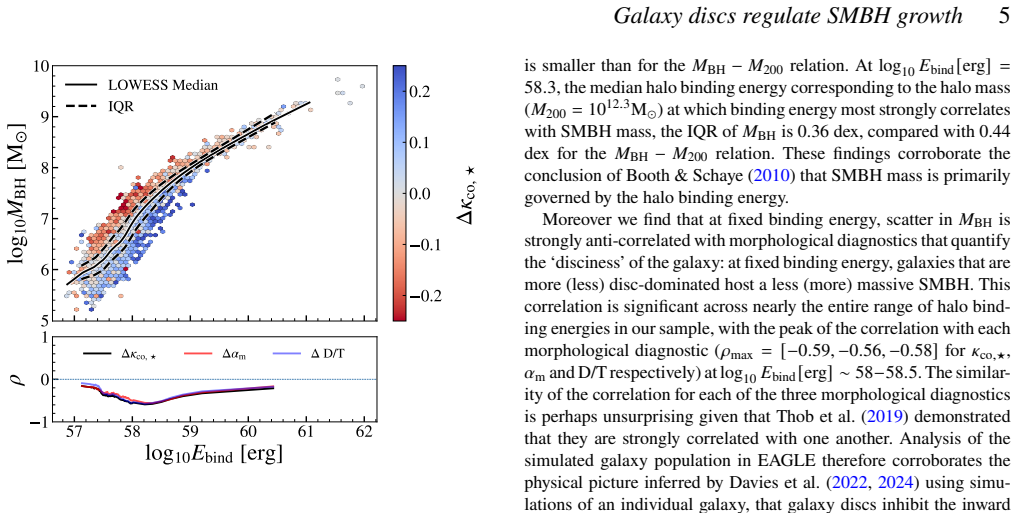
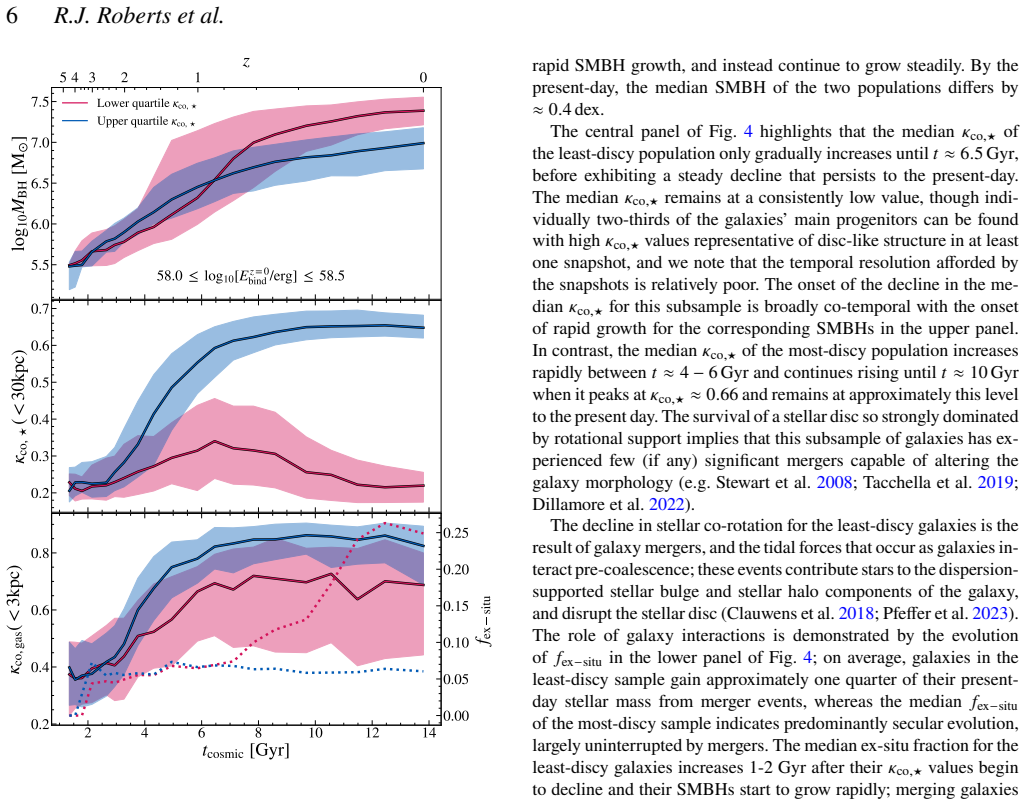
Gas in the central few parsecs of galaxies with present-day discs retains strong rotational support as the galaxy grows, inhibiting inward transport and precluding periods of rapid SMBH growth by gas accretion. In galaxies destined to be present-day ellipticals, however, this rotational support is disrupted by galaxy-galaxy interactions and mergers, enabling gas to be funnelled onto the central SMBH and triggering rapid growth. The mass of the black hole correlates tightly with halo binding energy, with morphology explaining much of the scatter.
What carries the argument
The preservation or disruption of rotational support in the central gas, which governs angular momentum transport and regulates accretion onto the supermassive black hole.
If this is right
- Black hole mass shows a tighter correlation with halo binding energy than with halo mass.
- At fixed stellar mass, disc-dominated galaxies host less massive black holes than elliptical galaxies.
- Merger history determines whether rotational support is disrupted, enabling rapid black hole growth.
- Secular evolution without major mergers keeps central black holes from growing rapidly.
Where Pith is reading between the lines
- High-resolution observations of gas kinematics in galaxy centers could directly test whether disc galaxies maintain higher rotational support than ellipticals.
- The mechanism implies that black hole growth is more tied to dynamical disturbances than to overall galaxy mass.
- This could help explain the diversity of black hole masses in galaxies of similar mass but different morphologies.
- Extending the analysis to higher redshifts might reveal when the morphological differences in black hole growth set in.
Load-bearing premise
The simulation's prescriptions for unresolved processes like star formation, feedback, and black hole accretion accurately model angular momentum transport and the effects of mergers on small scales.
What would settle it
Finding that central gas in present-day disc galaxies shows similar levels of rotational support disruption as in elliptical galaxies would contradict the claim.
Figures

read the original abstract
We examine the relationship between the mass of present-day central supermassive black holes (SMBHs, $M_{\rm BH}$), and the stellar mass ($M_{\star}$) and halo mass ($M_{200}$) of their host galaxies in the EAGLE simulation, and find that scatter about these relations correlates with both halo structure and galaxy morphology. EAGLE reproduces the observed $M_{\rm BH}$-$M_{\star}$ relation, including (qualitatively) its dependence on morphology: at fixed $M_{\star}$, disc-dominated galaxies host less massive SMBHs than ellipticals. We show that $M_{\rm BH}$ correlates with $M_{200}$, as expected if SMBHs are regulated by processes acting on the scale of the host dark matter halo, but exhibits a tighter correlation with the halo binding energy ($E_{\rm bind}$), signalling that this quantity, which encodes information about both halo mass and halo structure, is more fundamental to $M_{\rm BH}$. As with $M_{\rm BH}$-$M_{\star}$, scatter about the $M_{\rm BH}$-$E_{\rm bind}$ relation is strongly correlated with morphology. Gas in the central few parsecs of galaxies with present-day discs retains strong rotational support as the galaxy grows, inhibiting inward transport and precluding periods of rapid SMBH growth by gas accretion. In galaxies destined to be present-day ellipticals, however, this rotational support is disrupted, enabling gas to be funnelled onto the central SMBH, triggering rapid growth. Evolution of the mass fraction of stars formed ex-situ indicates that this disruption is caused by galaxy-galaxy interactions and mergers. Our findings corroborate the conclusion of recent studies, based on controlled simulations of an ~$L^{\star}$ galaxy, that prolonged secular galaxy evolution inhibits central SMBH growth.
Editorial analysis
A structured set of objections, weighed in public.
Referee Report
Summary. The paper uses the EAGLE cosmological simulation to examine the M_BH-M_star and M_BH-M_200 relations, finding that scatter correlates with galaxy morphology and halo structure. At fixed stellar mass, disc-dominated galaxies host lower-mass SMBHs than ellipticals. The authors attribute this to gas in the central few parsecs of disc galaxies retaining strong rotational support (inhibiting accretion), while mergers disrupt this support in galaxies that become ellipticals, enabling rapid BH growth. They report a tighter correlation of M_BH with halo binding energy E_bind than with M_200 or M_star, and link the mechanism to ex-situ star fractions indicating merger-driven angular-momentum redistribution.
Significance. If the causal interpretation holds, the result strengthens the case that prolonged secular evolution in disc galaxies suppresses SMBH growth via angular-momentum barriers, while mergers enable it, providing a simulation-based link between morphology and the M_BH-M_star relation that aligns with controlled high-resolution studies of individual galaxies.
major comments (3)
- [Abstract; implied methods and results sections on gas angular momentum tracking] The central mechanistic claim (gas in the central few parsecs retains rotational support in disc galaxies but is disrupted in ellipticals) is inferred from correlations with present-day morphology and ex-situ star fraction, yet the EAGLE gravitational softening (~0.7 kpc) and gas resolution mean the central few parsecs are unresolved. The sub-grid BH accretion (modified Bondi-Hoyle) does not explicitly incorporate an angular-momentum barrier or torque-limited transport, so it is unclear whether the simulation actually demonstrates the proposed inhibition of inflow or whether the result is an artifact of how the sub-grid model responds to large-scale rotation.
- [Results on M_BH-E_bind relation] The tighter M_BH-E_bind correlation is presented as evidence that binding energy is more fundamental than M_200, but the paper does not show whether this holds after controlling for the morphology dependence already identified, nor does it test whether E_bind simply encodes the same merger history information as the ex-situ fraction.
- [Discussion of ex-situ stars and merger disruption] The morphological split is defined at z=0 and then used to interpret the entire growth history; without an explicit test (e.g., tracking the time evolution of central gas specific angular momentum separately for the two populations), the causal direction (morphology regulates BH growth vs. BH growth influences morphology) remains ambiguous.
minor comments (2)
- [Abstract] The abstract states the central-few-parsecs claim without qualifying the resolution limit; a brief caveat would improve clarity.
- [Figures showing gas rotation or accretion rates] Figure captions and text should explicitly state the gravitational softening length and gas particle mass when discussing central gas properties.
Simulated Author's Rebuttal
We thank the referee for their constructive and detailed comments, which have prompted us to clarify several aspects of our analysis and interpretation. We address each major comment point by point below, indicating revisions made to the manuscript where appropriate.
read point-by-point responses
-
Referee: The central mechanistic claim (gas in the central few parsecs retains rotational support in disc galaxies but is disrupted in ellipticals) is inferred from correlations with present-day morphology and ex-situ star fraction, yet the EAGLE gravitational softening (~0.7 kpc) and gas resolution mean the central few parsecs are unresolved. The sub-grid BH accretion (modified Bondi-Hoyle) does not explicitly incorporate an angular-momentum barrier or torque-limited transport, so it is unclear whether the simulation actually demonstrates the proposed inhibition of inflow or whether the result is an artifact of how the sub-grid model responds to large-scale rotation.
Authors: We agree that EAGLE does not resolve the central few parsecs and that the modified Bondi-Hoyle sub-grid accretion model lacks an explicit angular-momentum barrier. Our mechanistic interpretation is therefore based on emergent correlations between resolved-scale gas properties, morphology, ex-situ fractions, and BH growth. These correlations reproduce the observed M_BH-M_star relation and its morphology dependence, and align with results from higher-resolution controlled simulations cited in the paper. We have added a new paragraph in the methods and discussion sections explicitly acknowledging the resolution limits and sub-grid assumptions, stating that our conclusions rest on these correlations rather than direct pc-scale modeling, to clarify that the result is not presented as a direct demonstration of the barrier. revision: partial
-
Referee: The tighter M_BH-E_bind correlation is presented as evidence that binding energy is more fundamental than M_200, but the paper does not show whether this holds after controlling for the morphology dependence already identified, nor does it test whether E_bind simply encodes the same merger history information as the ex-situ fraction.
Authors: We have carried out additional analysis to test this. After controlling for morphology (via residuals at fixed morphological type), the M_BH-E_bind relation remains tighter than M_BH-M_200. We also performed a partial correlation analysis showing that E_bind retains explanatory power for M_BH beyond what is captured by ex-situ fraction alone, although the two quantities are correlated as expected from merger history. We have added this controlled analysis, including a new figure, to the results section. revision: yes
-
Referee: The morphological split is defined at z=0 and then used to interpret the entire growth history; without an explicit test (e.g., tracking the time evolution of central gas specific angular momentum separately for the two populations), the causal direction (morphology regulates BH growth vs. BH growth influences morphology) remains ambiguous.
Authors: We acknowledge that a z=0 morphological classification requires care when inferring causality over cosmic time. The evolution of the ex-situ star fraction provides a temporal proxy, as its increases coincide with merger events that we link to the disruption of rotational support and subsequent BH growth. This timing supports mergers as the driver rather than the reverse. We have revised the discussion to more explicitly address this potential ambiguity and to justify the use of ex-situ evolution as evidence for the causal direction. Direct tracking of central gas specific angular momentum over time for the two populations was not performed here but would be a natural extension. revision: partial
Circularity Check
No circularity: relations measured directly from simulation outputs
full rationale
The paper's derivation chain consists of direct measurements of correlations (M_BH-M_star, M_BH-M_200, tighter M_BH-E_bind, and morphology scatter) extracted from EAGLE simulation snapshots, followed by inspection of auxiliary diagnostics such as central gas rotational support and ex-situ star fractions. These steps do not reduce any claimed result to its inputs by construction, nor do they involve fitted parameters redefined as predictions, self-definitional loops, or load-bearing self-citations. The mechanistic narrative is an interpretation of independent simulation fields rather than a tautological renaming or ansatz smuggling. The paper is self-contained against external benchmarks in the sense that its primary claims are empirical outputs of the run.
Axiom & Free-Parameter Ledger
axioms (1)
- domain assumption EAGLE sub-grid prescriptions correctly capture angular-momentum transport and merger-driven dynamical heating on unresolved scales
Reference graph
Works this paper leans on
-
[1]
Appleby S., Dav \'e R., Kraljic K., Angl \'e s-Alc \'a zar D., Narayanan D., 2020, @doi [ ] 10.1093/mnras/staa1169 , https://ui.adsabs.harvard.edu/abs/2020MNRAS.494.6053A 494, 6053
-
[2]
doi:10.1093/mnras/stac1339 , archiveprefix =
Bah \'e Y. M., et al., 2022, @doi [ ] 10.1093/mnras/stac1339 , https://ui.adsabs.harvard.edu/abs/2022MNRAS.516..167B 516, 167
-
[3]
Bondi H., Hoyle F., 1944, @doi [ ] 10.1093/mnras/104.5.273 , https://ui.adsabs.harvard.edu/abs/1944MNRAS.104..273B 104, 273
-
[4]
Booth C. M., Schaye J., 2009, @doi [ ] 10.1111/j.1365-2966.2009.15043.x , https://ui.adsabs.harvard.edu/abs/2009MNRAS.398...53B 398, 53
-
[5]
Booth C. M., Schaye J., 2010, @doi [ ] 10.1111/j.1745-3933.2010.00832.x , https://ui.adsabs.harvard.edu/abs/2010MNRAS.405L...1B 405, L1
-
[6]
Bower R. G., Benson A. J., Malbon R., Helly J. C., Frenk C. S., Baugh C. M., Cole S., Lacey C. G., 2006, @doi [ ] 10.1111/j.1365-2966.2006.10519.x , https://ui.adsabs.harvard.edu/abs/2006MNRAS.370..645B 370, 645
-
[7]
Bower R. G., Schaye J., Frenk C. S., Theuns T., Schaller M., Crain R. A., McAlpine S., 2017, @doi [ ] 10.1093/mnras/stw2735 , https://ui.adsabs.harvard.edu/abs/2017MNRAS.465...32B 465, 32
-
[8]
Byrne-Mamahit S., Hani M. H., Ellison S. L., Quai S., Patton D. R., 2023, @doi [ ] 10.1093/mnras/stac3674 , https://ui.adsabs.harvard.edu/abs/2023MNRAS.519.4966B 519, 4966
-
[9]
Byrne-Mamahit S., Patton D. R., Ellison S. L., Bickley R., Ferreira L., Hani M., Quai S., Wilkinson S., 2024, @doi [ ] 10.1093/mnras/stae419 , https://ui.adsabs.harvard.edu/abs/2024MNRAS.528.5864B 528, 5864
-
[10]
Byrne-Mamahit S., Ellison S. L., Patton D. R., Wilkinson S., Ferreira L., Bottrell C., 2025, @doi [ ] 10.1093/mnras/staf1765 , https://ui.adsabs.harvard.edu/abs/2025MNRAS.544.1673B 544, 1673
-
[11]
Clauwens B., Schaye J., Franx M., Bower R. G., 2018, @doi [ ] 10.1093/mnras/sty1229 , https://ui.adsabs.harvard.edu/abs/2018MNRAS.478.3994C 478, 3994
-
[12]
S., 1979, Journal of the American Statistical Association, 74, 829
Cleveland W. S., 1979, Journal of the American Statistical Association, 74, 829
1979
-
[13]
Correa C. A., Schaye J., 2020, @doi [ ] 10.1093/mnras/staa3053 , https://ui.adsabs.harvard.edu/abs/2020MNRAS.499.3578C 499, 3578
-
[14]
A., Schaye J., Clauwens B., Bower R
Correa C. A., Schaye J., Clauwens B., Bower R. G., Crain R. A., Schaller M., Theuns T., Thob A. C. R., 2017, @doi [ ] 10.1093/mnrasl/slx133 , https://ui.adsabs.harvard.edu/abs/2017MNRAS.472L..45C 472, L45
-
[15]
Crain R. A., van de Voort F., 2023, @doi [ ] 10.1146/annurev-astro-041923-043618 , https://ui.adsabs.harvard.edu/abs/2023ARA&A..61..473C 61, 473
-
[16]
Crain R. A., McCarthy I. G., Frenk C. S., Theuns T., Schaye J., 2010, @doi [ ] 10.1111/j.1365-2966.2010.16985.x , https://ui.adsabs.harvard.edu/abs/2010MNRAS.407.1403C 407, 1403
-
[17]
Crain R. A., et al., 2015, @doi [ ] 10.1093/mnras/stv725 , https://ui.adsabs.harvard.edu/abs/2015MNRAS.450.1937C 450, 1937
-
[18]
Croton D. J., et al., 2006, @doi [ ] 10.1111/j.1365-2966.2005.09675.x , https://ui.adsabs.harvard.edu/abs/2006MNRAS.365...11C 365, 11
-
[19]
Simba: Cosmological Simulations with Black Hole Growth and Feedback
Dav \'e R., Angl \'e s-Alc \'a zar D., Narayanan D., Li Q., Rafieferantsoa M. H., Appleby S., 2019, @doi [ ] 10.1093/mnras/stz937 , https://ui.adsabs.harvard.edu/abs/2019MNRAS.486.2827D 486, 2827
-
[20]
Davies J. J., Crain R. A., McCarthy I. G., Oppenheimer B. D., Schaye J., Schaller M., McAlpine S., 2019, @doi [ ] 10.1093/mnras/stz635 , https://ui.adsabs.harvard.edu/abs/2019MNRAS.485.3783D 485, 3783
-
[21]
Davies J. J., Crain R. A., Oppenheimer B. D., Schaye J., 2020, @doi [ ] 10.1093/mnras/stz3201 , https://ui.adsabs.harvard.edu/abs/2020MNRAS.491.4462D 491, 4462
-
[22]
Davies J. J., Pontzen A., Crain R. A., 2022, @doi [ ] 10.1093/mnras/stac1742 , https://ui.adsabs.harvard.edu/abs/2022MNRAS.515.1430D 515, 1430
-
[23]
Davies J. J., Pontzen A., Crain R. A., 2024, @doi [ ] 10.1093/mnras/stad3456 , https://ui.adsabs.harvard.edu/abs/2024MNRAS.527.4705D 527, 4705
-
[24]
Di Matteo T., Springel V., Hernquist L., 2005, @doi [ ] 10.1038/nature03335 , https://ui.adsabs.harvard.edu/abs/2005Natur.433..604D 433, 604
-
[25]
Dillamore A. M., Belokurov V., Font A. S., McCarthy I. G., 2022, @doi [ ] 10.1093/mnras/stac1038 , https://ui.adsabs.harvard.edu/abs/2022MNRAS.513.1867D 513, 1867
-
[26]
Dolag K., Borgani S., Murante G., Springel V., 2009, @doi [ ] 10.1111/j.1365-2966.2009.15034.x , https://ui.adsabs.harvard.edu/abs/2009MNRAS.399..497D 399, 497
-
[27]
G., 1991, @doi [ ] 10.1086/170451 , https://ui.adsabs.harvard.edu/abs/1991ApJ...378..496D 378, 496
Dubinski J., Carlberg R. G., 1991, @doi [ ] 10.1086/170451 , https://ui.adsabs.harvard.edu/abs/1991ApJ...378..496D 378, 496
-
[28]
Dubois Y., et al., 2014, @doi [ ] 10.1093/mnras/stu1227 , https://ui.adsabs.harvard.edu/abs/2014MNRAS.444.1453D 444, 1453
-
[29]
Dubois Y., Volonteri M., Silk J., Devriendt J., Slyz A., Teyssier R., 2015, @doi [ ] 10.1093/mnras/stv1416 , https://ui.adsabs.harvard.edu/abs/2015MNRAS.452.1502D 452, 1502
-
[30]
Ellison S. L., et al., 2022, @doi [ ] 10.1093/mnrasl/slac109 , https://ui.adsabs.harvard.edu/abs/2022MNRAS.517L..92E 517, L92
-
[31]
Ellison S., et al., 2025, @doi [The Open Journal of Astrophysics] 10.33232/001c.129235 , https://ui.adsabs.harvard.edu/abs/2025OJAp....8E..12E 8, 12
-
[32]
Ferrarese L., 2002, @doi [ ] 10.1086/342308 , https://ui.adsabs.harvard.edu/abs/2002ApJ...578...90F 578, 90
-
[33]
Ferrarese L., Merritt D., 2000, @doi [ ] 10.1086/312838 , https://ui.adsabs.harvard.edu/abs/2000ApJ...539L...9F 539, L9
-
[34]
Gebhardt K., et al., 2000, @doi [ ] 10.1086/312840 , https://ui.adsabs.harvard.edu/abs/2000ApJ...539L..13G 539, L13
-
[35]
Graham A. W., Sahu N., 2023, @doi [ ] 10.1093/mnras/stac2019 , https://ui.adsabs.harvard.edu/abs/2023MNRAS.518.2177G 518, 2177
-
[36]
Granato G. L., De Zotti G., Silva L., Bressan A., Danese L., 2004, @doi [ ] 10.1086/379875 , https://ui.adsabs.harvard.edu/abs/2004ApJ...600..580G 600, 580
-
[37]
Habouzit M., et al., 2021, @doi [ ] 10.1093/mnras/stab496 , https://ui.adsabs.harvard.edu/abs/2021MNRAS.503.1940H 503, 1940
-
[38]
H \"a ring N., Rix H.-W., 2004, @doi [ ] 10.1086/383567 , https://ui.adsabs.harvard.edu/abs/2004ApJ...604L..89H 604, L89
-
[39]
The FABLE simulations: A feedback model for galaxies, groups and clusters
Henden N. A., Puchwein E., Shen S., Sijacki D., 2018, @doi [ ] 10.1093/mnras/sty1780 , https://ui.adsabs.harvard.edu/abs/2018MNRAS.479.5385H 479, 5385
-
[40]
Henriques B. M. B., White S. D. M., Thomas P. A., Angulo R., Guo Q., Lemson G., Springel V., Overzier R., 2015, @doi [ ] 10.1093/mnras/stv705 , https://ui.adsabs.harvard.edu/abs/2015MNRAS.451.2663H 451, 2663
-
[41]
Hopkins P. F., Hernquist L., Cox T. J., Di Matteo T., Robertson B., Springel V., 2006, @doi [ ] 10.1086/499298 , https://ui.adsabs.harvard.edu/abs/2006ApJS..163....1H 163, 1
-
[42]
Hopkins P. F., Younger J. D., Hayward C. C., Narayanan D., Hernquist L., 2010, @doi [ ] 10.1111/j.1365-2966.2009.15990.x , https://ui.adsabs.harvard.edu/abs/2010MNRAS.402.1693H 402, 1693
-
[43]
Jahnke K., Macci \`o A. V., 2011, @doi [ ] 10.1088/0004-637X/734/2/92 , https://ui.adsabs.harvard.edu/abs/2011ApJ...734...92J 734, 92
-
[44]
Jiang L., Helly J. C., Cole S., Frenk C. S., 2014, @doi [ ] 10.1093/mnras/stu390 , https://ui.adsabs.harvard.edu/abs/2014MNRAS.440.2115J 440, 2115
-
[45]
Coevolution (Or Not) of Supermassive Black Holes and Host Galaxies
Kormendy J., Ho L. C., 2013, @doi [ ] 10.1146/annurev-astro-082708-101811 , https://ui.adsabs.harvard.edu/abs/2013ARA&A..51..511K 51, 511
work page internal anchor Pith review doi:10.1146/annurev-astro-082708-101811 2013
-
[46]
Kormendy J., Richstone D., 1995, @doi [ ] 10.1146/annurev.aa.33.090195.003053 , https://ui.adsabs.harvard.edu/abs/1995ARA&A..33..581K 33, 581
-
[47]
La Marca A., et al., 2025, @doi [arXiv e-prints] 10.48550/arXiv.2503.15317 , https://ui.adsabs.harvard.edu/abs/2025arXiv250315317E p. arXiv:2503.15317
-
[48]
Li Y., et al., 2020, @doi [ ] 10.3847/1538-4357/ab8f8d , https://ui.adsabs.harvard.edu/abs/2020ApJ...895..102L 895, 102
-
[49]
Magorrian J., et al., 1998, @doi [ ] 10.1086/300353 , https://ui.adsabs.harvard.edu/abs/1998AJ....115.2285M 115, 2285
-
[50]
K., 2003, @doi [ ] 10.1086/375804 , https://ui.adsabs.harvard.edu/abs/2003ApJ...589L..21M 589, L21
Marconi A., Hunt L. K., 2003, @doi [ ] 10.1086/375804 , https://ui.adsabs.harvard.edu/abs/2003ApJ...589L..21M 589, L21
-
[51]
Matthee J., Schaye J., Crain R. A., Schaller M., Bower R., Theuns T., 2017, @doi [ ] 10.1093/mnras/stw2884 , https://ui.adsabs.harvard.edu/abs/2017MNRAS.465.2381M 465, 2381
-
[52]
McAlpine S., et al., 2016, @doi [Astronomy and Computing] 10.1016/j.ascom.2016.02.004 , https://ui.adsabs.harvard.edu/abs/2016A&C....15...72M 15, 72
-
[53]
McAlpine S., Bower R. G., Rosario D. J., Crain R. A., Schaye J., Theuns T., 2018, @doi [ ] 10.1093/mnras/sty2489 , https://ui.adsabs.harvard.edu/abs/2018MNRAS.481.3118M 481, 3118
-
[54]
McAlpine S., Harrison C. M., Rosario D. J., Alexander D. M., Ellison S. L., Johansson P. H., Patton D. R., 2020, @doi [ ] 10.1093/mnras/staa1123 , https://ui.adsabs.harvard.edu/abs/2020MNRAS.494.5713M 494, 5713
-
[55]
McConnell N. J., Ma C.-P., 2013, @doi [ ] 10.1088/0004-637X/764/2/184 , https://ui.adsabs.harvard.edu/abs/2013ApJ...764..184M 764, 184
-
[56]
Mihos J. C., Hernquist L., 1994, @doi [ ] 10.1086/187299 , https://ui.adsabs.harvard.edu/abs/1994ApJ...425L..13M 425, L13
-
[57]
Mountrichas G., Buat V., 2023, @doi [ ] 10.1051/0004-6361/202347392 , https://ui.adsabs.harvard.edu/abs/2023A&A...679A.151M 679, A151
-
[58]
Navarro J. F., Frenk C. S., White S. D. M., 1996, @doi [ ] 10.1086/177173 , https://ui.adsabs.harvard.edu/abs/1996ApJ...462..563N 462, 563
-
[59]
, year = 1997, month = dec, volume = 490, pages =
Navarro J. F., Frenk C. S., White S. D. M., 1997, @doi [ ] 10.1086/304888 , https://ui.adsabs.harvard.edu/abs/1997ApJ...490..493N 490, 493
-
[60]
Nelson D., et al., 2018, @doi [ ] 10.1093/mnras/stx3040 , https://ui.adsabs.harvard.edu/abs/2018MNRAS.475..624N 475, 624
work page internal anchor Pith review doi:10.1093/mnras/stx3040 2018
-
[61]
Neto A. F., et al., 2007, @doi [ ] 10.1111/j.1365-2966.2007.12381.x , https://ui.adsabs.harvard.edu/abs/2007MNRAS.381.1450N 381, 1450
-
[62]
Oppenheimer B. D., et al., 2020, @doi [ ] 10.1093/mnras/stz3124 , https://ui.adsabs.harvard.edu/abs/2020MNRAS.491.2939O 491, 2939
-
[63]
Pfeffer J., Cavanagh M. K., Bekki K., Couch W. J., Drinkwater M. J., Forbes D. A., Koribalski B. S., 2023, @doi [ ] 10.1093/mnras/stac3466 , https://ui.adsabs.harvard.edu/abs/2023MNRAS.518.5260P 518, 5260
-
[64]
Pillepich A., et al., 2018, @doi [ ] 10.1093/mnras/stx3112 , https://ui.adsabs.harvard.edu/abs/2018MNRAS.475..648P 475, 648
-
[65]
Pontzen A., Tremmel M., Roth N., Peiris H. V., Saintonge A., Volonteri M., Quinn T., Governato F., 2017, @doi [ ] 10.1093/mnras/stw2627 , https://ui.adsabs.harvard.edu/abs/2017MNRAS.465..547P 465, 547
-
[66]
Qu Y., et al., 2017, @doi [ ] 10.1093/mnras/stw2437 , https://ui.adsabs.harvard.edu/abs/2017MNRAS.464.1659Q 464, 1659
-
[67]
Rey M. P., Pontzen A., Saintonge A., 2019, @doi [ ] 10.1093/mnras/stz552 , https://ui.adsabs.harvard.edu/abs/2019MNRAS.485.1906R 485, 1906
-
[68]
Robertson B., Bullock J. S., Cox T. J., Di Matteo T., Hernquist L., Springel V., Yoshida N., 2006, @doi [ ] 10.1086/504412 , https://ui.adsabs.harvard.edu/abs/2006ApJ...645..986R 645, 986
-
[69]
Rosas-Guevara Y. M., et al., 2015, @doi [ ] 10.1093/mnras/stv2056 , https://ui.adsabs.harvard.edu/abs/2015MNRAS.454.1038R 454, 1038
-
[70]
Roth N., Pontzen A., Peiris H. V., 2016, @doi [ ] 10.1093/mnras/stv2375 , https://ui.adsabs.harvard.edu/abs/2016MNRAS.455..974R 455, 974
-
[71]
Schaller M., et al., 2015, @doi [ ] 10.1093/mnras/stv1067 , https://ui.adsabs.harvard.edu/abs/2015MNRAS.451.1247S 451, 1247
-
[72]
Schaye J., et al., 2010, @doi [ ] 10.1111/j.1365-2966.2009.16029.x , https://ui.adsabs.harvard.edu/abs/2010MNRAS.402.1536S 402, 1536
-
[73]
Schaye J., et al., 2015, @doi [ ] 10.1093/mnras/stu2058 , https://ui.adsabs.harvard.edu/abs/2015MNRAS.446..521S 446, 521
-
[74]
The COLIBRE project: cosmological hydrodynamical simulations of galaxy formation and evolution
Schaye J., et al., 2025, @doi [arXiv e-prints] 10.48550/arXiv.2508.21126 , https://ui.adsabs.harvard.edu/abs/2025arXiv250821126S p. arXiv:2508.21126
work page internal anchor Pith review Pith/arXiv arXiv doi:10.48550/arxiv.2508.21126 2025
-
[75]
Silk J., Rees M. J., 1998, @doi [ ] 10.48550/arXiv.astro-ph/9801013 , https://ui.adsabs.harvard.edu/abs/1998A&A...331L...1S 331, L1
-
[76]
Smethurst R. J., et al., 2024, @doi [ ] 10.1093/mnras/stad1794 , https://ui.adsabs.harvard.edu/abs/2024MNRAS.52710855S 527, 10855
-
[77]
Soltan A., 1982, @doi [ ] 10.1093/mnras/200.1.115 , https://ui.adsabs.harvard.edu/abs/1982MNRAS.200..115S 200, 115
-
[78]
Springel V., White S. D. M., Tormen G., Kauffmann G., 2001, @doi [ ] 10.1046/j.1365-8711.2001.04912.x , https://ui.adsabs.harvard.edu/abs/2001MNRAS.328..726S 328, 726
-
[79]
Springel V., Di Matteo T., Hernquist L., 2005, @doi [ ] 10.1111/j.1365-2966.2005.09238.x , https://ui.adsabs.harvard.edu/abs/2005MNRAS.361..776S 361, 776
-
[80]
Stewart K. R., Bullock J. S., Wechsler R. H., Maller A. H., Zentner A. R., 2008, @doi [ ] 10.1086/588579 , https://ui.adsabs.harvard.edu/abs/2008ApJ...683..597S 683, 597
discussion (0)
Sign in with ORCID, Apple, or X to comment. Anyone can read and Pith papers without signing in.