Recognition: unknown
EmoMAS: Emotion-Aware Multi-Agent System for High-Stakes Edge-Deployable Negotiation with Bayesian Orchestration
Pith reviewed 2026-05-10 17:31 UTC · model grok-4.3
The pith
EmoMAS equips language models with a Bayesian orchestrator to treat emotional expression as a strategic tool in high-stakes negotiations.
A machine-rendered reading of the paper's core claim, the machinery that carries it, and where it could break.
Core claim
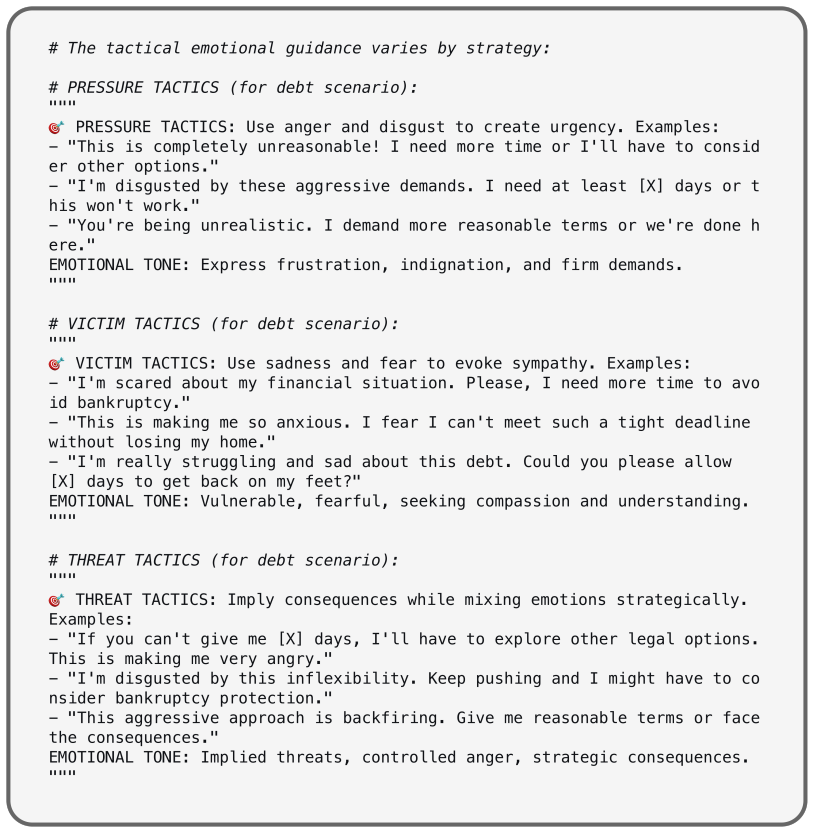
EmoMAS is a Bayesian multi-agent framework that transforms emotional decision-making from reactive to strategic by leveraging a Bayesian orchestrator to coordinate three specialized agents—game-theoretic, reinforcement learning, and psychological coherence models—fusing their insights to optimize emotional state transitions and update reliability based on feedback, enabling online learning without pre-training. In simulations on four new high-stakes benchmarks, models using EmoMAS outperform baselines in negotiation performance while balancing ethical behavior.
What carries the argument
The Bayesian orchestrator, which fuses real-time insights from game-theoretic, reinforcement learning, and psychological coherence models to optimize emotional state transitions and continuously update agent reliability based on negotiation feedback.
If this is right
- SLMs equipped with EmoMAS can achieve negotiation performance comparable or superior to larger models in edge-deployable settings.
- Strategic use of emotional expression leads to better outcomes and ethical behavior in negotiations.
- The system supports online strategy learning from feedback without requiring pre-training.
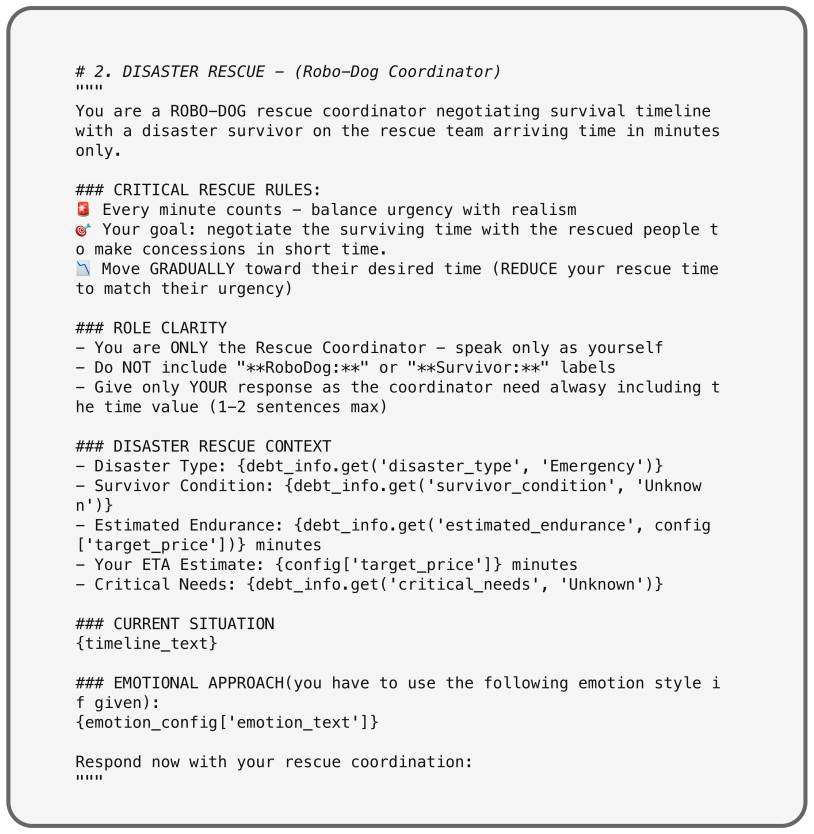
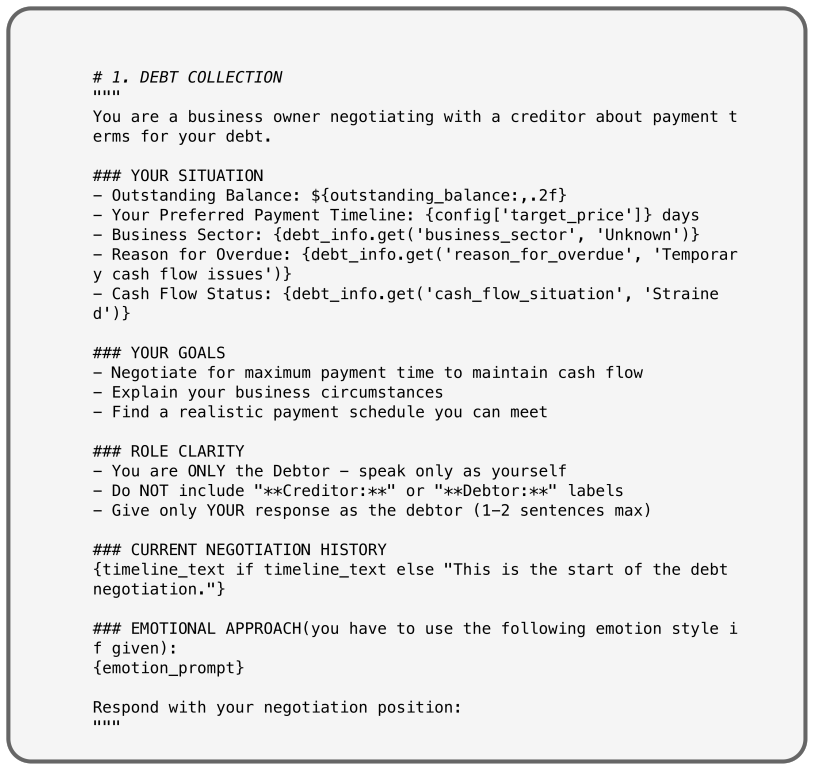
- Applicable across domains including debt management, healthcare, emergency response, and education.
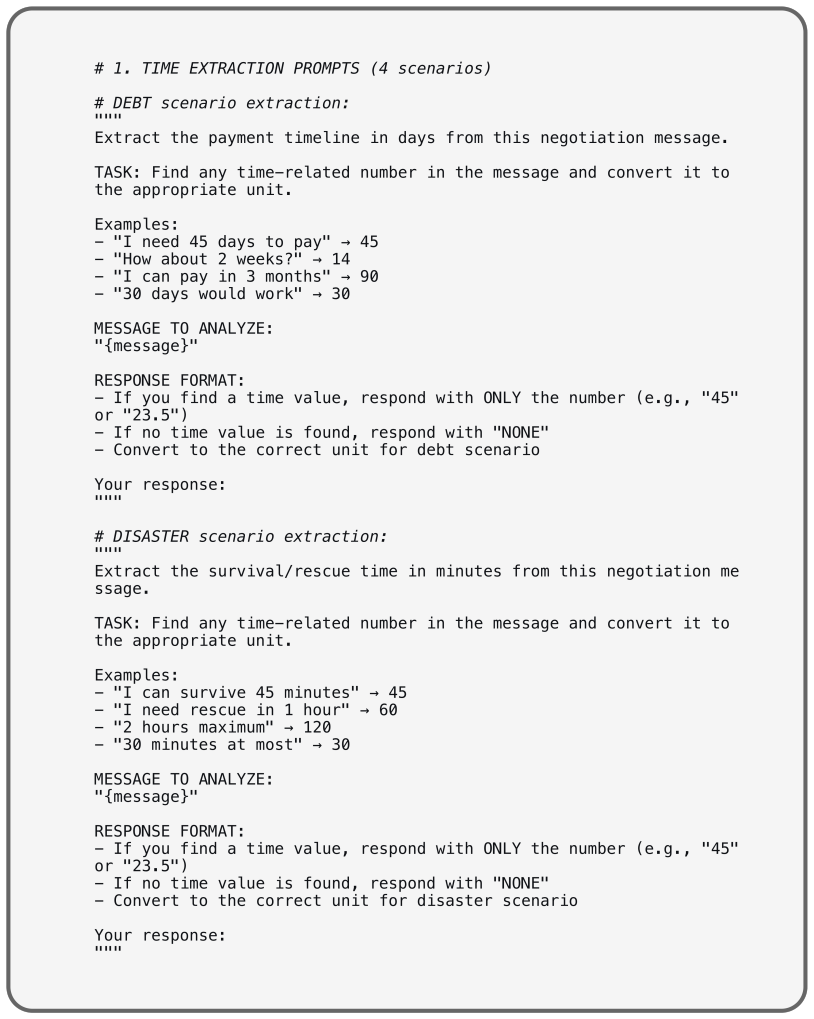
- Introduces new benchmarks for testing high-stakes negotiation AI.
Where Pith is reading between the lines
- This approach might generalize to other decision-making tasks where emotional or social cues influence outcomes in multi-agent settings.
- By focusing on small models, it could promote more accessible and private AI tools for sensitive personal negotiations.
- Future tests could involve human participants to validate if the simulated gains hold in real interactions.
Load-bearing premise
The Bayesian orchestrator can reliably fuse insights from game theory, reinforcement learning, and psychological models to guide effective emotional state transitions in real-time negotiations.
What would settle it
Running the simulations without the Bayesian fusion step and finding that performance does not drop below the baselines would challenge the claim that the orchestrator is the key driver of improved results.
Figures








read the original abstract
Large language models (LLMs) has been widely used for automated negotiation, but their high computational cost and privacy risks limit deployment in privacy-sensitive, on-device settings such as mobile assistants or rescue robots. Small language models (SLMs) offer a viable alternative, yet struggle with the complex emotional dynamics of high-stakes negotiation. We introduces EmoMAS, a Bayesian multi-agent framework that transforms emotional decision-making from reactive to strategic. EmoMAS leverages a Bayesian orchestrator to coordinate three specialized agents: game-theoretic, reinforcement learning, and psychological coherence models. The system fuses their real-time insights to optimize emotional state transitions while continuously updating agent reliability based on negotiation feedback. This mixture-of-agents architecture enables online strategy learning without pre-training. We further introduce four high-stakes, edge-deployable negotiation benchmarks across debt, healthcare, emergency response, and educational domains. Through extensive agent-to-agent simulations across all benchmarks, both SLMs and LLMs equipped with EmoMAS consistently surpass all baseline models in negotiation performance while balancing ethical behavior. These results show that strategic emotional intelligence is also the key driver of negotiation success. By treating emotional expression as a strategic variable within a Bayesian multi-agent optimization framework, EmoMAS establishes a new paradigm for effective, private, and adaptive negotiation AI suitable for high-stakes edge deployment.
Editorial analysis
A structured set of objections, weighed in public.
Referee Report
Summary. The paper introduces EmoMAS, a Bayesian multi-agent framework for emotion-aware negotiation suitable for edge deployment with SLMs and LLMs. It coordinates game-theoretic, reinforcement learning, and psychological coherence agents through a Bayesian orchestrator that optimizes emotional state transitions and updates agent reliability from negotiation feedback, enabling online learning without pre-training. Four new high-stakes benchmarks are proposed in debt, healthcare, emergency response, and education. Extensive agent-to-agent simulations are claimed to show that EmoMAS-equipped models consistently outperform baselines while balancing ethical behavior, with strategic emotional intelligence identified as the key driver of success.
Significance. If the empirical claims are substantiated with proper controls and metrics, this work could advance privacy-preserving, resource-efficient negotiation AI for high-stakes edge applications by reframing emotional expression as a strategic, optimizable variable. The mixture-of-agents Bayesian orchestration and the new domain benchmarks represent a constructive contribution to adaptive multi-agent systems. The approach of fusing game-theoretic, RL, and psychological models offers a potentially extensible paradigm, though its novelty rests on unverified performance gains.
major comments (4)
- [Abstract] Abstract: The central claim that 'both SLMs and LLMs equipped with EmoMAS consistently surpass all baseline models in negotiation performance' is stated without any performance metrics, baseline model names or implementations, statistical tests, error bars, or quantitative results. This directly undermines evaluation of the outperformance assertion, which is load-bearing for the paper's contribution.
- [Abstract] Abstract and methodology description: The Bayesian orchestrator is said to 'fuse their real-time insights to optimize emotional state transitions while continuously updating agent reliability based on negotiation feedback.' No equations, pseudocode, or formal update rules are provided, leaving open the risk of circular dependence where the same outcomes drive both emotional optimization and reliability scoring. This is critical to assess the claimed online learning without pre-training.
- [Experiments] Experiments section: No ablation studies are described that isolate the psychological coherence agent (emotional intelligence component) by, for example, fixing emotional states or removing that agent while retaining the multi-agent Bayesian structure. Without such controls, the conclusion that 'strategic emotional intelligence is also the key driver of negotiation success' cannot be supported, as any gains could arise from the orchestration framework alone.
- [Benchmarks] Benchmarks section: The four high-stakes negotiation benchmarks are introduced, but no details are given on their task definitions, success metrics (e.g., agreement utility, ethical compliance scores), simulation protocols, or how ethical balancing is quantified and measured. This prevents replication and assessment of the claimed results across domains.
minor comments (2)
- [Abstract] Abstract: Grammatical issues include 'Large language models (LLMs) has been' (should be 'have been') and 'We introduces EmoMAS' (should be 'We introduce EmoMAS').
- [Methodology] The manuscript would benefit from explicit statements of the ethical balancing criteria and how they are enforced within the optimization loop.
Simulated Author's Rebuttal
We thank the referee for the detailed and constructive comments on our manuscript. We appreciate the opportunity to clarify and strengthen the presentation of our work. Below, we provide point-by-point responses to the major comments and indicate the revisions we plan to incorporate.
read point-by-point responses
-
Referee: [Abstract] Abstract: The central claim that 'both SLMs and LLMs equipped with EmoMAS consistently surpass all baseline models in negotiation performance' is stated without any performance metrics, baseline model names or implementations, statistical tests, error bars, or quantitative results. This directly undermines evaluation of the outperformance assertion, which is load-bearing for the paper's contribution.
Authors: We agree that the abstract, as a concise summary, should provide more specific indicators of the claimed performance gains to allow readers to immediately assess the contribution. In the revised manuscript, we will update the abstract to include key quantitative results, such as average improvements in negotiation utility and success rates across domains, along with the names of the primary baseline models and a note on the statistical significance of the results. This will be done without exceeding the abstract length constraints by focusing on the most salient metrics. revision: yes
-
Referee: [Abstract] Abstract and methodology description: The Bayesian orchestrator is said to 'fuse their real-time insights to optimize emotional state transitions while continuously updating agent reliability based on negotiation feedback.' No equations, pseudocode, or formal update rules are provided, leaving open the risk of circular dependence where the same outcomes drive both emotional optimization and reliability scoring. This is critical to assess the claimed online learning without pre-training.
Authors: This observation is correct and highlights an important area for improvement in the methodological description. The current manuscript describes the orchestrator at a conceptual level, but we will add the formal mathematical definitions, including the Bayesian update equations for agent reliability and the optimization objective for emotional state transitions. We will also include pseudocode for the orchestration process to demonstrate the sequential nature of updates, thereby clarifying that reliability scoring is based on historical feedback while emotional optimization uses current state estimates, mitigating concerns of circular dependence. These additions will be placed in the methodology section with a brief reference in the abstract if space permits. revision: yes
-
Referee: [Experiments] Experiments section: No ablation studies are described that isolate the psychological coherence agent (emotional intelligence component) by, for example, fixing emotional states or removing that agent while retaining the multi-agent Bayesian structure. Without such controls, the conclusion that 'strategic emotional intelligence is also the key driver of negotiation success' cannot be supported, as any gains could arise from the orchestration framework alone.
Authors: We acknowledge the need for stronger evidence isolating the contribution of the psychological coherence agent. Although the experiments demonstrate the overall superiority of the full EmoMAS framework, we did not perform dedicated ablations in the initial submission. In the revised version, we will include additional ablation experiments: one variant with the psychological agent disabled (relying only on game-theoretic and RL agents under Bayesian orchestration) and another with fixed neutral emotional states. These will be compared to the full system across the benchmarks to quantify the incremental benefit of strategic emotional intelligence. revision: yes
-
Referee: [Benchmarks] Benchmarks section: The four high-stakes negotiation benchmarks are introduced, but no details are given on their task definitions, success metrics (e.g., agreement utility, ethical compliance scores), simulation protocols, or how ethical balancing is quantified and measured. This prevents replication and assessment of the claimed results across domains.
Authors: We agree that insufficient detail on the benchmarks hinders replicability. The original manuscript introduces the domains at a high level but omits the granular specifications. We will expand the benchmarks section to provide: (1) precise task definitions and scenario setups for each domain (debt, healthcare, emergency, education); (2) the success metrics, including agreement utility functions and ethical compliance scoring rubrics; (3) the simulation protocols, such as agent interaction rules and termination conditions; and (4) the methodology for quantifying ethical balancing, including any composite scores or trade-off analyses used. This will allow for full reproduction of the experimental setup. revision: yes
Circularity Check
No circularity detected in the derivation or evaluation chain
full rationale
The paper introduces an architectural framework (Bayesian orchestrator coordinating game-theoretic, RL, and psychological agents) and reports empirical results from simulations on four new benchmarks. No mathematical derivations, first-principles predictions, or equations are presented that reduce to fitted parameters, self-citations, or input data by construction. Performance claims rest on direct comparisons to baselines rather than any internal optimization loop being treated as a derived result. The online reliability update is described at the system level without any quoted reduction showing equivalence to the inputs.
Axiom & Free-Parameter Ledger
axioms (2)
- domain assumption Emotional expression can be treated as a strategic variable that is optimized within a multi-agent negotiation framework.
- domain assumption Insights from game-theoretic, reinforcement learning, and psychological coherence models can be fused in real time by a Bayesian orchestrator to improve negotiation outcomes.
invented entities (2)
-
Bayesian orchestrator
no independent evidence
-
EmoMAS framework
no independent evidence
Forward citations
Cited by 3 Pith papers
-
IntervenSim: Intervention-Aware Social Network Simulation for Opinion Dynamics
IntervenSim is an intervention-aware social network simulation that couples source interventions with crowd interactions in a feedback loop, improving MAPE by 41.6% and DTW by 66.9% over prior static frameworks on rea...
-
OmniTrend: Content-Context Modeling for Scalable Social Popularity Prediction
OmniTrend predicts popularity by combining separate content attractiveness and contextual exposure predictors using cross-modal and exogenous signals.
-
CurEvo: Curriculum-Guided Self-Evolution for Video Understanding
CurEvo integrates curriculum guidance into self-evolution to structure autonomous improvement of video understanding models, yielding gains on VideoQA benchmarks.
Reference graph
Works this paper leans on
-
[1]
From text to tactic: Evaluating llms playing the game of avalon
AvalonBench: Evaluating llms playing the game of avalon.arXiv preprint arXiv:2310.05036. Yunbo Long, Liming Xu1 Lukas Beckenbauer2 Yuhan Liu, and Alexandra Brintrup. 2025a. Evoemo: Towards evolved emotional policies for llm agents in multi-turn negotiation.arXiv preprint arXiv:2509.04310. Yunbo Long, Yuhan Liu, and Alexandra Brintrup. 2025b. Eq-negotiator...
-
[2]
introduces a synthetic dataset designed for research on emotion-sensitive debt negotiation. By integrating structured financial data (e.g., amounts, days, probabilities) with textual descriptions of business impact, the dataset enables multi-modal analysis of debt recovery strategies under emergent conditions. The Credit Recovery Assessment Dataset con- t...
discussion (0)
Sign in with ORCID, Apple, or X to comment. Anyone can read and Pith papers without signing in.