Recognition: unknown
IntervenSim: Intervention-Aware Social Network Simulation for Opinion Dynamics
Pith reviewed 2026-05-10 17:29 UTC · model grok-4.3
The pith
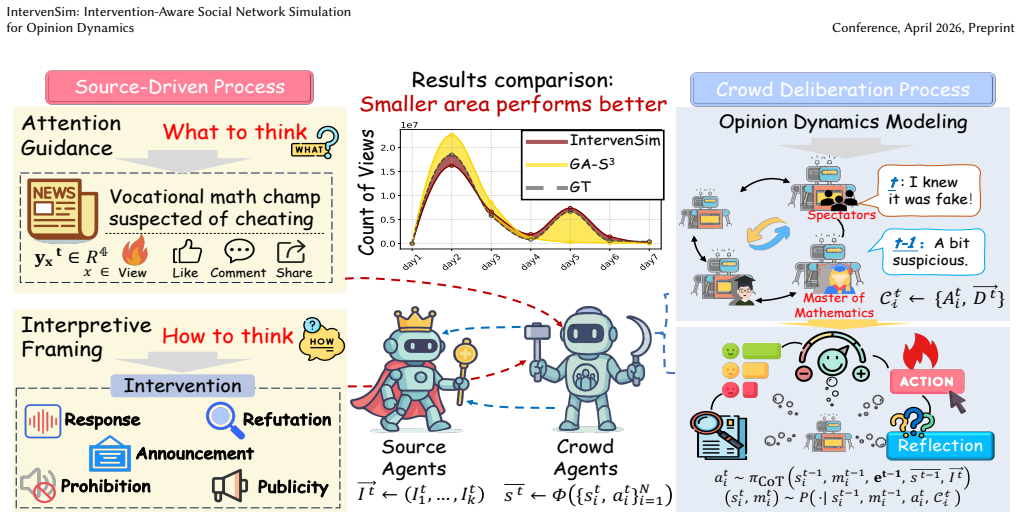
IntervenSim models social events by coupling source interventions with crowd reactions in a continuous feedback loop.
A machine-rendered reading of the paper's core claim, the machinery that carries it, and where it could break.
Core claim
The paper introduces an intervention-aware simulation framework, IntervenSim, that models event evolution and intervention in a closed loop. Source agents handle event developments and source-side interventions while crowd agents handle collective reactions, with their co-evolution captured through an intervention-aware mechanism that couples source-side intervention, group interaction, and feedback-driven adjustment of subsequent interventions.
What carries the argument
The intervention-aware mechanism that couples source-side intervention, group interaction, and feedback-driven adjustment of subsequent interventions.
If this is right
- Simulates regular event trajectories more faithfully than static models.
- Captures opinion dynamics under intervention in complex cases with secondary explosions or shifts.
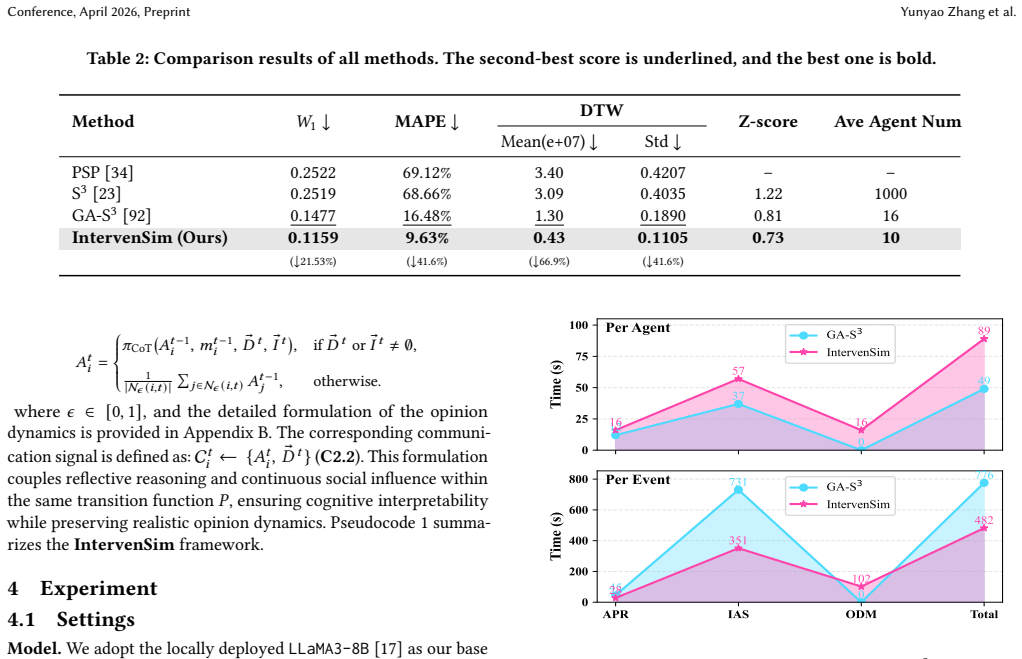
- Achieves 41.6 percent lower MAPE and 66.9 percent lower DTW error on diverse real events.
- Reduces computational cost by using fewer but more capable agents.
- Enables closed-loop adjustment where each intervention round responds to simulated crowd feedback.
Where Pith is reading between the lines
- The approach could support pre-testing of proposed interventions by running them inside the simulator before real deployment.
- It opens the possibility of scaling the same loop structure to study how interventions in one topic spill over to related events through shared crowd agents.
- Replacing large numbers of simple agents with a smaller set of LLM agents may generalize to other domains where continuous feedback between actors and environment matters.
- Controlled experiments with human participants could directly measure how closely the agent outputs match actual intervention responses.
Load-bearing premise
LLM-powered source and crowd agents can faithfully reproduce real human intervention behaviors and collective opinion dynamics without introducing systematic biases or artifacts from the models themselves.
What would settle it
Run IntervenSim and prior static simulators on a fresh real-world event with documented interventions, then compare both sets of predicted popularity and opinion time series against the actual observed data to check whether the reported error reductions appear.
Figures



read the original abstract
LLM-based social network simulation introduces a new computational approach for modeling event evolution in complex online environments. However, existing methods typically simulate social processes under a fixed event trajectory, treating the event as static once initialized and overlooking intervention dynamics, and thus fail to capture the intrinsic evolution of real social network events, where source-side interventions and collective interactions continuously reshape event trajectories, sometimes leading to secondary popularity explosions and collective attitude shifts. To address this limitation, we introduce an intervention-aware simulation framework, IntervenSim, that models event evolution and intervention in a closed loop. We model event developments and source-side interventions using source agents, and collective crowd reactions using crowd agents, capturing their continuous co-evolution through an intervention-aware mechanism that couples source-side intervention, group interaction, and feedback-driven adjustment of subsequent interventions. Experiments on diverse real-world events show that IntervenSim improves MAPE by 41.6% and DTW by 66.9% over prior frameworks, while reducing computational cost with fewer yet more capable agents. These improvements indicate that IntervenSim not only simulates regular event trajectories more faithfully, but also better captures opinion dynamics under intervention in complex cases.
Editorial analysis
A structured set of objections, weighed in public.
Referee Report
Summary. The paper introduces IntervenSim, an intervention-aware social network simulation framework using LLM-based source agents to model event developments and source-side interventions and crowd agents to model collective reactions. It proposes a closed-loop mechanism that couples interventions, group interactions, and feedback-driven adjustments to capture the continuous co-evolution of events and opinion dynamics, in contrast to prior static-trajectory simulations. Experiments on diverse real-world events are reported to yield 41.6% MAPE and 66.9% DTW improvements over prior frameworks while using fewer agents.
Significance. If the empirical gains are reproducible and the LLM agents prove faithful to human behavior, the work would meaningfully advance computational modeling of dynamic social processes by addressing intervention effects that existing methods overlook. The closed-loop design and agent-based architecture represent a concrete step toward more realistic simulation of secondary popularity spikes and attitude shifts.
major comments (2)
- [Experiments / Results] The headline empirical claim (41.6% MAPE / 66.9% DTW gains) is load-bearing for the paper's contribution, yet the abstract and experimental description supply no information on the specific prior frameworks used as baselines, the real-world event datasets, how intervention signals were extracted, statistical significance tests, error bars, or ablation controls. Without these details the reported improvements cannot be evaluated for robustness.
- [Methodology / Agent Design] The central modeling assumption—that LLM-powered source and crowd agents faithfully reproduce human intervention behaviors and collective opinion dynamics without systematic artifacts—is untested in the manuscript. No ablations across LLMs, no human-subject calibration, and no analysis of prompt sensitivity or long-horizon coherence are provided, leaving open the possibility that the observed gains arise from model idiosyncrasies rather than the closed-loop architecture.
minor comments (2)
- [Abstract] The abstract refers to 'diverse real-world events' without naming them or describing the data sources; adding a brief table or list would improve clarity.
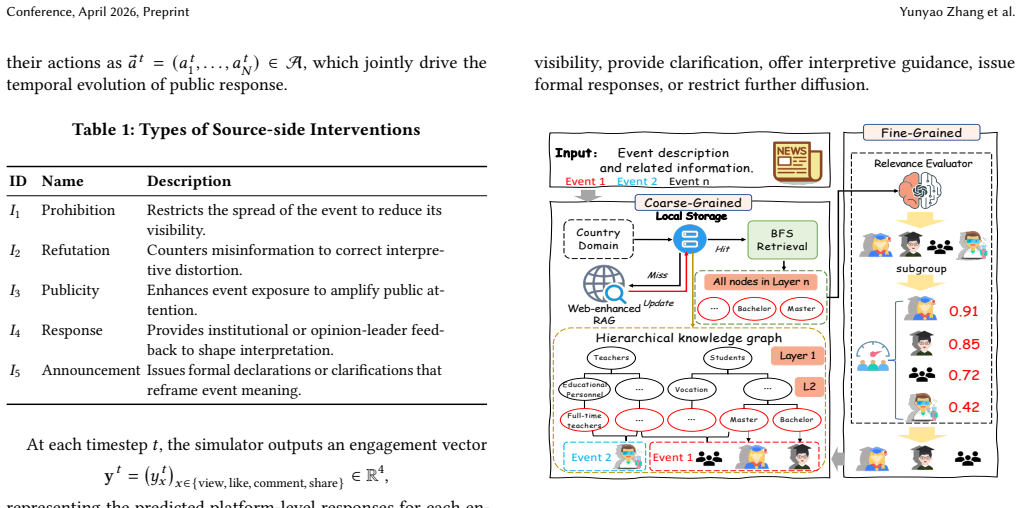
- [Framework Description] Notation for the intervention-aware coupling mechanism (source intervention ↔ crowd feedback) should be formalized with a diagram or pseudocode to make the closed-loop structure explicit.
Simulated Author's Rebuttal
We thank the referee for the constructive feedback on our manuscript. We address each major comment point by point below, providing honest clarifications and committing to revisions that strengthen the work without misrepresenting our contributions.
read point-by-point responses
-
Referee: [Experiments / Results] The headline empirical claim (41.6% MAPE / 66.9% DTW gains) is load-bearing for the paper's contribution, yet the abstract and experimental description supply no information on the specific prior frameworks used as baselines, the real-world event datasets, how intervention signals were extracted, statistical significance tests, error bars, or ablation controls. Without these details the reported improvements cannot be evaluated for robustness.
Authors: We agree that the experimental reporting in the initial submission was insufficiently detailed to allow full evaluation of the claims. In the revised manuscript, we will expand the Experiments section to explicitly name and describe the prior static-trajectory frameworks used as baselines, provide full details on the real-world event datasets (including sources, sizes, and selection criteria), explain the extraction of intervention signals from the data, report statistical significance tests with p-values, include error bars from multiple simulation runs, and present ablation controls isolating the closed-loop components. These additions will directly address the robustness concerns. revision: yes
-
Referee: [Methodology / Agent Design] The central modeling assumption—that LLM-powered source and crowd agents faithfully reproduce human intervention behaviors and collective opinion dynamics without systematic artifacts—is untested in the manuscript. No ablations across LLMs, no human-subject calibration, and no analysis of prompt sensitivity or long-horizon coherence are provided, leaving open the possibility that the observed gains arise from model idiosyncrasies rather than the closed-loop architecture.
Authors: We acknowledge that the fidelity of LLM agents to human behavior is an important and untested assumption in the current version. We will revise the Methodology and Experiments sections to include ablations across multiple LLMs, sensitivity analysis for key prompts, and metrics for long-horizon coherence to demonstrate that performance gains arise from the intervention-aware closed-loop mechanism. Full human-subject calibration studies, however, fall outside the scope of this work and would require separate resources; we will explicitly discuss this as a limitation and outline it as future work while emphasizing that the empirical results on real-world events provide supporting evidence for the framework's value. revision: partial
Circularity Check
No circularity: empirical claims rest on external comparisons
full rationale
The paper introduces IntervenSim as a closed-loop agent-based framework with source and crowd agents coupled by an intervention-aware mechanism. Its load-bearing claims are strictly empirical: measured MAPE and DTW improvements (41.6 % and 66.9 %) relative to prior frameworks on real-world event traces. No equations, parameter-fitting steps, self-definitions, or uniqueness theorems appear in the provided text that would reduce these performance numbers to the model's own inputs or to prior self-citations. The evaluation is presented as direct, out-of-sample comparison against external baselines, rendering the derivation chain self-contained.
Axiom & Free-Parameter Ledger
axioms (1)
- domain assumption LLM agents can accurately simulate real human intervention decisions and collective opinion shifts
invented entities (2)
-
Source agents
no independent evidence
-
Crowd agents
no independent evidence
Forward citations
Cited by 4 Pith papers
-
OmniTrend: Content-Context Modeling for Scalable Social Popularity Prediction
OmniTrend predicts popularity by combining separate content attractiveness and contextual exposure predictors using cross-modal and exogenous signals.
-
HotComment: A Benchmark for Evaluating Popularity of Online Comments
HotComment is a new multimodal benchmark that quantifies online comment popularity via content quality assessment, interaction-based prediction, and agent-simulated user engagement, accompanied by the StyleCmt stylist...
-
Seeing Further and Wider: Joint Spatio-Temporal Enlargement for Micro-Video Popularity Prediction
A new joint spatio-temporal enlargement model for micro-video popularity prediction using frame scoring for long sequences and a topology-aware memory bank for unbounded historical associations.
-
CurEvo: Curriculum-Guided Self-Evolution for Video Understanding
CurEvo integrates curriculum guidance into self-evolution to structure autonomous improvement of video understanding models, yielding gains on VideoQA benchmarks.
Reference graph
Works this paper leans on
-
[1]
Josh Achiam, Steven Adler, Sandhini Agarwal, Lama Ahmad, Ilge Akkaya, Floren- cia Leoni Aleman, Diogo Almeida, Janko Altenschmidt, Sam Altman, Shyamal Anadkat, et al. 2023. GPT-4 Technical Report.arXiv preprint arXiv:2303.08774 (2023)
work page internal anchor Pith review Pith/arXiv arXiv 2023
-
[2]
Badr AlKhamissi, Muhammad ElNokrashy, Mai Alkhamissi, and Mona Diab. 2024. Investigating Cultural Alignment of Large Language Models. InProceedings of the 62nd Annual Meeting of the Association for Computational Linguistics (Volume 1: Long Papers), Lun-Wei Ku, Andre Martins, and Vivek Srikumar (Eds.). Association for Computational Linguistics, Bangkok, Th...
2024
-
[3]
Kozlowski, Bernard Koch, Erik Brynjolfsson, James Evans, and Michael S
Jacy Reese Anthis, Ryan Liu, Sean M Richardson, Austin C. Kozlowski, Bernard Koch, Erik Brynjolfsson, James Evans, and Michael S. Bernstein. 2025. Po- sition: LLM Social Simulations Are a Promising Research Method. InForty- second International Conference on Machine Learning Position Paper Track. https: //openreview.net/forum?id=cRBg1dtj7o
2025
-
[4]
Eytan Bakshy, Solomon Messing, and Lada A Adamic. 2015. Exposure to ideologi- cally diverse news and opinion on Facebook.Science348, 6239 (2015), 1130–1132
2015
-
[5]
Youssef Bouanan, Gregory Zacharewicz, Judicael Ribault, and Bruno Vallespir
-
[6]
Discrete Event System Specification-Based Framework for Modeling and Simulation of Propagation Phenomena in Social Networks: Application to the Information Spreading in a Multi-Layer Social Network.Simulation95, 5 (2019), 411–427
2019
-
[7]
Elizabeth Bruch and Jon Atwell. 2015. Agent-based models in empirical social research.Sociological methods & research44, 2 (2015), 186–221
2015
- [8]
-
[9]
Myra Cheng, Esin Durmus, and Dan Jurafsky. 2023. Marked Personas: Using Natural Language Prompts to Measure Stereotypes in Language Models. InPro- ceedings of the 61st Annual Meeting of the Association for Computational Linguistics (Volume 1: Long Papers), Anna Rogers, Jordan Boyd-Graber, and Naoaki Okazaki (Eds.). Association for Computational Linguistic...
-
[10]
Bastien Chopard and Michel Droz. 1998. Cellular Automata.Modelling of Physical 1 (1998)
1998
-
[11]
Alexander E Curtis, Tanya A Smith, Bulat A Ziganshin, and John A Elefteriades
-
[12]
The mystery of the Z-score.Aorta4, 04 (2016), 124–130
2016
- [13]
- [14]
-
[15]
Xiongwei Dang, Wenxuan Liu, Xian Zhong, and Zheng Wang. 2025. SegTraj: A Segmented-Trajectory-Aware Spatio-Temporal Graph Convolutional Network for Social Group Detection. InProceedings of the 33rd ACM International Conference on Multimedia(Dublin, Ireland)(MM ’25). Association for Computing Machinery, New York, NY, USA, 4571–4579. doi:10.1145/3746027.3755506
-
[16]
Paul Davidsson. 2002. Agent-Based Social Simulation: A Computer Science View. Journal of Artificial Societies and Social Simulation5, 1 (2002)
2002
-
[17]
2012.A Systems-Based Approach to Policymaking
Kenyon B De Greene. 2012.A Systems-Based Approach to Policymaking. Springer Science & Business Media
2012
-
[18]
Morris H DeGroot. 1974. Reaching a consensus.Journal of the American Statistical association69, 345 (1974), 118–121
1974
-
[19]
Abhimanyu Dubey, Abhinav Jauhri, Abhinav Pandey, Abhishek Kadian, Ahmad Al-Dahle, Aiesha Letman, Akhil Mathur, Alan Schelten, Amy Yang, Angela Fan, et al. 2024. The llama 3 herd of models.arXiv preprint arXiv:2407.21783(2024)
work page internal anchor Pith review Pith/arXiv arXiv 2024
-
[20]
1996.Growing Artificial Societies: Social Science from the Bottom Up
Joshua M Epstein and Robert Axtell. 1996.Growing Artificial Societies: Social Science from the Bottom Up. Brookings Institution Press
1996
-
[21]
Anjalie Field, Doron Kliger, Shuly Wintner, Jennifer Pan, Dan Jurafsky, and Yulia Tsvetkov. 2018. Framing and Agenda-setting in Russian News: a Computational Analysis of Intricate Political Strategies. InProceedings of the 2018 Conference on Empirical Methods in Natural Language Processing, Ellen Riloff, David Chiang, Julia Hockenmaier, and Jun’ichi Tsuji...
-
[22]
Andreas Flache, Michael Mäs, Thomas Feliciani, Edmund Chattoe-Brown, Guil- laume Deffuant, Sylvie Huet, and Jan Lorenz. 2017. Models of social influence: Towards the next frontiers.Journal of Artificial Societies and Social Simulation20, 4 (2017)
2017
-
[23]
Linton Freeman. 2004. The development of social network analysis.A Study in the Sociology of Science1, 687 (2004), 159–167
2004
-
[24]
Chen Gao, Xiaochong Lan, Nian Li, Yuan Yuan, Jingtao Ding, Zhilun Zhou, Fengli Xu, and Yong Li. 2024. Large language models empowered agent-based modeling and simulation: A survey and perspectives.Humanities and Social Sciences Communications11, 1 (2024), 1–24
2024
- [25]
-
[26]
Josh A Goldstein, Jason Chao, Shelby Grossman, Alex Stamos, and Michael Tomz
-
[27]
How persuasive is AI-generated propaganda?PNAS nexus3, 2 (2024), pgae034
2024
-
[28]
Davide Grossi, Frank Dignum, Mehdi Dastani, and Lambèr Royakkers. 2005. Foundations of organizational structures in multiagent systems. InProceedings of the Fourth International Joint Conference on Autonomous Agents and Multiagent Systems(The Netherlands)(AAMAS ’05). Association for Computing Machinery, New York, NY, USA, 690–697. doi:10.1145/1082473.1082578
-
[29]
Andrew M Guess, Neil Malhotra, Jennifer Pan, Pablo Barberá, Hunt Allcott, Taylor Brown, Adriana Crespo-Tenorio, Drew Dimmery, Deen Freelon, Matthew Gentzkow, et al. 2023. How do social media feed algorithms affect attitudes and behavior in an election campaign?Science381, 6656 (2023), 398–404
2023
-
[30]
Daya Guo, Dejian Yang, Haowei Zhang, Junxiao Song, Peiyi Wang, Qihao Zhu, Runxin Xu, Ruoyu Zhang, Shirong Ma, Xiao Bi, et al. 2025. Deepseek-r1 incen- tivizes reasoning in llms through reinforcement learning.Nature645, 8081 (2025), 633–638
2025
-
[31]
Lei Guo. 2013. Toward the third level of agenda-setting theory: A network agenda setting model 1 2. InAgenda setting in a 2.0 world. Routledge, 112–133
2013
-
[32]
Rainer Hegselmann. 2015. Opinion dynamics and bounded confidence: models, analysis and simulation.The Journal of Artificial Societies and Social Simulation Conference, April 2026, Preprint Yunyao Zhang et al. (2015)
2015
-
[33]
Yangliu Hu, Zikai Song, Na Feng, Yawei Luo, Junqing Yu, Yi-Ping Phoebe Chen, and Wei Yang. 2025. Sf2t: Self-supervised fragment finetuning of video-llms for fine-grained understanding. InProceedings of the Computer Vision and Pattern Recognition Conference. 29108–29117
2025
-
[34]
Hongru Ji, Yuyin Fan, Meng Zhao, Xianghua Li, Lianwei Wu, and Chao Gao
-
[35]
STRIDE-ED: A Strategy-Grounded Stepwise Reasoning Framework for Empathetic Dialogue Systems
STRIDE-ED: A Strategy-Grounded Stepwise Reasoning Framework for Empathetic Dialogue Systems. arXiv:2604.07100 [cs.CL] https://arxiv.org/abs/ 2604.07100
work page internal anchor Pith review Pith/arXiv arXiv
-
[36]
Hongru Ji, Xianghua Li, Mingxin Li, Meng Zhao, and Chao Gao. 2025. Hybrid relational graphs with sentiment-laden semantic alignment for multimodal emo- tion recognition in conversation. InProceedings of the Thirty-Fourth International Joint Conference on Artificial Intelligence. 2973–2981
2025
-
[37]
2013.A solution to the ecological inference problem: Reconstructing individual behavior from aggregate data
Gary King. 2013.A solution to the ecological inference problem: Reconstructing individual behavior from aggregate data. Princeton University Press
2013
-
[38]
Qingchao Kong, Wenji Mao, Guandan Chen, and Daniel Zeng. 2018. Explor- ing trends and patterns of popularity stage evolution in social media.IEEE Transactions on Systems, Man, and Cybernetics: Systems50, 10 (2018), 3817–3827
2018
-
[39]
Liao, Esin Durmus, Alex Tamkin, and Deep Ganguli
Messi H.J. Lee, Jacob M. Montgomery, and Calvin K. Lai. 2024. Large Language Models Portray Socially Subordinate Groups as More Homogeneous, Consistent with a Bias Observed in Humans. InProceedings of the 2024 ACM Conference on Fairness, Accountability, and Transparency(Rio de Janeiro, Brazil)(FAccT ’24). Association for Computing Machinery, New York, NY,...
-
[40]
Patrick Lewis, Ethan Perez, Aleksandra Piktus, Fabio Petroni, Vladimir Karpukhin, Naman Goyal, Heinrich Küttler, Mike Lewis, Wen-tau Yih, Tim Rocktäschel, et al. 2020. Retrieval-augmented generation for knowledge-intensive nlp tasks. Advances in neural information processing systems33 (2020), 9459–9474
2020
-
[41]
Mei Li, Xiang Wang, Kai Gao, and Shanshan Zhang. 2017. A survey on information diffusion in online social networks: Models and methods.Information8, 4 (2017), 118
2017
-
[42]
Wenbing Li, Zikai Song, Hang Zhou, Yunyao Zhang, Junqing Yu, and Wei Yang
-
[43]
LoRA-Mixer: Coordinate Modular LoRA Experts Through Serial Attention Routing.arXiv preprint arXiv:2507.00029(2025)
work page internal anchor Pith review arXiv 2025
-
[44]
Wenbing Li, Hang Zhou, Junqing Yu, Zikai Song, and Wei Yang. 2024. Coupled mamba: Enhanced multimodal fusion with coupled state space model.Advances in Neural Information Processing Systems37 (2024), 59808–59832
2024
-
[45]
Junjie Liao, Huacong Tang, Zhou Ziheng, Yizhou Wang, and Fangwei Zhong
-
[46]
arXiv:2603.13876 [cs.MA] https://arxiv.org/ abs/2603.13876
How do Role Models Shape Collective Morality? Exemplar-Driven Moral Learning in Multi-Agent Simulation. arXiv:2603.13876 [cs.MA] https://arxiv.org/ abs/2603.13876
-
[47]
2017.Public opinion
Walter Lippmann. 2017.Public opinion. Routledge
2017
-
[48]
Benjamin Litterer, David Jurgens, and Dallas Card. 2023. When it Rains, it Pours: Modeling Media Storms and the News Ecosystem. InFindings of the Association for Computational Linguistics: EMNLP 2023, Houda Bouamor, Juan Pino, and Kalika Bali (Eds.). Association for Computational Linguistics, Singapore, 6346–6361. doi:10.18653/v1/2023.findings-emnlp.420
-
[49]
Yijun Liu, Wu Liu, Xiaoyan Gu, Allen He, Weiping Wang, and Yongdong Zhang
-
[50]
arXiv preprint arXiv:2512.02533(2025)
PopSim: Social Network Simulation for Social Media Popularity Prediction. arXiv preprint arXiv:2512.02533(2025)
-
[51]
Yunbo Long, Yunhan Liu, and Liming Xu. 2026. EmoMAS: Emotion-Aware Multi-Agent System for High-Stakes Edge-Deployable Negotiation with Bayesian Orchestration. arXiv:2604.07003 [cs.AI] https://arxiv.org/abs/2604.07003
work page internal anchor Pith review Pith/arXiv arXiv 2026
-
[52]
Peng Lu and Shizhao Nie. 2019. The strength distribution and combined duration prediction of online collective actions: Big data analysis and BP neural networks. Physica A: Statistical Mechanics and its Applications535 (2019), 121031
2019
-
[53]
Peng Lu, Shizhao Nie, Zheng Wang, Ziwei Jing, Jianwu Yang, Zhongxiang Qi, and Wangmo Pujia. 2018. Predicting durations of online collective actions based on Peaks’ heights.Communications in Nonlinear Science and Numerical Simulation 55 (2018), 338–354
2018
-
[54]
Peng Lu, Zheng Wang, Shizhao Nie, Wangmo Pujia, Pengfei Lu, and Baosheng Chen. 2018. Exploring the participate propensity in cyberspace collective actions: The 5‰rule.Physica A: Statistical Mechanics and Its Applications503 (2018), 582–590
2018
-
[55]
Peng Lu, Hou Yang, Hao Li, Mengdi Li, and Zhuo Zhang. 2021. Swarm intelli- gence, social force and multi-agent modeling of heroic altruism behaviors under collective risks.Knowledge-Based Systems214 (2021), 106725
2021
-
[56]
Maxwell E McCombs and Donald L Shaw. 1972. The agenda-setting function of mass media.Public opinion quarterly36, 2 (1972), 176–187
1972
-
[57]
Maxwell E McCombs and Donald L Shaw. 1993. The evolution of agenda-setting research: Twenty-five years in the marketplace of ideas.Journal of communication 43, 2 (1993), 58–67
1993
-
[58]
1974.Dynamics of Growth in a Finite World
Dennis L Meadows, William W Behrens, Donella H Meadows, Roger F Naill, Jørgen Randers, and Erich Zahn. 1974.Dynamics of Growth in a Finite World. Vol. 360. Wright-Allen Press, Cambridge, MA
1974
- [59]
-
[60]
Meinard Müller. 2007. Dynamic time warping.Information retrieval for music and motion(2007), 69–84
2007
-
[61]
Mark EJ Newman. 2002. Spread of epidemic disease on networks.Physical review E66, 1 (2002), 016128
2002
-
[62]
Shizhao Nie, Zheng Wang, Wangmo Pujia, Yuan Nie, and Peng Lu. 2018. Big data prediction of durations for online collective actions based on peak’s timing. Physica A: Statistical Mechanics and its Applications492 (2018), 138–154
2018
-
[63]
Daniele Notarmuzi, Claudio Castellano, Alessandro Flammini, Dario Mazzilli, and Filippo Radicchi. 2022. Universality, Criticality and Complexity of Information Propagation in Social Media.Nature Communications13, 1 (2022), 1308
2022
-
[64]
Alexandra Olteanu, Emre Kıcıman, and Carlos Castillo. 2018. A Critical Review of Online Social Data: Biases, Methodological Pitfalls, and Ethical Boundaries. InProceedings of the Eleventh ACM International Conference on Web Search and Data Mining(Marina Del Rey, CA, USA)(WSDM ’18). Association for Computing Machinery, New York, NY, USA, 785–786. doi:10.11...
-
[65]
Scott E Page. 2012. Aggregation in agent-based models of economies.The Knowledge Engineering Review27, 2 (2012), 151–162
2012
-
[66]
Joon Sung Park, Joseph O’Brien, Carrie Jun Cai, Meredith Ringel Morris, Percy Liang, and Michael S Bernstein. 2023. Generative Agents: Interactive Simulacra of Human Behavior. InProceedings of the 36th Annual ACM Symposium on User Interface Software and Technology. 1–22
2023
-
[67]
Zou, Aaron Shaw, Benjamin Mako Hill, Carrie Cai, Meredith Ringel Morris, Robb Willer, Percy Liang, and Michael S
Joon Sung Park, Carolyn Q. Zou, Aaron Shaw, Benjamin Mako Hill, Carrie Cai, Meredith Ringel Morris, Robb Willer, Percy Liang, and Michael S. Bernstein
-
[68]
LLM Agents Grounded in Self-Reports Enable General-Purpose Simulation of Individuals
Generative Agent Simulations of 1,000 People. arXiv:2411.10109 [cs.AI] https://arxiv.org/abs/2411.10109
work page internal anchor Pith review Pith/arXiv arXiv
-
[69]
Jinghua Piao, Yuwei Yan, Jun Zhang, Nian Li, Junbo Yan, Xiaochong Lan, Zhihong Lu, Zhiheng Zheng, Jing Yi Wang, Di Zhou, et al. 2025. Agentsociety: Large-scale simulation of llm-driven generative agents advances understanding of human behaviors and society.arXiv preprint arXiv:2502.08691(2025)
work page internal anchor Pith review Pith/arXiv arXiv 2025
-
[70]
William S Robinson. 2009. Ecological correlations and the behavior of individuals. International journal of epidemiology38, 2 (2009), 337–341
2009
-
[71]
Thomas C Schelling. 1971. Dynamic Models of Segregation.Journal of Mathe- matical Sociology1, 2 (1971), 143–186
1971
-
[72]
2006.Micromotives and Macrobehavior
Thomas C Schelling. 2006.Micromotives and Macrobehavior. WW Norton & Company
2006
-
[73]
Donald L Shaw, Maxwell McCombs, David H Weaver, and Bradley J Hamm
-
[74]
International journal of public opinion research11, 1 (1999), 2–24
Individuals, groups, and agenda melding: A theory of social dissonance. International journal of public opinion research11, 1 (1999), 2–24
1999
-
[75]
Zikai Song, Run Luo, Lintao Ma, Ying Tang, Yi-Ping Phoebe Chen, Junqing Yu, and Wei Yang. 2025. Temporal coherent object flow for multi-object tracking. In Proceedings of the AAAI Conference on Artificial Intelligence, Vol. 39. 6978–6986
2025
-
[76]
Flaminio Squazzoni. 2008. The Micro-Macro Link in Social Simulation.Sociologica 2, 1 (2008), 3–5
2008
-
[77]
Flaminio Squazzoni, Wander Jager, and Bruce Edmonds. 2014. Social Simulation in the Social Sciences: A Brief Overview.Social Science Computer Review32, 3 (2014), 279–294
2014
-
[78]
Kate Starbird, Ahmer Arif, and Tom Wilson. 2019. Disinformation as Collabora- tive Work: Surfacing the Participatory Nature of Strategic Information Operations. Proc. ACM Hum.-Comput. Interact.3, CSCW, Article 127 (Nov. 2019), 26 pages. doi:10.1145/3359229
-
[79]
Melanie Subbiah, Amrita Bhattacharjee, Yilun Hua, Tharindu Kumarage, Huan Liu, and Kathleen McKeown. 2023. Towards Detecting Harmful Agendas in News Articles. InProceedings of the 13th Workshop on Computational Approaches to Subjectivity, Sentiment, & Social Media Analysis, Jeremy Barnes, Orphée De Clercq, and Roman Klinger (Eds.). Association for Computa...
-
[80]
Ziying Tan, Linbo Luo, Haiyan Yin, Yew-Soon Ong, and Wentong Cai. 2025. Crowd Dynamics Demand Adaptivity: Self-Adaptive Physics-Informed Neural Network for Crowd Simulation. InProceedings of the 33rd ACM International Conference on Multimedia(Dublin, Ireland)(MM ’25). Association for Computing Machinery, New York, NY, USA, 5913–5921. doi:10.1145/3746027.3754569
discussion (0)
Sign in with ORCID, Apple, or X to comment. Anyone can read and Pith papers without signing in.