Recovering manifold structure in LLM responses through a joint Euclidean mirror
Pith reviewed 2026-05-10 18:22 UTC · model grok-4.3
The pith
Dissimilarities between LLM response distributions over tuning parameters embed into low-dimensional Euclidean space via a joint mirror surface that encodes their geometry.
A machine-rendered reading of the paper's core claim, the machinery that carries it, and where it could break.
Core claim
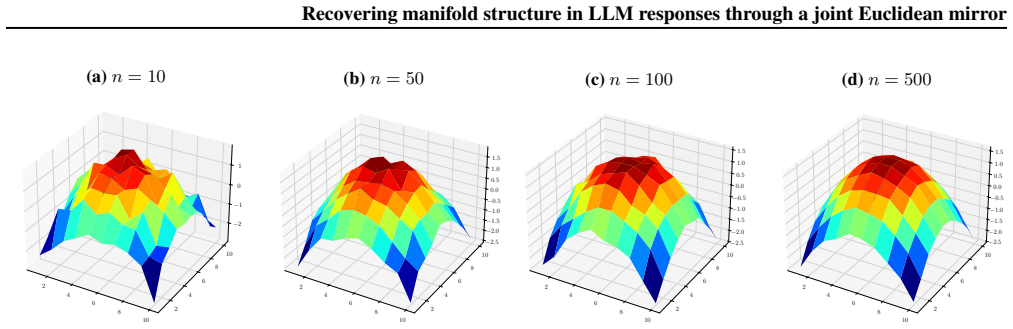
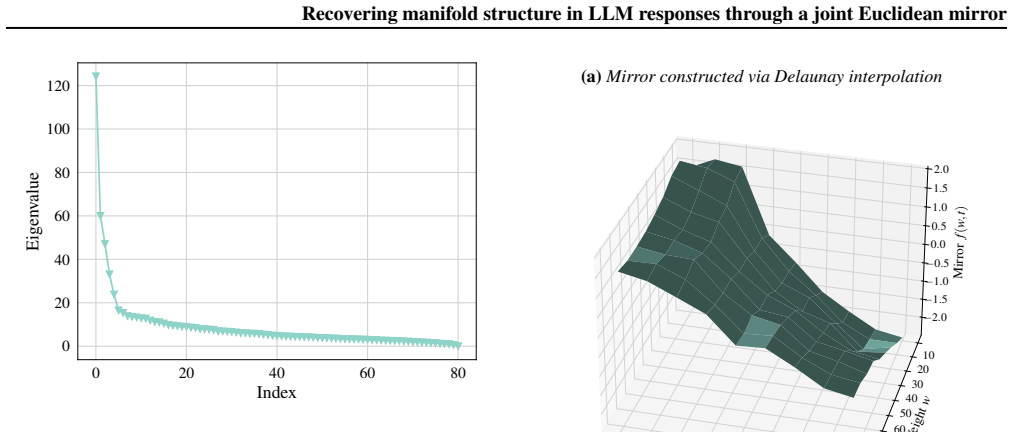
We show how dissimilarities between response distributions can be represented in low-dimensional Euclidean space through a joint Euclidean mirror surface encoding the underlying geometry, which permits both qualitative and quantitative analysis of large language models and provides insight into predicting response distributions for different values of tuning parameters. We propose an estimation procedure for the underlying joint Euclidean mirror based on observed samples from the response distributions, and we prove its asymptotic properties. Additionally, we propose a statistically consistent procedure to infer the value of an unknown model parameter based on samples from the corresponding,
What carries the argument
The joint Euclidean mirror surface: a low-dimensional Euclidean embedding that represents dissimilarities between response distributions and thereby recovers the manifold geometry induced by the parameter-to-distribution mapping.
Load-bearing premise
The response distributions over different tuning parameters form a structured family that admits a low-dimensional Euclidean embedding via the chosen dissimilarity with limited distortion.
What would settle it
Large deviations between the Euclidean distances recovered in the estimated mirror and the dissimilarities actually computed from response samples, or inconsistent recovery of known tuning parameters in controlled experiments, would falsify the claim that the mirror recovers the structure.
Figures






read the original abstract
Understanding the behavior of black-box large language models and determining effective means of comparing their performance is a key task in modern machine learning. We consider how large language models respond to a specific query by analyzing how the distributions of responses vary over different values of tuning parameters. We frame this problem in a general mathematical setting, treating the mapping from model parameters to response distributions as a structured family of probability measures, endowed with a geometry via a dissimilarity measure. We show how dissimilarities between response distributions can be represented in low-dimensional Euclidean space through a joint Euclidean mirror surface encoding the underlying geometry, which permits both qualitative and quantitative analysis of large language models and provides insight into predicting response distributions for different values of tuning parameters. We propose an estimation procedure for the underlying joint Euclidean mirror based on observed samples from the response distributions, and we prove its asymptotic properties. Additionally, we propose a statistically consistent procedure to infer the value of an unknown model parameter based on samples from the corresponding response distribution and the estimated joint Euclidean mirror. In an experimental setting with large language models, we find that changes in different tuning parameter values correspond to distinct directions in the embedding space, making it possible to estimate the tuning parameters that were used to generate a given response.
Editorial analysis
A structured set of objections, weighed in public.
Referee Report
Summary. The manuscript frames the mapping from LLM tuning parameters to response distributions as a structured family of probability measures equipped with a dissimilarity-based geometry. It introduces a joint Euclidean mirror surface to embed these dissimilarities into low-dimensional Euclidean space, proposes a sample-based estimator for the mirror with claimed asymptotic properties, develops a consistent procedure to infer unknown parameters from new response samples, and reports experiments in which distinct tuning parameters align with separate directions in the recovered embedding.
Significance. If the embedding is faithful and the asymptotic guarantees hold, the work supplies a geometrically interpretable and statistically grounded method for analyzing and predicting LLM behavior under parameter variation. The explicit proof of asymptotic properties for the mirror estimator and the consistency result for parameter inference constitute clear methodological strengths; the empirical observation of distinct directional effects supplies a falsifiable prediction that can be checked in further experiments.
major comments (2)
- [Theoretical development (around the definition of the joint Euclidean mirror)] The central modeling premise—that the parameter-to-distribution map admits a low-dimensional Euclidean embedding via the chosen dissimilarity without substantial distortion—is load-bearing for both the recovery claim and the inference procedure, yet the precise conditions guaranteeing this (e.g., curvature bounds, injectivity radius, or stability of the mirror surface) are not stated explicitly enough to verify the asymptotic results.
- [Experimental section] The experimental claim that 'changes in different tuning parameter values correspond to distinct directions' is presented as supporting evidence, but without reported error bars, sample sizes per condition, or the precise rule for declaring a direction 'distinct,' it is impossible to assess whether the observed separation exceeds what would be expected under the null of no geometric structure.
minor comments (3)
- [Abstract] The abstract introduces the term 'joint Euclidean mirror surface' without a brief parenthetical gloss or reference to the section where it is formally defined; a one-sentence clarification would improve accessibility.
- [Notation and definitions] Notation for the dissimilarity measure and the embedding dimension should be introduced once and used consistently; occasional switches between symbols for the same quantity appear in the theoretical statements.
- [Figures and captions] Figure captions in the experimental section would benefit from explicit statements of axis scaling, the number of Monte Carlo replicates, and the precise dissimilarity used to generate the plotted points.
Simulated Author's Rebuttal
We thank the referee for their thorough review and positive assessment of the manuscript's contributions. We address the two major comments below, agreeing to incorporate clarifications and additional details in a revised version.
read point-by-point responses
-
Referee: [Theoretical development (around the definition of the joint Euclidean mirror)] The central modeling premise—that the parameter-to-distribution map admits a low-dimensional Euclidean embedding via the chosen dissimilarity without substantial distortion—is load-bearing for both the recovery claim and the inference procedure, yet the precise conditions guaranteeing this (e.g., curvature bounds, injectivity radius, or stability of the mirror surface) are not stated explicitly enough to verify the asymptotic results.
Authors: We thank the referee for highlighting this important point. The asymptotic properties of the mirror estimator and the consistency of the parameter inference procedure are indeed predicated on the embedding being faithful, which requires certain regularity conditions on the underlying manifold and the dissimilarity measure. While our proofs invoke standard results from differential geometry and statistical manifold learning (such as those ensuring the existence of a smooth embedding), we agree that these should be stated more explicitly. In the revised manuscript, we will introduce a new subsection detailing the assumptions, including bounds on sectional curvature, a positive injectivity radius, and Lipschitz stability of the mirror surface with respect to the dissimilarity. This will make the verification of the asymptotic results straightforward. We believe this clarification strengthens the theoretical foundation without altering the core contributions. revision: yes
-
Referee: [Experimental section] The experimental claim that 'changes in different tuning parameter values correspond to distinct directions' is presented as supporting evidence, but without reported error bars, sample sizes per condition, or the precise rule for declaring a direction 'distinct,' it is impossible to assess whether the observed separation exceeds what would be expected under the null of no geometric structure.
Authors: The referee correctly notes that the experimental results would be more convincing with quantitative statistical support. Our experiments were conducted with multiple independent samples from each response distribution corresponding to different tuning parameter values, and the directional alignments were observed consistently across runs. However, to address the concern, we will revise the experimental section to report the sample sizes (e.g., number of queries and responses per parameter setting), include error bars or confidence intervals on the computed directions (perhaps via bootstrap resampling), and specify the criterion used for distinctness, such as a minimum angular separation of 30 degrees or a statistical test showing significant deviation from random directions. These additions will allow readers to evaluate the evidence against the null of no geometric structure. We maintain that the separation is clear in the visualizations, but formalizing it is a valuable improvement. revision: yes
Circularity Check
No significant circularity; derivation self-contained
full rationale
The abstract frames the joint Euclidean mirror as a representation of dissimilarities under a chosen geometry, with an estimation procedure whose asymptotic properties are separately proved and an inference procedure for unknown parameters that is statistically consistent. No equation or step reduces a claimed prediction or inference directly to a fitted quantity defined from the same data by construction, nor does any load-bearing premise collapse to a self-citation or ansatz smuggled from prior work by the same authors. The core modeling assumption (structured low-dimensional embeddability) is stated explicitly rather than derived from the results themselves. This matches the reader's assessment that the steps remain independent.
Axiom & Free-Parameter Ledger
free parameters (1)
- embedding dimension
axioms (2)
- domain assumption The family of response distributions indexed by tuning parameters forms a manifold whose geometry is captured by the chosen dissimilarity measure
- standard math Standard regularity conditions for asymptotic consistency of the estimator hold
invented entities (1)
-
joint Euclidean mirror surface
no independent evidence
Lean theorems connected to this paper
-
IndisputableMonolith/Foundation/AlexanderDuality.leanalexander_duality_circle_linking unclear?
unclearRelation between the paper passage and the cited Recognition theorem.
We say that the pair (F,D) is exactly Euclidean c-realizable if there exists a continuous function f:X→R^c such that ∥f(x)−f(x′)∥=D(F_x,F_x′).
-
IndisputableMonolith/Cost/FunctionalEquation.leanwashburn_uniqueness_aczel unclear?
unclearRelation between the paper passage and the cited Recognition theorem.
We propose an estimation procedure for the underlying joint Euclidean mirror based on observed samples... prove its asymptotic properties.
What do these tags mean?
- matches
- The paper's claim is directly supported by a theorem in the formal canon.
- supports
- The theorem supports part of the paper's argument, but the paper may add assumptions or extra steps.
- extends
- The paper goes beyond the formal theorem; the theorem is a base layer rather than the whole result.
- uses
- The paper appears to rely on the theorem as machinery.
- contradicts
- The paper's claim conflicts with a theorem or certificate in the canon.
- unclear
- Pith found a possible connection, but the passage is too broad, indirect, or ambiguous to say the theorem truly supports the claim.
Reference graph
Works this paper leans on
- [1]
-
[2]
Acharyya, A., Trosset, M. W., Priebe, C. E., and Helm, H. S. (2024) Consistent estimation of generative model representations in the data kernel perspective space. arXiv preprint arXiv:2409.17308
-
[3]
(2025) Euclidean Mirrors and Dynamics in Network Time Series
Athreya, A., Lubberts, Z., Park, Y., and Priebe, C. (2025) Euclidean Mirrors and Dynamics in Network Time Series . Journal of the American Statistical Association, 120, 1025--1036
work page 2025
-
[4]
(1962) Bicubic spline interpolation
de Boor, C. (1962) Bicubic spline interpolation. Journal of Mathematics and Physics, 41, 212--218
work page 1962
-
[5]
Chen, L. and Xu, J.-C. (2004) Optimal Delaunay triangulations. Journal of Computational Mathematics, 22, 299--308
work page 2004
-
[6]
(2025) Statistical optimal transport
Chewi, S., Niles-Weed, J., and Rigollet, P. (2025) Statistical optimal transport. Springer
work page 2025
-
[7]
Eilers, P. H. and Marx, B. D. (1996) Flexible smoothing with B-splines and penalties . Statistical Science, 11, 89--121
work page 1996
-
[8]
Fournier, N. and Guillin, A. (2015) On the rate of convergence in Wasserstein distance of the empirical measure. Probability Theory and Related Fields, 162, 707--738
work page 2015
-
[9]
Gillette, A. and Kur, E. (2024) Algorithm 1049: The delaunay density diagnostic. ACM Transactions on Mathematical Software, 50
work page 2024
-
[10]
(2025) Statistical inference on black-box generative models in the data kernel perspective space
Helm, H., Acharyya, A., Park, Y., Duderstadt, B., and Priebe, C. (2025) Statistical inference on black-box generative models in the data kernel perspective space. In Findings of the Association for Computational Linguistics: ACL 2025 (eds. W. Che, J. Nabende, E. Shutova and M. T. Pilehvar), 3955--3970. Association for Computational Linguistics
work page 2025
-
[11]
(2025) Llm comparator: Interactive analysis of side-by-side evaluation of large language models
Kahng, M., Tenney, I., Pushkarna, M., et al. (2025) Llm comparator: Interactive analysis of side-by-side evaluation of large language models. IEEE Transactions on Visualization and Computer Graphics, 31, 503--513
work page 2025
-
[12]
Kruskal, J. B. (1964) Multidimensional scaling by optimizing goodness of fit to a nonmetric hypothesis. Psychometrika, 29, 1--27
work page 1964
-
[13]
X., Mulyar, A., and Duderstadt, B
Nussbaum, Z., Morris, J. X., Mulyar, A., and Duderstadt, B. (2025) Nomic Embed: Training a Reproducible Long Context Text Embedder . Transactions on Machine Learning Research
work page 2025
-
[14]
Panaretos, V. M. and Zemel, Y. (2019) Statistical aspects of Wasserstein distances. Annual Review of Statistics and Its Application, 6, 405--431
work page 2019
-
[15]
(2007) Spline Functions: Basic Theory
Schumaker, L. (2007) Spline Functions: Basic Theory. Cambridge Mathematical Library. Cambridge University Press
work page 2007
-
[16]
Stone, C. J. (1994) The use of polynomial splines and their tensor products in multivariate function estimation. The Annals of Statistics, 22, 118--171
work page 1994
-
[17]
(2024) Democratizing large language models via personalized parameter-efficient fine-tuning
Tan, Z., Zeng, Q., Tian, Y., et al. (2024) Democratizing large language models via personalized parameter-efficient fine-tuning. In Proceedings of the 2024 Conference on Empirical Methods in Natural Language Processing (eds. Y. Al-Onaizan, M. Bansal and Y.-N. Chen), 6476--6491. Association for Computational Linguistics
work page 2024
- [18]
-
[19]
(2024) Personalized large language models
Woźniak, S., Koptyra, B., Janz, A., Kazienko, P., and Kocoń, J. (2024) Personalized large language models. In 2024 IEEE International Conference on Data Mining Workshops (ICDMW), 511--520
work page 2024
-
[20]
Zhang, Z., Rossi, R. A., Kveton, B., et al. (2025) Personalization of large language models: A survey. Transactions on Machine Learning Research
work page 2025
-
[21]
(2023) Judging LLM-as-a-judge with MT-bench and Chatbot Arena
Zheng, L., Chiang, W.-L., Sheng, Y., et al. (2023) Judging LLM-as-a-judge with MT-bench and Chatbot Arena . In Proceedings of the 37th International Conference on Neural Information Processing Systems. Curran Associates Inc
work page 2023
-
[22]
Zhu, M. and Ghodsi, A. (2006) Automatic dimensionality selection from the scree plot via the use of profile likelihood. Computational Statistics & Data Analysis, 51, 918--930
work page 2006
discussion (0)
Sign in with ORCID, Apple, or X to comment. Anyone can read and Pith papers without signing in.