Recognition: unknown
Designing Safe and Accountable GenAI as a Learning Companion with Women Banned from Formal Education
Pith reviewed 2026-05-10 17:14 UTC · model grok-4.3
The pith
Participatory design reveals women in restrictive settings can use safe GenAI as a mentor to raise aspirations and agency for learning and work.
A machine-rendered reading of the paper's core claim, the machinery that carries it, and where it could break.
Core claim
Participants envision GenAI primarily as an always-available companion for career guidance and peer-like support to offset absent learning communities, yet they highlight constraints from privacy and surveillance risks, culturally mismatched advice, and direct-answer modes that create false senses of progress. The participatory design sessions produced measurable pre-to-post increases in aspirations (p=.01), agency (p=.01), and avenues (p=.03). These findings translate into accountability-focused design directions centered on safety-first interactions with user control, context-grounded support suited to constrained resources, and pedagogically aligned help that promotes genuine learning.
What carries the argument
Remote participatory design process that elicits GenAI requirements from women in surveilled contexts while tracking pre-post changes in aspirations, agency, and avenues, then converts those into safety-first, context-grounded, and learning-aligned design directions.
If this is right
- GenAI systems must incorporate safety-first interaction patterns that give users explicit control over data sharing to address surveillance risks.
- Support must be grounded in local constraints such as household responsibilities and limited resources rather than generic or resource-heavy advice.
- Interactions should favor pedagogically aligned prompts that encourage active learning instead of delivering direct answers that may create illusions of mastery.
- Accountable GenAI design can shift from solely minimizing harm to actively supporting users in imagining and pursuing education and employment paths.
- The absence of formal learning communities can be partially offset by AI companions that function as mentors and peers when designed with user input.
Where Pith is reading between the lines
- Similar participatory methods could be tested in other regions where women face education bans or surveillance to see if agency gains replicate.
- The focus on genuine learning over quick answers points to a broader principle for educational AI tools to avoid fostering dependency across user groups.
- Design directions from this work could inform standards for AI accountability that include empowerment outcomes alongside risk metrics.
- Remote participatory studies may offer a scalable way to gather requirements from hard-to-reach populations without increasing their exposure.
Load-bearing premise
The measured increases in aspirations, agency, and avenues stem directly from the participatory envisioning process rather than from simply taking part in a study or other unmeasured influences, and the small remote sample reflects wider populations facing similar restrictions.
What would settle it
A follow-up experiment that splits participants into a participatory design group and a control group given only general information about GenAI, then checks whether aspiration, agency, and avenue scores rise only in the design group.
Figures


read the original abstract
In gender-restrictive and surveilled contexts, where access to formal education may be restricted for women, pursuing education involves safety and privacy risks. When women are excluded from schools and universities, they often turn to online self-learning and generative AI (GenAI) to pursue their educational and career aspirations. However, we know little about what safe and accountable GenAI support is required in the context of surveillance, household responsibilities, and the absence of learning communities. We present a remote participatory design study with 20 women in Afghanistan, informed by a recruitment survey (n = 140), examining how participants envision GenAI for learning and employability. Participants describe using GenAI less as an information source and more as an always-available peer, mentor, and source of career guidance that helps compensate for the absence of learning communities. At the same time, they emphasize that this companionship is constrained by privacy and surveillance risks, contextually unrealistic and culturally unsafe support, and direct-answer interactions that can undermine learning by creating an illusion of progress. Beyond eliciting requirements, envisioning the future with GenAI through participatory design was positively associated with significant increases in participants' aspirations (p=.01), perceived agency (p=.01), and perceived avenues (p=.03). These outcomes show that accountable and safe GenAI is not only about harm reduction but can also actively enable women to imagine and pursue viable learning and employment futures. Building on this, we translate participants' proposals into accountability-focused design directions that center on safety-first interaction and user control, context-grounded support under constrained resources, and offer pedagogically aligned assistance that supports genuine learning rather than quick answers.
Editorial analysis
A structured set of objections, weighed in public.
Referee Report
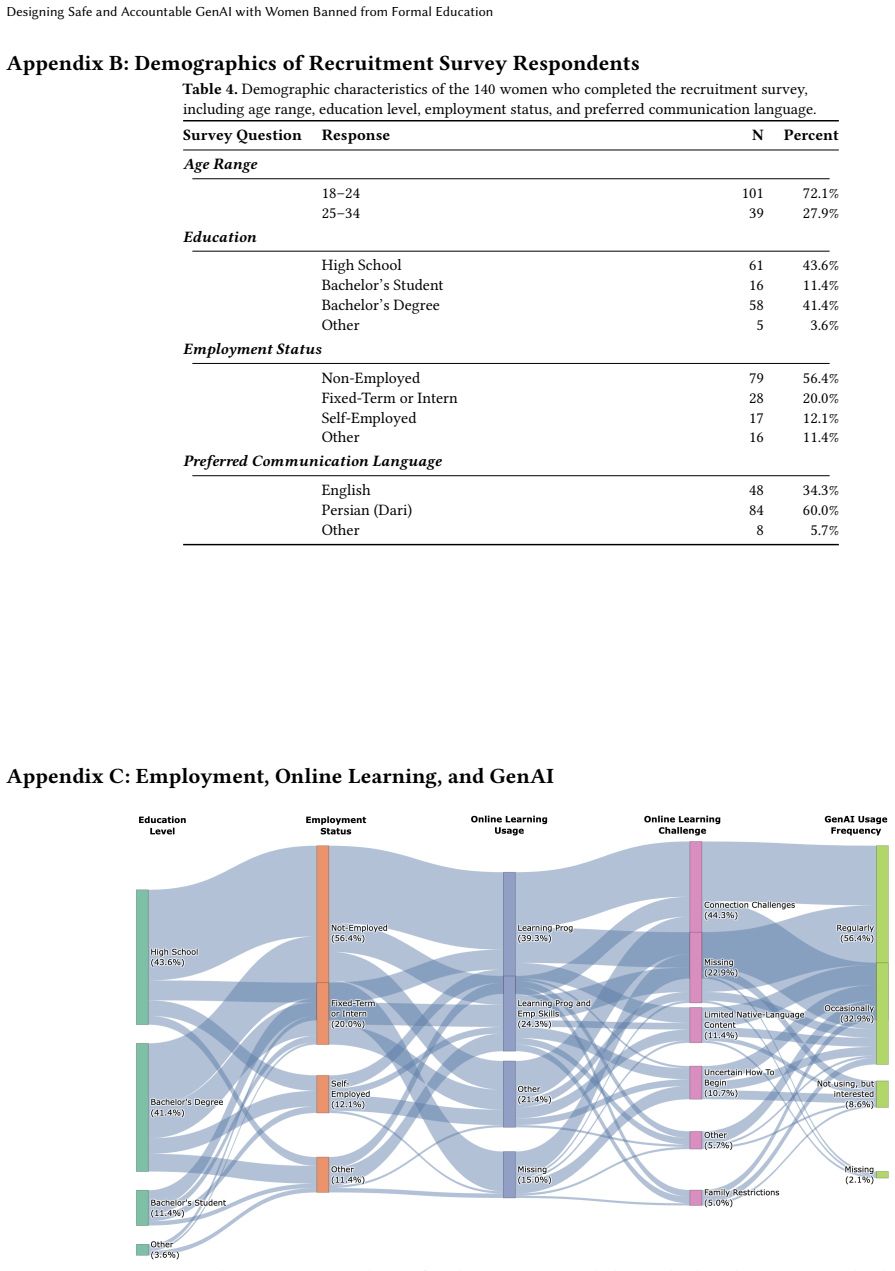
Summary. The paper presents a remote participatory design study with 20 women in Afghanistan (recruited via a survey of n=140) who are excluded from formal education due to gender restrictions. Participants envision GenAI primarily as an always-available peer, mentor, and career guide that compensates for missing learning communities, while raising concerns about privacy/surveillance risks, culturally unsafe outputs, and interactions that create an illusion of progress without genuine learning. The study reports statistically significant pre-post increases in aspirations (p=.01), perceived agency (p=.01), and perceived avenues (p=.03) after the design sessions. These findings are used to derive accountability-focused design directions centered on safety-first interaction with user control, context-grounded support under resource constraints, and pedagogically aligned assistance that promotes real learning rather than quick answers.
Significance. If the empirical claims hold after addressing methodological gaps, the work is significant for HCI, AI ethics, and computer-supported learning by providing rare, grounded insights from women in highly surveilled and restrictive environments. It shows how participatory design with GenAI can move beyond harm reduction to support empowerment and future-oriented thinking, offering concrete, user-derived design principles that are directly applicable to building safer educational AI tools. The emphasis on real-world constraints like household responsibilities and absence of communities adds practical value often missing from abstract AI safety discussions.
major comments (3)
- [Results (pre-post analysis)] Results section on pre-post measures: The reported increases in aspirations, agency, and avenues (p=.01, .01, .03) are presented without a control arm, randomization, attention-matched comparator, or any mechanism to isolate effects from study participation, social desirability bias, or repeated measurement. This undermines the central inference that the participatory GenAI envisioning process itself produced the changes and enabled pursuit of learning futures.
- [Results and Methods] Results and Methods sections: With n=20 for the core quantitative claims, the manuscript provides no effect sizes, no validation details for the aspiration/agency/avenues scales, no information on qualitative coding procedures or inter-rater reliability, and no discussion of selection biases introduced by recruiting the design-study participants from the n=140 survey. These omissions make the statistical claims difficult to interpret and limit the strength of the enablement argument.
- [Discussion and Design Implications] Discussion of design directions: The proposed accountability-focused directions (safety-first interaction, context-grounded support, pedagogically aligned assistance) are presented as translations of participant proposals, but the manuscript does not include traceable mappings (e.g., via participant quotes or tables) showing how specific themes directly informed each direction, weakening the claim that the directions are participant-centered.
minor comments (3)
- [Methods] Clarify the exact timing and wording of the pre-post questions, the remote study platform used, and any steps taken to ensure participant safety and data privacy during sessions.
- [Discussion] Add an explicit limitations subsection that addresses generalizability beyond the remote Afghan sample and potential cultural or contextual factors not captured in the design sessions.
- [Results] Ensure all p-values are accompanied by effect sizes and confidence intervals in the results reporting.
Simulated Author's Rebuttal
We thank the referee for these constructive comments, which help clarify the scope and limitations of our findings. We address each point below and indicate revisions to strengthen the manuscript.
read point-by-point responses
-
Referee: Results section on pre-post measures: The reported increases in aspirations, agency, and avenues (p=.01, .01, .03) are presented without a control arm, randomization, attention-matched comparator, or any mechanism to isolate effects from study participation, social desirability bias, or repeated measurement. This undermines the central inference that the participatory GenAI envisioning process itself produced the changes and enabled pursuit of learning futures.
Authors: We agree that the pre-post design without a control group precludes strong causal claims. The manuscript already frames the results as 'positively associated' rather than produced by the process. We will expand the Results and Discussion sections to explicitly discuss potential confounds including social desirability bias, repeated measurement effects, and the absence of a comparator, while retaining the exploratory nature of the observed associations in this hard-to-reach population. revision: yes
-
Referee: Results and Methods sections: With n=20 for the core quantitative claims, the manuscript provides no effect sizes, no validation details for the aspiration/agency/avenues scales, no information on qualitative coding procedures or inter-rater reliability, and no discussion of selection biases introduced by recruiting the design-study participants from the n=140 survey. These omissions make the statistical claims difficult to interpret and limit the strength of the enablement argument.
Authors: We accept these omissions weaken interpretability. Revisions will add: (1) effect sizes (Cohen's d) for the pre-post changes; (2) details on scale adaptation from prior validated instruments on aspirations and agency in constrained settings, with any available psychometric information; (3) description of the thematic analysis process, including dual coding and inter-rater reliability (Cohen's kappa); and (4) explicit discussion of selection bias arising from the survey subsample. These additions will appear in Methods and Results. revision: yes
-
Referee: Discussion of design directions: The proposed accountability-focused directions (safety-first interaction, context-grounded support, pedagogically aligned assistance) are presented as translations of participant proposals, but the manuscript does not include traceable mappings (e.g., via participant quotes or tables) showing how specific themes directly informed each direction, weakening the claim that the directions are participant-centered.
Authors: We agree that explicit traceability would strengthen the participant-centered claim. We will add a summary table in the Discussion that maps each design direction to the corresponding themes and includes representative participant quotes, making the derivation process transparent without altering the core content. revision: yes
- The study was conducted as a single-arm pre-post design; we cannot retroactively introduce a control arm, randomization, or attention-matched comparator to strengthen causal inference.
Circularity Check
No significant circularity in empirical participatory design study
full rationale
The paper reports an empirical remote participatory design study with 20 participants (informed by a recruitment survey of n=140) and pre-post measures of aspirations, agency, and avenues. These outcomes are presented as direct observations from participant data and statistical tests (p-values reported), with no equations, fitted parameters, self-referential definitions, or load-bearing self-citations. The central claim that envisioning GenAI enables learning futures rests on independent empirical inputs rather than reducing to prior assumptions or author-defined quantities by construction. Methodological limitations such as lack of controls are separate from circularity concerns.
Axiom & Free-Parameter Ledger
axioms (2)
- domain assumption Remote participatory design can be conducted ethically and safely with participants under surveillance without introducing additional risks
- domain assumption Self-reported pre-post changes in aspirations, agency, and avenues validly reflect meaningful shifts attributable to the design activity
Reference graph
Works this paper leans on
-
[1]
Shukra Raj Adhikari, Bhawani Shankar Adhikari, and Ganga Acharya. 2024. E-learning method and University life of married female students in patriar- chal social structure in sociological Perspective. InForum Ilmu Sosial, Vol. 51. Universitas Negeri Semarang, Semarang, Indonesia, 66–84
2024
-
[2]
Edmund Afoakwah, Francisco Carballo, Alex Caro, Samantha D’Cunha, Stephanie Dobrowolski, and Alexandra Fallon. 2021. Dialling up Learning
2021
-
[3]
Abdullah Al-Abri. 2025. Exploring ChatGPT as a virtual tutor: A multi- dimensional analysis of large language models in academic support.Education and Information Technologies30 (2025), 1–36
2025
-
[4]
Ashton Anderson, Daniel Huttenlocher, Jon Kleinberg, and Jure Leskovec. 2014. Engaging with Massive Online Courses. InProceedings of the 23rd International Conference on World Wide Web (WWW ’14). Association for Computing Machin- ery, New York, NY, USA, 687–698. doi:10.1145/2566486.2568042
-
[5]
Noam Angrist, Peter Bergman, and Moitshepi Matsheng. 2022. Experimental evidence on learning using low-tech when school is out.Nature human behaviour 6, 7 (2022), 941–950
2022
-
[6]
André Barcaui. 2025. ChatGPT as a cognitive crutch: Evidence from a randomized controlled trial on knowledge retention.Social Sciences & Humanities Open12 (2025), 102287. doi:10.1016/j.ssaho.2025.102287
-
[7]
Patrick Bassner, Ben Lenk-Ostendorf, Ramona Beinstingel, Tobias Wasner, and Stephan Krusche. 2025. Less stress, better scores, same learning: The dissociation of performance and learning in AI-supported programming education.Computers and Education: Artificial Intelligence6 (2025), 100537. doi:10.1016/j.caeai.2025. 100537
-
[8]
Hamayoon Behmanush. 2025. Supporting Marginalized Learners with GenAI. In Proceedings of the AAAI/ACM Conference on AI, Ethics, and Society, Vol. 8. AAAI Press, Washington, DC, USA, 2848–2849
2025
-
[9]
Hamayoon Behmanush, Freshta Akhtari, Roghieh Nooripour, Ingmar Weber, and Vikram Kamath Cannanure. 2025. Hope, Aspirations, and the Impact of LLMs on Female Programming Learners in Afghanistan. InWorkshop on Artificial Intelligence with and for Learning Sciences: Past, Present, and Future Horizons. Springer, Cham, Switzerland, 11 pages
2025
-
[10]
Hamayoon Behmanush, Freshta Akhtari, Roghieh Nooripour, Ingmar Weber, and Vikram Kamath Cannanure. 2025. Online Learning and GenAI: Supporting Women’s Aspirations Amid Socio-Political Instability in Afghanistan. InPro- ceedings of the ACM SIGCAS/SIGCHI Conference on Computing and Sustainable Societies. Association for Computing Machinery, New York, NY, US...
2025
-
[11]
democratizing innovation
Erling Björgvinsson, Pelle Ehn, and Per-Anders Hillgren. 2010. Participatory design and" democratizing innovation". InProceedings of the 11th Biennial partic- ipatory design conference. Association for Computing Machinery, New York, NY, USA, 41–50
2010
-
[12]
Benjamin S Bloom. 1984. The 2 sigma problem: The search for methods of group instruction as effective as one-to-one tutoring.Educational researcher13, 6 (1984), 4–16
1984
-
[13]
Virginia Braun and Victoria Clarke. 2006. Using thematic analysis in psychology. Qualitative research in psychology3, 2 (2006), 77–101
2006
-
[14]
Virginia Braun and Victoria Clarke. 2019. Reflecting on reflexive thematic analysis.Qualitative research in sport, exercise and health11, 4 (2019), 589–597
2019
-
[15]
Arianna Briganti and Nilofar Sekandari. 2025. Digital transformation for Afghan women in Central Asia: a pathway to economic empowerment for inclusive regional stability. https://www.osce.org/files/f/documents/c/e/589841.pdf
2025
-
[16]
Lauren Bringman-Rodenbarger and Michael Hortsch. 2020. How students choose E-learning resources: The importance of ease, familiarity, and convenience.Faseb Bioadvances2, 5 (2020), 286–295
2020
-
[17]
Amanda Buddemeyer, Jennifer Nwogu, Jaemarie Solyst, Erin Walker, Tara Nkrumah, Amy Ogan, Leshell Hatley, and Angela Stewart. 2022. Unwritten magic: Participatory design of AI Dialogue to empower marginalized voices. In Proceedings of the 2022 ACM conference on information technology for social good. Association for Computing Machinery, New York, NY, USA, 366–372
2022
-
[18]
We dream of climbing the ladder; to get there, we have to do our job better
Vikram Kamath Cannanure, Eloísa Ávila-Uribe, Tricia Ngoon, Yves Adji, Sharon Wolf, Kaja Jasińska, Timothy Brown, and Amy Ogan. 2022. “We dream of climbing the ladder; to get there, we have to do our job better”: Designing for Teacher Aspirations in rural Côte d’Ivoire. InProceedings of the 5th ACM SIGCAS/SIGCHI Conference on Computing and Sustainable Soci...
2022
-
[19]
Vikram Kamath Cannanure, Justin Souvenir Niweteto, Yves Thierry Adji, Akpe Y Hermann, Kaja K Jasinska, Timothy X Brown, and Amy Ogan. 2020. I’m fine where I am, but I want to do more: Exploring Teacher Aspirations in Rural Côte d’Ivoire. InProceedings of the 3rd ACM SIGCAS Conference on Computing and Sustainable Societies. Association for Computing Machin...
2020
-
[20]
Vikram Kamath Cannanure, Sharon Wolf, Kaja Jasinska, Tim Brown, and Amy Ogan. 2025. Enabling a virtual community of practice facilitated by a chatbot for rural teachers. InProceedings of the 5th Biennial African Human Computer Interaction Conference. Association for Computing Machinery, New York, NY, USA, 311–320
2025
-
[21]
Stephen Casper, Carson Ezell, Charlotte Siegmann, Noam Kolt, Taylor Lynn Curtis, Benjamin Bucknall, Andreas Haupt, Kevin Wei, Jérémy Scheurer, Marius Hobbhahn, Lee Sharkey, Satyapriya Krishna, Marvin von Hagen, Silas Alberti, Alan Chan, Qinyi Sun, Michael Gerovitch, David Bau, Max Tegmark, David Krueger, and Dylan Hadfield-Menell. 2024. Black-Box Access i...
-
[22]
Eason Chen, Jia-En Lee, Jionghao Lin, and Kenneth Koedinger. 2024. GPTutor: Great personalized tutor with large language models for personalized learning content generation. InProceedings of the Eleventh ACM Conference on Learning@ Scale. Association for Computing Machinery, New York, NY, USA, 539–541
2024
-
[23]
2002.Research methods in education
Louis Cohen, Lawrence Manion, and Keith Morrison. 2002.Research methods in education. routledge, London, UK
2002
-
[24]
InProceedings of the 2022 ACM Conference on Fairness, Accountability, and Transparency (FAccT ’22)
A. Feder Cooper, Emanuel Moss, Benjamin Laufer, and Helen Nissenbaum. 2022. Accountability in an Algorithmic Society: Relationality, Responsibility, and Ro- bustness in Machine Learning. InProceedings of the 2022 ACM Conference on Fairness, Accountability, and Transparency (FAccT ’22). Association for Computing Machinery, New York, NY, USA, 864–876. doi:1...
-
[25]
Nathalie DiBerardino and Luke Stark. 2023. (Anti)-Intentional Harms: The Conceptual Pitfalls of Emotion AI in Education. InProceedings of the 2023 ACM Conference on Fairness, Accountability, and Transparency (FAccT ’23)(Chicago, IL, USA). Association for Computing Machinery, New York, NY, USA, 1386–1395. doi:10.1145/3593013.3594088
-
[26]
Betsy DiSalvo. 2016. Participatory design through a learning science lens. In Proceedings of the 2016 CHI Conference on Human Factors in Computing Systems. Association for Computing Machinery, New York, NY, USA, 4459–4463
2016
-
[27]
Ravit Dotan, Lisa S. Parker, and John G. Radzilowicz. 2024. Responsible Adop- tion of Generative AI in Higher Education: Developing a “Points to Consider” Approach Based on Faculty Perspectives. InProceedings of the 2024 ACM Con- ference on Fairness, Accountability, and Transparency (FAccT ’24)(Rio de Janeiro, Brazil). Association for Computing Machinery,...
-
[28]
Louie Giray, Jonard Nemeño, and Jelomil Edem. 2025. Self-Directed Learning Using ChatGPT Positively Affects Student Engagement.International Journal of Technology in Education8, 3 (2025), 667–680
2025
-
[29]
Manel Guettala, Samir Bourekkache, Okba Kazar, Saad Harous, et al. 2024. Gen- erative artificial intelligence in education: Advancing adaptive and personalized learning.Acta Informatica Pragensia13, 3 (2024), 460–489
2024
-
[30]
Christina N Harrington. 2020. The forgotten margins: what is community-based participatory health design telling us?Interactions27, 3 (2020), 24–29
2020
-
[31]
Don’t Forget the Teachers
Emma Harvey, Allison Koenecke, and Rene F Kizilcec. 2025. " Don’t Forget the Teachers": Towards an Educator-Centered Understanding of Harms from Large Language Models in Education. InProceedings of the 2025 CHI Conference on Human Factors in Computing Systems. Association for Computing Machinery, New York, NY, USA, 1–19
2025
-
[32]
2023.Guidance for generative AI in educa- tion and research
Wayne Holmes, Fengchun Miao, et al. 2023.Guidance for generative AI in educa- tion and research. Unesco Publishing, Paris, France
2023
-
[33]
My cousin bought the phone for me. I never go to mobile shops
Samia Ibtasam, Lubna Razaq, Maryam Ayub, Jennifer R Webster, Syed Ishtiaque Ahmed, and Richard Anderson. 2019. " My cousin bought the phone for me. I never go to mobile shops. " The Role of Family in Women’s Technological Inclu- sion in Islamic Culture.Proceedings of the ACM on Human-Computer Interaction 3, CSCW (2019), 1–33
2019
-
[34]
Jussi S Jauhiainen and Agustín Garagorry Guerra. 2024. Generative AI and educa- tion: dynamic personalization of pupils’ school learning material with ChatGPT. InFrontiers in Education, Vol. 9. Frontiers Media SA, Lausanne, Switzerland, 1288723
2024
-
[35]
Aziz Ullah Karimy, Juma Rasuli, P Chandrasekhar Reddy, Musa Joya, Ali Juma Hamdard, and Hassan Rahnaward Ghulami. 2024. A Review on the Feasibility of AI-Supported Education Platforms in Afghanistan: Addressing Barriers to Behmanush et al. Women and Girls’ Education. In2024 IEEE Global Humanitarian Technology Conference (GHTC). IEEE, PA, USA, 1–8
2024
-
[36]
Naveena Karusala, Apoorva Bhalla, and Neha Kumar. 2019. Privacy, patriarchy, and participation on social media. InProceedings of the 2019 on Designing Inter- active Systems Conference. Association for Computing Machinery, New York, NY, USA, 511–526
2019
-
[37]
Enkelejda Kasneci, Kathrin Seßler, Stefan Küchemann, Maria Bannert, Daryna Dementieva, Frank Fischer, Urs Gasser, Georg Groh, Stephan Günnemann, Eyke Hüllermeier, et al. 2023. ChatGPT for good? On opportunities and challenges of large language models for education.Learning and individual differences103 (2023), 102274
2023
-
[38]
Michael Katell, Meg Young, Dharma Dailey, Bernease Herman, Vivian Guetler, Aaron Tam, Corinne Binz, Daniella Raz, and P. M. Krafft. 2020. Toward Situated Interventions for Algorithmic Equity: Lessons from the Field. InProceedings of the 2020 Conference on Fairness, Accountability, and Transparency (FAccT’20). Association for Computing Machinery, New York,...
-
[39]
Matthew A Kraft. 2020. Interpreting effect sizes of education interventions. Educational researcher49, 4 (2020), 241–253
2020
-
[40]
J. Richard Landis and Gary G. Koch. 1977. The Measurement of Observer Agree- ment for Categorical Data.Biometrics33, 1 (1977), 159–174. doi:10.2307/2529310
-
[41]
Lea Holst Laursen. 2025. Post-its, postcards, and dream clouds: exploring partici- patory design methods as avenues to capture rural youth voices.CoDesign21, 2 (2025), 195–210
2025
-
[42]
Travis J Lybbert and Bruce Wydick. 2017. Hope as aspirations, agency, and path- ways: poverty dynamics and microfinance in Oaxaca, Mexico. InThe economics of poverty traps. University of Chicago Press, Chicago, USA, 153–177
2017
-
[43]
2025.Digital Teacher Support in South Africa: How WhatsApp Chatbots and Generative AI Are Bridging the Gap
Niall McNulty. 2025.Digital Teacher Support in South Africa: How WhatsApp Chatbots and Generative AI Are Bridging the Gap. Medium. https://medium.com/ @niall.mcnulty/digital-teacher-support-in-south-africa-730ff623d319
2025
-
[44]
2025.What Works to Advance Women’s Digital Literacy? A Review of Good Practices and Programs
Rim Melake, Danielle Robinson, Sarah Danman, Harmonie Kobanghe Langazo, and Alicia Hammond. 2025.What Works to Advance Women’s Digital Literacy? A Review of Good Practices and Programs. Technical Report P173166. World Bank Group, Washington, DC. https://documents.worldbank.org/en/publication/ documents-reports/documentdetail/099040225191054238
-
[45]
Jacob Metcalf, Emanuel Moss, Elizabeth Anne Watkins, Ranjit Singh, and Madeleine Clare Elish. 2021. Algorithmic Impact Assessments and Accountabil- ity: The Co-construction of Impacts. InProceedings of the 2021 ACM Conference on Fairness, Accountability, and Transparency (FAccT ’21). Association for Computing Machinery, New York, NY, USA, 735–746. doi:10....
-
[46]
Michael J Muller and Sarah Kuhn. 1993. Participatory design.Commun. ACM 36, 6 (1993), 24–28
1993
-
[47]
Henrietta Nanyonjo, Melissa Densmore, Sierra Van Riel, Fiona Ssozi, and Dorothea Kleine. 2025. GeJuSTA Gender-Just Co-Design Toolkit (v5.3). https: //melissadensmore.com/gejusta. Licensed under CC BY-NC-SA 4.0
2025
-
[48]
I want it to talk like Darth Vader
Michele Newman, Kaiwen Sun, Ilena B Dalla Gasperina, Grace Y Shin, Matthew Kyle Pedraja, Ritesh Kanchi, Maia B Song, Rannie Li, Jin Ha Lee, and Jason Yip. 2024. " I want it to talk like Darth Vader": Helping Children Con- struct Creative Self-Efficacy with Generative AI. InProceedings of the 2024 CHI Conference on Human Factors in Computing Systems. Assoc...
2024
-
[49]
Hellina Hailu Nigatu, John Canny, and Sarah E Chasins. 2024. Low-Resourced Languages and Online Knowledge Repositories: A Need-Finding Study.. InPro- ceedings of the 2024 CHI Conference on Human Factors in Computing Systems. Association for Computing Machinery, New York, NY, USA, 1–21
2024
-
[50]
How can we learn and use AI at the same time?
Isabella Pu, Prerna Ravi, Linh Dieu Dinh, Chelsea Joe, Caitlin Ogoe, Zixuan Li, Cynthia Breazeal, and Anastasia K Ostrowski. 2025. "How can we learn and use AI at the same time?": Participatory Design of GenAI with High School Students. InProceedings of the 24th Interaction Design and Children. Association for Computing Machinery, New York, NY, USA, 204–220
2025
-
[51]
Sabit Rahim, Gul Sahar, Gul Jabeen, Sabila Khatoon, et al . 2025. Harnessing generative AI: Reviewing applications, challenges, and solutions for out-of-school children in developing regions.Sustainable Futures10 (2025), 101206
2025
-
[52]
Inioluwa Deborah Raji, Andrew Smart, Rebecca N. White, Margaret Mitchell, Timnit Gebru, Ben Hutchinson, Jamila Smith-Loud, Daniel Theron, and Parker Barnes. 2020. Closing the AI Accountability Gap: Defining an End-to-End Frame- work for Internal Algorithmic Auditing. InConference on Fairness, Accountability, and Transparency (FAccT’20). Association for Co...
-
[53]
Prerna Ravi, John Masla, Gisella Kakoti, Grace C Lin, Emma Anderson, Matt Taylor, Anastasia K Ostrowski, Cynthia Breazeal, Eric Klopfer, and Hal Abelson
-
[54]
InProceedings of the 2025 CHI Conference on Human Factors in Computing Systems
Co-designing Large Language Model Tools for Project-Based Learning with K12 Educators. InProceedings of the 2025 CHI Conference on Human Factors in Computing Systems. Association for Computing Machinery, New York, NY, USA, 1–25
2025
-
[55]
Agha Ali Raza, Mustafa Naseem, Namoos Hayat Qasmi, Shan Randhawa, Fizzah Malik, Behzad Taimur, Sacha St-Onge Ahmad, Sarojini Hirshleifer, Arman Rezaee, and Aditya Vashistha. 2022. Fostering engagement of underserved communities with credible health information on social media. InProceedings of the ACM Web Conference 2022. Association for Computing Machine...
2022
- [56]
-
[57]
Sami Sarsa, Paul Denny, Arto Hellas, and Juho Leinonen. 2022. Automatic generation of programming exercises and code explanations using large language models. InProceedings of the 2022 ACM conference on international computing education research-volume 1. Association for Computing Machinery, New York, NY, USA, 27–43
2022
-
[58]
Abdul Qahar Sarwari and Hamedi Mohd Adnan. 2024. Alternative educational activities and programs for female students banned from formal education in Afghanistan.Issues in Educational Research34, 3 (2024), 1170–1179
2024
-
[59]
Md Istiak Hossain Shihab, Christopher Hundhausen, Ahsun Tariq, Summit Haque, Yunhan Qiao, and Brian Wise Mulanda. 2025. The Effects of GitHub Copilot on Computing Students’ Programming Effectiveness, Efficiency, and Processes in Brownfield Coding Tasks. InProceedings of the 2025 ACM Conference on International Computing Education Research V. 1. Associatio...
2025
-
[60]
Shaghayegh Shirzad and Mansoor Ali Darazi. 2025. AI Literacy in Education: Balancing Innovation, Ethics, and Equity in the Digital Age.Journal of New Trends in English Language Learning (JNTELL)4, Special Issue (2025), 9 pages
2025
-
[61]
Summit Shrestha, Josiah Hester, Ashutosh Dhekne, Umakishore Ramachan- dran, and Alex Cabral. 2025. Bringing Context to the Underserved: Rethinking Context-Aware Design to Bridge the Digital Divide. InProceedings of the ACM SIGCAS/SIGCHI Conference on Computing and Sustainable Societies. Association for Computing Machinery, New York, NY, USA, 647–665
2025
-
[62]
C. R. Snyder, C. Harris, J. R. Anderson, S. A. Holleran, L. M. Irving, S. T. Sig- mon, L. Yoshinobu, J. Gibb, C. Langelle, and P. Harney. 1991. The will and the ways: Development and validation of an individual-differences measure of hope. Journal of Personality and Social Psychology60, 4 (1991), 570–585
1991
-
[63]
Sharifa Sultana, François Guimbretière, Phoebe Sengers, and Nicola Dell. 2018. Design within a patriarchal society: Opportunities and challenges in designing for rural women in bangladesh. InProceedings of the 2018 CHI conference on human factors in computing systems. Association for Computing Machinery, New York, NY, USA, 1–13
2018
-
[64]
Manohar Swaminathan and Tarini Naik. 2025. Generative AI for Teachers with Vision Impairments in the Global South: A Bridge Too Far?. InProceedings of the 27th International ACM SIGACCESS Conference on Computers and Accessibility. Association for Computing Machinery, New York, NY, USA, 1–18
2025
-
[65]
Rachel Szczytko, Sarah J Carrier, and Kathryn T Stevenson. 2018. Impacts of outdoor environmental education on teacher reports of attention, behavior, and learning outcomes for students with emotional, cognitive, and behavioral disabil- ities. InFrontiers in Education, Vol. 3. Frontiers Media SA, Lausanne, Switzerland, 46
2018
-
[66]
Myles Joshua Toledo Tan and Nicholle Mae Amor Tan Maravilla. 2024. Shaping integrity: why generative artificial intelligence does not have to undermine education.Frontiers in Artificial Intelligence7 (2024), 1471224. doi:10.3389/frai. 2024.1471224
-
[67]
Kentaro Toyama. 2018. From needs to aspirations in information technology for development.Information Technology for Development24, 1 (2018), 15–36
2018
-
[68]
Khai N. Truong, Gillian R. Hayes, and Gregory D. Abowd. 2006. Storyboard- ing: An Empirical Determination of Best Practices and Effective Guidelines. InProceedings of the 6th ACM Conference on Designing Interactive Systems (DIS ’06). Association for Computing Machinery, New York, NY, USA, 12–21. doi:10.1145/1142405.1142410
-
[69]
Ari Tuhkala. 2021. A systematic literature review of participatory design studies involving teachers.European Journal of Education56, 4 (2021), 641–659
2021
-
[70]
Laurah Turner, Matt Kelleher, Seth Overla, Weibing Zheng, Alexander Gregath, Micheal Gharib, Andrew Zahn, Sally A Santen, and Danielle E Weber. 2025. Harnessing the Generative Power of AI to Move Closer to Personalized Medical Education.Academic Medicine100 (2025), 10–1097
2025
-
[71]
UNESCO. 2025. Nurturing Safe Learning Environments to Realize the Right to Education: Brief. https://unesdoc.unesco.org/ark:/48223/pf0000396302
2025
-
[72]
UNICEF and UNESCO. 2025. Afghanistan Education Situation Report
2025
-
[73]
https://www.unicef.org/afghanistan/documents/afghanistan-education- situation-report-2025
2025
-
[74]
United Nations General Assembly. 2015. Transforming Our World: The 2030 Agenda for Sustainable Development. Resolution adopted by the General As- sembly on 25 September 2015 (A/RES/70/1). https://sdgs.un.org/2030agenda Seventieth session
2015
-
[75]
Rama Adithya Varanasi, Divya Siddarth, Vivek Seshadri, Kalika Bali, and Aditya Vashistha. 2022. Feeling proud, feeling embarrassed: Experiences of low-income women with crowd work. InProceedings of the 2022 CHI Conference on Human Factors in Computing Systems. Association for Computing Machinery, New York, NY, USA, 1–18
2022
-
[76]
IW Wait. 2013. Reducing instructional barriers through software virtualization. Journal of Online Engineering Education4 (2013), 5 pages. Designing Safe and Accountable GenAI with Women Banned from Formal Education
2013
- [77]
-
[78]
Yixuan Wang. 2025. Becoming a co-designer: the change in participants’ per- ceived self-efficacy during a co-design process.CoDesign21, 1 (2025), 52–73
2025
-
[79]
Michel Wermelinger. 2023. Using github copilot to solve simple programming problems. InProceedings of the 54th ACM Technical Symposium on Computer Science Education V. 1. Association for Computing Machinery, New York, NY, USA, 172–178
2023
-
[80]
Lixiang Yan, Lele Sha, Linxuan Zhao, Yuheng Li, Roberto Martinez-Maldonado, Guanliang Chen, Xinyu Li, Yueqiao Jin, and Dragan Gašević. 2024. Practical and ethical challenges of large language models in education: A systematic scoping review.British Journal of Educational Technology55, 1 (2024), 90–112
2024
discussion (0)
Sign in with ORCID, Apple, or X to comment. Anyone can read and Pith papers without signing in.