Recognition: no theorem link
Generation time in a discrete epidemic model with asymptomatic carriers: beyond geometric waiting times
Pith reviewed 2026-05-10 16:53 UTC · model grok-4.3
The pith
Rearrangement of the basic reproduction number directly yields the generation-time distribution in a discrete epidemic model with asymptomatic stages.
A machine-rendered reading of the paper's core claim, the machinery that carries it, and where it could break.
Core claim
Expressing the basic reproduction number as a sum over all possible transmission delays and then dividing each term by the total recovers the probability mass function of the generation time. The resulting expectation is a convex combination of the pre-symptom and post-symptom expected generation times, where the weights are the fractions of secondary cases produced before and after symptom onset.
What carries the argument
The compact recursive system of state equations for the latent, asymptomatic, and symptomatic stages, whose solution for the basic reproduction number is algebraically rearranged into generation-time probabilities.
If this is right
- Generation-time probabilities can be obtained analytically without Monte-Carlo simulation of full transmission trees.
- The expected generation time shortens or lengthens according to the relative infectiousness of the asymptomatic versus symptomatic phases.
- All moments of the generation time are recoverable from the first n moments of the latent period, the incubation period, and the infectiousness-weighted forward recurrence times.
- For the diseases examined with Weibull waiting times, only measles exhibits high variability in its generation-time distribution.
Where Pith is reading between the lines
- The same rearrangement technique could be applied to any discrete compartmental model whose reproduction number is written as a sum over delay bins.
- Because the generation-time distribution enters directly into the renewal equation for incidence, the derived probabilities allow immediate substitution into growth-rate calculations without additional approximation.
- If real transmission data show that waiting times in different stages are correlated, the convex-combination structure for the mean would no longer hold exactly.
Load-bearing premise
The waiting times spent in each infected stage are independent and drawn from known discrete distributions, while infectiousness within each phase is either constant or follows a prescribed function of elapsed time.
What would settle it
Collect contact-tracing data that records both symptom-onset dates and laboratory-confirmed transmission intervals for a disease such as influenza or SARS-CoV-2; the empirical histogram of those intervals must match the distribution derived from the model's rearranged reproduction number.
Figures




read the original abstract
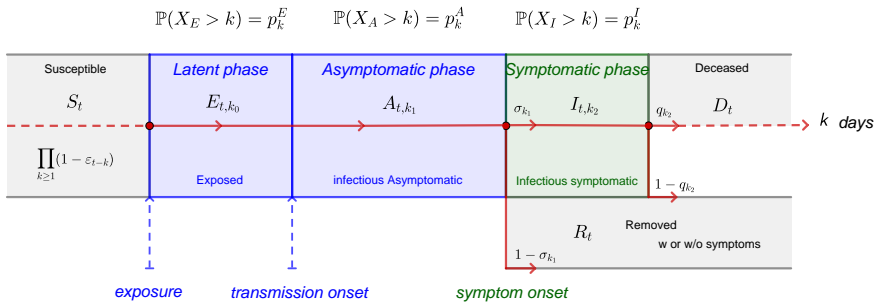
We study the random times between successive cases in a transmission chain of infectious diseases with asymptomatic carriers. We derive the probability distribution of this generation time (in days) from a discrete-time epidemic model with variable infectiousness both along elapsed times and across phases. The introduced non-Markovian model is a compact recursive system featuring random waiting times at each of the three infected stages: latent, asymptomatic, and symptomatic. By rearranging the terms of the basic reproduction number, which represents the expected number of secondary cases produced by an asymptomatic primary case who may eventually develop symptoms, we get to the generation-time probabilities. The expected generation time is a convex combination of the expected generation times before and after the onset of symptoms. Additionally, our analysis reveals that the n-th moment of the generation time is related to the moments up to n-th order of the weighted forward recurrence time at each phase and the moments up to n-th order of the latent period and the incubation period. These weights are the infectiousness along the elapsed times for each transmission phase. Finally, we illustrate several data-driven epidemic scenarios, assuming that infectiousness varies only across phases and discrete Weibull distributions for the waiting times. Each disease analyzed, except measles, exhibits moderate variability in its respective generation time distribution.
Editorial analysis
A structured set of objections, weighed in public.
Referee Report
Summary. The manuscript develops a non-Markovian discrete-time epidemic model with three infected stages (latent, asymptomatic, symptomatic) featuring independent discrete waiting-time distributions and phase-dependent infectiousness that may vary with elapsed time. It derives the generation-time probability distribution by algebraic rearrangement of the basic reproduction number R0 for an index case beginning in the asymptomatic phase, shows that the expected generation time is a convex combination of the conditional expectations before versus after symptom onset, and relates the n-th moment of the generation time to moments (up to order n) of the weighted forward recurrence times within each phase together with moments of the latent and incubation periods. The framework is illustrated with data-driven scenarios that adopt discrete Weibull waiting times and constant-within-phase infectiousness, yielding moderate generation-time variability for most examined diseases except measles.
Significance. If the derivations hold, the work supplies an analytically tractable route to generation-time distributions that avoids the restrictive geometric waiting-time assumption common in Markovian models. The explicit convex-combination expression for the mean and the moment relations involving weighted forward recurrence times constitute a reusable tool for uncertainty propagation in epidemic forecasting. The data-driven illustrations demonstrate applicability to concrete diseases, although the absence of direct comparison to empirical generation-time observations or simulated outbreak trajectories limits immediate translational impact.
major comments (3)
- [Derivation of generation-time probabilities (Section 3)] The central derivation obtains generation-time probabilities by rearranging the expression for R0. While the construction is internally consistent once the infectiousness profile and the three independent discrete waiting-time distributions are fixed, the manuscript must display the explicit algebraic steps (including the normalization that yields a proper probability distribution) and verify that the resulting probabilities are non-negative and sum to one for the chosen parameter values.
- [Moment relations (Section 4)] The claimed relation between the n-th moment of the generation time and the moments (up to order n) of the weighted forward recurrence times, latent period, and incubation period is load-bearing for the higher-order analysis. An explicit formula or inductive proof sketch should be supplied, together with a numerical check that the relation recovers the correct moments when the waiting-time distributions are geometric.
- [Numerical illustrations (Section 5)] The data-driven illustrations adopt Weibull shape and scale parameters together with phase-specific infectiousness weights without reporting sensitivity to these choices or comparison against simulated transmission chains or published empirical generation-time estimates. Adding such validation is necessary to support the conclusion of moderate variability (except for measles).
minor comments (2)
- [Model definition] Clarify whether the discrete Weibull distributions are obtained by discretizing the continuous Weibull or are defined directly on the positive integers; the latter choice affects the forward-recurrence-time formulas.
- [Throughout] Ensure uniform notation for the infectiousness weights across phases and elapsed times; a single table summarizing all parameters for each disease would improve readability.
Simulated Author's Rebuttal
We thank the referee for their constructive and detailed comments, which have identified areas where the manuscript can be strengthened. We address each major comment below and describe the revisions we plan to implement.
read point-by-point responses
-
Referee: [Derivation of generation-time probabilities (Section 3)] The central derivation obtains generation-time probabilities by rearranging the expression for R0. While the construction is internally consistent once the infectiousness profile and the three independent discrete waiting-time distributions are fixed, the manuscript must display the explicit algebraic steps (including the normalization that yields a proper probability distribution) and verify that the resulting probabilities are non-negative and sum to one for the chosen parameter values.
Authors: We agree that the derivation would be clearer with explicit steps. In the revised manuscript we will expand Section 3 to present the full algebraic rearrangement of R0 that yields the generation-time probabilities, including the explicit normalization factor that ensures they form a proper distribution, followed by a direct verification that all probabilities are non-negative and sum to one for the parameter values used in the numerical illustrations. revision: yes
-
Referee: [Moment relations (Section 4)] The claimed relation between the n-th moment of the generation time and the moments (up to order n) of the weighted forward recurrence times, latent period, and incubation period is load-bearing for the higher-order analysis. An explicit formula or inductive proof sketch should be supplied, together with a numerical check that the relation recovers the correct moments when the waiting-time distributions are geometric.
Authors: We will add an explicit closed-form expression for the n-th moment of the generation time in terms of the moments (up to order n) of the weighted forward recurrence times and the latent/incubation periods. A short inductive proof sketch will be included, together with a numerical verification that the formula recovers the known moments when all waiting-time distributions are geometric. revision: yes
-
Referee: [Numerical illustrations (Section 5)] The data-driven illustrations adopt Weibull shape and scale parameters together with phase-specific infectiousness weights without reporting sensitivity to these choices or comparison against simulated transmission chains or published empirical generation-time estimates. Adding such validation is necessary to support the conclusion of moderate variability (except for measles).
Authors: We will add a sensitivity analysis in the revised Section 5 that varies the Weibull shape/scale parameters and the phase-specific infectiousness weights around the chosen values. Direct comparison against simulated transmission chains or published empirical generation-time estimates would require additional datasets and stochastic simulation code that lie outside the present theoretical scope; we will explicitly discuss this limitation and note how the derived expressions could be used for such validation in future work. revision: partial
Circularity Check
No significant circularity in the derivation chain
full rationale
The paper's central derivation obtains the generation-time probability distribution by rearranging the time-indexed transmission contributions that define R0 (the expected secondary cases from an index asymptomatic case that may progress to symptoms). This is the standard normalization step in which the generation-time probabilities are the normalized infectiousness kernel, the mean generation time is the corresponding convex combination of pre- and post-symptom conditional expectations, and higher moments follow from weighted forward-recurrence times within each phase. The construction is self-contained once the three independent discrete waiting-time distributions and the phase-specific infectiousness profiles are supplied; no algebraic step reduces to a self-definition, a fitted parameter renamed as a prediction, or a load-bearing self-citation. The result follows directly from the model definitions without circularity.
Axiom & Free-Parameter Ledger
free parameters (2)
- Weibull shape and scale parameters for each phase
- Phase-specific infectiousness weights
axioms (2)
- domain assumption Waiting times at the three stages are independent and follow specified discrete distributions
- domain assumption Infectiousness is constant within each phase or varies deterministically with elapsed time
Reference graph
Works this paper leans on
-
[1]
Bai: An age-of-infection model with both symptomatic and asymptomatic infections
F. Bai: An age-of-infection model with both symptomatic and asymptomatic infections. Journal of Mathematical Biology 86 (2023), article
2023
-
[2]
doi:10.1007 /s00285-023-01920-w D. Breda, F. Florian, J. Ripoll, R. V ermiglio: E fficient numerical computation of the basic reproduction number for structured populations, J. Comput. Appl. Math. 384, 113165 (2021). DOI: 10.1016 /j.cam.2020.113165 C. Barril, À. Calsina, J. Ripoll: A practical approach to R0 in continuous-time ecological models. Math. Meth....
-
[3]
Barril, À
C. Barril, À. Calsina, S. Cuadrado, J. Ripoll: On the basic reproduction number in continuously structured populations, Math. Meth. Appl. Sci. 44 (1), 799–812 (2021). DOI: 10.1002 /mma.6787 C. Barril, À. Calsina, S. Cuadrado, J. Ripoll: Reproduction number for an age of infection structured model, Mathe- matical Modelling of Natural Phenomena 16 (2021), Article
2021
-
[4]
doi:10.1051 /mmnp/2021033 F. Brauer, Z. Feng, C. Castillo-Chávez: Discrete epidemic models. Mathematical Biosciences and Engineering 7 (2010), 1–15. doi: 10.3934 /mbe.2010.7.1 D. Breda, T. Kuniya, J. Ripoll, R. V ermiglio: Collocation of next-generation operators for computing the basic repro- duction number of structured populations, J Sci Comput 85, 40 ...
-
[5]
Diekmann, J.A.P
doi:10.1186 /s12916-014-0196-0 O. Diekmann, J.A.P . Heesterbeek, J.A.J. Metz: On the definition and the computation of the basic reproduction ratio R0 in models for infectious diseases in heterogeneous populations. J. Math. Biol. 28 (1990) 365–382. O. Diekmann, H.G. Othmer, R. Planqué, M.C.J. Bootsma: The discrete-time KermackMcKendrick model: A versatile ...
1990
-
[6]
Ferretti, C
L. Ferretti, C. Wymant, M. Kendall, L. Zhao, A. Nurtay, L. Abeler-Dörner, M. Parker, D. Bonsall, C. Fraser: Quanti- fying SARS-CoV -2 transmission suggests epidemic control with digital contact tracing. Science 368 (2020),
2020
-
[7]
doi:10.1126/science.abb6936 C. Fraser, S. Riley, R. M. Anderson, N. M. Ferguson: Factors that make an infectious disease outbreak controllable. Proceedings of the National Academy of Sciences , 101(16):6146–6151,
-
[8]
N. Hernandez-Ceron, Z. Feng, C. Castillo-Chavez: Discrete Epidemic Models with Arbitrary Stage Distributions and Applications to Disease Control. Bulletin of Mathematical Biology 75 (2013), 1716–1746. doi:10.1007 /s11538- 013-9866-x M.J. Keeling, B.T. Grenfell: Disease extinction and community size: Modeling the persistence of measles. Science 275 (1997),...
-
[9]
Ripoll, J
J. Ripoll, J. Font: A Discrete Model for the Evolution of Infection Prior to Symptom Onset. Mathematics 11 (2023),
2023
-
[10]
https://doi.org/10.3390/math11051092 L. Sanz, R. Bravo de la Parra: Discrete-time staged progression epidemic models. Mathematical and Computer Mod- elling of Dynamical Systems 30 (2024), 496–522. doi:10.1080 /13873954.2024.2356681 H. Seno: A Primer on Population Dynamics Modeling: Basic Ideas for Mathematical Formulation. Springer, Singa- pore,
-
[11]
N. Shaikh, P . Swali, R.M.G.J. Houben: Asymptomatic but infectious - The silent driver of pathogen transmission. A pragmatic review. Epidemics 44 (2023), article 100704. doi:10.1016 /j.epidem.2023.100704 A. Svensson: A note on generation times in epidemic models. Math Biosci. 208 (2007), 300–311. doi:10.1016/j.mbs.2006.10.010 H. R. Thieme: Discrete-Time D...
-
[12]
J. Wallinga, M. Lipsitch: How Generation Intervals Shape the Relationship between Growth Rates and Repro- ductive Numbers. Proceedings of the Royal Society B: Biological Sciences 274 (2007), no. 1609, 599604. https://doi.org/10.1098/rspb.2006.3754. J.S. Weitz: Asymptomatic: The Silent Spread of COVID-19 and the Future of Pandemics. Johns Hopkins University Press,
-
[13]
Y ang, J
Q. Y ang, J. Saldaña, C. Scoglio: Generalized epidemic model incorporating non-Markovian infection processes and waning immunity. Physical Review E 108 (2023), article 014405. doi:10.1103 /PhysRevE.108.014405 21
2023
discussion (0)
Sign in with ORCID, Apple, or X to comment. Anyone can read and Pith papers without signing in.