Recognition: 2 theorem links
· Lean TheoremScore Shocks: The Burgers Equation Structure of Diffusion Generative Models
Pith reviewed 2026-05-10 18:06 UTC · model grok-4.3
The pith
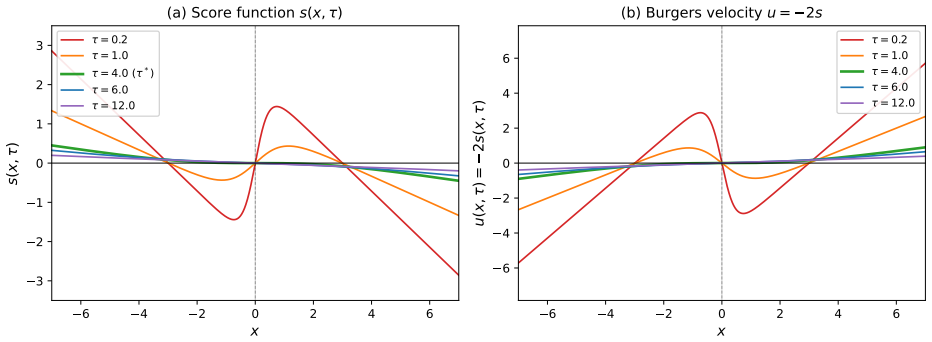
The score field in diffusion generative models obeys the viscous Burgers equation, with mode separation appearing as sharpening interfaces.
A machine-rendered reading of the paper's core claim, the machinery that carries it, and where it could break.
Core claim
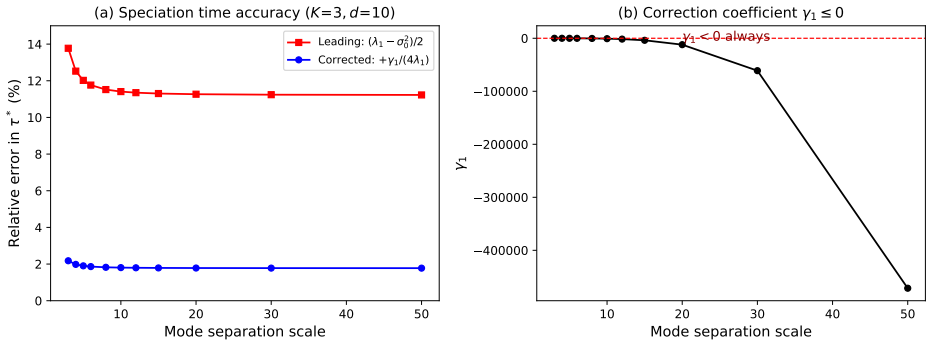
For VE diffusion, the heat-evolved data density implies that the score obeys viscous Burgers in one dimension and the corresponding irrotational vector Burgers system in R^d. For any binary decomposition of the noised density into two positive heat solutions, the score separates into a smooth background and a universal tanh interfacial term determined by the component log-ratio. Near a regular binary mode boundary this yields a normal criterion for speciation. In symmetric binary Gaussian mixtures the criterion recovers the critical diffusion time detected by the midpoint derivative of the score and agrees with the spectral criterion of Biroli et al. After subtracting the background drift, a
What carries the argument
The score decomposition into smooth background drift plus universal tanh interfacial term fixed by the log-ratio of two heat-evolved density components.
If this is right
- The inter-mode layer exhibits a local Burgers tanh profile that becomes global in the symmetric Gaussian case with width σ_τ^{2}/a.
- Score errors are exponentially amplified across the interfacial layer.
- Burgers dynamics preserves irrotationality of the score.
- A change of variables reduces the VP-SDE to the VE case and supplies a closed-form VP speciation time.
Where Pith is reading between the lines
- If the Burgers structure is generic, diffusion schedules could be tuned to control interface sharpening rates and thereby improve coverage of multimodal targets.
- The irrotational vector Burgers system may admit integrable reductions in higher dimensions that mirror known fluid-dynamical simplifications.
- The local tanh profile observed on quartic wells suggests the interface description may extend to non-Gaussian data distributions without requiring global symmetry.
Load-bearing premise
Any noised density can be decomposed into two positive heat solutions whose log-ratio fixes the interfacial part of the score.
What would settle it
A numerical computation, on either a symmetric Gaussian mixture or a quartic double-well, showing that the score profile across a mode boundary deviates from the predicted tanh shape at the critical diffusion time.
Figures


read the original abstract
We analyze the score field of a diffusion generative model through a Burgers-type evolution law. For VE diffusion, the heat-evolved data density implies that the score obeys viscous Burgers in one dimension and the corresponding irrotational vector Burgers system in $\R^d$, giving a PDE view of \emph{speciation transitions} as the sharpening of inter-mode interfaces. For any binary decomposition of the noised density into two positive heat solutions, the score separates into a smooth background and a universal $\tanh$ interfacial term determined by the component log-ratio; near a regular binary mode boundary this yields a normal criterion for speciation. In symmetric binary Gaussian mixtures, the criterion recovers the critical diffusion time detected by the midpoint derivative of the score and agrees with the spectral criterion of Biroli, Bonnaire, de~Bortoli, and M\'ezard (2024). After subtracting the background drift, the inter-mode layer has a local Burgers $\tanh$ profile, which becomes global in the symmetric Gaussian case with width $\sigma_\tau^2/a$. We also quantify exponential amplification of score errors across this layer, show that Burgers dynamics preserves irrotationality, and use a change of variables to reduce the VP-SDE to the VE case, yielding a closed-form VP speciation time. Gaussian-mixture formulas are verified to machine precision, and the local theorem is checked numerically on a quartic double-well.
Editorial analysis
A structured set of objections, weighed in public.
Referee Report
Summary. The paper presents an analysis of the score field in diffusion generative models, demonstrating that for variance-exploding (VE) diffusion, the score satisfies the viscous Burgers equation in one dimension and an irrotational vector Burgers system in higher dimensions. This framework interprets speciation transitions as the sharpening of inter-mode interfaces. A key result is that for any binary decomposition of the noised density into two positive heat solutions, the score separates into a smooth background and a universal tanh interfacial term determined by the log-ratio of the components. The claims are supported by machine-precision verification for symmetric binary Gaussian mixtures, numerical checks on a quartic double-well, and a closed-form expression for the VP-SDE speciation time obtained via reduction to the VE case.
Significance. If the central derivations hold, this work provides a significant PDE-based perspective on the dynamics of diffusion models, linking them to classical fluid mechanics equations like Burgers' equation. This could offer new insights into the mechanisms of mode separation and the amplification of score errors during sampling. The explicit interface profiles and agreement with existing spectral criteria in Gaussian cases strengthen the contribution. The use of machine-checked formulas and numerical validation on non-Gaussian potentials are notable strengths that enhance reproducibility and credibility.
major comments (1)
- The assertion that 'for any binary decomposition of the noised density into two positive heat solutions, the score separates into a smooth background and a universal tanh interfacial term determined by the component log-ratio' (Abstract) requires qualification. The general form s = (p1 s1 + p2 s2)/(p1 + p2) is a sigmoid-weighted average of component scores. This reduces to a clean tanh profile (after background subtraction) only when the interface is thin, s1 ≈ s2 + constant across it, and the log-ratio varies linearly—conditions that hold near well-separated mode boundaries but fail for arbitrary overlapping decompositions where component scores vary smoothly without a sharp transition. Since the speciation-as-interface-sharpening interpretation rests on this separation being general, the 'any' qualifier needs either a precise statement of assumptions or demonstration that the tanh form
minor comments (1)
- The explicit form of the Burgers equation and the width σ_τ²/a of the tanh profile should be stated with equation numbers in the main text to support the abstract claims.
Simulated Author's Rebuttal
We thank the referee for their careful reading, positive assessment of the work, and constructive suggestion regarding the generality of the interfacial profile. We address the major comment below and will revise the manuscript to incorporate the necessary qualification.
read point-by-point responses
-
Referee: The assertion that 'for any binary decomposition of the noised density into two positive heat solutions, the score separates into a smooth background and a universal tanh interfacial term determined by the component log-ratio' (Abstract) requires qualification. The general form s = (p1 s1 + p2 s2)/(p1 + p2) is a sigmoid-weighted average of component scores. This reduces to a clean tanh profile (after background subtraction) only when the interface is thin, s1 ≈ s2 + constant across it, and the log-ratio varies linearly—conditions that hold near well-separated mode boundaries but fail for arbitrary overlapping decompositions where component scores vary smoothly without a sharp transition. Since the speciation-as-interface-sharpening interpretation rests on this separation being general, the 'any' qualifier needs either a precise statement of assumptions or demonstration that the tanh form
Authors: We agree that the general score for an arbitrary binary decomposition is the weighted average s = (p1 s1 + p2 s2)/(p1 + p2). Our derivation shows that this expression always admits an exact decomposition into a smooth background term plus an interfacial correction whose functional form is governed solely by the log-ratio of the two heat solutions. The correction reduces to the explicit tanh profile (after background subtraction) precisely in the thin-interface regime where the component scores differ by an approximately constant vector and the log-ratio varies linearly across the layer; these conditions are satisfied locally near regular, well-separated binary mode boundaries. For overlapping decompositions lacking a sharp transition, no well-defined interface exists and the speciation interpretation does not apply. We will revise the abstract and the statement of the local theorem to include this precise qualification of the assumptions, while retaining the universal dependence on the log-ratio. revision: yes
Circularity Check
No significant circularity; Burgers structure derived from heat equation and score definition
full rationale
The paper derives the viscous Burgers equation for the score directly from the heat-evolved density under VE diffusion and the standard score definition s = ∇log p. The binary decomposition claim and tanh interfacial term follow from algebraic manipulation of the score as a weighted average of component scores, without reducing to fitted parameters or self-referential definitions. Agreement with the external 2024 spectral criterion of Biroli et al. is presented as independent verification rather than input. No self-citation load-bearing the central result, no uniqueness theorems imported from the authors' prior work, and no ansatz or renaming of known results as new derivations. The chain is self-contained against the heat equation.
Axiom & Free-Parameter Ledger
axioms (1)
- domain assumption The noised density admits a binary decomposition into two positive solutions of the heat equation
Lean theorems connected to this paper
-
IndisputableMonolith/Foundation/AlphaCoordinateFixation.leancostAlphaLog_fourth_deriv_at_zero unclear?
unclearRelation between the paper passage and the cited Recognition theorem.
the score obeys viscous Burgers in one dimension ... via the Cole–Hopf transformation
What do these tags mean?
- matches
- The paper's claim is directly supported by a theorem in the formal canon.
- supports
- The theorem supports part of the paper's argument, but the paper may add assumptions or extra steps.
- extends
- The paper goes beyond the formal theorem; the theorem is a base layer rather than the whole result.
- uses
- The paper appears to rely on the theorem as machinery.
- contradicts
- The paper's claim conflicts with a theorem or certificate in the canon.
- unclear
- Pith found a possible connection, but the passage is too broad, indirect, or ambiguous to say the theorem truly supports the claim.
Reference graph
Works this paper leans on
-
[1]
URLhttps://doi.org/10.1090/gsm/191
doi: 10.1090/gsm/191. URLhttps://doi.org/10.1090/gsm/191. Igor V Girsanov. On transforming a certain class of stochastic processes by absolutely continuous substitution of measures.Theory of Probability and its Applications, 5(3):285–301, 1960. 38 Thomas Hakon Grönwall. Note on the derivatives with respect to a parameter of the solutions of a system of di...
-
[2]
doi: 10.48550/arXiv.2204.03458. URLhttps://arxiv.org/abs/2204.03458. Eberhard Hopf. The partial differential equationut + uux = µuxx.Communications on Pure and Applied Mathematics, 3(3):201–230, 1950. doi: 10.1002/cpa.3160030302. URLhttps://doi.org/ 10.1002/cpa.3160030302. Pierre-Henri Hugoniot. Sur la propagation du mouvement dans les corps et spécialeme...
work page internal anchor Pith review doi:10.48550/arxiv.2204.03458 1950
-
[3]
Flow Straight and Fast: Learning to Generate and Transfer Data with Rectified Flow
doi: 10.48550/arXiv.2209.03003. URLhttps://arxiv.org/abs/2209.03003. Andrea Montanari. Sampling, diffusions, and stochastic localization.arXiv preprint, 2023. doi: 10.48550/arXiv.2305.10690. URLhttps://arxiv.org/abs/2305.10690. William John Macquorn Rankine. On the thermodynamic theory of waves of finite longitudinal disturbance.Philosophical Transactions...
work page internal anchor Pith review Pith/arXiv arXiv doi:10.48550/arxiv.2209.03003 2023
-
[4]
URLhttps://arxiv.org/abs/2509.00336
doi: 10.48550/arXiv.2509.00336. URLhttps://arxiv.org/abs/2509.00336. Gerald Beresford Whitham.Linear and Nonlinear Waves. John Wiley & Sons, 1974. doi: 10.1002/ 9781118032954. URLhttps://doi.org/10.1002/9781118032954. 41
discussion (0)
Sign in with ORCID, Apple, or X to comment. Anyone can read and Pith papers without signing in.