Recognition: 2 theorem links
· Lean TheoremDetection and Evolution of Linear Polarization of the Galactic Center Transient MAXI J1744-294
Pith reviewed 2026-05-10 17:59 UTC · model grok-4.3
The pith
Polarization measurements of MAXI J1744-294 match a nearby magnetar and place the source inside the Galactic center near Sgr A*.
A machine-rendered reading of the paper's core claim, the machinery that carries it, and where it could break.
Core claim
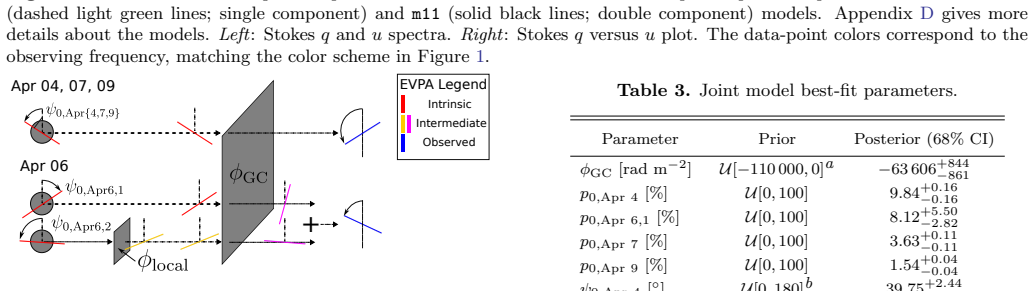
MAXI J1744-294 exhibits linear polarization whose normalized Stokes parameters q and u over four epochs are consistent with a single Faraday screen of RM = −63606 +844/−861 rad m−2. This value matches the rotation measure of the Galactic center magnetar PSR J1745-2900 to within the uncertainties. The agreement constitutes the first direct evidence that MAXI J1744-294 resides within the Galactic center region, is bound to Sgr A*, and is therefore a member of the nuclear star cluster. A secondary polarized component detected only on 2025 April 6 implies an additional local screen of RM ≈ −6000 rad m−2 whose strength, under the assumption of synchrotron cooling, corresponds to a magnetic field
What carries the argument
The Faraday rotation measure derived from the frequency dependence of the observed polarization angle in the Stokes q–u plane, compared directly to the independently measured RM of PSR J1745-2900.
If this is right
- MAXI J1744-294 is gravitationally bound to Sgr A* and belongs to the nuclear star cluster.
- Sgr A*’s rotation measure of order 10^5 rad m−2 is generated locally rather than by unrelated line-of-sight material.
- The uniform Faraday screen across the Galactic center allows polarization to serve as a distance indicator for other transients in the same region.
- The secondary component on April 6 is consistent with a short-lived knot in a relativistic jet carrying a magnetic field of 15–30 gauss.
Where Pith is reading between the lines
- Polarization monitoring of other unidentified radio sources near Sgr A* could locate additional members of the nuclear cluster.
- The uniformity of the screen supports models in which the dominant Faraday rotation occurs inside the nuclear star cluster rather than in the Galactic disk.
- Detection of similar secondary components in future outbursts would allow repeated measurements of magnetic-field strength in transient jets near the black hole.
Load-bearing premise
The observed polarization is produced by a single uniform Faraday screen shared with the magnetar, and the secondary component arises from synchrotron cooling inside a compact jet knot.
What would settle it
A future epoch in which MAXI J1744-294 shows a rotation measure differing by more than a few thousand rad m−2 from the magnetar value, or astrometric measurements showing the source is not bound to Sgr A*, would falsify the shared-screen interpretation.
Figures



read the original abstract
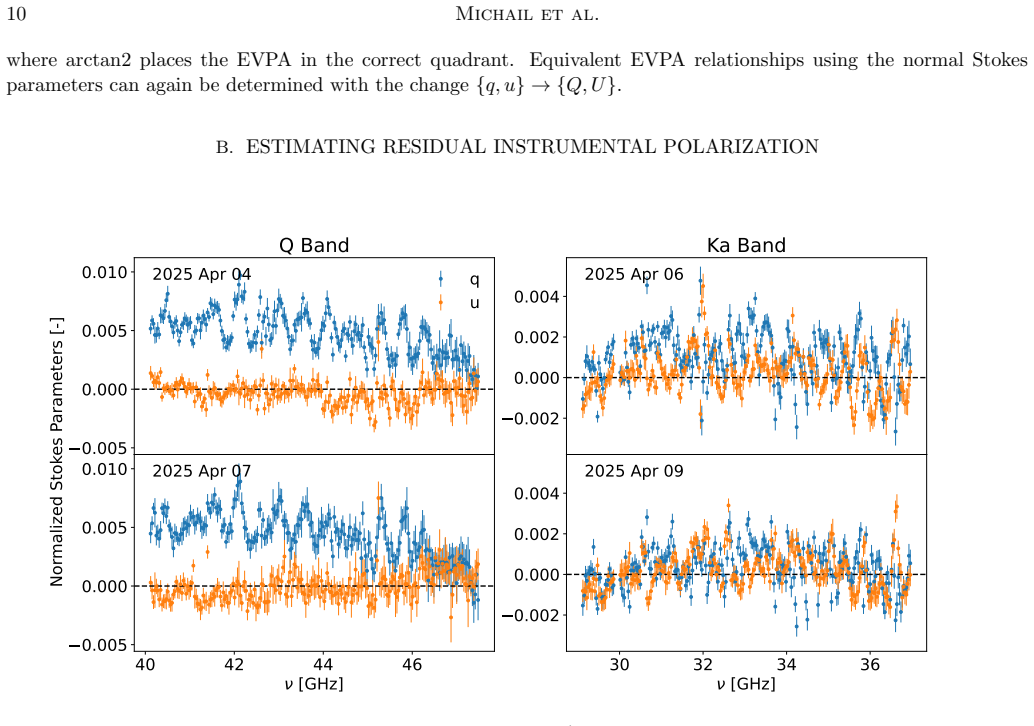
MAXI J1744$-$294, likely a low-mass X-ray binary system, is a Galactic-center transient source, detected at radio and X-ray wavelengths, located approximately $19''$ southeast of Sgr A*. We report the first detection of its variable linear polarization in four epochs spanning 2025 Apr 04--09. The normalized 33 and 43 GHz Stokes parameters $q$ and $u$ over the four epochs imply a common Faraday rotation screen with a rotation measure RM $=-63\,606^{+844}_{-861}$ radians m$^{-2}$, the third largest RM detected within the Galaxy. The RM is consistent with that of the Galactic center magnetar PSR J1745$-$2900, giving the first direct evidence that MAXI J1744 lies within the Galactic center region, is bound to Sgr A*, and therefore, is part of the nuclear star cluster. The uniformity in the Galactic center Faraday screen suggests that Sgr A*'s $\approx-10^5$ rad m$^{-2}$ RM is intrinsic rather than originating from an unrelated line-of-sight source. On 2025 Apr 06, we detected a secondary polarized component with an additional RM $\approx-6000$ rad m$^{-2}$, which was not seen at any other epoch. Assuming this secondary component primarily cools by synchrotron radiation, the implied local magnetic field strength is $\sim$15--30 gauss. In the context of a jetted X-ray binary progenitor, the additional RM screen and magnetic field strength are explainable with a short-lived knot in a putative jet.
Editorial analysis
A structured set of objections, weighed in public.
Referee Report
Summary. The manuscript reports the first detection of variable linear polarization from the Galactic-center X-ray transient MAXI J1744-294 at 33 and 43 GHz across four epochs (2025 Apr 04-09). Fitting the normalized Stokes q and u parameters yields a common Faraday rotation measure RM = -63606^{+844}_{-861} rad m^{-2} that is consistent with the RM of the Galactic-center magnetar PSR J1745-2900. This match is presented as direct evidence that MAXI J1744-294 lies within the Galactic center and is bound to Sgr A*. A secondary polarized component detected only on April 6 with RM ≈ -6000 rad m^{-2} is interpreted as emission from a short-lived knot in a putative jet, with an implied local magnetic field of 15-30 G under a synchrotron-cooling assumption.
Significance. If the single external-screen interpretation is robust, the result supplies the first polarization-based evidence placing an X-ray binary transient inside the Galactic-center nuclear star cluster. The large, uniform RM also bears on whether Sgr A*’s own RM is intrinsic. The multi-epoch Stokes-parameter data set and its direct comparison to an independent magnetar measurement are clear strengths; the work is observationally grounded and the fitting approach is in principle reproducible from the reported q/u values.
major comments (2)
- [RM fitting procedure (main text, description of common-RM solution from q/u)] The central claim that a single external Faraday screen produces the observed q and u across all epochs and both frequencies rests on the assumption that the primary component is uncontaminated by internal rotation, time-variable intrinsic angle, or blending with the secondary component. The detection of a distinct secondary component (RM ≈ -6000 rad m^{-2}) on April 6 demonstrates that multiple polarized signals can coexist along the line of sight; the manuscript does not show that the primary-component fit remains unbiased when this possibility is allowed (e.g., via joint multi-component modeling or epoch-by-epoch residual analysis).
- [Interpretation of secondary component (main text, April 6 analysis and B-field derivation)] The magnetic-field estimate of 15-30 G for the April 6 secondary component is derived under the explicit assumption of synchrotron cooling in a compact knot. The manuscript does not quantify how the inferred B would change under alternative cooling (adiabatic expansion, inverse-Compton) or foreground-screen scenarios, nor does it present the synchrotron-loss timescale calculation that would make the assumption unique given the observed variability.
minor comments (3)
- [Abstract] In the abstract, 'MAXI J1744 lies' should read 'MAXI J1744-294 lies'.
- [Abstract and discussion] The statement that the derived RM is 'the third largest RM detected within the Galaxy' would benefit from a brief citation or table placing it in context with the two larger values.
- [Figure captions] Figure captions should explicitly state the frequency, epoch, and whether the plotted quantities are observed or model-subtracted Stokes parameters.
Simulated Author's Rebuttal
We thank the referee for the careful and constructive review of our manuscript. The two major comments raise valid points about the robustness of the primary RM fit and the justification for the synchrotron-cooling assumption used for the secondary component. We address each below and have revised the manuscript to incorporate additional analysis and discussion where appropriate.
read point-by-point responses
-
Referee: [RM fitting procedure (main text, description of common-RM solution from q/u)] The central claim that a single external Faraday screen produces the observed q and u across all epochs and both frequencies rests on the assumption that the primary component is uncontaminated by internal rotation, time-variable intrinsic angle, or blending with the secondary component. The detection of a distinct secondary component (RM ≈ -6000 rad m^{-2}) on April 6 demonstrates that multiple polarized signals can coexist along the line of sight; the manuscript does not show that the primary-component fit remains unbiased when this possibility is allowed (e.g., via joint multi-component modeling or epoch-by-epoch residual analysis).
Authors: We agree that the presence of the secondary component on April 6 requires explicit demonstration that the primary RM solution is not biased. In the revised manuscript we will add an epoch-by-epoch residual analysis after subtracting the best-fit common-RM model from the primary component. The residuals are consistent with the quoted uncertainties on all epochs except April 6, where the deviation is fully accounted for by the separately fitted secondary component. A joint multi-component fit across the full data set is not warranted given the low signal-to-noise ratio and the fact that the secondary signal is isolated both temporally and in RM space; we will state this limitation explicitly and note that the primary RM remains stable when April 6 is excluded from the fit. revision: partial
-
Referee: [Interpretation of secondary component (main text, April 6 analysis and B-field derivation)] The magnetic-field estimate of 15-30 G for the April 6 secondary component is derived under the explicit assumption of synchrotron cooling in a compact knot. The manuscript does not quantify how the inferred B would change under alternative cooling (adiabatic expansion, inverse-Compton) or foreground-screen scenarios, nor does it present the synchrotron-loss timescale calculation that would make the assumption unique given the observed variability.
Authors: We accept that the synchrotron-cooling assumption needs quantitative support. The revised manuscript will include the synchrotron-loss timescale calculation, which yields a cooling time of order one day for B ≈ 20 G and the observed frequency, comparable to the variability timescale of the April 6 component. We will also add a brief discussion of alternatives: adiabatic expansion would imply a lower B (by a factor of ~3–5) but is disfavored by the rapid variability; inverse-Compton losses would require unrealistically high photon densities. While a full parameter exploration of every scenario is beyond the scope of the current data, we now explicitly justify why synchrotron cooling is the most plausible mechanism for a compact jet knot. revision: yes
Circularity Check
No circularity: RM derived by direct fit to Stokes parameters; magnetar comparison is external
full rationale
The paper fits a single RM value to the observed normalized Stokes q and u across four epochs at 33/43 GHz, then notes consistency with the independently measured RM of PSR J1745-2900. This comparison supplies external evidence for a shared screen rather than defining the RM or the source location in terms of itself. The secondary April 6 component is identified separately with its own RM. No equation reduces the claimed GC location or screen uniformity to a tautology, a fitted parameter renamed as a prediction, or a self-citation chain. The derivation remains self-contained against the polarization data.
Axiom & Free-Parameter Ledger
free parameters (1)
- RM fit parameters
axioms (2)
- domain assumption Faraday rotation is the dominant mechanism producing the observed frequency-dependent polarization angle
- domain assumption The secondary component on 2025 Apr 06 cools primarily by synchrotron radiation
invented entities (1)
-
short-lived knot in a putative jet
no independent evidence
Lean theorems connected to this paper
-
IndisputableMonolith/Cost/FunctionalEquation.leanwashburn_uniqueness_aczel unclear?
unclearRelation between the paper passage and the cited Recognition theorem.
The normalized 33 and 43 GHz Stokes parameters q and u over the four epochs imply a common Faraday rotation screen with a rotation measure RM =−63 606+844−861 radians m−2
-
IndisputableMonolith/Foundation/AlphaCoordinateFixation.leanalpha_pin_under_high_calibration unclear?
unclearRelation between the paper passage and the cited Recognition theorem.
Assuming this secondary component primarily cools by synchrotron radiation, the implied local magnetic field strength is ∼15–30 gauss
What do these tags mean?
- matches
- The paper's claim is directly supported by a theorem in the formal canon.
- supports
- The theorem supports part of the paper's argument, but the paper may add assumptions or extra steps.
- extends
- The paper goes beyond the formal theorem; the theorem is a base layer rather than the whole result.
- uses
- The paper appears to rely on the theorem as machinery.
- contradicts
- The paper's claim conflicts with a theorem or certificate in the canon.
- unclear
- Pith found a possible connection, but the passage is too broad, indirect, or ambiguous to say the theorem truly supports the claim.
Reference graph
Works this paper leans on
-
[1]
2023, MNRAS, 524, 2966, doi: 10.1093/mnras/stad2047 Astropy Collaboration, Robitaille, T
Abbate, F., Noutsos, A., Desvignes, G., et al. 2023, MNRAS, 524, 2966, doi: 10.1093/mnras/stad2047 Astropy Collaboration, Robitaille, T. P., Tollerud, E. J., et al. 2013, A&A, 558, A33, doi: 10.1051/0004-6361/201322068 Astropy Collaboration, Price-Whelan, A. M., Sip˝ ocz, B. M., et al. 2018, AJ, 156, 123, doi: 10.3847/1538-3881/aabc4f Astropy Collaboratio...
-
[2]
Blandford, R. D., & K¨ onigl, A. 1979, ApJ, 232, 34, doi: 10.1086/157262
-
[4]
1999b, ApJ, 521, 582, doi: 10.1086/307592
Falcke, H. 1999b, ApJ, 521, 582, doi: 10.1086/307592
-
[5]
Bower, G. C., Wright, M. C. H., Falcke, H., & Backer, D. C. 2003, ApJ, 588, 331, doi: 10.1086/373989
-
[6]
C., Broderick, A., Dexter, J., et al
Bower, G. C., Broderick, A., Dexter, J., et al. 2018, ApJ, 868, 101, doi: 10.3847/1538-4357/aae983 14Michail et al
-
[7]
Brentjens, M. A., & de Bruyn, A. G. 2005, A&A, 441, 1217, doi: 10.1051/0004-6361:20052990
-
[8]
2013, MNRAS, 432, 931, doi: 10.1093/mnras/stt493 CASA Team, Bean, B., Bhatnagar, S., et al
Brocksopp, C., Corbel, S., Tzioumis, A., et al. 2013, MNRAS, 432, 931, doi: 10.1093/mnras/stt493 CASA Team, Bean, B., Bhatnagar, S., et al. 2022, PASP, 134, 114501, doi: 10.1088/1538-3873/ac9642
-
[9]
J., & Ransom, S
Condon, J. J., & Ransom, S. M. 2016, Essential Radio Astronomy
2016
-
[10]
, archivePrefix = "arXiv", eprint =
Desvignes, G., Eatough, R. P., Pen, U. L., et al. 2018, ApJL, 852, L12, doi: 10.3847/2041-8213/aaa2f8
-
[11]
Dickey, J. M., Landecker, T. L., Thomson, A. J. M., et al. 2019, The Astrophysical Journal, 871, 106, doi: 10.3847/1538-4357/aaf85f
-
[12]
P., Falcke, H., Karuppusamy, R., et al
Eatough, R. P., Falcke, H., Karuppusamy, R., et al. 2013, Nature, 501, 391, doi: 10.1038/nature12499 GRAVITY Collaboration, Abuter, R., Amorim, A., et al. 2019, A&A, 625, L10, doi: 10.1051/0004-6361/201935656
-
[13]
2025, The Astronomer’s Telegram, 17045, 1
Grollimund, N., Corbel, S., Bahramian, A., et al. 2025, The Astronomer’s Telegram, 17045, 1
2025
-
[14]
Hannikainen, D. C., Hunstead, R. W., Campbell-Wilson, D., et al. 2000, ApJ, 540, 521, doi: 10.1086/309294
-
[15]
O., Nakajima, M., Kudo, Y., et al
Heinke, C. O., Nakajima, M., Kudo, Y., et al. 2025, The Astronomer’s Telegram, 17010, 1
2025
-
[16]
Hughes, A. K., Sivakoff, G. R., Macpherson, C. E., et al. 2023, MNRAS, 521, 185, doi: 10.1093/mnras/stad396
-
[17]
K., Steiner, J
Jaisawal, G. K., Steiner, J. F., Strohmayer, T. E., et al. 2025, The Astronomer’s Telegram, 17040, 1
2025
-
[18]
Kepley, A. A., Tsutsumi, T., Brogan, C. L., et al. 2020, PASP, 132, 024505, doi: 10.1088/1538-3873/ab5e14
-
[19]
2022, joshspeagle/dynesty: v1.2.1, v1.2.1 Zenodo, doi: 10.5281/zenodo.6414759
Koposov, S., Speagle, J., Barbary, K., et al. 2022, joshspeagle/dynesty: v1.2.1, v1.2.1 Zenodo, doi: 10.5281/zenodo.6414759
-
[20]
2025, The Astronomer’s Telegram, 16975, 1
Kudo, Y., Negoro, H., Nakajima, M., et al. 2025, The Astronomer’s Telegram, 16975, 1
2025
-
[21]
Lacy, M., Baum, S. A., Chandler, C. J., et al. 2020, PASP, 132, 035001, doi: 10.1088/1538-3873/ab63eb
-
[22]
Liu, H. B., Wright, M. C. H., Zhao, J.-H., et al. 2016, A&A, 593, A107, doi: 10.1051/0004-6361/201628731
-
[23]
Longair, M. S. 2011, High Energy Astrophysics
2011
-
[24]
2026, The Astronomer’s Telegram, 17663, 1
Mandel, S., Mori, K., Hua, Z., et al. 2026, The Astronomer’s Telegram, 17663, 1
2026
-
[25]
2025, arXiv e-prints, arXiv:2509.14465
Mandel, S., Mori, K., Ciurlo, A., et al. 2025a, arXiv e-prints, arXiv:2509.14465, doi: 10.48550/arXiv.2509.14465
-
[26]
Marra, L., Mikuˇ sincov´ a, R., Vincentelli, F. M., et al. 2025, arXiv e-prints, arXiv:2506.17050, doi: 10.48550/arXiv.2506.17050
-
[27]
Marrone, D. P., Moran, J. M., Zhao, J.-H., & Rao, R. 2006, ApJ, 640, 308, doi: 10.1086/500106
-
[28]
Marrone, D. P., Moran, J. M., Zhao, J.-H., & Rao, R. 2007, ApJL, 654, L57, doi: 10.1086/510850
-
[29]
M., von Fellenberg, S., Haggard, D., et al
Michail, J. M., von Fellenberg, S., Haggard, D., et al. 2025, The Astronomer’s Telegram, 17174, 1
2025
-
[30]
Michail, J. M., von Fellenberg, S. D., Keating, G. K., et al. 2026, ApJ, 997, 282, doi: 10.3847/1538-4357/ae25ef
-
[31]
Miller-Jones, J. C. A., Tetarenko, A. J., Sivakoff, G. R., et al. 2019, Nature, 569, 374, doi: 10.1038/s41586-019-1152-0
-
[32]
Mori, K., Hailey, C. J., Mandel, S., et al. 2019, ApJ, 885, 142, doi: 10.3847/1538-4357/ab4b47
-
[33]
Nakajima, M., Negoro, H., Kudo, Y., et al. 2025, The Astronomer’s Telegram, 16983, 1 O’Sullivan, S. P., Brown, S., Robishaw, T., et al. 2012, MNRAS, 421, 3300, doi: 10.1111/j.1365-2966.2012.20554.x
-
[34]
Gaensler, B. M. 2020, RM-Tools: Rotation measure (RM) synthesis and Stokes QU-fitting,, Astrophysics Source Code Library, record ascl:2005.003 http://ascl.net/2005.003 Rodriguez Cavero, N. 2024, arXiv e-prints, arXiv:2402.10371, doi: 10.48550/arXiv.2402.10371
-
[35]
2008, A&A, 478, 435, doi: 10.1051/0004-6361:20066470
Roy, S., Pramesh Rao, A., & Subrahmanyan, R. 2008, A&A, 478, 435, doi: 10.1051/0004-6361:20066470
-
[36]
Roychowdhury, T., von Fellenberg, S. D., Michail, J. M., et al. 2025, PASP, 137, 114102, doi: 10.1088/1538-3873/ae16d6
-
[37]
B., & Lightman, A
Rybicki, G. B., & Lightman, A. P. 1986, Radiative Processes in Astrophysics
1986
-
[38]
J., Hamaker, J
Sault, R. J., Hamaker, J. P., & Bregman, J. D. 1996, A&AS, 117, 149
1996
-
[39]
, archivePrefix = "arXiv", eprint =
Sicheneder, E., & Dexter, J. 2017, MNRAS, 467, 3642, doi: 10.1093/mnras/stx103 von Fellenberg, S. D., Roychowdhury, T., Michail, J. M., et al. 2025, ApJL, 979, L20, doi: 10.3847/2041-8213/ada3d2
-
[40]
2025, The Astronomer’s Telegram, 17068, 1
Wang, Y., Coti Zelati, F., Rea, N., et al. 2025, The Astronomer’s Telegram, 17068, 1
2025
-
[41]
2025, The Astronomer’s Telegram, 17009, 1
Watanabe, S., Aoyama, A., Takeda, T., et al. 2025, The Astronomer’s Telegram, 17009, 1
2025
-
[42]
Yusef-Zadeh, F., Diesing, R., Wardle, M., et al. 2015, ApJL, 811, L35, doi: 10.1088/2041-8205/811/2/L35 MAXI J1744-294 Linear Polarization Detection and Evolution15
-
[43]
Zdziarski, A. A., Tetarenko, A. J., & Sikora, M. 2022, ApJ, 925, 189, doi: 10.3847/1538-4357/ac38a9
discussion (0)
Sign in with ORCID, Apple, or X to comment. Anyone can read and Pith papers without signing in.