Recognition: unknown
LSST Strong Lensing Systems Dark Matter Sensitivity Analysis with Neural Ratio Estimators
Pith reviewed 2026-05-10 17:29 UTC · model grok-4.3
The pith
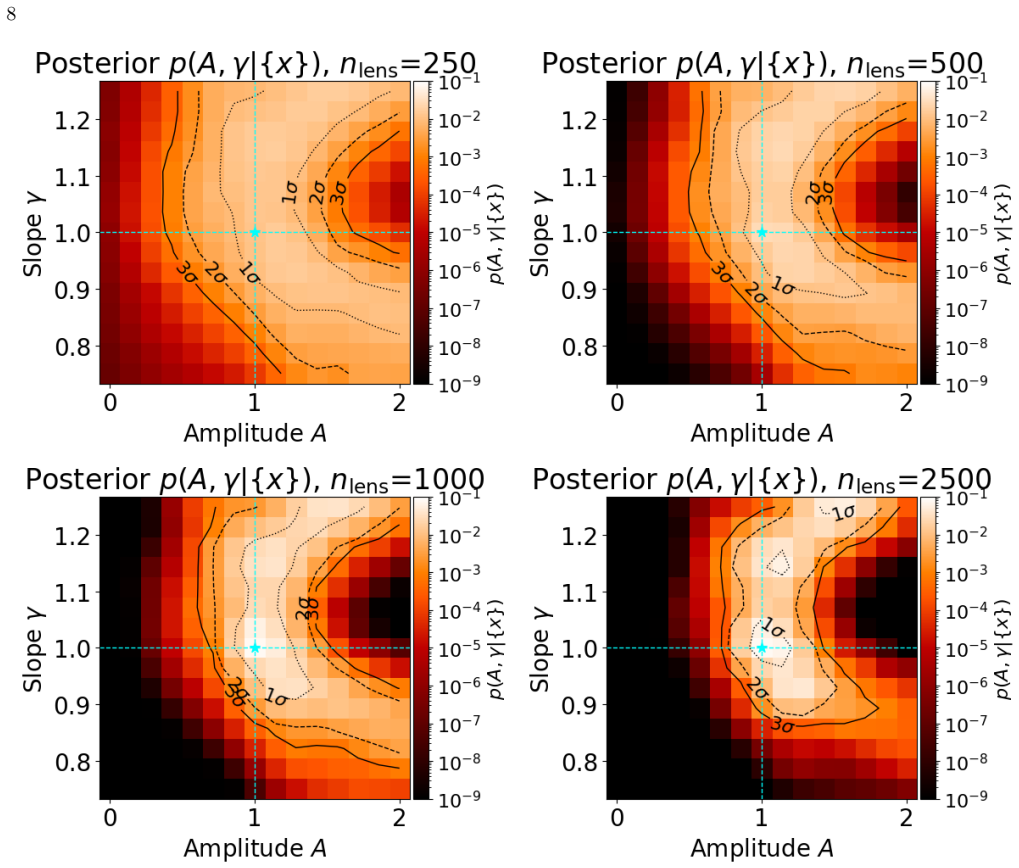
LSST forecasts show that analyzing 2500 strong lenses can exclude 74 percent of the dark matter halo mass function prior volume at 3 sigma.
A machine-rendered reading of the paper's core claim, the machinery that carries it, and where it could break.
Core claim
Simulations of LSST-quality strong lensing data demonstrate that combining 2500 lenses allows exclusion of approximately 74 percent of the considered prior volume at the 3 sigma level and 36 percent at the 5 sigma level for halo mass function parameters. This level of constraint is sufficient to distinguish Lambda-CDM from many non-standard dark matter scenarios. The signal arises from the full halo population, since removing halos below 10 to the 7.5 solar masses shifts the posteriors, and line-of-sight halos contribute an increasing fraction of the information at higher redshifts.
What carries the argument
Neural ratio estimators trained on simulated strong lensing images that incorporate dark matter subhalos and line-of-sight halos down to 10^7 solar masses.
Load-bearing premise
The entire forecast assumes that the simulations perfectly reproduce the actual data-generating process, including all noise and modeling details.
What would settle it
Measuring posteriors from real LSST data on 2500 strong lenses that exclude far less than 74 percent of the prior volume at 3 sigma would falsify the claimed sensitivity.
Figures



read the original abstract
Strong gravitational lensing offers a unique probe of dark matter (DM) on sub-galactic scales, where the abundance and distribution of low-mass halos are highly sensitive to the underlying properties of DM particles. In this work, we forecast LSST's sensitivity to DM substructure in galaxy-galaxy strong lenses using simulated samples and neural ratio estimators (NREs). Our simulations include both subhalos within the main deflector and line-of-sight (LOS) halos, with halo masses down to $\sim 10^7 M_\odot$ under the expected LSST ten-year survey imaging quality. We show that the constraining power on halo mass function (HMF) parameters improves significantly with sample size. Analyses based on a few hundred lenses yield broad posteriors comparable with other probes like the Ly-$\alpha$ forest. By contrast, when combining 2500 lenses, $\approx 74\%$ and $\approx 36\%$ of the prior volume considered can be excluded at the $3\sigma$ and $5\sigma$ levels respectively, enabling statistically significant exclusions of non-$\Lambda$CDM scenarios. We further demonstrate that the sensitivity arises not only from the high-mass end of the HMF but also from low-mass halos: masking halos below $\log (m_{\rm halo}/M_\odot) \leq 7.5$ induces a measurable shift in the inferred posteriors. Finally, we find that LOS halos contribute significantly to the constraining power, with increasing importance of LOS halos at higher redshifts. While this analysis assumes perfect knowledge of the data-generating process and cannot be directly applied to data analysis, it quantifies constraints achievable with LSST alone and motivates the development of robust inference methods for real survey data.
Editorial analysis
A structured set of objections, weighed in public.
Referee Report
Summary. The paper forecasts LSST's constraining power on dark matter halo mass function (HMF) parameters using simulated strong-lensing systems analyzed with neural ratio estimators (NREs). Simulations incorporate both subhalos and line-of-sight halos down to ~10^7 M_⊙ under ten-year LSST imaging quality. Key results include scaling of posterior constraints with sample size, exclusion of ~74% and ~36% of the considered prior volume at 3σ and 5σ with 2500 lenses, measurable impact from low-mass halos (via masking tests), and significant contribution from LOS halos that increases with redshift. The analysis is explicitly conditioned on perfect knowledge of the data-generating process.
Significance. This simulation-based forecast quantifies the statistical power of LSST strong lensing for sub-galactic DM probes and demonstrates the utility of NREs for handling large lens samples. The explicit scaling with sample size, the masking experiment isolating low-mass halo contributions, and the redshift-dependent LOS role provide concrete, falsifiable benchmarks that can guide method development. The paper's transparent boundary condition (perfect knowledge) allows the reported exclusion fractions to be interpreted correctly as an upper-bound forecast rather than a direct data-analysis claim.
major comments (1)
- [§4] §4 (results on 2500-lens sample): the 74%/36% prior-volume exclusion figures at 3σ/5σ are load-bearing for the central claim, yet the text does not state the precise definition of the prior volume (e.g., the exact ranges and priors on HMF slope/normalization) nor the exact procedure used to convert NRE posterior samples into these volume-exclusion percentages; a short appendix or equation would make the numbers directly reproducible.
minor comments (3)
- [Abstract] Abstract and §1: the phrase 'enabling statistically significant exclusions of non-ΛCDM scenarios' is slightly overstated given the perfect-knowledge assumption; a qualifier such as 'under idealized conditions' would align the language with the explicit caveat later in the text.
- [Figure 5] Figure 5 (or equivalent masking panel): the shift in posteriors when masking halos below log(m_halo/M_⊙) = 7.5 is shown, but the caption does not indicate the number of realizations or the precise HMF parameter ranges used; adding this would clarify the robustness of the low-mass contribution claim.
- [§3.2] §3.2 (NRE training): the architecture and training details are summarized, but the loss function, number of simulations per training batch, and convergence diagnostics are not reported; these are standard for reproducibility of ratio-estimator results.
Simulated Author's Rebuttal
We thank the referee for their positive evaluation and recommendation for minor revision. We address the single major comment below and will update the manuscript accordingly.
read point-by-point responses
-
Referee: §4 (results on 2500-lens sample): the 74%/36% prior-volume exclusion figures at 3σ/5σ are load-bearing for the central claim, yet the text does not state the precise definition of the prior volume (e.g., the exact ranges and priors on HMF slope/normalization) nor the exact procedure used to convert NRE posterior samples into these volume-exclusion percentages; a short appendix or equation would make the numbers directly reproducible.
Authors: We agree that the exact prior ranges on the HMF parameters and the procedure for computing the excluded prior volume fractions should be stated explicitly for reproducibility. In the revised manuscript we will add a short appendix (or dedicated subsection in §4) that specifies the prior ranges and functional forms for the HMF slope and normalization, together with the precise equation used to convert the NRE posterior samples into the reported 3σ and 5σ prior-volume exclusion percentages. revision: yes
Circularity Check
No significant circularity; forecast is self-contained simulation result
full rationale
The paper's central result is a forecast of exclusion power on HMF parameters obtained by training neural ratio estimators on large suites of forward simulations of strong lenses (including subhalos and LOS halos) and then evaluating posterior volume exclusion against external priors. No equation or step reduces the reported 74%/36% exclusion fractions (or the sensitivity to low-mass halos or LOS contributions) to a fitted parameter defined by the same data; the analysis is explicitly conditioned on perfect knowledge of the data-generating process and does not claim applicability to real observations. No self-citation is load-bearing for the forecast numbers, and no ansatz, uniqueness theorem, or renaming of a known result is invoked to force the outcome.
Axiom & Free-Parameter Ledger
free parameters (2)
- HMF slope and normalization parameters
- Lens and source redshift distributions
axioms (2)
- domain assumption The data-generating process (lens modeling, halo populations, imaging quality) is known perfectly
- domain assumption Neural ratio estimators can accurately recover the likelihood ratio for the chosen summary statistics
Reference graph
Works this paper leans on
-
[1]
Baltz, E. A., Marshall, P., & Oguri, M. 2009, JCAP, 2009, 015, doi: 10.1088/1475-7516/2009/01/015
-
[2]
Bode, P., Ostriker, J. P., & Turok, N. 2001, ApJ, 556, 93, doi: 10.1086/321541
-
[3]
2018, Constraining Effective Field Theories with Machine Learning
Brehmer, J., Cranmer, K., Louppe, G., & Pavez, J. 2018, Constraining Effective Field Theories with Machine Learning. https://arxiv.org/abs/1805.00013
-
[4]
Brehmer, J., Louppe, G., Pavez, J., & Cranmer, K. 2020, Proceedings of the National Academy of Sciences, 117, 5242, doi: 10.1073/pnas.1915980117
-
[5]
Brehmer, J., Mishra-Sharma, S., Hermans, J., Louppe, G., & Cranmer, K. 2019, ApJ, 886, 49, doi: 10.3847/1538-4357/ab4c41 Campeau-Poirier, `E., Perreault-Levasseur, L., Coogan, A., & Hezaveh, Y. 2023, in Machine Learning for Astrophysics, 6, doi: 10.48550/arXiv.2309.16063 Col´ ın, P., Avila-Reese, V., & Valenzuela, O. 2000, ApJ, 542, 622, doi: 10.1086/317057
-
[6]
Collett, T. E. 2015, ApJ, 811, 20, doi: 10.1088/0004-637X/811/1/20
-
[7]
Coogan, A., Montel, N. A., Karchev, K., et al. 2022, One never walks alone: the effect of the perturber population on subhalo measurements in strong gravitational lenses. https://arxiv.org/abs/2209.09918
-
[8]
Cranmer, K., Pavez, J., & Louppe, G. 2015, arXiv e-prints, arXiv:1506.02169, doi: 10.48550/arXiv.1506.02169
-
[9]
Diemand, J., Kuhlen, M., & Madau, P. 2007, ApJ, 667, 859, doi: 10.1086/520573
-
[10]
2025a, arXiv e-prints, arXiv:2511.13669, doi: 10.48550/arXiv.2511.13669
Erickson, S., Millon, M., Venkatraman, P., et al. 2025a, arXiv e-prints, arXiv:2511.13669, doi: 10.48550/arXiv.2511.13669
-
[11]
2025b, AJ, 170, 44, doi: 10.3847/1538-3881/add99f
Erickson, S., Wagner-Carena, S., Marshall, P., et al. 2025b, AJ, 170, 44, doi: 10.3847/1538-3881/add99f
-
[12]
Ferreira, E. G. M. 2021, A&A Rv, 29, 7, doi: 10.1007/s00159-021-00135-6
-
[13]
2025, ApJ, 989, 226, doi: 10.3847/1538-4357/adee20
Filipp, A., Hezaveh, Y., & Perreault-Levasseur, L. 2025, ApJ, 989, 226, doi: 10.3847/1538-4357/adee20
-
[14]
2021, JCAP, 2021, 024, doi: 10.1088/1475-7516/2021/08/024
Fleury, P., Larena, J., & Uzan, J.-P. 2021, JCAP, 2021, 024, doi: 10.1088/1475-7516/2021/08/024
-
[15]
2020, MNRAS, 491, 6077, doi: 10.1093/mnras/stz3480 13
Gilman, D., Birrer, S., Nierenberg, A., et al. 2020, MNRAS, 491, 6077, doi: 10.1093/mnras/stz3480 13
-
[16]
Deep residual learning for image recognition
He, K., Zhang, X., Ren, S., & Sun, J. 2016, in 2016 IEEE Conference on Computer Vision and Pattern Recognition (CVPR), 1, doi: 10.1109/CVPR.2016.90
-
[17]
Hezaveh, Y. D., Dalal, N., Marrone, D. P., et al. 2016, ApJ, 823, 37, doi: 10.3847/0004-637X/823/1/37
-
[18]
Nine-Year Wilkinson Microwave Anisotropy Probe (WMAP) Observations: Cosmological Parameter Results
Hinshaw, G., Larson, D., Komatsu, E., et al. 2013, ApJS, 208, 19, doi: 10.1088/0067-0049/208/2/19
-
[19]
2018, PhRvD, 97, 123002, doi: 10.1103/PhysRevD.97.123002
Hiroshima, N., Ando, S., & Ishiyama, T. 2018, PhRvD, 97, 123002, doi: 10.1103/PhysRevD.97.123002
-
[20]
Hogg, N. B., Nightingale, J. W., He, Q., et al. 2025, arXiv e-prints, arXiv:2503.08785, doi: 10.48550/arXiv.2503.08785
-
[21]
Physical Review Letters85, 1158–1161 (2000) https://doi.org/ 10.1103/PhysRevLett.85.1158
Hu, W., Barkana, R., & Gruzinov, A. 2000, PhRvL, 85, 1158, doi: 10.1103/PhysRevLett.85.1158 Ivezi´ c,ˇZ., Kahn, S. M., & Tyson, J. A. e. a. 2019a, ApJ, 873, 111, doi: 10.3847/1538-4357/ab042c Ivezi´ c,ˇZ., Kahn, S. M., Tyson, J. A., et al. 2019b, ApJ, 873, 111, doi: 10.3847/1538-4357/ab042c
-
[22]
2024, arXiv e-prints, arXiv:2407.17292, doi: 10.48550/arXiv.2407.17292
Jarugula, S., Nord, B., Gandrakota, A., & ´Ciprijanovi´ c, A. 2024, arXiv e-prints, arXiv:2407.17292, doi: 10.48550/arXiv.2407.17292
-
[23]
Adam: A Method for Stochastic Optimization
Kingma, D. P., & Ba, J. 2014, arXiv e-prints, arXiv:1412.6980, doi: 10.48550/arXiv.1412.6980
work page internal anchor Pith review Pith/arXiv arXiv doi:10.48550/arxiv.1412.6980 2014
-
[24]
2007, ApJ, 671, 1135, doi: 10.1086/522878
Kuhlen, M., Diemand, J., & Madau, P. 2007, ApJ, 671, 1135, doi: 10.1086/522878
-
[25]
2022, A&A, 668, A166, doi: 10.1051/0004-6361/202244978 LSST Science Collaboration, Abell, P
Loudas, N., Pavlidou, V., Casadio, C., & Tassis, K. 2022, A&A, 668, A166, doi: 10.1051/0004-6361/202244978 LSST Science Collaboration, Abell, P. A., Allison, J., & et al. 2009, arXiv e-prints, arXiv:0912.0201. https://arxiv.org/abs/0912.0201
-
[26]
, year = 1997, month = dec, volume = 490, pages =
Navarro, J. F., Frenk, C. S., & White, S. D. M. 1997, ApJ, 490, 493, doi: 10.1086/304888 Planck Collaboration, Aghanim, N., Akrami, Y., et al. 2020, A&A, 641, A6, doi: 10.1051/0004-6361/201833910
-
[27]
2025, JCAP, 2025, 053, doi: 10.1088/1475-7516/2025/05/053
Poh, J., Samudre, A., ´Ciprijanovi´ c, A., et al. 2025, JCAP, 2025, 053, doi: 10.1088/1475-7516/2025/05/053
-
[28]
Rogers, K. K., & Poulin, V. 2025, Physical Review Research, 7, L012018, doi: 10.1103/PhysRevResearch.7.L012018
-
[29]
2014, ApJL, 793, L10, doi: 10.1088/2041-8205/793/1/L10 S´ ersic, J
Serjeant, S. 2014, ApJL, 793, L10, doi: 10.1088/2041-8205/793/1/L10 S´ ersic, J. L. 1963, Boletin de la Asociacion Argentina de Astronomia La Plata Argentina, 6, 41
-
[30]
G., Staveley-Smith, L., de Blok, W
Sheth, R. K., Mo, H. J., & Tormen, G. 2001, MNRAS, 323, 1, doi: 10.1046/j.1365-8711.2001.04006.x
-
[31]
J., Schawinski, K., Slosar, A., et al
Springel, V., Wang, J., Vogelsberger, M., et al. 2008, MNRAS, 391, 1685, doi: 10.1111/j.1365-2966.2008.14066.x
-
[32]
2024, arXiv e-prints, arXiv:2406.15542, doi: 10.48550/arXiv.2406.15542
Stone, C., Adam, A., Coogan, A., et al. 2024, arXiv e-prints, arXiv:2406.15542, doi: 10.48550/arXiv.2406.15542
-
[33]
2018, arXiv e-prints, arXiv:1808.00973, doi: 10.48550/arXiv.1808.00973
Stoye, M., Brehmer, J., Louppe, G., Pavez, J., & Cranmer, K. 2018, arXiv e-prints, arXiv:1808.00973, doi: 10.48550/arXiv.1808.00973
-
[34]
Tessore, N., & Metcalf, R. B. 2015, A&A, 580, A79, doi: 10.1051/0004-6361/201526773
-
[35]
2025, arXiv e-prints, arXiv:2509.13318, doi: 10.48550/arXiv.2509.13318
Freese, K. 2025, arXiv e-prints, arXiv:2509.13318, doi: 10.48550/arXiv.2509.13318
-
[36]
2011, MNRAS, 410, 166, doi: 10.1111/j.1365-2966.2010.17432.x
Gavazzi, R. 2010, MNRAS, 408, 1969, doi: 10.1111/j.1365-2966.2010.16865.x
-
[37]
2025, arXiv e-prints, arXiv:2510.20778, doi: 10.48550/arXiv.2510.20778
Venkatraman, P., Erickson, S., Marshall, P., et al. 2025, arXiv e-prints, arXiv:2510.20778, doi: 10.48550/arXiv.2510.20778
-
[38]
Viel, M., Becker, G. D., Bolton, J. S., & Haehnelt, M. G. 2013, PhRvD, 88, 043502, doi: 10.1103/PhysRevD.88.043502
-
[39]
http://www.w3.org/1998/Math/MathML
Viel, M., Lesgourgues, J., Haehnelt, M. G., Matarrese, S., & Riotto, A. 2005, PhRvD, 71, 063534, doi: 10.1103/PhysRevD.71.063534
-
[40]
http://www.w3.org/1998/Math/MathML
Villasenor, B., Robertson, B., Madau, P., & Schneider, E. 2023, PhRvD, 108, 023502, doi: 10.1103/PhysRevD.108.023502
-
[41]
2023, ApJ, 942, 75, doi: 10.3847/1538-4357/aca525
Wagner-Carena, S., Aalbers, J., Birrer, S., et al. 2023, ApJ, 942, 75, doi: 10.3847/1538-4357/aca525
-
[42]
2024, arXiv e-prints, arXiv:2404.14487, doi: 10.48550/arXiv.2404.14487
Wagner-Carena, S., Lee, J., Pennington, J., et al. 2024, arXiv e-prints, arXiv:2404.14487, doi: 10.48550/arXiv.2404.14487
-
[43]
Zhang, G., S ¸eng¨ ul, A. C ¸ ., & Dvorkin, C. 2024, MNRAS, 527, 4183, doi: 10.1093/mnras/stad3521
discussion (0)
Sign in with ORCID, Apple, or X to comment. Anyone can read and Pith papers without signing in.