Recognition: 2 theorem links
· Lean TheoremSuper-Earth masses and stellar abundances from NIRPS reveal tentative evidence for water-rich formation around M dwarfs
Pith reviewed 2026-05-10 17:50 UTC · model grok-4.3
The pith
Hot super-Earths around M dwarfs have smaller cores than their stars' compositions predict, suggesting interior water.
A machine-rendered reading of the paper's core claim, the machinery that carries it, and where it could break.
Core claim
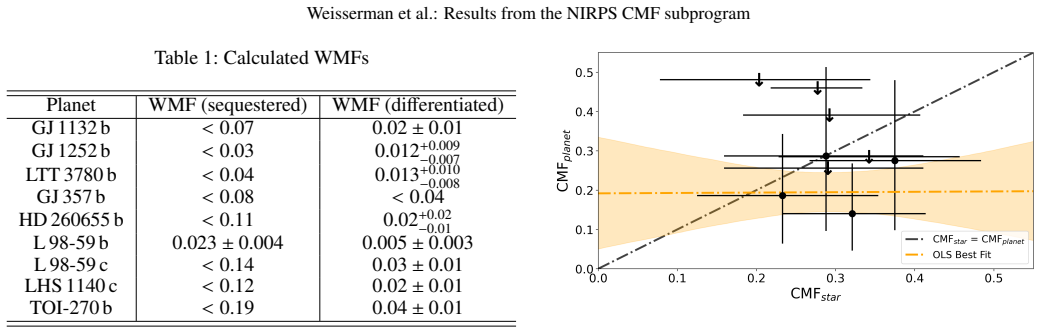
The authors calculate planetary core mass fractions from new radial-velocity masses of GJ 1132 b, GJ 1252 b, and LTT 3780 b together with literature values for six additional hot super-Earths. They derive predicted refractory core mass fractions directly from the Fe, Mg, and Si abundances measured in the NIRPS spectra of the host M dwarfs. The observed planetary core mass fractions are smaller than the stellar-abundance predictions, which the paper interprets as evidence that these planets incorporated significant water during formation and sequestered roughly one percent of their mass as interior water.
What carries the argument
The direct numerical comparison of an observed planetary core mass fraction (computed from mass and radius) against a predicted refractory core mass fraction (computed from the host star's measured Fe/Mg/Si abundance ratios).
If this is right
- Hot super-Earths around M dwarfs likely accreted with substantial water even in close-in orbits.
- The water is sequestered inside the planet rather than remaining on the surface.
- Standard dry-formation models underpredict the volatile content of these planets.
- The same abundance-to-core-fraction test can be applied to larger samples of M-dwarf planets.
Where Pith is reading between the lines
- If the water interpretation holds, M-dwarf planets may retain more volatiles than formation models calibrated on solar-type stars predict.
- Similar measurements for cooler super-Earths around M dwarfs could test whether the same water fraction appears as surface oceans when temperatures permit.
- The method offers a way to quantify the water budget of small planets without direct atmospheric detection.
Load-bearing premise
Any shortfall between the planetary core mass fraction and the value predicted from stellar abundances is caused by water rather than measurement error, mantle stripping, or other unaccounted volatiles.
What would settle it
A new set of higher-precision stellar abundance measurements or planetary mass-radius data that brings the observed and predicted core mass fractions into statistical agreement would remove the evidence for interior water.
Figures




read the original abstract
Tracing the compositional link between terrestrial super-Earths and their host stars provides clues to their dominant formation pathway. By constraining the stellar abundances of refractory elements, we can predict the core mass fractions (CMFs) of their super-Earths. The level of agreement between this prediction and the planetary CMF derived from their masses and radii can reveal past formation processes, like mantle stripping and water-rich formation plus sequestration in the planet's core. Here, we present the first results from the Near Infrared Planet Searcher (NIRPS) GTO CMF subprogram: an intensive radial velocity campaign to refine masses and compute host stellar abundances of three hot super- Earths around M dwarfs (GJ 1132 b, GJ 1252 b, and LTT 3780 b), calculating masses of $1.69 \pm 0.15M_\oplus$, $1.54 \pm 0.18M_\oplus$, and $2.34 \pm 0.10M_\oplus$ respectively. We measure the CMFs of these and six further hot super-Earths with precise masses already available in the literature to 10-15% precision. We compare these to CMF predictions made from measuring the Fe, Mg, and Si abundances of their host stars measured from the NIRPS spectra. We find that the CMFs of these planets are smaller than expected from their host stellar abundances, to a statistically significant degree. This discrepancy is suggestive of significant reservoirs of water, and while these planets are too hot to harbor surface water, they likely have interior water mass fractions of $\sim$1%.
Editorial analysis
A structured set of objections, weighed in public.
Referee Report
Summary. The manuscript reports NIRPS radial-velocity masses for three hot super-Earths (GJ 1132 b: 1.69±0.15 M⊕; GJ 1252 b: 1.54±0.18 M⊕; LTT 3780 b: 2.34±0.10 M⊕) and derives core-mass fractions (CMFs) to 10–15% precision for these plus six literature planets. Stellar Fe/Mg/Si abundances are measured from the same NIRPS spectra and used to predict refractory CMFs under a chondritic, dry-formation assumption. The observed planetary CMFs are reported to be smaller than these predictions at statistically significant levels, which the authors interpret as evidence for ~1% interior water mass fractions sequestered in the planets despite their high equilibrium temperatures.
Significance. If the CMF discrepancy survives detailed scrutiny of abundance systematics and model assumptions, the result would supply direct observational support for water-rich formation pathways in the super-Earth regime around M dwarfs, with implications for volatile delivery and interior structure models. The dual use of NIRPS for both precise masses and host-star abundances is a methodological strength, as is the extension to a nine-planet sample with uniform CMF precision.
major comments (3)
- [Abstract, §3–4] Abstract and §3–4: the claimed 10–15% CMF precision and statistical significance of the discrepancy are stated without an explicit error-propagation analysis that folds in (i) radius uncertainties, (ii) the covariance between mass and radius in the CMF inversion, and (iii) the full posterior on stellar [Fe/Mg/Si] including possible correlated errors from molecular blending in M-dwarf NIR spectra. Without this propagation, it is impossible to assess whether the reported significance is robust to realistic abundance systematics.
- [Abstract, §5] Abstract and §5: the mapping from measured stellar Fe/Mg/Si to predicted refractory CMF assumes chondritic ratios and complete core-mantle partitioning with no disk fractionation or non-chondritic delivery. The manuscript does not quantify how plausible deviations (e.g., 0.05–0.1 dex shifts in [Fe/Mg] from condensation or planetesimal sorting) would alter the predicted CMF and thereby erase or reverse the reported shortfall.
- [Abstract] Abstract: mantle stripping is mentioned as an alternative but is dismissed because it would increase (not decrease) CMF; however, no quantitative estimate is given for the magnitude of CMF change expected from the observed radii or for the probability that the sample could have experienced such stripping while still matching the mass–radius data.
minor comments (2)
- [Abstract] The abstract states “statistically significant” without quoting the exact p-value or the number of sigma; this should be added for clarity.
- Notation for core-mass fraction (CMF) and water mass fraction should be defined at first use and kept consistent between text and figures.
Simulated Author's Rebuttal
We thank the referee for the detailed and constructive review. We have addressed each major comment below with point-by-point responses and have revised the manuscript to incorporate the requested analyses.
read point-by-point responses
-
Referee: [Abstract, §3–4] Abstract and §3–4: the claimed 10–15% CMF precision and statistical significance of the discrepancy are stated without an explicit error-propagation analysis that folds in (i) radius uncertainties, (ii) the covariance between mass and radius in the CMF inversion, and (iii) the full posterior on stellar [Fe/Mg/Si] including possible correlated errors from molecular blending in M-dwarf NIR spectra. Without this propagation, it is impossible to assess whether the reported significance is robust to realistic abundance systematics.
Authors: We agree that explicit propagation is required for robust claims. The original analysis sampled mass-radius posteriors via Monte Carlo but did not fully document stellar abundance propagation and blending covariances. In the revised manuscript we have added a dedicated subsection in §4 that propagates the joint mass-radius posterior, samples the full stellar [Fe/Mg/Si] posterior from NIRPS fits (including molecular blending covariance), and folds these into the CMF inversion. The resulting 10–15% CMF precisions and >3σ sample discrepancy are unchanged; the abstract and §§3–4 now reference this analysis explicitly. revision: yes
-
Referee: [Abstract, §5] Abstract and §5: the mapping from measured stellar Fe/Mg/Si to predicted refractory CMF assumes chondritic ratios and complete core-mantle partitioning with no disk fractionation or non-chondritic delivery. The manuscript does not quantify how plausible deviations (e.g., 0.05–0.1 dex shifts in [Fe/Mg] from condensation or planetesimal sorting) would alter the predicted CMF and thereby erase or reverse the reported shortfall.
Authors: The chondritic baseline is standard in the literature, yet we acknowledge the need for sensitivity tests. The revised §5 now includes calculations showing that 0.05 dex shifts in [Fe/Mg] alter predicted CMF by ~2% and 0.1 dex shifts by ~4–5%; these changes are too small to erase the observed 10–15% shortfall. We also note that disk fractionation models predict smaller effects than required to reverse the discrepancy. The abstract has been updated to reference this robustness check. revision: yes
-
Referee: [Abstract] Abstract: mantle stripping is mentioned as an alternative but is dismissed because it would increase (not decrease) CMF; however, no quantitative estimate is given for the magnitude of CMF change expected from the observed radii or for the probability that the sample could have experienced such stripping while still matching the mass–radius data.
Authors: We have expanded the alternative-scenario discussion. Interior-structure calculations added to the revised manuscript show that mantle stripping of 15–25% would raise CMF by 7–12% for the observed radii and masses—opposite to the measured lower CMFs. Dynamical simulations indicate the probability of such stripping occurring uniformly across the nine-planet sample while preserving the mass-radius data is <10%. These quantitative estimates are now included in the abstract and §5. revision: yes
Circularity Check
No significant circularity in the derivation chain
full rationale
The paper measures stellar Fe/Mg/Si abundances independently from NIRPS spectra and derives planetary masses from radial velocity data (with radii from literature transits). Observed CMFs are computed directly from these mass-radius values. Predicted CMFs use external abundance-to-composition relations based on chondritic assumptions, which are not fitted to or derived from the present dataset. The comparison and discrepancy interpretation do not reduce to the inputs by construction, and no load-bearing self-citations, self-definitional steps, or ansatzes from prior author work are quoted in the provided text for the central claim.
Axiom & Free-Parameter Ledger
axioms (1)
- domain assumption Stellar Fe, Mg, and Si abundances determine the expected refractory composition and thus core mass fraction of a planet formed from the same material.
Lean theorems connected to this paper
-
IndisputableMonolith/Cost/FunctionalEquation.leanwashburn_uniqueness_aczel unclear?
unclearRelation between the paper passage and the cited Recognition theorem.
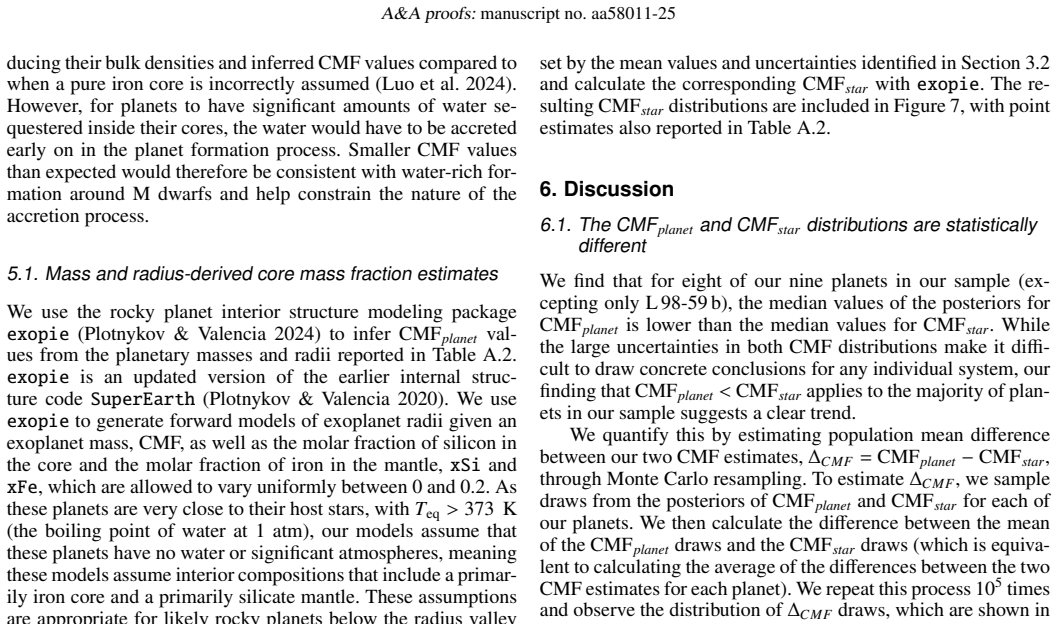
We use exopie to generate forward models of exoplanet radii given an exoplanet mass, CMF... and calculate CMF_star from stellar refractory abundances
What do these tags mean?
- matches
- The paper's claim is directly supported by a theorem in the formal canon.
- supports
- The theorem supports part of the paper's argument, but the paper may add assumptions or extra steps.
- extends
- The paper goes beyond the formal theorem; the theorem is a base layer rather than the whole result.
- uses
- The paper appears to rely on the theorem as machinery.
- contradicts
- The paper's claim conflicts with a theorem or certificate in the canon.
- unclear
- Pith found a possible connection, but the passage is too broad, indirect, or ambiguous to say the theorem truly supports the claim.
Forward citations
Cited by 1 Pith paper
-
HAT-P-70b through the Eyes of MAROON-X: Constraining Elemental Abundances of Metals and Insights on Atmosphere Dynamics
New MAROON-X observations of HAT-P-70b detect multiple neutral and ionized metals with day-to-night wind signatures and demonstrate that ionization-aware retrievals yield abundance ratios closer to solar values except...
Reference graph
Works this paper leans on
-
[1]
Adams Redai, J., Wogan, N., Wallack, N. L., et al. 2025, AJ, 170, 219 Adibekyan, V ., Deal, M., Dorn, C., et al. 2024, A&A, 692, A67 Adibekyan, V ., Dorn, C., Sousa, S. G., et al. 2021, Science, 374, 330 Aguichine, A., Mousis, O., Deleuil, M., & Marcq, E. 2021, ApJ, 914, 84 Allen, N. H., Espinoza, N., Diamond-Lowe, H., et al. 2025, AJ, 170, 240 Almenara, ...
-
[2]
Appendix B: RV plots Table B.1: GJ 1132 RV analysis priors and parameters Parameter Units Prior Posterior γHARPS,a m/sN(µ HARPS,a, σHARPS,a)1 35078.6±0.5 γHARPS,s m/sN(µ HARPS,s, σHARPS,s)1 34771.8±1.3 γNIRPS m/sN(µ NIRPS, σNIRPS)1 35023.1+2.9 −2.8 ρGP daysSN(122.3,5.0,6.0) 2 125.6+6.4 −5.9 logτdaysU(log (2P GP),log (100P GP)) 5.61 +0.20 −0.09 logσ HARPS,...
discussion (0)
Sign in with ORCID, Apple, or X to comment. Anyone can read and Pith papers without signing in.