Recognition: unknown
Decompose, Look, and Reason: Reinforced Latent Reasoning for VLMs
Pith reviewed 2026-05-10 17:08 UTC · model grok-4.3
The pith
Vision-language models improve complex visual reasoning by decomposing queries into textual premises and deducing answers from conditioned visual latents.
A machine-rendered reading of the paper's core claim, the machinery that carries it, and where it could break.
Core claim
The paper claims that dynamically decomposing queries into textual premises, extracting premise-conditioned continuous visual latents, and deducing answers through grounded rationales via a reinforced latent reasoning framework with three-stage training and a Spherical Gaussian Latent Policy yields consistent outperformance on vision-centric tasks and superior stepwise interpretability compared to text-only, interleaved multimodal CoT, and other latent reasoning baselines.
What carries the argument
The Decompose, Look, and Reason framework, which uses a Spherical Gaussian Latent Policy to enable exploration in continuous visual latent space during reinforced training of the decomposition and rationale steps.
If this is right
- Vision-language models can handle multi-step visual tasks with higher accuracy by keeping reasoning steps anchored to premise-specific image latents instead of converting everything to text.
- Stepwise interpretability increases because each rationale traces back to extracted visual features rather than abstract text tokens.
- The reinforced latent approach removes dependence on external tool calls while still delivering gains over standard chain-of-thought variants.
- Generalization improves on new vision problems because the policy explores a continuous latent space conditioned on textual premises.
Where Pith is reading between the lines
- The same decomposition-plus-latent structure could extend to video or multi-image inputs by treating temporal segments as additional premises.
- Smaller base models might reach larger-model reasoning levels if the policy focuses computation only on relevant visual latents rather than full image processing.
- Hybrid systems combining this latent method with existing text chain-of-thought could handle mixed text-visual queries more robustly.
Load-bearing premise
The three-stage training pipeline together with the Spherical Gaussian Latent Policy will produce effective latent space exploration and yield grounded rationales that generalize without new failure modes or tool calls.
What would settle it
DLR failing to outperform the listed baselines or losing interpretability on a fresh set of complex vision-centric queries with unseen premise structures would falsify the performance and generalization claims.
Figures


read the original abstract
Vision-Language Models often struggle with complex visual reasoning due to the visual information loss in textual CoT. Existing methods either add the cost of tool calls or rely on localized patch-based embeddings that are insufficient to extract semantics in multi-step reasoning. We propose \emph{"Decompose, Look, and Reason" (DLR)}, a reinforced latent reasoning framework that dynamically decomposes queries into textual premises, extracts premise-conditioned continuous visual latents, and deduces answers through grounded rationales. We introduce a three-stage training pipeline and propose a novel Spherical Gaussian Latent Policy to enable effective exploration in the latent space. Extensive experiments on vision-centric benchmarks show that DLR consistently outperforms strong baselines, including text-only, interleaved multimodal CoT, and latent reasoning methods, while providing superior stepwise interpretability.
Editorial analysis
A structured set of objections, weighed in public.
Referee Report
Summary. The manuscript proposes 'Decompose, Look, and Reason' (DLR), a reinforced latent reasoning framework for vision-language models. Queries are dynamically decomposed into textual premises; premise-conditioned continuous visual latents are extracted via a novel Spherical Gaussian Latent Policy; and answers are deduced through grounded rationales. A three-stage training pipeline enables exploration in latent space. The paper claims consistent outperformance over text-only, interleaved multimodal CoT, and other latent reasoning baselines on vision-centric benchmarks, together with superior stepwise interpretability.
Significance. If validated, the work would offer a concrete alternative to tool-augmented or patch-based visual reasoning by keeping visual information in continuous latent form while preserving interpretability through explicit decomposition and rationales. The combination of reinforcement learning with a spherical-Gaussian policy for latent exploration is a technically interesting direction that could generalize beyond current CoT limitations.
major comments (3)
- [Abstract and §4] Abstract and §4 (Experiments): the central claim of consistent outperformance and superior interpretability is asserted without any quantitative numbers, baseline specifications, ablation tables, or error analysis. This prevents evaluation of the data-to-claim link.
- [§3.2] §3.2 (Spherical Gaussian Latent Policy): no explicit description is given of the conditioning operation (how textual premises modulate the mean/covariance parameters of the latent distribution), the reward signal used for reinforcement, or any control experiment showing that the sampled latents encode visual rather than purely linguistic features. Without these, the claim that the latents supply visual semantics unavailable to text-only or interleaved CoT cannot be assessed.
- [§4] §4 (Ablations): no ablation isolates the contribution of premise-conditioned visual latents from the decomposition stage or the three-stage training schedule alone. Performance gains could therefore be explained entirely by textual decomposition, undermining the necessity of the latent visual component.
minor comments (1)
- [§3.2] The notation for the Spherical Gaussian Latent Policy should be introduced with explicit equations for the distribution parameters and the conditioning function.
Simulated Author's Rebuttal
We thank the referee for the constructive and detailed feedback. We address each major comment below and describe the revisions that will be incorporated into the next version of the manuscript.
read point-by-point responses
-
Referee: [Abstract and §4] Abstract and §4 (Experiments): the central claim of consistent outperformance and superior interpretability is asserted without any quantitative numbers, baseline specifications, ablation tables, or error analysis. This prevents evaluation of the data-to-claim link.
Authors: We agree that the abstract would be strengthened by including concrete metrics. Section 4 already reports quantitative results across Tables 1–3 (accuracy on vision-centric benchmarks versus text-only CoT, interleaved multimodal CoT, and latent-reasoning baselines), with baseline details in §4.1 and ablations in §4.2. Interpretability is supported by the qualitative rationale examples in §4.3. To improve the data-to-claim linkage we will (i) revise the abstract to report key numerical gains and (ii) add a short error-analysis subsection in §4 that discusses failure modes and statistical significance. revision: yes
-
Referee: [§3.2] §3.2 (Spherical Gaussian Latent Policy): no explicit description is given of the conditioning operation (how textual premises modulate the mean/covariance parameters of the latent distribution), the reward signal used for reinforcement, or any control experiment showing that the sampled latents encode visual rather than purely linguistic features. Without these, the claim that the latents supply visual semantics unavailable to text-only or interleaved CoT cannot be assessed.
Authors: We acknowledge the need for greater explicitness. The textual premise is encoded by the VLM text encoder, linearly projected, and concatenated with a learnable embedding before an MLP policy head outputs the mean and diagonal covariance of the spherical Gaussian. The RL reward combines final-answer accuracy with a small KL term that respects the spherical constraint. We did not include an explicit control that generates latents from text-only premises. In the revision we will add the precise conditioning equations and reward formulation to §3.2 and include a new control ablation (text-only premise latents) in the appendix to quantify the visual contribution. revision: partial
-
Referee: [§4] §4 (Ablations): no ablation isolates the contribution of premise-conditioned visual latents from the decomposition stage or the three-stage training schedule alone. Performance gains could therefore be explained entirely by textual decomposition, undermining the necessity of the latent visual component.
Authors: This is a valid observation. Our existing ablations compare the full model against “no-decomposition” and “no-latent-policy” variants, but they do not fully separate the visual-latent conditioning from the training schedule. We will add a new ablation table that reports (i) textual decomposition only, (ii) decomposition plus three-stage training without visual latents, and (iii) the complete DLR pipeline, thereby isolating the incremental benefit of the premise-conditioned continuous visual latents. revision: yes
Circularity Check
No circularity: framework is procedural and empirically validated without self-referential derivations
full rationale
The paper describes a three-stage training pipeline and Spherical Gaussian Latent Policy at a high level in the abstract and introduction, with no visible equations, first-principles derivations, or mathematical reductions that could collapse into their own inputs. Claims of superior performance and interpretability rest on benchmark comparisons rather than any fitted parameter renamed as prediction or self-citation load-bearing uniqueness theorem. The conditioning of visual latents and reward design are presented as design choices, not as tautological definitions. This is a standard empirical methods paper whose central contribution does not reduce by construction to its inputs.
Axiom & Free-Parameter Ledger
Reference graph
Works this paper leans on
-
[1]
Qwen3-vl technical report. Preprint, arXiv:2511.21631. Lin Chen, Jinsong Li, Xiaoyi Dong, Pan Zhang, Yuhang Zang, Zehui Chen, Haodong Duan, Jiaqi Wang, Yu Qiao, Dahua Lin, and 1 others
work page internal anchor Pith review Pith/arXiv arXiv
-
[2]
Refocus: Visual editing as a chain of thought for structured image understanding.arXiv preprint arXiv:2501.05452. Jun Gao, Yongqi Li, Ziqiang Cao, and Wenjie Li
-
[3]
Vision-R1: Incentivizing Reasoning Capability in Multimodal Large Language Models
Vision-r1: Incentivizing reasoning capa- bility in multimodal large language models.arXiv preprint arXiv:2503.06749. Bangzheng Li, Ximeng Sun, Jiang Liu, Ze Wang, Jialian Wu, Xiaodong Yu, Hao Chen, Emad Bar- soum, Muhao Chen, and Zicheng Liu
work page internal anchor Pith review arXiv
-
[4]
Latent visual reasoning.arXiv preprint arXiv:2509.24251, 2025a
Latent visual reasoning.arXiv preprint arXiv:2509.24251. Junnan Li, Dongxu Li, Silvio Savarese, and Steven Hoi
-
[5]
Understanding R1-Zero-Like Training: A Critical Perspective
Understanding r1-zero-like training: A critical perspective, 2025.URL https://arxiv. org/abs/2503.20783. Pan Lu, Hritik Bansal, Tony Xia, Jiacheng Liu, Chun- yuan Li, Hannaneh Hajishirzi, Hao Cheng, Kai- Wei Chang, Michel Galley, and Jianfeng Gao
work page internal anchor Pith review arXiv 2025
-
[6]
MathVista: Evaluating Mathematical Reasoning of Foundation Models in Visual Contexts
Mathvista: Evaluating math reasoning in visual con- texts with gpt-4v, bard, and other large multimodal models.CoRR, abs/2310.02255, 5:15. Pan Lu, Swaroop Mishra, Tanglin Xia, Liang Qiu, Kai- Wei Chang, Song-Chun Zhu, Oyvind Tafjord, Peter Clark, and Ashwin Kalyan
work page internal anchor Pith review arXiv
-
[7]
DeepSeekMath: Pushing the Limits of Mathematical Reasoning in Open Language Models
Learn to explain: Multimodal reasoning via thought chains for science question answering.Advances in neural information processing systems, 35:2507–2521. Hao Shao, Shengju Qian, Han Xiao, Guanglu Song, Zhuofan Zong, Letian Wang, Yu Liu, and Hong- sheng Li. 2024a. Visual cot: Advancing multi-modal language models with a comprehensive dataset and benchmark ...
work page internal anchor Pith review Pith/arXiv arXiv
-
[8]
Zoomeye: Enhancing multimodal llms with human-like zooming capabilities through tree-based image exploration. InProceedings of the 2025 Conference on Empirical Methods in Natural Language Processing, pages 6613–6629. Zhaochen Su, Linjie Li, Mingyang Song, Yunzhuo Hao, Zhengyuan Yang, Jun Zhang, Guanjie Chen, Ji- awei Gu, Juntao Li, Xiaoye Qu, and 1 others...
-
[9]
Ex- ploring the reasoning abilities of multimodal large language models (mllms): A comprehensive survey on emerging trends in multimodal reasoning.arXiv preprint arXiv:2401.06805. Penghao Wu and Saining Xie
-
[10]
Machine mental imagery: Empower multimodal reasoning with latent visual tokens.arXiv preprint arXiv:2506.17218. Xiang Yue, Tianyu Zheng, Yuansheng Ni, Yubo Wang, Kai Zhang, Shengbang Tong, Yuxuan Sun, Botao Yu, Ge Zhang, Huan Sun, and 1 others
-
[11]
Multimodal Chain-of-Thought Reasoning in Language Models
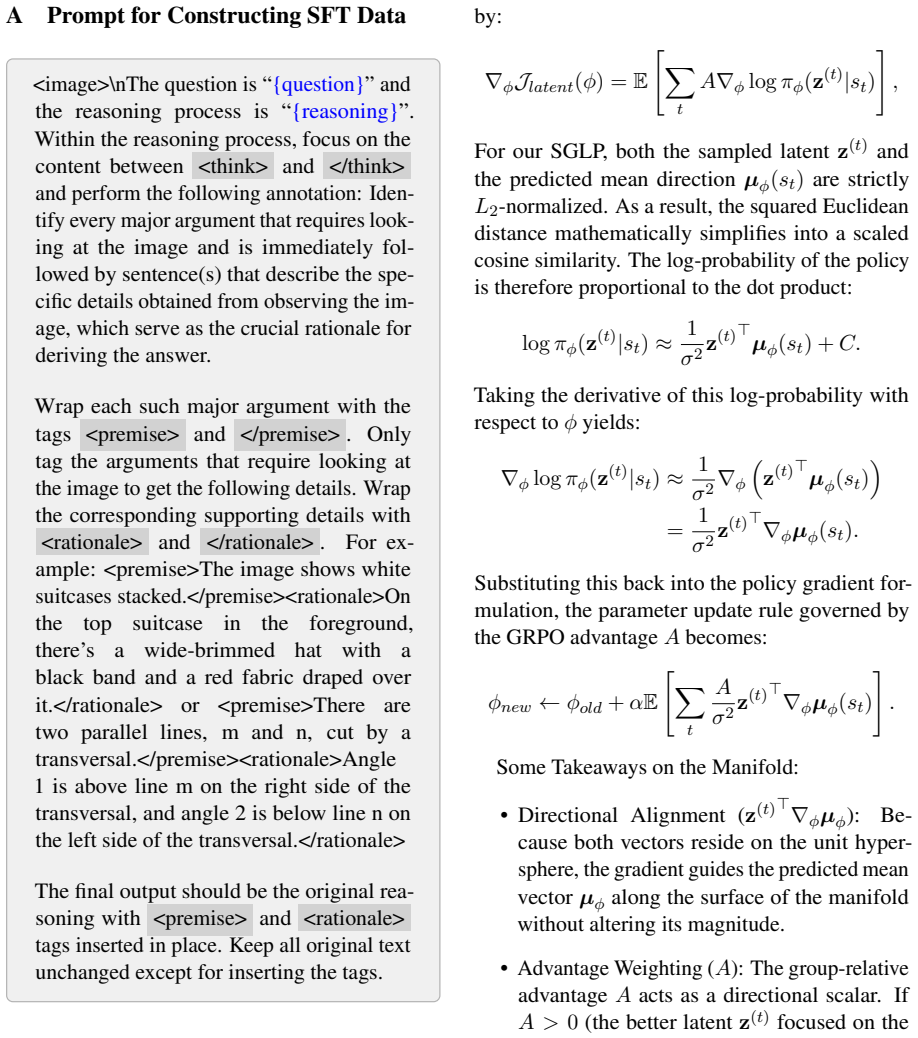
Multi- modal chain-of-thought reasoning in language mod- els.arXiv preprint arXiv:2302.00923. 10 A Prompt for Constructing SFT Data <image>\nThe question is “{question}” and the reasoning process is “{reasoning}”. Within the reasoning process, focus on the content between <think> and </think> and perform the following annotation: Iden- tify every major ar...
work page internal anchor Pith review arXiv
-
[12]
The policy samples a group of G= 4 trajectories per query
Stage III: Latent Policy Optimization.For the reinforcement finetuning stage, we implement our SGLP framework on the ViRL dataset (39k) (Wang et al., 2025a). The policy samples a group of G= 4 trajectories per query. The VLM learning rate is 1×10 −6 with sampling temperature set to 1.0, effective batch size of 8, and maximum tokens of 2048 for 1 epoch. Th...
2048
discussion (0)
Sign in with ORCID, Apple, or X to comment. Anyone can read and Pith papers without signing in.