Recognition: 2 theorem links
· Lean TheoremGenerative Experiences for Digital Mental Health Interventions: Evidence from a Randomized Study
Pith reviewed 2026-05-12 01:06 UTC · model grok-4.3
The pith
Generative experience paradigm in digital mental health tools leads to reduced stress and better user experience in a randomized trial.
A machine-rendered reading of the paper's core claim, the machinery that carries it, and where it could break.
Core claim
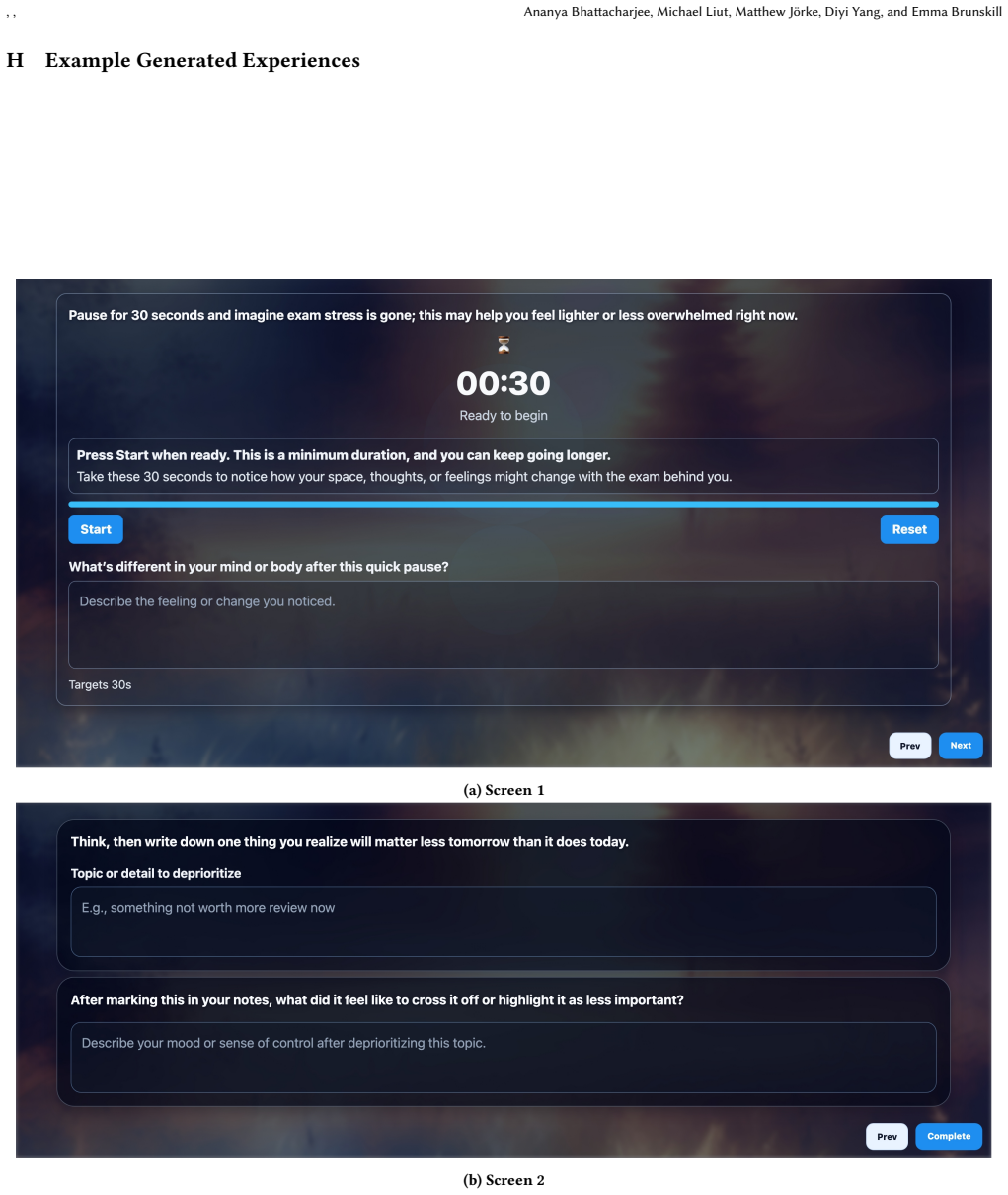
We introduce generative experience as a paradigm for DMH support, where the intervention experience is composed at runtime. We instantiate this in GUIDE, a system that generates personalized intervention content and multimodal interaction structure through rubric-guided generation of modular components. In a preregistered study with N = 237 participants, GUIDE significantly reduced stress (p = .02) and improved the user experience (p = .04) compared to an LLM-based cognitive restructuring control. GUIDE also supported diverse forms of reflection and action through varied interaction flows, while revealing tensions around personalization across the interaction sequence. This work lays the n.
What carries the argument
The generative experience paradigm, realized through GUIDE's rubric-guided generation of modular components that dynamically assemble personalized content and multimodal interaction structures at runtime.
Load-bearing premise
The benefits observed are due to the generative experience design rather than differences in the quality of the generated content, the novelty of the interface, or other unmeasured factors between the two conditions.
What would settle it
Replicating the study but equalizing the content quality and removing the dynamic modular generation while keeping the LLM use would show no difference in stress or user experience if the generative paradigm is not the key factor.
Figures




read the original abstract
Digital mental health (DMH) tools have extensively explored personalization of interventions to users' needs and contexts. However, this personalization often targets what support is provided, not how it is experienced. Even well-matched content can fail when the interaction format misaligns with how someone can engage. We introduce generative experience as a paradigm for DMH support, where the intervention experience is composed at runtime. We instantiate this in GUIDE, a system that generates personalized intervention content and multimodal interaction structure through rubric-guided generation of modular components. In a preregistered study with N = 237 participants, GUIDE significantly reduced stress (p = .02) and improved the user experience (p = .04) compared to an LLM-based cognitive restructuring control. GUIDE also supported diverse forms of reflection and action through varied interaction flows, while revealing tensions around personalization across the interaction sequence. This work lays the foundation for interventions that dynamically shape how support is experienced and enacted in digital settings.
Editorial analysis
A structured set of objections, weighed in public.
Referee Report
Summary. The paper introduces the 'generative experience' paradigm for digital mental health interventions, in which the intervention experience itself is dynamically composed at runtime rather than only personalizing content. It instantiates this paradigm in the GUIDE system, which uses rubric-guided generation to produce personalized intervention content and multimodal interaction structures from modular components. A preregistered randomized study with N=237 participants reports that GUIDE produced statistically significant reductions in stress (p=.02) and improvements in user experience (p=.04) relative to an LLM-based cognitive restructuring control condition. The work also describes varied forms of reflection and action supported by different interaction flows and notes tensions around personalization across the interaction sequence.
Significance. If the RCT results prove robust after fuller reporting, the work is significant for shifting DMH research from static personalization of content to runtime generation of the entire interaction experience. The preregistered RCT design with a clear primary outcome provides a stronger empirical basis than many exploratory DMH studies, and the examination of diverse reflection/action flows offers concrete design insights. This could inform next-generation AI-supported mental health tools that adapt not only what is said but how support is enacted.
major comments (2)
- [Methods/Study Design] Methods/Study Design section: The manuscript describes the control as an 'LLM-based cognitive restructuring condition' but provides no explicit matching or reporting on prompt engineering quality, output length, number of interaction turns, or modality variety between GUIDE and the control. Because GUIDE's core innovation is rubric-guided runtime generation of modular multimodal components, any systematic difference in these implementation details could explain the observed stress and UX differences without requiring the claimed generative-experience paradigm shift.
- [Results] Results section: Primary outcomes are reported only as p-values (stress p=.02, UX p=.04) with N=237. The manuscript does not report effect sizes, confidence intervals, exact statistical tests, handling of missing data, or a CONSORT flow diagram. These omissions make it impossible to assess practical significance, randomization integrity, or whether the effects are large enough to support the paradigm-level claim.
minor comments (2)
- [Abstract] Abstract: The abstract states the study is preregistered but does not include the preregistration identifier or link, which is now standard practice for transparency in clinical or behavioral RCTs.
- [Results/Discussion] The manuscript would benefit from a table or figure summarizing the exact interaction flows generated by GUIDE versus the control to make the 'varied interaction flows' claim more concrete and reproducible.
Simulated Author's Rebuttal
Thank you for the opportunity to respond to the referee's report. We value the constructive feedback and have addressed the major comments regarding the control condition details and statistical reporting by planning specific revisions to the manuscript.
read point-by-point responses
-
Referee: [Methods/Study Design] Methods/Study Design section: The manuscript describes the control as an 'LLM-based cognitive restructuring condition' but provides no explicit matching or reporting on prompt engineering quality, output length, number of interaction turns, or modality variety between GUIDE and the control. Because GUIDE's core innovation is rubric-guided runtime generation of modular multimodal components, any systematic difference in these implementation details could explain the observed stress and UX differences without requiring the claimed generative-experience paradigm shift.
Authors: We thank the referee for highlighting the need for greater transparency in condition implementation. The control was designed as a fixed LLM prompt for cognitive restructuring to provide a strong, standard baseline without dynamic rubric-guided generation. In the revised manuscript, we will add explicit details on the control's prompt engineering, average output lengths, number of interaction turns, and modalities used. We will also clarify how the generative paradigm enables runtime adaptation of multimodal flows that are not feasible in the control, while acknowledging that these differences are central to the paradigm rather than confounds. This reporting will allow readers to better evaluate the comparison. revision: yes
-
Referee: [Results] Results section: Primary outcomes are reported only as p-values (stress p=.02, UX p=.04) with N=237. The manuscript does not report effect sizes, confidence intervals, exact statistical tests, handling of missing data, or a CONSORT flow diagram. These omissions make it impossible to assess practical significance, randomization integrity, or whether the effects are large enough to support the paradigm-level claim.
Authors: We agree that more complete statistical reporting is necessary to support interpretation of the results and the paradigm claim. The revised manuscript will report effect sizes (Cohen's d), 95% confidence intervals, the exact preregistered statistical tests, details on missing data handling (minimal per preregistration, using complete cases), and a CONSORT flow diagram. These additions will enable assessment of practical significance, randomization integrity, and the robustness of the findings. revision: yes
Circularity Check
Empirical RCT result stands independently; no derivation chain present
full rationale
The paper reports results from a preregistered randomized study (N=237) comparing GUIDE against an LLM-based cognitive restructuring control, with statistical tests for stress reduction (p=.02) and UX improvement (p=.04). No mathematical derivations, equations, fitted parameters, or self-citation chains are invoked to support the central claim. The evidence is generated by the experimental design and data collection rather than reducing to definitions, prior self-work, or ansatzes by construction. This is a standard empirical evaluation with no load-bearing circular steps.
Axiom & Free-Parameter Ledger
axioms (1)
- domain assumption Standard assumptions of randomized controlled trials (random assignment, no differential attrition, valid outcome measures)
Lean theorems connected to this paper
-
IndisputableMonolith/Foundation/RealityFromDistinction.leanreality_from_one_distinction unclear?
unclearRelation between the paper passage and the cited Recognition theorem.
We introduce generative experience as a paradigm for DMH support, where the intervention experience is composed at runtime... GUIDE generates personalized intervention content and multimodal interaction structure through rubric-guided generation of modular components.
-
IndisputableMonolith/Cost/FunctionalEquation.leanwashburn_uniqueness_aczel unclear?
unclearRelation between the paper passage and the cited Recognition theorem.
The system... generates multiple candidate interventions... selects among them using rubric-guided evaluation... composes candidate UX realizations from a set of interaction modules
What do these tags mean?
- matches
- The paper's claim is directly supported by a theorem in the formal canon.
- supports
- The theorem supports part of the paper's argument, but the paper may add assumptions or extra steps.
- extends
- The paper goes beyond the formal theorem; the theorem is a base layer rather than the whole result.
- uses
- The paper appears to rely on the theorem as machinery.
- contradicts
- The paper's claim conflicts with a theorem or certificate in the canon.
- unclear
- Pith found a possible connection, but the passage is too broad, indirect, or ambiguous to say the theorem truly supports the claim.
Reference graph
Works this paper leans on
-
[1]
Alaa A Abd-Alrazaq, Mohannad Alajlani, Ali Abdallah Alalwan, Bridgette M Bewick, Peter Gardner, and Mowafa Househ. 2019. An overview of the features of chatbots in mental health: A scoping review.International journal of medical informatics132 (2019), 103978
work page 2019
-
[2]
Melis Yilmaz Balban, Eric Neri, Manuela M Kogon, Lara Weed, Bita Nouriani, Booil Jo, Gary Holl, Jamie M Zeitzer, David Spiegel, and Andrew D Huber- man. 2023. Brief structured respiration practices enhance mood and reduce physiological arousal.Cell Reports Medicine4, 1 (2023)
work page 2023
-
[3]
Han Bao, Yongan Yu, Bohan Wang, Xiaowen Lu, and Xin Tong. 2025. MILO: An LLM Multi-Stage Conversational Agent for Fostering Teenagers’ Mental Resilience. InAdjunct Proceedings of the 38th Annual ACM Symposium on User Interface Software and Technology. 1–3
work page 2025
-
[4]
Eric PS Baumer. 2015. Reflective informatics: conceptual dimensions for design- ing technologies of reflection. InProceedings of the 33rd Annual ACM Conference on Human Factors in Computing Systems. 585–594
work page 2015
-
[5]
1979.Cognitive therapy of depression
Aaron T Beck. 1979.Cognitive therapy of depression. Guilford press
work page 1979
-
[6]
2020.Cognitive behavior therapy: Basics and beyond
Judith S Beck. 2020.Cognitive behavior therapy: Basics and beyond. Guilford Publications
work page 2020
-
[7]
Caterina Bérubé, Theresa Schachner, Roman Keller, Elgar Fleisch, Florian v Wangenheim, Filipe Barata, and Tobias Kowatsch. 2021. Voice-based conversa- tional agents for the prevention and management of chronic and mental health conditions: systematic literature review.Journal of medical Internet research23, 3 (2021), e25933
work page 2021
-
[8]
Ananya Bhattacharjee, Pan Chen, Abhijoy Mandal, Anne Hsu, Katie O’Leary, Alex Mariakakis, Joseph Jay Williams, et al. 2024. Exploring user perspectives on brief reflective questioning activities for stress management: Mixed methods study.JMIR Formative Research8, 1 (2024), e47360
work page 2024
- [9]
-
[10]
Ananya Bhattacharjee, Joseph Jay Williams, Miranda Beltzer, Jonah Meyerhoff, Harsh Kumar, Haochen Song, David C Mohr, Alex Mariakakis, and Rachel Kornfield. 2025. Investigating the Role of Situational Disruptors in Engagement with Digital Mental Health Tools.Proceedings of the ACM on Human-Computer Interaction9, 7 (2025), 1–35
work page 2025
-
[11]
Ananya Bhattacharjee, Joseph Jay Williams, Karrie Chou, Justice Tomlinson, Jonah Meyerhoff, Alex Mariakakis, and Rachel Kornfield. 2022. " I kind of bounce off it": translating mental health principles into real life through story-based text messages.Proceedings of the ACM on Human-computer Interaction6, CSCW2 (2022), 1–31
work page 2022
-
[12]
Ananya Bhattacharjee, Joseph Jay Williams, Jonah Meyerhoff, Harsh Kumar, Alex Mariakakis, and Rachel Kornfield. 2023. Investigating the role of context in the delivery of text messages for supporting psychological wellbeing. In Proceedings of the 2023 CHI Conference on Human Factors in Computing Systems. 1–19
work page 2023
-
[13]
Ananya Bhattacharjee, Sarah Yi Xu, Pranav Rao, Yuchen Zeng, Jonah Meyerhoff, Syed Ishtiaque Ahmed, David C Mohr, Michael Liut, Alex Mariakakis, Rachel Kornfield, et al. 2025. Perfectly to a Tee: Understanding User Perceptions of Personalized LLM-Enhanced Narrative Interventions. InProceedings of the 2025 ACM Designing Interactive Systems Conference. 1387–1416
work page 2025
-
[14]
Ananya Bhattacharjee, Yuchen Zeng, Sarah Yi Xu, Dana Kulzhabayeva, Minyi Ma, Rachel Kornfield, Syed Ishtiaque Ahmed, Alex Mariakakis, Mary P Cz- erwinski, Anastasia Kuzminykh, et al. 2024. Understanding the role of large language models in personalizing and scaffolding strategies to combat academic procrastination. InProceedings of the 2024 CHI Conference...
work page 2024
-
[15]
Joyce E Bono, Theresa M Glomb, Winny Shen, Eugene Kim, and Amanda J Koch. 2013. Building positive resources: Effects of positive events and positive reflection on work stress and health.Academy of Management Journal56, 6 (2013), 1601–1627
work page 2013
-
[16]
John Brooke et al . 1996. SUS-A quick and dirty usability scale.Usability evaluation in industry189, 194 (1996), 4–7
work page 1996
-
[17]
Yining Cao, Peiling Jiang, and Haijun Xia. 2025. Generative and malleable user interfaces with generative and evolving task-driven data model. InProceedings of the 2025 CHI Conference on Human Factors in Computing Systems. 1–20
work page 2025
-
[18]
Mohit Chandra, Siddharth Sriraman, Gaurav Verma, Harneet Singh Khanuja, Jose Suarez Campayo, Zihang Li, Michael L Birnbaum, and Munmun De Choud- hury. 2025. Lived experience not found: Llms struggle to align with experts on addressing adverse drug reactions from psychiatric medication use. InPro- ceedings of the 2025 Conference of the Nations of the Ameri...
work page 2025
-
[19]
Jiaqi Chen, Yanzhe Zhang, Yutong Zhang, Yijia Shao, and Diyi Yang. 2025. Generative interfaces for language models.arXiv preprint arXiv:2508.19227 (2025)
work page internal anchor Pith review Pith/arXiv arXiv 2025
-
[20]
Bruce F Chorpita, Eric L Daleiden, and John R Weisz. 2005. Modularity in the design and application of therapeutic interventions.Applied and preventive psychology11, 3 (2005), 141–156
work page 2005
-
[21]
Victoria Clarke and Virginia Braun. 2017. Thematic analysis.The journal of positive psychology12, 3 (2017), 297–298
work page 2017
-
[22]
Alia J Crum, Peter Salovey, and Shawn Achor. 2013. Rethinking stress: the role of mindsets in determining the stress response.Journal of personality and social psychology104, 4 (2013), 716
work page 2013
-
[23]
Anna Fang, Hriday Chhabria, Alekhya Maram, and Haiyi Zhu. 2025. Social simulation for everyday self-care: Design insights from leveraging VR, AR, and LLMs for practicing stress relief. InProceedings of the 2025 CHI Conference on Human Factors in Computing Systems. 1–23
work page 2025
-
[24]
Kathleen Kara Fitzpatrick, Alison Darcy, and Molly Vierhile. 2017. Delivering cognitive behavior therapy to young adults with symptoms of depression and anxiety using a fully automated conversational agent (Woebot): a randomized controlled trial.JMIR mental health4, 2 (2017), e7785
work page 2017
-
[25]
Krzysztof Gajos and Daniel S Weld. 2004. SUPPLE: automatically generating user interfaces. InProceedings of the 9th international conference on Intelligent user interfaces. 93–100
work page 2004
-
[26]
Krzysztof Z Gajos, Jacob O Wobbrock, and Daniel S Weld. 2007. Automatically generating user interfaces adapted to users’ motor and vision capabilities. In Proceedings of the 20th annual ACM symposium on User interface software and technology. 231–240
work page 2007
-
[27]
Elisa Galmarini, Laura Marciano, and Peter Johannes Schulz. 2024. The effective- ness of visual-based interventions on health literacy in health care: a systematic review and meta-analysis.BMC Health Services Research24, 1 (2024), 718
work page 2024
-
[28]
Denise C Gottfredson, Thomas D Cook, Frances EM Gardner, Deborah Gorman- Smith, George W Howe, Irwin N Sandler, and Kathryn M Zafft. 2015. Standards of evidence for efficacy, effectiveness, and scale-up research in prevention science: Next generation.Prevention science16, 7 (2015), 893–926
work page 2015
-
[29]
Yijie Guo, Ruhan Wang, Zhenhan Huang, Tongtong Jin, Xiwen Yao, Yuan-Ling Feng, Weiwei Zhang, Yuan Yao, and Haipeng Mi. 2025. Exploring the Design of LLM-based Agent in Enhancing Self-disclosure Among the Older Adults. In Proceedings of the 2025 CHI Conference on Human Factors in Computing Systems. 1–17
work page 2025
-
[30]
Camilla Harshbarger, Olivia Burrus, Sivakumar Rangarajan, John Bollenbacher, Brittany Zulkiewicz, Rohit Verma, Carla A Galindo, and Megan A Lewis. 2021. Challenges of and solutions for developing tailored video interventions that integrate multiple digital assets to promote engagement and improve health outcomes: tutorial.JMIR mHealth and uHealth9, 3 (202...
work page 2021
-
[31]
Jan Hartmann, Alistair Sutcliffe, and Antonella De Angeli. 2008. Towards a the- ory of user judgment of aesthetics and user interface quality.ACM Transactions on Computer-Human Interaction (TOCHI)15, 4 (2008), 1–30
work page 2008
-
[32]
Andreas Hinderks. 2017. Design and evaluation of a short version of the user ex- perience questionnaire (UEQ-S).International Journal of Interactive Multimedia and Artificial Intelligence(2017)
work page 2017
-
[33]
Eric Horvitz. 1999. Principles of mixed-initiative user interfaces. InProceedings of the SIGCHI conference on Human Factors in Computing Systems. 159–166
work page 1999
-
[34]
Steven Houben, Jakob E Bardram, Jo Vermeulen, Kris Luyten, and Karin Coninx
-
[35]
Activity-centric support for ad hoc knowledge work: A case study of co-activity manager. InProceedings of the SIGCHI Conference on Human Factors , , Ananya Bhattacharjee, Michael Liut, Matthew Jörke, Diyi Yang, and Emma Brunskill in Computing Systems. 2263–2272
-
[36]
Jeremy F Huckins, Alex W DaSilva, Weichen Wang, Elin Hedlund, Courtney Rogers, Subigya K Nepal, Jialing Wu, Mikio Obuchi, Eilis I Murphy, Meghan L Meyer, et al . 2020. Mental health and behavior of college students during the early phases of the COVID-19 pandemic: Longitudinal smartphone and ecological momentary assessment study.Journal of medical Interne...
work page 2020
-
[37]
I Don’t Know Why I Should Use This App
Seungwan Jin, Bogoan Kim, and Kyungsik Han. 2025. " I Don’t Know Why I Should Use This App": Holistic Analysis on User Engagement Challenges in Mobile Mental Health. InProceedings of the 2025 CHI Conference on Human Factors in Computing Systems. 1–23
work page 2025
-
[38]
Eunkyung Jo, Daniel A Epstein, Hyunhoon Jung, and Young-Ho Kim. 2023. Understanding the benefits and challenges of deploying conversational AI lever- aging large language models for public health intervention. InProceedings of the 2023 CHI Conference on Human Factors in Computing Systems. 1–16
work page 2023
-
[39]
Eunkyung Jo, Yuin Jeong, SoHyun Park, Daniel A Epstein, and Young-Ho Kim
-
[40]
InProceedings of the CHI Conference on Human Factors in Computing Systems
Understanding the Impact of Long-Term Memory on Self-Disclosure with Large Language Model-Driven Chatbots for Public Health Intervention. InProceedings of the CHI Conference on Human Factors in Computing Systems. 1–21
- [41]
-
[42]
Benjamin T Kaveladze, Jan G Voelkel, Michael N Stagnaro, Mingjing Huang, Amanda E Smock, Erin K Sullivan, Yao M Xu, Madison P McCall, Juan Pablo Zapata, Syed Ishtiaque Ahmed, et al. 2026. A crowdsourced megastudy of 12 digital single-session interventions for depression in US adults.Nature Human Behaviour(2026), 1–17
work page 2026
-
[43]
Majeed Kazemitabaar, Runlong Ye, Xiaoning Wang, Austin Zachary Henley, Paul Denny, Michelle Craig, and Tovi Grossman. 2024. Codeaid: Evaluating a classroom deployment of an llm-based programming assistant that balances student and educator needs. InProceedings of the CHI Conference on Human Factors in Computing Systems. 1–20
work page 2024
-
[44]
Taewan Kim, Seolyeong Bae, Hyun Ah Kim, Su-woo Lee, Hwajung Hong, Chanmo Yang, and Young-Ho Kim. 2024. MindfulDiary: harnessing large lan- guage model to support psychiatric patients’ journaling. InProceedings of the 2024 CHI Conference on Human Factors in Computing Systems. 1–20
work page 2024
-
[45]
Predrag Klasnja, Eric B Hekler, Saul Shiffman, Audrey Boruvka, Daniel Almi- rall, Ambuj Tewari, and Susan A Murphy. 2015. Microrandomized trials: An experimental design for developing just-in-time adaptive interventions.Health Psychology34, S (2015), 1220
work page 2015
-
[46]
2004.Tangible user interface input: Tools and techniques
Scott Robert Klemmer. 2004.Tangible user interface input: Tools and techniques. University of California, Berkeley
work page 2004
-
[47]
Rachel Kornfield, Renwen Zhang, Jennifer Nicholas, Stephen M Schueller, Scott A Cambo, David C Mohr, and Madhu Reddy. 2020. " Energy is a Fi- nite Resource": Designing Technology to Support Individuals across Fluctuating Symptoms of Depression. InProceedings of the 2020 CHI Conference on Human Factors in Computing Systems. 1–17
work page 2020
- [48]
-
[49]
Haitao Li, Qian Dong, Junjie Chen, Huixue Su, Yujia Zhou, Qingyao Ai, Ziyi Ye, and Yiqun Liu. 2024. Llms-as-judges: a comprehensive survey on llm-based evaluation methods.arXiv preprint arXiv:2412.05579(2024)
work page internal anchor Pith review Pith/arXiv arXiv 2024
-
[50]
Ryan Li, Yanzhe Zhang, and Diyi Yang. 2025. Sketch2code: Evaluating vision- language models for interactive web design prototyping. InProceedings of the 2025 Conference of the Nations of the Americas Chapter of the Association for Com- putational Linguistics: Human Language Technologies (Volume 1: Long Papers). 3921–3955
work page 2025
-
[51]
Jieun Lim, Youngji Koh, Auk Kim, and Uichin Lee. 2024. Exploring context- aware mental health self-tracking using multimodal smart speakers in home environments. InProceedings of the 2024 CHI Conference on Human Factors in Computing Systems. 1–18
work page 2024
-
[52]
Michelle Liu and Stephen M Schueller. 2023. Moving evidence-based mental health interventions into practice: implementation of digital mental health interventions.Current treatment options in psychiatry10, 4 (2023), 333–345
work page 2023
-
[53]
Tianjian Liu, Hongzheng Zhao, Yuheng Liu, Xingbo Wang, and Zhenhui Peng
-
[54]
InProceedings of the 37th Annual ACM Symposium on User Interface Software and Technology
Compeer: A generative conversational agent for proactive peer support. InProceedings of the 37th Annual ACM Symposium on User Interface Software and Technology. 1–22
-
[55]
I-Chen Lo and Pei-Luen Patrick Rau. 2025. D-Twins: Your Digital Twin Designed for Real-Time Boredom Intervention. InProceedings of the 2025 CHI Conference on Human Factors in Computing Systems. 1–15
work page 2025
-
[56]
Reuben Luera, Ryan Rossi, Alexa Siu, Franck Dernoncourt, Tong Yu, Sungchul Kim, Ruiyi Zhang, Xiang Chen, Hanieh Salehy, Nedim Lipka, et al. 2026. Sur- vey on user interface design and interactions for generative AI applications. Foundations and Trends in Human-Computer Interaction19, 3 (2026), 213–279
work page 2026
-
[57]
Mark Maybury. 1998. Intelligent user interfaces: an introduction. InProceedings of the 4th international conference on Intelligent user interfaces. 3–4
work page 1998
-
[58]
Jonah Meyerhoff, Miranda Beltzer, Sarah Popowski, Chris J Karr, Theresa Nguyen, Joseph J Williams, Charles J Krause, Harsh Kumar, Ananya Bhat- tacharjee, David C Mohr, et al . 2024. Small Steps over time: A longitudinal usability test of an automated interactive text messaging intervention to sup- port self-management of depression and anxiety symptoms.Jo...
work page 2024
-
[59]
David C Mohr, Stephen M Schueller, Enid Montague, Michelle Nicole Burns, and Parisa Rashidi. 2014. The behavioral intervention technology model: an integrated conceptual and technological framework for eHealth and mHealth interventions.Journal of medical Internet research16, 6 (2014), e146
work page 2014
-
[60]
David C Mohr, Mi Zhang, and Stephen M Schueller. 2017. Personal sensing: understanding mental health using ubiquitous sensors and machine learning. Annual review of clinical psychology13 (2017), 23–47
work page 2017
-
[61]
Robert R Morris and Rosalind Picard. 2014. Crowd-powered positive psycholog- ical interventions.The Journal of Positive Psychology9, 6 (2014), 509–516
work page 2014
-
[62]
Robert R Morris, Stephen M Schueller, and Rosalind W Picard. 2015. Efficacy of a web-based, crowdsourced peer-to-peer cognitive reappraisal platform for depression: randomized controlled trial.Journal of medical Internet research17, 3 (2015), e72
work page 2015
-
[63]
Brad A Myers. 1995. User interface software tools.ACM Transactions on Computer-Human Interaction (TOCHI)2, 1 (1995), 64–103
work page 1995
-
[64]
Inbal Nahum-Shani, Shawna N Smith, Bonnie J Spring, Linda M Collins, Katie Witkiewitz, Ambuj Tewari, and Susan A Murphy. 2016. Just-in-time adaptive interventions (JITAIs) in mobile health: key components and design principles for ongoing health behavior support.Annals of behavioral medicine(2016), 1–17
work page 2016
-
[65]
Jeffrey Nichols, Brad A Myers, Michael Higgins, Joseph Hughes, Thomas K Harris, Roni Rosenfeld, and Mathilde Pignol. 2002. Generating remote con- trol interfaces for complex appliances. InProceedings of the 15th annual ACM symposium on User interface software and technology. 161–170
work page 2002
-
[66]
Jeffrey Nichols, Brad A Myers, and Kevin Litwack. 2004. Improving automatic interface generation with smart templates. InProceedings of the 9th international conference on Intelligent user interfaces. 286–288
work page 2004
-
[67]
Jakob Nielsen. 1994.Usability engineering. Morgan Kaufmann
work page 1994
-
[68]
Kathleen O’Leary, Stephen M Schueller, Jacob O Wobbrock, and Wanda Pratt
-
[69]
Suddenly, we got to become therapists for each other
“Suddenly, we got to become therapists for each other” Designing Peer Support Chats for Mental Health. InProceedings of the 2018 CHI Conference on Human Factors in Computing Systems. 1–14
work page 2018
-
[70]
Kevin Pacheco-Barrios, Jorge Ortega-Márquez, and Felipe Fregni. 2024. Haptic technology: Exploring its underexplored clinical applications—A systematic review.Biomedicines12, 12 (2024), 2802
work page 2024
-
[71]
Pablo Paredes, Ran Gilad-Bachrach, Mary Czerwinski, Asta Roseway, Kael Rowan, and Javier Hernandez. 2014. PopTherapy: coping with stress through pop-culture.. InPervasiveHealth. 109–117
work page 2014
-
[72]
Gun Woo Park, Payod Panda, Lev Tankelevitch, and Sean Rintel. 2024. The coexplorer technology probe: A generative ai-powered adaptive interface to support intentionality in planning and running video meetings. InProceedings of the 2024 ACM Designing Interactive Systems Conference. 1638–1657
work page 2024
-
[73]
Dan Roland Persson, Mel Ramasawmy, Nushrat Khan, Amitava Banerjee, Ann Blandford, Jakob Eyvind Bardram, and Per Bækgaard. 2025. A Design Frame- work for Microintervention Software Technology in Digital Health: Critical Interpretive Synthesis.Journal of Medical Internet Research27 (2025), e72658
work page 2025
-
[74]
Savvas Petridis, Benjamin D Wedin, James Wexler, Mahima Pushkarna, Aaron Donsbach, Nitesh Goyal, Carrie J Cai, and Michael Terry. 2024. Constitution- maker: Interactively critiquing large language models by converting feedback into principles. InProceedings of the 29th International Conference on Intelligent User Interfaces. 853–868
work page 2024
-
[75]
Shankar R Ponnekanti, Brian Lee, Armando Fox, Pat Hanrahan, and Terry Winograd. 2001. ICrafter: A service framework for ubiquitous computing environments. InInternational Conference on Ubiquitous Computing. Springer, 56–75
work page 2001
-
[76]
Jordan Poppenk, Stefan Köhler, and Morris Moscovitch. 2010. Revisiting the novelty effect: when familiarity, not novelty, enhances memory.Journal of Experimental Psychology: Learning, Memory, and Cognition36, 5 (2010), 1321
work page 2010
-
[77]
Simon Provoost, Ho Ming Lau, Jeroen Ruwaard, and Heleen Riper. 2017. Em- bodied conversational agents in clinical psychology: a scoping review.Journal of medical Internet research19, 5 (2017), e151
work page 2017
-
[78]
Angel Puerta and Jacob Eisenstein. 1998. Towards a general computational framework for model-based interface development systems. InProceedings of the 4th international conference on Intelligent user interfaces. 171–178
work page 1998
-
[79]
Paul M Salkovskis, Magnus Blondahl Sighvatsson, and Jon Fridrik Sigurdsson
-
[80]
How effective psychological treatments work: mechanisms of change in cognitive behavioural therapy and beyond.Behavioural and cognitive psy- chotherapy51, 6 (2023), 595–615
work page 2023
discussion (0)
Sign in with ORCID, Apple, or X to comment. Anyone can read and Pith papers without signing in.