Recognition: unknown
Multiphase Gas Structure in the Circumnuclear Region of NGC 5506 Observed with ALMA
Pith reviewed 2026-05-10 17:22 UTC · model grok-4.3
The pith
The circumnuclear disk in NGC 5506 is supported vertically by turbulence from supernovae.
A machine-rendered reading of the paper's core claim, the machinery that carries it, and where it could break.
Core claim
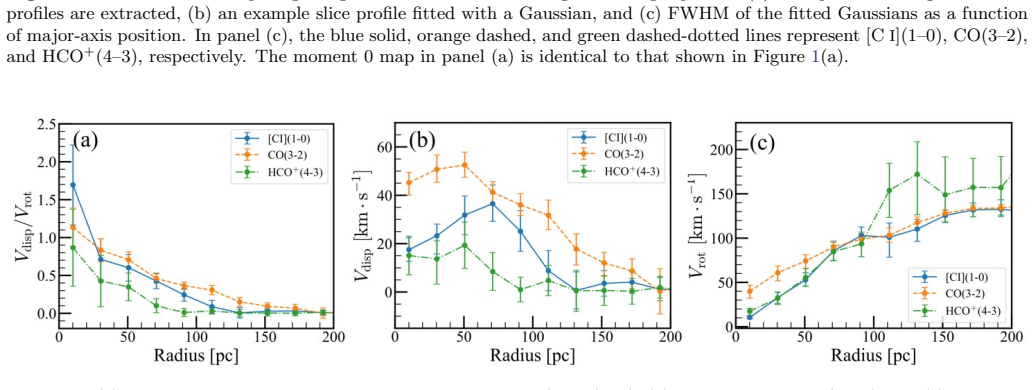
The paper establishes that the observed CND scale height and velocity dispersions traced by [C I](1-0) and CO(3-2) are consistent with a model in which supernova-driven turbulence provides the vertical support for the CND. This follows from the high ratio of velocity dispersion to rotational velocity serving as a proxy for large scale height to radius ratios in the central region, combined with the absence of significant differences in thickness or velocity structure between the two tracers across the disk.
What carries the argument
The ratio of velocity dispersion to rotational velocity as a proxy for disk scale height to radius, compared to predictions from a supernova turbulence model that supplies vertical support.
If this is right
- The CND thickness can be maintained by local star formation activity without dominant contributions from AGN outflows or magnetic fields.
- The AGN bicone dissociates CO preferentially but leaves the overall vertical structure set by supernova turbulence.
- Multiphase line ratios can separate AGN dissociation effects from the turbulence that sets disk thickness.
- The same supernova support mechanism may operate in circumnuclear disks of other nearby Seyfert galaxies.
Where Pith is reading between the lines
- Supernova turbulence may slow the loss of angular momentum in the CND and thereby regulate the supply of gas to the central black hole.
- Simulations that include both supernova and AGN feedback could check whether this vertical support balance is common across Seyfert systems.
- Face-on observations at matched resolution would test whether the inferred thickness is intrinsic or affected by the edge-on viewing angle.
Load-bearing premise
The measured velocity dispersion is dominated by supernova-driven turbulence rather than inflows, magnetic support, or unresolved orbital motions.
What would settle it
High-resolution data or modeling that shows the velocity dispersion contains substantial non-turbulent contributions such as bulk inflows or beam-smeared orbital motions, producing a mismatch with the turbulence model's predicted scale height.
Figures




read the original abstract
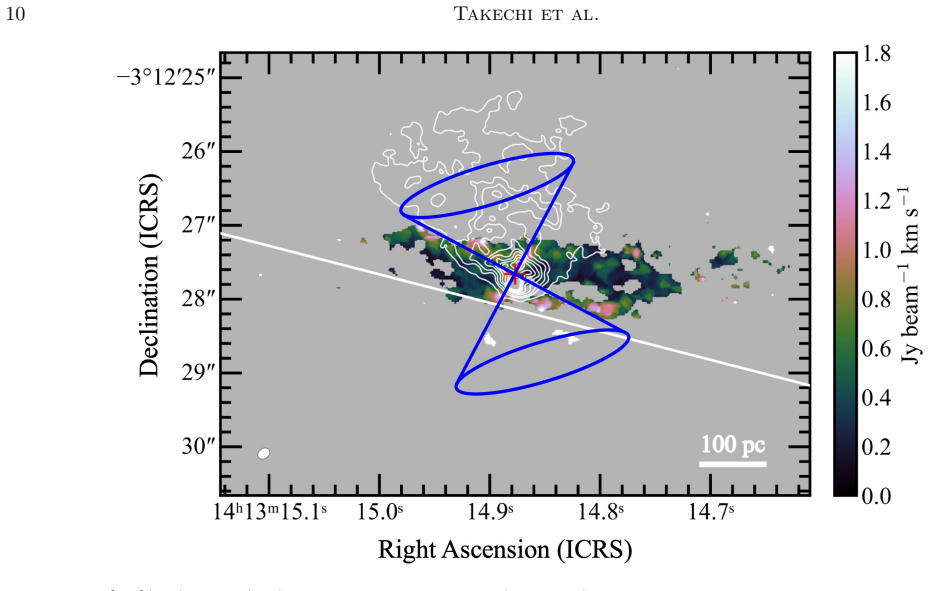
We present a study of the multiphase gas structure and kinematics of the circumnuclear disk (CND) of NGC 5506, a nearby edge-on Seyfert galaxy, at a spatial resolution of $\sim20$ pc. Observations of [C I](1-0), CO(3-2), and HCO$^{+}$(4-3) obtained with the Atacama Large Millimeter/submillimeter Array reveal the CND dominated by rotational motion on scales of several hundred parsecs. No significant differences in geometrical thickness or velocity structure are found between [C I](1-0) and CO(3-2) across the CND, whereas HCO$^{+}$(4-3) emission is more concentrated toward the disk plane. The ratio of velocity dispersion to rotational velocity, a proxy for disk scale height-to-radius ratio, is high ($\gtrsim0.9$) in the central region ($\lesssim30$ pc) for both [C I](1-0) and CO(3-2), indicating geometrically thick structures in both tracers. Regions where the [C I](1-0)/CO(3-2) ratio exceeds the CND average are spatially correlated with the [O III]$\lambda$5007 bicone observed with the Hubble Space Telescope, suggesting that CO is preferentially dissociated by the AGN-driven biconical ionized outflow. The observed CND scale height and velocity dispersions traced by [C I](1-0) and CO(3-2) are consistent with a model in which supernova-driven turbulence provides the vertical support for the CND.
Editorial analysis
A structured set of objections, weighed in public.
Referee Report
Summary. The paper presents ALMA observations of [C I](1-0), CO(3-2), and HCO+(4-3) in the circumnuclear disk (CND) of edge-on Seyfert galaxy NGC 5506 at ~20 pc resolution. It reports that the CND is rotation-dominated on hundreds of pc scales, with no major differences in thickness or velocity structure between [C I] and CO(3-2) while HCO+ is more planar; the [C I]/CO ratio spatially correlates with the HST [O III] bicone, interpreted as AGN outflow dissociation of CO; and the high central σ/v_rot (≳0.9 within ≲30 pc) and observed scale height are consistent with a supernova-driven turbulence model providing vertical support.
Significance. If the turbulence-support conclusion holds after quantitative verification, the work supplies high-resolution multiphase constraints on CND structure in a Seyfert galaxy, linking supernova feedback to disk thickness and demonstrating AGN outflow effects on molecular chemistry. The direct use of three tracers and spatial correlation with ionized gas are clear observational strengths that advance understanding of gas dynamics near AGN.
major comments (2)
- [Discussion] Discussion section: The central claim that the observed CND scale height and velocity dispersions are consistent with supernova-driven turbulence providing vertical support lacks an explicit energy budget calculation (e.g., SN energy injection rate versus turbulent dissipation rate at the measured height and σ). Without this, the numerical consistency cannot be shown to be unique to the SN model rather than other support mechanisms.
- [Kinematic results] Kinematic results (likely §3): The high σ/v_rot ratio (proxy for h/R) is interpreted as turbulence support, but the contribution of the bicone outflow (already identified via the [C I]/CO vs. [O III] correlation) to the line widths is not decomposed or bounded; unresolved orbital motions or inflows could inflate the dispersion and undermine the isotropic turbulence assumption.
minor comments (2)
- [Abstract] Abstract: The statement of consistency with the supernova turbulence model should cite the specific reference or parameters of that model for immediate clarity.
- [Figures] Figure captions: Include explicit beam sizes, position angles, and any applied corrections (e.g., beam-smearing) to aid reproducibility of the thickness and dispersion measurements.
Simulated Author's Rebuttal
We thank the referee for the constructive and detailed report. The comments highlight important points that strengthen the interpretation of our ALMA observations of the CND in NGC 5506. We address each major comment below and have revised the manuscript accordingly to incorporate an explicit energy budget calculation and additional kinematic analysis.
read point-by-point responses
-
Referee: Discussion section: The central claim that the observed CND scale height and velocity dispersions are consistent with supernova-driven turbulence providing vertical support lacks an explicit energy budget calculation (e.g., SN energy injection rate versus turbulent dissipation rate at the measured height and σ). Without this, the numerical consistency cannot be shown to be unique to the SN model rather than other support mechanisms.
Authors: We agree that an explicit energy budget calculation is needed to demonstrate that supernova-driven turbulence can quantitatively account for the observed vertical support. In the revised Discussion, we now include a calculation of the supernova energy injection rate based on the star-formation rate derived from the central molecular gas mass and compare it directly to the turbulent dissipation rate required to maintain the measured scale height and velocity dispersion (using the standard relation for turbulent energy dissipation). This shows that the available SN energy input is sufficient and comparable to the dissipation rate at the observed height and σ. We also briefly discuss why alternative support mechanisms (e.g., magnetic fields or radiation pressure) are less favored given the available constraints, while acknowledging that the calculation assumes a standard IMF and SN efficiency. revision: yes
-
Referee: Kinematic results (likely §3): The high σ/v_rot ratio (proxy for h/R) is interpreted as turbulence support, but the contribution of the bicone outflow (already identified via the [C I]/CO vs. [O III] correlation) to the line widths is not decomposed or bounded; unresolved orbital motions or inflows could inflate the dispersion and undermine the isotropic turbulence assumption.
Authors: We acknowledge that the AGN-driven bicone outflow, whose effect on molecular chemistry is traced by the elevated [C I]/CO ratio, could contribute to the observed line widths, particularly along the bicone directions. In the revised manuscript we have added a quantitative bound on this contribution by comparing the velocity dispersion measured in regions spatially coincident with the HST [O III] bicone versus regions outside it. The central high σ/v_rot (≳0.9 within ≲30 pc) persists even after excluding the bicone-overlapping pixels, and the overall velocity field remains rotation-dominated. We also note that any unresolved orbital motions or inflows would need to be highly isotropic to mimic the observed dispersion; however, we agree that full decomposition would require higher-resolution data or additional modeling and have added this caveat explicitly. revision: partial
Circularity Check
No circularity: observational measurements presented as empirical consistency with external model
full rationale
The paper is a direct ALMA observational study reporting measured CND kinematics (velocity dispersion, rotation, scale height proxies) from [C I](1-0), CO(3-2), and HCO+(4-3) lines. The central claim is that these observed quantities 'are consistent with a model in which supernova-driven turbulence provides the vertical support.' This is framed as comparison to an external model rather than any derivation, prediction, or fit that reduces to the paper's own inputs by construction. No equations, parameter fits, or self-citations are shown to create a closed loop where a 'prediction' is statistically forced by the data used to define it. The analysis remains self-contained against external benchmarks.
Axiom & Free-Parameter Ledger
axioms (2)
- domain assumption Velocity dispersion traces turbulent support against gravity in a rotating disk
- standard math Standard excitation and optical-depth assumptions for [C I], CO, and HCO+ lines
Reference graph
Works this paper leans on
-
[1]
thebibliography [1] 20pt to REFERENCES 6pt =0pt \@twocolumntrue 12pt -12pt 10pt plus 3pt =0pt =0pt =1pt plus 1pt =0pt =0pt -12pt =13pt plus 1pt =20pt =13pt plus 1pt \@M =10000 =-1.0em =0pt =0pt 0pt =0pt =1.0em @enumiv\@empty 10000 10000 `\.\@m \@noitemerr \@latex@warning Empty `thebibliography' environment \@ifnextchar \@reference \@latexerr Missing key o...
-
[2]
Antonucci, R.\ 1993, , 31, 473. doi:10.1146/annurev.aa.31.090193.002353
-
[3]
Armitage, P. J. & Pringle, J. E.\ 1997, , 488, L47. doi:10.1086/310907
-
[4]
Asmus, D., H \"o nig, S. F., & Gandhi, P.\ 2016, , 822, 109. doi:10.3847/0004-637X/822/2/109
-
[5]
Baba, S., Wada, K., Izumi, T., et al.\ 2024, , 966, 15. doi:10.3847/1538-4357/ad34d3
-
[6]
doi:10.1051/0004-6361:20030210
Bianchi, S., Balestra, I., Matt, G., et al.\ 2003, , 402, 141. doi:10.1051/0004-6361:20030210
-
[7]
Bolatto, A. D., Leroy, A. K., Jameson, K., et al.\ 2011, , 741, 12. doi:10.1088/0004-637X/741/1/12
-
[8]
Burton, M. G., Ashley, M. C. B., Braiding, C., et al.\ 2015, , 811, 13. doi:10.1088/0004-637X/811/1/13
-
[9]
I., Graci \'a -Carpio, J., et al.\ 2016, , 586, A28
Burtscher, L., Davies, R. I., Graci \'a -Carpio, J., et al.\ 2016, , 586, A28. doi:10.1051/0004-6361/201527575
-
[10]
Bertin, E. & Arnouts, S.\ 1996, , 117, 393. doi:10.1051/aas:1996164
-
[11]
Bradley, L., Sip o cz, B., Robitaille, T., et al.\ 2024, Zenodo, 1.12.0. doi:10.5281/zenodo.10967176
-
[12]
Carilli, C. L. & Walter, F.\ 2013, , 51, 105. doi:10.1146/annurev-astro-082812-140953
-
[13]
2022, , 134, 114501, 10.1088/1538-3873/ac9642
CASA Team, Bean, B., Bhatnagar, S., et al.\ 2022, , 134, 114501. doi:10.1088/1538-3873/ac9642
-
[14]
Chambers, K. C., Magnier, E. A., Metcalfe, N., et al.\ 2016, arXiv:1612.05560. doi:10.48550/arXiv.1612.05560
work page internal anchor Pith review Pith/arXiv arXiv doi:10.48550/arxiv.1612.05560 2016
-
[15]
Cid Fernandes, R., Heckman, T., Schmitt, H., et al.\ 2001, , 558, 81. doi:10.1086/322449
-
[16]
doi:10.1051/0004-6361/201834560
Combes, F., Garc \' a-Burillo, S., Audibert, A., et al.\ 2019, , 623, A79. doi:10.1051/0004-6361/201834560
-
[17]
doi:10.48550/arXiv.astro-ph/0612009
Davies, R., Genzel, R., Tacconi, L., et al.\ 2007, The Central Engine of Active Galactic Nuclei, 373, 639. doi:10.48550/arXiv.astro-ph/0612009
-
[18]
Davies, R. I., Burtscher, L., Rosario, D., et al.\ 2015, , 806, 127. doi:10.1088/0004-637X/806/1/127
-
[19]
Davies, R., Baron, D., Shimizu, T., et al.\ 2020, , 498, 4150. doi:10.1093/mnras/staa2413
-
[20]
Di Teodoro, E. M. & Fraternali, F.\ 2015, , 451, 3021. doi:10.1093/mnras/stv1213
-
[21]
Downes, D. & Solomon, P. M.\ 1998, , 507, 615. doi:10.1086/306339
-
[22]
doi:10.1016/j.newar.2006.06.027
Elitzur, M.\ 2006, , 50, 728. doi:10.1016/j.newar.2006.06.027
-
[23]
& Shlosman, I.\ 2006, , 648, L101
Elitzur, M. & Shlosman, I.\ 2006, , 648, L101. doi:10.1086/508158
-
[24]
Emmering, R. T., Blandford, R. D., & Shlosman, I.\ 1992, , 385, 460. doi:10.1086/170955
-
[25]
doi:10.1051/0004-6361/202449245
Esposito, F., Alonso-Herrero, A., Garc \' a-Burillo, S., et al.\ 2024, , 686, A46. doi:10.1051/0004-6361/202449245
-
[26]
Fischer, T. C., Crenshaw, D. M., Kraemer, S. B., et al.\ 2013, , 209, 1. doi:10.1088/0067-0049/209/1/1
-
[27]
doi:10.1051/0004-6361/202141075
Garc \' a-Burillo, S., Alonso-Herrero, A., Ramos Almeida, C., et al.\ 2021, , 652, A98. doi:10.1051/0004-6361/202141075
-
[28]
N., Tombesi, F., et al.\ 2013, , 430, 60
Gofford, J., Reeves, J. N., Tombesi, F., et al.\ 2013, , 430, 60. doi:10.1093/mnras/sts481
-
[29]
Gofford, J., Reeves, J. N., McLaughlin, D. E., et al.\ 2015, , 451, 4169. doi:10.1093/mnras/stv1207
-
[30]
M., Heckman, T., & Leitherer, C.\ 2001, , 546, 845
Gonz \'a lez Delgado, R. M., Heckman, T., & Leitherer, C.\ 2001, , 546, 845. doi:10.1086/318295
-
[31]
Greenhill, L. J., Booth, R. S., Ellingsen, S. P., et al.\ 2003, , 590, 162. doi:10.1086/374862
-
[32]
Greve, T. R., Papadopoulos, P. P., Gao, Y., et al.\ 2009, , 692, 1432. doi:10.1088/0004-637X/692/2/1432
-
[33]
M., Gonz \'a lez-Delgado, R., Leitherer, C., et al.\ 1997, , 482, 114
Heckman, T. M., Gonz \'a lez-Delgado, R., Leitherer, C., et al.\ 1997, , 482, 114. doi:10.1086/304139
-
[34]
F., Beckert, T., Ohnaka, K., et al.\ 2006, , 452, 459
H \"o nig, S. F., Beckert, T., Ohnaka, K., et al.\ 2006, , 452, 459. doi:10.1051/0004-6361:20054622
-
[35]
Hicks, E. K. S., Davies, R. I., Malkan, M. A., et al.\ 2009, , 696, 1, 448. doi:10.1088/0004-637X/696/1/448
-
[36]
Imanishi, M., Nakanishi, K., Izumi, T., et al.\ 2018, , 853, L25. doi:10.3847/2041-8213/aaa8df
-
[37]
Izumi, T., Kohno, K., Mart \' n, S., et al.\ 2013, , 65, 100. doi:10.1093/pasj/65.5.100
-
[38]
2018, ApJ, 867, 48, doi: 10.3847/1538-4357/aae20b
Izumi, T., Wada, K., Fukushige, R., et al.\ 2018, , 867, 48. doi:10.3847/1538-4357/aae20b
-
[39]
2023, Science, 382, 554, doi: 10.1126/science.adf0569 Jur´ aˇ nov´ a, A., Kara, E., Behar, E., et al
Izumi, T., Wada, K., Imanishi, M., et al.\ 2023, Science, 382, 554. doi:10.1126/science.adf0569
-
[40]
Jiao, Q., Zhao, Y., Lu, N., et al.\ 2019, , 880, 133. doi:10.3847/1538-4357/ab29ed
-
[41]
Kabasares, K. M., Barth, A. J., Buote, D. A., et al.\ 2022, , 934, 162. doi:10.3847/1538-4357/ac7a38
-
[42]
Karachentsev, I. D., Kudrya, Y. N., Karachentseva, V. E., et al.\ 2006, Astrophysics, 49, 450. doi:10.1007/s10511-006-0044-9
-
[43]
Karachentsev, I. D., Karachentseva, V. E., & Nasonova, O. G.\ 2014, Astrophysics, 57, 457. doi:10.1007/s10511-014-9349-2
-
[44]
Kawakatu, N. & Wada, K.\ 2008, , 681, 73. doi:10.1086/588574
-
[45]
Kawakatu, N., Wada, K., & Ichikawa, K.\ 2020, , 889, 84. doi:10.3847/1538-4357/ab5f60
-
[46]
Khorunzhev, G. A., Sazonov, S. Y., Burenin, R. A., et al.\ 2012, Astronomy Letters, 38, 475. doi:10.1134/S1063773712080026
-
[47]
Kinney, A. L., Schmitt, H. R., Clarke, C. J., et al.\ 2000, , 537, 152. doi:10.1086/309016
-
[48]
Konigl, A. & Kartje, J. F.\ 1994, , 434, 446. doi:10.1086/174746
-
[49]
Kormendy, J. & Ho, L. C.\ 2013, , 51, 511. doi:10.1146/annurev-astro-082708-101811
work page internal anchor Pith review doi:10.1146/annurev-astro-082708-101811 2013
-
[50]
Krolik, J. H. & Begelman, M. C.\ 1988, , 329, 702. doi:10.1086/166414
-
[51]
Krolik, J. H.\ 2007, , 661, 52. doi:10.1086/515432
-
[52]
Lawrence, A. & Elvis, M.\ 2010, , 714, 561. doi:10.1088/0004-637X/714/1/561
-
[53]
Levenson, N. A., Radomski, J. T., Packham, C., et al.\ 2009, , 703, 390. doi:10.1088/0004-637X/703/1/390
-
[54]
doi:10.1051/0004-6361/202244564
Liu, D., Schinnerer, E., Saito, T., et al.\ 2023, , 672, A36. doi:10.1051/0004-6361/202244564
-
[55]
Maiolino, R., Stanga, R., Salvati, M., et al.\ 1994, , 290, 40
1994
-
[56]
Maiolino, R. & Rieke, G. H.\ 1995, , 454, 95. doi:10.1086/176468
-
[57]
Maloney, P. R., Hollenbach, D. J., & Tielens, A. G. G. M.\ 1996, , 466, 561. doi:10.1086/177532
-
[58]
Mason, R. E., Levenson, N. A., Shi, Y., et al.\ 2009, , 693, L136. doi:10.1088/0004-637X/693/2/L136
-
[59]
Matt, G., Balokovi \'c , M., Marinucci, A., et al.\ 2015, , 447, 3029. doi:10.1093/mnras/stu2653
-
[60]
Meijerink, R., Spaans, M., & Israel, F. P.\ 2007, , 461, 793. doi:10.1051/0004-6361:20066130
-
[61]
Merloni, A., Bongiorno, A., Brusa, M., et al.\ 2014, , 437, 3550. doi:10.1093/mnras/stt2149
-
[62]
V., Sutherland, R., & Wagner, A
Mukherjee, D., Bicknell, G. V., Sutherland, R., et al.\ 2016, , 461, 967. doi:10.1093/mnras/stw1368
-
[63]
& Kawakatu, N.\ 2021, , 914, L11
Nagai, H. & Kawakatu, N.\ 2021, , 914, L11. doi:10.3847/2041-8213/ac03ba
-
[64]
M., Oliva, E., Marconi, A., et al.\ 2002, , 391, L21
Nagar, N. M., Oliva, E., Marconi, A., et al.\ 2002, , 391, L21. doi:10.1051/0004-6361:20021039
-
[65]
Nenkova, M., Ivezi \'c , Z ., & Elitzur, M.\ 2002, , 570, L9. doi:10.1086/340857
-
[66]
M., Ivezi´ c,ˇZ., & Elitzur, M
Nenkova, M., Sirocky, M. M., Ivezi \'c , Z ., et al.\ 2008, , 685, 147. doi:10.1086/590482
-
[67]
2008b, ApJ, 685, 160, doi: 10.1086/590483
Nenkova, M., Sirocky, M. M., Nikutta, R., et al.\ 2008, , 685, 160. doi:10.1086/590483
-
[68]
Netzer, H.\ 2015, , 53, 365. doi:10.1146/annurev-astro-082214-122302
-
[69]
Niko ajuk, M., Czerny, B., & Gurynowicz, P.\ 2009, , 394, 2141. doi:10.1111/j.1365-2966.2009.14478.x
-
[70]
et al.\ 1996,
Nota, A. et al.\ 1996,
1996
-
[71]
& Umemura, M.\ 1999, , 521, L13
Ohsuga, K. & Umemura, M.\ 1999, , 521, L13. doi:10.1086/312181
-
[72]
& Umemura, M.\ 2001, , 559, 157
Ohsuga, K. & Umemura, M.\ 2001, , 559, 157. doi:10.1086/322398
-
[73]
Osterbrock, D. E. & Ferland, G. J.\ 2006, Astrophysics of gaseous nebulae and active galactic nuclei, 2nd. ed. by D.E. Osterbrock and G.J. Ferland. Sausalito, CA: University Science Books, 2006
2006
-
[74]
Papadakis, I. E.\ 2004, , 348, 207. doi:10.1111/j.1365-2966.2004.07351.x
-
[75]
Pier, E. A. & Krolik, J. H.\ 1992, , 401, 99. doi:10.1086/172042
-
[76]
Pier, E. A. & Krolik, J. H.\ 1993, , 418, 673. doi:10.1086/173427
-
[77]
Planck Collaboration, Aghanim, N., Akrami, Y., et al.\ 2020, , 641, A6. doi:10.1051/0004-6361/201833910
-
[78]
Pogge, R. W.\ 1988, , 328, 519. doi:10.1086/166309
-
[79]
Risaliti, G., Elvis, M., & Nicastro, F.\ 2002, , 571, 234. doi:10.1086/324146
-
[80]
Roy, A. L., Ulvestad, J. S., Wilson, A. S., et al.\ 2000, Perspectives on Radio Astronomy: Science with Large Antenna Arrays, 173. doi:10.48550/arXiv.astro-ph/9909105
work page internal anchor Pith review doi:10.48550/arxiv.astro-ph/9909105 2000
discussion (0)
Sign in with ORCID, Apple, or X to comment. Anyone can read and Pith papers without signing in.