Recognition: no theorem link
Narrix: Remixing Narrative Strategies from Examples for Story Writing
Pith reviewed 2026-05-10 16:53 UTC · model grok-4.3
The pith
Narrix helps novice writers retain and creatively adapt narrative strategies from examples better than chat-based tools.
A machine-rendered reading of the paper's core claim, the machinery that carries it, and where it could break.
Core claim
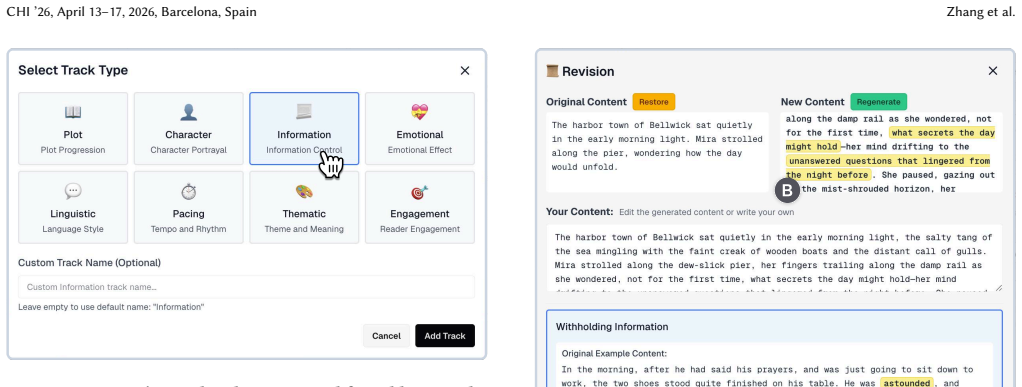
Experienced storytellers decompose stories into local narrative strategies and how these strategies shape higher-level arcs. This decomposition helps writers recognize patterns in others' work and adapt those patterns to tell new stories. Narrix supports novices by analyzing strategies in example stories, highlighting them with color-coded lexical cues and explanations, and situating them on an interactive story arc for exploration by emotional shifts and turning points. Writers then drag strategies onto multi-dimensional tracks and apply block-scoped edits to revise or continue their drafts through controlled generation steered by specified strategies. In a within-subjects study with twelve
What carries the argument
Narrix's decomposition and remixing interface, which uses color-coded highlights, interactive story arcs, and drag-and-drop application to multi-dimensional tracks to identify and steer generation with narrative strategies.
If this is right
- Novice writers can more readily identify patterns in example stories and apply them to their own work through visual cues and direct manipulation.
- Writing tools can move beyond open-ended chat to support controlled, strategy-specific generation for revisions and continuations.
- Participants gain measurable confidence when they can explore strategies by emotional shifts and turning points on an arc.
- Retention of specific narrative strategies increases when they are highlighted in context and available for immediate reuse in drafts.
Where Pith is reading between the lines
- Similar strategy-highlighting and drag-and-drop controls could be tested in adjacent creative tasks such as script or game-narrative writing.
- Longer-term use of the interface might transfer skill so that writers later identify strategies without tool support.
- The multi-dimensional tracks suggest a way to layer multiple strategies simultaneously that could reduce prompt-crafting effort in other AI writing systems.
- Educational applications might pair Narrix with classroom exercises to teach narrative structure through active remixing rather than passive reading.
Load-bearing premise
The improvements in retention, confidence, and creative adaptation observed with twelve participants are caused by Narrix's specific features rather than novelty effects, order effects, or other factors not detailed in the abstract.
What would settle it
A larger between-subjects study that measures the same outcomes after a one-week delay and finds no significant difference in retention or adaptation between Narrix users and baseline chat users.
Figures




read the original abstract
Experienced storytellers decompose stories into local narrative strategies and how these strategies shape higher-level arcs. This decomposition helps writers recognize patterns in others' work and adapt those patterns to tell new stories. Novices, however, struggle to identify these strategies or to reuse them effectively. We present Narrix, a novel writing tool that helps novice writers recognize narrative strategies in example stories and repurpose these strategies in their own writing. Narrix analyzes strategies in example stories, highlights them with color-coded lexical cues and explanations, and situates them on an interactive story arc for exploration by emotional shifts and turning points. Writers then drag strategies onto multi-dimensional tracks and apply block-scoped edits to revise or continue their drafts through controlled generation steered by specified strategies. Through a within-subjects study (N=12), Narrix showed improved participants' retention, confidence, and creative adaptation of narrative strategies compared to a baseline chat-based writing interface.
Editorial analysis
A structured set of objections, weighed in public.
Referee Report
Summary. The paper introduces Narrix, an interactive writing interface that extracts narrative strategies from example stories, visualizes them via color-coded lexical cues and an interactive emotional arc, and enables users to drag strategies onto multi-dimensional tracks for block-scoped generation and revision. Through a within-subjects user study (N=12), it claims that Narrix improves participants' retention of strategies, confidence in using them, and creative adaptation compared to a baseline chat-based writing interface.
Significance. If the empirical results hold after addressing study-design limitations, the work would contribute a concrete HCI system for scaffolding narrative strategy learning in creative writing, with potential to inform future tools that combine example-based remixing with controlled generation. The design choices around lexical highlighting, arc visualization, and drag-to-track application are novel and directly address a documented novice-expert gap.
major comments (2)
- [§4] §4 (User Study): The central claim that Narrix produces measurable gains in retention, confidence, and creative adaptation rests on a within-subjects comparison (N=12) whose abstract and reported protocol supply no information on counterbalancing of condition order, pre-registered statistical tests, effect sizes, or power analysis; without these, observed differences cannot be confidently attributed to the color-coded cues, interactive arc, or drag-to-track mechanisms rather than order, novelty, or learning effects.
- [§4.3] §4.3 (Metrics and Analysis): The paper asserts improvements in 'retention, confidence, and creative adaptation' but does not specify how these constructs were operationalized (e.g., exact quiz items for retention, Likert scales for confidence, or rubric for adaptation) or whether inter-rater reliability was assessed for any qualitative coding; this directly affects the load-bearing interpretation of the results.
minor comments (2)
- [Abstract] The abstract would benefit from a single sentence summarizing the statistical approach or key quantitative outcomes to allow readers to gauge evidence strength immediately.
- [§3] Figure captions for the system screenshots could more explicitly link visual elements (e.g., color coding) to the narrative-strategy remixing workflow described in §3.
Simulated Author's Rebuttal
We thank the referee for their constructive comments on the user study. We address each major point below and will revise the manuscript to improve clarity and transparency on study design and metrics.
read point-by-point responses
-
Referee: [§4] §4 (User Study): The central claim that Narrix produces measurable gains in retention, confidence, and creative adaptation rests on a within-subjects comparison (N=12) whose abstract and reported protocol supply no information on counterbalancing of condition order, pre-registered statistical tests, effect sizes, or power analysis; without these, observed differences cannot be confidently attributed to the color-coded cues, interactive arc, or drag-to-track mechanisms rather than order, novelty, or learning effects.
Authors: We agree that these methodological details are important for interpreting the results and should have been included. In the revised manuscript, we will expand §4 to describe the counterbalancing of condition order used in the within-subjects design, report effect sizes for the key comparisons, and include a power analysis. We will also clarify the statistical tests applied and note that the analysis plan was determined prior to data collection (though the study was not formally pre-registered). These additions will help readers assess potential confounds and strengthen attribution to the interface features. revision: yes
-
Referee: [§4.3] §4.3 (Metrics and Analysis): The paper asserts improvements in 'retention, confidence, and creative adaptation' but does not specify how these constructs were operationalized (e.g., exact quiz items for retention, Likert scales for confidence, or rubric for adaptation) or whether inter-rater reliability was assessed for any qualitative coding; this directly affects the load-bearing interpretation of the results.
Authors: We acknowledge that the original manuscript did not provide sufficient detail on how the constructs were measured or on reliability. We will revise §4.3 to specify the operationalization of retention (including the quiz items), confidence (including the Likert scale items), and creative adaptation (including the rubric). We will also report inter-rater reliability for any qualitative coding. The full instruments and coding guidelines will be added to an appendix. This will allow for a clearer and more reliable interpretation of the findings. revision: yes
Circularity Check
No circularity: empirical system evaluation with no derivations or self-referential claims
full rationale
The paper describes a writing interface (Narrix) and reports results from a within-subjects user study (N=12) comparing it to a baseline chat interface. No mathematical derivations, equations, fitted parameters, predictions from first principles, or uniqueness theorems appear in the provided abstract or description. The central claim rests on direct empirical comparison of retention, confidence, and adaptation metrics rather than any chain that reduces to its own inputs by construction. Self-citations, if present in the full text, are not load-bearing for the reported outcomes, which are presented as observed study results rather than derived necessities. This is a standard HCI system paper whose evaluation is self-contained against external benchmarks.
Axiom & Free-Parameter Ledger
axioms (1)
- domain assumption Experienced storytellers decompose stories into local narrative strategies that shape higher-level arcs.
invented entities (1)
-
Narrix
no independent evidence
Reference graph
Works this paper leans on
-
[1]
Tazin Afrin, Omid Kashefi, Christopher Olshefski, Diane Litman, Rebecca Hwa, and Amanda Godley. 2021. Effective Interfaces for Student-Driven Revision Sessions for Argumentative Writing. InProceedings of the 2021 CHI Conference on Human Factors in Computing Systems (CHI ’21). Association for Computing Machinery, New York, NY, USA, 1–13. doi:10.1145/341176...
-
[2]
Prithviraj Ammanabrolu, Wesley Cheung, William Broniec, and Mark O. Riedl. 2020. Automated Storytelling via Causal, Commonsense Plot Ordering. arXiv:2009.00829 [cs] doi:10.48550/arXiv.2009.00829
-
[3]
2004.Narratology: Introduction to the Theory of Narrative
Mieke Bal. 2004.Narratology: Introduction to the Theory of Narrative. University of Toronto Press, Scholarly Publishing Division, Toronto
2004
-
[4]
Aaron Bangor, Philip Kortum, and James Miller. 2009. Determining What Individual SUS Scores Mean: Adding an Adjective Rating Scale.J. Usability Studies4, 3 (May 2009), 114–123
2009
-
[5]
Berndt and James Clifford
Donald J. Berndt and James Clifford. 1994. Using Dynamic Time Warping to Find Patterns in Time Series. InProceedings of the 3rd International Conference on Knowledge Discovery and Data Mining (AAAIWS’94). AAAI Press, Seattle, WA, 359–370
1994
-
[6]
Virginia Braun and Victoria Clarke. 2006. Using Thematic Analysis in Psychol- ogy.Qualitative Research in Psychology3, 2 (Jan. 2006), 77–101. doi:10.1191/ 1478088706qp063oa
2006
-
[7]
Marc Cavazza, Fred Charles, and Steven J. Mead. 2001. Characters in Search of an Author: AI-Based Virtual Storytelling. InVirtual Storytelling Using Virtual Reality Technologies for Storytelling, Olivier Balet, Gérard Subsol, and Patrice Torguet (Eds.). Springer, Berlin, Heidelberg, 145–154. doi:10.1007/3-540-45420-9_16
-
[8]
Tuhin Chakrabarty, Philippe Laban, and Chien-Sheng Wu. 2025. AI-Slop to AI-Polish? Aligning Language Models through Edit-Based Writing Rewards and Test-Time Computation. arXiv:2504.07532 [cs] doi:10.48550/arXiv.2504.07532
-
[9]
Jim Chang and Jason Chang. 2015. WriteAhead2: Mining Lexical Grammar Patterns for Assisted Writing. InProceedings of the 2015 Conference of the North American Chapter of the Association for Computational Linguistics: Demonstra- tions. Association for Computational Linguistics, Denver, Colorado, 106–110. doi:10.3115/v1/N15-3022
-
[10]
Davida H. Charney and Richard A. Carls. 1995. Learning to Write in a Genre: What Student Writers Take from Model Texts.Research in the Teaching of English 29, 1 (Feb. 1995), 88–125. doi:10.58680/rte199515358
-
[11]
Erin Cherry and Celine Latulipe. 2014. Quantifying the Creativity Support of Digital Tools through the Creativity Support Index.ACM Trans. Comput.-Hum. Interact.21, 4 (Aug. 2014), 1–25. doi:10.1145/2617588
-
[12]
Jean-Peïc Chou, Alexa Fay Siu, Nedim Lipka, Ryan Rossi, Franck Dernoncourt, and Maneesh Agrawala. 2023. TaleStream: Supporting Story Ideation with Trope Knowledge. InProceedings of the 36th Annual ACM Symposium on User Interface Software and Technology (UIST ’23). ACM, San Francisco CA USA, 1–12. doi:10.1145/3586183.3606807
-
[14]
John Joon Young Chung, Wooseok Kim, Kang Min Yoo, Hwaran Lee, Eytan Adar, and Minsuk Chang. 2022. TaleBrush: Sketching Stories with Generative Pretrained Language Models. InProceedings of the 2022 CHI Conference on Human Factors in Computing Systems (CHI ’22). Association for Computing Machinery, New York, NY, USA, 1–19. doi:10.1145/3491102.3501819
-
[15]
John Joon Young Chung and Max Kreminski. 2024. Patchview: LLM-Powered Worldbuilding with Generative Dust and Magnet Visualization. InProceedings of the 37th Annual ACM Symposium on User Interface Software and Technology (UIST ’24). Association for Computing Machinery, New York, NY, USA, 1–19. doi:10.1145/3654777.3676352 Narrix: Remixing Narrative Strategi...
-
[16]
doi: 10.1037/1040-3590.6.4.284
Domenic V. Cicchetti. 1994. Guidelines, Criteria, and Rules of Thumb for Evalu- ating Normed and Standardized Assessment Instruments in Psychology.Psy- chological Assessment6, 4 (1994), 284–290. doi:10.1037/1040-3590.6.4.284
-
[17]
Allan Collins, John Seely Brown, and Ann Holum. 1991. Cognitive Apprentice- ship: Making Thinking Visible.American educator15, 3 (1991), 6–11
1991
-
[18]
2006.Cognitive Apprenticeship
Allan Collins and Manu Kapur. 2006.Cognitive Apprenticeship. The Cambridge Handbook of the Learning Sciences, Vol. 291. Cambridge University Press, Cambridge, UK
2006
-
[19]
Hai Dang, Chelse Swoopes, Daniel Buschek, and Elena L. Glassman. 2025. Cor- pusStudio: Surfacing Emergent Patterns In A Corpus Of Prior Work While Writing. InProceedings of the 2025 CHI Conference on Human Factors in Comput- ing Systems (CHI ’25). Association for Computing Machinery, New York, NY, USA, 1–19. doi:10.1145/3706598.3713974
-
[20]
Dhillon, Somayeh Molaei, Jiaqi Li, Maximilian Golub, Shaochun Zheng, and Lionel P
Paramveer S. Dhillon, Somayeh Molaei, Jiaqi Li, Maximilian Golub, Shaochun Zheng, and Lionel P. Robert. 2024. Shaping Human-AI Collaboration: Varied Scaffolding Levels in Co-Writing with Language Models. arXiv:2402.11723 [cs]
-
[21]
Shehzaad Dhuliawala, Mojtaba Komeili, Jing Xu, Roberta Raileanu, Xian Li, Asli Celikyilmaz, and Jason Weston. 2024. Chain-of-Verification Reduces Halluci- nation in Large Language Models. InFindings of the Association for Computa- tional Linguistics: ACL 2024, Lun-Wei Ku, Andre Martins, and Vivek Srikumar (Eds.). Association for Computational Linguistics,...
2024
-
[22]
doi:10.18653/v1/2024.findings-acl.212
-
[23]
Dana Lynn Driscoll, Joseph Paszek, Gwen Gorzelsky, Carol L. Hayes, and Ed- mund Jones. 2020. Genre Knowledge and Writing Development: Results From the Writing Transfer Project.Written Communication37, 1 (Jan. 2020), 69–103. doi:10.1177/0741088319882313
-
[24]
Alexandre Duval, Thomas Lamson, Gaël de Léséleuc de Kérouara, and Matthias Gallé. 2021. Breaking Writer’s Block: Low-Cost Fine-Tuning of Natural Language Generation Models. InProceedings of the 16th Conference of the European Chapter of the Association for Computational Linguistics: System Demonstrations, Dimitra Gkatzia and Djamé Seddah (Eds.). Associati...
-
[25]
Angela Fan, Mike Lewis, and Yann Dauphin. 2018. Hierarchical Neural Story Generation. arXiv:1805.04833 [cs] doi:10.48550/arXiv.1805.04833
-
[26]
Robert L. Fowler and Anne S. Barker. 1974. Effectiveness of Highlighting for Retention of Text Material.Journal of Applied Psychology59, 3 (1974), 358–364. doi:10.1037/h0036750
-
[27]
Gatys, Alexander S
Leon A. Gatys, Alexander S. Ecker, and Matthias Bethge. 2016. Image Style Transfer Using Convolutional Neural Networks. InProceedings of the IEEE Conference on Computer Vision and Pattern Recognition. IEEE, Las Vegas, Nevada, USA, 2414–2423
2016
-
[28]
Katy Ilonka Gero, Vivian Liu, and Lydia Chilton. 2022. Sparks: Inspiration for Science Writing Using Language Models. InProceedings of the 2022 ACM Designing Interactive Systems Conference (DIS ’22). Association for Computing Machinery, New York, NY, USA, 1002–1019. doi:10.1145/3532106.3533533
-
[29]
Pablo Gervás, Belén Díaz-Agudo, Federico Peinado, and Raquel Hervás. 2005. Story Plot Generation Based on CBR.Knowledge-Based Systems18, 4 (Aug. 2005), 235–242. doi:10.1016/j.knosys.2004.10.011
-
[30]
MaCarthur, and Jill Fitzgerald (Eds.)
Steve Graham, Charles A. MaCarthur, and Jill Fitzgerald (Eds.). 2007.Best Practices in Writing Instruction. The Guilford Press, New York, NY, US. xii, 340 pages
2007
-
[31]
2007.Writing Next: Effective Strategies to Improve Writing of Adolescents in Middle and High Schools
Steve Graham and Dolores Perin. 2007.Writing Next: Effective Strategies to Improve Writing of Adolescents in Middle and High Schools. Alliance for Excellent Education, Washington, D.C., US
2007
-
[32]
Hart and Lowell E
Sandra G. Hart and Lowell E. Staveland. 1988. Development of NASA-TLX (Task Load Index): Results of Empirical and Theoretical Research. InAdvances in Psychology, Peter A. Hancock and Najmedin Meshkati (Eds.). Human Mental Workload, Vol. 52. North-Holland, Amsterdam, The Netherlands, 139–183. doi:10. 1016/S0166-4115(08)62386-9
1988
-
[33]
Sara Hennessy. 1993. Situated Cognition and Cognitive Apprenticeship: Impli- cations for Classroom Learning.Studies in Science Education22, 1 (Jan. 1993), 1–41. doi:10.1080/03057269308560019
-
[34]
Shelton, Fanny Chevalier, Kari Kraus, and Niklas Elmqvist
Md Naimul Hoque, Tasfia Mashiat, Bhavya Ghai, Cecilia D. Shelton, Fanny Chevalier, Kari Kraus, and Niklas Elmqvist. 2024. The HaLLMark Effect: Sup- porting Provenance and Transparent Use of Large Language Models in Writing with Interactive Visualization. InProceedings of the CHI Conference on Human Factors in Computing Systems (CHI ’24). Association for C...
-
[35]
Chieh-Yang Huang, Shih-Hong Huang, and Ting-Hao Kenneth Huang. 2020. Heteroglossia: In-Situ Story Ideation with the Crowd. InProceedings of the 2020 CHI Conference on Human Factors in Computing Systems (CHI ’20). Association for Computing Machinery, New York, NY, USA, 1–12. doi:10.1145/3313831. 3376715
-
[36]
Yichen Huang, Yizhe Zhang, Oussama Elachqar, and Yu Cheng. 2020. INSET: Sentence Infilling with INter-SEntential Transformer. InProceedings of the 58th Annual Meeting of the Association for Computational Linguistics, Dan Jurafsky, Joyce Chai, Natalie Schluter, and Joel Tetreault (Eds.). Association for Computa- tional Linguistics, Online, 2502–2515. doi:1...
-
[37]
Yi-Ching Huang, Hao-Chuan Wang, and Jane Yung-jen Hsu. 2018. Feedback Orchestration: Structuring Feedback for Facilitating Reflection and Revision in Writing. InCompanion of the 2018 ACM Conference on Computer Supported Cooperative Work and Social Computing (CSCW ’18 Companion). Association for Computing Machinery, New York, NY, USA, 257–260. doi:10.1145/...
-
[38]
Julie Hui and Michelle L. Sprouse. 2023. Lettersmith: Scaffolding Written Profes- sional Communication Among College Students. InProceedings of the 2023 CHI Conference on Human Factors in Computing Systems (CHI ’23). Association for Computing Machinery, New York, NY, USA, 1–17. doi:10.1145/3544548.3581029
-
[39]
Hui, Darren Gergle, and Elizabeth M
Julie S. Hui, Darren Gergle, and Elizabeth M. Gerber. 2018. IntroAssist: A Tool to Support Writing Introductory Help Requests. InProceedings of the 2018 CHI Conference on Human Factors in Computing Systems (CHI ’18). Association for Computing Machinery, New York, NY, USA, 1–13. doi:10.1145/3173574.3173596
-
[41]
Daphne Ippolito, David Grangier, Chris Callison-Burch, and Douglas Eck. 2019. Unsupervised Hierarchical Story Infilling. InProceedings of the First Workshop on Narrative Understanding, David Bamman, Snigdha Chaturvedi, Elizabeth Clark, Madalina Fiterau, and Mohit Iyyer (Eds.). Association for Computational Linguistics, Minneapolis, Minnesota, 37–43. doi:1...
- [42]
-
[43]
Takumi Ito, Naomi Yamashita, Tatsuki Kuribayashi, Masatoshi Hidaka, Jun Suzuki, Ge Gao, Jack Jamieson, and Kentaro Inui. 2023. Use of an AI-Powered Rewriting Support Software in Context with Other Tools: A Study of Non- Native English Speakers. InProceedings of the 36th Annual ACM Symposium on User Interface Software and Technology (UIST ’23). Association...
-
[44]
Maurice Jakesch, Advait Bhat, Daniel Buschek, Lior Zalmanson, and Mor Naa- man. 2023. Co-Writing with Opinionated Language Models Affects Users’ Views. InProceedings of the 2023 CHI Conference on Human Factors in Computing Systems. ACM, Hamburg Germany, 1–15. doi:10.1145/3544548.3581196
-
[45]
Ziwei Ji, Nayeon Lee, Rita Frieske, Tiezheng Yu, Dan Su, Yan Xu, Etsuko Ishii, Ye Jin Bang, Andrea Madotto, and Pascale Fung. 2023. Survey of Hallucination in Natural Language Generation.ACM Comput. Surv.55, 12 (March 2023), 248:1–248:38. doi:10.1145/3571730
-
[46]
Kang, Gabriel Amoako, Neil Sengupta, and Steven P
Hyeonsu B. Kang, Gabriel Amoako, Neil Sengupta, and Steven P. Dow. 2018. Paragon: An Online Gallery for Enhancing Design Feedback with Visual Exam- ples. InProceedings of the 2018 CHI Conference on Human Factors in Computing Systems. ACM, Montreal QC Canada, 1–13. doi:10.1145/3173574.3174180
-
[47]
X. J. Kennedy and Dana Gioia. 2016.Literature: An Introduction to Fiction, Poetry, Drama, and Writing. Pearson, Boston
2016
-
[48]
Bernstein
Joy Kim, Sarah Sterman, Allegra Argent Beal Cohen, and Michael S. Bernstein
-
[49]
Mechanical Novel: Crowdsourcing Complex Work through Reflection and Revision. InProceedings of the 2017 ACM Conference on Computer Supported Cooperative Work and Social Computing (CSCW ’17). Association for Computing Machinery, New York, NY, USA, 233–245. doi:10.1145/2998181.2998196
- [50]
-
[51]
Michael Lebowitz. 1984. Creating Characters in a Story-Telling Universe.Poetics 13, 3 (1984), 171–194
1984
-
[52]
Brian Lee, Savil Srivastava, Ranjitha Kumar, Ronen Brafman, and Scott R. Klemmer. 2010. Designing with Interactive Example Galleries. InProceed- ings of the SIGCHI Conference on Human Factors in Computing Systems (CHI ’10). Association for Computing Machinery, New York, NY, USA, 2257–2266. doi:10.1145/1753326.1753667
-
[53]
In Proceedings of the 2024 CHI Conference on Human Factors in Computing Systems (CHI ’24)
Mina Lee, Katy Ilonka Gero, John Joon Young Chung, Simon Buckingham Shum, Vipul Raheja, Hua Shen, Subhashini Venugopalan, Thiemo Wambsganss, David Zhou, Emad A. Alghamdi, Tal August, Avinash Bhat, Madiha Zahrah Choksi, Senjuti Dutta, Jin L. C. Guo, Md Naimul Hoque, Yewon Kim, Simon Knight, Seyed Parsa Neshaei, Agnia Sergeyuk, Antonette Shibani, Disha Shri...
-
[54]
Yoonjoo Lee, Tae Soo Kim, Minsuk Chang, and Juho Kim. 2022. Interactive Children’s Story Rewriting Through Parent-Children Interaction. InProceedings of the First Workshop on Intelligent and Interactive Writing Assistants (In2Writing 2022). Association for Computational Linguistics, Dublin, Ireland, 62–71. doi:10. 18653/v1/2022.in2writing-1.9 CHI ’26, Apr...
2022
-
[55]
Tao Lei, Regina Barzilay, and Tommi Jaakkola. 2016. Rationalizing Neural Predictions. InProceedings of the 2016 Conference on Empirical Methods in Natural Language Processing, Jian Su, Kevin Duh, and Xavier Carreras (Eds.). Association for Computational Linguistics, Austin, Texas, 107–117. doi:10.18653/v1/D16- 1011
-
[56]
James R. Lewis, Brian S. Utesch, and Deborah E. Maher. 2013. UMUX-LITE: When There’s No Time for the SUS. InProceedings of the SIGCHI Conference on Human Factors in Computing Systems (CHI ’13). Association for Computing Machinery, New York, NY, USA, 2099–2102. doi:10.1145/2470654.2481287
-
[57]
Rhema Linder, Clair Snodgrass, and Andruid Kerne. 2014. Everyday Ideation: All of My Ideas Are on Pinterest. InProceedings of the SIGCHI Conference on Human Factors in Computing Systems (CHI ’14). Association for Computing Machinery, New York, NY, USA, 2411–2420. doi:10.1145/2556288.2557273
-
[58]
Yuwen Lu, Alan Leung, Amanda Swearngin, Jeffrey Nichols, and Titus Barik
-
[59]
In Proceedings of the 2025 CHI Conference on Human Factors in Computing Systems (CHI ’25)
Misty: UI Prototyping Through Interactive Conceptual Blending. In Proceedings of the 2025 CHI Conference on Human Factors in Computing Systems (CHI ’25). Association for Computing Machinery, New York, NY, USA, 1–17. arXiv:2409.13900 [cs] doi:10.1145/3706598.3713924
-
[60]
Zhuoran Lu, Qian Zhou, and Yi Wang. 2025. WhatELSE: Shaping Narrative Spaces at Configurable Level of Abstraction for AI-Bridged Interactive Story- telling. InProceedings of the 2025 CHI Conference on Human Factors in Computing Systems (CHI ’25). Association for Computing Machinery, New York, NY, USA, 1–18. doi:10.1145/3706598.3713363
-
[61]
Deena Mohammad Mansour. 2017. Using COCA to Foster Students’ Use of English Collocations in Academic Writing. InProceedings of the 3rd Interna- tional Conference on Higher Education Advances. Universitat Politècnica València, Valencia, Spain, 600–607. doi:10.4995/HEAD17.2017.5301
-
[62]
Damien Masson, Young-Ho Kim, and Fanny Chevalier. 2025. Textoshop: Inter- actions Inspired by Drawing Software to Facilitate Text Editing. InProceedings of the 2025 CHI Conference on Human Factors in Computing Systems. ACM, Yokohama Japan, 1–14. doi:10.1145/3706598.3713862
-
[63]
1997.Story: Style, Structure, Substance, and the Principles of Screenwriting
Robert McKee. 1997.Story: Style, Structure, Substance, and the Principles of Screenwriting. Dey Street Books, New York
1997
-
[64]
James R. Meehan. 1977. TALE-SPIN, an Interactive Program That Writes Stories. InProceedings of the 5th International Joint Conference on Artificial Intelligence - Volume 1 (IJCAI’77). Morgan Kaufmann Publishers Inc., San Francisco, CA, USA, 91–98
1977
-
[65]
InProceedings of the 2023 CHI Conference on Human Factors in Computing Systems (CHI ’23)
Piotr Mirowski, Kory W. Mathewson, Jaylen Pittman, and Richard Evans. 2023. Co-Writing Screenplays and Theatre Scripts with Language Models: Evaluation by Industry Professionals. InProceedings of the 2023 CHI Conference on Human Factors in Computing Systems (CHI ’23). Association for Computing Machinery, New York, NY, USA, 1–34. doi:10.1145/3544548.3581225
- [66]
-
[67]
Donald M. Murray. 2004.A Writer Teaches Writing Revised. Cengage Learning, Boston, MA
2004
-
[68]
M. Asif Naeem, I. Wayan S. Linggawa, Aftab A. Mughal, Christof Lutteroth, and Gerald Weber. 2018. A Smart Email Client Prototype for Effective Reuse of Past Replies.IEEE Access6 (2018), 69453–69471. doi:10.1109/ACCESS.2018.2878523
-
[69]
Ngoon, Joy O Kim, and Scott Klemmer
Tricia J. Ngoon, Joy O Kim, and Scott Klemmer. 2021. Shöwn: Adaptive Con- ceptual Guidance Aids Example Use in Creative Tasks. InDesigning Interactive Systems Conference 2021 (DIS ’21). Association for Computing Machinery, New York, NY, USA, 1834–1845. doi:10.1145/3461778.3462072
-
[70]
Pinelopi Papalampidi, Frank Keller, and Mirella Lapata. 2019. Movie Plot Anal- ysis via Turning Point Identification. InProceedings of the 2019 Conference on Empirical Methods in Natural Language Processing and the 9th International Joint Conference on Natural Language Processing (EMNLP-IJCNLP), Kentaro Inui, Jing Jiang, Vincent Ng, and Xiaojun Wan (Eds.)...
-
[71]
Rafael PÉrez Ý PÉrez and Mike and Sharples. 2001. MEXICA: A Computer Model of a Cognitive Account of Creative Writing.Journal of Experimental & Theoretical Artificial Intelligence13, 2 (April 2001), 119–139. doi:10.1080/09528130010029820
-
[72]
2012.Narratology: The Form and Functioning of Narrative
Gerald Prince. 2012.Narratology: The Form and Functioning of Narrative. Vol. 108. Walter de Gruyter, Berlin, Germany
2012
-
[73]
Anyi Rao, Jean-Peïc Chou, and Maneesh Agrawala. 2024. ScriptViz: A Visualiza- tion Tool to Aid Scriptwriting Based on a Large Movie Database. InProceedings of the 37th Annual ACM Symposium on User Interface Software and Technology (UIST ’24). Association for Computing Machinery, New York, NY, USA, 1–13. doi:10.1145/3654777.3676402
-
[74]
Andrew J Reagan, Lewis Mitchell, Dilan Kiley, Christopher M Danforth, and Peter Sheridan Dodds. 2016. The Emotional Arcs of Stories Are Dominated by Six Basic Shapes.EPJ Data Sci.5, 1 (Dec. 2016), 31. doi:10.1140/epjds/s13688- 016-0093-1
-
[75]
Mohi Reza, Nathan Laundry, Ilya Musabirov, Peter Dushniku, Zhi Yuan "Michael" Yu, Kashish Mittal, Tovi Grossman, Michael Liut, Anastasia Kuzminykh, and Joseph Jay Williams. 2023. ABScribe: Rapid Exploration of Multiple Writ- ing Variations in Human-AI Co-Writing Tasks Using Large Language Models. arXiv:2310.00117 [cs] doi:10.48550/arXiv.2310.00117
-
[76]
Mohi Reza, Nathan M Laundry, Ilya Musabirov, Peter Dushniku, Zhi Yuan “Michael” Yu, Kashish Mittal, Tovi Grossman, Michael Liut, Anastasia Kuzminykh, and Joseph Jay Williams. 2024. ABScribe: Rapid Exploration & Organization of Multiple Writing Variations in Human-AI Co-Writing Tasks Using Large Language Models. InProceedings of the 2024 CHI Conference on ...
-
[77]
Mark O. Riedl. 2008. Vignette-Based Story Planning: Creativity through Explo- ration and Retrieval. InProceedings of the 5th International Joint Workshop on Computational Creativity. Association for Computational Creativity, Madrid, Spain, 41–50
2008
-
[78]
Riedl and Robert Michael Young
Mark O. Riedl and Robert Michael Young. 2010. Narrative Planning: Balancing Plot and Character.Journal of Artificial Intelligence Research39 (2010), 217–268
2010
-
[79]
Daniel Ritchie, Ankita Arvind Kejriwal, and Scott R. Klemmer. 2011. D.Tour: Style-Based Exploration of Design Example Galleries. InProceedings of the 24th Annual ACM Symposium on User Interface Software and Technology - UIST ’11. ACM Press, Santa Barbara, California, USA, 165. doi:10.1145/2047196.2047216
-
[80]
Oliver Schmitt and Daniel Buschek. 2021. CharacterChat: Supporting the Cre- ation of Fictional Characters through Conversation and Progressive Manifesta- tion with a Chatbot. InCreativity and Cognition. ACM, Virtual Event Italy, 1–10. doi:10.1145/3450741.3465253
-
[81]
Raymond Scupin. 1997. The KJ Method: A Technique for Analyzing Data Derived from Japanese Ethnology.Human Organization56, 2 (1997), 233–237. jstor:44126786
1997
-
[82]
Hua Shen, Chieh-Yang Huang, Tongshuang Wu, and Ting-Hao Kenneth Huang
discussion (0)
Sign in with ORCID, Apple, or X to comment. Anyone can read and Pith papers without signing in.