Recognition: 2 theorem links
· Lean TheoremDust Absorption towards Supernova Remnant W44
Pith reviewed 2026-05-10 18:17 UTC · model grok-4.3
The pith
Water ice abundances are 1.5 to 3 times lower in the molecular cloud interacting with supernova remnant W44 than in similar nearby clouds.
A machine-rendered reading of the paper's core claim, the machinery that carries it, and where it could break.
Core claim
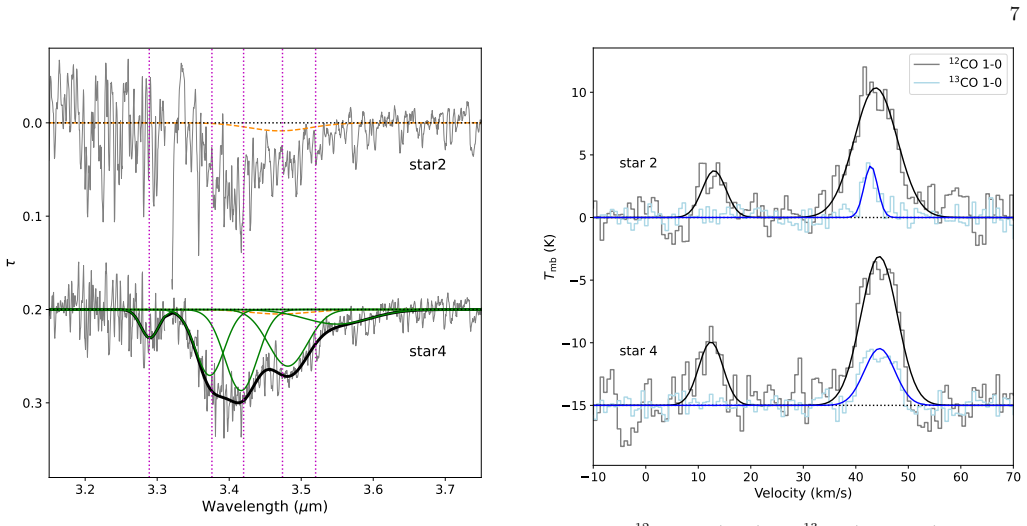
Medium-resolution infrared spectra show H2O ice absorption at 3.0 microns and aliphatic hydrocarbon absorption at 3.4 microns toward two stars, with probable CO ice at 4.67 microns toward one. Millimeter CO J=1-0 emission and three-dimensional dust maps establish that the dense gas tied to W44 accounts for more than 60 percent of the total extinction (A_K approximately 2.6) along these lines of sight. The derived H2O ice column densities are a factor of 1.5-3 lower than those found in nearby molecular clouds at comparable extinctions, and the CO ice abundance relative to H2O is less than 12 percent. One sightline also exhibits an unusually strong 3.4 micron feature whose carriers may be tied
What carries the argument
Infrared absorption spectroscopy of background stars combined with millimeter CO mapping and 3D dust extinction models to isolate the contribution of the W44-interacting cloud.
If this is right
- Shocks and cosmic rays from the supernova remnant destroy water and CO ice mantles in the interacting cloud.
- The low CO ice to water ice ratio is a direct consequence of this selective destruction.
- Aliphatic hydrocarbon carriers may be enhanced either in the diffuse gas or within the processed molecular material near W44.
- The overall dust and ice composition along these sightlines is altered by the SNR interaction.
- Similar ice depletion should appear in other supernova remnant-molecular cloud contact regions.
Where Pith is reading between the lines
- Models of interstellar ice chemistry must incorporate localized destruction zones around supernova remnants when predicting molecular abundances available for star formation.
- The unusually strong 3.4 micron feature could be tested with higher-resolution spectra to decide whether it traces diffuse-cloud carriers or material processed inside the SNR environment.
- Extending the same observing strategy to other well-studied SNR-cloud systems would show whether the factor of 1.5-3 reduction is typical or depends on remnant age and shock strength.
Load-bearing premise
The measured absorption features arise primarily in the molecular cloud that is interacting with W44 rather than in unrelated foreground or background material, and the comparison clouds are similar enough in every other respect that the abundance difference can be attributed to W44.
What would settle it
Ice column density measurements toward stars behind the same molecular cloud but offset from W44's influence that recover the higher abundances typical of unaffected clouds would show the reduction is not caused by the remnant.
Figures



read the original abstract
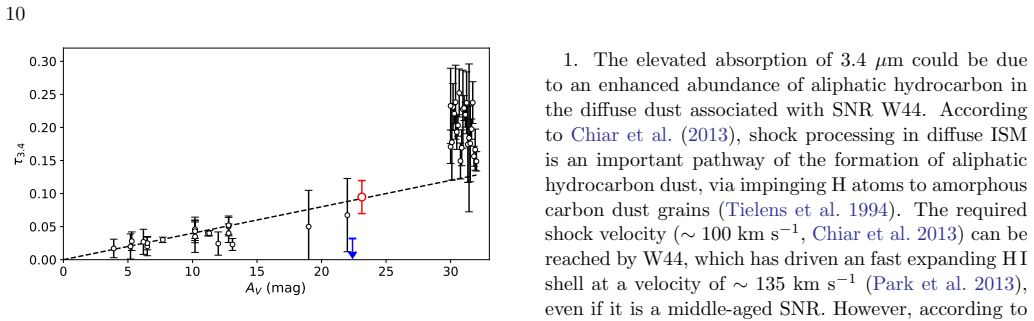
Supernova remnants (SNRs) can strongly affect the chemical composition of the interstellar dust. In this paper we investigate to what degree the dust and ices are modified by observing four stars expected to be absorbed by a giant molecular cloud interacting with SNR W44, using medium-resolution spectroscopy in 2-5 $\mu$m. Absorption from H2O ice around 3.0 $\mu$m and aliphatic hydrocarbon dust around 3.4 $\mu$m were detected towards two stars, while probable CO ice at 4.67 $\mu$m towards one of them. Millimeter gas-phase CO J = 1-0 lines and three-dimensional dust extinction maps show that the dense molecular gas associated with W44 dominates (> 60%) the total interstellar extinction (A_K ~ 2.6) along these two sightlines. The H2O ice column densities are a factor of 1.5-3 lower than nearby MCs at similar extinctions, possibly because of the destruction of ice by shocks and cosmic rays (CRs) from W44, consistent with the low CO ice abundance relative to H2O (< 12%). One of the sightlines shows an unusually strong 3.4 $\mu$m aliphatic hydrocarbon absorption. If the carriers are located in diffuse dust along the sightline, unrelated to W44, its strength is ~ 4 times larger than those typically observed for diffuse dust clouds. Alternatively, the carriers may be enhanced in the W44 environment. We discuss several possible explanations, including shock formation of aliphatic hydrocarbons in diffuse clouds associated with W44, contribution from aliphatic hydrocarbons in shocked and CR-bombarded molecular clouds, and changes in the extinction law due to the SNR interaction.
Editorial analysis
A structured set of objections, weighed in public.
Referee Report
Summary. The paper presents medium-resolution 2-5 μm spectroscopy toward four stars behind a giant molecular cloud interacting with SNR W44. Absorption from H2O ice (3.0 μm) and aliphatic hydrocarbons (3.4 μm) is detected toward two sightlines, with probable CO ice (4.67 μm) toward one. Millimeter CO J=1-0 and 3D extinction maps indicate that dense gas associated with W44 dominates >60% of the total A_K ≈ 2.6 along these lines of sight. The derived H2O ice column densities are 1.5-3 times lower than in nearby molecular clouds at comparable extinctions; this is interpreted as evidence for ice destruction by shocks and cosmic rays from W44, consistent with a low CO ice abundance relative to H2O (<12%). One sightline shows an unusually strong 3.4 μm feature whose origin (diffuse dust or W44-processed material) is discussed.
Significance. If the attribution of the ice features to the W44-interacting cloud is robust and the comparison sample is appropriately matched, the results would provide direct observational evidence for SNR-driven processing of interstellar ices, with implications for dust evolution and astrochemistry in supernova environments. The multi-wavelength approach combining IR spectroscopy, mm gas tracers, and 3D extinction maps is a positive aspect of the work.
major comments (3)
- [Extinction analysis (mm CO J=1-0 and 3D dust maps)] The claim that dense molecular gas associated with W44 dominates >60% of the total extinction (A_K ~2.6) does not isolate the ice-bearing component. Foreground diffuse material or unrelated dense clumps could contribute to the observed H2O and CO ice absorption without having experienced W44 shocks/CRs. This attribution is load-bearing for the destruction interpretation but is not demonstrated by the mm CO J=1-0 and 3D map data alone.
- [Comparison with other molecular clouds] The factor of 1.5-3 lower H2O ice column densities relative to nearby MCs at similar extinctions requires explicit matching criteria for the comparison sample (volume density, kinetic temperature, local radiation field, and metallicity). Without these, the deficit cannot be unambiguously assigned to W44 processing rather than differing initial conditions.
- [CO ice detection and abundance] The CO ice abundance upper limit (<12% relative to H2O) is presented without the underlying column-density values, detection limits, or error analysis for the 4.67 μm feature. This weakens the consistency argument with the H2O deficit.
minor comments (3)
- The manuscript should include a table of observed column densities with uncertainties and a summary of the four sightlines (coordinates, A_K values, and which features are detected).
- Error bars or confidence intervals are not visible on the reported ice column densities or the 1.5-3 factor; these should be added to all quantitative claims.
- The discussion of the strong 3.4 μm aliphatic feature would benefit from additional references to literature values in both diffuse and dense environments for context.
Simulated Author's Rebuttal
We thank the referee for their constructive and detailed report. We address each major comment below and indicate where revisions will be made to strengthen the manuscript.
read point-by-point responses
-
Referee: The claim that dense molecular gas associated with W44 dominates >60% of the total extinction (A_K ~2.6) does not isolate the ice-bearing component. Foreground diffuse material or unrelated dense clumps could contribute to the observed H2O and CO ice absorption without having experienced W44 shocks/CRs. This attribution is load-bearing for the destruction interpretation but is not demonstrated by the mm CO J=1-0 and 3D map data alone.
Authors: We agree this attribution is critical. The 3D extinction maps place the bulk of A_K at the distance of W44, and the mm CO J=1-0 spectra show emission at velocities matching the known W44-molecular cloud interaction. The two sightlines with ice detections were specifically chosen to intersect the interacting region. Nevertheless, we acknowledge that velocity information alone does not fully exclude unrelated dense clumps at similar distance. In revision we will expand the discussion to include the spatial correlation with W44's radio shell and the absence of ice features toward the two control sightlines with lower W44-associated extinction, thereby strengthening the case that the observed ices are dominated by the processed material. revision: partial
-
Referee: The factor of 1.5-3 lower H2O ice column densities relative to nearby MCs at similar extinctions requires explicit matching criteria for the comparison sample (volume density, kinetic temperature, local radiation field, and metallicity). Without these, the deficit cannot be unambiguously assigned to W44 processing rather than differing initial conditions.
Authors: We selected the comparison sample (primarily Taurus, Perseus, and IC 5146) on the basis of comparable total A_K and similar Galactic radii to control for metallicity and average radiation field. Direct volume-density and kinetic-temperature measurements are not uniformly available for every reference cloud in the literature. In the revised manuscript we will add an explicit table listing the adopted A_K, approximate n(H2), and T_kin ranges for each comparison cloud, together with a short discussion of the remaining uncertainties. We maintain that the observed deficit remains noteworthy given the unique presence of SNR-driven shocks and enhanced CR flux at W44, but we will present the comparison more cautiously. revision: yes
-
Referee: The CO ice abundance upper limit (<12% relative to H2O) is presented without the underlying column-density values, detection limits, or error analysis for the 4.67 μm feature. This weakens the consistency argument with the H2O deficit.
Authors: We regret the omission. The 4.67 μm feature is only marginally detected toward one star; the <12% upper limit was obtained from the 3σ noise level in the continuum-subtracted spectrum assuming a typical CO ice band strength. In the revision we will insert the measured (or limiting) optical depth, the adopted band strength, the resulting N(CO) value with uncertainty, and the explicit calculation of the N(CO)/N(H2O) ratio. This will make the consistency argument with the H2O-ice deficit fully traceable. revision: yes
Circularity Check
No significant circularity; purely observational with external benchmarks
full rationale
The paper reports direct spectroscopic measurements of H2O ice, CO ice, and aliphatic hydrocarbon absorption features toward background stars, combined with independent mm-wave CO J=1-0 data and 3D extinction maps to attribute >60% of A_K to the W44-interacting cloud. Column densities are extracted from observed spectra and compared to literature values for other molecular clouds at comparable extinctions; no equations, fitted parameters, or derivations are defined in terms of the target results. The interpretive suggestion of ice destruction by W44 shocks/CRs is an inference from the data, not a self-referential loop or self-citation load-bearing step. All load-bearing elements rest on external observations and literature comparisons.
Axiom & Free-Parameter Ledger
axioms (2)
- domain assumption The dense molecular gas associated with W44 dominates (>60%) the total interstellar extinction along the observed sightlines
- domain assumption Nearby molecular clouds used for comparison have similar properties except for the absence of W44 shocks and cosmic rays
Reference graph
Works this paper leans on
-
[1]
2013, Science, 339, 807, doi: 10.1126/science.1231160
Ackermann, M., Ajello, M., Allafort, A., et al. 2013, Science, 339, 807, doi: 10.1126/science.1231160
-
[2]
J., Whittet, D
Adamson, A. J., Whittet, D. C. B., & Duley, W. W. 1990, MNRAS, 243, 400
1990
-
[3]
Aharonian, F. A. 2013, APh, 43, 71, doi: 10.1016/j.astropartphys.2012.08.007
-
[4]
2014, A&A, 569, A81, doi: 10.1051/0004-6361/201423561
Anderl, S., Gusdorf, A., & G¨ usten, R. 2014, A&A, 569, A81, doi: 10.1051/0004-6361/201423561
-
[5]
Arumainayagam, C. R., Garrod, R. T., Boyer, M. C., et al. 2019, ChSRv, 48, 2293, doi: 10.1039/C7CS00443E Astropy Collaboration, Price-Whelan, A. M., Sip˝ ocz, B. M., et al. 2018, ApJ, 156, 123, doi: 10.3847/1538-3881/aabc4f Astropy Collaboration, Price-Whelan, A. M., Lim, P. L., et al. 2022, ApJ, 935, 167, doi: 10.3847/1538-4357/ac7c74
-
[6]
2012, A&A, 541, L12, doi: 10.1051/0004-6361/201219207
Ceccarelli, C. 2012, A&A, 541, L12, doi: 10.1051/0004-6361/201219207
-
[7]
Barlow, M. J. 1978, MNRAS, 183, 367, doi: 10.1093/mnras/183.3.367
-
[8]
Bergin, E. A., Melnick, G. J., & Neufeld, D. A. 1998, ApJ, 499, 777, doi: 10.1086/305656
-
[9]
Bergin, E. A., Neufeld, D. A., & Melnick, G. J. 1999, ApJ, 510, L145, doi: 10.1086/311817
-
[10]
Bohlin, R. C., Savage, B. D., & Drake, J. F. 1978, ApJ, 224, 132, doi: 10.1086/156357
-
[11]
and Wolfire, Mark and Leroy, Adam K
Bolatto, A. D., Wolfire, M., & Leroy, A. K. 2013, ARA&A, 51, 207, doi: 10.1146/annurev-astro-082812-140944
work page Pith review doi:10.1146/annurev-astro-082812-140944 2013
-
[12]
Boogert, A. C. A., Chiar, J. E., Knez, C., et al. 2013, ApJ, 777, 73, doi: 10.1088/0004-637X/777/1/73
-
[13]
Boogert, A. C. A., Gerakines, P. A., & Whittet, D. C. B. 2015, ARA&A, 53, 541, doi: 10.1146/annurev-astro-082214-122348
work page Pith review doi:10.1146/annurev-astro-082214-122348 2015
-
[14]
Boogert, A. C. A., Huard, T. L., Cook, A. M., et al. 2011, ApJ, 729, 92, doi: 10.1088/0004-637X/729/2/92
-
[15]
Brogan, C. L., Goss, W. M., Hunter, T. R., et al. 2013, ApJ, 771, 91, doi: 10.1088/0004-637X/771/2/91
-
[16]
Y., Sellgren, K., & Geballe, T
Brooke, T. Y., Sellgren, K., & Geballe, T. R. 1999, ApJ, 517, 883, doi: 10.1086/307237
-
[17]
Burkhardt, A. M., Shingledecker, C. N., Le Gal, R., et al. 2019, ApJ, 881, 32, doi: 10.3847/1538-4357/ab2be8
-
[18]
2014, A&A, 565, A74, doi: 10.1051/0004-6361/201322685
Cardillo, M., Tavani, M., Giuliani, A., et al. 2014, A&A, 565, A74, doi: 10.1051/0004-6361/201322685
-
[19]
2012, , 20, 56, 10.1007/s00159-012-0056-x
Caselli, P., & Ceccarelli, C. 2012, A&ARv, 20, 56, doi: 10.1007/s00159-012-0056-x
-
[20]
W., & Havnes, O
Caselli, P., Hartquist, T. W., & Havnes, O. 1997, A&A, 322, 296
1997
-
[21]
Chiar, J. E., Adamson, A. J., Kerr, T. H., & Whittet, D. C. B. 1994, ApJ, 426, 240, doi: 10.1086/174058 —. 1995, ApJ, 455, 234, doi: 10.1086/176571
-
[22]
Chiar, J. E., Adamson, A. J., Pendleton, Y. J., et al. 2002, ApJ, 570, 198, doi: 10.1086/339570
-
[23]
Chiar, J. E., Adamson, A. J., & Whittet, D. C. B. 1996, ApJ, 472, 665, doi: 10.1086/178097
-
[24]
Chiar, J. E., & Tielens, A. G. G. M. 2001, ApJ, 550, L207, doi: 10.1086/319631
-
[25]
Ricca, A. 2013, ApJ, 770, 78, doi: 10.1088/0004-637X/770/1/78
-
[26]
Chiar, J. E., Tielens, A. G. G. M., Whittet, D. C. B., et al. 2000, ApJ, 537, 749, doi: 10.1086/309047
-
[27]
Chiar, J. E., Pendleton, Y. J., Allamandola, L. J., et al. 2011, ApJ, 731, 9, doi: 10.1088/0004-637X/731/1/9
-
[28]
Chu, L. E. U., Hodapp, K., & Boogert, A. 2020, ApJ, 904, 86, doi: 10.3847/1538-4357/abbfa5
-
[29]
Claussen, M. J., Frail, D. A., Goss, W. M., & Gaume, R. A. 1997, ApJ, 489, 143, doi: 10.1086/304784
-
[30]
2015, MNRAS, 449, L11, doi: 10.1093/mnrasl/slu204 13
Codella, C., Fontani, F., Ceccarelli, C., et al. 2015, MNRAS, 449, L11, doi: 10.1093/mnrasl/slu204 13
-
[31]
Cosentino, G., Jim´ enez-Serra, I., Henshaw, J. D., et al. 2018, MNRAS, 474, 3760, doi: 10.1093/mnras/stx3013
-
[32]
2019, ApJ, 881, L42, doi: 10.3847/2041-8213/ab38c5
Cosentino, G., Jim´ enez-Serra, I., Caselli, P., et al. 2019, ApJ, 881, L42, doi: 10.3847/2041-8213/ab38c5
-
[33]
Cosentino, G., Jim´ enez-Serra, I., Tan, J. C., et al. 2022, MNRAS, 511, 953, doi: 10.1093/mnras/stac070
-
[34]
Cushing, M. C., Vacca, W. D., & Rayner, J. T. 2004, PASP, 116, 362, doi: 10.1086/382907
-
[35]
2018, A&A, 618, A173, doi: 10.1051/0004-6361/201833277
Dartois, E., Chabot, M., Id Barkach, T., et al. 2018, A&A, 618, A173, doi: 10.1051/0004-6361/201833277
-
[36]
2001, A&A, 365, 144, doi: 10.1051/0004-6361:20000174
Dartois, E., & d’Hendecourt, L. 2001, A&A, 365, 144, doi: 10.1051/0004-6361:20000174
-
[37]
Dartois, E., d’Hendecourt, L., Thi, W., Pontoppidan, K. M., & van Dishoeck, E. F. 2002, A&A, 394, 1057, doi: 10.1051/0004-6361:20021228
-
[38]
M., Deboffle, D., & d’Hendecourt, L
Dartois, E., Mu˜ noz Caro, G. M., Deboffle, D., & d’Hendecourt, L. 2004, A&A, 423, L33, doi: 10.1051/0004-6361:200400032
-
[39]
Draine, B. T. 2011, Physics of the Interstellar and Intergalactic Medium
2011
-
[40]
Draine, B. T., & McKee, C. F. 1993, ARA&A, 31, 373, doi: 10.1146/annurev.aa.31.090193.002105
-
[41]
Draine, B. T., Roberge, W. G., & Dalgarno, A. 1983, ApJ, 264, 485, doi: 10.1086/160617
-
[42]
2014, ApJ, 786, L24, doi: 10.1088/2041-8205/786/2/L24
Dumas, G., Vaupr´ e, S., Ceccarelli, C., et al. 2014, ApJ, 786, L24, doi: 10.1088/2041-8205/786/2/L24
-
[43]
Frerking, M. A., Langer, W. D., & Wilson, R. W. 1982, ApJ, 262, 590, doi: 10.1086/160451
-
[44]
Gao, J., Jiang, B. W., & Li, A. 2010, EP&S, 62, 63, doi: 10.5047/eps.2008.12.006
-
[45]
doi:10.1051/0004-6361:20065560 , eprint =
Garrod, R. T., & Herbst, E. 2006, A&A, 457, 927, doi: 10.1051/0004-6361:20065560
-
[46]
Dishoeck, E. F. 1995, A&A, 296, 810, doi: 10.48550/arXiv.astro-ph/9409076
-
[47]
R., Dartois, E., & Mu˜ noz Caro, G
Godard, M., Geballe, T. R., Dartois, E., & Mu˜ noz Caro, G. M. 2012, A&A, 537, A27, doi: 10.1051/0004-6361/201117197
-
[48]
2011, A&A, 529, A146, doi: 10.1051/0004-6361/201016228
Godard, M., F´ eraud, G., Chabot, M., et al. 2011, A&A, 529, A146, doi: 10.1051/0004-6361/201016228
-
[49]
Goedhart, S., Cotton, W. D., Camilo, F., et al. 2024, MNRAS, 531, 649, doi: 10.1093/mnras/stae1166
-
[50]
Goto, M., Bailey, J. D., Hocuk, S., et al. 2018, A&A, 610, A9, doi: 10.1051/0004-6361/201629830
-
[51]
Goto, M., Vasyunin, A. I., Giuliano, B. M., et al. 2021, A&A, 651, A53, doi: 10.1051/0004-6361/201936385
-
[52]
, year = 2019, month = dec, volume =
Finkbeiner, D. 2019, ApJ, 887, 93, doi: 10.3847/1538-4357/ab5362
-
[53]
Guillet, V., Jones, A. P., & Pineau Des Forˆ ets, G. 2009, A&A, 497, 145, doi: 10.1051/0004-6361/200811115
-
[54]
Guillet, V., Pineau Des Forˆ ets, G., & Jones, A. P. 2011, A&A, 527, A123, doi: 10.1051/0004-6361/201015973 G¨ unay, B., Burton, M. G., Afs,ar, M., & Schmidt, T. W. 2022, MNRAS, 515, 4201, doi: 10.1093/mnras/stac1482
-
[55]
Hasegawa, T. I., & Herbst, E. 1993, MNRAS, 261, 83, doi: 10.1093/mnras/261.1.83
-
[56]
Hensley, B. S., & Draine, B. T. 2020, ApJ, 895, 38, doi: 10.3847/1538-4357/ab8cc3
-
[57]
Hoffman, I. M., Goss, W. M., Brogan, C. L., & Claussen, M. J. 2005, ApJ, 627, 803, doi: 10.1086/430419
-
[58]
Hu, C.-Y., Zhukovska, S., Somerville, R. S., & Naab, T. 2019, MNRAS, 487, 3252, doi: 10.1093/mnras/stz1481
-
[59]
Tielens, A. G. G. M. 1993, ApJS, 86, 713, doi: 10.1086/191796
-
[60]
Indebetouw, R., Mathis, J. S., Babler, B. L., et al. 2005, ApJ, 619, 931, doi: 10.1086/426679
-
[61]
Ishii, M., Nagata, T., Chrysostomou, A., & Hough, J. H. 2002, AJ, 124, 2790, doi: 10.1086/344070
-
[62]
Ivlev, A. V., R¨ ocker, T. B., Vasyunin, A., & Caselli, P. 2015, ApJ, 805, 59, doi: 10.1088/0004-637X/805/1/59
-
[63]
Jang, D., An, D., Sellgren, K., et al. 2022, ApJ, 930, 16, doi: 10.3847/1538-4357/ac5d51 Jim´ enez-Serra, I., Caselli, P., Mart´ ın-Pintado, J., &
-
[64]
Hartquist, T. W. 2008, A&A, 482, 549, doi: 10.1051/0004-6361:20078054
-
[65]
Jones, A. P., Tielens, A. G. G. M., & Hollenbach, D. J. 1996, ApJ, 469, 740, doi: 10.1086/177823
-
[66]
2020, ApJ, 160, 263, doi: 10.3847/1538-3881/abc00e
Lee, Y.-H., Koo, B.-C., & Lee, J.-J. 2020, ApJ, 160, 263, doi: 10.3847/1538-3881/abc00e
-
[67]
Lee, Y.-H., Koo, B.-C., Lee, J.-J., Burton, M. G., & Ryder, S. 2019, ApJ, 157, 123, doi: 10.3847/1538-3881/ab0212
-
[68]
2021, MNRAS, 508, 1056, doi: 10.1093/mnras/stab2475
Lo, J.-I., Lu, H.-C., Peng, Y.-C., Chou, S.-L., & Cheng, B.-M. 2021, MNRAS, 508, 1056, doi: 10.1093/mnras/stab2475
-
[69]
Madden, M. C. L., Boogert, A. C. A., Chiar, J. E., et al. 2022, ApJ, 930, 2, doi: 10.3847/1538-4357/ac617d
-
[70]
Mangum, J. G., & Shirley, Y. L. 2015, PASA, 127, 266, doi: 10.1086/680323 Mat´ e, B., Molpeceres, G., Jim´ enez-Redondo, M., Tanarro, I., & Herrero, V. J. 2016, ApJ, 831, 51, doi: 10.3847/0004-637X/831/1/51
-
[71]
Maxted, N. I., de Wilt, P., Rowell, G. P., et al. 2016, MNRAS, 462, 532, doi: 10.1093/mnras/stw1687
-
[72]
Mazumdar, P., Tram, L. N., Wyrowski, F., Menten, K. M., & Tang, X. 2022, A&A, 668, A180, doi: 10.1051/0004-6361/202037564 14
-
[73]
McClure, M. K., Rocha, W. R. M., Pontoppidan, K. M., et al. 2023, NatAs, 7, 431, doi: 10.1038/s41550-022-01875-w
-
[74]
McEwen, B. C., Pihlstr¨ om, Y. M., & Sjouwerman, L. O. 2016, ApJ, 826, 189, doi: 10.3847/0004-637X/826/2/189
-
[75]
Bode, M. F., & Adamson, A. J. 1989, MNRAS, 241, 873, doi: 10.1093/mnras/241.14.873
-
[76]
2006, ApJ, 647, L49, doi: 10.1086/507296
Mennella, V. 2006, ApJ, 647, L49, doi: 10.1086/507296
-
[77]
Micelotta, E. R., Jones, A. P., & Tielens, A. G. G. M. 2010, A&A, 510, A36, doi: 10.1051/0004-6361/200911682
-
[78]
, archivePrefix = "arXiv", eprint =
Nicholas, B. P., Rowell, G., Burton, M. G., et al. 2012, MNRAS, 419, 251, doi: 10.1111/j.1365-2966.2011.19688.x
-
[79]
K., Nobukawa, M., Koyama, K., et al
Nobukawa, K. K., Nobukawa, M., Koyama, K., et al. 2018, ApJ, 854, 87, doi: 10.3847/1538-4357/aaa8dc
-
[80]
Oka, T., Geballe, T. R., Goto, M., et al. 2019, ApJ, 883, 54, doi: 10.3847/1538-4357/ab3647
discussion (0)
Sign in with ORCID, Apple, or X to comment. Anyone can read and Pith papers without signing in.