Recognition: 1 theorem link
· Lean TheoremUnveiling Inner Shadows and Polarization Signatures of Rotating Einstein-Gauss-Bonnet Black Holes
Pith reviewed 2026-05-10 17:54 UTC · model grok-4.3
The pith
Combining accretion disk shadows and polarization images more effectively reveals the optical properties of rotating Einstein-Gauss-Bonnet black holes.
A machine-rendered reading of the paper's core claim, the machinery that carries it, and where it could break.
Core claim
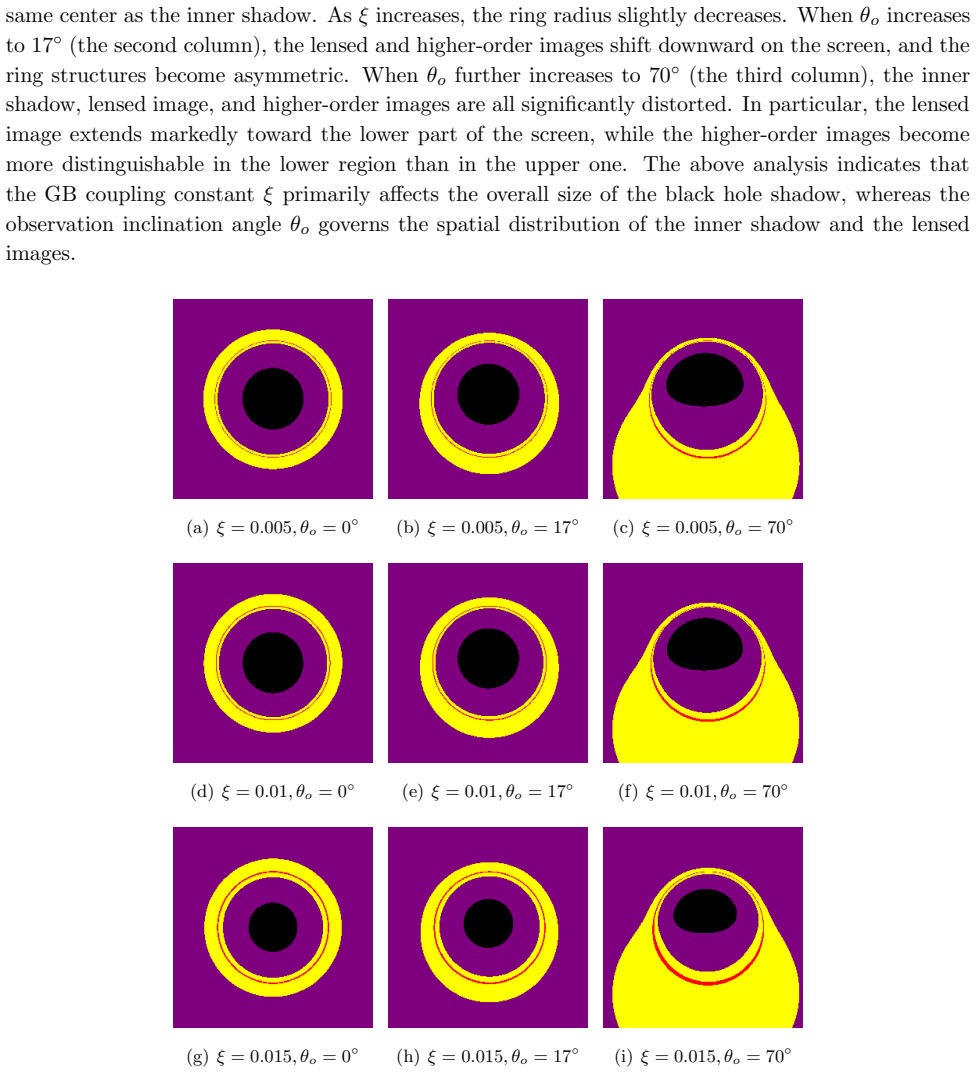
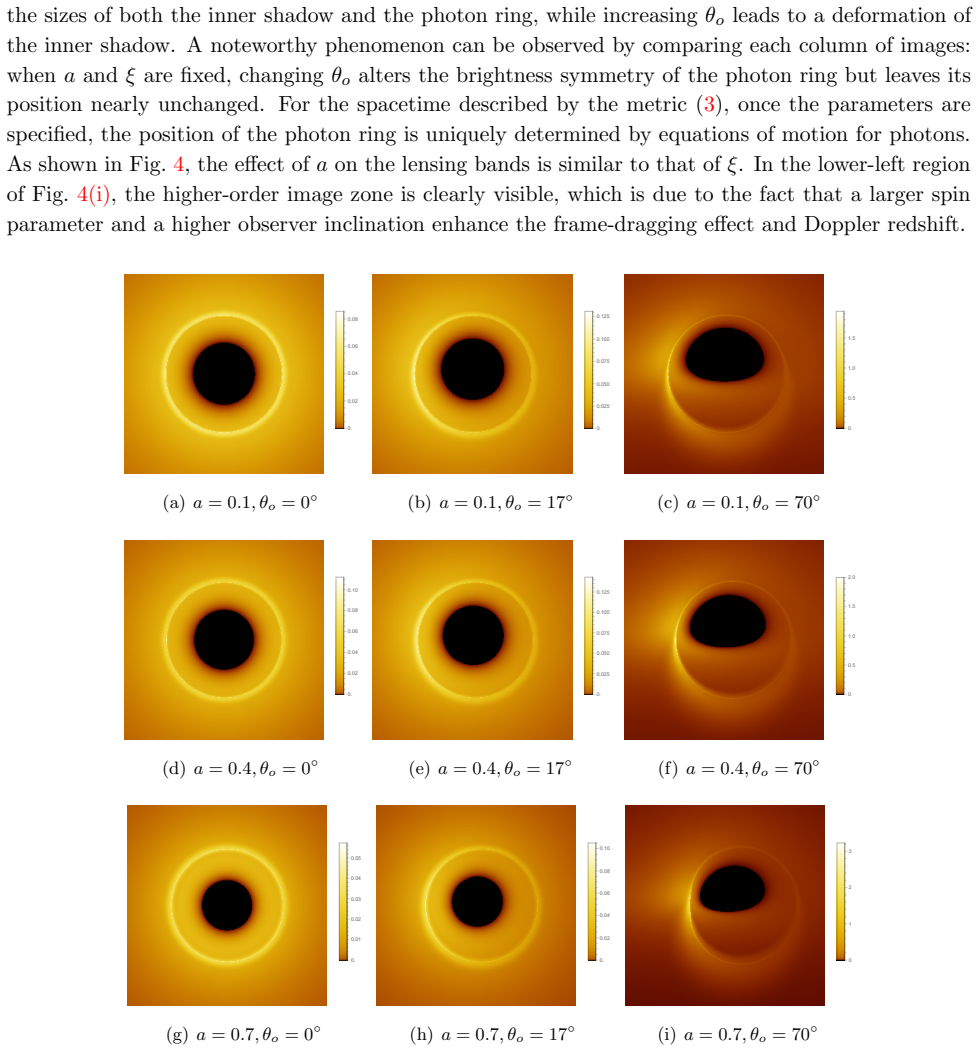
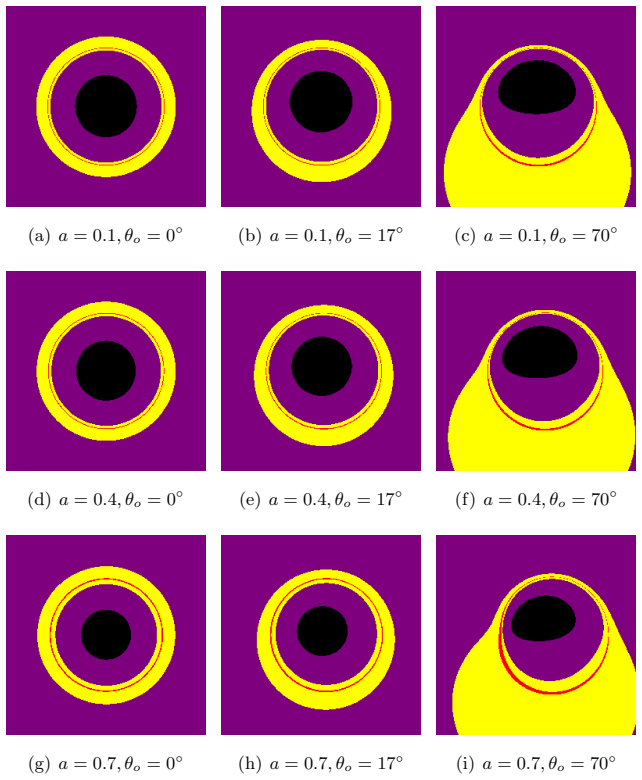
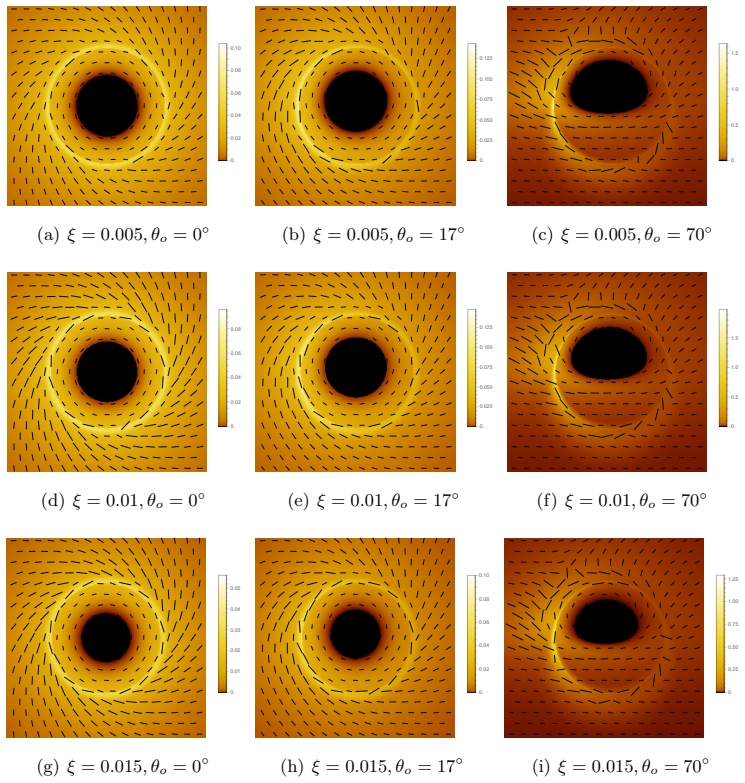
Based on the backward ray-tracing method, rotating Einstein-Gauss-Bonnet black holes produce inner shadows whose size decreases only with the Gauss-Bonnet coupling constant while spin and inclination alter the shape; the photon ring responds most to inclination. Polarization intensity follows the accretion disk pattern, but polarization direction near the inner shadow and photon ring changes significantly with the coupling constant. The simultaneous combination and synergistic analysis of both accretion disk and polarization images more profoundly reveals the optical properties of rotating EGB black holes than reliance on either alone.
What carries the argument
Backward ray-tracing through a thin accretion disk model, which generates both the inner shadow morphology and the polarization direction map sensitive to the Gauss-Bonnet coupling.
If this is right
- The inner shadow size decreases only with increasing Gauss-Bonnet coupling constant ξ.
- Spin parameter a changes the inner shadow shape but not its size.
- Observation inclination angle θ_o deforms the inner shadow and affects the photon ring more than ξ or a does.
- Polarization direction near the inner shadow and photon ring changes significantly with ξ.
- The combination of disk and polarization images supplies a stronger basis for identifying rotating EGB black holes than either image type alone.
Where Pith is reading between the lines
- If observed, the polarization shift could serve as an independent check on spacetime parameters inferred from shadow size alone.
- Similar combined imaging might help test other higher-curvature gravity models by extracting extra information from polarization data.
- Discrepancies between measured shadow size and polarization patterns could point to limitations in the thin-disk assumption or the chosen metric.
Load-bearing premise
The thin-disk model and the specific rotating Einstein-Gauss-Bonnet metric accurately determine polarization patterns without major contamination from disk turbulence or radiative transfer details.
What would settle it
High-resolution observations of a supermassive black hole in which polarization direction near the photon ring stays fixed while shadow size varies in a manner inconsistent with the predicted dependence on the Gauss-Bonnet coupling constant.
Figures



read the original abstract
Based on the backward ray-tracing method, this paper numerically investigates the shadow and polarization images of rotating Einstein-Gauss-Bonnet (EGB) black hole within the framework of a thin disk model. We systematically analyze the effects of the main model parameters and the observation inclination angle $\theta_o$ on both types of images. The results show that, as an intrinsic property of the black hole, the inner shadow undergoes significant deformation with increasing $\theta_o$. The increase of the GB coupling constant $\xi$ only reduces the size of the inner shadow, while the spin parameter a does not alter its size but also its shape. And, the photon ring is more sensitive to variations in $\theta_o$, while it is less affected by $\xi$ and $a$. For polarization images, the influence of $\xi$ on the polarization intensity is generally consistent with that observed in the accretion disk images. However, the polarization direction near the region of the inner shadow and photon ring changes significantly with $\xi$. This feature can provide an additional and effective observational tool for extracting information about the spacetime structure in Einstein-Gauss-Bonnet (EGB) gravity. Finally, we conclude that, compared to previous reliance on either accretion disk or polarization images alone, the simultaneous combination and synergistic analysis of both can more profoundly reveal the optical properties of rotating EGB black holes, providing a stronger theoretical basis for identifying such black holes through future high-resolution observations.
Editorial analysis
A structured set of objections, weighed in public.
Referee Report
Summary. The paper numerically investigates the shadow and polarization images of rotating Einstein-Gauss-Bonnet black holes using backward ray-tracing in a thin disk model. It analyzes the effects of spin parameter a, Gauss-Bonnet coupling ξ, and observer inclination θ_o on the inner shadow, photon ring, and polarization properties. The results indicate that the inner shadow size decreases with increasing ξ, its shape changes with a, and it deforms with θ_o. Polarization direction near the inner shadow and photon ring varies significantly with ξ. The paper concludes that the combined analysis of accretion disk and polarization images provides a stronger probe of the rotating EGB spacetime than either alone.
Significance. If the numerical computations are accurate, this study adds to the understanding of observational signatures in modified gravity by showing how polarization can complement intensity images in revealing spacetime properties. The systematic parameter exploration is a strength, potentially aiding in the interpretation of future observations. Credit is given for the forward simulation approach without circular fitting. However, the significance is tempered by the lack of validation details.
major comments (2)
- The abstract reports numerical results on parameter dependence but provides no error bars, convergence tests, or comparison to the Kerr limit (ξ=0). This undermines confidence in the claimed sensitivities of the inner shadow to ξ and polarization direction to ξ, as these could be affected by numerical artifacts in the ray-tracing.
- The conclusion that synergistic analysis of both image types is superior is not supported by an explicit joint analysis or quantitative comparison showing reduced degeneracies; the effects are presented separately for disk images and polarization images.
minor comments (1)
- The thin disk model assumptions and ray-tracing implementation details should be stated more explicitly to allow reproducibility and assessment of the polarization calculation.
Simulated Author's Rebuttal
We thank the referee for the constructive and detailed comments. We address each major point below and will revise the manuscript to strengthen the numerical validation and the support for our conclusions on synergistic analysis.
read point-by-point responses
-
Referee: The abstract reports numerical results on parameter dependence but provides no error bars, convergence tests, or comparison to the Kerr limit (ξ=0). This undermines confidence in the claimed sensitivities of the inner shadow to ξ and polarization direction to ξ, as these could be affected by numerical artifacts in the ray-tracing.
Authors: We agree that the abstract and main text would benefit from explicit validation details. The ray-tracing implementation follows standard backward integration methods used in the literature, but to directly address the concern we will add a new subsection on Numerical Methods. This will include: (1) direct comparisons of the ξ=0 limit to established Kerr results for both shadow size and polarization patterns, confirming agreement within numerical precision; (2) convergence tests varying ray density, integration tolerance, and grid resolution, demonstrating that reported quantities (inner shadow radius and polarization angle) stabilize to better than 1%; (3) a brief note on the deterministic nature of the computation, where uncertainties arise primarily from discretization rather than statistical error bars. We will also revise the abstract to mention consistency with the Kerr limit. These changes will substantiate that the sensitivities to ξ are physical rather than artifacts. revision: yes
-
Referee: The conclusion that synergistic analysis of both image types is superior is not supported by an explicit joint analysis or quantitative comparison showing reduced degeneracies; the effects are presented separately for disk images and polarization images.
Authors: The referee correctly notes that the current results are shown separately. Our claim of synergy rests on the distinct responses: ξ primarily shrinks the inner shadow in intensity images while producing a clear shift in polarization direction near the shadow and photon ring. To make this quantitative, we will add a dedicated paragraph in the Discussion section that performs an explicit joint comparison using the existing parameter scans. Specifically, we will illustrate how the allowed range of ξ (and a) consistent with observed shadow size is further narrowed when the polarization angle must also match, providing a simple estimate of the reduction in parameter degeneracy. This addition will be based on the data already computed and will directly support the conclusion without requiring new simulations. revision: yes
Circularity Check
No significant circularity
full rationale
The paper performs numerical backward ray-tracing on a fixed rotating EGB metric (imported from prior literature) and a standard thin-disk emissivity model to generate shadow and polarization images for varying parameters (a, ξ, θ_o). No parameters are fitted to data, no predictions are made that reduce to the inputs by construction, and no load-bearing uniqueness theorems or ansatzes are smuggled via self-citation. The central claim—that joint disk+polarization analysis is more informative—is an interpretive conclusion drawn from the distinct numerical sensitivities observed in the computed images, not a tautological re-expression of the inputs. The derivation chain is therefore self-contained forward simulation.
Axiom & Free-Parameter Ledger
free parameters (3)
- spin parameter a
- Gauss-Bonnet coupling ξ
- observer inclination θ_o
axioms (3)
- domain assumption The spacetime is described by the rotating Einstein-Gauss-Bonnet metric derived in prior literature.
- domain assumption The accretion flow can be modeled as a geometrically thin, optically thick disk with prescribed emissivity.
- standard math Backward ray-tracing with the standard null geodesic equations yields accurate intensity and polarization maps.
Lean theorems connected to this paper
-
IndisputableMonolith/Foundation/RealityFromDistinction.leanreality_from_one_distinction unclear?
unclearRelation between the paper passage and the cited Recognition theorem.
Based on the backward ray-tracing method, this paper numerically investigates the shadow and polarization images of rotating Einstein–Gauss–Bonnet (EGB) black hole within the framework of a thin disk model.
What do these tags mean?
- matches
- The paper's claim is directly supported by a theorem in the formal canon.
- supports
- The theorem supports part of the paper's argument, but the paper may add assumptions or extra steps.
- extends
- The paper goes beyond the formal theorem; the theorem is a base layer rather than the whole result.
- uses
- The paper appears to rely on the theorem as machinery.
- contradicts
- The paper's claim conflicts with a theorem or certificate in the canon.
- unclear
- Pith found a possible connection, but the passage is too broad, indirect, or ambiguous to say the theorem truly supports the claim.
Forward citations
Cited by 2 Pith papers
-
Polarized Equatorial Emission around Kerr Black Holes with Synchronized Scalar Hair. I. Direct images
Polarization maps of direct images from scalar-hairy Kerr black holes exhibit dephasing in the polarization-vector twist (larger for weakly scalarized cases) and a reversal for vertical magnetic fields at high inclinations.
-
Reshaping the inner shadow of a Kerr black hole by a torn accretion disk
Torn accretion disks around Kerr black holes erode the inner shadow and create bifurcated, crescent, and multi-ring shadow features driven by sub-disk discontinuities and outer tilt angle.
Reference graph
Works this paper leans on
-
[1]
Shadows and strong gravitational lensing: a brief review,
P.V.P. Cunha and C.A.R. Herdeiro,Shadows and strong gravitational lensing: a brief review, Gen. Rel. Grav.50(2018) 42 [1801.00860]
- [2]
-
[3]
X.-X. Zeng, K.-J. He, G.-P. Li, E.-W. Liang and S. Guo,QED and accretion flow models effect on optical appearance of Euler–Heisenberg black holes,Eur. Phys. J. C82(2022) 764 [2209.05938]
-
[4]
X.-X. Zeng, K.-J. He and G.-P. Li,Effects of dark matter on shadows and rings of Brane-World black holes illuminated by various accretions,Sci. China Phys. Mech. Astron.65(2022) 290411 [2111.05090]
-
[5]
S.E. Gralla, D.E. Holz and R.M. Wald,Black Hole Shadows, Photon Rings, and Lensing Rings, Phys. Rev. D100(2019) 024018 [1906.00873]
-
[6]
Testing the nature of dark compact objects: a status report
V. Cardoso and P. Pani,Testing the nature of dark compact objects: a status report,Living Rev. Rel.22(2019) 4 [1904.05363]
work page internal anchor Pith review arXiv 2019
-
[7]
Blandford and R.L
R.D. Blandford and R.L. Znajek,Electromagnetic extractions of energy from Kerr black holes, Mon. Not. Roy. Astron. Soc.179(1977) 433
1977
-
[8]
Shakura and R.A
N.I. Shakura and R.A. Sunyaev,Black holes in binary systems. Observational appearance, Astron. Astrophys.24(1973) 337
1973
-
[9]
Lightman and D.M
A.P. Lightman and D.M. Eardley,Black Holes in Binary Systems: Instability of Disk Accretion, Astrophys. J. Lett.187(1974) L1
1974
-
[10]
Luminet,Image of a spherical black hole with thin accretion disk,Astron
J.P. Luminet,Image of a spherical black hole with thin accretion disk,Astron. Astrophys.75 (1979) 228
1979
-
[11]
K. Beckwith and C. Done,Extreme gravitational lensing near rotating black holes,Mon. Not. Roy. Astron. Soc.359(2005) 1217 [astro-ph/0411339]
-
[12]
R. Narayan, M.D. Johnson and C.F. Gammie,The Shadow of a Spherically Accreting Black Hole,Astrophys. J. Lett.885(2019) L33 [1910.02957]
-
[13]
X.-X. Zeng, H.-Q. Zhang and H. Zhang,Shadows and photon spheres with spherical accretions in the four-dimensional Gauss–Bonnet black hole,Eur. Phys. J. C80(2020) 872 [2004.12074]. 18
-
[14]
M. Heydari-Fard, M. Heydari-Fard and N. Riazi,Shadows and photon rings of a spherically accreting Kehagias–Sfetsos black hole,Int. J. Mod. Phys. D32(2023) 2350088 [2307.01529]
- [15]
-
[16]
X.-X. Zeng, G.-P. Li and K.-J. He,The shadows and observational appearance of a noncommutative black hole surrounded by various profiles of accretions,Nucl. Phys. B974 (2022) 115639 [2106.14478]
-
[17]
Shadows and rings of the Kehagias-Sfetsos black hole surrounded by thin disk accretion,
G.-P. Li and K.-J. He,Shadows and rings of the Kehagias-Sfetsos black hole surrounded by thin disk accretion,JCAP06(2021) 037 [2105.08521]
-
[18]
C.-Y. Yang, K.-J. He, X.-X. Zeng and L.-F. Li,Observational signatures and polarized images of rotating charged black holes in Kalb-Ramond Gravity,2508.07393
-
[19]
C.-Y. Yang, M.I. Aslam, X.-X. Zeng and R. Saleem,Shadow images of Ghosh-Kumar rotating black hole illuminated by spherical light sources and thin accretion disks,JHEAp46(2025) 345 [2411.11807]
- [20]
-
[21]
Imaging thick accretion disks and jets surrounding black holes,
Z. Zhang, Y. Hou, M. Guo and B. Chen,Imaging thick accretion disks and jets surrounding black holes,JCAP05(2024) 032 [2401.14794]
-
[22]
K. Gjorgjieski, J. Kunz and P. Nedkova,Comparison of magnetized thick disks around black holes and boson stars,Eur. Phys. J. C84(2024) 286 [2401.13857]
-
[23]
X.-M. Kuang, Z.-Y. Tang, B. Wang and A. Wang,Constraining a modified gravity theory in strong gravitational lensing and black hole shadow observations,Phys. Rev. D106(2022) 064012 [2206.05878]
- [24]
-
[25]
Images and flares of geodesic hot spots around a Kerr black hole,
J. Huang, Z. Zhang, M. Guo and B. Chen,Images and flares of geodesic hot spots around a Kerr black hole,Phys. Rev. D109(2024) 124062 [2402.16293]
- [26]
- [27]
- [28]
-
[29]
The observation image of a soliton boson star illuminated by various accretions,
K.-J. He, G.-P. Li, C.-Y. Yang and X.-X. Zeng,The observation image of a soliton boson star illuminated by various accretions,JCAP10(2025) 003 [2502.16623]
- [30]
-
[31]
Polarized image of synchrotron radiations of hotspots in Schwarzschilld- Melvin black hole spacetime
H. Zhu and M. Guo,Polarized image of synchrotron radiations of hotspots in Schwarzschilld-Melvin black hole spacetime,2205.04777
-
[32]
Gravitational bending of light near compact objects,
A.M. Beloborodov,Gravitational bending of light near compact objects,Astrophys. J. Lett.566 (2002) L85 [astro-ph/0201117]. [35]Event Horizon Telescopecollaboration,The Polarized Image of a Synchrotron-emitting Ring of Gas Orbiting a Black Hole,Astrophys. J.912(2021) 35 [2105.01804]
-
[33]
Polarized image of equatorial emission in the Kerr geometry,
Z. Gelles, E. Himwich, D.C.M. Palumbo and M.D. Johnson,Polarized image of equatorial emission in the Kerr geometry,Phys. Rev. D104(2021) 044060 [2105.09440]
- [34]
-
[35]
Shi and T
H.-Y. Shi and T. Zhu,Polarized image of a synchrotron emitting ring around a static hairy black hole in Horndeski theory,Eur. Phys. J. C84(2024) 814
2024
-
[36]
Polarized image of equatorial emission in horizonless spacetimes: Naked singularities,
V. Deliyski, G. Gyulchev, P. Nedkova and S. Yazadjiev,Polarized image of equatorial emission in horizonless spacetimes: Naked singularities,Phys. Rev. D108(2023) 104049 [2303.14756]
-
[37]
Lovelock,The four-dimensionality of space and the einstein tensor,J
D. Lovelock,The four-dimensionality of space and the einstein tensor,J. Math. Phys.13(1972) 874
1972
-
[38]
Lanczos,A Remarkable property of the Riemann-Christoffel tensor in four dimensions, Annals Math.39(1938) 842
C. Lanczos,A Remarkable property of the Riemann-Christoffel tensor in four dimensions, Annals Math.39(1938) 842
1938
-
[39]
Lovelock,The Einstein tensor and its generalizations,J
D. Lovelock,The Einstein tensor and its generalizations,J. Math. Phys.12(1971) 498
1971
-
[40]
Zwiebach,Curvature Squared Terms and String Theories,Phys
B. Zwiebach,Curvature Squared Terms and String Theories,Phys. Lett. B156(1985) 315
1985
-
[41]
S. Nojiri, S.D. Odintsov and V.K. Oikonomou,Ghost-free Gauss-Bonnet Theories of Gravity, Phys. Rev. D99(2019) 044050 [1811.07790]
-
[42]
Wiltshire,Spherically Symmetric Solutions of Einstein-maxwell Theory With a Gauss-Bonnet Term,Phys
D.L. Wiltshire,Spherically Symmetric Solutions of Einstein-maxwell Theory With a Gauss-Bonnet Term,Phys. Lett. B169(1986) 36
1986
-
[43]
Boulware and S
D.G. Boulware and S. Deser,String Generated Gravity Models,Phys. Rev. Lett.55(1985) 2656
1985
- [44]
-
[45]
Neupane,Thermodynamic and gravitational instability on hyperbolic spaces,Phys
I.P. Neupane,Thermodynamic and gravitational instability on hyperbolic spaces,Phys. Rev. D 69(2004) 084011 [hep-th/0302132]
-
[46]
Dehghani,Charged rotating black branes in anti-de Sitter Einstein-Gauss-Bonnet gravity, Phys
M.H. Dehghani,Charged rotating black branes in anti-de Sitter Einstein-Gauss-Bonnet gravity, Phys. Rev. D67(2003) 064017 [hep-th/0211191]
-
[47]
Torii and H
T. Torii and H. Maeda,Spacetime structure of static solutions in gauss-bonnet gravity: Neutral case,Physical Review D¡ªParticles, Fields, Gravitation, and Cosmology71(2005) 124002
2005
-
[48]
Rotating black holes in4DEinstein-Gauss-Bonnet gravity and its shadow,
R. Kumar and S.G. Ghosh,Rotating black holes in4DEinstein-Gauss-Bonnet gravity and its shadow,JCAP07(2020) 053 [2003.08927]
-
[49]
Generating rotating regular black hole solutions without complexification
M. Azreg-A¨ ınou,Generating rotating regular black hole solutions without complexification,Phys. Rev. D90(2014) 064041 [1405.2569]. 20
work page Pith review arXiv 2014
-
[50]
M. Azreg-A¨ ınou,From static to rotating to conformal static solutions: Rotating imperfect fluid wormholes with(out) electric or magnetic field,Eur. Phys. J. C74(2014) 2865 [1401.4292]
-
[51]
Kerr,Gravitational field of a spinning mass as an example of algebraically special metrics, Phys
R.P. Kerr,Gravitational field of a spinning mass as an example of algebraically special metrics, Phys. Rev. Lett.11(1963) 237
1963
-
[52]
Chandrasekhar,The mathematical theory of black holes(1985)
S. Chandrasekhar,The mathematical theory of black holes(1985)
1985
-
[53]
Carter,Global structure of the Kerr family of gravitational fields,Phys
B. Carter,Global structure of the Kerr family of gravitational fields,Phys. Rev.174(1968) 1559
1968
-
[54]
Shadows of Kerr black holes with scalar hair
P.V.P. Cunha, C.A.R. Herdeiro, E. Radu and H.F. Runarsson,Shadows of Kerr black holes with scalar hair,Phys. Rev. Lett.115(2015) 211102 [1509.00021]
work page Pith review arXiv 2015
- [55]
- [56]
-
[57]
Observing the Inner Shadow of a Black Hole: A Direct View of the Event Horizon,
A. Chael, M.D. Johnson and A. Lupsasca,Observing the Inner Shadow of a Black Hole: A Direct View of the Event Horizon,Astrophys. J.918(2021) 6 [2106.00683]
- [58]
-
[59]
Coport: a new public code for polarized radiative transfer in a covariant framework,
J. Huang, L. Zheng, M. Guo and B. Chen,Coport: a new public code for polarized radiative transfer in a covariant framework,JCAP11(2024) 054 [2407.10431]
-
[60]
Polarization images of solitonic boson stars,
X.-X. Zeng, C.-Y. Yang, H. Yu and K.-J. He,Polarization images of solitonic boson stars,Eur. Phys. J. C86(2026) 169 [2508.11992]. 21
discussion (0)
Sign in with ORCID, Apple, or X to comment. Anyone can read and Pith papers without signing in.