Recognition: no theorem link
MIMIC-Py: An Extensible Tool for Personality-Driven Automated Game Testing with Large Language Models
Pith reviewed 2026-05-10 18:15 UTC · model grok-4.3
The pith
MIMIC-Py turns personality-driven LLM agents into a reusable Python framework for automated game testing across different environments.
A machine-rendered reading of the paper's core claim, the machinery that carries it, and where it could break.
Core claim
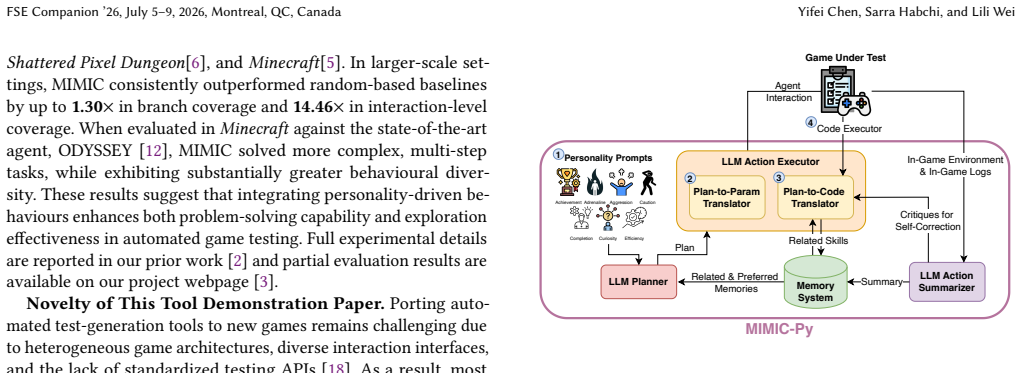
MIMIC-Py exposes personality traits as configurable inputs and adopts a modular architecture that decouples planning, execution, and memory from game-specific logic. It supports multiple interaction mechanisms, enabling agents to interact with games via exposed APIs or synthesized code, and thereby enables deployment to new game environments with minimal engineering effort.
What carries the argument
The modular architecture that keeps planning, execution, and memory separate from game-specific logic, so the same agent components can be reused by swapping only the game interface.
If this is right
- Different personality settings can be supplied at runtime to produce varied testing behaviors without rewriting the agent.
- Agents can switch between API calls and generated code to control the game depending on what the environment provides.
- Only the game-specific interface layer needs new implementation when targeting a different title.
- The framework supplies a shared Python base that replaces one-off research prototypes for repeated use.
Where Pith is reading between the lines
- The same separation of concerns could be applied to LLM-driven testing in domains other than games, such as web or mobile applications.
- Teams could maintain a library of personality profiles and reuse them across projects to reduce repeated test design work.
- Frequent game updates might become easier to handle if only the interface layer changes while the core agent stays fixed.
Load-bearing premise
The modular architecture successfully decouples game-specific logic so that moving to a new game requires only minimal additional engineering effort.
What would settle it
A side-by-side measurement of the lines of code and developer time required to adapt MIMIC-Py to an unrelated new game versus building a fresh custom LLM tester for that same game.
Figures


read the original abstract
Modern video games are complex, non-deterministic systems that are difficult to test automatically at scale. Although prior work shows that personality-driven Large Language Model (LLM) agents can improve behavioural diversity and test coverage, existing tools largely remain research prototypes and lack cross-game reusability. This tool paper presents MIMIC-Py, a Python-based automated game-testing tool that transforms personality-driven LLM agents into a reusable and extensible framework. MIMIC-Py exposes personality traits as configurable inputs and adopts a modular architecture that decouples planning, execution, and memory from game-specific logic. It supports multiple interaction mechanisms, enabling agents to interact with games via exposed APIs or synthesized code. We describe the design of MIMIC-Py and show how it enables deployment to new game environments with minimal engineering effort, bridging the gap between research prototypes and practical automated game testing. The source code and a demo video are available on our project webpage: https://mimic-persona.github.io/MIMIC-Py-Home-Page/.
Editorial analysis
A structured set of objections, weighed in public.
Referee Report
Summary. This tool paper presents MIMIC-Py, a Python-based extensible framework for personality-driven automated game testing with LLMs. It exposes personality traits as configurable inputs, uses a modular architecture decoupling planning/execution/memory from game-specific logic, and supports multiple interaction mechanisms (exposed APIs or synthesized code) to enable reuse across games, claiming this requires only minimal engineering effort for new environments.
Significance. If the reusability claims hold, MIMIC-Py could meaningfully advance practical automated game testing by turning research prototypes into a cross-game framework that increases behavioral diversity and coverage. The public release of source code and a demo video on the project webpage is a clear strength supporting reproducibility and adoption.
major comments (2)
- [Abstract] Abstract: the central claim that the modular architecture 'enables deployment to new game environments with minimal engineering effort' is asserted without any supporting metrics (e.g., person-hours, lines of custom code, or components modified), case studies, or porting walkthroughs for multiple distinct games.
- [Design description] Design description: while the decoupling of planning, execution, and memory from game-specific logic and the support for API vs. code-synthesis interactions are outlined conceptually, no quantitative validation or concrete examples demonstrate that these interfaces suffice for arbitrary non-deterministic games without substantial per-game engineering.
Simulated Author's Rebuttal
We thank the referee for their constructive review and for recognizing the potential of MIMIC-Py to advance automated game testing through its public release and modular design. We address each major comment below and outline the specific revisions we will make to strengthen the manuscript's claims with supporting evidence.
read point-by-point responses
-
Referee: [Abstract] Abstract: the central claim that the modular architecture 'enables deployment to new game environments with minimal engineering effort' is asserted without any supporting metrics (e.g., person-hours, lines of custom code, or components modified), case studies, or porting walkthroughs for multiple distinct games.
Authors: We agree that the abstract's claim regarding minimal engineering effort lacks supporting metrics, case studies, or porting walkthroughs in the current version. The manuscript describes the modular architecture and interaction mechanisms but does not provide quantitative evidence or detailed examples of deployment across games. In the revised manuscript, we will update the abstract for precision and add a new subsection (likely in the Design or Evaluation section) that includes concrete porting examples for at least two additional distinct games. This will report metrics such as lines of custom code modified, components changed, and estimated effort based on our implementation experience to substantiate the reusability claims. revision: yes
-
Referee: [Design description] Design description: while the decoupling of planning, execution, and memory from game-specific logic and the support for API vs. code-synthesis interactions are outlined conceptually, no quantitative validation or concrete examples demonstrate that these interfaces suffice for arbitrary non-deterministic games without substantial per-game engineering.
Authors: We acknowledge that the design description remains conceptual without quantitative validation or concrete examples for arbitrary non-deterministic games. The paper outlines the decoupling of components and the API versus code-synthesis options but does not empirically show their sufficiency across diverse games. In the revision, we will expand the design description with specific case studies and examples from our work, illustrating how the interfaces handle non-determinism in practice. These will include details on any per-game customizations required and metrics on engineering effort to demonstrate that the interfaces enable reuse with minimal changes. revision: yes
Circularity Check
No circularity: tool description paper with no derivations or self-referential reductions
full rationale
The paper is a software tool description that presents a modular architecture as a design choice to decouple components from game-specific logic. It asserts reusability and minimal engineering effort for new games but provides no equations, fitted parameters, predictions that reduce to inputs, or load-bearing self-citations. The central claims are descriptive assertions about the framework's structure and interfaces, not derived results that loop back to the paper's own definitions or prior self-work by construction. No patterns from the enumerated circularity kinds apply, as there is no derivation chain to inspect.
Axiom & Free-Parameter Ledger
axioms (1)
- domain assumption Personality-driven LLM agents can improve behavioral diversity and test coverage in games
Reference graph
Works this paper leans on
- [1]
-
[2]
Yifei Chen, Sarra Habchi, and Lili Wei. 2025. MIMIC: Integrating Diverse Person- ality Traits for Better Game Testing Using Large Language Model. InProceedings of the 40th IEEE/ACM International Conference on Automated Software Engineering (Seoul, South Korea)(ASE ’25). Association for Computing Machinery, Seoul, South Korea, 39–51. doi:10.48550/arXiv.2510.01635
-
[3]
Yifei Chen, Sarra Habchi, and Lili Wei. 2026. MIMIC-Py: A Tool for Personality- Driven Automated Game Testing with Large Language Models. https://mimic- persona.github.io/MIMIC-Py-Home-Page/
2026
-
[4]
Chroma. [n. d.]. chroma-core/chroma Open-source search and retrieval database for AI applications. https://github.com/chroma-core/chroma
-
[5]
TM Microsoft Corporation
Mojang AB. TM Microsoft Corporation. 2025. Minecraft. https://www.minecraft. net/en-us
2025
-
[6]
Evan Debenham. 2025. Shattered Pixel Dungeon. https://shatteredpixel.com/
2025
- [7]
-
[8]
Yunfan Gao, Yun Xiong, Xinyu Gao, Kangxiang Jia, Jinliu Pan, Yuxi Bi, Yi Dai, Jiawei Sun, Meng Wang, and Haofen Wang. 2024. Retrieval-Augmented Generation for Large Language Models: A Survey. arXiv:2312.10997 [cs.CL] https://arxiv.org/abs/2312.10997
work page internal anchor Pith review Pith/arXiv arXiv 2024
-
[9]
Global Growth Insights. 2025. Game testing Service market. https: //www.globalgrowthinsights.com/market-reports/game-testing-service- market-108174
2025
-
[10]
Patrick Lewis, Ethan Perez, Aleksandra Piktus, Fabio Petroni, Vladimir Karpukhin, Naman Goyal, Heinrich Küttler, Mike Lewis, Wen tau Yih, Tim Rocktäschel, Sebastian Riedel, and Douwe Kiela. 2021. Retrieval-Augmented Generation for Knowledge-Intensive NLP Tasks. arXiv:2005.11401 [cs.CL] https://arxiv.org/abs/ 2005.11401
work page internal anchor Pith review arXiv 2021
- [11]
- [12]
-
[13]
Newzoo. 2026. 2025 PC and console games industry year in review. https: //newzoo.com/resources/blog/year-in-review-2025-to-date
2026
-
[14]
OpenAI. 2019. https://openai.com/index/openai-five-defeats-dota-2-world- champions/
2019
- [15]
-
[16]
Wei Peng, Ming Liu, and Yi Mou. 2008. Do Aggressive People Play Violent Computer Games in a More Aggressive Way? Individual Difference and Idiosyn- cratic Game-Playing Experience.Cyberpsychology & behavior : the impact of the Internet, multimedia and virtual reality on behavior and society11 (05 2008), 157–61. doi:10.1089/cpb.2007.0026
-
[17]
Johannes Pfau, Jan David Smeddinck, and Rainer Malaka. 2017. Automated Game Testing with ICARUS: Intelligent Completion of Adventure Riddles via Unsu- pervised Solving. InExtended Abstracts of the Annual Symposium on Computer- Human Interaction in Play (CHI PLAY ’17 Extended Abstracts). Association for Com- puting Machinery, New York, NY, USA, 153–164. do...
-
[18]
Cristiano Politowski, Fabio Petrillo, and Yann-Gaël Guéhéneuc. 2021. A Survey of Video Game Testing. In2021 IEEE/ACM International Conference on Automation of Software Test (AST). IEEE, Madrid, Spain, 90–99. doi:10.1109/AST52587.2021.00018
-
[19]
PrismarineJS. 2025. https://prismarinejs.github.io/mineflayer/#/
2025
-
[20]
Mohit Shridhar, Xingdi Yuan, Marc-Alexandre Côté, Yonatan Bisk, Adam Trischler, and Matthew Hausknecht. 2021. ALFWorld: Aligning Text and Em- bodied Environments for Interactive Learning. InProceedings of the Interna- tional Conference on Learning Representations (ICLR). ICLR, Vienna, Austria. https://arxiv.org/abs/2010.03768
work page internal anchor Pith review arXiv 2021
-
[21]
Samantha Stahlke, Atiya Nova, and Pejman Mirza-Babaei. 2020. Artificial Players in the Design Process: Developing an Automated Testing Tool for Game Level and World Design. InProceedings of the Annual Symposium on Computer-Human Inter- action in Play(Virtual Event, Canada)(CHI PLAY ’20). Association for Computing Machinery, New York, NY, USA, 267–280. doi...
-
[22]
Stelmaszczykadrian. 2023. GitHub - stelmaszczykadrian/Dungeon-Adventures. https://github.com/stelmaszczykadrian/Dungeon-Adventures
2023
-
[23]
Guanzhi Wang, Yuqi Xie, Yunfan Jiang, Ajay Mandlekar, Chaowei Xiao, Yuke Zhu, Linxi Fan, and Anima Anandkumar. 2023. Voyager: An Open-Ended Embodied Agent with Large Language Models. arXiv:2305.16291 [cs.AI] https://arxiv.org/ abs/2305.16291
work page internal anchor Pith review Pith/arXiv arXiv 2023
-
[24]
Narnia C. Worth and Angela S. Book. 2014. Personality and behavior in a massively multiplayer online role-playing game.Computers in Human Behavior 38 (2014), 322–330. doi:10.1016/j.chb.2014.06.009
-
[25]
Eray Yapağcı, Yavuz Alp Sencer Öztürk, and Eray Tüzün. 2025. Agents in the Sandbox: End-to-End Crash Bug Reproduction for Minecraft. InProceedings of the 40th IEEE/ACM International Conference on Automated Software Engineering (Seoul, South Korea)(ASE ’25). Association for Computing Machinery, Seoul, South Korea, 3094–3106. doi:10.48550/arXiv.2503.20036
-
[26]
Nick Yee, Nicolas Ducheneaut, Les Nelson, and Peter Likarish. 2011. Introverted elves & conscientious gnomes: the expression of personality in world of warcraft. InProceedings of the SIGCHI Conference on Human Factors in Computing Systems (Vancouver, BC, Canada)(CHI ’11). Association for Computing Machinery, New York, NY, USA, 753–762. doi:10.1145/1978942.1979052
- [27]
- [28]
-
[29]
Xizhou Zhu, Yuntao Chen, Hao Tian, Chenxin Tao, Weijie Su, Chenyu Yang, Gao Huang, Bin Li, Lewei Lu, Xiaogang Wang, Yu Qiao, Zhaoxiang Zhang, and Jifeng Dai. 2023. Ghost in the Minecraft: Generally Capable Agents for Open- World Environments via Large Language Models with Text-based Knowledge and Memory. arXiv:2305.17144 [cs.AI] https://arxiv.org/abs/2305...
discussion (0)
Sign in with ORCID, Apple, or X to comment. Anyone can read and Pith papers without signing in.