Recognition: no theorem link
Karma Mechanisms for Decentralised, Cooperative Multi Agent Path Finding
Pith reviewed 2026-05-10 18:09 UTC · model grok-4.3
The pith
Karma credits let agents negotiate fair conflict resolutions in decentralized multi-agent path finding.
A machine-rendered reading of the paper's core claim, the machinery that carries it, and where it could break.
Core claim
By formulating conflict resolution as bilateral negotiations regulated by karma credits that track each agent's history of cooperative replanning, agents can resolve path conflicts in a fully decentralized fashion. This produces more balanced replanning loads and reduced disparity in service times across the team, all while maintaining system-wide efficiency in dynamic, lifelong scenarios such as robotic warehouses.
What carries the argument
Karma mechanisms: artificial non-tradeable credits that record agents' past cooperative replanning behavior and regulate which agent yields in future pairwise conflict negotiations.
If this is right
- Replanning effort distributes more evenly across agents.
- Service-time disparities shrink without loss of overall throughput.
- No central coordinator or global priority list is required.
- The framework supports continuous lifelong operation with only pairwise messages.
Where Pith is reading between the lines
- Credit-based negotiation could extend fairness benefits to other decentralized resource problems such as shared vehicle routing or sensor allocation.
- Physical robot tests would reveal whether message delays or sensor noise disrupt the negotiation equilibrium.
- Hybrid systems might combine karma negotiations with occasional centralized corrections for rare high-stakes conflicts.
Load-bearing premise
Bilateral negotiations driven by karma credits will reliably favor long-term fairness over short-term self-interest in repeated dynamic interactions without global oversight.
What would settle it
In the warehouse simulation, if the ratio of maximum to minimum agent service times stays above 2.5 while total task completions per unit time drop below the non-karma decentralized baseline, the fairness claim fails.
Figures




read the original abstract
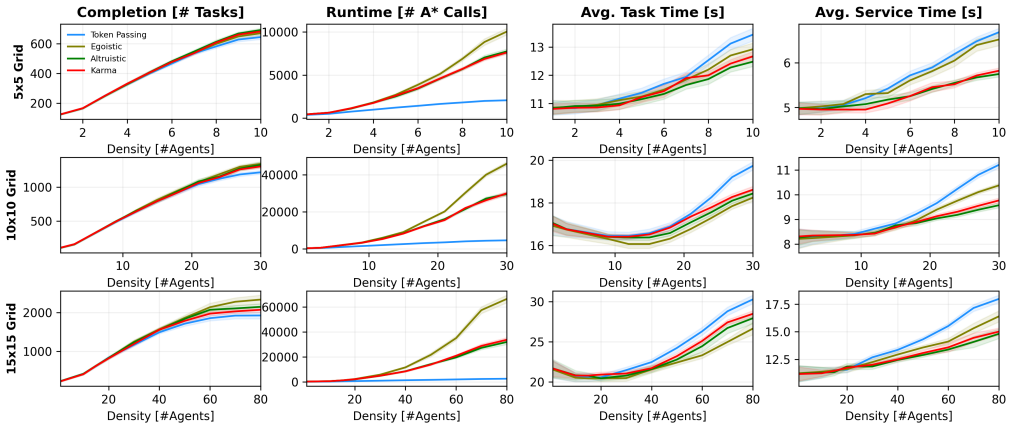
Multi-Agent Path Finding (MAPF) is a fundamental coordination problem in large-scale robotic and cyber-physical systems, where multiple agents must compute conflict-free trajectories with limited computational and communication resources. While centralised optimal solvers provide guarantees on solution optimality, their exponential computational complexity limits scalability to large-scale systems and real-time applicability. Existing decentralised heuristics are faster, but result in suboptimal outcomes and high cost disparities. This paper proposes a decentralised coordination framework for cooperative MAPF based on Karma mechanisms - artificial, non-tradeable credits that account for agents' past cooperative behaviour and regulate future conflict resolution decisions. The approach formulates conflict resolution as a bilateral negotiation process that enables agents to resolve conflicts through pairwise replanning while promoting long-term fairness under limited communication and without global priority structures. The mechanism is evaluated in a lifelong robotic warehouse multi-agent pickup-and-delivery scenario with kinematic orientation constraints. The results highlight that the Karma mechanism balances replanning effort across agents, reducing disparity in service times without sacrificing overall efficiency. Code: https://github.com/DerKevinRiehl/karma_dmapf
Editorial analysis
A structured set of objections, weighed in public.
Referee Report
Summary. The paper proposes Karma mechanisms as a decentralized coordination framework for multi-agent path finding (MAPF). Agents maintain artificial, non-tradeable karma credits that reflect past cooperative behavior; conflicts are resolved via bilateral negotiations that trigger pairwise replanning. The central claim is that this produces long-term fairness by balancing replanning effort across agents, thereby reducing disparity in service times, while preserving overall system efficiency. The mechanism is evaluated empirically in a lifelong multi-agent pickup-and-delivery warehouse scenario subject to kinematic orientation constraints, with open-source code provided.
Significance. If the empirical findings are robust, the approach would constitute a practical, communication-light alternative to centralized optimal MAPF solvers for large-scale robotic systems, directly addressing scalability while incorporating a lightweight fairness mechanism. The public GitHub repository is a clear strength that supports reproducibility and community follow-up.
major comments (2)
- [Evaluation section] The evaluation (warehouse scenario results) reports reduced disparity in service times and balanced replanning effort but provides no explicit definition of the service-time and effort metrics, no comparison against standard decentralized MAPF baselines (e.g., priority-based or conflict-based search variants), and no statistical significance tests or variance measures across runs; these omissions make it impossible to verify the claim that overall efficiency is preserved.
- [Karma mechanism definition] The manuscript contains no formal analysis (Lyapunov function, contraction argument, or fixed-point characterization) of the karma-credit update dynamics under arbitrary infinite-horizon conflict sequences and kinematic constraints; without such analysis the central claim that bilateral negotiations produce bounded long-term fairness remains an unproven empirical observation.
minor comments (2)
- [Abstract] The abstract states that the mechanism operates 'without global priority structures' yet does not clarify whether any implicit ordering (e.g., agent IDs) is still used inside the bilateral negotiation protocol.
- [Mechanism description] Notation for the karma credit update rule should be introduced with an explicit equation rather than prose description to aid readability.
Simulated Author's Rebuttal
We thank the referee for the constructive and detailed feedback. We address each major comment point by point below, indicating where revisions will be made to improve clarity, completeness, and rigor.
read point-by-point responses
-
Referee: The evaluation (warehouse scenario results) reports reduced disparity in service times and balanced replanning effort but provides no explicit definition of the service-time and effort metrics, no comparison against standard decentralized MAPF baselines (e.g., priority-based or conflict-based search variants), and no statistical significance tests or variance measures across runs; these omissions make it impossible to verify the claim that overall efficiency is preserved.
Authors: We agree that the evaluation section requires additional detail for full verifiability. In the revised manuscript we will add explicit definitions: service time is the duration from task assignment to delivery completion for each agent, and replanning effort is the cumulative number of pairwise replanning invocations triggered by conflicts. We will include direct comparisons against decentralized baselines, specifically a priority-based planner (with random tie-breaking) and a decentralized variant of conflict-based search. Results will be reported with mean and standard deviation across 20 independent runs, accompanied by paired t-tests (p < 0.05) to assess statistical significance of fairness improvements while confirming that makespan and throughput remain statistically indistinguishable from the baselines. These changes directly address the concern that efficiency preservation cannot be verified. revision: yes
-
Referee: The manuscript contains no formal analysis (Lyapunov function, contraction argument, or fixed-point characterization) of the karma-credit update dynamics under arbitrary infinite-horizon conflict sequences and kinematic constraints; without such analysis the central claim that bilateral negotiations produce bounded long-term fairness remains an unproven empirical observation.
Authors: We acknowledge that the manuscript presents the fairness properties of the Karma mechanism through empirical evaluation rather than a formal stability proof. The bilateral negotiation rule updates karma credits proportionally to the replanning cost incurred, which empirically bounds disparity in service times under the tested warehouse dynamics. A complete Lyapunov or contraction analysis for arbitrary infinite-horizon sequences with kinematic constraints is indeed non-trivial and outside the current scope. In revision we will expand the mechanism description with a precise statement of the update rule and add a dedicated subsection providing a heuristic boundedness argument based on the non-negative, conserved nature of total karma and the incentive alignment of negotiations. We will also explicitly state the lack of a general proof as a limitation and outline it as future work. This revision clarifies the evidential basis without overstating theoretical guarantees. revision: partial
Circularity Check
No significant circularity; mechanism defined independently of results
full rationale
The paper introduces the Karma mechanism as a standalone decentralized coordination framework using non-tradeable credits and bilateral negotiations for conflict resolution in MAPF. The abstract and description present the approach as formulated from first principles of limited communication and fairness promotion, with evaluation results (warehouse scenario) treated as post-hoc validation rather than inputs to the definition. No equations, fitted parameters renamed as predictions, or self-citation chains are exhibited that reduce the central claim to its own inputs by construction. Self-citation on prior MAPF work is normal and not load-bearing here, as the fairness balancing is asserted via the mechanism's design and empirical outcomes without circular reduction.
Axiom & Free-Parameter Ledger
axioms (2)
- domain assumption Agents will participate in bilateral negotiations and respect karma-based outcomes in conflict resolution.
- domain assumption Karma credits accurately reflect long-term cooperative behavior and can be maintained with limited communication.
invented entities (1)
-
Karma credits
no independent evidence
Forward citations
Cited by 1 Pith paper
-
Collective Alignment in LLM Multi-Agent Systems: Disentangling Bias from Cooperation via Statistical Physics
LLM multi-agent systems on lattices show bias-driven order-disorder crossovers instead of true phase transitions, with extracted effective couplings and fields serving as model-specific fingerprints.
Reference graph
Works this paper leans on
-
[1]
A review of research in multi-robot systems,
A. Gautam and S. Mohan, “A review of research in multi-robot systems,” in2012 IEEE 7th international conference on industrial and information systems (ICIIS). IEEE, 2012, pp. 1–5
2012
-
[2]
A review of graph-based multi-agent pathfinding solvers: From classical to beyond classical,
J. Gao, Y . Li, X. Li, K. Yan, K. Lin, and X. Wu, “A review of graph-based multi-agent pathfinding solvers: From classical to beyond classical,”Knowledge-Based Systems, vol. 283, p. 111121, 2024
2024
-
[3]
Multi-agent path finding–an overview,
R. Stern, “Multi-agent path finding–an overview,”Artificial intelli- gence: 5th RAAI summer School, dolgoprudny, Russia, july 4–7, 2019, tutorial lectures, pp. 96–115, 2019
2019
-
[4]
Path and action plan- ning in non-uniform environments for multi-agent pickup and delivery tasks,
T. Yamauchi, Y . Miyashita, and T. Sugawara, “Path and action plan- ning in non-uniform environments for multi-agent pickup and delivery tasks,” inEuropean Conference on Multi-Agent Systems. Springer, 2021, pp. 37–54
2021
-
[5]
Optimal multirobot path planning on graphs: Complete algorithms and effective heuristics,
J. Yu and S. M. LaValle, “Optimal multirobot path planning on graphs: Complete algorithms and effective heuristics,”IEEE Transactions on Robotics, vol. 32, no. 5, pp. 1163–1177, 2016
2016
-
[6]
Branch-and- cut-and-price for multi-agent path finding,
E. Lam, P. Le Bodic, D. Harabor, and P. J. Stuckey, “Branch-and- cut-and-price for multi-agent path finding,”Computers & Operations Research, vol. 144, p. 105809, 2022
2022
-
[7]
A formal basis for the heuristic determination of minimum cost paths,
P. E. Hart, N. J. Nilsson, and B. Raphael, “A formal basis for the heuristic determination of minimum cost paths,”IEEE transactions on Systems Science and Cybernetics, vol. 4, no. 2, pp. 100–107, 1968
1968
-
[8]
The increasing cost tree search for optimal multi-agent pathfinding,
G. Sharon, R. Stern, M. Goldenberg, and A. Felner, “The increasing cost tree search for optimal multi-agent pathfinding,”Artificial intel- ligence, vol. 195, pp. 470–495, 2013
2013
-
[9]
Meta-agent conflict-based search for optimal multi-agent path finding,
G. Sharon, R. Stern, A. Felner, and N. Sturtevant, “Meta-agent conflict-based search for optimal multi-agent path finding,” inPro- ceedings of the International Symposium on Combinatorial Search, vol. 3, no. 1, 2012, pp. 97–104
2012
-
[10]
Walk, stop, count, and swap: decen- tralized multi-agent path finding with theoretical guarantees,
H. Wang and M. Rubenstein, “Walk, stop, count, and swap: decen- tralized multi-agent path finding with theoretical guarantees,”IEEE Robotics and Automation Letters, vol. 5, no. 2, pp. 1119–1126, 2020
2020
-
[11]
Theory and implementation of path planning by negotiation for decentralized agents,
O. Purwin, R. D’Andrea, and J.-W. Lee, “Theory and implementation of path planning by negotiation for decentralized agents,”Robotics and Autonomous Systems, vol. 56, no. 5, pp. 422–436, 2008
2008
-
[12]
Multi-agent pathfinding as a combinatorial auction,
O. Amir, G. Sharon, and R. Stern, “Multi-agent pathfinding as a combinatorial auction,” inProceedings of the AAAI Conference on Artificial Intelligence, vol. 29, no. 1, 2015
2015
-
[13]
Decentralized multi-agent path finding in warehouse environments for fleets of mobile robots with limited communication range,
A. Maoudj and A. L. Christensen, “Decentralized multi-agent path finding in warehouse environments for fleets of mobile robots with limited communication range,” inInternational Conference on Swarm Intelligence. Springer, 2022, pp. 104–116
2022
-
[14]
Evolution of path costs for efficient decentralized multi-agent pathfinding,
U. Farhadi, H. Hess, A. Maoudj, and A. L. Christensen, “Evolution of path costs for efficient decentralized multi-agent pathfinding,”Swarm and Evolutionary Computation, vol. 93, p. 101833, 2025
2025
-
[15]
Path negotiation for self-interested multirobot vehicles in shared space,
H. Inotsume, A. Aggarwal, R. Higa, and S. Nakadai, “Path negotiation for self-interested multirobot vehicles in shared space,” in2020 IEEE/RSJ International Conference on Intelligent Robots and Systems (IROS). IEEE, 2020, pp. 11 587–11 594
2020
-
[16]
Decentralized multi-agent navigation planning with braids,
C. I. Mavrogiannis and R. A. Knepper, “Decentralized multi-agent navigation planning with braids,” inAlgorithmic Foundations of Robotics XII: Proceedings of the Twelfth Workshop on the Algorithmic Foundations of Robotics. Springer, 2020, pp. 880–895
2020
-
[17]
Decentralized multi-agent path finding for uav traffic management,
F. Ho, R. Geraldes, A. Gonc ¸alves, B. Rigault, B. Sportich, D. Kubo, M. Cavazza, and H. Prendinger, “Decentralized multi-agent path finding for uav traffic management,”IEEE Transactions on Intelligent Transportation Systems, vol. 23, no. 2, pp. 997–1008, 2020
2020
-
[18]
Decentralized multi-agent path finding framework and strategies based on automated negotiation,
M. O. Keskin, F. Cant ¨urk, C. Eran, and R. Aydo ˘gan, “Decentralized multi-agent path finding framework and strategies based on automated negotiation,”Autonomous Agents and Multi-Agent Systems, vol. 38, no. 1, p. 10, 2024
2024
-
[19]
Negotiated decentralized aircraft conflict resolution,
A. R. Pritchett and A. Genton, “Negotiated decentralized aircraft conflict resolution,”IEEE transactions on intelligent transportation systems, vol. 19, no. 1, pp. 81–91, 2017
2017
-
[20]
Decentralized path planning for multi- agent teams with complex constraints,
V . R. Desaraju and J. P. How, “Decentralized path planning for multi- agent teams with complex constraints,”Autonomous Robots, vol. 32, no. 4, pp. 385–403, 2012
2012
-
[21]
Socialmapf: Optimal and efficient multi-agent path finding with strategic agents for social navigation,
R. Chandra, R. Maligi, A. Anantula, and J. Biswas, “Socialmapf: Optimal and efficient multi-agent path finding with strategic agents for social navigation,”IEEE Robotics and Automation Letters, vol. 8, no. 6, pp. 3214–3221, 2023
2023
-
[22]
Resource allocation with karma mechanisms—a review,
K. Riehl, A. Kouvelas, and M. A. Makridis, “Resource allocation with karma mechanisms—a review,”Economies, vol. 12, no. 8, p. 211, 2024
2024
-
[23]
Karma: A secure economic framework for peer-to-peer resource sharing,
V . Vishnumurthy, S. Chandrakumar, and E. G. Sirer, “Karma: A secure economic framework for peer-to-peer resource sharing,” inWorkshop on Economics of Peer-to-peer Systems, vol. 35, no. 6, 2003
2003
-
[24]
The hungarian method for the assignment problem,
H. W. Kuhn, “The hungarian method for the assignment problem,” Naval Research Logistics Quarterly, vol. 2, no. 1-2, pp. 83–97, 1955
1955
discussion (0)
Sign in with ORCID, Apple, or X to comment. Anyone can read and Pith papers without signing in.