Recognition: unknown
A Natural gtrsim 100times Telescope: Discovery of the Strongly Lensed Type II SN 2025mkn at z=1.37
Pith reviewed 2026-05-10 17:29 UTC · model grok-4.3
The pith
A Type II supernova at redshift 1.37 has been discovered magnified by more than 100 times through gravitational lensing.
A machine-rendered reading of the paper's core claim, the machinery that carries it, and where it could break.
Core claim
SN 2025mkn is a strongly lensed Type II supernova at redshift 1.37, with its light magnified by a factor of at least 100 by the gravitational field of a z=0.42 elliptical galaxy. The transient was first seen as a blue point source, later resolved into multiple images by JWST, including a close pair and a fainter counterimage, with spectra confirming the redshift and supernova type. The observed luminosity requires high magnification to align with local Type II events, and lens models are consistent with this, showing the faint image arrived first.
What carries the argument
Strong gravitational lensing by the foreground elliptical galaxy at z=0.42, which splits the supernova light into multiple images with high magnification factors.
Load-bearing premise
The assumption that the multiple images and spectra come from one single Type II supernova at z=1.37 whose intrinsic properties match those of nearby supernovae once the magnification is accounted for.
What would settle it
If high-resolution imaging or additional spectra reveal that the images have inconsistent redshifts or light curve shapes that cannot be explained by time delays and a single event, the lensing interpretation would be falsified.
Figures


read the original abstract
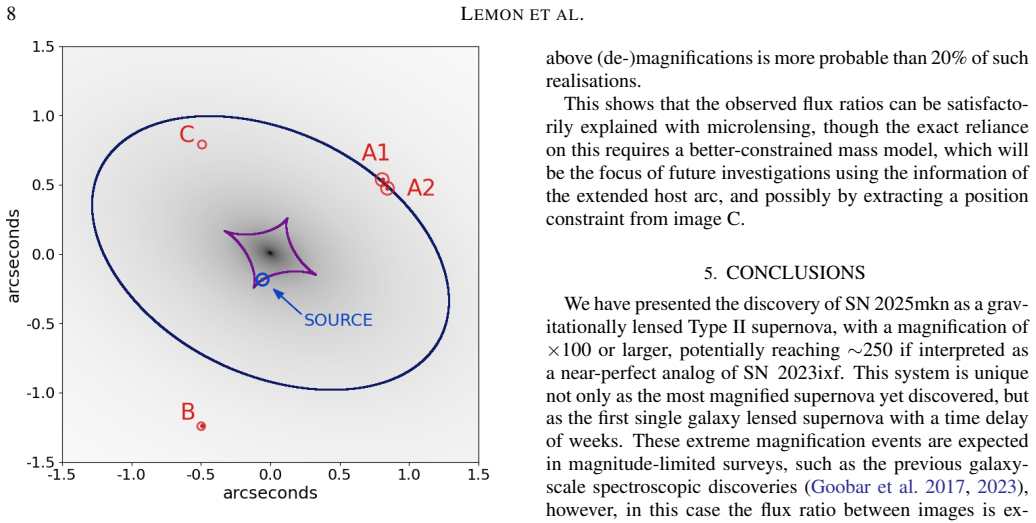
We present the discovery of SN 2025mkn, a gravitationally lensed Type II supernova. First detected as a blue transient in ZTF, 0.83$^{\prime\prime}$ from a $z=0.42$ elliptical galaxy, follow-up SNIFS/UH2.2m and LRIS/Keck spectra revealed absorption lines at $z=1.371$. Later JWST NIRCam imaging shows that the bright transient is a close pair of point sources separated by $\sim 0.07^{\prime\prime}$, and a 30 times fainter counterimage opposite the lens, for which NIRSpec reveals strong H$\alpha$ emission also at $z=1.371$. The light curves and spectra are consistent with the Type II supernova source being magnified $\gtrsim 100$ times, with $\sim 250$ required to reconcile its luminosity with that of nearby events such as SN 2023ixf. Lens models are consistent with such high magnifications, and always show that the faint image arrived first (undetected in earlier ZTF imaging), consistent with the later spectral phase of this fainter image. A fourth image is also predicted and possibly detected in the NIRSpec data. Light-curve-based time-delay measurements are not possible due to the first image being the faintest; however, the resolved NIRSpec spectra offer a future opportunity for time-delay cosmography through supernova phase measurements.
Editorial analysis
A structured set of objections, weighed in public.
Referee Report
Summary. The manuscript reports the discovery of SN 2025mkn as a strongly gravitationally lensed Type II supernova at z=1.371, lensed by a z=0.42 elliptical galaxy. Multi-facility observations (ZTF detection, SNIFS/LRIS spectra showing z=1.371 absorption, JWST NIRCam imaging of a ~0.07″ image pair plus 30× fainter counter-image, and NIRSpec spectra with Hα at z=1.371) are presented. Lens models are stated to be consistent with magnifications ≳100× (∼250× needed to match the luminosity of local Type II events such as SN 2023ixf after distance modulus and k-correction), with the faint image arriving first, matching the observed spectral phase difference; a fourth image is predicted.
Significance. If the classification, redshift, and high-magnification interpretation hold, this would constitute a rare, well-observed example of a strongly lensed core-collapse supernova at cosmological distance, functioning as a natural telescope for high-z transient studies. The multi-telescope dataset and use of standard gravitational lensing calculations provide independent lines of evidence; the potential for future time-delay cosmography via resolved NIRSpec spectral phases is a notable strength.
major comments (2)
- [Lens modeling] Lens modeling section: the claim that magnifications ≳100 (∼250 to reconcile with SN 2023ixf) are required is load-bearing for the central result, yet the models appear constrained primarily by image positions; near-caustic sensitivity to source position within the 0.07″ separation and to the assumed mass profile (e.g., isothermal vs. free ellipticity or external shear) is not quantified. A family of lower-μ (∼20–50) solutions consistent with positions alone could still reproduce the configuration without violating the data, and it is unclear whether the observed 30:1 flux ratio was imposed as a constraint.
- [Observations and analysis] Light-curve and spectral analysis: the Type II classification and luminosity match rest on qualitative consistency with local analogs (explicitly SN 2023ixf) rather than quantitative light-curve fits, error bars on the magnification factor, or full dataset details including k-corrections and uncertainties; this weakens the assertion that ∼250× is specifically required.
minor comments (2)
- [Abstract] Abstract and text: the factor of ∼250 should be presented with an associated uncertainty range or sensitivity statement rather than as a point value.
- [Figures] Figure captions and data presentation: ensure all JWST images, spectra, and light curves are labeled with exact epochs, phases, and filter information for reproducibility.
Simulated Author's Rebuttal
We thank the referee for their careful and constructive review of our manuscript. We have revised the lens modeling and light-curve/spectral analysis sections to provide more quantitative details on magnification constraints, model sensitivities, and comparisons to local analogs. Our point-by-point responses follow.
read point-by-point responses
-
Referee: [Lens modeling] Lens modeling section: the claim that magnifications ≳100 (∼250 to reconcile with SN 2023ixf) are required is load-bearing for the central result, yet the models appear constrained primarily by image positions; near-caustic sensitivity to source position within the 0.07″ separation and to the assumed mass profile (e.g., isothermal vs. free ellipticity or external shear) is not quantified. A family of lower-μ (∼20–50) solutions consistent with positions alone could still reproduce the configuration without violating the data, and it is unclear whether the observed 30:1 flux ratio was imposed as a constraint.
Authors: We thank the referee for this important observation. In the revised manuscript we expand the lens modeling section with a systematic exploration of mass profiles (isothermal, power-law with free index, and models including free ellipticity plus external shear). We sample source positions within the observed 0.07″ image separation and report the resulting magnification distribution, including uncertainties. The 30:1 flux ratio measured directly from the JWST NIRCam imaging was imposed as a constraint. While position-only models can admit lower magnifications, the joint constraint from positions, flux ratio, and consistency with the observed supernova brightness yields μ ≳ 100 in all viable models. A new figure shows the magnification posterior from the model ensemble. revision: yes
-
Referee: [Observations and analysis] Light-curve and spectral analysis: the Type II classification and luminosity match rest on qualitative consistency with local analogs (explicitly SN 2023ixf) rather than quantitative light-curve fits, error bars on the magnification factor, or full dataset details including k-corrections and uncertainties; this weakens the assertion that ∼250× is specifically required.
Authors: We agree that quantitative support strengthens the luminosity argument. The revised manuscript now includes template light-curve fits to the multi-band photometry using SN 2023ixf as reference, with k-corrections computed from the observed spectra. The full photometric table and spectral comparisons are provided in an appendix. We propagate uncertainties from the light-curve fit, distance modulus, and cosmology to derive error bars on the magnification factor. The value ∼250× is the factor required to match the peak absolute magnitude of SN 2023ixf after corrections; we clarify that the lens models independently require μ ≳ 100, with the precise value depending on the assumed intrinsic luminosity. revision: yes
Circularity Check
No significant circularity; magnification from standard lens models compared to independent luminosity data
full rationale
The paper's chain begins with direct observations (ZTF detection, Keck/LRIS and SNIFS spectra yielding z=1.371 absorption lines, JWST NIRCam resolving the 0.07″ pair plus 30:1 fainter counter-image, NIRSpec confirming Hα at same redshift). Lens models are then applied to these image positions and flux ratios using conventional mass profiles for the z=0.42 elliptical; the resulting μ ≳ 100 is compared to the observed brightness to check consistency with local Type II events like SN 2023ixf after distance and k-correction. No equation or step defines the magnification via the luminosity match, renames a fit as a prediction, or imports a uniqueness theorem from self-citation. The time-delay discussion explicitly notes that light-curve delays are unavailable and defers to future spectral-phase measurements. The derivation therefore remains self-contained against external benchmarks and standard lensing formalism.
Axiom & Free-Parameter Ledger
free parameters (1)
- magnification factor =
~250
axioms (2)
- standard math General relativity accurately describes light deflection by foreground galaxies
- domain assumption Absorption and emission line patterns uniquely identify Type II supernovae at the measured redshift
Forward citations
Cited by 3 Pith papers
-
SCAT Data Release 1: 1810 optical spectra of 1330 transients
SCAT DR1 delivers 1810 spectra of 1330 transients with classifications, fitted light curves, new redshifts for many host galaxies, and host properties as a testbed for photometric classification pipelines.
-
The Quadruply Lensed Supernova SN 2025wny: Implications for LSST
A protocol is outlined for maximizing LSST quadruply lensed supernova science through pre-listed hosts, real-time modeling, and immediate follow-up to capture all images and time delays.
-
HOLISMOKES XXI: Detecting strongly lensed type Ia supernovae from time series of multi-band LSST-like imaging data -- Part II
A convLSTM classifier identifies lensed SNe Ia in simulated LSST-like time series, reaching ~60% true-positive rate at O(10^{-4}) false-positive rate by the seventh epoch even after adding realistic PSF variations and...
Reference graph
Works this paper leans on
-
[1]
Abdul Karim, M., Aguilar, J., Ahlen, S., et al. 2025, Phys. Rev. D, 112, 083515, doi: 10.1103/tr6y-kpc6
-
[2]
G., Aguilar, J., Ahlen, S., et al
Adame, A. G., Aguilar, J., Ahlen, S., et al. 2025, JCAP, 2025, 028, doi: 10.1088/1475-7516/2025/07/028
-
[3]
2021, A&A, 653, A29, doi: 10.1051/0004-6361/202040169
Bayer, J., Huber, S., V ogl, C., et al. 2021, A&A, 653, A29, doi: 10.1051/0004-6361/202040169
-
[4]
Bellm, E. C., Kulkarni, S. R., Graham, M. J., et al. 2019, PASP, 131, 018002, doi: 10.1088/1538-3873/aaecbe
-
[5]
2006, in Astronomical Society of the Pacific Conference
Bertin, E. 2006, in Astronomical Society of the Pacific Conference
2006
-
[6]
Bertin, E., & Arnouts, S. 1996, A&AS, 117, 393, doi: 10.1051/aas:1996164
-
[7]
2002, in Astronomical Society of the Pacific Conference Series, V ol
Bertin, E., Mellier, Y ., Radovich, M., et al. 2002, in Astronomical Society of the Pacific Conference Series, V ol. 281, Astronomical Data Analysis Software and Systems XI, ed. D. A. Bohlender, D. Durand, & T. H. Handley, 228
2002
-
[8]
2018, Physics of the Dark Universe, 22, 189, doi: 10.1016/j.dark.2018.11.002
Birrer, S., & Amara, A. 2018, Physics of the Dark Universe, 22, 189, doi: 10.1016/j.dark.2018.11.002
-
[9]
The Journal of Open Source Software , keywords =
Birrer, S., Shajib, A., Gilman, D., et al. 2021, The Journal of Open Source Software, 6, 3283, doi: 10.21105/joss.03283
-
[10]
Blagorodnova, N., Neill, J. D., Walters, R., et al. 2018, PASP, 130, 035003, doi: 10.1088/1538-3873/aaa53f
-
[11]
2023, JWST Calibration Pipeline, v1.9.4, Zenodo, doi: 10.5281/zenodo.7577320
Bushouse, H., Eisenhamer, J., Dencheva, N., et al. 2023, JWST Calibration Pipeline, v1.9.4, Zenodo, doi: 10.5281/zenodo.7577320
-
[12]
Busmann, M., O’Connor, B., Sommer, J., et al. 2025, A&A, 701, A225, doi: 10.1051/0004-6361/202554626
-
[13]
Byler, N., Dalcanton, J. J., Conroy, C., & Johnson, B. D. 2017, ApJ, 840, 44, doi: 10.3847/1538-4357/aa6c66 CASA Team, Bean, B., Bhatnagar, S., et al. 2022, PASP, 134, 114501, doi: 10.1088/1538-3873/ac9642
-
[14]
2003, PASP, 115, 763, doi: 10.1086/376392
Chabrier, G. 2003, PASP, 115, 763, doi: 10.1086/376392
work page internal anchor Pith review doi:10.1086/376392 2003
-
[15]
Chambers, K. C., Magnier, E. A., Metcalfe, N., et al. 2016, arXiv e-prints, arXiv:1612.05560, doi: 10.48550/arXiv.1612.05560
work page internal anchor Pith review Pith/arXiv arXiv doi:10.48550/arxiv.1612.05560 2016
-
[16]
Chen, W., Kelly, P. L., Frye, B. L., et al. 2024, ApJ, 970, 102, doi: 10.3847/1538-4357/ad50a5
-
[17]
Conroy, C., & Gunn, J. E. 2010, ApJ, 712, 833, doi: 10.1088/0004-637X/712/2/833
-
[18]
Conroy, C., Gunn, J. E., & White, M. 2009, ApJ, 699, 486, doi: 10.1088/0004-637X/699/1/486
work page internal anchor Pith review doi:10.1088/0004-637x/699/1/486 2009
-
[19]
Conroy, C., White, M., & Gunn, J. E. 2010, ApJ, 708, 58, doi: 10.1088/0004-637X/708/1/58
-
[20]
Coughlin, M. W., Bloom, J. S., Nir, G., et al. 2023, ApJS, 267, 31, doi: 10.3847/1538-4365/acdee1
-
[21]
Coulter, D. A., Larison, C., Pierel, J. D. R., et al. 2026, arXiv e-prints, arXiv:2601.04156, doi: 10.48550/arXiv.2601.04156
-
[22]
2024, MNRAS, 528, 6845, doi: 10.1093/mnras/stae432
Cristiani, S., Cupani, G., Trost, A., et al. 2024, MNRAS, 528, 6845, doi: 10.1093/mnras/stae432
-
[23]
Dekany, R., Smith, R. M., Riddle, R., et al. 2020, PASP, 132, 038001, doi: 10.1088/1538-3873/ab4ca2 DESI Collaboration, Aghamousa, A., Aguilar, J., et al. 2016, arXiv e-prints, arXiv:1611.00037. https://arxiv.org/abs/1611.00037 DESI Collaboration, Abareshi, B., Aguilar, J., et al. 2022, AJ, 164, 207, doi: 10.3847/1538-3881/ac882b DESI Collaboration, Abdul...
-
[24]
Duev, D. A., Mahabal, A., Masci, F. J., et al. 2019, MNRAS, 489, 3582, doi: 10.1093/mnras/stz2357
-
[25]
2024, The Journal of Open Source Software, 9, 6775, doi: 10.21105/joss.06775
Dux, F. 2024, The Journal of Open Source Software, 9, 6775, doi: 10.21105/joss.06775
-
[26]
Dye, S., Lawrence, A., Read, M. A., et al. 2018, MNRAS, 473, 5113, doi: 10.1093/mnras/stx2622
-
[27]
Ferland, G. J., Porter, R. L., van Hoof, P. A. M., et al. 2013, RMxAA, 49, 137, doi: 10.48550/arXiv.1302.4485
-
[28]
2010, MNRAS, 401, 791, doi: 10.1111/j.1365-2966.2009.15715.x
Feroz, F., Hobson, M. P., & Bridges, M. 2009, MNRAS, 398, 1601, doi: 10.1111/j.1365-2966.2009.14548.x
-
[29]
Flewelling, H. A., Magnier, E. A., Chambers, K. C., et al. 2020, ApJS, 251, 7, doi: 10.3847/1538-4365/abb82d Gaia Collaboration. 2020, VizieR Online Data Catalog, I/350 Gaia Collaboration, Brown, A. G. A., Vallenari, A., et al. 2021, A&A, 649, A1, doi: 10.1051/0004-6361/202039657
-
[30]
Goldstein, D. A., & Nugent, P. E. 2016, ApJL, 834, L5, doi: 10.3847/2041-8213/834/1/L5
-
[31]
Goobar, A., Amanullah, R., Kulkarni, S. R., et al. 2017, Science, 356, 291, doi: 10.1126/science.aal2729
-
[32]
2023, Nature Astronomy, 7, 1098, doi: 10.1038/s41550-023-01981-3 DISCOVERY OFSN 2025MKN11
Goobar, A., Johansson, J., Schulze, S., et al. 2023, Nature Astronomy, 7, 1098, doi: 10.1038/s41550-023-01981-3 DISCOVERY OFSN 2025MKN11
-
[33]
2023, Measuring the Hubble constant with the next multiple-imaged lensed supernova, JWST Proposal
Goobar, A., Adamo, A., Andreoni, I., et al. 2023, Measuring the Hubble constant with the next multiple-imaged lensed supernova, JWST Proposal. Cycle 2, ID. #3468
2023
-
[34]
2025, Transient Name Server AstroNote, 201, 1
Goobar, A., Lemon, C., Johansson, J., et al. 2025, Transient Name Server AstroNote, 201, 1
2025
-
[35]
Gordon, K. D., Clayton, G. C., Decleir, M., et al. 2023, ApJ, 950, 86, doi: 10.3847/1538-4357/accb59 Gössl, C. A., & Riffeser, A. 2002, A&A, 381, 1095, doi: 10.1051/0004-6361:20011522
-
[36]
Graham, M. J., Kulkarni, S. R., Bellm, E. C., et al. 2019, PASP, 131, 078001, doi: 10.1088/1538-3873/ab006c
-
[37]
2023, AJ, 165, 144, doi: 10.3847/1538-3881/acb212 18
Guy, J., Bailey, S., Kremin, A., et al. 2023, AJ, 165, 144, doi: 10.3847/1538-3881/acb212
-
[38]
Statistics and Computing , keywords =
Higson, E., Handley, W., Hobson, M., & Lasenby, A. 2019, Statistics and Computing, 29, 891, doi: 10.1007/s11222-018-9844-0
-
[39]
2025, Transient Name Server Classification Report, 2025-2137, 1
Hinkle, J. 2025, Transient Name Server Classification Report, 2025-2137, 1
2025
-
[40]
2022, ApJ, 936, 157, doi: 10.3847/1538-4357/ac7394 Jiménez-Vicente, J., & Mediavilla, E
Hu, L., Wang, L., Chen, X., & Yang, J. 2022, ApJ, 936, 157, doi: 10.3847/1538-4357/ac7394 Jiménez-Vicente, J., & Mediavilla, E. 2022, ApJ, 941, 80, doi: 10.3847/1538-4357/ac9e59
-
[41]
Johansson, J., Goobar, A., Price, S. H., et al. 2021, MNRAS, 502, 510, doi: 10.1093/mnras/staa3829
-
[42]
Johansson, J., Perley, D. A., Goobar, A., et al. 2025, ApJL, 995, L17, doi: 10.3847/2041-8213/ae1d61
-
[43]
D., Leja, J., Conroy, C., & Speagle, J
Johnson, B. D., Leja, J., Conroy, C., & Speagle, J. S. 2021, ApJS, 254, 22, doi: 10.3847/1538-4365/abef67
work page internal anchor Pith review doi:10.3847/1538-4365/abef67 2021
-
[44]
Jones, D. O., McGill, P., Manning, T. A., et al. 2024, arXiv e-prints, arXiv:2410.17322, doi: 10.48550/arXiv.2410.17322
-
[45]
Kelly, P. L., Rodney, S. A., Treu, T., et al. 2015, Science, 347, 1123, doi: 10.1126/science.aaa3350
-
[46]
L., Rodney, S., Treu, T., et al
Kelly, P. L., Rodney, S., Treu, T., et al. 2023, Science, 380, eabh1322, doi: 10.1126/science.abh1322
-
[47]
Kim, Y .-L., Rigault, M., Neill, J. D., et al. 2022, PASP, 134, 024505, doi: 10.1088/1538-3873/ac50a0
-
[48]
2016, in Society of Photo-Optical Instrumentation Engineers (SPIE) Conference
Lang-Bardl, F., Bender, R., Goessl, C., et al. 2016, in Society of Photo-Optical Instrumentation Engineers (SPIE) Conference
2016
-
[49]
Ground-based and Airborne Instrumentation for Astronomy VI , year = 2016, editor =
Series, V ol. 9908, Ground-based and Airborne Instrumentation for Astronomy VI, ed. C. J. Evans, L. Simard, & H. Takami, 990844, doi: 10.1117/12.2232039
-
[50]
2004, in Society of Photo-Optical Instrumentation Engineers (SPIE) Conference
Lantz, B., Aldering, G., Antilogus, P., et al. 2004, in Society of Photo-Optical Instrumentation Engineers (SPIE) Conference
2004
-
[51]
5249, Optical Design and Engineering, ed
Series, V ol. 5249, Optical Design and Engineering, ed. L. Mazuray, P. J. Rogers, & R. Wartmann, 146–155, doi: 10.1117/12.512493
-
[52]
Leja, J., Carnall, A. C., Johnson, B. D., Conroy, C., & Speagle, J. S. 2019a, ApJ, 876, 3, doi: 10.3847/1538-4357/ab133c
-
[53]
Leja, J., Johnson, B. D., Conroy, C., van Dokkum, P. G., & Byler, N. 2017, ApJ, 837, 170, doi: 10.3847/1538-4357/aa5ffe
-
[54]
Leja, J., Johnson, B. D., Conroy, C., et al. 2019b, ApJ, 877, 140, doi: 10.3847/1538-4357/ab1d5a
-
[55]
2024, SSRv, 220, 23, doi: 10.1007/s11214-024-01042-9
Lemon, C., Courbin, F., More, A., et al. 2024, SSRv, 220, 23, doi: 10.1007/s11214-024-01042-9
-
[56]
Lindegren, L., Klioner, S. A., Hernández, J., et al. 2021, A&A, 649, A2, doi: 10.1051/0004-6361/202039709
-
[57]
Magnier, E. A., Schlafly, E. F., Finkbeiner, D. P., et al. 2020, ApJS, 251, 6, doi: 10.3847/1538-4365/abb82a
-
[58]
2019, PASP, 131, 038002, doi: 10.1088/1538-3873/aaf3fa
Mahabal, A., Rebbapragada, U., Walters, R., et al. 2019, PASP, 131, 038002, doi: 10.1088/1538-3873/aaf3fa
-
[59]
The Zwicky Transient Facility: Data Processing, Products, and Archive
Masci, F. J., Laher, R. R., Rusholme, B., et al. 2019, PASP, 131, 018003, doi: 10.1088/1538-3873/aae8ac
work page internal anchor Pith review doi:10.1088/1538-3873/aae8ac 2019
-
[60]
2023, The Journal of Open Source Software, 8, 5340, doi: 10.21105/joss.05340
Michalewicz, K., Millon, M., Dux, F., & Courbin, F. 2023, The Journal of Open Source Software, 8, 5340, doi: 10.21105/joss.05340
-
[61]
N., Doel, P., Gutierrez, G., et al
Miller, T. N., Doel, P., Gutierrez, G., et al. 2024, AJ, 168, 95, doi: 10.3847/1538-3881/ad45fe Mörtsell, E., Johansson, J., Dhawan, S., et al. 2020, MNRAS, 496, 3270, doi: 10.1093/mnras/staa1600
-
[62]
Oguri, M., & Marshall, P. J. 2010, MNRAS, 405, 2579, doi: 10.1111/j.1365-2966.2010.16639.x
-
[63]
Pascale, M., Frye, B. L., Pierel, J. D. R., et al. 2025, ApJ, 979, 13, doi: 10.3847/1538-4357/ad9928
-
[64]
Patterson, M. T., Bellm, E. C., Rusholme, B., et al. 2019, PASP, 131, 018001, doi: 10.1088/1538-3873/aae904
-
[65]
Perley, D. A. 2019, PASP, 131, 084503, doi: 10.1088/1538-3873/ab215d
-
[66]
Perley, R. A., Chandler, C. J., Butler, B. J., & Wrobel, J. M. 2011, ApJL, 739, L1, doi: 10.1088/2041-8205/739/1/L1
-
[67]
D., Sivaramakrishnan, A., Lajoie, C.-P., et al
Perrin, M. D., Sivaramakrishnan, A., Lajoie, C.-P., et al. 2014, in Society of Photo-Optical Instrumentation Engineers (SPIE) Conference Series, V ol. 9143, Space Telescopes and Instrumentation 2014: Optical, Infrared, and Millimeter Wave, ed. J. M. Oschmann, Jr., M. Clampin, G. G. Fazio, & H. A. MacEwen, 91433X, doi: 10.1117/12.2056689
-
[68]
Pierel, J. D. R., Hayes, E. E., Millon, M., et al. 2025, arXiv e-prints, arXiv:2509.12301, doi: 10.48550/arXiv.2509.12301
-
[69]
2024, AJ, 168, 245, doi: 10.3847/1538-3881/ad76a4
Poppett, C., Tyas, L., Aguilar, J., et al. 2024, AJ, 168, 245, doi: 10.3847/1538-3881/ad76a4
-
[70]
Quimby, R. M., Werner, M. C., Oguri, M., et al. 2013, ApJL, 768, L20, doi: 10.1088/2041-8205/768/1/L20
-
[71]
Rauscher, B. J. 2024, PASP, 136, 015001, doi: 10.1088/1538-3873/ad1b36
-
[72]
, year = 1964, month = jan, volume =
Refsdal, S. 1964, MNRAS, 128, 307, doi: 10.1093/mnras/128.4.307
-
[73]
Rigault, M., Neill, J. D., Blagorodnova, N., et al. 2019, A&A, 627, A115, doi: 10.1051/0004-6361/201935344
-
[74]
Schechter, P. L., & Wambsganss, J. 2002, ApJ, 580, 685, doi: 10.1086/343856 12 LEMON ET AL
-
[75]
Measuring Reddening with SDSS Stellar Spectra and Recalibrating SFD
Schlafly, E. F., & Finkbeiner, D. P. 2011, ApJ, 737, 103, doi: 10.1088/0004-637X/737/2/103
work page internal anchor Pith review doi:10.1088/0004-637x/737/2/103 2011
-
[76]
Schlafly, E. F., Kirkby, D., Schlegel, D. J., et al. 2023, AJ, 166, 259, doi: 10.3847/1538-3881/ad0832
-
[77]
Shajib, A. J., Vernardos, G., Collett, T. E., et al. 2024, SSRv, 220, 87, doi: 10.1007/s11214-024-01105-x
-
[78]
2004, in American Institute of Physics Conference
Skilling, J. 2004, in American Institute of Physics Conference
2004
-
[79]
Series, V ol. 735, Bayesian Inference and Maximum Entropy Methods in Science and Engineering: 24th International Workshop on Bayesian Inference and Maximum Entropy Methods in Science and Engineering, ed. R. Fischer, R. Preuss, & U. V . Toussaint (AIP), 395–405, doi: 10.1063/1.1835238
-
[80]
Skilling, J. 2006, Bayesian Analysis, 1, 833 , doi: 10.1214/06-BA127
discussion (0)
Sign in with ORCID, Apple, or X to comment. Anyone can read and Pith papers without signing in.