Recognition: 2 theorem links
· Lean TheoremCo-operating multiorbital and nonlocal correlations in bilayer nickelate
Pith reviewed 2026-05-10 17:55 UTC · model grok-4.3
The pith
Multiorbital and nonlocal correlations in bilayer nickelates produce competing states with spin-polaron shadow bands.
A machine-rendered reading of the paper's core claim, the machinery that carries it, and where it could break.
Core claim
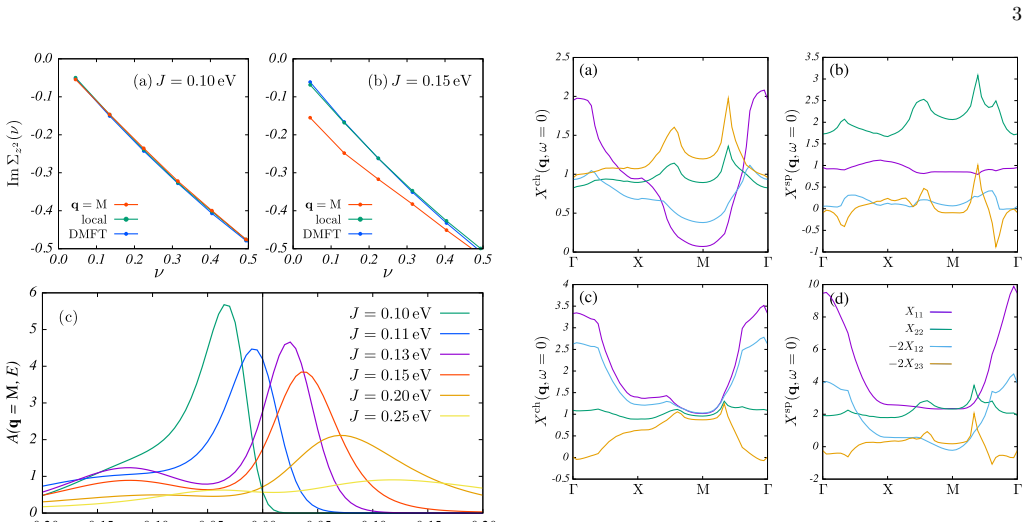
Within an effective three-orbital model solved beyond dynamical mean-field theory, the interplay of multiorbital physics and nonlocal self-energy effects yields two distinct low-energy regimes controlled by interorbital interaction strength: the notorious flat gamma quasiparticle band either lies entirely in the occupied spectrum or crosses the Fermi level, in which case electron-paramagnon scattering generates spin-polaron bound states visible as a shadow band carrying incoherent spectral weight below the Fermi level.
What carries the argument
Effective three-orbital model solved with an advanced many-body solver that captures k-dependent correlations beyond dynamical mean-field theory.
If this is right
- Additional competing low-energy states exist in bilayer nickelates beyond previously discussed phases.
- Spin-polaron formation can produce bound states that appear as shadow bands in the spectral function.
- The position of the flat gamma band relative to the Fermi level depends sensitively on interorbital interaction strength.
- These states offer a possible explanation for the observed controversy in recent ARPES experiments.
Where Pith is reading between the lines
- Nonlocal correlation effects may be essential for interpreting normal-state spectra in other layered nickelates under pressure.
- Similar spin-polaron mechanisms could be tested by looking for shadow bands in related materials with comparable orbital fillings.
- The dependence on interorbital interaction suggests that small changes in doping or pressure could switch between the occupied-band and crossing-band regimes.
Load-bearing premise
The effective three-orbital model plus the chosen advanced many-body solver accurately capture the k-dependent correlations and low-energy physics of the high-pressure normal state without missing essential degrees of freedom.
What would settle it
High-resolution angle-resolved photoemission spectra of high-pressure La3Ni2O7 that either clearly detect or definitively rule out an incoherent shadow band below the Fermi level with the predicted momentum dependence.
Figures


read the original abstract
The interplay of multiorbital physics and nonlocal self-energy effects is studied within an effective three-orbital model for the high-pressure normal state of superconducting bilayer nickelate La$_3$Ni$_2$O$_7$. The model is solved within an advanced many-body framework capturing $k$-dependent correlations beyond dynamical mean-field theory. Different low-energy scenarios subtly depend on the strength of the interorbital interaction, either placing the notorious flat $\gamma$ quasiparticle band in the occupied part of the spectrum, or letting it cross the Fermi level. In the latter case, intriguing spin-polaron formation due to the scattering of electrons with paramagnon excitations takes place. This leads to bound states appearing as a shadow band with incoherent low-energy spectral weight below the Fermi level. Our results uncover additional competing states that exist in bilayer nickelates and could explain the controversy of recent angle-resolved photoemission experiments.
Editorial analysis
A structured set of objections, weighed in public.
Referee Report
Summary. The manuscript studies the interplay of multiorbital physics and nonlocal self-energy effects in an effective three-orbital model for the high-pressure normal state of superconducting bilayer nickelate La₃Ni₂O₇. Solved with an advanced many-body framework beyond DMFT that captures k-dependent correlations, the work finds that low-energy scenarios (position of the flat γ quasiparticle band relative to E_F and formation of spin-polaron bound states appearing as a shadow band) depend subtly on the interorbital interaction strength; in the case where the γ band crosses E_F, paramagnon scattering produces incoherent spectral weight below E_F. The authors argue these competing states help explain recent ARPES controversies.
Significance. If the central results hold under the chosen interaction value, the paper would usefully highlight how nonlocal correlations and multiorbital effects generate additional low-energy features in bilayer nickelates, offering a possible resolution to ARPES discrepancies on the flat band. The use of a solver beyond DMFT is a strength for addressing momentum-dependent physics.
major comments (2)
- [Abstract and results] Abstract and results discussion: the claim that spin-polaron shadow bands explain the ARPES controversy is load-bearing on the interorbital interaction strength being tuned such that the γ band crosses E_F (rather than remaining occupied). This strength functions as a free parameter without independent constraint from the model equations or a demonstrated robustness scan across a plausible range, raising the risk that the shadow band is an artifact of a narrow window rather than a generic feature.
- [Model and method] Model and method sections: the effective three-orbital model plus the chosen solver is asserted to capture the k-dependent correlations and low-energy physics without missing essential degrees of freedom, yet the subtlety of the γ-band position and shadow-band formation on the interaction value makes it necessary to quantify how sensitive the conclusions are to this assumption or to compare against alternative models.
minor comments (2)
- [Figures] Figure captions and parameter tables should explicitly state the numerical value(s) of the interorbital interaction used for each panel and whether results persist under small variations.
- [Notation] Notation for the γ band, shadow band, and paramagnon excitations should be defined consistently in the text and figures to avoid ambiguity for readers unfamiliar with the specific ARPES controversy.
Simulated Author's Rebuttal
We thank the referee for the careful reading and constructive feedback on our manuscript. We address the major comments point by point below, providing clarifications and committing to revisions that will strengthen the presentation of our results without altering the core findings.
read point-by-point responses
-
Referee: [Abstract and results] Abstract and results discussion: the claim that spin-polaron shadow bands explain the ARPES controversy is load-bearing on the interorbital interaction strength being tuned such that the γ band crosses E_F (rather than remaining occupied). This strength functions as a free parameter without independent constraint from the model equations or a demonstrated robustness scan across a plausible range, raising the risk that the shadow band is an artifact of a narrow window rather than a generic feature.
Authors: We agree that the emergence of the spin-polaron shadow band is tied to the regime in which the γ quasiparticle band crosses the Fermi level, which in turn depends on the interorbital interaction strength. This dependence is already noted in the manuscript as part of the subtle competition between different low-energy scenarios. The specific value used is motivated by estimates from ab initio constrained calculations for the nickelate system and is chosen to place the system in the regime consistent with certain ARPES reports of a crossing band. We acknowledge that a broader parameter scan would better demonstrate robustness. In the revised manuscript we will add a supplementary figure showing the γ-band position and spectral features across a range of interorbital interaction strengths (approximately ±20% around the chosen value), confirming that the shadow band appears generically once the band crosses E_F and is not confined to an unphysically narrow window. revision: yes
-
Referee: [Model and method] Model and method sections: the effective three-orbital model plus the chosen solver is asserted to capture the k-dependent correlations and low-energy physics without missing essential degrees of freedom, yet the subtlety of the γ-band position and shadow-band formation on the interaction value makes it necessary to quantify how sensitive the conclusions are to this assumption or to compare against alternative models.
Authors: The three-orbital model is obtained by downfolding the full DFT band structure onto the Ni d_{x²-y²}, d_{z²}, and d_{xy} orbitals that dominate the low-energy physics near the Fermi level in the high-pressure phase; this choice is standard in the literature for bilayer nickelates and retains the essential orbital degrees of freedom. The solver (a diagrammatic extension beyond DMFT that includes momentum-dependent self-energy) is selected precisely to capture the nonlocal correlations responsible for the paramagnon scattering and shadow-band formation. We will expand the method section to include a short justification of the orbital truncation and a reference to why two-orbital models miss the interorbital scattering channel that stabilizes the shadow band. In addition, the parameter scan mentioned in response to the first comment will directly quantify the sensitivity of the γ-band position and shadow-band intensity to the interorbital interaction, thereby addressing the robustness concern within the present framework. revision: yes
Circularity Check
No significant circularity; parameter dependence is explicit model exploration
full rationale
The paper solves an effective three-orbital model for the bilayer nickelate using an advanced many-body solver that captures k-dependent correlations. It explicitly states that low-energy scenarios (gamma-band position and spin-polaron shadow band) depend on the interorbital interaction strength and presents both cases without claiming one is derived from first principles or fitted to force a specific outcome. No self-definitional loops, fitted inputs renamed as predictions, or load-bearing self-citations that reduce the central claim to its own inputs are present. The results are direct numerical outputs for chosen parameter values, and the interpretive link to ARPES controversy does not constitute a circular reduction by construction.
Axiom & Free-Parameter Ledger
free parameters (1)
- interorbital interaction strength
axioms (1)
- domain assumption Effective three-orbital model faithfully represents the high-pressure normal state of La3Ni2O7
invented entities (1)
-
spin-polaron bound state
no independent evidence
Lean theorems connected to this paper
-
IndisputableMonolith/Cost/FunctionalEquation.leanwashburn_uniqueness_aczel unclear?
unclearRelation between the paper passage and the cited Recognition theorem.
effective three-orbital Hubbard Hamiltonian... solved using the dual triply irreducible local expansion (D-TRILEX) method... low-energy scenarios subtly depend on the strength of the interorbital interaction
-
IndisputableMonolith/Foundation/AlexanderDuality.leanalexander_duality_circle_linking unclear?
unclearRelation between the paper passage and the cited Recognition theorem.
three electrons distributed over Ni-eg {dz2, dx2-y2}... two antibonding Ni-dx2-y2-dominated (α, β) bands, one antibonding Ni-dz2-dominated δ band and one nonbonding Ni-dz2-dominated flat γ band
What do these tags mean?
- matches
- The paper's claim is directly supported by a theorem in the formal canon.
- supports
- The theorem supports part of the paper's argument, but the paper may add assumptions or extra steps.
- extends
- The paper goes beyond the formal theorem; the theorem is a base layer rather than the whole result.
- uses
- The paper appears to rely on the theorem as machinery.
- contradicts
- The paper's claim conflicts with a theorem or certificate in the canon.
- unclear
- Pith found a possible connection, but the passage is too broad, indirect, or ambiguous to say the theorem truly supports the claim.
Forward citations
Cited by 2 Pith papers
-
Correlation-Driven Orbital-Selective Fermiology and Superconductivity in the Bilayer Nickelate La$_3$Ni$_2$O$_7$
Correlations in the nickelate drive the gamma band below the Fermi level and shift the dominant superconducting pairing to d_x2-y2 interlayer spin-singlet mediated by antiferromagnetism and Hund's coupling.
-
Superconductivity in bilayer La$_3$Ni$_2$O$_7$: A review focusing on the strong-coupling Hund's rule assisted pairing mechanism
Superconductivity in La3Ni2O7 arises from interlayer Cooper pairs of 3d_x2-y2 electrons driven by effective J_perp from Hund-assisted AFM exchange transfer, while localized 3d_z2 electrons form rung singlets that prod...
Reference graph
Works this paper leans on
-
[1]
Quantum magnetism and criticality,
S. Sachdev, “Quantum magnetism and criticality,” Na- ture Phys.4, 173 (2008)
2008
-
[2]
From quantum matter to high- temperature superconductivity in copper oxides,
B. Keimer, S. A. Kivelson, M. R. Norman, S. Uchida, and J. Zaanen, “From quantum matter to high- temperature superconductivity in copper oxides,” Nature 518, 179 (2015)
2015
-
[3]
Antiferromag- netism and d-wave superconductivity in cuprates: A cluster dynamical mean-field theory,
A. I. Lichtenstein and M. I. Katsnelson, “Antiferromag- netism and d-wave superconductivity in cuprates: A cluster dynamical mean-field theory,” Phys. Rev. B62, R9283–R9286 (2000)
2000
-
[4]
Cluster Dynam- ical Mean Field Analysis of the Mott Transition,
O. Parcollet, G. Biroli, and G. Kotliar, “Cluster Dynam- ical Mean Field Analysis of the Mott Transition,” Phys. Rev. Lett.92, 226402 (2004)
2004
-
[5]
Iron pnictides and chalcogenides: a new paradigm for super- conductivity,
Rafael M. Fernandes, Amalia I. Coldea, Hong Ding, Ian R. Fisher, P. J. Hirschfeld, and Gabriel Kotlia, “Iron pnictides and chalcogenides: a new paradigm for super- conductivity,” Nature601, 35 (2022)
2022
-
[6]
Signatures of superconductivity near 80 k in a nickelate under high pressure,
Hualei Sun, Mengwu Huo, Xunwu Hu, Jingyuan Li, Yifeng Han, Lingyun Tang, Zhongquan Mao, Peng- tao Yang, Bosen Wang, Jinguang Cheng, Dao-Xin Yao, Guang-Ming Zhang, and Meng Wang, “Signatures of superconductivity near 80 k in a nickelate under high pressure,” Nature621, 493–498 (2023)
2023
-
[7]
Signa- tures of ambient pressure superconductivity in thin film La3Ni2O7,
Eun Kyo Ko, Yijun Yu, Yidi Liu, Lopa Bhatt, Jiarui Li, Vivek Thampy, Cheng-Tai Kuo, Bai Yang Wang, Yonghun Lee, Kyuho Lee, Jun-Sik Lee, Berit H. Goodge, David A. Muller, and Harold Y. Hwang, “Signa- tures of ambient pressure superconductivity in thin film La3Ni2O7,” Nature638, 935 (2025)
2025
-
[8]
Ambient- pressure superconductivity onset above 40 k in bilayer nickelate ultrathin films,
Guangdi Zhou, Wei Lv, Heng Wang, Zihao Nie, Yaqi Chen, Yueying Li, Haoliang Huang, Weiqiang Chen, Yu- jie Sun, Qi-Kun Xue, and Zhuoyu Chen, “Ambient- pressure superconductivity onset above 40 k in bilayer nickelate ultrathin films,” Nature640, 641 (2025)
2025
-
[9]
Frank Lechermann, Steffen B¨ otzel, and Ilya M. Eremin, “Low-energy perspective of interacting electrons in the normal state of superconducting bilayer nickelate,” Preprint arXiv:2503.12412 (2025)
-
[10]
Charge distribution and magnetism in bi- layer La 3Ni2O7: a hybrid functional study,
Kateryna Foyevtsova, Ilya Elfimov, and George A. Sawatzky, “Charge distribution and magnetism in bi- layer La 3Ni2O7: a hybrid functional study,” Preprint arXiv:2507.08123 (2025)
-
[11]
Pressure and strain effects on the ab initioGWelectronic struc- ture of La 3Ni2O7,
Jean-Baptiste de Vaulx, Quintin N. Meier, Pierre Toule- monde, Andr´ es Cano, and Valerio Olevano, “Pressure and strain effects on the ab initioGWelectronic struc- ture of La 3Ni2O7,” Phys. Rev. B112, 085143 (2025)
2025
-
[12]
Electronic structures and multi- orbital models of La 3Ni2O7 thin films at ambient pres- sure,
Xunwu Hu, Wenyuan Qiu, Cui-Qun Chen, Zhihui Luo, and Dao-Xin Yao, “Electronic structures and multi- orbital models of La 3Ni2O7 thin films at ambient pres- sure,” Commun. Phys.8, 506 (2025)
2025
-
[13]
Bilayer Two-Orbital Model of La3Ni2O7 under Pressure,
Zhihui Luo, Xunwu Hu, Meng Wang, W´ ei W´ u, and Dao- Xin Yao, “Bilayer Two-Orbital Model of La3Ni2O7 under Pressure,” Phys. Rev. Lett.131, 126001 (2023)
2023
-
[14]
Electronic correlations and supercon- ducting instability in La 3Ni2O7 under high pressure,
Frank Lechermann, Jannik Gondolf, Steffen B¨ otzel, and Ilya M. Eremin, “Electronic correlations and supercon- ducting instability in La 3Ni2O7 under high pressure,” Phys. Rev. B108, L201121 (2023)
2023
-
[15]
Electronic structure, dimer physics, orbital- selective behavior, and magnetic tendencies in the bi- layer nickelate superconductor La 3Ni2O7 under pres- sure,
Yang Zhang, Ling-Fang Lin, Adriana Moreo, and Elbio Dagotto, “Electronic structure, dimer physics, orbital- selective behavior, and magnetic tendencies in the bi- layer nickelate superconductor La 3Ni2O7 under pres- sure,” Phys. Rev. B108, L180510 (2023)
2023
-
[16]
Correlated electronic structure, orbital-selective behavior, and magnetic corre- lations in double-layer La 3Ni2O7 under pressure,
D. A. Shilenko and I. V. Leonov, “Correlated electronic structure, orbital-selective behavior, and magnetic corre- lations in double-layer La 3Ni2O7 under pressure,” Phys. Rev. B108, 125105 (2023)
2023
-
[17]
Charge and spin instabilities in supercon- ducting La3Ni2O7,
Xuejiao Chen, Peiheng Jiang, Jie Li, Zhicheng Zhong, and Yi Lu, “Charge and spin instabilities in supercon- ducting La3Ni2O7,” Phys. Rev. B111, 014515 (2025)
2025
-
[18]
Possible HighTc Superconductiv- ity in La 3Ni2O7 under High Pressure through Manifes- tation of a Nearly Half-Filled Bilayer Hubbard Model,
Hirofumi Sakakibara, Naoya Kitamine, Masayuki Ochi, and Kazuhiko Kuroki, “Possible HighTc Superconductiv- ity in La 3Ni2O7 under High Pressure through Manifes- tation of a Nearly Half-Filled Bilayer Hubbard Model,” Phys. Rev. Lett.132, 106002 (2024)
2024
-
[19]
Correlated Electronic Structure of La 3Ni2O7 under Pressure,
Viktor Christiansson, Francesco Petocchi, and Philipp Werner, “Correlated Electronic Structure of La 3Ni2O7 under Pressure,” Phys. Rev. Lett.131, 206501 (2023)
2023
-
[20]
Possibles ±-wave superconductivity in La 3Ni2O7,
Qing-Geng Yang, Da Wang, and Qiang-Hua Wang, “Possibles ±-wave superconductivity in La 3Ni2O7,” Phys. Rev. B108, L140505 (2023)
2023
-
[21]
Interplay of twoE g orbitals in superconducting 6 La3Ni2O7 under pressure,
Chen Lu, Zhiming Pan, Fan Yang, and Congjun Wu, “Interplay of twoE g orbitals in superconducting 6 La3Ni2O7 under pressure,” Phys. Rev. B110, 094509 (2024)
2024
-
[22]
s ±-Wave Pairing and the Destructive Role of Apical-Oxygen Deficiencies in La 3Ni2O7 under Pres- sure,
Yu-Bo Liu, Jia-Wei Mei, Fei Ye, Wei-Qiang Chen, and Fan Yang, “s ±-Wave Pairing and the Destructive Role of Apical-Oxygen Deficiencies in La 3Ni2O7 under Pres- sure,” Phys. Rev. Lett.131, 236002 (2023)
2023
-
[23]
Interlayer valence bonds and two-component theory for high-Tc superconductivity of La 3Ni2O7 under pressure,
Yi-feng Yang, Guang-Ming Zhang, and Fu-Chun Zhang, “Interlayer valence bonds and two-component theory for high-Tc superconductivity of La 3Ni2O7 under pressure,” Phys. Rev. B108, L201108 (2023)
2023
-
[24]
Bilayert−J−J ⊥ Model and Magnetically Mediated Pairing in the Pressur- ized Nickelate La3Ni2O7,
Xing-Zhou Qu, Dai-Wei Qu, Jialin Chen, Congjun Wu, Fan Yang, Wei Li, and Gang Su, “Bilayert−J−J ⊥ Model and Magnetically Mediated Pairing in the Pressur- ized Nickelate La3Ni2O7,” Phys. Rev. Lett.132, 036502 (2024)
2024
-
[25]
Pressure Driven Fractionalization of Ionic Spins Results in Cupratelike High-T c Superconductivity in La3Ni2O7,
Ruoshi Jiang, Jinning Hou, Zhiyu Fan, Zi-Jian Lang, and Wei Ku, “Pressure Driven Fractionalization of Ionic Spins Results in Cupratelike High-T c Superconductivity in La3Ni2O7,” Phys. Rev. Lett.132, 126503 (2024)
2024
-
[26]
High-Tc superconductivity in La 3Ni2O7 based on the bilayer two-orbital t-J model,
Zhihui Luo, Biao Lv, Meng Wang, W´ ei W´ u, and Dao-Xin Yao, “High-Tc superconductivity in La 3Ni2O7 based on the bilayer two-orbital t-J model,” npj Quantum Mater. 9, 61 (2024)
2024
-
[27]
Type-IIt−Jmodel and shared superexchange coupling from Hund’s rule in superconducting La 3Ni2O7,
Hanbit Oh and Ya-Hui Zhang, “Type-IIt−Jmodel and shared superexchange coupling from Hund’s rule in superconducting La 3Ni2O7,” Phys. Rev. B108, 174511 (2023)
2023
-
[28]
Quenched Pair Breaking by Interlayer Correlations as a Key to Superconductivity in La 3Ni2O7,
Siheon Ryee, Niklas Witt, and Tim O. Wehling, “Quenched Pair Breaking by Interlayer Correlations as a Key to Superconductivity in La 3Ni2O7,” Phys. Rev. Lett.133, 096002 (2024)
2024
-
[29]
Competingd xy ands ± pairing symmetries in supercon- ducting La 3Ni2O7: LDA + FLEX calculations,
Griffin Heier, Kyungwha Park, and Sergey Y. Savrasov, “Competingd xy ands ± pairing symmetries in supercon- ducting La 3Ni2O7: LDA + FLEX calculations,” Phys. Rev. B109, 104508 (2024)
2024
-
[30]
Structural transitions, oc- tahedral rotations, and electronic properties of A 3Ni2O7 rare-earth nickelates under high pressure,
B. Geisler, J. J. Hamlin, G. R. Stewart, R. G. Hen- nig, and P. J. Hirschfeld, “Structural transitions, oc- tahedral rotations, and electronic properties of A 3Ni2O7 rare-earth nickelates under high pressure,” npj Quantum Mater.9, 38 (2024)
2024
-
[31]
Role of correlations in Ruddlesden-Popper bilayer nickelates under compressive strain,
Logan Bleys, Nicholas Corkill, Yi-Feng Zhao, Gheo- rghe Lucian Pascut, Harrison LaBollita, Antia S. Botana, and Khandker F. Quader, “Role of correlations in Ruddlesden-Popper bilayer nickelates under compressive strain,” Preprint arXiv:2509.00940 (2025)
-
[32]
Ef- fective Bi-Layer Model Hamiltonian and Density-Matrix Renormalization Group Study for the High-Tc Supercon- ductivity in La3Ni2O7 under High Pressure,
Yang Shen, Mingpu Qin, and Guang-Ming Zhang, “Ef- fective Bi-Layer Model Hamiltonian and Density-Matrix Renormalization Group Study for the High-Tc Supercon- ductivity in La3Ni2O7 under High Pressure,” Chin. Phys. Lett.40, 127401 (2023)
2023
-
[33]
Bound-State of superfluous electron and spin-wave in ferromagnetic chains,
M. I. Katsnelson, “Bound-State of superfluous electron and spin-wave in ferromagnetic chains,” Fiz. Met. Met- alloved.54, 396 (1982)
1982
-
[34]
From Hubbard bands to spin-polaron excitations in the doped Mott material NaxCoO2,
Aljoscha Wilhelm, Frank Lechermann, Hartmut Hafer- mann, Mikhail I. Katsnelson, and Alexander I. Lichten- stein, “From Hubbard bands to spin-polaron excitations in the doped Mott material NaxCoO2,” Phys. Rev. B91, 155114 (2015)
2015
-
[35]
Ilia S. Dedov, Andrey A. Katanin, and Evgeny A. Stepanov, “Non-Fermi-liquid behaviour and Fermi- surface expansion induced by van Hove-driven ferromag- netic fluctuations: the D-TRILEX analysis,” Preprint arXiv:2511.14614 (2025)
-
[36]
Consistent partial bosonization of the extended Hub- bard model,
E. A. Stepanov, V. Harkov, and A. I. Lichtenstein, “Consistent partial bosonization of the extended Hub- bard model,” Phys. Rev. B100, 205115 (2019)
2019
-
[37]
Impact of partially bosonized col- lective fluctuations on electronic degrees of freedom,
V. Harkov, M. Vandelli, S. Brener, A. I. Lichtenstein, and E. A. Stepanov, “Impact of partially bosonized col- lective fluctuations on electronic degrees of freedom,” Phys. Rev. B103, 245123 (2021)
2021
-
[38]
Multi-band D-TRILEX approach to materials with strong electronic correlations,
M. Vandelli, J. Kaufmann, M. El-Nabulsi, V. Harkov, A. I. Lichtenstein, and E. A. Stepanov, “Multi-band D-TRILEX approach to materials with strong electronic correlations,” SciPost Phys.13, 036 (2022)
2022
-
[39]
Coexist- ing charge density wave and ferromagnetic instabilities in monolayer InSe,
E. A. Stepanov, V. Harkov, M. R¨ osner, A. I. Lichten- stein, M. I. Katsnelson, and A. N. Rudenko, “Coexist- ing charge density wave and ferromagnetic instabilities in monolayer InSe,” npj Comput. Mater.8, 118 (2022)
2022
-
[40]
Doping-dependent Charge- and Spin-Density Wave Orderings in a Mono- layer of Pb Adatoms on Si(111),
M. Vandelli, A. Galler, A. Rubio, A. I. Lichtenstein, S. Biermann, and E. A. Stepanov, “Doping-dependent Charge- and Spin-Density Wave Orderings in a Mono- layer of Pb Adatoms on Si(111),” npj Quantum Mater. 9, 19 (2024)
2024
-
[41]
Interconnected renormalization of Hub- bard bands and Green’s function zeros in Mott insulators induced by strong magnetic fluctuations,
E. A. Stepanov, M. Chatzieleftheriou, N. Wagner, and G. Sangiovanni, “Interconnected renormalization of Hub- bard bands and Green’s function zeros in Mott insulators induced by strong magnetic fluctuations,” Phys. Rev. B 110, L161106 (2024)
2024
-
[42]
Local and Nonlocal Electronic Correlations at the Metal-Insulator Transition in the Two-Dimensional Hub- bard Model,
M. Chatzieleftheriou, S. Biermann, and E. A. Stepanov, “Local and Nonlocal Electronic Correlations at the Metal-Insulator Transition in the Two-Dimensional Hub- bard Model,” Phys. Rev. Lett.132, 236504 (2024)
2024
-
[43]
Fingerprints of a charge ice state in the doped Mott insulator Nb 3Cl8,
Evgeny A. Stepanov, “Fingerprints of a charge ice state in the doped Mott insulator Nb 3Cl8,” Phys. Rev. B112, 045131 (2025)
2025
-
[44]
Superconductivity of bad fermions and the origin of two gaps in cuprates,
E. A. Stepanov, S. Iskakov, M. I. Katsnelson, and A. I. Lichtenstein, “Superconductivity of bad fermions and the origin of two gaps in cuprates,” Commun. Phys.9, 91 (2026)
2026
-
[45]
Orbital Isotropy of Magnetic Fluctuations in Correlated Electron Materials Induced by Hund’s Exchange Coupling,
Evgeny A. Stepanov, Yusuke Nomura, Alexander I. Lichtenstein, and Silke Biermann, “Orbital Isotropy of Magnetic Fluctuations in Correlated Electron Materials Induced by Hund’s Exchange Coupling,” Phys. Rev. Lett. 127, 207205 (2021)
2021
-
[46]
Eliminating Orbital Selectivity from the Metal-Insulator Transition by Strong Magnetic Fluctuations,
Evgeny A. Stepanov, “Eliminating Orbital Selectivity from the Metal-Insulator Transition by Strong Magnetic Fluctuations,” Phys. Rev. Lett.129, 096404 (2022)
2022
-
[47]
Extended regime of metastable metallic and insulating phases in a two- orbital electronic system,
M. Vandelli, J. Kaufmann, V. Harkov, A. I. Lichten- stein, K. Held, and E. A. Stepanov, “Extended regime of metastable metallic and insulating phases in a two- orbital electronic system,” Phys. Rev. Res.5, L022016 (2023)
2023
-
[48]
Can Orbital- Selective N´ eel Transitions Survive Strong Nonlocal Elec- tronic Correlations?
Evgeny A. Stepanov and Silke Biermann, “Can Orbital- Selective N´ eel Transitions Survive Strong Nonlocal Elec- tronic Correlations?” Phys. Rev. Lett.132, 226501 (2024)
2024
-
[49]
Charge Density Wave Ordering in NdNiO2: Effects of Multiorbital Nonlocal Correlations,
E. A. Stepanov, M. Vandelli, A. I. Lichtenstein, and F. Lechermann, “Charge Density Wave Ordering in NdNiO2: Effects of Multiorbital Nonlocal Correlations,” npj Comput. Mater.10, 108 (2024)
2024
-
[50]
Nature of momentum- and orbital-dependent magnetic fluctua- tions in Sr 2RuO4,
Maria Chatzieleftheriou, Alexander N. Rudenko, Yvan Sidis, Silke Biermann, and Evgeny A. Stepanov, “Nature of momentum- and orbital-dependent magnetic fluctua- tions in Sr 2RuO4,” Phys. Rev. B112, 195118 (2025)
2025
-
[51]
Dual-space cluster-diagrammatic approach to nonlocal electronic correlations,
F´ elix Fossati and Evgeny A. Stepanov, “Dual-space cluster-diagrammatic approach to nonlocal electronic correlations,” Phys. Rev. B113, 075149 (2026)
2026
-
[52]
Electron-magnon dynamics triggered by an ultrashort laser pulse: A real-time dualGWstudy,
Nagamalleswararao Dasari, Hugo U. R. Strand, Mar- 7 tin Eckstein, Alexander I. Lichtenstein, and Evgeny A. Stepanov, “Electron-magnon dynamics triggered by an ultrashort laser pulse: A real-time dualGWstudy,” Phys. Rev. B111, 235129 (2025)
2025
-
[53]
Nonlocal Correlation Effects in dc and Op- tical Conductivity of the Hubbard Model,
Nagamalleswararao Dasari, Hugo U. R. Strand, Mar- tin Eckstein, Alexander I. Lichtenstein, and Evgeny A. Stepanov, “Nonlocal Correlation Effects in dc and Op- tical Conductivity of the Hubbard Model,” Phys. Rev. Lett.136, 106905 (2026)
2026
-
[54]
Continuous-time quantum Monte Carlo method for fermions,
A. N. Rubtsov, V. V. Savkin, and A. I. Lichten- stein, “Continuous-time quantum Monte Carlo method for fermions,” Phys. Rev. B72, 035122 (2005)
2005
-
[55]
Continuous-Time Solver for Quantum Im- purity Models,
P. Werner, A. Comanac, L. de’ Medici, M. Troyer, and A. J. Millis, “Continuous-Time Solver for Quantum Im- purity Models,” Phys. Rev. Lett.97, 076405 (2006)
2006
-
[56]
Dynamical Screening in Correlated Electron Materials,
Philipp Werner and Andrew J. Millis, “Dynamical Screening in Correlated Electron Materials,” Phys. Rev. Lett.104, 146401 (2010)
2010
-
[57]
Continuous-time Monte Carlo methods for quantum impurity models,
E. Gull, A. J. Millis, A. I. Lichtenstein, A. N. Rubtsov, M. Troyer, and P. Werner, “Continuous-time Monte Carlo methods for quantum impurity models,” Rev. Mod. Phys.83, 349–404 (2011)
2011
-
[58]
w2dynamics: Local one- and two-particle quan- tities from dynamical mean field theory,
M. Wallerberger, A. Hausoel, P. Gunacker, A. Kowal- ski, N. Parragh, F. Goth, K. Held, and G. Sangio- vanni, “w2dynamics: Local one- and two-particle quan- tities from dynamical mean field theory,” Comput. Phys. Commun.235, 388–399 (2019)
2019
-
[59]
ana cont: Python package for analytic continuation,
Josef Kaufmann and Karsten Held, “ana cont: Python package for analytic continuation,” Comput. Phys. Com- mun.282, 108519 (2023)
2023
-
[60]
See Supplemental Material for the the temperature de- pendence of the flatγband, for the identification of the leading scattering momentum of magnetic fluctuations within theγband, and for the orbital and momeentum dependence of the self-energy
-
[61]
Superconductivity Governed by Janus- Faced Fermiology in Strained Bilayer Nickelates,
Siheon Ryee, Niklas Witt, Giorgio Sangiovanni, and Tim O. Wehling, “Superconductivity Governed by Janus- Faced Fermiology in Strained Bilayer Nickelates,” Phys. Rev. Lett.135, 236003 (2025)
2025
-
[62]
Theory of magnetic excitations in the multilayer nickelate superconductor La 3Ni2O7,
Steffen B¨ otzel, Frank Lechermann, Jannik Gondolf, and Ilya M. Eremin, “Theory of magnetic excitations in the multilayer nickelate superconductor La 3Ni2O7,” Phys. Rev. B109, L180502 (2024)
2024
-
[63]
Wenjie Sun, Zhicheng Jiang, Bo Hao, Shengjun Yan, Hongyi Zhang, Maosen Wang, Yang Yang, Haoying Sun, Zhengtai Liu, Dianxiang Ji, Zhengbin Gu, Jian Zhou, Dawei Shen, Donglai Feng, and Yuefeng Nie, “Observa- tion of superconductivity-induced leading-edge gap in Sr- doped La 3Ni2O7 thin films,” Preprint arXiv:2507.07409 (2025)
-
[64]
Electronic structure of compressively strained thin film La 2PrNi2O7,
Bai Yang Wang, Yong Zhong, Sebastien Abadi, Yidi Liu, Yijun Yu, Xiaoliang Zhang, Yi-Ming Wu, Ruo- han Wang, Jiarui Li, Yaoju Tarn, Eun Kyo Ko, Vivek Thampy, Makoto Hashimoto, Donghui Lu, Young S. Lee, Thomas P. Devereaux, Chunjing Jia, Harold Y. Hwang, and Zhi-Xun Shen, “Electronic structure of compressively strained thin film La 2PrNi2O7,” Preprint arXiv...
-
[65]
Angle- resolved photoemission spectroscopy of superconducting (La, Pr) 3Ni2O7/SrLaAlO4 heterostructures,
Peng Li, Guangdi Zhou, Wei Lv, Yueying Li, Chang- ming Yue, Haoliang Huang, Lizhi Xu, Jianchang Shen, Yu Miao, Wenhua Song, Zihao Nie, Yaqi Chen, Heng Wang, Weiqiang Chen, Yaobo Huang, Zhen- Hua Chen, Tian Qian, Junhao Lin, Junfeng He, Yu- Jie Sun, Zhuoyu Chen, and Qi-Kun Xue, “Angle- resolved photoemission spectroscopy of superconducting (La, Pr) 3Ni2O7/...
2025
-
[66]
Infrared Probe of the Electronic Structure and Charge Dynamics of Na 0.7CoO2,
N. L. Wang, P. Zheng, D. Wu, Y. C. Ma, T. Xiang, R. Y. Jin, and D. Mandrus, “Infrared Probe of the Electronic Structure and Charge Dynamics of Na 0.7CoO2,” Phys. Rev. Lett.93, 237007 (2004)
2004
-
[67]
Supplemental Material Co-operating multiorbital and nonlocal correlations in bilayer nickelate Evgeny A
Bai Yang Wang, private communication. Supplemental Material Co-operating multiorbital and nonlocal correlations in bilayer nickelate Evgeny A. Stepanov, 1, 2 Steffen B¨ otzel,3 Ilya M. Eremin, 3 and Frank Lechermann 3 1CPHT, CNRS, ´Ecole polytechnique, Institut Polytechnique de Paris, 91120 Palaiseau, France 2Coll` ege de France, 11 place Marcelin Berthel...
discussion (0)
Sign in with ORCID, Apple, or X to comment. Anyone can read and Pith papers without signing in.