Recognition: unknown
Behavior-Aware Item Modeling via Dynamic Procedural Solution Representations for Knowledge Tracing
Pith reviewed 2026-05-10 16:50 UTC · model grok-4.3
The pith
Modeling problem solutions as four dynamic procedural stages improves knowledge tracing predictions by adapting to individual learner behaviors.
A machine-rendered reading of the paper's core claim, the machinery that carries it, and where it could break.
Core claim
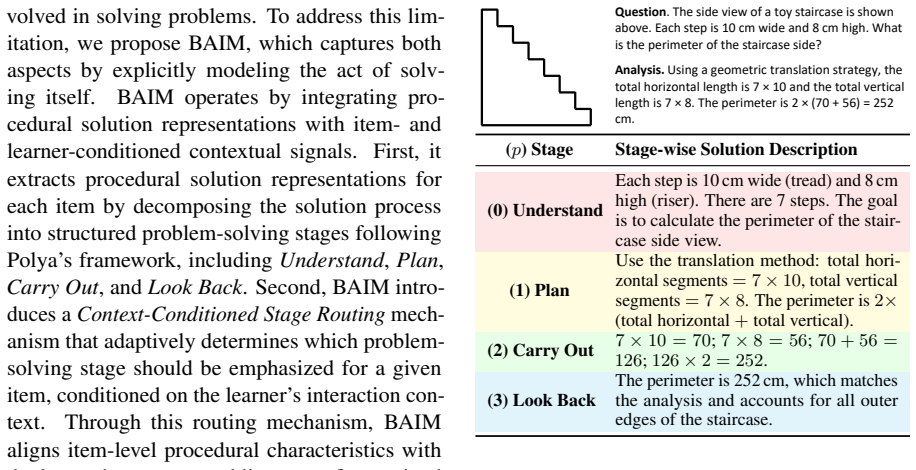
BAIM enriches item representations by integrating dynamic procedural solution information. It leverages a reasoning language model to decompose each item's solution into four problem-solving stages (understand, plan, carry out, and look back) and derives stage-level representations from per-stage embedding trajectories. A context-conditioned routing mechanism then adaptively emphasizes different stages for different learners inside any KT backbone, producing item embeddings that reflect procedural dynamics beyond surface features.
What carries the argument
Four-stage procedural decomposition of solutions (understand-plan-carry out-look back) whose embeddings are routed by a context-conditioned mechanism that conditions on learner history.
Load-bearing premise
The four-stage decomposition produced by the reasoning language model actually isolates meaningful procedural dynamics rather than surface wording, and the routing mechanism captures real learner differences instead of fitting noise.
What would settle it
If ablating the stage decomposition or the routing mechanism produces no drop in prediction accuracy on held-out repeated learner-item pairs, the benefit of dynamic procedural representations would be falsified.
Figures




read the original abstract
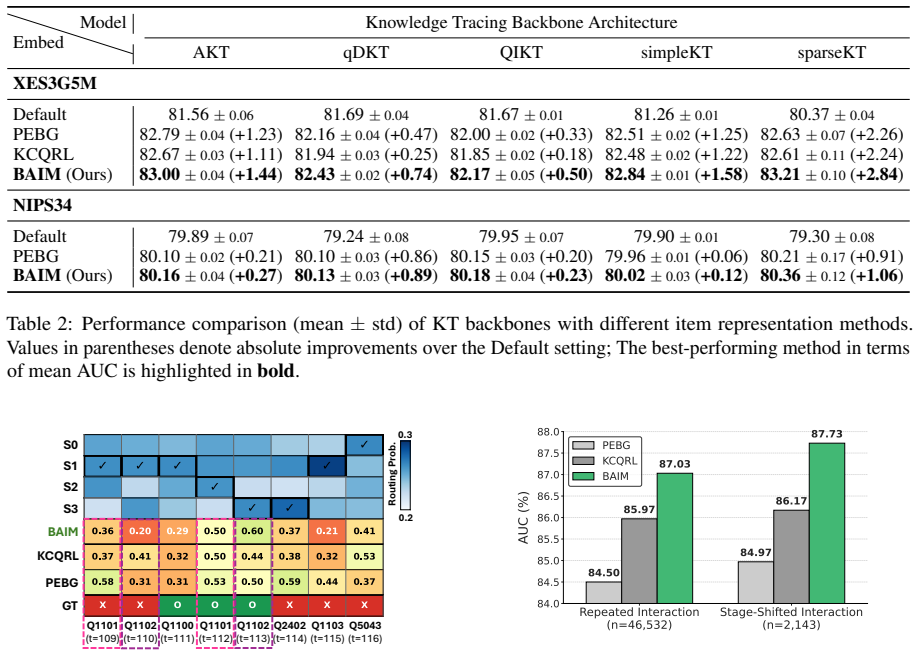
Knowledge Tracing (KT) aims to predict learners' future performance from past interactions. While recent KT approaches have improved via learning item representations aligned with Knowledge Components, they overlook the procedural dynamics of problem solving. We propose Behavior-Aware Item Modeling (BAIM), a framework that enriches item representations by integrating dynamic procedural solution information. BAIM leverages a reasoning language model to decompose each item's solution into four problem-solving stages (i.e., understand, plan, carry out, and look back), pedagogically grounded in Polya's framework. Specifically, it derives stage-level representations from per-stage embedding trajectories, capturing latent signals beyond surface features. To reflect learner heterogeneity, BAIM adaptively routes these stage-wise representations, introducing a context-conditioned mechanism within a KT backbone, allowing different procedural stages to be emphasized for different learners. Experiments on XES3G5M and NIPS34 show that BAIM consistently outperforms strong pretraining-based baselines, achieving particularly large gains under repeated learner interactions.
Editorial analysis
A structured set of objections, weighed in public.
Referee Report
Summary. The paper proposes Behavior-Aware Item Modeling (BAIM) for knowledge tracing. It uses a reasoning language model to decompose each item's solution into four stages (understand, plan, carry out, look back) grounded in Polya's framework, derives stage-level representations from per-stage embedding trajectories, and introduces a context-conditioned routing mechanism to adaptively emphasize stages for different learners within a KT backbone. Experiments on XES3G5M and NIPS34 report consistent outperformance over strong pretraining baselines, with particularly large gains on repeated learner interactions.
Significance. If the central empirical claims hold after validation, the work could meaningfully advance KT by moving beyond static KC-aligned representations to incorporate dynamic procedural solution behaviors and learner-specific routing. The pedagogically motivated four-stage decomposition offers a structured way to enrich item modeling, and the focus on repeated interactions addresses a practically relevant setting. No machine-checked proofs or parameter-free derivations are present, but the approach is falsifiable via the reported dataset comparisons.
major comments (2)
- [Abstract] Abstract: the claim of 'particularly large gains under repeated learner interactions' is presented without error bars, ablation results, subset statistics, or analysis of routing decisions on held-out repeated-interaction data, leaving the attribution to behavior-aware modeling unverifiable from the reported information.
- [Method/Experiments] Method and Experiments sections: the four-stage decomposition and context-conditioned routing are central to the claim that representations capture 'latent signals beyond surface features' and 'learner heterogeneity,' yet no ablation removing the stage decomposition, no human validation of stage quality, and no analysis of routing behavior on repeated-interaction subsets are provided; without these, gains could arise from added capacity rather than the claimed procedural dynamics.
minor comments (2)
- [Introduction] The citation and brief explanation of Polya's four-stage framework should be expanded in the introduction or method to make the pedagogical grounding explicit for readers unfamiliar with it.
- [Method] Notation for stage-level embedding trajectories and the routing mechanism could be clarified with a small diagram or pseudocode to improve reproducibility.
Simulated Author's Rebuttal
We thank the referee for their constructive comments, which highlight important aspects for strengthening the presentation of our results and the validation of our methodological contributions. We address each major comment below.
read point-by-point responses
-
Referee: [Abstract] Abstract: the claim of 'particularly large gains under repeated learner interactions' is presented without error bars, ablation results, subset statistics, or analysis of routing decisions on held-out repeated-interaction data, leaving the attribution to behavior-aware modeling unverifiable from the reported information.
Authors: We agree that additional details are necessary to support this claim in the abstract. In the revised manuscript, we will include error bars in the reported performance metrics, provide subset statistics and ablation results specifically for repeated learner interactions, and analyze the routing decisions on held-out data from repeated interactions. This will allow readers to verify the attribution to the behavior-aware modeling. We will also revise the abstract to better contextualize the claim. revision: yes
-
Referee: [Method/Experiments] Method and Experiments sections: the four-stage decomposition and context-conditioned routing are central to the claim that representations capture 'latent signals beyond surface features' and 'learner heterogeneity,' yet no ablation removing the stage decomposition, no human validation of stage quality, and no analysis of routing behavior on repeated-interaction subsets are provided; without these, gains could arise from added capacity rather than the claimed procedural dynamics.
Authors: To address concerns about added capacity, we will incorporate an ablation study that isolates the effect of the four-stage decomposition by comparing against a version without stage-level representations. We will also add an analysis of the context-conditioned routing behavior, focusing on repeated-interaction subsets to show adaptation to learner heterogeneity. For human validation of stage quality, since the stages are derived from a reasoning language model aligned with Polya's framework, we did not include it originally; we will add a discussion of this and potentially a qualitative assessment if feasible, but acknowledge that full human validation may be a limitation. revision: partial
Circularity Check
No significant circularity in the derivation chain
full rationale
The paper proposes BAIM by leveraging an external reasoning language model to decompose item solutions into four stages grounded in Polya's framework, then derives stage-level embeddings and applies context-conditioned adaptive routing within a KT model. All central claims rest on empirical results from experiments on XES3G5M and NIPS34 datasets rather than any self-referential derivation, fitted parameter renamed as prediction, or load-bearing self-citation. No equation or step reduces by construction to its own inputs; the method introduces new components validated externally.
Axiom & Free-Parameter Ledger
axioms (1)
- domain assumption Polya's four-stage problem-solving framework (understand, plan, carry out, look back) accurately captures latent procedural dynamics in educational items.
Reference graph
Works this paper leans on
-
[1]
Qwen3-vl technical report. Preprint, arXiv:2511.21631. Christopher M Bishop and Nasser M Nasrabadi
work page internal anchor Pith review Pith/arXiv arXiv
-
[2]
Empirical Evaluation of Gated Recurrent Neural Networks on Sequence Modeling
Empirical evaluation of gated recurrent neural networks on sequence mod- eling. arxiv 2014.arXiv preprint arXiv:1412.3555,
work page internal anchor Pith review arXiv 2014
-
[3]
Gemini 2.5: Pushing the frontier with advanced reasoning, multimodality, long con- text, and next generation agentic capabilities.arXiv preprint arXiv:2507.06261. Albert T Corbett and John R Anderson
work page internal anchor Pith review Pith/arXiv arXiv
-
[4]
Unggi Lee, Sungjun Yoon, Joon Seo Yun, Kyoungsoo Park, YoungHoon Jung, Damji Stratton, and Hyeon- cheol Kim
A systematic review of deep knowledge tracing (2015-2025): Toward re- sponsible ai for education. Unggi Lee, Sungjun Yoon, Joon Seo Yun, Kyoungsoo Park, YoungHoon Jung, Damji Stratton, and Hyeon- cheol Kim
2015
-
[5]
InProceedings of the 2024 Joint International Conference on Compu- tational Linguistics, Language Resources and Evalu- ation (LREC-COLING 2024), pages 4891–4900
Difficulty-focused contrastive learning for knowledge tracing with a large language model-based difficulty prediction. InProceedings of the 2024 Joint International Conference on Compu- tational Linguistics, Language Resources and Evalu- ation (LREC-COLING 2024), pages 4891–4900. Yunfei Liu, Yang Yang, Xianyu Chen, Jian Shen, Haifeng Zhang, and Yong Yu
2024
-
[6]
Automated knowledge concept anno- tation and question representation learning for knowl- edge tracing.arXiv preprint arXiv:2410.01727. Chris Piech, Jonathan Bassen, Jonathan Huang, Surya Ganguli, Mehran Sahami, Leonidas J Guibas, and Jascha Sohl-Dickstein
-
[7]
1957.How to solve it: A new aspect of mathematical method, 2nd edition
George Pólya. 1957.How to solve it: A new aspect of mathematical method, 2nd edition. Princeton univer- sity press, Princeton, NJ. Alan H Schoenfeld. 2014.Mathematical problem solv- ing. Elsevier. Alan H Schoenfeld and Douglas J Herrmann
1957
-
[8]
Openai gpt-5 system card.arXiv preprint arXiv:2601.03267. Oscar Skean, Md Rifat Arefin, Dan Zhao, Niket Nikul Patel, Jalal Naghiyev, Yann LeCun, and Ravid Shwartz-Ziv
work page internal anchor Pith review Pith/arXiv arXiv
-
[9]
qdkt: Question-centric deep knowledge tracing.arXiv preprint arXiv:2005.12442, 2020
qdkt: Question-centric deep knowledge tracing. arXiv preprint arXiv:2005.12442. John Sweller
-
[10]
Pooling and attention: What are effective designs for llm-based embedding models?arXiv preprint arXiv:2409.02727. Ashish Vaswani, Noam Shazeer, Niki Parmar, Jakob Uszkoreit, Llion Jones, Aidan N Gomez, Ł ukasz Kaiser, and Illia Polosukhin
-
[11]
InternVL3.5: Advancing Open-Source Multimodal Models in Versatility, Reasoning, and Efficiency
Curran Associates, Inc. Weiyun Wang, Zhangwei Gao, Lixin Gu, Hengjun Pu, Long Cui, Xingguang Wei, Zhaoyang Liu, Linglin Jing, Shenglong Ye, Jie Shao, and 1 others. 2025a. Internvl3.5: Advancing open-source multimodal models in versatility, reasoning, and efficiency.arXiv preprint arXiv:2508.18265. Wentao Wang, Huifang Ma, Yan Zhao, and Zhixin Li. 2024a. P...
work page internal anchor Pith review Pith/arXiv arXiv
-
[12]
InNeurIPS 2020 Competition and Demo Track, volume 133, pages 151–169
Instructions and guide for diagnostic questions: The NeurIPS 2020 ed- ucation challenge. InNeurIPS 2020 Competition and Demo Track, volume 133, pages 151–169. PMLR. Bihan Xu, Zhenya Huang, Jiayu Liu, Shuanghong Shen, Qi Liu, Enhong Chen, Jinze Wu, and Shijin Wang
2020
-
[13]
The projec- tion network consists of a linear transformation Linear(4Dinput →D kt) followed by ReLU activa- tion and dropout
Procedural Solution Representation.For each item It, the stage-aware item embeddings {h′ t,p}3 p=0 are concatenated and passed through a projection network fproj(·) to produce a so- lution representation st ∈R Dkt. The projec- tion network consists of a linear transformation Linear(4Dinput →D kt) followed by ReLU activa- tion and dropout. Learner Interact...
2017
discussion (0)
Sign in with ORCID, Apple, or X to comment. Anyone can read and Pith papers without signing in.