Recognition: unknown
Kinetic and canonical momentum broadening in the Glasma
Pith reviewed 2026-05-10 17:04 UTC · model grok-4.3
The pith
Kinetic momentum broadening in the Glasma includes non-trivial contributions from transverse fields even in the eikonal limit.
A machine-rendered reading of the paper's core claim, the machinery that carries it, and where it could break.
Core claim
By mapping Wong equations onto Heisenberg equations, the paper obtains equations of motion for both kinetic and canonical momenta in a non-Abelian background. It demonstrates that the kinetic momentum, being gauge-invariant, receives additional broadening from the transverse components of the Glasma field, even within the eikonal approximation.
What carries the argument
The exact correspondence between classical Wong equations and quantum Heisenberg equations of motion in a non-Abelian background, which transfers the definition of gauge-invariant kinetic momentum to the quantum setting.
If this is right
- Equations of motion are now available for both kinetic and canonical momenta in the Glasma.
- Transverse field components produce non-trivial broadening of kinetic momentum even in the eikonal limit.
- A transverse Coulomb gauge condition at the initial time reduces the accumulation of numerical errors.
- The correspondence provides a controlled starting point for a full quantum real-time simulation.
Where Pith is reading between the lines
- Existing models of early-stage particle production in heavy-ion collisions may need to incorporate these transverse contributions when computing spectra or jet quenching.
- The same momentum definitions could be applied to other time-dependent non-Abelian backgrounds beyond the Glasma.
- The framework opens a route to calculate quantum corrections to the classical broadening by extending the Heisenberg evolution.
- Improved numerical stability could enable simulations with finer lattices or longer evolution times.
Load-bearing premise
The classical Wong equations correspond exactly to the Heisenberg equations for a particle in a classical non-Abelian background field, so that the same momentum definitions can be used directly in the quantum case.
What would settle it
Evolve a test particle in an explicit Glasma field configuration using both the Wong equations and the Heisenberg equations and check whether the computed kinetic momentum broadening agrees exactly.
Figures


read the original abstract
We lay the foundations for a quantum formalism describing the real-time evolution of particles in the Glasma phase of a heavy-ion collision, focusing on the implications of gauge invariance in the definition of the momentum of a particle in a classical background field. We first establish the correspondence between the classical Wong's equations and the Heisenberg equations of motion for a particle in a classical non-Abelian background field. Using this correspondence, we obtain equations of motion for both the kinetic momentum -- the gauge invariant, physically measurable quantity -- and the canonical momentum, which is conjugate to the coordinates in the Hamiltonian. In particular, the kinetic momentum broadening receives non-trivial contributions from the transverse field components, even in the eikonal limit. Finally, we demonstrate that imposing a transverse Coulomb gauge condition at the initial time significantly reduces the accumulation of numerical errors, thereby providing an optimized framework for the forthcoming quantum implementation.
Editorial analysis
A structured set of objections, weighed in public.
Referee Report
Summary. The paper establishes a correspondence between the classical Wong equations and the Heisenberg equations of motion for a particle in a classical non-Abelian background field. Using this mapping, it derives the time evolution of both the gauge-invariant kinetic momentum and the canonical momentum for particles propagating in the Glasma. The central result is that kinetic-momentum broadening receives non-trivial contributions from the transverse components of the background field even in the eikonal limit. The manuscript also shows that imposing a transverse Coulomb gauge at the initial time reduces the accumulation of numerical errors, providing an optimized setup for a future quantum implementation.
Significance. If the classical-to-quantum correspondence holds for second moments without additional commutator corrections, the work supplies a gauge-invariant foundation for real-time quantum simulations of momentum broadening in the Glasma. This is relevant for heavy-ion phenomenology because the distinction between kinetic and canonical momentum affects the interpretation of jet quenching and particle spectra at early times. The numerical gauge choice is a practical advance that could improve stability in forthcoming lattice or operator-based calculations.
major comments (2)
- [Section 3 (Correspondence and momentum definitions)] The central claim that transverse-field contributions to kinetic-momentum broadening remain non-trivial in the eikonal limit rests on transferring the classical Wong–Heisenberg correspondence directly to the quantum operator level. Because the kinetic momentum involves the covariant derivative and the color charge is an operator, commutator terms that vanish in the classical limit can survive in ⟨(Δp_kin)²⟩. The manuscript should explicitly demonstrate that these terms do not cancel the transverse contributions once the eikonal limit (large p_z, vanishing transverse velocity) is imposed on the operator equations.
- [Section 4 (Equations of motion for kinetic and canonical momentum)] The eikonal-limit analysis in the derivation of the broadening equations assumes that the transverse velocity remains negligible while retaining transverse field components. This assumption needs to be checked against the full operator Heisenberg equations rather than their classical expectation values, because second-moment observables are sensitive to ordering ambiguities.
minor comments (2)
- [Section 5 (Numerical implementation)] The abstract states that the transverse Coulomb gauge 'significantly reduces' numerical errors, but the manuscript should quantify the reduction (e.g., by showing the growth rate of the error norm with and without the gauge choice) to make the practical advantage concrete.
- [Section 2 (Setup and notation)] Notation for the color-charge operators and the representation matrices should be introduced once and used consistently; occasional switches between classical and operator notation in the early sections can confuse readers.
Simulated Author's Rebuttal
We thank the referee for the careful reading of our manuscript and the constructive comments, which help clarify the quantum aspects of our analysis. We address each major comment below and have incorporated revisions to strengthen the operator-level treatment in the eikonal limit.
read point-by-point responses
-
Referee: [Section 3 (Correspondence and momentum definitions)] The central claim that transverse-field contributions to kinetic-momentum broadening remain non-trivial in the eikonal limit rests on transferring the classical Wong–Heisenberg correspondence directly to the quantum operator level. Because the kinetic momentum involves the covariant derivative and the color charge is an operator, commutator terms that vanish in the classical limit can survive in ⟨(Δp_kin)²⟩. The manuscript should explicitly demonstrate that these terms do not cancel the transverse contributions once the eikonal limit (large p_z, vanishing transverse velocity) is imposed on the operator equations.
Authors: We appreciate the referee highlighting the need for explicit verification at the operator level. The equations of motion for the kinetic momentum operator are obtained directly from the Heisenberg picture using the established correspondence, rather than by direct substitution of classical expressions. In the eikonal limit, the transverse velocity operator is parametrically suppressed as O(1/p_z). Commutator terms arising from the covariant derivative and color-charge operators are of higher order in this expansion and vanish upon taking the expectation value in a highly boosted state. We have added an explicit calculation of these commutators in a new paragraph in Section 3, confirming that they do not cancel the transverse-field contributions to the broadening. The revised manuscript now includes this demonstration. revision: yes
-
Referee: [Section 4 (Equations of motion for kinetic and canonical momentum)] The eikonal-limit analysis in the derivation of the broadening equations assumes that the transverse velocity remains negligible while retaining transverse field components. This assumption needs to be checked against the full operator Heisenberg equations rather than their classical expectation values, because second-moment observables are sensitive to ordering ambiguities.
Authors: We agree that second-moment quantities require careful handling of operator ordering. Our derivation in Section 4 begins from the complete Heisenberg equations for the momentum operators before imposing the eikonal limit. The transverse velocity is set to zero only after the time derivatives have been computed and the expectation value taken. To resolve ordering ambiguities, we adopt symmetric (Weyl) ordering for operator products in the broadening equations. We have clarified this procedure in the revised text and added a short discussion showing that the leading transverse-field terms survive at the operator level under the large-p_z expansion. This addresses the concern without altering the central results. revision: yes
Circularity Check
No circularity: derivation follows directly from established Wong-Heisenberg correspondence without self-referential reductions
full rationale
The paper begins by establishing the correspondence between the classical Wong equations and the Heisenberg equations for a particle in a classical non-Abelian background field. It then derives the equations of motion for both kinetic momentum (gauge-invariant) and canonical momentum directly from this correspondence. The central result—that kinetic momentum broadening receives non-trivial contributions from transverse field components even in the eikonal limit—follows from these derived equations of motion. A transverse Coulomb gauge condition is introduced solely for numerical stability in the forthcoming quantum implementation and does not enter the analytical derivation of the broadening result. No fitted parameters, self-definitional quantities, load-bearing self-citations, or ansatze smuggled via prior work are present in the derivation chain. The paper is self-contained against external benchmarks such as the standard Wong and Heisenberg equations.
Axiom & Free-Parameter Ledger
axioms (2)
- domain assumption Classical Wong equations correspond to Heisenberg equations for a particle in a classical non-Abelian background field
- standard math Gauge invariance must be preserved in the definition of physically measurable momentum
Forward citations
Cited by 2 Pith papers
-
Light-front Hamiltonian jet evolution in the Glasma
A light-front Hamiltonian method evolves a quark through Glasma fields to obtain transverse momentum broadening and jet quenching consistent with classical scaling in saturation momentum.
-
Quantum simulating multi-particle processes in high energy nuclear physics: dijet production and color (de)coherence
A framework is developed that encodes leading-order QCD antenna and dipole processes as quantum circuits, with benchmarks against analytic limits in simplified media.
Reference graph
Works this paper leans on
-
[1]
(5), whileA µ denotes the unknown Glasma fields in the future light-cone from Region III in Fig
and II (x+ >0,x − <0) are known analytically from Eq. (5), whileA µ denotes the unknown Glasma fields in the future light-cone from Region III in Fig. 1. The Fock-Schwinger gauge choice is convenient because it imposes that the field generated by one of the nuclei vanishes at the coordinate of 4 z t x+x− III Glasma fields Ai,A η I Pure gauge αi (1) II Pur...
-
[2]
classical Casimir invariant
Wong’s equations The dynamics of a classical spinless point-like particle evolving in a classical Yang-Mills fieldA a µ can be described by Wong’s equations of motion [12] dxµ dλ = 1 m pµ kin(λ),(15a) dp µ kin dλ = g m Qa(λ)F µν,a(λ)p kin ν (λ),(15b) dQa dλ =− g m f abcQc(λ)A b µ(λ)p µ kin(λ),(15c) in whichx µ denotes the particle coordinate,Q a the class...
-
[3]
Wong’s equations in the Glasma Let us now specialize these results to the Glasma back- ground field configuration, with details of its construction pre- sented in Sec. II A. We focus on two limiting cases in which the quark trajectories are known and the kinetic momentum broadening in Eq. (27) reduces to correlators of Glasma elec- tric and magnetic field...
-
[4]
Quantum to classical correspondence The classical equations of motion can be obtained by tak- ing the classical limit of the more general quantum formalism. To demonstrate the quantum-to-classical correspondence, we derive the Heisenberg equations of motion for the coordi- nate, kinetic momentum, color charge and spin operators of a quantum particle propa...
-
[5]
Examining the difference between the kinetic and canon- ical momentum given in Eq
Kinetic and canonical momentum A similar procedure can be applied to compute d ˆp µ/dλ, from which one isolates the components of the Lorentz force that contribute solely to the canonical momentum broaden- ing. Examining the difference between the kinetic and canon- ical momentum given in Eq. (36) allows one to distinguish the effects of the classical med...
-
[6]
For the classical canonical broadening, we showed that it may be extracted from the canonical Lorentz force exerted on the particle, see Eq
Gauge dependence of canonical momentum broadening In the quantum formalism, if one starts from a wavefunction given by a wave packet, the canonical momentum broaden- ing may be interpreted as the spreading of the wave packet in momentum space, caused by the interaction with the classical background field. For the classical canonical broadening, we showed ...
-
[7]
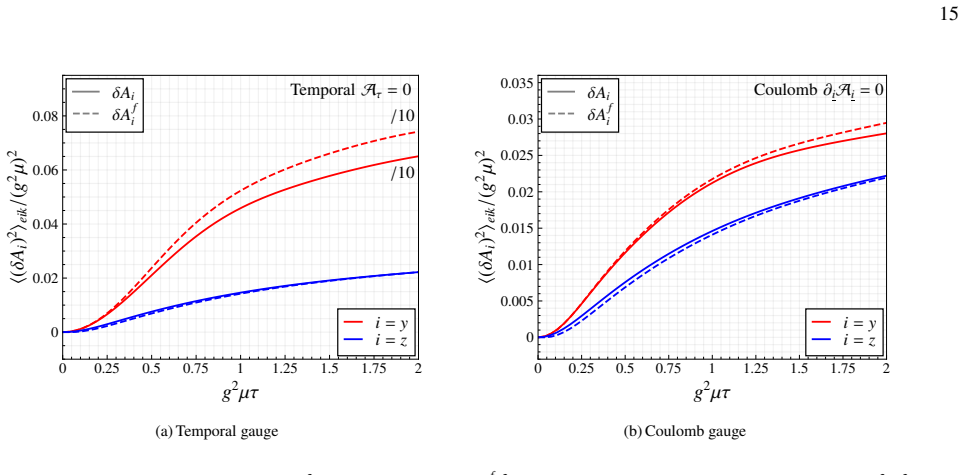
Gauge field evolution along the particle trajectory To study the evolution of the gauge field along the particle trajectory, we relate the change of the gauge potential δAi(τ)≡A i(τ)−A i(0) (55) to the difference between the canonical and kinetic Lorentz forces gδA f i (τ)≡δp i(τ)−δp kin i (τ),(56) using the classical correspondence of the kinetic momentu...
-
[8]
(56), squaring and averaging over color charge configurations as defined in Eq
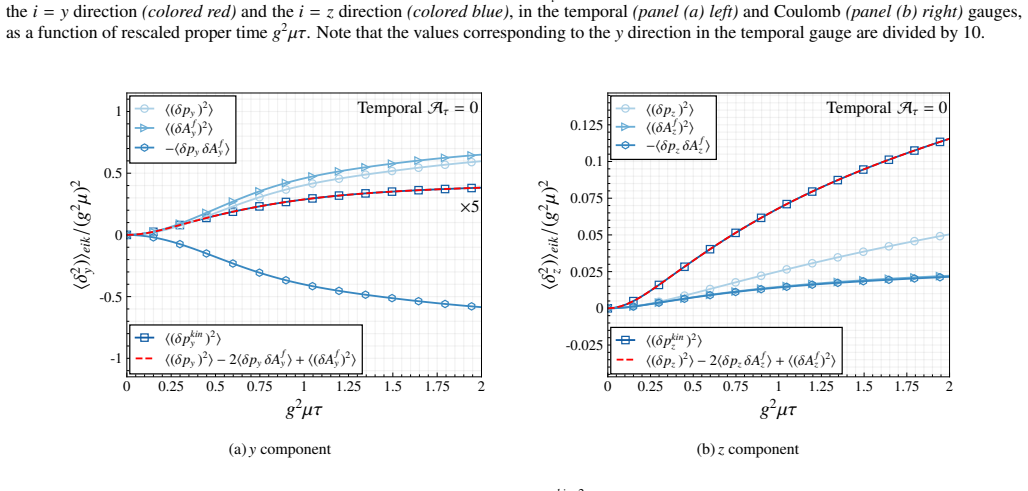
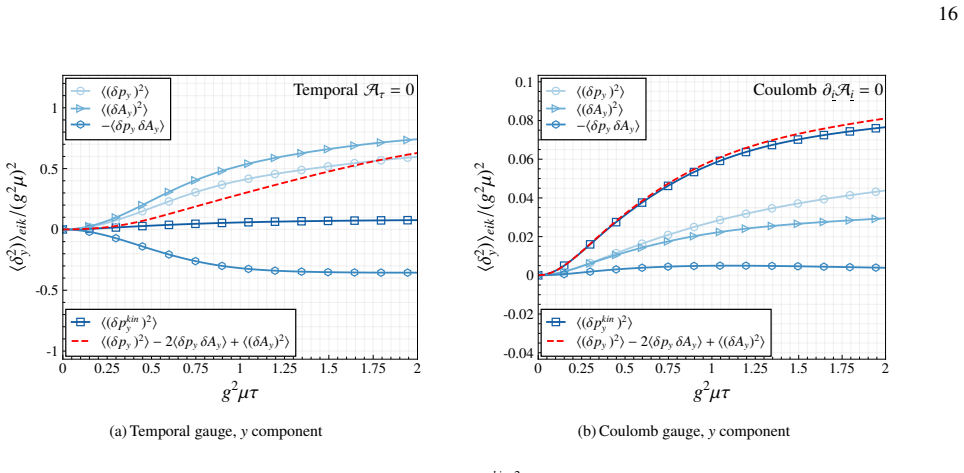
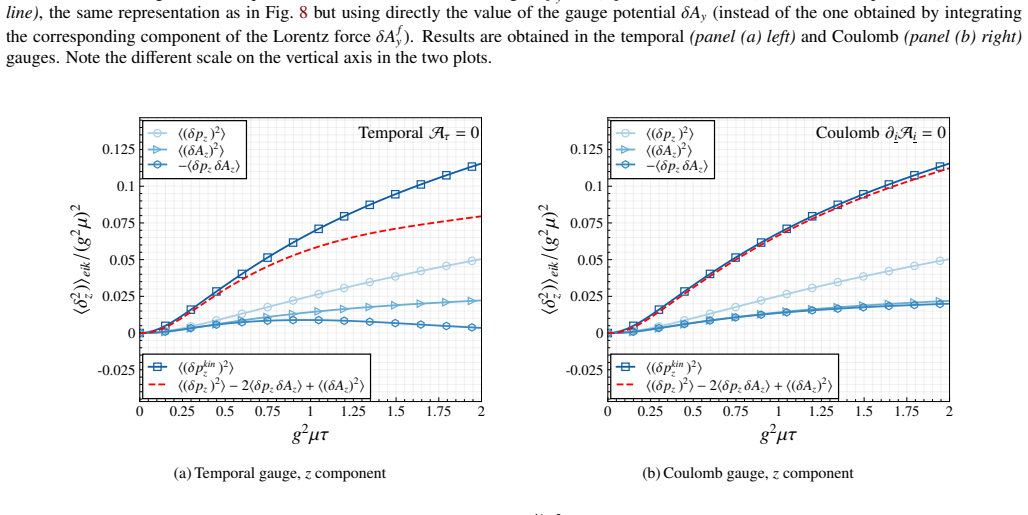
Momentum broadening decomposition By using Eq. (56), squaring and averaging over color charge configurations as defined in Eq. (21) along with the 2-point function given in Eq. (20), as we did to obtain⟨(δp kin i )2⟩Q in Eq. (27), one can derive a relation between the kinetic and canonical momentum broadening ⟨(δpkin i )2⟩Q =⟨(δp i)2⟩Q −2g⟨δp i δA f i ⟩Q ...
-
[9]
Coulomb gauge fixing The Glasma fields are numerically solved in the temporal gaugeA τ =0, but this gauge leaves a residual freedom to perform time independent gauge transformations. In order to optimize numerical efficiency in evaluating the kinetic mo- mentum broadening via Eq. (62), we further impose the trans- verse Coulomb gauge as an initial conditi...
- [10]
-
[11]
T. Lappi and L. McLerran, Nucl. Phys. A772, 200 (2006), arXiv:hep-ph/0602189
work page Pith review arXiv 2006
-
[12]
K. Fukushima and F. Gelis, Nucl. Phys. A874, 108 (2012), arXiv:1106.1396 [hep-ph]
-
[13]
F. Gelis, Int. J. Mod. Phys. A28, 1330001 (2013), arXiv:1211.3327 [hep-ph]
- [14]
-
[15]
Nonlinear Gluon Evolution in the Color Glass Condensate: I
E. Iancu, A. Leonidov, and L. D. McLerran, Nucl. Phys. A692, 583 (2001), arXiv:hep-ph/0011241
work page Pith review arXiv 2001
-
[16]
The Color Glass Condensate and High Energy Scattering in QCD
E. Iancu and R. Venugopalan, “The Color glass condensate and high-energy scattering in QCD,” inQuark-gluon plasma 4, edited by R. C. Hwa and X.-N. Wang (2003) pp. 249–3363, arXiv:hep-ph/0303204
work page Pith review arXiv 2003
-
[17]
F. Gelis, E. Iancu, J. Jalilian-Marian, and R. Venugopalan, Ann. Rev. Nucl. Part. Sci.60, 463 (2010), arXiv:1002.0333 [hep-ph]
work page Pith review arXiv 2010
-
[18]
L. Cunqueiro and A. M. Sickles, Prog. Part. Nucl. Phys.124, 103940 (2022), arXiv:2110.14490 [nucl-ex]
-
[19]
H. van Hees, V . Greco, and R. Rapp, Phys. Rev. C73, 034913 (2006), arXiv:nucl-th/0508055
-
[20]
L. Apolin ´ario, Y .-J. Lee, and M. Winn, Prog. Part. Nucl. Phys. 127, 103990 (2022), arXiv:2203.16352 [hep-ph]
-
[21]
S. K. Wong, Nuovo Cim. A65, 689 (1970)
1970
-
[22]
M. Ruggieri and S. K. Das, Phys. Rev. D98, 094024 (2018), arXiv:1805.09617 [nucl-th]
- [23]
- [24]
- [25]
-
[26]
M. Ruggieri, Pooja, J. Prakash, and S. K. Das, Phys. Rev. D 106, 034032 (2022), arXiv:2203.06712 [hep-ph]
- [27]
- [28]
-
[29]
D. Avramescu, V . Greco, T. Lappi, H. M ¨antysaari, and D. M¨uller, Phys. Rev. D111, 074036 (2025), arXiv:2409.10564 [hep-ph]
-
[30]
D. Avramescu, V . Greco, T. Lappi, H. M ¨antysaari, and D. M ¨uller, Phys. Rev. Lett.134, 172301 (2025), arXiv:2409.10565 [hep-ph]
-
[31]
L. Backfried, K. Boguslavski, and P. Hotzy, Phys. Rev. D110, 114013 (2024), arXiv:2408.12646 [hep-ph]
- [32]
- [33]
- [34]
- [35]
-
[36]
D. Avramescu, V . B ˘aran, V . Greco, A. Ipp, D. I. M ¨uller, and M. Ruggieri, Phys. Rev. D107, 114021 (2023), arXiv:2303.05599 [hep-ph]
-
[37]
M. E. Carrington, B. T. Friesen, and S. Mrowczynski, (2026), arXiv:2604.02050 [nucl-th]
work page internal anchor Pith review Pith/arXiv arXiv 2026
- [38]
- [39]
- [40]
- [41]
- [42]
- [43]
- [44]
-
[45]
P. Romatschke, Phys. Rev. C75, 014901 (2007), arXiv:hep- ph/0607327
-
[46]
Introductory lectures on jet quenching in heavy ion collisions
J. Casalderrey-Solana and C. A. Salgado, Acta Phys. Polon. B 38, 3731 (2007), arXiv:0712.3443 [hep-ph]
work page Pith review arXiv 2007
-
[47]
R. Baier and Y . Mehtar-Tani, Phys. Rev. C78, 064906 (2008), arXiv:0806.0954 [hep-ph]
-
[48]
Transverse Momentum Broadening and the Jet Quenching Parameter, Redux
F. D’Eramo, H. Liu, and K. Rajagopal, Phys. Rev. D84, 065015 (2011), arXiv:1006.1367 [hep-ph]
work page Pith review arXiv 2011
-
[49]
S. Mrowczynski, B. Schenke, and M. Strickland, Phys. Rept. 682, 1 (2017), arXiv:1603.08946 [hep-ph]
-
[50]
S. Hauksson, S. Jeon, and C. Gale, Phys. Rev. C105, 014914 (2022), arXiv:2109.04575 [hep-ph]
- [51]
-
[52]
S. Hauksson and E. Iancu, JHEP08, 027 (2023), arXiv:2303.03914 [hep-ph]
- [53]
-
[54]
A. Dumitru and Y . Nara, Phys. Lett. B621, 89 (2005), arXiv:hep-ph/0503121
-
[55]
A. Dumitru, Y . Nara, and M. Strickland, Phys. Rev. D75, 025016 (2007), arXiv:hep-ph/0604149
-
[56]
A. Dumitru, Y . Nara, B. Schenke, and M. Strickland, Phys. Rev. C78, 024909 (2008), arXiv:0710.1223 [hep-ph]
-
[57]
D. Bodeker and K. Rummukainen, JHEP07, 022 (2007), arXiv:0705.0180 [hep-ph]
- [58]
-
[59]
P. Aurenche and B. G. Zakharov, Phys. Lett. B718, 937 (2013), arXiv:1205.6462 [hep-ph]
work page Pith review arXiv 2013
- [60]
- [61]
- [62]
- [63]
- [64]
- [65]
-
[66]
Bayesian Constraints on Pre-Equilibrium Jet Quenching and Predictions for Oxygen Collisions
D. Pablos and A. Takacs, (2025), arXiv:2509.19430 [hep-ph]
work page internal anchor Pith review Pith/arXiv arXiv 2025
-
[67]
K. Boguslavski, A. Kurkela, T. Lappi, F. Lindenbauer, and 20 J. Peuron, Phys. Rev. D109, 014025 (2024), arXiv:2303.12520 [hep-ph]
- [68]
- [69]
-
[70]
K. Boguslavski, A. Kurkela, T. Lappi, F. Lindenbauer, and J. Peuron, Phys. Lett. B850, 138525 (2024), arXiv:2303.12595 [hep-ph]
-
[71]
K. Boguslavski, A. Kurkela, T. Lappi, F. Lindenbauer, and J. Peuron, Phys. Rev. D110, 034019 (2024), arXiv:2312.00447 [hep-ph]
-
[72]
K. Boguslavski, F. Lindenbauer, A. Mazeliauskas, A. Takacs, and F. Zhou, (2025), arXiv:2510.25669 [hep-ph]
work page internal anchor Pith review arXiv 2025
-
[73]
A. Altenburger, K. Boguslavski, and F. Lindenbauer, (2025), arXiv:2509.03868 [hep-ph]
- [74]
- [75]
-
[76]
I. Danhoni, N. Mullins, and J. Noronha, (2026), arXiv:2603.00844 [hep-ph]
- [77]
-
[78]
Hamiltonian evolution of jets in the glasma phase of heavy-ion collisions,
D. Avramescu, C. Lamas, T. Lappi, M. Li, and C. A. Salgado, “Hamiltonian evolution of jets in the glasma phase of heavy-ion collisions,” (2026), manuscript in preparation
2026
- [79]
-
[80]
L. D. McLerran and R. Venugopalan, Phys. Rev. D49, 2233 (1994), arXiv:hep-ph/9309289
work page Pith review arXiv 1994
discussion (0)
Sign in with ORCID, Apple, or X to comment. Anyone can read and Pith papers without signing in.