Recognition: no theorem link
Light-front Hamiltonian jet evolution in the Glasma
Pith reviewed 2026-05-12 04:50 UTC · model grok-4.3
The pith
A light-front Hamiltonian formalism evolves a high-energy quark through the Glasma and reproduces classical transverse momentum broadening.
A machine-rendered reading of the paper's core claim, the machinery that carries it, and where it could break.
Core claim
The central claim is that evolving the quark state under the light-front Hamiltonian in the presence of classical time-dependent Glasma fields yields a transverse momentum broadening and a jet quenching parameter that are consistent with classical estimates, including the expected scaling with the saturation momentum, while also generating a gauge-dependent color rotation of the quark.
What carries the argument
Light-front Hamiltonian evolution of the quark wave function in a discrete basis under a time-dependent external potential supplied by the Glasma fields.
If this is right
- Transverse momentum broadening grows with the saturation momentum of the Glasma in the manner expected from classical field theory.
- The jet quenching parameter extracted from the evolution can be used to make estimates for different collision systems.
- The quark acquires a color rotation whose strength depends on the saturation scale and the chosen gauge.
- The same framework provides a systematic route to include non-eikonal propagation and parton splittings in later calculations.
Where Pith is reading between the lines
- The method could be applied to gluon jets to test whether the same classical scaling survives when the propagating particle carries adjoint color charge.
- Comparing the computed broadening to data from proton-nucleus collisions would isolate the contribution of the Glasma from other nuclear effects.
- The observed gauge dependence of color rotation indicates that fully gauge-invariant operators will be needed once gluon emission is restored.
- Phenomenological use of the quenching parameter for different beam energies could help map the transition region where quantum branching becomes important.
Load-bearing premise
The quark is kept in the single-particle sector with no gluon emission allowed, and the Glasma is treated as a fixed classical background.
What would settle it
A precision measurement of jet transverse momentum broadening in heavy-ion collisions that shows a dependence on the saturation momentum differing from the one obtained in this evolution would falsify the reported consistency with classical estimates.
Figures


read the original abstract
We develop a light-front Hamiltonian formalism to study the real-time quantum evolution of a high-energy quark propagating through the Glasma phase of a heavy-ion collision. In this work, the quark Fock space is truncated to the $\ket{q}$ sector and the wavefunction is expanded in a discrete basis representation, following the time-dependent Basis Light-Front Quantization (tBLFQ) framework. The classical Glasma background fields enter as a time-dependent external potential, and physical observables are extracted as expectation values of quantum operators over the time-evolved state. We compute the transverse momentum broadening and the jet quenching parameter, finding results consistent with classical estimates, including the expected scaling with respect to the saturation momentum, and use them to perform phenomenological estimations for different collision systems. We also study the color rotation of the quark state induced by the Glasma fields, and examine its dependence on the saturation scale and the gauge choice. This formalism allows systematic improvements to include, in particular, non-eikonal propagation and parton splittings that will be considered in forthcoming publications.
Editorial analysis
A structured set of objections, weighed in public.
Referee Report
Summary. The manuscript develops a light-front Hamiltonian formalism based on time-dependent Basis Light-Front Quantization (tBLFQ) to study the real-time evolution of a high-energy quark propagating through the Glasma. The quark Fock space is truncated to the single-particle |q> sector, the Glasma enters as a classical time-dependent external potential, and observables are computed as expectation values over the time-evolved state. The authors extract the transverse momentum broadening and jet quenching parameter, report consistency with classical estimates including the expected scaling with saturation momentum Q_s, perform phenomenological estimates for different collision systems, and examine the induced color rotation and its dependence on Q_s and gauge choice.
Significance. If the numerical results hold, the work supplies a controlled quantum framework for jet propagation in the Glasma that is systematically improvable toward non-eikonal effects and parton splittings. The light-front Hamiltonian approach with discrete basis expansion offers a concrete route to real-time evolution that complements classical Yang-Mills simulations, and the reported scaling checks and phenomenological estimates provide immediate contact with heavy-ion phenomenology.
major comments (2)
- [§3.2] §3.2 (Observables): the jet quenching parameter is extracted from the time-evolved single-quark state via the relation to <p_T^2>/L; because the background is strictly classical and the Fock space is restricted to |q>, this quantity reduces by construction to the classical color rotation plus momentum kick, so the reported consistency does not constitute an independent test of the quantum formalism.
- [§4.1] §4.1 (Numerical results): the scaling of broadening with Q_s is asserted to match classical expectations, yet no explicit ratio, fit exponent, or uncertainty band is provided; without these, it is impossible to judge whether the discrete-basis evolution reproduces the analytic Q_s^2 scaling to within controlled numerical error.
minor comments (3)
- [Abstract] The abstract states consistency with classical results but supplies neither numerical values nor error estimates; adding a sentence with the extracted <p_T^2>/Q_s^2 ratio and its uncertainty would strengthen the claim.
- [Figure 7] Figure captions for the color-rotation plots should explicitly state the gauge (light-cone or Coulomb) and the precise definition of the color vector used in the expectation value.
- [§2.3] Reference to the original tBLFQ papers is present but the discretization parameters (basis size, time-step size, infrared cutoff) used for the Glasma evolution are only summarized; a short table listing these choices for each Q_s run would improve reproducibility.
Simulated Author's Rebuttal
We thank the referee for the careful reading of our manuscript and the constructive comments. We address the two major comments point by point below. Both points are well taken, and we will revise the manuscript accordingly to improve clarity and provide the requested quantitative details.
read point-by-point responses
-
Referee: [§3.2] §3.2 (Observables): the jet quenching parameter is extracted from the time-evolved single-quark state via the relation to <p_T^2>/L; because the background is strictly classical and the Fock space is restricted to |q>, this quantity reduces by construction to the classical color rotation plus momentum kick, so the reported consistency does not constitute an independent test of the quantum formalism.
Authors: We agree that, given the truncation to the single-particle |q> sector and the use of a classical time-dependent background, the extracted jet quenching parameter is equivalent to the classical momentum kick arising from color precession. The reported consistency therefore validates the numerical implementation of the tBLFQ time evolution in this limit rather than testing genuinely quantum corrections. The manuscript already states that the present truncation is the initial step toward systematic extensions that will incorporate parton splittings and non-eikonal effects. We will revise the text in §3.2 to explicitly note that the current results test the classical limit of the formalism. revision: yes
-
Referee: [§4.1] §4.1 (Numerical results): the scaling of broadening with Q_s is asserted to match classical expectations, yet no explicit ratio, fit exponent, or uncertainty band is provided; without these, it is impossible to judge whether the discrete-basis evolution reproduces the analytic Q_s^2 scaling to within controlled numerical error.
Authors: We acknowledge that a quantitative characterization of the scaling would allow a clearer assessment of numerical accuracy. In the revised manuscript we will include a power-law fit to the transverse-momentum broadening versus Q_s, reporting the extracted exponent together with uncertainty estimates obtained from the discrete-basis data. This will demonstrate that the numerical results reproduce the expected Q_s^2 scaling within the controlled errors of the calculation. revision: yes
Circularity Check
No significant circularity detected
full rationale
The paper computes transverse momentum broadening and the jet quenching parameter as expectation values of operators on the time-evolved single-quark state in a truncated Fock space with a classical Glasma background. These quantities are extracted directly from the Hamiltonian evolution and then compared to independent classical estimates in the literature, including their scaling with the saturation scale Q_s. No step reduces a claimed prediction to a fitted input by construction, no self-citation is load-bearing for the central observables, and the truncation is stated explicitly rather than smuggled in. The derivation chain is therefore self-contained against external benchmarks.
Axiom & Free-Parameter Ledger
axioms (2)
- domain assumption Fock space truncated to the single-quark |q> sector
- domain assumption Glasma background treated as classical time-dependent external potential
Reference graph
Works this paper leans on
-
[1]
The quark propagation Hamiltonian The Lagrangian that describes the evolution of the quark fermion field (Ψ) in the presence of a classical external gluon field (A µ) can be derived from the Dirac Lagrangian using minimal coupling, where the covariant derivative is modified as∂ µ → D µ =∂ µ +igA µ withA µ =A a µta. As an ini- tial investigation, we trunca...
-
[2]
Basis representation We employ a basis representation to construct the Hilbert space of the system and to perform the time evolution. We choose the eigenstates of the kinetic energy part of the free Hamiltonian as the basis states|β⟩, so that the basis retains the same symmetries as the free theory m2 + ⃗p2 ⊥ p+ |β⟩=P − β |β⟩.(39) Each basis state is labe...
-
[3]
Time evolution The evolution of the jet as a quantum state obeys the time- dependent Schr¨odinger equation on the light front i ∂ ∂x+ |ψ,x +⟩= 1 2 P−(x+)|ψ;x +⟩.(42) The solution of the evolved state can be written as |ψ;x +⟩=U(x +; 0)|ψ; 0⟩,(43) with the unitary evolution operator defined as U(x + f ;x + i )=T + exp − i 2 Z x+ f x+ i dx+P−(x+) ...
-
[4]
Direct quantum calculation The expectation value of the momentum broadening opera- tor defined in Eq. (54) can be evaluated equivalently in either the Heisenberg or Sch¨odinger picture, ⟨(δpkin i (x+))2⟩ψ =H ⟨ψ|(δpkin i (x+))2 H|ψ⟩H =⟨ψ;x +|(δpkin i (x+))2|ψ;x +⟩. (56) We adopt the latter formulation here. Expanding the square in Eq. (54), three terms con...
-
[5]
Lorentz force calculation An alternative approach to evaluating the momentum broadening operator is to compute the change rate of the trans- verse kinetic momentum and then integrate this operator over the evolution time ⟨(δpkin i (x+))2⟩ψ = Z x+ 0 ds+ Z x+ 0 d ¯s+ × H⟨ψ| dp kin i,H (s+) ds+ dp kin i,H ( ¯s+) d ¯s+ |ψ⟩H .(64) which provides a direct corre...
-
[6]
− z2 2σ2z # =0,(75a) Z ∞ −∞ dz z2 (2πσ2z )1/2 exp
Delocalization effects: Abelian toy-model In this section, we explore how the finite spatial extent of the jet in transverse space affects momentum broadening. We start from the Lorentz force components in Eq. (70), but in- stead of treating the jet as a perfectly localized delta function, we consider a Gaussian wave packet |ψ⟩= 1 (2πσ2y)1/4 1 (2πσ2z )1/4...
-
[7]
Dependence on the IR regulator We consider three values of the charge densityg 2µ= 1.33 GeV, 2 GeV and 2.5 GeV and two values of the IR reg- ulator,m g =0 GeV and 0.2 GeV. The lattice transverse size L⊥ is adjusted accordingly to keepg 2µL⊥ =100 fixed, while N⊥ =1024 is held constant. The saturation scaleQ s for each parameter setup is estimated using the...
-
[8]
Phenomenological estimates The obtained values of ˆqcan be used to parametrically esti- mate the energy loss during the Glasma phase and to compare to the energy loss in the QGP phase. We here recall that the BDMPS-Z picture of independent soft scatterings is not well suited for the Glasma, so the results in this section must be un- derstood as an educate...
-
[9]
The Glasma fields are derived in the tempo- ral gaugeA τ =0
Gauge dependence We begin by studying how the color rotation depends on the gauge choice. The Glasma fields are derived in the tempo- ral gaugeA τ =0. In all previous sections, we have used the residual gauge freedom to additionally impose the transverse Coulomb gauge condition∂ iAi =0, withi ∈ {x,y}, as this choice reduces the magnitude of the background...
-
[10]
Saturation scale dependence We next examine how the color rotation depends on the Glasma model parameters, in particular on the saturation scale Qs. We work in the temporal gauge, where the color rota- tion is more pronounced and therefore more sensitive to the background field parameters. Withm g =0, the saturation scale is the only dimensionful scale of...
-
[11]
They are convenient for describing the evolution of the boost-invariant Glasma
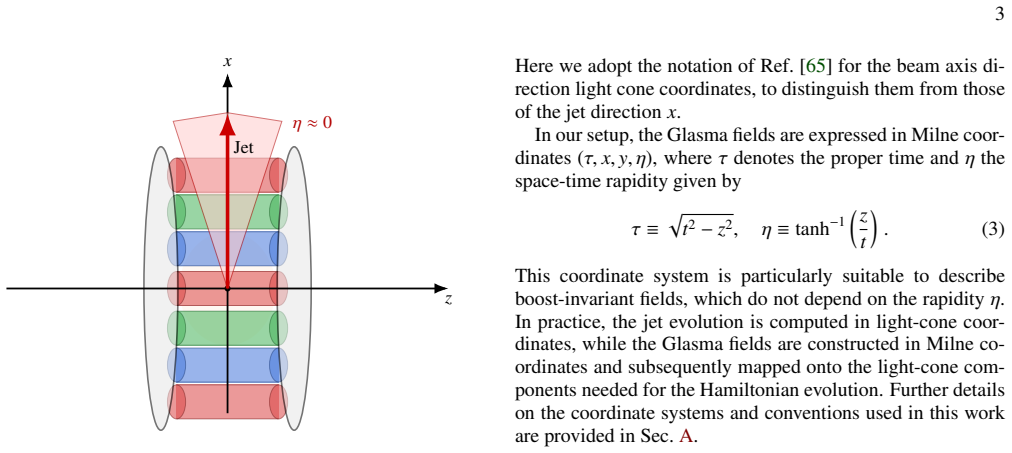
Milne coordinates The Milne coordinates arex µ (M) =(τ,x,y, η), whereτis the proper time andηthe space-time rapidity. They are convenient for describing the evolution of the boost-invariant Glasma. They are related to the Minkowski coordinates by τ= p t2 −z 2 , η=tanh −1(z/t),(A1) or the inverse relation t=τcoshη ,z=τsinhη .(A2) The metric tensor can be o...
-
[12]
Jet light-cone coordinates We define the light-cone coordinates of the jet asx µ = (x+,x −,y,z), where x± =t±x.(A6) In our setup, the jet propagates ultra-relativistically along the positivex-direction. Accordingly, its light-front time is iden- tified withx +, whilex − serves as the longitudinal spatial di- rection. In analogy to using Eq. (A3), we find ...
-
[13]
Beam light-cone coordinates We define the light-cone coordinates of the nuclei, propa- gating alongzdirection, asx •∗ =(x •,x,y,x ∗), where x• =t+z x ∗ =t−z.(A10) The metric tensor and vector transformations are identical to those in the jet light-cone coordinate system under thex↔z exchange. Appendix B: Quantum many-body representation of the light-front...
- [14]
-
[15]
Introductory lectures on jet quenching in heavy ion collisions
J. Casalderrey-Solana and C. A. Salgado, Acta Phys. Polon. B 38, 3731 (2007), arXiv:0712.3443 [hep-ph]
work page Pith review arXiv 2007
-
[16]
A. Majumder and M. Van Leeuwen, Prog. Part. Nucl. Phys. 66, 41 (2011), arXiv:1002.2206 [hep-ph]
-
[17]
Jet physics in heavy-ion collisions
Y . Mehtar-Tani, J. G. Milhano, and K. Tywoniuk, Int. J. Mod. Phys. A28, 1340013 (2013), arXiv:1302.2579 [hep-ph]
work page Pith review arXiv 2013
-
[18]
Jet quenching and medium response in high-energy heavy-ion collisions: a review
S. Cao and X.-N. Wang, Rept. Prog. Phys.84, 024301 (2021), arXiv:2002.04028 [hep-ph]
-
[19]
L. Apolin ´ario, Y .-J. Lee, and M. Winn, Prog. Part. Nucl. Phys. 127, 103990 (2022), arXiv:2203.16352 [hep-ph]
-
[20]
G. Aadet al.(ATLAS), Phys. Rev. Lett.105, 252303 (2010), arXiv:1011.6182 [hep-ex]
-
[21]
L. Adamczyket al.(STAR), Phys. Rev. Lett.119, 062301 (2017), arXiv:1609.03878 [nucl-ex]
-
[22]
S. Chatrchyanet al.(CMS), Eur. Phys. J. C72, 1945 (2012), arXiv:1202.2554 [nucl-ex]
-
[23]
K. Adcoxet al.(PHENIX), Phys. Rev. Lett.88, 022301 (2002), arXiv:nucl-ex/0109003
work page Pith review arXiv 2002
- [24]
-
[25]
T. Lappi and L. McLerran, Nucl. Phys. A772, 200 (2006), arXiv:hep-ph/0602189
work page Pith review arXiv 2006
-
[26]
K. Fukushima and F. Gelis, Nucl. Phys. A874, 108 (2012), arXiv:1106.1396 [hep-ph]
-
[27]
F. Gelis, Int. J. Mod. Phys. A28, 1330001 (2013), arXiv:1211.3327 [hep-ph]
- [28]
-
[29]
S. Caoet al.(JETSCAPE), Phys. Rev. C104, 024905 (2021), arXiv:2102.11337 [nucl-th]
- [30]
- [31]
- [32]
-
[33]
D. Avramescu, V . B ˘aran, V . Greco, A. Ipp, D. I. M ¨uller, and M. Ruggieri, Phys. Rev. D107, 114021 (2023), arXiv:2303.05599 [hep-ph]
-
[34]
K. Boguslavski, A. Kurkela, T. Lappi, F. Lindenbauer, and J. Peuron, Phys. Rev. D109, 014025 (2024), arXiv:2303.12520 [hep-ph]
-
[35]
K. Boguslavski, A. Kurkela, T. Lappi, F. Lindenbauer, and J. Peuron, Phys. Lett. B850, 138525 (2024), arXiv:2303.12595 [hep-ph]
-
[36]
K. Boguslavski, A. Kurkela, T. Lappi, F. Lindenbauer, and J. Peuron, Phys. Rev. D110, 034019 (2024), arXiv:2312.00447 [hep-ph]
-
[37]
A. Altenburger, K. Boguslavski, and F. Lindenbauer, (2025), arXiv:2509.03868 [hep-ph]
- [38]
-
[39]
Jet quenching as a probe of the initial stages in heavy-ion collisions
C. Andres, N. Armesto, H. Niemi, R. Paatelainen, and C. A. Salgado, Phys. Lett. B803, 135318 (2020), arXiv:1902.03231 [hep-ph]
- [40]
- [41]
-
[42]
Bayesian Constraints on Pre-Equilibrium Jet Quenching and Predictions for Oxygen Collisions
D. Pablos and A. Takacs, (2025), arXiv:2509.19430 [hep-ph]
work page internal anchor Pith review Pith/arXiv arXiv 2025
- [43]
- [44]
-
[45]
M. E. Carrington, B. T. Friesen, and S. Mrowczynski, (2026), arXiv:2604.02050 [nucl-th]
work page internal anchor Pith review Pith/arXiv arXiv 2026
-
[46]
M. Ruggieri and S. K. Das, Phys. Rev. D98, 094024 (2018), arXiv:1805.09617 [nucl-th]
- [47]
- [48]
- [49]
-
[50]
M. Ruggieri, Pooja, J. Prakash, and S. K. Das, Phys. Rev. D 106, 034032 (2022), arXiv:2203.06712 [hep-ph]
- [51]
- [52]
-
[53]
D. Avramescu, V . Greco, T. Lappi, H. M ¨antysaari, and D. M ¨uller, Phys. Rev. D111, 074036 (2025), arXiv:2409.10564 [hep-ph]
-
[54]
D. Avramescu, V . Greco, T. Lappi, H. M ¨antysaari, and D. M ¨uller, Phys. Rev. Lett.134, 172301 (2025), arXiv:2409.10565 [hep-ph]
-
[55]
L. Backfried, K. Boguslavski, and P. Hotzy, Phys. Rev. D110, 114013 (2024), arXiv:2408.12646 [hep-ph]
- [56]
-
[57]
F. Gelis, K. Kajantie, and T. Lappi, Phys. Rev. C71, 024904 (2005), arXiv:hep-ph/0409058
work page internal anchor Pith review arXiv 2005
- [58]
-
[59]
F. Gelis and N. Tanji, JHEP02, 126 (2016), arXiv:1506.03327 [hep-ph]
-
[60]
N. Tanji and J. Berges, Phys. Rev. D97, 034013 (2018), arXiv:1711.03445 [hep-ph]
-
[61]
S. J. Brodsky, H.-C. Pauli, and S. S. Pinsky, Phys. Rept.301, 299 (1998), arXiv:hep-ph/9705477
work page Pith review arXiv 1998
-
[62]
S. J. Brodsky, G. F. de Teramond, H. G. Dosch, and J. Erlich, Phys. Rept.584, 1 (2015), arXiv:1407.8131 [hep-ph]
work page Pith review arXiv 2015
-
[63]
J. P. Vary, C. Mondal, S. Xu, X. Zhao, and Y . Li, (2025), 10.1140/epjs/s11734-025-02084-y, arXiv:2512.08283 [hep-ph]
- [64]
- [65]
- [66]
- [67]
- [68]
- [69]
- [70]
- [71]
- [72]
- [73]
- [74]
- [75]
-
[76]
Li, PoSLHCP2024, 105 (2025), arXiv:2411.01318 [nucl- th]
M. Li, PoSLHCP2024, 105 (2025), arXiv:2411.01318 [nucl- th]
-
[77]
Kinetic and canonical momentum broadening in the Glasma
D. Avramescu, C. Lamas, T. Lappi, M. Li, and C. A. Salgado, (2026), arXiv:2604.08520 [hep-ph]
work page internal anchor Pith review Pith/arXiv arXiv 2026
- [78]
-
[79]
The Color Glass Condensate and High Energy Scattering in QCD
E. Iancu and R. Venugopalan, “The Color glass condensate and high-energy scattering in QCD,” inQuark-gluon plasma 4, edited by R. C. Hwa and X.-N. Wang (2003) pp. 249–3363, arXiv:hep-ph/0303204
work page Pith review arXiv 2003
-
[80]
F. Gelis, E. Iancu, J. Jalilian-Marian, and R. Venugopalan, Ann. Rev. Nucl. Part. Sci.60, 463 (2010), arXiv:1002.0333 [hep-ph]
work page Pith review arXiv 2010
discussion (0)
Sign in with ORCID, Apple, or X to comment. Anyone can read and Pith papers without signing in.