Recognition: 2 theorem links
· Lean TheoremPSI: Shared State as the Missing Layer for Coherent AI-Generated Instruments in Personal AI Agents
Pith reviewed 2026-05-10 16:53 UTC · model grok-4.3
The pith
Shared state architecture integrates independently generated AI modules into coherent personal environments.
A machine-rendered reading of the paper's core claim, the machinery that carries it, and where it could break.
Core claim
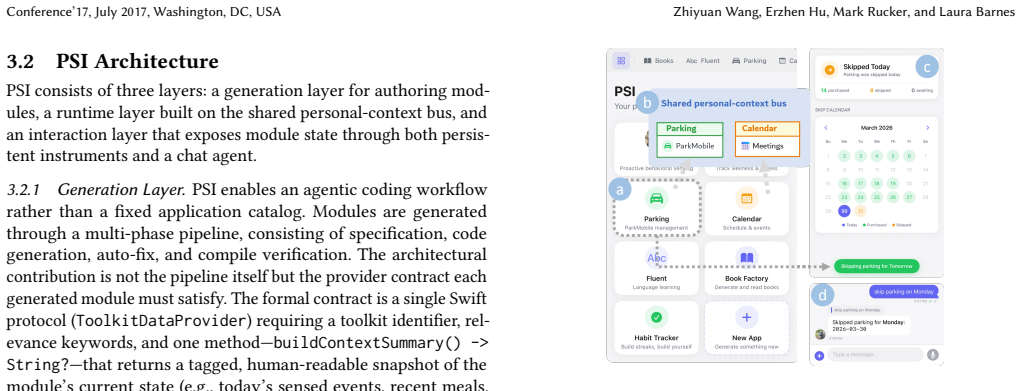
By defining a contract where each module exposes its current state and affordances on a shared personal-context bus, PSI enables AI-generated instruments to become persistent, connected, and complementary to chat interfaces, allowing automatic integration of subsequent modules without additional engineering.
What carries the argument
The personal-context bus, which serves as the shared state layer for publishing current state and write-back affordances to enable cross-module interactions.
If this is right
- Modules gain the ability to perform cross-module reasoning and synchronized actions.
- Instruments remain accessible through both dedicated GUIs and a generic chat agent.
- Newly generated instruments integrate automatically into the existing environment.
- AI-generated personal software shifts from isolated applications to coherent computing environments.
Where Pith is reading between the lines
- Broader adoption could lead to standardized interfaces for state sharing in personal AI ecosystems.
- Similar architectures might apply to collaborative or multi-agent systems beyond personal use.
- Developers of personal AI tools could focus on module logic rather than integration concerns.
- Long-term use might reveal patterns in how state evolves across many instruments.
Load-bearing premise
A single three-week autobiographical deployment suffices to show that the shared-state contract enables automatic integration for general users and environments.
What would settle it
If a newly generated instrument in a different setup does not automatically publish to and read from the shared bus to integrate with prior modules, the automatic integration claim would be falsified.
Figures



read the original abstract
Personal AI tools can now be generated from natural-language requests, but they often remain isolated after creation. We present PSI, a shared-state architecture that turns independently generated modules into coherent instruments: persistent, connected, and chat-complementary artifacts accessible through both GUIs and a generic chat agent. By publishing current state and write-back affordances to a shared personal-context bus, modules enable cross-module reasoning and synchronized actions across interfaces. We study PSI through a three-week autobiographical deployment in a self-developed personal AI environment and show that later-generated instruments can be integrated automatically through the same contract. PSI identifies shared state as the missing systems layer that transforms AI-generated personal software from isolated apps into coherent personal computing environments.
Editorial analysis
A structured set of objections, weighed in public.
Referee Report
Summary. The paper presents PSI, a shared-state architecture for personal AI agents that enables independently generated modules to function as coherent instruments. By publishing current state and write-back affordances to a shared personal-context bus, modules support cross-module reasoning, synchronized actions, and accessibility via both GUIs and chat agents. The central claim is that this shared-state contract transforms isolated AI-generated personal software into persistent, connected computing environments, as evidenced by automatic integration of later-generated instruments in a three-week autobiographical deployment within a self-developed personal AI environment.
Significance. If the result holds, PSI could address fragmentation in AI-generated personal tools by supplying a missing systems layer for coherence and integration, with relevance to HCI research on personal agents and end-user programming. The emphasis on a contract-based approach for state sharing offers a concrete architectural proposal that could inform future agent platforms.
major comments (2)
- [Deployment Study / Evaluation] The evaluation consists solely of qualitative autobiographical observations from a three-week deployment in the authors' self-developed environment, with no quantitative metrics, error analysis, failure cases, baseline comparisons (e.g., identical generation workflow without the shared-state layer), or replication outside the author's stack. This leaves the claim that the shared-state contract enables automatic cross-module integration vulnerable to author-specific implementation details and selection biases.
- [Abstract and Claims] The generalization that later-generated instruments integrate automatically through the same contract is supported only by the single self-reported case; the manuscript does not address how the approach would perform with different base agents, generation processes, or user contexts, undermining the broader assertion that shared state is the 'missing layer' for coherent personal computing environments.
minor comments (1)
- [Introduction / Architecture] The abstract and introduction use terms such as 'personal-context bus' and 'write-back affordances' without an early, precise definition or diagram; adding a dedicated subsection or figure in the architecture description would improve clarity.
Simulated Author's Rebuttal
We thank the referee for the constructive feedback on our manuscript. We address each major comment below, acknowledging the limitations of our evaluation while defending the value of the autobiographical deployment as an initial demonstration of the PSI architecture.
read point-by-point responses
-
Referee: [Deployment Study / Evaluation] The evaluation consists solely of qualitative autobiographical observations from a three-week deployment in the authors' self-developed environment, with no quantitative metrics, error analysis, failure cases, baseline comparisons (e.g., identical generation workflow without the shared-state layer), or replication outside the author's stack. This leaves the claim that the shared-state contract enables automatic cross-module integration vulnerable to author-specific implementation details and selection biases.
Authors: We agree that the evaluation is limited to qualitative observations from a single autobiographical deployment and lacks quantitative metrics, baselines, or external replication. This was a deliberate choice to capture longitudinal, real-world integration behavior in a personal context that controlled studies cannot easily replicate. We will revise the manuscript to explicitly discuss observed failure modes, selection biases, and the exploratory nature of the study, while adding a dedicated limitations section and outlining future controlled experiments with baselines. revision: partial
-
Referee: [Abstract and Claims] The generalization that later-generated instruments integrate automatically through the same contract is supported only by the single self-reported case; the manuscript does not address how the approach would perform with different base agents, generation processes, or user contexts, undermining the broader assertion that shared state is the 'missing layer' for coherent personal computing environments.
Authors: The paper frames PSI as an architectural contract demonstrated through one extended case, not as a universally validated solution. We will revise the abstract and conclusion to qualify the 'missing layer' claim as a hypothesis grounded in the observed automatic integration, and we will add discussion of how the contract could transfer to other agents while noting the need for broader validation across contexts. revision: partial
- We cannot supply quantitative metrics, error analysis, or baseline comparisons without new experiments outside the current scope.
- Replication with different base agents or user stacks is not possible in this revision as it requires external environments and participants.
Circularity Check
No significant circularity in the derivation chain
full rationale
The paper proposes the PSI shared-state architecture as a systems layer for coherent AI-generated instruments and validates it via a three-week autobiographical deployment in the authors' self-developed environment. No equations, formal derivations, fitted parameters, or predictions appear in the provided text. The central claim that the shared-state contract enables automatic cross-module integration does not reduce by construction to any input; it is presented as an observed outcome of the proposed contract rather than a self-definitional or statistically forced result. No load-bearing self-citations, uniqueness theorems, or ansatzes imported from prior author work are invoked. The argument remains self-contained as an architectural proposal grounded in direct experience.
Axiom & Free-Parameter Ledger
Lean theorems connected to this paper
-
IndisputableMonolith/Foundation/RealityFromDistinction.leanreality_from_one_distinction unclear?
unclearRelation between the paper passage and the cited Recognition theorem.
By publishing current state and write-back affordances to a shared personal-context bus, modules enable cross-module reasoning and synchronized actions across interfaces.
-
IndisputableMonolith/Cost/FunctionalEquation.leanwashburn_uniqueness_aczel unclear?
unclearRelation between the paper passage and the cited Recognition theorem.
The formal contract is a single Swift protocol (ToolkitDataProvider) requiring ... buildContextSummary()
What do these tags mean?
- matches
- The paper's claim is directly supported by a theorem in the formal canon.
- supports
- The theorem supports part of the paper's argument, but the paper may add assumptions or extra steps.
- extends
- The paper goes beyond the formal theorem; the theorem is a base layer rather than the whole result.
- uses
- The paper appears to rely on the theorem as machinery.
- contradicts
- The paper's claim conflicts with a theorem or certificate in the canon.
- unclear
- Pith found a possible connection, but the passage is too broad, indirect, or ambiguous to say the theorem truly supports the claim.
Reference graph
Works this paper leans on
-
[1]
OpenClaw: An Open-Source Framework for Personal AI Agents
2025. OpenClaw: An Open-Source Framework for Personal AI Agents. https: //github.com/openclaw/openclaw
2025
-
[2]
Anthropic. 2025. Claude Code: Anthropic’s Agentic Coding Tool. https://docs. anthropic.com/en/docs/claude-code
2025
-
[3]
Michel Beaudouin-Lafon. 2000. Instrumental Interaction: An Interaction Model for Designing Post-WIMP User Interfaces. InProceedings of the SIGCHI Conference on Human Factors in Computing Systems (CHI ’00). 446–453. doi:10.1145/332040. 332473
-
[4]
Yining Cao, Peiling Jiang, and Haijun Xia. 2025. Generative and Malleable User Interfaces with Generative and Evolving Task-Driven Data Model. InProceedings of the 2025 CHI Conference on Human Factors in Computing Systems (CHI ’25). Article 686, 20 pages. doi:10.1145/3706598.3713285
-
[5]
Lee, Bongshin Lee, Wanda Pratt, and Julie A
Eun Kyoung Choe, Nicole B. Lee, Bongshin Lee, Wanda Pratt, and Julie A. Kientz
-
[6]
Understanding quantified-selfers’ practices in collecting and exploring personal data. InProceedings of the SIGCHI Conference on Human Factors in Com- puting Systems(Toronto, Ontario, Canada)(CHI ’14). Association for Computing Machinery, New York, NY, USA, 1143–1152. doi:10.1145/2556288.2557372
-
[7]
Akshat Choube, Ha Le, Jiachen Li, Kaixin Ji, Vedant Das Swain, and Varun Mishra
-
[8]
GLOSS: Group of LLMs for Open-ended Sensemaking of Passive Sensing Data for Health and Wellbeing.Proc. ACM Interact. Mob. Wearable Ubiquitous Technol.9, 3, Article 76 (Sept. 2025), 32 pages. doi:10.1145/3749474
-
[9]
Audrey Desjardins and Aubree Ball. 2018. Revealing Tensions in Autobiographical Design in HCI. InProceedings of the 2018 Designing Interactive Systems Conference (Hong Kong, China)(DIS ’18). Association for Computing Machinery, New York, NY, USA, 753–764. doi:10.1145/3196709.3196781
-
[10]
Anind K. Dey. 2001. Understanding and Using Context.Personal Ubiquitous Comput.5, 1 (Jan. 2001), 4–7. doi:10.1007/s007790170019
-
[11]
Daniel A. Epstein, An Ping, James Fogarty, and Sean A. Munson. 2015. A lived informatics model of personal informatics. InProceedings of the 2015 ACM Interna- tional Joint Conference on Pervasive and Ubiquitous Computing(Osaka, Japan)(Ubi- Comp ’15). Association for Computing Machinery, New York, NY, USA, 731–742. doi:10.1145/2750858.2804250
-
[12]
Bill Gaver, Tony Dunne, and Elena Pacenti. 1999. Design: Cultural probes.Inter- actions6, 1 (Jan. 1999), 21–29. doi:10.1145/291224.291235
-
[13]
William W. Gaver. 2012. What Should We Expect from Research Through Design?. InProceedings of the SIGCHI Conference on Human Factors in Computing Systems (CHI ’12). 937–946. doi:10.1145/2207676.2208538
-
[14]
GitHub. 2021. GitHub Copilot. https://github.com/features/copilot
2021
-
[15]
Saul Greenberg and Bill Buxton. 2008. Usability Evaluation Considered Harmful (Some of the Time). InProceedings of the SIGCHI Conference on Human Factors in Computing Systems. 111–120. doi:10.1145/1357054.1357074
-
[16]
Eric Horvitz. 1999. Principles of mixed-initiative user interfaces. InProceedings of the SIGCHI Conference on Human Factors in Computing Systems(Pittsburgh, Pennsylvania, USA)(CHI ’99). Association for Computing Machinery, New York, NY, USA, 159–166. doi:10.1145/302979.303030
-
[17]
Hilary Hutchinson, Wendy Mackay, Bo Westerlund, Benjamin B. Bederson, Al- lison Druin, Catherine Plaisant, Michel Beaudouin-Lafon, Stéphane Conversy, Helen Evans, Heiko Hansen, Nicolas Roussel, and Björn Eiderbäck. 2003. Technol- ogy probes: inspiring design for and with families. InProceedings of the SIGCHI Conference on Human Factors in Computing System...
-
[18]
Peiling Jiang, Jude Rayan, Steven P. Dow, and Haijun Xia. 2023. Graphologue: Exploring Large Language Model Responses with Interactive Diagrams. InPro- ceedings of the 36th Annual ACM Symposium on User Interface Software and Technology(San Francisco, CA, USA)(UIST ’23). Association for Computing Machinery, New York, NY, USA, Article 3, 20 pages. doi:10.11...
-
[19]
Daniel R. Olsen Jr. 2007. Evaluating User Interface Systems Research. InProceed- ings of the 20th Annual ACM Symposium on User Interface Software and Technology. 251–258. doi:10.1145/1294211.1294256
-
[20]
Young-Ho Kim, Bongshin Lee, Arjun Srinivasan, and Eun Kyoung Choe. 2021. Data@Hand: Fostering Visual Exploration of Personal Data on Smartphones Leveraging Speech and Touch Interaction. InProceedings of the 2021 CHI Con- ference on Human Factors in Computing Systems(Yokohama, Japan)(CHI ’21). Association for Computing Machinery, New York, NY, USA, Article...
-
[21]
Andrew J. Ko, Robin Abraham, Laura Beckwith, Alan Blackwell, Margaret Burnett, Martin Erwig, Chris Scaffidi, Joseph Lawrance, Henry Lieberman, Brad Myers, Mary Beth Rosson, Gregg Rothermel, Mary Shaw, and Susan Wiedenbeck. 2011. The State of the Art in End-User Software Engineering.Comput. Surveys43, 3, Article 21 (2011). doi:10.1145/1922649.1922658
-
[22]
David Ledo, Steven Houben, Jo Vermeulen, Nicolai Marquardt, Lora Oehlberg, and Saul Greenberg. 2018. Evaluation Strategies for HCI Toolkit Research. In Proceedings of the 2018 CHI Conference on Human Factors in Computing Systems. Article 36, 17 pages. doi:10.1145/3173574.3173610
-
[23]
Ian Li, Anind Dey, and Jodi Forlizzi. 2010. A stage-based model of personal informatics systems. InProceedings of the SIGCHI Conference on Human Factors in Computing Systems(Atlanta, Georgia, USA)(CHI ’10). Association for Computing Machinery, New York, NY, USA, 557–566. doi:10.1145/1753326.1753409
-
[24]
Jiahao Nick Li, Yan Xu, Tovi Grossman, Stephanie Santosa, and Michelle Li. 2024. OmniActions: Predicting Digital Actions in Response to Real-World Multimodal Sensory Inputs with LLMs. InProceedings of the 2024 CHI Conference on Human Factors in Computing Systems(Honolulu, HI, USA)(CHI ’24). Association for Computing Machinery, New York, NY, USA, Article 8...
-
[25]
Toby Jia-Jun Li, Amos Azaria, and Brad A. Myers. 2017. SUGILITE: Creating Multimodal Smartphone Automation by Demonstration. InProceedings of the 2017 CHI Conference on Human Factors in Computing Systems(Denver, Colorado, USA)(CHI ’17). Association for Computing Machinery, New York, NY, USA, 6038–6049. doi:10.1145/3025453.3025483
-
[26]
Toby Jia-Jun Li, Marissa Radensky, Justin Jia, Kirielle Singarajah, Tom M. Mitchell, and Brad A. Myers. 2019. PUMICE: A Multi-Modal Agent that Learns Concepts and Conditionals from Natural Language and Demonstrations. InProceedings of the 32nd Annual ACM Symposium on User Interface Software and Technology (New Orleans, LA, USA)(UIST ’19). Association for ...
- [27]
-
[28]
Geoffrey Litt. 2023. Malleable Software in the Age of LLMs. https://www. geoffreylitt.com/2023/03/25/llm-end-user-programming.html
2023
-
[29]
Nelson F Liu, Kevin Lin, John Hewitt, Ashwin Paranjape, Michele Bevilacqua, Fabio Petroni, and Percy Liang. 2024. Lost in the middle: How language models use long contexts.Transactions of the association for computational linguistics12 (2024), 157–173
2024
-
[30]
Cheema, Hasti Seifi, and Pooyan Fazli
Wendy E. Mackay and Michel Beaudouin-Lafon. 2025. Interaction Substrates: Combining Power and Simplicity in Interactive Systems. InProceedings of the 2025 CHI Conference on Human Factors in Computing Systems (CHI ’25). Association for Computing Machinery, New York, NY, USA, Article 687, 16 pages. doi:10. 1145/3706598.3714006
-
[31]
Pattie Maes. 1994. Agents that reduce work and information overload.Commun. ACM37, 7 (July 1994), 30–40. doi:10.1145/176789.176792
-
[32]
Damien Masson, Sylvain Malacria, Géry Casiez, and Daniel Vogel. 2024. Direct- GPT: A Direct Manipulation Interface to Interact with Large Language Models. InProceedings of the 2024 CHI Conference on Human Factors in Computing Systems (Honolulu, HI, USA)(CHI ’24). Association for Computing Machinery, New York, NY, USA, Article 975, 16 pages. doi:10.1145/36...
-
[33]
Bonnie A. Nardi. 1993.A Small Matter of Programming: Perspectives on End User Computing. MIT Press
1993
-
[34]
Carman Neustaedter and Phoebe Sengers. 2012. Autobiographical design in HCI research: designing and learning through use-it-yourself. InProceedings of the Designing Interactive Systems Conference(Newcastle Upon Tyne, United Kingdom)(DIS ’12). Association for Computing Machinery, New York, NY, USA, 514–523. doi:10.1145/2317956.2318034
-
[35]
2013.The Design of Everyday Things: Revised and Expanded Edition
Don Norman. 2013.The Design of Everyday Things: Revised and Expanded Edition. Basic Books
2013
-
[36]
Joon Sung Park, Joseph C. O’Brien, Carrie Jun Cai, Meredith Ringel Morris, Percy Liang, and Michael S. Bernstein. 2023. Generative Agents: Interactive Simulacra of Human Behavior. InProceedings of the 36th Annual ACM Symposium on User PSI: Shared State as the Missing Layer for Coherent AI-Generated Instruments in Personal AI Agents Conference’17, July 201...
-
[37]
Omar Shaikh, Shardul Sapkota, Shan Rizvi, Eric Horvitz, Joon Sung Park, Diyi Yang, and Michael S. Bernstein. 2025. Creating General User Models from Com- puter Use. InProceedings of the 38th Annual ACM Symposium on User Interface Software and Technology (UIST ’25). doi:10.1145/3746059.3747722
-
[38]
Ben Shneiderman. 1983. Direct Manipulation: A Step Beyond Programming Languages.Computer16, 8 (1983), 57–69
1983
-
[39]
Sangho Suh, Meng Chen, Bryan Min, Toby Jia-Jun Li, and Haijun Xia. 2024. Luminate: Structured Generation and Exploration of Design Space with Large Language Models for Human-AI Co-Creation. InProceedings of the 2024 CHI Conference on Human Factors in Computing Systems(Honolulu, HI, USA)(CHI ’24). Association for Computing Machinery, New York, NY, USA, Art...
-
[40]
Glassman, Jeevana Priya Inala, and Chenglong Wang
Priyan Vaithilingam, Elena L. Glassman, Jeevana Priya Inala, and Chenglong Wang. 2024. DynaVis: Dynamically Synthesized UI Widgets for Visualization Editing. InProceedings of the 2024 CHI Conference on Human Factors in Computing Systems(Honolulu, HI, USA)(CHI ’24). Association for Computing Machinery, New York, NY, USA, Article 985, 17 pages. doi:10.1145/...
-
[41]
Mark Weiser. 1991. The Computer for the 21st Century.Scientific American265, 3 (1991), 94–104
1991
-
[42]
Dora Zhao, Diyi Yang, and Michael S. Bernstein. 2025. Knoll: Creating a Knowl- edge Ecosystem for Large Language Models. InProceedings of the 38th Annual ACM Symposium on User Interface Software and Technology (UIST ’25). Article 140, 23 pages. doi:10.1145/3746059.3747711
-
[43]
John Zimmerman, Jodi Forlizzi, and Shelley Evenson. 2007. Research Through Design as a Method for Interaction Design Research in HCI. InProceedings of the SIGCHI Conference on Human Factors in Computing Systems (CHI ’07). 493–502. doi:10.1145/1240624.1240704 A Evaluation Task Set The evaluation comprises 50 reasoning tasks across three fami- lies (cross-m...
discussion (0)
Sign in with ORCID, Apple, or X to comment. Anyone can read and Pith papers without signing in.