Recognition: no theorem link
GNN-as-Judge: Unleashing the Power of LLMs for Graph Learning with GNN Feedback
Pith reviewed 2026-05-15 12:45 UTC · model grok-4.3
The pith
GNNs can judge agreement patterns to generate reliable pseudo labels for fine-tuning LLMs on text-attributed graphs with scarce labels.
A machine-rendered reading of the paper's core claim, the machinery that carries it, and where it could break.
Core claim
GNN-as-Judge introduces a collaborative pseudo-labeling strategy that identifies the most influenced unlabeled nodes from labeled nodes, exploits agreement and disagreement patterns between LLMs and GNNs to generate reliable labels, and pairs this with a weakly-supervised LLM fine-tuning algorithm that distills knowledge while mitigating label noise.
What carries the argument
The collaborative pseudo-labeling strategy that selects reliable labels from LLM-GNN agreement and disagreement patterns, together with weakly-supervised fine-tuning to control noise.
If this is right
- The method outperforms existing approaches on multiple TAG datasets.
- Gains are largest in low-resource regimes where labeled nodes are scarce.
- LLMs become better at handling complex structural patterns once given GNN-guided pseudo labels.
- Weakly-supervised fine-tuning reduces the harm from any noisy labels that remain.
Where Pith is reading between the lines
- Hybrid LLM-GNN loops may become a standard pattern for other semi-supervised graph tasks beyond TAGs.
- The same agreement-based filtering could lower the amount of labeled data needed across many graph learning settings.
- If the structural bias from GNNs transfers, the framework could be tested on non-text graphs by swapping the LLM component.
Load-bearing premise
Agreement and disagreement patterns between LLMs and GNNs can reliably identify accurate pseudo labels without introducing substantial noise that harms fine-tuning.
What would settle it
On a held-out TAG dataset with ground-truth labels, the pseudo labels produced by the agreement-disagreement step show high error rates and cause the fine-tuned LLM to perform worse than a baseline that ignores the GNN feedback.
Figures

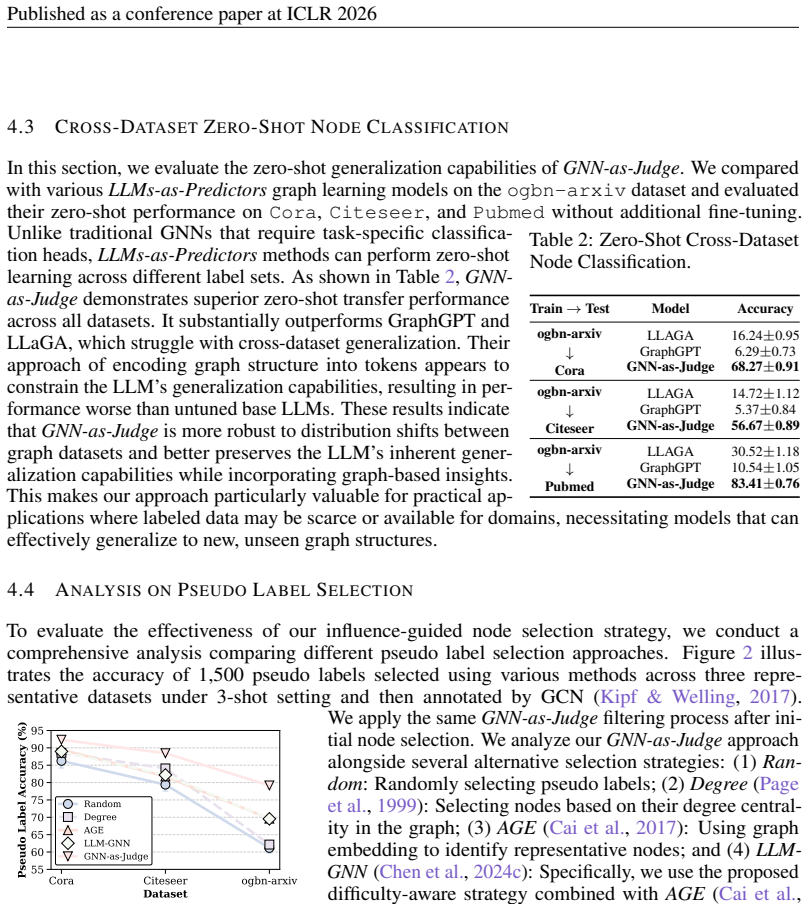

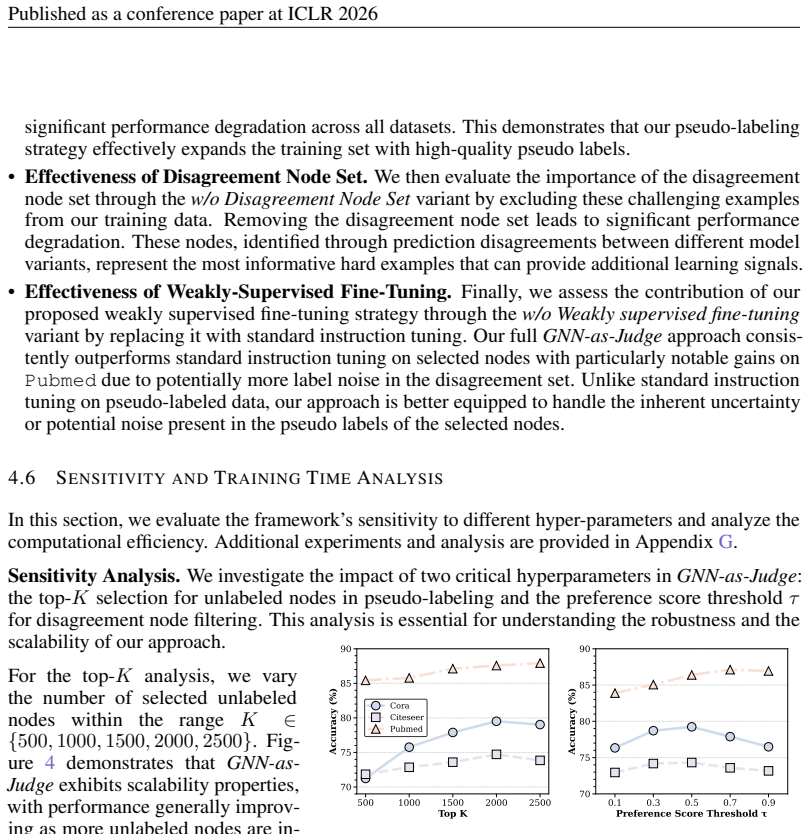
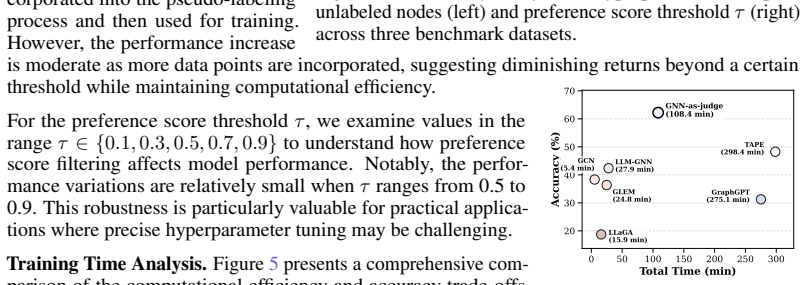


read the original abstract
Large Language Models (LLMs) have shown strong performance on text-attributed graphs (TAGs) due to their superior semantic understanding ability on textual node features. However, their effectiveness as predictors in the low-resource setting, where labeled nodes are severely limited and scarce, remains constrained since fine-tuning LLMs usually requires sufficient labeled data, especially when the TAG shows complex structural patterns. In essence, this paper targets two key challenges: (i) the difficulty of generating and selecting reliable pseudo labels on TAGs for LLMs, and (ii) the need to mitigate potential label noise when fine-tuning LLMs with pseudo labels. To counter the challenges, we propose a new framework, GNN-as-Judge, which can unleash the power of LLMs for few-shot semi-supervised learning on TAGs by incorporating the structural inductive bias of Graph Neural Networks (GNNs). Specifically, GNN-as-Judge introduces a collaborative pseudo-labeling strategy that first identifies the most influenced unlabeled nodes from labeled nodes, then exploits both the agreement and disagreement patterns between LLMs and GNNs to generate reliable labels. Furthermore, we develop a weakly-supervised LLM fine-tuning algorithm that can distill the knowledge from informative pseudo labels while mitigating the potential label noise. Experiments on multiple TAG datasets demonstrate that GNN-as-Judge significantly outperforms existing methods, particularly in low-resource regimes where labeled data are scarce.
Editorial analysis
A structured set of objections, weighed in public.
Referee Report
Summary. The manuscript proposes GNN-as-Judge, a framework for few-shot semi-supervised learning on text-attributed graphs. It first identifies the most influenced unlabeled nodes via GNN propagation from labeled seeds, then generates pseudo-labels by exploiting agreement and disagreement patterns between LLM and GNN predictions. A weakly-supervised fine-tuning procedure is introduced to distill knowledge from these pseudo-labels while mitigating noise. Experiments on multiple TAG datasets are reported to show significant gains over existing methods, especially in low-resource regimes.
Significance. If the central experimental claims hold after verification, the work would be a meaningful contribution to combining semantic reasoning from LLMs with structural inductive bias from GNNs for label-scarce graph tasks. The collaborative pseudo-labeling strategy and noise-aware fine-tuning address practical bottlenecks in TAG learning and could influence subsequent hybrid LLM-GNN pipelines.
major comments (2)
- [§4] §4 (Experiments) and the abstract: the headline claim of significant outperformance relies on the assumption that LLM-GNN agreement/disagreement produces sufficiently accurate pseudo-labels, yet no table, figure, or subsection reports the precision or accuracy of the selected pseudo-labels against held-out ground truth. Without this direct measurement, gains cannot be confidently attributed to the judge mechanism rather than the fine-tuning recipe or baseline choices.
- [§3.2] §3.2 (Collaborative Pseudo-Labeling): the selection of 'most influenced unlabeled nodes' (Eq. (3)) and the subsequent agreement filter are presented as noise-mitigating, but the manuscript provides no ablation that isolates the disagreement filter's contribution or quantifies how often agreement occurs on nodes where both models share the same systematic error. This is load-bearing for the low-resource regime claims.
minor comments (2)
- [Figure 1] Figure 1: the framework diagram would benefit from explicit arrows or labels distinguishing the agreement versus disagreement paths and the influence propagation step.
- [§3] Notation: several symbols (e.g., the influence threshold and the weighting factor in the weakly-supervised loss) are introduced without a consolidated table of definitions.
Simulated Author's Rebuttal
We thank the referee for the constructive feedback. The points raised highlight opportunities to strengthen the empirical support for our claims, and we will incorporate the suggested analyses in the revised manuscript.
read point-by-point responses
-
Referee: [§4] §4 (Experiments) and the abstract: the headline claim of significant outperformance relies on the assumption that LLM-GNN agreement/disagreement produces sufficiently accurate pseudo-labels, yet no table, figure, or subsection reports the precision or accuracy of the selected pseudo-labels against held-out ground truth. Without this direct measurement, gains cannot be confidently attributed to the judge mechanism rather than the fine-tuning recipe or baseline choices.
Authors: We agree that a direct measurement of pseudo-label quality is necessary to attribute gains specifically to the collaborative judge mechanism. In the revision we will add a dedicated subsection (and accompanying table) in §4 that reports precision, recall, and accuracy of the selected pseudo-labels against held-out ground truth on all evaluated datasets. This analysis will be performed by temporarily withholding a portion of the labeled nodes for verification purposes. revision: yes
-
Referee: [§3.2] §3.2 (Collaborative Pseudo-Labeling): the selection of 'most influenced unlabeled nodes' (Eq. (3)) and the subsequent agreement filter are presented as noise-mitigating, but the manuscript provides no ablation that isolates the disagreement filter's contribution or quantifies how often agreement occurs on nodes where both models share the same systematic error. This is load-bearing for the low-resource regime claims.
Authors: We acknowledge the value of isolating the disagreement filter's contribution. The current experiments include comparisons against LLM-only and GNN-only pseudo-labeling, but we will add a targeted ablation study that removes the disagreement component while keeping the influence-based node selection and agreement filter. We will also report the frequency with which LLM-GNN agreement occurs on nodes that are later found to be erroneous according to ground truth, thereby quantifying potential shared systematic errors. revision: yes
Circularity Check
No circularity: framework uses independent LLM and GNN components for pseudo-labeling
full rationale
The derivation chain consists of a collaborative pseudo-labeling step that selects influenced nodes and filters via LLM-GNN agreement/disagreement, followed by a separate weakly-supervised fine-tuning procedure. These steps rely on standard, externally defined GNN message-passing and LLM prompting mechanisms rather than any self-referential definition, fitted parameter renamed as prediction, or load-bearing self-citation. No equations appear that equate outputs to inputs by construction, and the experimental claims rest on empirical comparisons rather than tautological reductions. The method is therefore self-contained against external benchmarks.
Axiom & Free-Parameter Ledger
Forward citations
Cited by 1 Pith paper
-
A Unified Graph Language Model for Multi-Domain Multi-Task Graph Alignment Instruction Tuning
UniGraphLM uses a multi-domain multi-task GNN encoder and adaptive alignment to create unified graph tokens for LLMs across diverse domains and tasks.
Reference graph
Works this paper leans on
-
[1]
" write newline "" before.all 'output.state := FUNCTION n.dashify 't := "" t empty not t #1 #1 substring "-" = t #1 #2 substring "--" = not "--" * t #2 global.max substring 't := t #1 #1 substring "-" = "-" * t #2 global.max substring 't := while if t #1 #1 substring * t #2 global.max substring 't := if while FUNCTION format.date year duplicate empty "emp...
-
[2]
\@ifxundefined[1] #1\@undefined \@firstoftwo \@secondoftwo \@ifnum[1] #1 \@firstoftwo \@secondoftwo \@ifx[1] #1 \@firstoftwo \@secondoftwo [2] @ #1 \@temptokena #2 #1 @ \@temptokena \@ifclassloaded agu2001 natbib The agu2001 class already includes natbib coding, so you should not add it explicitly Type <Return> for now, but then later remove the command n...
-
[3]
\@lbibitem[] @bibitem@first@sw\@secondoftwo \@lbibitem[#1]#2 \@extra@b@citeb \@ifundefined br@#2\@extra@b@citeb \@namedef br@#2 \@nameuse br@#2\@extra@b@citeb \@ifundefined b@#2\@extra@b@citeb @num @parse #2 @tmp #1 NAT@b@open@#2 NAT@b@shut@#2 \@ifnum @merge>\@ne @bibitem@first@sw \@firstoftwo \@ifundefined NAT@b*@#2 \@firstoftwo @num @NAT@ctr \@secondoft...
-
[4]
@open @close @open @close and [1] URL: #1 \@ifundefined chapter * \@mkboth \@ifxundefined @sectionbib * \@mkboth * \@mkboth\@gobbletwo \@ifclassloaded amsart * \@ifclassloaded amsbook * \@ifxundefined @heading @heading NAT@ctr thebibliography [1] @ \@biblabel @NAT@ctr \@bibsetup #1 @NAT@ctr @ @openbib .11em \@plus.33em \@minus.07em 4000 4000 `\.\@m @bibit...
discussion (0)
Sign in with ORCID, Apple, or X to comment. Anyone can read and Pith papers without signing in.