Recognition: unknown
Resolving satellite-in situ mismatches in Net Primary Production using high-frequency in situ bio-optical observations in the subpolar Northwest Atlantic
Pith reviewed 2026-05-10 17:23 UTC · model grok-4.3
The pith
Satellite NPP models overestimate high-latitude ocean productivity by factors of 2.5 to 4.
A machine-rendered reading of the paper's core claim, the machinery that carries it, and where it could break.
Core claim
Depth-integrated NPP from satellite models was overestimated by a factor of 2.5 to 4 relative to in situ estimates from high-frequency bio-optical profiles. VGPM produced lower surface values but unrealistic vertical structure and missed a major bloom due to non-regional chlorophyll data. BIO model differences were attributable to photosynthetic-irradiance parameter assignment. Good agreement between satellite and in situ NPP becomes possible once the P-I assignment challenge is resolved.
What carries the argument
High-frequency depth-resolved moored bio-optical profiler data combined with prior P-I parameters to generate daily in situ NPP estimates, used to diagnose discrepancies in satellite models VGPM and BIO.
If this is right
- Regional calibration of chlorophyll-a products is necessary to capture phytoplankton blooms in high-latitude satellite NPP estimates.
- Assignment of appropriate photosynthetic parameters is critical for aligning satellite NPP with in situ observations.
- High-frequency in situ bio-optical time series can identify and help correct vertical structure issues in satellite NPP models.
Where Pith is reading between the lines
- Overestimations in NPP could lead to inflated estimates of the ocean carbon sink in high latitudes if not corrected.
- Similar validation efforts in other high-latitude regions might reveal comparable model biases.
- Future work could focus on developing dynamic P-I parameterizations based on real-time bio-optical data.
Load-bearing premise
The in situ NPP derived from daily bio-optical profiles using prior P-I parameters accurately represents true productivity at the mooring site and that this single location and year represent broader high-latitude conditions.
What would settle it
Independent NPP measurements using methods such as carbon-14 uptake incubations conducted at the same mooring site would directly test whether the reported overestimation factor holds.
Figures




read the original abstract
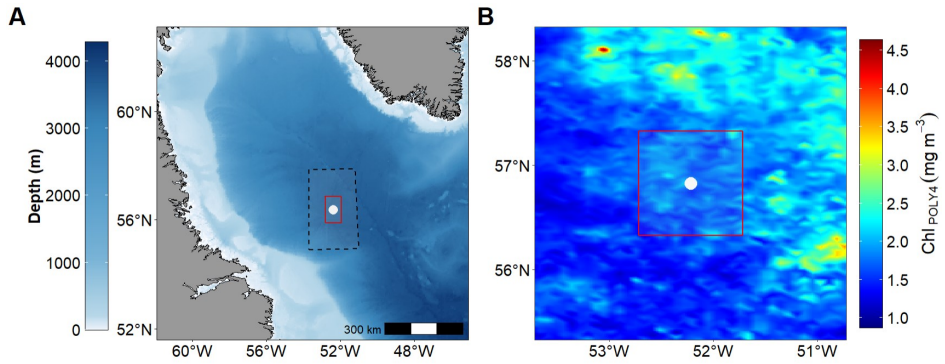
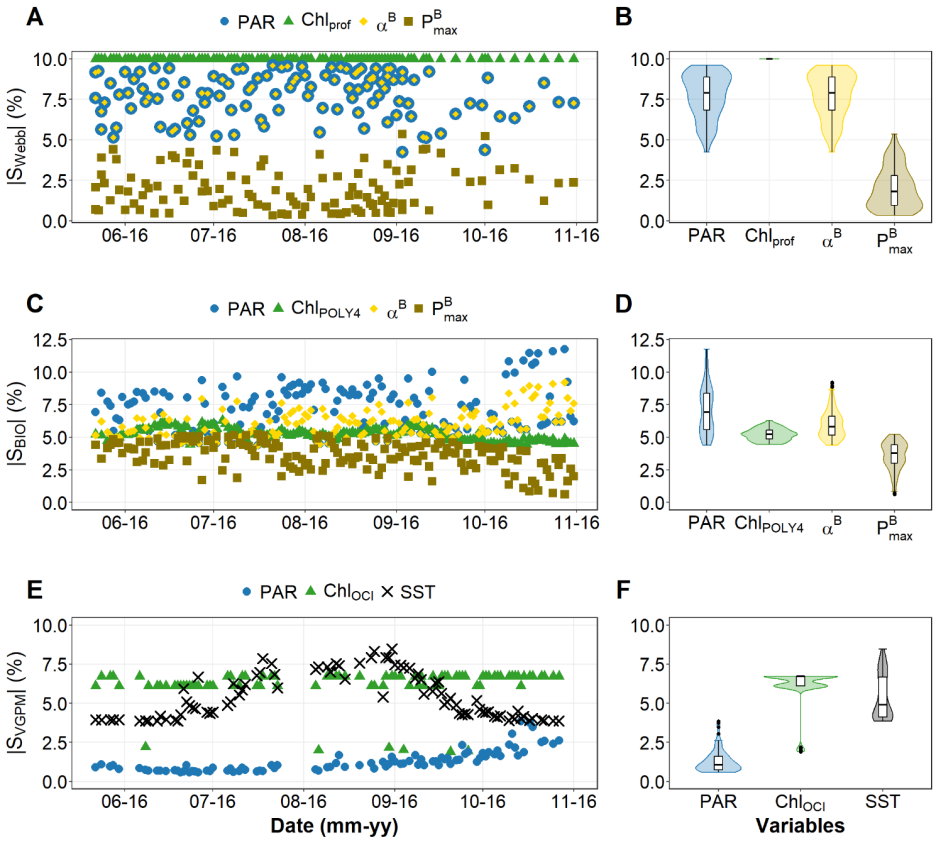
Net primary productivity (NPP) forms the basis of biological carbon pump, but its estimates in high-latitude regions remain highly uncertain despite its disproportional importance for the global carbon sink. Optical satellites are limited by cloud cover, low irradiance, and shallow light penetration, with uncertainties further exacerbated by the lack of in situ validations and regional model tuning for NPP measurements. This study compared two satellite-based models, a global (VGPM) and a regionally tuned (BIO) NPP model, with a time series of in situ NPP. Using a high-frequency, depth-resolved moored profiler in the subpolar Northwest Atlantic (56{\deg}N) in 2016, in situ NPP was estimated by daily bio-optical profiles and prior measurement of photosynthesis-irradiance (P-I) parameters. Our findings indicated that satellite-derived estimates of depth-integrated NPP were overestimated by a factor of 2.5 to 4. However, the reasons for the discrepancies varied between the VGPM and BIO model. VGPM used global photosynthetic parameters with a simplified depth assumption, leading to an unrealistic vertical structure for depth-integrated NPP, despite its surface values were lower than in situ estimates. A major phytoplankton bloom in June-July was missed by VGPM, likely due to the use of non-regionally calibrated OCI Chl-a, which led to an underestimation of biomass. In contrast, the BIO model used regionally tuned POLY4 Chl-a products, and the differences in the assignment of P-I parameters accounted for the remaining discrepancies. This study showed the possibility to reach good agreement between satellite and in situ NPPs if the challenge of P-I assignment can be overcome. We recommend further studies to investigate discrepancies of NPP estimates in high-latitude regions, focusing on data sources and model choices, as well as improving regional model calibration to enhance NPP accuracy.
Editorial analysis
A structured set of objections, weighed in public.
Referee Report
Summary. The paper compares depth-integrated net primary production (NPP) from two satellite models (global VGPM and regionally tuned BIO) against in situ estimates derived from daily high-frequency bio-optical profiles at a 56°N mooring in the subpolar Northwest Atlantic during 2016. In situ NPP is computed using prior photosynthesis-irradiance (P-I) parameters; the comparison shows satellite estimates overestimate in situ values by a factor of 2.5–4, with VGPM discrepancies linked to simplified vertical structure and non-regional Chl-a, and BIO discrepancies linked to P-I assignment. The authors conclude that agreement is reachable once P-I assignment is improved and recommend further high-latitude studies.
Significance. If the in situ estimates hold, the result would be significant for high-latitude carbon-cycle studies because it quantifies a large, model-specific bias in satellite NPP and identifies concrete levers (vertical assumptions, Chl-a product, P-I assignment) for improvement. The high-frequency moored profiler dataset itself is a useful validation resource for the community.
major comments (2)
- [Methods (in situ NPP estimation from bio-optical profiles and prior P-I parameters)] The central claim that satellite NPP overestimates in situ NPP by a factor of 2.5–4 rests on the accuracy of the in situ values, which are obtained by applying prior P-I parameters to the bio-optical profiles. The manuscript provides no contemporaneous P-I measurements at the mooring site, no sensitivity analysis on parameter uncertainty, and no cross-check against independent productivity methods (e.g., 14C uptake or oxygen-based estimates). Because any systematic bias in the chosen priors directly scales the reported factor and the model-specific diagnoses, this assumption is load-bearing and requires explicit validation or uncertainty propagation.
- [Discussion and conclusions] The single-year (2016), single-site (56°N mooring) design limits the ability to generalize the 2.5–4 overestimation factor or the conclusion that “agreement is reachable” to broader high-latitude conditions. No discussion is given of inter-annual variability, spatial heterogeneity, or how representative the 2016 bloom timing and community composition are of the subpolar Northwest Atlantic.
minor comments (2)
- [Abstract] The abstract states the overestimation factor without accompanying error bars, confidence intervals, or statistical test results; adding these (or referencing the relevant table/figure) would strengthen the quantitative claim.
- [Methods] The specific numerical values and sources of the “prior measurement of photosynthesis-irradiance (P-I) parameters” should be stated explicitly (including any regional or seasonal adjustments) so readers can assess applicability to the 2016 deployment.
Simulated Author's Rebuttal
We thank the referee for the detailed and constructive review. The two major comments highlight important limitations in our validation approach and the scope of generalization. We address each point below and will revise the manuscript accordingly to strengthen the presentation of uncertainties and limitations.
read point-by-point responses
-
Referee: [Methods (in situ NPP estimation from bio-optical profiles and prior P-I parameters)] The central claim that satellite NPP overestimates in situ NPP by a factor of 2.5–4 rests on the accuracy of the in situ values, which are obtained by applying prior P-I parameters to the bio-optical profiles. The manuscript provides no contemporaneous P-I measurements at the mooring site, no sensitivity analysis on parameter uncertainty, and no cross-check against independent productivity methods (e.g., 14C uptake or oxygen-based estimates). Because any systematic bias in the chosen priors directly scales the reported factor and the model-specific diagnoses, this assumption is load-bearing and requires explicit validation or uncertainty propagation.
Authors: We agree that the in situ NPP estimates depend on prior P-I parameters and that this is a load-bearing assumption. Contemporaneous P-I measurements at the mooring were not available in the 2016 dataset, and new measurements cannot be obtained retrospectively. However, we will add a sensitivity analysis in the revised Methods and Results sections that perturbs the P-I parameters within reported ranges from the literature for the subpolar Northwest Atlantic and quantifies the resulting range in the overestimation factors. We will also add a brief comparison to independent productivity estimates (e.g., 14C-based values) from nearby studies to provide external context. These additions will make the uncertainty explicit while preserving the core comparison. revision: yes
-
Referee: [Discussion and conclusions] The single-year (2016), single-site (56°N mooring) design limits the ability to generalize the 2.5–4 overestimation factor or the conclusion that “agreement is reachable” to broader high-latitude conditions. No discussion is given of inter-annual variability, spatial heterogeneity, or how representative the 2016 bloom timing and community composition are of the subpolar Northwest Atlantic.
Authors: We acknowledge that a single-year, single-site study inherently limits broad generalization. In the revised Discussion we will expand the text to address inter-annual variability by referencing multi-year satellite and mooring records from the region, discuss spatial heterogeneity using published gradients across the subpolar Northwest Atlantic, and evaluate the representativeness of the 2016 bloom timing and community composition against historical data. We will also moderate the phrasing of our conclusions to emphasize that the 2.5–4 factor and the potential for agreement are specific to the conditions observed and require further validation elsewhere. revision: yes
- Provision of contemporaneous P-I measurements at the 56°N mooring site during 2016, which would require new in situ experiments not present in the existing dataset.
- Extension of the analysis to multiple years or additional sites, as the high-frequency bio-optical profiler data are limited to the 2016 deployment at this single location.
Circularity Check
No circularity: direct empirical comparison of independent datasets
full rationale
The paper conducts an observational comparison of two satellite NPP models against in situ depth-integrated NPP calculated from daily bio-optical profiles at a mooring site, using externally measured prior P-I parameters as input. No mathematical derivation, prediction, or first-principles result is presented that reduces by construction to the paper's own fitted values, self-citations, or inputs. Discrepancies are diagnosed by inspecting model components (vertical structure, Chl-a products, P-I assignment) against the independent in situ time series. The in situ estimates rely on prior measurements rather than parameters fitted within this study, and no self-citation chain or ansatz is invoked to justify core claims. This matches the default case of a self-contained empirical study against external benchmarks.
Axiom & Free-Parameter Ledger
axioms (2)
- domain assumption Prior photosynthesis-irradiance (P-I) parameters measured elsewhere accurately represent the photosynthetic response at the study site.
- domain assumption The single mooring location at 56°N in 2016 is representative for evaluating satellite model performance in the broader subpolar Northwest Atlantic.
Reference graph
Works this paper leans on
-
[1]
Department of Oceanography, Dalhousie University, Halifax, NS, Canada
-
[2]
Department of Statistic, Dalhousie University, Halifax, NS, Canada
-
[3]
Ocean and Ecosystem Science Division, Fisheries and Oceans Canada, Bedford Institute of Oceanography, Dartmouth, NS, Canada
-
[4]
Scripps Institution of Oceanography, University of California San Diego, La Jolla, CA, United States Corresponding author: Kitty.kam@dal.ca (Kitty Kam) Abstract Net primary productivity (NPP) forms the basis of biological carbon pump, but its estimates in high-latitude regions remain highly uncertain despite its disproportional importance for the global c...
2016
-
[5]
ground truth
and is fundamental for mediating and enhancing biological carbon export through the BCP (Martz et al., 2009). Several key metrics commonly used by BCP studies, such as export ratio and efficiency, rely on the estimates of NPP (Buesseler et al., 2020). Traditionally, NPP can be estimated from the photosynthetic rate of phytoplankton using incubation of sea...
2009
-
[6]
Conclusion This study presents a comparative analysis of net primary productivity (NPP) time series derived from two satellite-based models and an in situ-based model in the Central Labrador Sea between May and November 2016. A considerable difference in NPP magnitude is observed between satellite- and in situ-based time series, mainly due to differences ...
-
[7]
https://doi.org/10.5194/bg-10-4383-2013 Arruda, R., Atamanchuk, D., Boteler, C., & Wallace, D. W. R. (2024). Seasonality of pCO2 and air -sea CO2 fluxes in the Central Labrador Sea. Frontiers in Marine Science, 11. https://doi.org/10.3389/fmars.2024.1472697 Arteaga, L. A., Behrenfeld, M. J., Boss, E., & Westberry, T. K. (2022). Vertical Structure in Phyto...
-
[8]
https://doi.org/10.3389/fmars.2023.1062413 Bisson, K. M., Siegel, D. A., DeVries, T., Cael, B. B., & Buesseler, K. O. (2018). How Data Set Characteristics Influence Ocean Carbon Export Models. Global Biogeochemical Cycles, 32(9), 1312–
-
[9]
W., Claustre, H., Levy, M., Siegel, D
https://doi.org/10.1029/2018GB005934 Boyd, P. W., Claustre, H., Levy, M., Siegel, D. A., & Weber, T. (2019). Multi-faceted particle pumps drive carbon sequestration in the ocean. Nature, 568(7752), Article 7752. https://doi.org/10.1038/s41586-019- 1098-2 31 Brewin, R. J. W., Sathyendranath, S., Kulk, G., Rio, M.-H., Concha, J. A., Bell, T. G., Bracher, A....
-
[10]
https://doi.org/10.1038/ngeo2818 Devred, E., Clay, S., Ringuette, M., Perry, T., Amirian, M., Irwin, A., & Finkel, Z. (2025). Net primary production in the Labrador Sea between 2014 and 2022 derived from ocean colour remote sensing based on ecological regimes. Remote Sensing of Environment, 323, 114713. https://doi.org/10.1016/j.rse.2025.114713 DeVries, T...
-
[11]
https://doi.org/10.1364/AO.45.007443 Kahru, M. (2017). Ocean productivity from space: Commentary. Global Biogeochemical Cycles, 31(1), 214–216. https://doi.org/10.1002/2016GB005582 Kiefer, D. A. (1973). Fluorescence properties of natural phytoplankton populations. Marine Biology, 22(3), 263–269. https://doi.org/10.1007/BF00389180 Koelling, J., Atamanchuk,...
-
[12]
ProOceanus ProCV CO2 sensor
Aanderaa oxygen optode Nitrate Deep SUNA ocean nitrate sensor Dissolved Inorganic Carbon 1. ProOceanus ProCV CO2 sensor
-
[13]
Aanderaa pCO2 optode Salinity (conductivity) SBE 19plus V2 SeaCAT Physical Temperature, Depth SBE 19plus V2 SeaCAT 36 filled by the DINEOF method (Alvera-Azcárate et al., 2011) PAR In situ Ed(490) profiles converted to PAR profiles using the COART model (Jin et al., 2006) Satellite PAR Modeled subsurface light field based on Gregg & Carder (1990) and scal...
2011
discussion (0)
Sign in with ORCID, Apple, or X to comment. Anyone can read and Pith papers without signing in.