Recognition: unknown
Arqon: A suite of control applications enabling a reliable quantum network
Pith reviewed 2026-05-10 16:56 UTC · model grok-4.3
The pith
Arqon is a suite of control applications that meets all reliability requirements for accepted demands in quantum networks.
A machine-rendered reading of the paper's core claim, the machinery that carries it, and where it could break.
Core claim
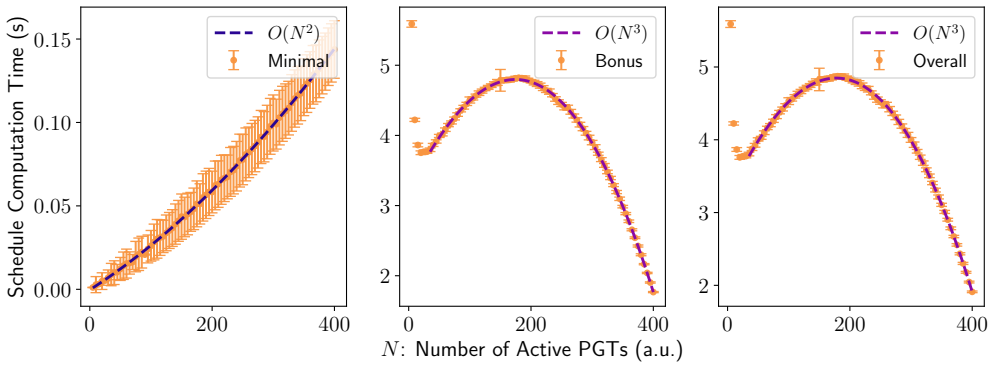
Arqon is a suite of control applications designed to deliver reliable service in centrally controlled quantum networks. Through both analytic and numerical evaluation that Arqon satisfies all reliability requirements for accepted demands on static network topologies. A complete Python implementation is provided along with complexity analysis showing admission control scales as O(k^3) in the number of incoming demands k and schedule computation scales as O(N^3) in the number of accepted demands to schedule N.
What carries the argument
Arqon suite of control applications that performs admission control and scheduling to guarantee reliable entangled-link creation between end nodes.
Load-bearing premise
The reliability requirements obtained by extending classical network concepts are the right ones for quantum service delivery and that static topologies suffice to establish the claims.
What would settle it
A concrete static network topology and set of demands for which the Python implementation accepts a demand but the resulting schedule fails to deliver the required entangled links on time.
Figures







read the original abstract
A quantum network's purpose is to enable users to execute applications on end nodes. This requires the network to provide the service of creating entangled links between those nodes. Users of mature networks, such as the internet or the telephone network expect accepted service demands to be met reliably. We first define reliability requirements that extend classical computer network concepts to quantum network service delivery. We then introduce Arqon, a suite of control applications designed to deliver reliable service in centrally controlled quantum networks. We demonstrate through both analytic and numerical evaluation that Arqon satisfies all reliability requirements for accepted demands. These evaluations consider static network topologies. We provide a complete Python implementation and perform complexity analysis showing that admission control scales as $O(k^3)$ in the number of incoming demands $k$ and schedule computation scales as ${O(N^3)}$ in the number of accepted demands to schedule $N$.
Editorial analysis
A structured set of objections, weighed in public.
Referee Report
Summary. The manuscript defines reliability requirements for quantum network service delivery by extending classical computer network concepts. It introduces Arqon, a suite of control applications for centrally controlled quantum networks, and claims via analytic and numerical evaluations on static network topologies that Arqon satisfies all reliability requirements for accepted demands. The paper provides a complete Python implementation and reports complexity results: admission control scales as O(k^3) in the number of incoming demands k, while schedule computation scales as O(N^3) in the number of accepted demands N.
Significance. If the evaluations hold under the stated assumptions, the work supplies concrete definitions, a control suite, and open-source code for reliable quantum service delivery. The reproducible Python implementation and explicit complexity bounds are strengths that support further community validation and extension. This could be a useful step toward practical quantum network control, though the static-topology scope limits immediate applicability to operational systems.
major comments (2)
- [Abstract] Abstract: The central claim that Arqon satisfies all reliability requirements rests exclusively on analytic and numerical evaluations performed on static network topologies. Quantum service delivery inherently involves time-dependent processes (probabilistic entanglement generation, qubit decoherence during storage, and finite link lifetimes) that are absent from static models. If these dynamics cause an accepted demand to violate end-to-end fidelity or latency bounds, the satisfaction result does not transfer, making the static limitation load-bearing for the claim that Arqon enables reliable quantum networks.
- [Evaluations] Evaluations section: The manuscript asserts that both analytic and numerical results exist and that a Python implementation is supplied, yet the abstract and available text provide no explicit description of simulation parameters, data-exclusion criteria, or error-bar reporting. Without these, it is impossible to confirm that the reported satisfaction is robust rather than sensitive to post-hoc choices, directly affecting verifiability of the central claim.
minor comments (2)
- [Complexity analysis] The complexity analysis is stated clearly but would benefit from a brief pseudocode outline or reference to the specific algorithms whose cubic scaling is claimed.
- [Definitions] Notation for the reliability requirements (e.g., how classical concepts are formally extended to fidelity and latency) could be introduced earlier to improve readability for readers unfamiliar with quantum networking.
Simulated Author's Rebuttal
We thank the referee for their constructive comments on our manuscript. We address each of the major comments in turn below.
read point-by-point responses
-
Referee: [Abstract] The central claim that Arqon satisfies all reliability requirements rests exclusively on analytic and numerical evaluations performed on static network topologies. Quantum service delivery inherently involves time-dependent processes (probabilistic entanglement generation, qubit decoherence during storage, and finite link lifetimes) that are absent from static models. If these dynamics cause an accepted demand to violate end-to-end fidelity or latency bounds, the satisfaction result does not transfer, making the static limitation load-bearing for the claim that Arqon enables reliable quantum networks.
Authors: Our manuscript explicitly limits its scope to static network topologies, as noted in the abstract and throughout the text. Within this scope, we define reliability requirements extending classical concepts and show via analysis and numerical evaluation that Arqon meets them for accepted demands. The static model allows us to derive the O(k^3) and O(N^3) complexity bounds and provide concrete service guarantees without modeling probabilistic dynamics. We do not claim that the results transfer directly to dynamic settings with decoherence and probabilistic generation; such extensions would require incorporating time-dependent models, which we identify as future work. To address the concern, we will revise the abstract to more clearly state the static assumption and its implications as a limitation of the current work. revision: partial
-
Referee: [Evaluations] The manuscript asserts that both analytic and numerical results exist and that a Python implementation is supplied, yet the abstract and available text provide no explicit description of simulation parameters, data-exclusion criteria, or error-bar reporting. Without these, it is impossible to confirm that the reported satisfaction is robust rather than sensitive to post-hoc choices, directly affecting verifiability of the central claim.
Authors: The Python implementation accompanying the manuscript includes the full code for generating the numerical results, allowing readers to examine all parameters, topologies, and computation methods used. That said, we concur that the main body of the paper would benefit from an explicit description of these elements. In the revised manuscript, we will expand the Evaluations section to include a detailed account of the simulation parameters, the criteria for the numerical experiments, and any statistical reporting such as error bars or robustness checks. revision: yes
Circularity Check
No circularity in derivation chain
full rationale
The paper defines reliability requirements by extending classical network concepts, introduces the Arqon control suite, and demonstrates satisfaction via analytic and numerical evaluations on static topologies. No load-bearing step reduces by the paper's own equations or self-citations to a fitted parameter, self-defined quantity, or prior author result; the evaluations rest on independent definitions and simulations without tautological renaming or ansatz smuggling.
Axiom & Free-Parameter Ledger
axioms (2)
- domain assumption Quantum networks provide the service of creating entangled links between end nodes on demand.
- domain assumption Reliability requirements can be defined by extending classical computer network concepts to quantum service delivery.
Reference graph
Works this paper leans on
-
[1]
Quantum repeaters 25 and quantum key distribution: Analysis of secret-key rates
S. Abruzzo, S. Bratzik, N. K. Bernardes, H. Kamper- mann, P. van Loock, and D. Bruß. “Quantum repeaters 25 and quantum key distribution: Analysis of secret-key rates”. In:Physical Review A87.5 (May 2013).issn: 1094-1622.doi:10.1103/physreva.87.052315
-
[2]
On the distributions of the scan statistics of a Poisson process
S. E. Alm. “On the distributions of the scan statistics of a Poisson process”. In:Probability and Mathemati- cal Statistics, Essays in honour of Carl-Gustav Esseen (1983). Uppsala, Sweden, pp. 1–9
1983
-
[3]
Blind Quantum Computa- tion
P. Arright and L. Salvail. “Blind Quantum Computa- tion”. In:International Journal of Quantum Informa- tion04.05 (2006), pp. 883–898
2006
-
[4]
Leveraging Inter- net Principles to Build a Quantum Network
L. Bacciottini, M. G. D. Andrade, S. Pouryousef, E.A.V.Milligen,A.Chandra,N.K.Panigrahy,N.S.V. Rao, G. Vardoyan, and D. Towsley. “Leveraging Inter- net Principles to Build a Quantum Network”. In:IEEE Network(2025), pp. 1–1.doi:10 . 1109 / MNET . 2025 . 3569494
2025
-
[5]
On Distributed Communications Networks
P. Baran. “On Distributed Communications Networks”. In:IEEE Transactions on Communications Systems 12.1(1964),pp.1–9.doi:10.1109/TCOM.1964.1088883
-
[6]
Beauchamp, S
T. Beauchamp, S. Gauthier, and S. Wehner.Code and Data for for Arqon: A Suite of Control Applications En- abling Reliable Quantum Networks. 2026.doi:10.4121/ 97e0f340-6cc2-4908-9670-8308fed3e2ec
2026
-
[7]
A Modular Quantum Network Architecture for Integrating Network Scheduling with Local Program Execution
T. R. Beauchamp, H. Jirovská, S. Gauthier, and S. Wehner. “A Modular Quantum Network Architecture for Integrating Network Scheduling with Local Program Execution”. In:IEEE Transactions on Quantum Engi- neering(2025), pp. 1–31.doi:10 . 1109 / TQE . 2025 . 3624658
2025
-
[8]
Quantum cryptography: Public key distribution and coin tossing,
C. H. Bennett and G. Brassard. “Quantum cryptogra- phy: Public key distribution and coin tossing”. In:Pro- ceedings of the International Conference on Computers, Systems & Signal Processing, Bangalore, India. Vol. 1. Bangalore, India: IEEE, 1984, pp. 175–179.doi:https: //doi.org/10.1016/j.tcs.2014.05.025
-
[9]
Teleporting an unknown quantum state via dual classical and einstein-podolsky-rosen channels,
C. H. Bennett, G. Brassard, C. Crépeau, R. Jozsa, A. Peres, and W. K. Wootters. “Teleporting an unknown quantum state via dual classical and Einstein-Podolsky- Rosen channels”. In:Phys. Rev. Lett.70 (13 Mar. 1993), pp. 1895–1899.doi:10.1103/PhysRevLett.70.1895
-
[10]
Purification of noisy entanglement and faithful teleportation via noisy channels,
C. H. Bennett, G. Brassard, S. Popescu, B. Schu- macher, J. A. Smolin, and W. K. Wootters. “Purifi- cation of Noisy Entanglement and Faithful Teleporta- tion via Noisy Channels”. In:Physical Review Letters 76.5 (Jan. 1996), pp. 722–725.issn: 1079-7114.doi: 10.1103/physrevlett.76.722
-
[11]
Heralded en- tanglement between solid-state qubits separated by three metres
H. Bernien, B. Hensen, W. Pfaff, G. Koolstra, M. S. Blok, L. Robledo, T. H. Taminiau, M. Markham, D. J. Twitchen, L. Childress, and R. Hanson. “Heralded en- tanglement between solid-state qubits separated by three metres”. In:Nature497.7447 (Apr. 2013), pp. 86– 90
2013
-
[12]
Deployed measurement-device independent quantum key distri- bution and Bell-state measurements coexisting with standard internet data and networking equipment
R. C. Berrevoets, T. Middelburg, R. F. L. Vermeulen, L.D.Chiesa,F.Broggi,S.Piciaccia,R.Pluis,P.Umesh, J. F. Marques, W. Tittel, and J. A. Slater. “Deployed measurement-device independent quantum key distri- bution and Bell-state measurements coexisting with standard internet data and networking equipment”. In: Communications Physics5.1 (2022), p. 186.doi:...
2022
-
[13]
Remote-entanglement protocols for stationary qubits with photonic interfaces,
H. K. Beukers, M. Pasini, H. Choi, D. Englund, R. Han- son, and J. Borregaard. “Remote-Entanglement Proto- cols for Stationary Qubits with Photonic Interfaces”. In: PRX Quantum5.1 (Mar. 2024).issn: 2691-3399.doi: 10.1103/prxquantum.5.010202
-
[14]
ISDN frame relay and its congestion control
R. Bhardwaj and B. Jabbari. “ISDN frame relay and its congestion control”. In:International Journal of Satellite Communications9.5 (1991), pp. 363–380.doi: https://doi.org/10.1002/sat.4600090513. eprint: https : / / onlinelibrary . wiley . com / doi / pdf / 10 . 1002/sat.4600090513
-
[15]
Observation of entanglement between a single trapped atom and a single photon
B. B. Blinov, D. L. Moehring, L.-M. Duan, and C. Monroe. “Observation of entanglement between a single trapped atom and a single photon”. In:Nature428.6979 (Mar. 2004), pp. 153–157.doi:10.1038/nature02377
-
[16]
Measurement of the Bell operator and quantum teleportation
S. L. Braunstein and A. Mann. “Measurement of the Bell operator and quantum teleportation”. In:Physical Review A51.3 (1995), R1727.doi:https://doi.org/ 10.1103/PhysRevA.51.R1727
-
[17]
Quan- tum Repeaters: The Role of Imperfect Local Operations in Quantum Communication
H.-J. Briegel, W. Dür, J. I. Cirac, and P. Zoller. “Quan- tum Repeaters: The Role of Imperfect Local Operations in Quantum Communication”. In:Physical Review Let- ters81.26 (Dec. 1998), pp. 5932–5935.doi:10.1103/ physrevlett.81.5932
1998
-
[18]
Universal Blind Quantum Computation
A. Broadbent, J. Fitzsimons, and E. Kashefi. “Universal Blind Quantum Computation”. In:2009 50th Annual IEEE Symposium on Foundations of Computer Science. Atlanta, Georgia, USA: IEEE, Oct. 2009, pp. 517–526. doi:10.1109/focs.2009.36
-
[19]
C. Brukner, N. Paunkovic, T. Rudolph, and V. Ve- dral.Entanglement-assisted Orientation in Space. 2005. arXiv:quant-ph/0509123
-
[20]
G. C. Buttazzo.Hard Real-Time Computing Systems: Predictable Scheduling Algorithms and Applications. third. New York, NY, USA: Springer Science + Busi- ness Media, 2011.isbn: 978-1-4614-0675-4
2011
-
[21]
Creation of entangled states of distant atoms by interference
C. Cabrillo, J. I. Cirac, P. García-Fernández, and P. Zoller. “Creation of entangled states of distant atoms by interference”. In:Phys. Rev. A59 (2 Feb. 1999), pp. 1025–1033
1999
-
[22]
Diamond NV centers for quantum computing and quantum networks
L. Childress and R. Hanson. “Diamond NV centers for quantum computing and quantum networks”. In:MRS Bulletin38.2 (2013), pp. 134–138.doi:10.1557/mrs. 2013.20
work page doi:10.1557/mrs 2013
-
[23]
Secure assisted quantum computation
A. M. Childs. “Secure assisted quantum computation”. In:Quantum Information and Computation5.6 (Sept. 2005).issn: 1533-7146.doi:10.26421/qic5.6
-
[24]
Func- tional Quantum Nodes for Entanglement Distribution over Scalable Quantum Networks
C. W. Chou, J. Laurat, H. Deng, K. S. Choi, H. de Riedmatten, D. Felinto, and H. J. Kimble. “Func- tional Quantum Nodes for Entanglement Distribution over Scalable Quantum Networks”. In:Science316.5829 (June 2007), pp. 1316–1320.doi:10 . 1126 / science . 1140300
2007
-
[25]
Measurement-induced entanglement for excitation storedinremoteatomicensembles
C. W. Chou, H. de Riedmatten, D. Felinto, S. V. Polyakov, S. J. van Enk, and H. J. Kimble. “Measurement-induced entanglement for excitation storedinremoteatomicensembles”.In:Nature438.7069 (Dec. 2005), pp. 828–832. 26
2005
-
[26]
Request Scheduling in Quantum Networks
C. Cicconetti, M. Conti, and A. Passarella. “Request Scheduling in Quantum Networks”. en. In:IEEE Trans- actions on Quantum Engineering2 (2021), pp. 2–17. issn: 2689-1808.doi:10.1109/TQE.2021.3090532
-
[27]
Quantum Computations with Cold Trapped Ions
J. I. Cirac and P. Zoller. “Quantum Computations with Cold Trapped Ions”. In:Phys. Rev. Lett.74 (20 May 1995), pp. 4091–4094.doi:10.1103/PhysRevLett.74. 4091
-
[28]
Improved an- alytical bounds on delivery times of long-distance en- tanglement
T. Coopmans, S. Brand, and D. Elkouss. “Improved an- alytical bounds on delivery times of long-distance en- tanglement”. In:Physical Review A105.1 (Jan. 2022). issn: 2469-9934.doi:10.1103/physreva.105.012608
-
[29]
Quantum networks with neutral atom processing nodes
J. P. Covey, H. Weinfurter, and H. Bernien. “Quantum networks with neutral atom processing nodes”. en. In: npj Quantum Information9.1 (Sept. 2023). Number: 1 Publisher: Nature Publishing Group, pp. 1–12.issn: 2056-6387.doi:10.1038/s41534-023-00759-9
-
[30]
A Link Layer Protocol for Quantum Networks
A.Dahlberg,M.Skrzypczyk,T.Coopmans,L.Wubben, F. Rozpędek, M. Pompili, A. Stolk, P. Pawełczak, R. Knegjens, J. d. O. Filho, R. Hanson, and S. Wehner. “A Link Layer Protocol for Quantum Networks”. In: Proceedings of the ACM Special Interest Group on Data Communication.Aug.2019,pp.159–173.doi:10.1145/ 3341302.3342070
-
[31]
A quantum-logic gate between distant quantum-network modules
S. Daiss, S. Langenfeld, S. Welte, E. Distante, P. Thomas, L. Hartung, O. Morin, and G. Rempe. “A quantum-logic gate between distant quantum-network modules”. In:Science371.6529 (2021), pp. 614–617. doi:10.1126/science.abe3150. eprint:https://www. science.org/doi/pdf/10.1126/science.abe3150
-
[32]
Tools for the Analysis of Quantum Protocols Requiring State Generation Within a Time Window
B. Davies, T. Beauchamp, G. Vardoyan, and S. Wehner. “Tools for the Analysis of Quantum Protocols Requiring State Generation Within a Time Window”. In:IEEE Transactions on Quantum Engineering5 (2024), pp. 1– 20.doi:10.1109/TQE.2024.3358674
-
[33]
C. G. Davis. “An experimental pulse code modulation systemforshort-haultrunks”.In:The Bell System Tech- nical Journal41.1 (1962), pp. 1–24.doi:10.1002/j. 1538-7305.1962.tb03261.x
work page doi:10.1002/j 1962
-
[34]
An operating system for execut- ing applications on quantum network nodes
C. Delle Donne et al. “An operating system for execut- ing applications on quantum network nodes”. In:Na- ture639.8054 (Mar. 2025), pp. 321–328.doi:10.1038/ s41586-025-08704-w
2025
-
[35]
Quantum Privacy Ampli- fication and the Security of Quantum Cryptography over Noisy Channels
D. Deutsch, A. Ekert, R. Jozsa, C. Macchiavello, S. Popescu, and A. Sanpera. “Quantum Privacy Ampli- fication and the Security of Quantum Cryptography over Noisy Channels”. In:Physical Review Letters77.13 (Sept. 1996), pp. 2818–2821.issn: 1079-7114.doi:10. 1103/physrevlett.77.2818
1996
-
[36]
D. Ding and L. Jiang.Coordinating Decisions via Quan- tum Telepathy. arXiv:2407.21723. Sept. 2024.doi:10. 48550/arXiv.2407.21723
-
[37]
Verifiable Blind Quantum Computing with Trapped Ions and Sin- gle Photons
P. Drmota, D. Nadlinger, D. Main, B. Nichol, E. Ain- ley, D. Leichtle, A. Mantri, E. Kashefi, R. Srinivas, G. Araneda, C. Ballance, and D. Lucas. “Verifiable Blind Quantum Computing with Trapped Ions and Sin- gle Photons”. In:Physical Review Letters132.15 (Apr. 2024).issn: 1079-7114.doi:10 . 1103 / physrevlett . 132.150604
2024
-
[38]
Long-distance quantum communication with atomic ensembles and linear optics
L.-M. Duan, M. D. Lukin, J. I. Cirac, and P. Zoller. “Long-distance quantum communication with atomic ensembles and linear optics”. In:Nature414.6862 (Nov. 2001), pp. 413–418
2001
-
[39]
Quan- tum repeaters based on entanglement purification
W. Dür, H.-J. Briegel, J. I. Cirac, and P. Zoller. “Quan- tum repeaters based on entanglement purification”. In: Physical Review A59.1 (Jan. 1999). Publisher: Amer- ican Physical Society, pp. 169–181.doi:10 . 1103 / PhysRevA.59.169
1999
-
[40]
Quantum Register Based on Individual Electronic and Nuclear Spin Qubits in Diamond
M. V. G. Dutt, L. Childress, L. Jiang, E. Togan, J. Maze, F. Jelezko, A. S. Zibrov, P. R. Hemmer, and M. D. Lukin. “Quantum Register Based on Individual Electronic and Nuclear Spin Qubits in Diamond”. In: Science316.5829 (2007), pp. 1312–1316.doi:10.1126/ science.1139831
2007
-
[41]
Quantum cryptography based on Bell’s theorem,
A. K. Ekert. “Quantum cryptography based on Bell’s theorem”.In:Phys. Rev. Lett.67(6Aug.1991),pp.661– 663.doi:10.1103/PhysRevLett.67.661
-
[42]
An Ar- chitecture for Control of Entanglement Generation Switches in Quantum Networks
S. Gauthier, G. Vardoyan, and S. Wehner. “An Ar- chitecture for Control of Entanglement Generation Switches in Quantum Networks”. In:IEEE Transac- tions on Quantum Engineering4 (2023), pp. 1–17.doi: 10.1109/TQE.2023.3320047
-
[43]
On-demand resource allocation for a quantum network hub,
S. Gauthier, T. Vasantam, and G. Vardoyan. “On- Demand Resource Allocation for a Quantum Network Hub”. In:IEEE Transactions on Quantum Engineering 7 (2026), pp. 1–30.doi:10.1109/TQE.2025.3641834
-
[44]
Cartesian vs. Radial – A Comparative Evaluation of Two Visualization Tools
J. Glaz and N. Balakrishnan, eds.Scan Statistics and Applications. Boston, MA: Birkhäuser Boston, 1999. isbn: 978-0-8176-4041-5.doi:10.1007/978- 1- 4612- 1578-3
-
[45]
J. Glaz, J. I. Naus, and S. Wallenstein.Scan statistics. Springer series in statistics. New York: Springer, 2001. isbn: 978-0-387-98819-1
2001
-
[46]
On noise in swap ASAP repeater chains: exact analytics, distributions and tight approximations
K. Goodenough, T. Coopmans, and D. Towsley. “On noise in swap ASAP repeater chains: exact analytics, distributions and tight approximations”. In:Quantum9 (May 2025), p. 1744.issn: 2521-327X.doi:10.22331/ q-2025-05-15-1744
2025
-
[47]
Longer- Baseline Telescopes Using Quantum Repeaters
D. Gottesman, T. Jennewein, and S. Croke. “Longer- Baseline Telescopes Using Quantum Repeaters”. In: Phys. Rev. Lett.109 (7 2012), p. 070503.doi:10.1103/ PhysRevLett.109.070503
2012
-
[48]
Science276(5321), 2012–2014 (1997) https: //doi.org/10.1126/science.276.5321.2012
A. Gruber, A. Dräbenstedt, C. Tietz, L. Fleury, J. Wrachtrup, and C. von Borczyskowski. “Scanning Con- focal Optical Microscopy and Magnetic Resonance on Single Defect Centers”. In:Science276.5321 (1997), pp. 2012–2014.doi:10.1126/science.276.5321.2012
-
[49]
ESDI: EntanglementSchedulingandDistributionintheQuan- tum Internet
H. Gu, R. Yu, Z. Li, X. Wang, and F. Zhou. “ESDI: EntanglementSchedulingandDistributionintheQuan- tum Internet”. In:2023 32nd International Conference on Computer Communications and Networks (ICCCN) (2023), pp. 1–10.doi:10 . 1109 / ICCCN58024 . 2023 . 10230193
2023
-
[50]
J. M. Halpern, R. HAAS, a. doria avri, L. Dong, W. Wang, H. M. Khosravi, J. H. Salim, and R. Gopal. Forwarding and Control Element Separation (ForCES) Protocol Specification. Request for Comments RFC
-
[51]
Internet Engineering Task Force, Mar
Num Pages: 124. Internet Engineering Task Force, Mar. 2010.doi:10.17487/RFC5810. 27
-
[52]
Quantum load balancing in ad hoc networks
M. Hasanpour, S. Shariat, P. Barnaghi, S. A. Hoseinita- batabaei, S. Vahid, and R. Tafazolli. “Quantum load balancing in ad hoc networks”. en. In:Quantum Infor- mation Processing16.6 (Apr. 2017), p. 148.issn: 1573- 1332.doi:10.1007/s11128-017-1578-y
-
[53]
Probability inequalities for sums of bounded random variables
W. Hoeffding. “Probability Inequalities for Sums of Bounded Random Variables”. In:Journal of the Amer- ican Statistical Association58.301 (1963), pp. 13–30. doi:10.1080/01621459.1963.10500830.eprint:https: //www.tandfonline.com/doi/pdf/10.1080/01621459. 1963.10500830
work page doi:10.1080/01621459.1963.10500830.eprint:https: 1963
-
[54]
Gen- eral teleportation channel, singlet fraction, and qua- sidistillation
M. Horodecki, P. Horodecki, and R. Horodecki. “Gen- eral teleportation channel, singlet fraction, and qua- sidistillation”. In:Phys. Rev. A60 (3 Sept. 1999), pp. 1888–1898.doi:10.1103/PhysRevA.60.1888
-
[55]
P. C. Humphreys, N. Kalb, J. P. J. Morits, R. N. Schouten, R. F. L. Vermeulen, D. J. Twitchen, M. Markham, and R. Hanson. “Deterministic delivery of remote entanglement on a quantum network”. In:Na- ture558.7709 (June 2018). arXiv:1712.07567, pp. 268– 273.issn: 0028-0836, 1476-4687.doi:10.1038/s41586- 018-0200-5
-
[56]
Optimal entanglement distribution policies in homoge- neous repeater chains with cutoffs
Á. G. Iñesta, G. Vardoyan, L. Scavuzzo, and S. Wehner. “Optimal entanglement distribution policies in homoge- neous repeater chains with cutoffs”. en. In:npj Quantum Information9.1 (May 2023). Number: 1 Publisher: Na- ture Publishing Group, pp. 1–7.issn: 2056-6387.doi: 10.1038/s41534-023-00713-9
-
[57]
Congestion control and traffic management in ATM networks: Recent advances and a survey
R. Jain. “Congestion control and traffic management in ATM networks: Recent advances and a survey”. In: Computer Networks and ISDN Systems28.13 (1996). ATM/NII, pp. 1723–1738.issn: 0169-7552.doi:https: //doi.org/10.1016/0169-7552(96)00012-8
-
[59]
Design and analysis of communication proto- cols for quantum repeater networks
C. Jones, D. Kim, M. T. Rakher, P. G. Kwiat, and T. D. Ladd. “Design and analysis of communication proto- cols for quantum repeater networks”. In:New Journal of Physics18.8 (Aug. 2016), p. 083015.doi:10.1088/ 1367-2630/18/8/083015
2016
-
[60]
Operating system profiling via latency analy- sis
N. Joukov, A. Traeger, R. Iyer, C. P. Wright, and E. Zadok. “Operating system profiling via latency analy- sis”. In:Proceedings of the 7th Symposium on Operating Systems Design and Implementation. OSDI ’06. Seat- tle, Washington: USENIX Association, 2006, pp. 89– 102.isbn: 1931971471
2006
-
[61]
P. Kómár, E. M. Kessler, M. Bishof, L. Jiang, A. S. Sørensen, J. Ye, and M. D. Lukin. “A quantum network of clocks”. In:Nature Physics10.8 (June 2014), pp. 582– 587.issn: 1745-2481.doi:10.1038/nphys3000
-
[62]
A P4 Data Plane for the Quantum Internet
W. Kozlowski, F. Kuipers, and S. Wehner. “A P4 Data Plane for the Quantum Internet”. In:Proceedings of the 3rd P4 Workshop in Europe. CoNEXT ’20: The 16th In- ternational Conference on emerging Networking EXper- iments and Technologies. Barcelona Spain: ACM, Dec. 2020,pp.49–51.isbn:978-1-4503-8181-9.doi:10.1145/ 3426744.3431321
-
[63]
Software- DefinedNetworking:AComprehensiveSurvey
D. Kreutz, F. M. V. Ramos, P. E. Veríssimo, C. E. Rothenberg, S. Azodolmolky, and S. Uhlig. “Software- DefinedNetworking:AComprehensiveSurvey”.In:Pro- ceedings of the IEEE103.1 (Jan. 2015), pp. 14–76.issn: 1558-2256.doi:10.1109/JPROC.2014.2371999
-
[64]
Aaijet al.[LHCb Collaboration]
V. Krutyanskiy, M. Canteri, M. Meraner, J. Bate, V. Krcmarsky,J.Schupp,N.Sangouard,andB.P.Lanyon. “Telecom-Wavelength Quantum Repeater Node Based on a Trapped-Ion Processor”. In:Phys. Rev. Lett.130 (21 May 2023), p. 213601.doi:10.1103/PhysRevLett. 130.213601
-
[65]
Entangle- ment of Trapped-Ion Qubits Separated by 230 Meters
V. Krutyanskiy, M. Galli, V. Krcmarsky, S. Baier, D. A. Fioretto, Y. Pu, A. Mazloom, P. Sekatski, M. Canteri, M. Teller, J. Schupp, J. Bate, M. Meraner, N. San- gouard, B. P. Lanyon, and T. E. Northup. “Entangle- ment of Trapped-Ion Qubits Separated by 230 Meters”. In:Phys. Rev. Lett.130 (5 Feb. 2023), p. 050803.doi: 10.1103/PhysRevLett.130.050803
-
[66]
Entan- gling single atoms over 33 km telecom fibre
T.vanLeent,M.Bock,F.Fertig,R.Garthoff,S.Eppelt, Y. Zhou, P. Malik, M. Seubert, T. Bauer, W. Rosen- feld, W. Zhang, C. Becher, and H. Weinfurter. “Entan- gling single atoms over 33 km telecom fibre”. In:Nature 607.7917 (July 2022), pp. 69–73
2022
-
[67]
Ob- servation of coherent optical information storage in an atomic medium using halted light pulses
C. Liu, Z. Dutton, C. H. Behroozi, and L. V. Hau. “Ob- servation of coherent optical information storage in an atomic medium using halted light pulses”. In:Nature 409 (2001), pp. 490–493.doi:10.1038/35054017
-
[68]
Long-lived remote ion-ion entangle- ment for scalable quantum repeaters
W.-Z. Liu et al. “Long-lived remote ion-ion entangle- ment for scalable quantum repeaters”. In:Nature(Feb. 2026).doi:10.1038/s41586-026-10177-4
- [69]
-
[70]
Quantum interfer- ence of photon pairs from two remote trapped atomic ions
P.Maunz,D.L.Moehring,S.Olmschenk,K.C.Younge, D. N. Matsukevich, and C. Monroe. “Quantum interfer- ence of photon pairs from two remote trapped atomic ions”. In:Nature Physics3.8 (2007), pp. 538–541
2007
-
[71]
OpenFlow: enabling innovation in campus net- works
N. McKeown, T. Anderson, H. Balakrishnan, G. Parulkar, L. Peterson, J. Rexford, S. Shenker, and J. Turner. “OpenFlow: enabling innovation in campus net- works”. en. In:ACM SIGCOMM Computer Communi- cation Review38.2 (Mar. 2008), pp. 69–74.issn: 0146- 4833.doi:10.1145/1355734.1355746
-
[72]
Interferometric Bell-state analysis
M. Michler, K. Mattle, H. Weinfurter, and A. Zeilinger. “Interferometric Bell-state analysis”. In:Physical Re- view A53.3 (1996), R1209
1996
-
[73]
Approximations for Distributions of Scan Statistics
J. I. Naus. “Approximations for Distributions of Scan Statistics”. In:Journal of the American Statistical As- sociation77.377 (1982). Publisher: [American Statisti- cal Association, Taylor & Francis, Ltd.], pp. 177–183. issn: 0162-1459.doi:10.2307/2287786
-
[74]
Quantum Network Nodes Based on Diamond Qubits with an Efficient Nanophotonic Interface
C. T. Nguyen, D. D. Sukachev, M. K. Bhaskar, B. Machielse, D. S. Levonian, E. N. Knall, P. Stroganov, R. Riedinger, H. Park, M. Lon čar, and M. D. Lukin. “Quantum Network Nodes Based on Diamond Qubits with an Efficient Nanophotonic Interface”. In:Phys. Rev. Lett.123 (18 Oct. 2019), p. 183602.doi:10.1103/ PhysRevLett.123.183602
2019
-
[75]
Peterson and B
L. Peterson and B. Davie.Computer Networks: A Sys- tems Approach. Open-source edition available athttps: //book.systemsapproach.org/, licensed under CC BY 4.0. Elsevier, 2012. Chap. 2.5. 28
2012
-
[76]
Storage of Light in Atomic Vapor
D. F. Phillips, A. Fleischhauer, A. Mair, R. L. Walsworth, and M. D. Lukin. “Storage of Light in Atomic Vapor”. In:Physical Review Letters86.5 (2001), pp. 783–786.doi:10.1103/PhysRevLett.86.783
-
[77]
A quantum network stack and protocols for reliable entanglement-based networks
A. Pirker and W. Dür. “A quantum network stack and protocols for reliable entanglement-based networks”. In: New Journal of Physics21.3 (Mar. 2019). Publisher: IOP Publishing, p. 033003.issn: 1367-2630.doi:10 . 1088/1367-2630/ab05f7
2019
-
[78]
Experimental demonstration of entanglement delivery using a quantum network stack
M. Pompili, C. Delle Donne, I. te Raa, B. van der Vecht, M. Skrzypczyk, G. Ferreira, L. de Kluijver, A. J. Stolk, S. L. N. Hermans, P. Pawełczak, W. Kozlowski, R. Han- son, and S. Wehner. “Experimental demonstration of entanglement delivery using a quantum network stack”. en. In:npj Quantum Information8.1 (Oct. 2022). Num- ber: 1 Publisher: Nature Publish...
-
[79]
M. Pompili, S. L. N. Hermans, S. Baier, H. K. C. Beukers, P. C. Humphreys, R. N. Schouten, R. F. L. Vermeulen, M. J. Tiggelman, L. dos Santos Martins, B. Dirkse, S. Wehner, and R. Hanson. “Realization of a multinode quantum network of remote solid-state qubits”. In:Science372.6539 (Apr. 2021). Publisher: American Association for the Advancement of Science...
-
[80]
Quantum networks based on color centers in di- amond
M. Ruf, N. H. Wan, H. Choi, D. Englund, and R. Han- son. “Quantum networks based on color centers in di- amond”. In:Journal of Applied Physics130.7 (Aug. 2021), p. 070901.issn: 0021-8979.doi:10 . 1063 / 5 . 0056534
2021
-
[81]
Fowler, Matteo Mariantoni, John M
N. Sangouard, R. Dubessy, and C. Simon. “Quantum repeaters based on single trapped ions”. In:Phys. Rev. A79 (4 Apr. 2009), p. 042340.doi:10.1103/PhysRevA. 79.042340
discussion (0)
Sign in with ORCID, Apple, or X to comment. Anyone can read and Pith papers without signing in.