Recognition: unknown
Homoclinic and heteroclinic solutions of the nonlinear Schr\"odinger equation with a complex Wadati potential
Pith reviewed 2026-05-10 16:51 UTC · model grok-4.3
The pith
A complex Wadati potential supports homoclinic and heteroclinic solutions to the nonlinear Schrödinger equation that asymptote to nonlinear plane waves.
A machine-rendered reading of the paper's core claim, the machinery that carries it, and where it could break.
Core claim
Stationary solutions asymptoting to nonlinear plane waves of the nonlinear Schrödinger equation with a PT-symmetric, complex linear potential are characterized. The potential includes both a spatially varying gain-loss profile and a repulsive real part, generated by a Wadati potential function, that support the existence of homoclinic and heteroclinic solutions that asymptote to the same or different, respectively, nonlinear plane waves in the far field. Asymptotic analysis and numerical simulations are used to examine solution existence, bifurcations, and structure.
What carries the argument
The Wadati potential function that generates a PT-symmetric complex potential consisting of a repulsive real part and a spatially varying imaginary gain-loss profile.
If this is right
- Homoclinic solutions exist that connect a nonlinear plane wave to itself at infinity.
- Heteroclinic solutions exist that connect two different nonlinear plane waves at infinity.
- The solutions undergo bifurcations as parameters of the potential vary.
- These structures contribute to resonant nonlinear wave generation in dispersive media with localized gain and loss.
Where Pith is reading between the lines
- The same potential construction might permit analogous homoclinic and heteroclinic solutions in other nonlinear dispersive equations.
- Stability analysis of the found solutions under small perturbations could determine their persistence in physical realizations.
- The asymptotic and numerical techniques could be extended to study time-dependent or driven versions of the system.
Load-bearing premise
The specific Wadati potential form supports the existence of homoclinic and heteroclinic solutions asymptoting to nonlinear plane waves, as explored via asymptotic analysis and numerical simulations without rigorous a priori proof.
What would settle it
A numerical simulation or asymptotic calculation for the given Wadati potential parameters that finds no homoclinic or heteroclinic solutions connecting nonlinear plane waves would disprove the claim.
Figures




read the original abstract
Stationary solutions asymptoting to nonlinear plane waves of the nonlinear Schr\"odinger equation with a PT-symmetric, complex linear potential are characterized. The potential includes both a spatially varying gain-loss profile and a repulsive real part, generated by a Wadati potential function,that support the existence of homoclinic and heteroclinic solutions that asymptote to the same or different, respectively, nonlinear plane waves in the far field. Asymptotic analysis and numerical simulations are used to examine solution existence, bifurcations, and structure. Such solutions play an important role in resonant nonlinear wave generation of dispersive media with localized gain and loss.
Editorial analysis
A structured set of objections, weighed in public.
Referee Report
Summary. The paper claims that the nonlinear Schrödinger equation with a PT-symmetric complex linear potential generated by a Wadati function admits stationary homoclinic and heteroclinic solutions asymptoting to (the same or different) nonlinear plane waves at infinity. These are characterized via asymptotic analysis of the far-field behavior combined with numerical simulations that explore existence, bifurcations, and solution profiles. The potential combines a spatially varying gain-loss term with a repulsive real part, and the solutions are motivated by their role in resonant nonlinear wave generation in dispersive media with localized gain and loss.
Significance. If the asymptotic matching is accurate and the numerical profiles are robust, the work supplies concrete examples of homoclinic/heteroclinic connections in a physically motivated PT-symmetric setting. This adds to the literature on localized structures in non-Hermitian nonlinear systems with applications in optics and Bose-Einstein condensates. The Wadati construction for generating the desired potential is a useful technical feature, though the manuscript supplies neither machine-checked proofs nor parameter-free derivations.
major comments (1)
- [Numerical results / simulations section] The central existence claim rests entirely on asymptotic matching at infinity plus numerical continuation or shooting, with no a priori existence theorem, topological argument, or rigorous error control. This is load-bearing for the abstract's assertion that the potential 'support[s] the existence' of such solutions; without it, the observed connections could be discretization artifacts or fail to satisfy the far-field asymptotics to all orders (see the stress-test note).
minor comments (1)
- [Abstract] Abstract contains a missing space: 'Wadati potential function,that' should read 'Wadati potential function, that'.
Simulated Author's Rebuttal
We thank the referee for their thoughtful review and for acknowledging the physical motivation and technical utility of the Wadati construction. We address the single major comment below in a direct and substantive manner.
read point-by-point responses
-
Referee: [Numerical results / simulations section] The central existence claim rests entirely on asymptotic matching at infinity plus numerical continuation or shooting, with no a priori existence theorem, topological argument, or rigorous error control. This is load-bearing for the abstract's assertion that the potential 'support[s] the existence' of such solutions; without it, the observed connections could be discretization artifacts or fail to satisfy the far-field asymptotics to all orders (see the stress-test note).
Authors: The referee correctly identifies that the manuscript contains no a priori existence theorem or topological argument. Our claims rest on a combination of asymptotic matching of the far-field behavior to nonlinear plane waves (obtained by linearizing the stationary equation around the plane-wave solutions and identifying the admissible decaying modes) together with numerical shooting and continuation. We have monitored the residual of the differential equation to tolerances below 10^{-8} and verified that the computed profiles satisfy the integrated form of the stationary equation to machine precision across multiple domain sizes and discretization schemes. Nevertheless, we acknowledge that this does not constitute rigorous error control or a proof that the connections persist in the continuum limit. We therefore agree that the abstract wording should be revised to reflect the numerical character of the evidence. We will add a short subsection detailing the numerical methods, convergence tests, and higher-order asymptotic consistency checks performed in response to the stress-test note. We do not intend to supply a rigorous existence proof, as the non-Hamiltonian, PT-symmetric structure makes standard variational or topological techniques inapplicable without substantial additional analysis that lies outside the scope of the present work. revision: partial
Circularity Check
No circularity; existence claims rest on asymptotic analysis plus numerical continuation, not self-referential definitions or fitted inputs
full rationale
The paper characterizes stationary homoclinic/heteroclinic solutions of the NLS with a Wadati-generated PT-symmetric potential by performing asymptotic matching to nonlinear plane waves at infinity and then using numerical shooting or continuation to locate profiles. No equation is defined in terms of its own output, no parameter is fitted to a data subset and then relabeled a prediction, and no load-bearing uniqueness theorem is imported via self-citation. The derivation chain therefore remains self-contained against external benchmarks; the lack of an a priori existence proof is a rigor issue, not a circularity issue.
Axiom & Free-Parameter Ledger
Reference graph
Works this paper leans on
-
[1]
Naturally, it is interesting to look at possible family of homoclinic waves bifurcating from CI waves for ρ0 < ρ i
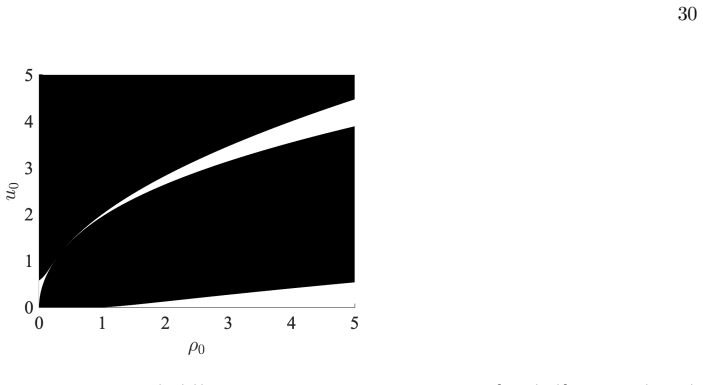
Elevation waves in the subsonic regime Previously, we examined the bifurcation of depression waves from the zero velocity limit (from CI waves) for ρ0 > ρ i 0, where ρi 0 is the intercept of the existence boundary of depression waves, d(ρ0). Naturally, it is interesting to look at possible family of homoclinic waves bifurcating from CI waves for ρ0 < ρ i
-
[2]
In the small velocity limit, we have approximate solutions given by Eq
For the remainder of this discussion, we focus on the Wadati potential function w(x) = sech( x), for which ρi 0 = 0 .25. In the small velocity limit, we have approximate solutions given by Eq. ( 43). Notably, these waves have an elevation (depression) density (shifted momentum) profile. Moreover, the shifted momentum is sign indefinite, in contrast to the...
-
[3]
Large density, rapidly varying potential: the dark soliton limit In the previous sections, we noted the existence of distinct families of non-resonant stationary waves (in the subsonic regime) of the depression and elevation types. In this section, we consider the regime of large density and a rapidly 12 varying Wadati potential, and demonstrate that the ...
-
[4]
( 51) are Rj(y) → 0, M j(y) → 0, |y| → 0
(52) The boundary conditions for eq. ( 51) are Rj(y) → 0, M j(y) → 0, |y| → 0. (53) The self adjoint linear operator d2 dy2 + V (y) in eq. ( 51a) subject to decaying boundary conditions admits a one- dimensional kernel spanned by H(y) = tanh( √r0y)sech2(√r0y). (54) One can check that F1(y) is even. Consequently, its L2(R) inner product with the odd kernel...
-
[5]
In this regime, the solution structure is dominated by the Wadati potential function
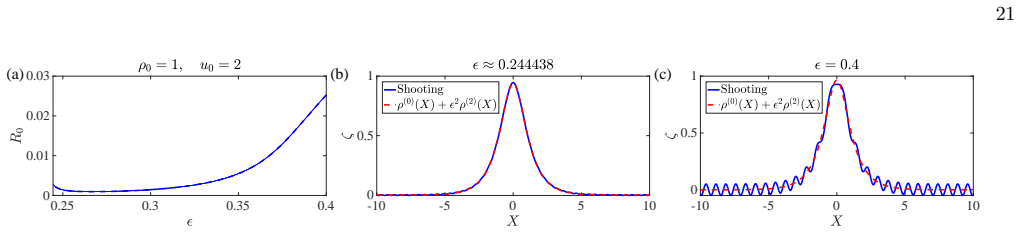
Small density regime We now consider solutions for small density with ρ(x) = O(ϵ), u0 = O(1) for 0 < ϵ ≪ 1, x ∈ R. In this regime, the solution structure is dominated by the Wadati potential function. Inserting the asymptotic expansion ρ(x) = ϵR1(x) + ϵ2R2(x) + · · · , m (x) = ϵM1(x) + ϵ2M2(x) + · · · , (61) into eq. ( 10), using ( 21) with ρ0 = ϵr0 while...
-
[6]
Here, the spatial dynamics associated with the Wadati ODE system ( 35) reduces to −8µρ − 4A ≈ 4w(x)m(x), m ′(x) = −w(x)ρ′(x), (71) at leading order
Resonant homoclinics in the large |µ| regime A regime of particular interest, due to its analytical tractability, is that of the large propagation constant, |µ| = ρ0 + u2 0/2 ≫ 1, and large A = ρ0u2 0 + (1/2)ρ2 0 ≫ 1. Here, the spatial dynamics associated with the Wadati ODE system ( 35) reduces to −8µρ − 4A ≈ 4w(x)m(x), m ′(x) = −w(x)ρ′(x), (71) at leadi...
-
[7]
However, as explicated in sec
Resonant homoclinics in a slowly varying potential Recall from the hydraulic section IV B with slowly varying Wadati potential function w(ϵx), 0 < ϵ ≪ 1, that boundary conditions satisfying u0 > √ f1,2(ρ0) are supersonic and there exist approximate elevation wave solutions. However, as explicated in sec. IV A, homoclinic solutions to the equilibrium (ρ0, ...
-
[8]
We utilize their asymptotic reductions in the hydraulic regime as appropriate initial guesses (in the regime where ρ+ ≫ 1)
Anti-kinks For a representative potential w = sech2(x), we compute the family of Type-II heteroclinic antikinks. We utilize their asymptotic reductions in the hydraulic regime as appropriate initial guesses (in the regime where ρ+ ≫ 1). Performing the parametric continuation (in ρ+) towards the small density limit, we trace the curve u+(ρ+) of existence f...
-
[9]
Given this symmetry, we expect density kink solutions to exist alongside their antikink counterparts for the same chemical potential µ
Kinks For PT-symmetric potentials, we saw that if ψ(x, t) is a solution, so is ψ∗(−x, −t). Given this symmetry, we expect density kink solutions to exist alongside their antikink counterparts for the same chemical potential µ. The density profiles of both kink-antikink pairs are shown in Fig. 19 (b). Their corresponding profiles are also shown on the zero...
-
[10]
transcriticality
Type-II heteroclinic solutions for other W adati potential functions To gain further insight into the properties of Type-II solutions for a general w(x), we compute a family corresponding to w = sech( x). We display the curve of existence for the left and right asymptotic states of this family in Fig. 20. Note the slower decay of sech(x) compared to sech2...
-
[11]
For the case when u0 = 2√ρ0 (i.e
+ · · · , corresponding to an elevation (depression) homoclinic when u0 ≫ √ρ0 (u0 ≪ √ρ0). For the case when u0 = 2√ρ0 (i.e. u0 = √f1(ρ0))(µ2 = 2A), the solution can be written compactly as ρ(X) = 1 9 (√ 12 √ 2Aw2(X) + 4w4(X) + 3 √ 2A + 2w2(X) ) , m (X) = √ F (ρ(X)). (A7) Appendix B: Hydraulic analysis of the conservative case with repulsive potential We h...
-
[12]
Thus, all three roots of the cubic equation in eq
(B3) In particular, given the positive definiteness of w(X) > 0, it can be shown that the spatial discriminant is always sign definite and is also positive when ρ0 > 0 (D(X) > 0). Thus, all three roots of the cubic equation in eq. ( B2) are real- valued (and do not touch for any finite X), distinguishing this case from the conservative case with attractiv...
-
[13]
C. M. Bender and S. Boettcher, Physical review letters 80, 5243 (1998)
1998
-
[14]
El-Ganainy, K
R. El-Ganainy, K. G. Makris, M. Khajavikhan, Z. H. Musslimani, S. Rotter, and D. N. Christodoulides, Nature Physics 14, 11 (2018)
2018
-
[15]
V. V. Konotop, J. Yang, and D. A. Zezyulin, Reviews of Modern Physics 88, 035002 (2016)
2016
-
[16]
A. A. Zyablovsky, A. P. Vinogradov, A. A. Pukhov, A. V. Dorofeenko, and A. A. Lisyansky, Physics-Uspekhi 57, 1063 (2014)
2014
-
[17]
C. M. Bender, PT symmetry: In quantum and classical physics (World Scientific, 2019). 33
2019
-
[18]
C. Hang, G. Huang, and V. V. Konotop, Physical review letters 110, 083604 (2013)
2013
-
[19]
C. E. Rüter, K. G. Makris, R. El-Ganainy, D. N. Christodoulides, M. Segev, and D. Kip, Nature physics 6, 192 (2010)
2010
-
[20]
Chong, L
Y. Chong, L. Ge, H. Cao, and A. D. Stone, Physical review letters 105, 053901 (2010)
2010
-
[21]
Ramezani, T
H. Ramezani, T. Kottos, R. El-Ganainy, and D. N. Christodoulides, Physical Review A—Atomic, Molecular, and Optical Physics 82, 043803 (2010)
2010
-
[22]
K. G. Makris, A. Brandstötter, P. Ambichl, Z. H. Musslimani, and S. Rotter, Light: Science & Applications 6, e17035 (2017)
2017
-
[23]
D. R. Smith, J. B. Pendry, and M. C. Wiltshire, science 305, 788 (2004)
2004
-
[24]
Z. Gu, H. Gao, P.-C. Cao, T. Liu, X.-F. Zhu, and J. Zhu, Physical Review Applied 16, 057001 (2021)
2021
-
[25]
Achilleos, G
V. Achilleos, G. Theocharis, O. Richoux, and V. Pagneux, Physical Review B 95, 144303 (2017)
2017
-
[26]
Zhang, Y
L. Zhang, Y. Yang, Y. Ge, Y.-J. Guan, Q. Chen, Q. Yan, F. Chen, R. Xi, Y. Li, D. Jia, et al., Nature communications 12, 6297 (2021)
2021
-
[27]
Rivet, A
E. Rivet, A. Brandstötter, K. G. Makris, H. Lissek, S. Rotter, and R. Fleury, Nature Physics 14, 942 (2018)
2018
-
[28]
Lien, Y.-N
J.-Y. Lien, Y.-N. Chen, N. Ishida, H.-B. Chen, C.-C. Hwang, and F. Nori, Physical Review B 91, 024511 (2015)
2015
-
[29]
Byrnes, N
T. Byrnes, N. Y. Kim, and Y. Yamamoto, Nature Physics 10, 803 (2014)
2014
-
[30]
Wadati, Journal of the Physical Society of Japan 77, 074005 (2008)
M. Wadati, Journal of the Physical Society of Japan 77, 074005 (2008)
2008
-
[31]
J. T. Cole, K. G. Makris, Z. H. Musslimani, D. N. Christodoulides, and S. Rotter, Physica D: Nonlinear Phenomena 336, 53 (2016)
2016
-
[32]
Komis, S
I. Komis, S. Sardelis, Z. H. Musslimani, and K. G. Makris, Physical Review E 102, 032203 (2020)
2020
-
[33]
K. G. Makris, A. Brandstötter, I. Krešić, and S. Rotter, in Frontiers in Optics (Optical Society of America, 2019), pp. JTu3A–36
2019
-
[34]
K. G. Makris, I. Krešić, A. Brandstötter, and S. Rotter, Optica 7, 619 (2020)
2020
-
[35]
K. G. Makris, Z. H. Musslimani, D. N. Christodoulides, and S. Rotter, Nature communications 6, 7257 (2015)
2015
-
[36]
K. G. Makris, Z. H. Musslimani, D. N. Christodoulides, and S. Rotter, IEEE Journal of Selected Topics in Quantum Electronics 22, 42 (2016)
2016
-
[37]
N. Ossi, S. Chandramouli, Z. H. Musslimani, and K. G. Makris, Optics Letters 47, 1001 (2022)
2022
-
[38]
D. A. Zezyulin, Physical Review E 106, 054209 (2022)
2022
-
[39]
Chandramouli, N
S. Chandramouli, N. Ossi, Z. H. Musslimani, and K. G. Makris, Nonlinearity 36, 6798 (2023)
2023
-
[40]
Nixon and J
S. Nixon and J. Yang, Optics Letters 41, 2747 (2016)
2016
-
[41]
Barashenkov, D
I. Barashenkov, D. Zezyulin, and V. Konotop, in Non-Hermitian Hamiltonians in Quantum Physics: Selected Contributions from the 15th International Conference on Non-Hermitian Hamiltonians in Quantum Physics, Palermo, Italy, 18-23 May 2015 (Springer, 2016), pp. 143–155
2015
-
[42]
E. N. Tsoy, I. M. Allayarov, and F. K. Abdullaev, Optics Letters 39, 4215 (2014)
2014
-
[43]
Klaus and J
M. Klaus and J. K. Shaw, Physical Review E 65, 036607 (2002)
2002
-
[44]
Yang, Studies in Applied Mathematics 147, 4 (2021)
J. Yang, Studies in Applied Mathematics 147, 4 (2021)
2021
-
[45]
R. W. Boyd, Nonlinear Optics (Academic Press, San Diego, CA, 2003)
2003
-
[46]
L. P. Pitaevskii and S. Stringari, Bose-Einstein Condensation (Clarendon, 2003), ISBN 0-19-850719-4 978-0-19-850719-2
2003
-
[47]
G. A. El and M. A. Hoefer, Physica D: Nonlinear Phenomena 333, 11 (2016)
2016
-
[48]
R. H. J. Grimshaw and N. F. Smyth, J. Fluid Mech 169, 429–464 (1986)
1986
-
[49]
A. M. Leszczyszyn, G. A. El, Yu. G. Gladush, and A. M. Kamchatnov, Phys. Rev. A 79, 063608 (2009)
2009
-
[50]
Lee and R
S.-J. Lee and R. H. J. Grimshaw, Physics of Fluids A: Fluid Dynamics 2, 194 (1990)
1990
-
[51]
S.-J. Lee, G. T. Yates, and T. Y. Wu, Journal of Fluid Mechanics 199, 569 (1989)
1989
-
[53]
Engels and C
P. Engels and C. Atherton, Phys. Rev. Lett. 99, 160405 (2007)
2007
-
[54]
T. Y. Wu, Journal of the Engineering Mechanics Division 107, 501 (1981)
1981
-
[55]
C. J. Gorter, Progress in low temperature physics , vol. 3 (Elsevier, 1961)
1961
-
[56]
Wilks, The properties of liquid and solid helium (Oxford University Press, 1967)
J. Wilks, The properties of liquid and solid helium (Oxford University Press, 1967)
1967
-
[57]
V. V. Konotop and D. A. Zezyulin, Optics Letters 39, 5535 (2014)
2014
-
[58]
Hakim, Phys
V. Hakim, Phys. Rev. E 55, 2835 (1997)
1997
-
[59]
J. Yang, J. Comput. Phys. 228, 7007 (2009)
2009
-
[60]
G. El, M. Hoefer, and M. Shearer, SIAM Rev. 59, 3 (2017)
2017
-
[61]
Pomeau, A
Y. Pomeau, A. Ramani, and B. Grammaticos, Physica D: Nonlinear Phenomena 31, 127 (1988)
1988
-
[62]
Yang, Nonlinear Waves in Integrable and Nonintegrable Systems , Mathematical Modeling and Computation (Society for Industrial and Applied Mathematics, 2010), ISBN 978-0-89871-705-1
J. Yang, Nonlinear Waves in Integrable and Nonintegrable Systems , Mathematical Modeling and Computation (Society for Industrial and Applied Mathematics, 2010), ISBN 978-0-89871-705-1
2010
-
[63]
T. R. Akylas and R. H. J. Grimshaw, J. Fluid Mech. 242, 279 (1992)
1992
-
[64]
Akylas and T.-S
T. Akylas and T.-S. Yang, Studies in Applied Mathematics 94, 1 (1995)
1995
-
[65]
Grimshaw, in Asymptotic methods in fluid mechanics: survey and recent advances (Springer, 2010), pp
R. Grimshaw, in Asymptotic methods in fluid mechanics: survey and recent advances (Springer, 2010), pp. 71–120
2010
-
[66]
El, Dispersive Hydrodynamics and Modulation Theory (2017)
G. El, Dispersive Hydrodynamics and Modulation Theory (2017)
2017
-
[67]
Hang and G
C. Hang and G. Huang, Advances in Physics: X 2, 737 (2017)
2017
-
[68]
C. Hang, G. Gabadadze, and G. Huang, Physical Review A 95, 023833 (2017)
2017
-
[69]
A. Amo, D. Sanvitto, F. P. Laussy, D. Ballarini, E. del Valle, M. D. Martin, A. Lemaître, J. Bloch, D. N. Krizhanovskii, M. S. Skolnick, et al., Nature 457, 291 (2009)
2009
-
[70]
A. M. Kamchatnov and Y. V. Kartashov, Europhysics Letters 97, 10006 (2012)
2012
-
[71]
W. Wan, S. Muenzel, and J. W. Fleischer, Phys. Rev. Lett. 104, 073903 (2010)
2010
discussion (0)
Sign in with ORCID, Apple, or X to comment. Anyone can read and Pith papers without signing in.