Recognition: 2 theorem links
· Lean TheoremSensor Placement for Tsunami Early Warning via Large-Scale Bayesian Optimal Experimental Design
Pith reviewed 2026-05-10 16:39 UTC · model grok-4.3
The pith
Reformulating Bayesian optimal experimental design as dense matrix subset selection enables scalable sensor network optimization for tsunami early warning on large GPU systems.
A machine-rendered reading of the paper's core claim, the machinery that carries it, and where it could break.
Core claim
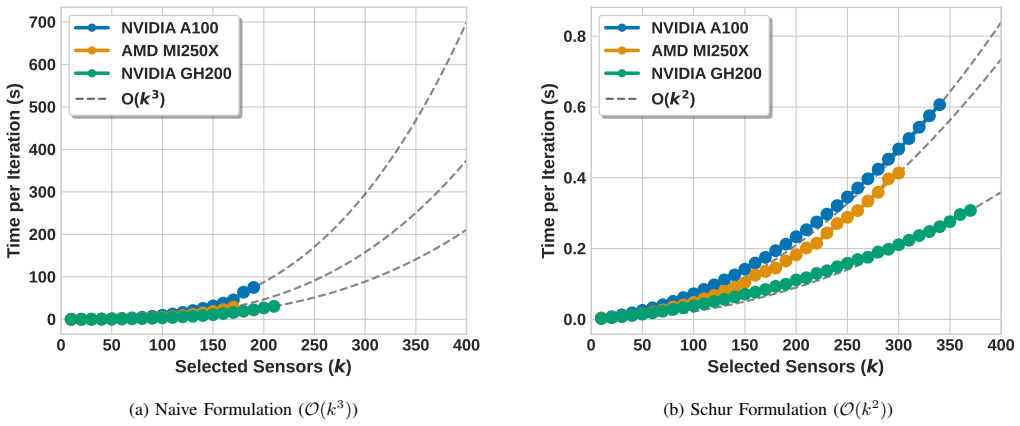
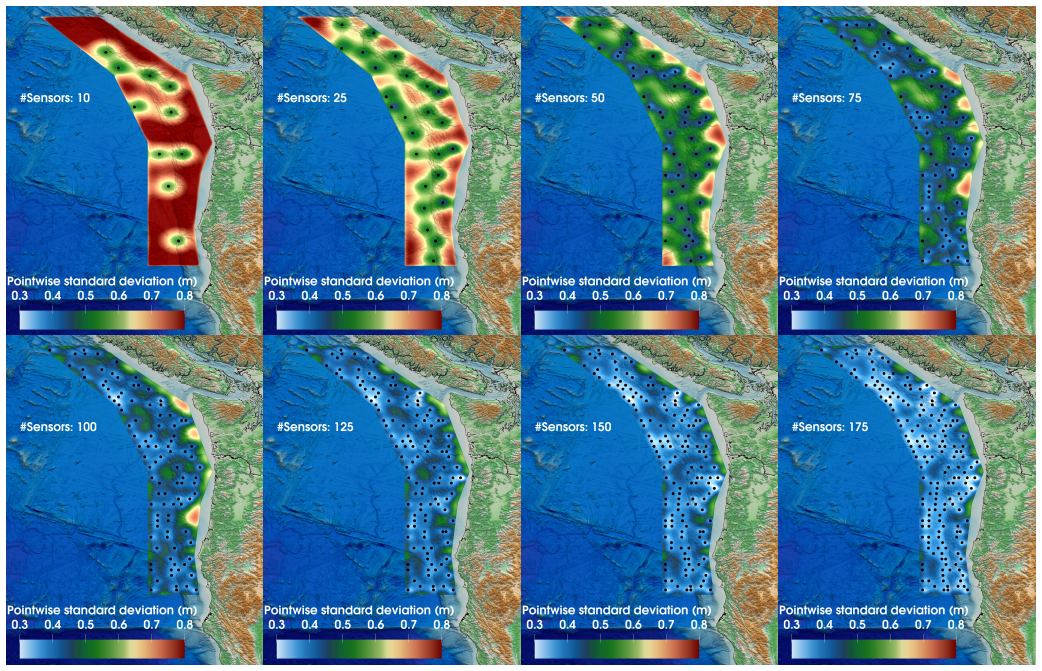
By treating the tsunami system as linear time-invariant, the Bayesian OED problem reduces to combinatorial subset selection on a dense data matrix without loss of accuracy. The authors introduce a multi-GPU greedy algorithm using Schur complement updates and a pipelined approach that overlaps I/O with computation. This yields near-perfect weak and strong scaling on hundreds of GPUs and produces an optimized 175-sensor network that minimizes uncertainty in a parameter field exceeding one billion degrees of freedom for a large tsunami forecasting model.
What carries the argument
The central mechanism is the data-space reformulation of the inverse problem for linear time-invariant hyperbolic PDE systems, which converts Bayesian OED into dense matrix subset selection solved by a Schur-complement-update greedy algorithm on multi-GPU hardware.
If this is right
- Optimized placements of 175 sensors can minimize uncertainty in source and seafloor parameters for real-time tsunami forecasting.
- The matrix-subset formulation supports application to other large inverse problems governed by linear wave equations.
- Near-perfect scaling on hundreds of GPUs makes it practical to optimize networks with more sensors or higher-resolution models.
- The greedy algorithm can be reused for related experimental design tasks in wave-propagation systems.
Where Pith is reading between the lines
- The method could support adaptive sensor networks that update placements as new data arrives during an event.
- Successive linearizations around current states might extend the framework to mildly nonlinear tsunami behaviors.
- The subset-selection view may link to similar design problems in other geophysical monitoring applications.
- Integration with surrogate models could reduce the cost of building the required dense matrices for even larger systems.
Load-bearing premise
The tsunami wave propagation can be modeled as a linear time-invariant system with enough accuracy that the data-space reformulation gives the same optimal sensor placements as the original problem.
What would settle it
Testing the sensors chosen by the method in a high-fidelity nonlinear tsunami simulation and finding that they reduce forecast uncertainty no more than a random selection of the same number of sensors.
Figures


read the original abstract
Real-time tsunami early warning relies on distributed sensor networks to infer seismic sources and seafloor motion. Optimizing these networks via Bayesian optimal experimental design (OED) is exceptionally challenging for systems governed by hyperbolic partial differential equations, which lack the spectral decay required by standard low-rank approximations. We present a scalable Bayesian OED framework for linear time-invariant systems. By reformulating the inverse problem in the data space, we transform OED into dense matrix subset selection. We propose a multi-GPU, Schur-complement-update-based, greedy algorithm that solves the OED problem using a pipelined approach that fully overlaps I/O with GPU computations. Our framework achieves near-perfect weak and strong scaling across hundreds of GPUs on Perlmutter and Frontier. Applied to the 2025 Gordon Bell Prize-winning digital twin for tsunami forecasting in the Cascadia Subduction Zone, we optimize a 175-sensor network, minimizing the uncertainty of a parameter field with over one billion degrees of freedom.
Editorial analysis
A structured set of objections, weighed in public.
Referee Report
Summary. The manuscript proposes a Bayesian optimal experimental design (OED) framework for linear time-invariant (LTI) systems governed by hyperbolic PDEs. By reformulating the inverse problem in data space, OED is transformed into dense matrix subset selection. A multi-GPU greedy algorithm based on Schur-complement updates with pipelined I/O-computation overlap is presented, claiming near-perfect weak and strong scaling on hundreds of GPUs on Perlmutter and Frontier. The method is applied to optimize a 175-sensor network minimizing uncertainty in a parameter field with over one billion degrees of freedom for the 2025 Gordon Bell Prize-winning Cascadia Subduction Zone tsunami digital twin.
Significance. If the LTI assumption is justified and the scaling claims are substantiated with validation, the work advances scalable algorithms for Bayesian OED in high-dimensional inverse problems, with direct relevance to real-time geophysical monitoring and disaster early warning. The combination of exact data-space reformulation for hyperbolic systems and demonstrated exascale performance on a production digital twin represents a concrete contribution to distributed computing methods for large-scale experimental design.
major comments (2)
- [Abstract] Abstract: The central technical contribution relies on restricting to LTI systems to obtain an exact reformulation as dense matrix subset selection whose optimality is determined by the Gram matrix of the observation operator. The application to the Cascadia tsunami digital twin (based on shallow-water equations) is presented without quantifying the modeling error from nonlinear advection or bathymetry terms, which directly affects whether the reported 175-sensor network achieves the claimed uncertainty minimization.
- [Abstract] Abstract and results: The claims of successful scaling and application are stated without error analysis, baseline comparisons (e.g., against random selection or standard greedy without Schur updates), or metrics assessing greedy approximation quality. This absence makes the assertions of near-perfect weak/strong scaling across hundreds of GPUs and effective uncertainty reduction for the >1B-DOF parameter field unverifiable from the provided text.
Simulated Author's Rebuttal
We thank the referee for their constructive and detailed feedback. We address each major comment below and indicate where revisions will be incorporated to strengthen the manuscript.
read point-by-point responses
-
Referee: [Abstract] Abstract: The central technical contribution relies on restricting to LTI systems to obtain an exact reformulation as dense matrix subset selection whose optimality is determined by the Gram matrix of the observation operator. The application to the Cascadia tsunami digital twin (based on shallow-water equations) is presented without quantifying the modeling error from nonlinear advection or bathymetry terms, which directly affects whether the reported 175-sensor network achieves the claimed uncertainty minimization.
Authors: We agree that the shallow-water equations contain nonlinear advection and variable bathymetry terms, so the LTI assumption constitutes an approximation obtained by linearization around a reference state. This linearization is standard in tsunami early-warning literature for small-to-moderate perturbations. Nevertheless, we acknowledge that an explicit quantification or bound on the resulting modeling error would improve the presentation. In the revised manuscript we will add a dedicated paragraph in the application section that (i) states the linearization procedure used in the digital twin, (ii) cites prior studies comparing linear and nonlinear tsunami propagation for sensor-placement purposes, and (iii) discusses the expected impact on the reported uncertainty reduction for the 175-sensor network. revision: yes
-
Referee: [Abstract] Abstract and results: The claims of successful scaling and application are stated without error analysis, baseline comparisons (e.g., against random selection or standard greedy without Schur updates), or metrics assessing greedy approximation quality. This absence makes the assertions of near-perfect weak/strong scaling across hundreds of GPUs and effective uncertainty reduction for the >1B-DOF parameter field unverifiable from the provided text.
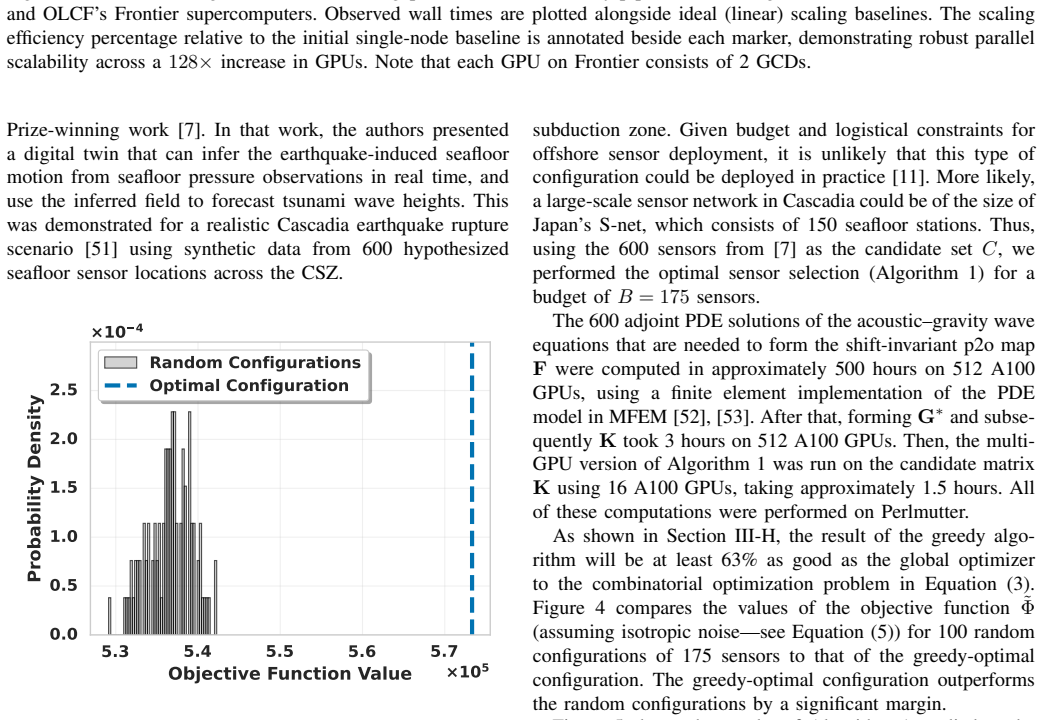
Authors: The abstract is intentionally concise; the full manuscript contains dedicated subsections on validation that include (a) error analysis of the greedy Schur-complement algorithm with respect to the exact combinatorial optimum on smaller instances, (b) direct comparisons against random selection and the classical greedy algorithm without pipelined Schur updates, and (c) quantitative metrics (suboptimality gap, wall-clock time, and weak/strong scaling efficiencies) on both Perlmutter and Frontier. To address the referee’s concern about verifiability from the abstract alone, we will expand the abstract with one or two sentences that explicitly reference these validation results and the achieved scaling efficiencies. revision: partial
Circularity Check
No circularity; reformulation is self-contained under explicit LTI assumption
full rationale
The paper's derivation chain begins with the explicit modeling choice to restrict to linear time-invariant systems, which directly permits rewriting the Bayesian inverse problem as dense matrix subset selection via the data-space Gram matrix. This step is a standard algebraic consequence of linearity and time-invariance rather than a self-referential definition or a fitted parameter renamed as a prediction. The subsequent multi-GPU Schur-complement greedy algorithm and its scaling claims follow from standard parallel linear-algebra techniques applied to the resulting dense matrices; no load-bearing step reduces to a self-citation chain, an ansatz smuggled from prior work, or a uniqueness theorem imported from the authors themselves. The application to the Cascadia digital twin inherits optimality only under the stated LTI premise, which is presented as an assumption rather than derived from the paper's own outputs. The overall contribution is therefore an algorithmic reformulation whose correctness is independently verifiable from the LTI premise and does not collapse to its own inputs by construction.
Axiom & Free-Parameter Ledger
axioms (1)
- domain assumption The tsunami forecasting system can be modeled as a linear time-invariant system governed by hyperbolic PDEs.
Lean theorems connected to this paper
-
IndisputableMonolith/Cost/FunctionalEquation.leanwashburn_uniqueness_aczel unclearBy reformulating the inverse problem in the data space, we transform OED into dense matrix subset selection... Schur-complement-update-based, greedy algorithm
-
IndisputableMonolith/Foundation/RealityFromDistinction.leanreality_from_one_distinction unclearreal-time Bayesian inference for extreme-scale LTI systems... data-space Hessian matrix (K)
Reference graph
Works this paper leans on
-
[1]
Earthquake early warning in Japan: Warning the general public and future prospects,
O. Kamigaichi, M. Saito, K. Doi, T. Matsumori, S. Tsukada, K. Takeda, T. Shimoyama, K. Nakamura, M. Kiyomoto, and Y . Watanabe, “Earthquake early warning in Japan: Warning the general public and future prospects,”Seismological Research Letters, vol. 80, no. 5, pp. 717–726, 2009. [Online]. Available: https: //doi.org/10.1785/gssrl.80.5.717
-
[2]
B. Hirshorn, S. Weinstein, D. Wang, K. Koyanagi, N. Becker, and C. McCreery,Earthquake source parameters: Rapid estimates for tsunami forecasts and warnings. Springer Berlin Heidelberg, 2020, pp. 299–333. [Online]. Available: https://doi.org/10.1007/978-3-642-27737-5 160-2
-
[3]
Developing a warning system for inbound tsunamis from the Cascadia Subduction Zone,
R. J. LeVeque, P. Bodin, G. Cram, B. W. Crowell, F. I. Gonz ´alez, M. Harrington, D. Manalang, D. Melgar, D. A. Schmidt, J. E. Vidale, C. J. V ogl, and W. S. D. Wilcock, “Developing a warning system for inbound tsunamis from the Cascadia Subduction Zone,” inOCEANS 2018 MTS/IEEE Charleston. IEEE, 2018, pp. 1–10. [Online]. Available: https://doi.org/10.1109...
-
[4]
0.5 petabyte simu lation of a 45-qubit quantum circuit,
C. Uphoff, S. Rettenberger, M. Bader, E. H. Madden, T. Ulrich, S. Wollherr, and A.-A. Gabriel, “Extreme scale multi-physics simulations of the tsunamigenic 2004 Sumatra megathrust earthquake,” inProceedings of the International Conference for High Performance Computing, Networking, Storage and Analysis, ser. SC ’17, 2017, pp. 1–16. [Online]. Available: ht...
-
[5]
Near-field tsunami forecasting from cabled ocean bottom pressure data,
H. Tsushima, R. Hino, H. Fujimoto, Y . Tanioka, and F. Imamura, “Near-field tsunami forecasting from cabled ocean bottom pressure data,”Journal of Geophysical Research: Solid Earth, vol. 114, no. B6,
-
[6]
Available: https://doi.org/10.1029/2008JB005988
[Online]. Available: https://doi.org/10.1029/2008JB005988
-
[7]
Chapter 6 - Earthquake and tsunami early warning with GNSS data,
B. W. Crowell, “Chapter 6 - Earthquake and tsunami early warning with GNSS data,” inGNSS Monitoring of the Terrestrial Environment, Y . Aoki and C. Kreemer, Eds. Elsevier, 2024, pp. 111–127. [Online]. Available: https://doi.org/10.1016/B978-0-323-95507-2.00004-9
-
[8]
Multiscale light- matter dynamics in quantum materials: From electrons to topological superlattices,
S. Henneking, S. Venkat, V . Dobrev, J. Camier, T. Kolev, M. Fernando, A.-A. Gabriel, and O. Ghattas, “Real-time Bayesian inference at extreme scale: A digital twin for tsunami early warning applied to the Cascadia Subduction Zone,” inProceedings of the International Conference for High Performance Computing, Networking, Storage and Analysis, ser. SC ’25....
-
[9]
National Academies of Sciences, Engineering, and Medicine, Foundational Research Gaps and Future Directions for Digital Twins. Washington, DC: The National Academies Press, 2024. [Online]. Available: https://doi.org/10.17226/26894
-
[10]
Summary of coastal geologic evidence for past great earthquakes at the Cascadia Subduction Zone,
B. F. Atwater, A. R. Nelson, J. J. Clague, G. A. Carver, D. K. Yamaguchi, P. T. Bobrowsky, J. Bourgeois, M. E. Darienzo, W. C. Grant, E. Hemphill-Haley, H. M. Kelsey, G. C. Jacoby, S. P. Nishenko, S. P. Palmer, C. D. Peterson, and M. A. Reinhart, “Summary of coastal geologic evidence for past great earthquakes at the Cascadia Subduction Zone,”Earthquake S...
-
[11]
C. Goldfinger, C. H. Nelson, A. E. Morey, J. E. Johnson, J. R. Patton, E. B. Karabanov, J. Gutierrez-Pastor, A. T. Eriksson, E. Gracia, G. Dunhill, R. J. Enkin, A. Dallimore, and T. Vallier, “Turbidite event history—Methods and implications for Holocene paleoseismicity of the Cascadia Subduction Zone,” U.S. Geological Survey, Tech. Rep., 2012. [Online]. A...
-
[12]
Earthquake and tsunami early warning on the Cascadia Subduction Zone: A feasibility study for an offshore geophysical monitoring network,
D. Schmidt, W. Wilcock, R. J. LeVeque, F. Gonzalez, G. Cram, D. Manalang, M. Harrington, E. Roland, and P. Bodin, “Earthquake and tsunami early warning on the Cascadia Subduction Zone: A feasibility study for an offshore geophysical monitoring network,” University of Washington, Tech. Rep., 2019. [Online]. Available: https://hdl.handle.net/1773/50968
2019
-
[13]
G. E. Hilley, E. E. Brodsky, D. Roman, D. J. Shillington, M. Brudzinski, M. Behn, H. Tobin, and the SZ4D RCN, “SZ4D implementation plan,”Stanford Digital Repository, 2022. [Online]. Available: https://doi.org/10.25740/hy589fc7561
-
[14]
C. R. Barnes, M. M. R. Best, F. R. Johnson, and B. Pirenne,NEPTUNE Canada: Installation and initial operation of the world’s first regional cabled ocean observatory. Springer Berlin Heidelberg, 2015, pp. 415–
2015
-
[15]
Available: https://doi.org/10.1007/978-3-642-11374-1 16
[Online]. Available: https://doi.org/10.1007/978-3-642-11374-1 16
-
[16]
MOWLAS: NIED observation network for earthquake, tsunami and volcano,
S. Aoi, Y . Asano, T. Kunugi, T. Kimura, K. Uehira, N. Takahashi, H. Ueda, K. Shiomi, T. Matsumoto, and H. Fujiwara, “MOWLAS: NIED observation network for earthquake, tsunami and volcano,” Earth, Planets and Space, vol. 72, no. 1, pp. 1–31, 2020. [Online]. Available: https://doi.org/10.1186/s40623-020-01250-x
-
[17]
Optimal experimental design: Formulations and computations,
X. Huan, J. Jagalur, and Y . Marzouk, “Optimal experimental design: Formulations and computations,”Acta Numerica, vol. 33, pp. 715–840,
-
[18]
Available: https://doi.org/10.1017/S0962492924000023
[Online]. Available: https://doi.org/10.1017/S0962492924000023
-
[19]
T. Isaac, N. Petra, G. Stadler, and O. Ghattas, “Scalable and efficient algorithms for the propagation of uncertainty from data through inference to prediction for large-scale problems, with application to flow of the Antarctic ice sheet,”Journal of Computational Physics, vol. 296, pp. 348–368, 2015. [Online]. Available: https: //doi.org/10.1016/j.jcp.2015.04.047
-
[20]
L. Seelinger, A. Reinarz, L. Rannabauer, M. Bader, P. Bastian, and R. Scheichl, “High performance uncertainty quantification with parallelized multilevel Markov chain Monte Carlo,” inProceedings of the International Conference for High Performance Computing, Networking, Storage and Analysis, ser. SC ’21, 2021, pp. 1–15. [Online]. Available: https://doi.or...
-
[21]
Learning physics-based models from data: Perspectives from inverse problems and model reduction,
O. Ghattas and K. Willcox, “Learning physics-based models from data: Perspectives from inverse problems and model reduction,” Acta Numerica, vol. 30, pp. 445–554, 2021. [Online]. Available: https://doi.org/10.1017/S0962492921000064
-
[22]
A. Alexanderian, N. Petra, G. Stadler, and I. Sunseri, “Optimal design of large-scale Bayesian linear inverse problems under reducible model uncertainty: Good to know what you don’t know,”SIAM/ASA Journal on Uncertainty Quantification, vol. 9, no. 1, pp. 163–184, 2021. [Online]. Available: https://doi.org/10.1137/20M1347292
-
[23]
K. Koval, A. Alexanderian, and G. Stadler, “Optimal experimental design under irreducible uncertainty for linear inverse problems governed by PDEs,”Inverse Problems, vol. 36, no. 7, p. 075007, 2020. [Online]. Available: https://doi.org/10.1088/1361-6420/ab89c5
-
[24]
A. Alexanderian, N. Petra, G. Stadler, and O. Ghattas, “A-optimal design of experiments for infinite-dimensional Bayesian linear inverse problems with regularizedl 0-sparsification,”SIAM Journal on Scientific Computing, vol. 36, no. 5, pp. A2122–A2148, 2014. [Online]. Available: https://doi.org/10.1137/130933381
-
[25]
Q. Wu, P. Chen, and O. Ghattas, “A fast and scalable computational framework for large-scale high-dimensional Bayesian optimal experimental design,”SIAM/ASA Journal on Uncertainty Quantification, vol. 11, no. 2, pp. 524–551, 2023. [Online]. Available: https://doi.org/10.1137/21M1466499
-
[26]
On Bayesian A- and D-optimal experimental designs in infinite dimensions,
A. Alexanderian, P. J. Gloor, and O. Ghattas, “On Bayesian A- and D-optimal experimental designs in infinite dimensions,”Bayesian Analysis, vol. 11, no. 3, pp. 671–695, 2016. [Online]. Available: https://doi.org/10.1214/15-BA969
-
[27]
Bayesian D-optimal experimental designs via column subset selection,
S. Eswar, V . Rao, and A. K. Saibaba, “Bayesian D-optimal experimental designs via column subset selection,”arXiv preprint arXiv:2402.16000,
-
[28]
Bayesian D-optimal experimental designs via column subset selection,
[Online]. Available: https://doi.org/10.48550/arXiv.2402.16000
-
[29]
Structured column subset selection for Bayesian optimal experimental design,
H. D ´ıaz, A. K. Saibaba, S. Eswar, V . Rao, and Z. Di, “Structured column subset selection for Bayesian optimal experimental design,” arXiv preprint arXiv:2506.00336, 2025. [Online]. Available: https: //doi.org/10.48550/arXiv.2506.00336
-
[30]
C. Greif and K. Urban, “Decay of the Kolmogorov N-width for wave problems,”Applied Mathematics Letters, vol. 96, pp. 216–222, 2019. [Online]. Available: https://doi.org/10.1016/j.aml.2019.05.013
-
[31]
S. Henneking, S. Venkat, and O. Ghattas, “Goal-oriented real-time Bayesian inference for linear autonomous dynamical systems with application to digital twins for tsunami early warning,”Journal of Computational Physics, vol. 552, p. 114682, 2026. [Online]. Available: https://doi.org/10.1016/j.jcp.2026.114682
-
[32]
S. Venkat, M. Fernando, S. Henneking, and O. Ghattas, “Fast and scalable FFT-based GPU-accelerated algorithms for block-triangular Toeplitz matrices with application to linear inverse problems governed by autonomous dynamical systems,”SIAM Journal on Scientific Computing, vol. 47, no. 5, pp. B1201–B1226, 2025. [Online]. Available: https://doi.org/10.1137/...
-
[33]
Sequential Bayesian optimal experimental design via approximate dynamic programming
X. Huan and Y . M. Marzouk, “Sequential Bayesian optimal experimental design via approximate dynamic programming,”arXiv preprint arXiv:1604.08320, 2016. [Online]. Available: https://doi.org/ 10.48550/arXiv.1604.08320
-
[34]
A greedy approach for placement of subsurface aquifer wells in an ensemble filtering framework,
M. E. Gharamti, Y . M. Marzouk, X. Huan, and I. Hoteit, “A greedy approach for placement of subsurface aquifer wells in an ensemble filtering framework,” inDynamic Data-Driven Environmental Systems Science. Springer International Publishing, 2015, pp. 301–309. [Online]. Available: https://doi.org/10.1007/978-3-319-25138-7 27
-
[35]
Inverse problems: A Bayesian perspective,
A. M. Stuart, “Inverse problems: A Bayesian perspective,”Acta Numerica, vol. 19, pp. 451–559, 2010. [Online]. Available: https: //doi.org/10.1017/S0962492910000061
-
[36]
S. Venkat, K. ´Swirydowicz, N. Wolfe, and O. Ghattas, “Mixed- precision performance portability of FFT-based GPU-accelerated algorithms for block-triangular Toeplitz matrices,” inProceedings of the SC’25 Workshops of the International Conference for High Performance Computing, Networking, Storage and Analysis, ser. SC ’25 Workshops, 2025, pp. 1133–1146. [...
-
[37]
The Annals of Mathe- matical Statistics22(1), 79–86 (1951) https://doi.org/10.1214/aoms/1177729694
S. Kullback and R. A. Leibler, “On information and sufficiency,”The Annals of Mathematical Statistics, vol. 22, no. 1, pp. 79–86, 1951. [Online]. Available: https://doi.org/10.1214/aoms/1177729694
-
[38]
Simulation-based optimal Bayesian experimental design for nonlinear systems,
X. Huan and Y . M. Marzouk, “Simulation-based optimal Bayesian experimental design for nonlinear systems,”Journal of Computational Physics, vol. 232, no. 1, pp. 288–317, 2013. [Online]. Available: https://doi.org/10.1016/j.jcp.2012.08.013
-
[39]
D. A. Harville,Matrix Algebra From a Statistician’s Perspective. New York, NY: Springer New York, 1997. [Online]. Available: https://doi.org/10.1007/b98818
-
[40]
Algorithmic complexity: Three NP-hard problems in computational statistics,
W. J. Welch, “Algorithmic complexity: Three NP-hard problems in computational statistics,”Journal of Statistical Computation and Simulation, vol. 15, no. 1, pp. 17–25, 1982. [Online]. Available: https://doi.org/10.1080/00949658208810560
-
[41]
Theoretical Computer Science , keywords =
A. C ¸ ivril and M. Magdon-Ismail, “On selecting a maximum volume sub-matrix of a matrix and related problems,”Theoretical Computer Science, vol. 410, no. 47–49, pp. 4801–4811, 2009. [Online]. Available: https://doi.org/10.1016/j.tcs.2009.06.018
-
[42]
On implementing MPI-IO portably and with high performance,
R. Thakur, W. Gropp, and E. Lusk, “On implementing MPI-IO portably and with high performance,” inProceedings of the Sixth Workshop on I/O in Parallel and Distributed Systems, 1999, pp. 23–32. [Online]. Available: https://doi.org/10.1145/301816.301826
-
[43]
The impact of file systems on MPI-IO scalability,
R. Latham, R. Ross, and R. Thakur, “The impact of file systems on MPI-IO scalability,” inEuropean Parallel Virtual Machine/Message Passing Interface Users’ Group Meeting. Springer, 2004, pp. 87–96. [Online]. Available: https://doi.org/10.1007/978-3-540-30218-6 18
-
[44]
R. Latham and R. Ross, “Parallel I/O basics,” inEarth System Modelling-Volume 4: IO and Postprocessing. Springer, 2013, pp. 3–12. [Online]. Available: https://doi.org/10.1007/978-3-642-36464-8 2
-
[45]
An overview of the HDF5 technology suite and its applications,
M. Folk, G. Heber, Q. Koziol, E. Pourmal, and D. Robinson, “An overview of the HDF5 technology suite and its applications,” in Proceedings of the EDBT/ICDT 2011 Workshop on Array Databases, 2011, pp. 36–47. [Online]. Available: https://doi.org/10.1145/1966895. 1966900
-
[46]
Tuning HDF5 for Lustre file systems,
M. Howison, Q. Koziol, D. Knaak, J. Mainzer, and J. Shalf, “Tuning HDF5 for Lustre file systems,” inWorkshop on Interfaces and Architectures for Scientific Data Storage, 2010. [Online]. Available: https://escholarship.org/uc/item/46r9d86r
2010
-
[47]
A case study for scientific I/O: Improving the FLASH astrophysics code,
R. Latham, C. Daley, W.-k. Liao, K. Gao, R. Ross, A. Dubey, and A. Choudhary, “A case study for scientific I/O: Improving the FLASH astrophysics code,”Computational Science & Discovery, vol. 5, no. 1, p. 015001, 2012. [Online]. Available: https://doi.org/10.1088/ 1749-4699/5/1/015001
2012
-
[48]
T. M. Cover and J. A. Thomas,Elements of Information Theory, 2nd ed. Hoboken, NJ: John Wiley & Sons, 2006. [Online]. Available: https://doi.org/10.1002/047174882X
-
[49]
An exact algorithm for maximum entropy sampling,
C.-W. Ko, J. Lee, and M. Queyranne, “An exact algorithm for maximum entropy sampling,”Operations Research, vol. 43, no. 4, pp. 684–691,
-
[50]
Available: https://doi.org/10.1287/opre.43.4.684
[Online]. Available: https://doi.org/10.1287/opre.43.4.684
-
[51]
G. L. Nemhauser, L. A. Wolsey, and M. L. Fisher, “An analysis of approximations for maximizing submodular set functions—I,” Mathematical Programming, vol. 14, no. 1, pp. 265–294, 1978. [Online]. Available: https://doi.org/10.1007/BF01588971
-
[52]
Submodularity of the expected information gain in infinite-dimensional linear inverse problems,
A. Alexanderian and S. Maio, “Submodularity of the expected information gain in infinite-dimensional linear inverse problems,” arXiv preprint arXiv:2602.09285, 2026. [Online]. Available: https: //doi.org/10.48550/arXiv.2602.09285
-
[53]
Accelerated greedy algorithms for maximizing submodular set functions,
M. Minoux, “Accelerated greedy algorithms for maximizing submodular set functions,” inOptimization Techniques. Lecture Notes in Control and Information Sciences.Berlin, Heidelberg: Springer, 1978, pp. 234–243. [Online]. Available: https://doi.org/10.1007/BFb0006528
-
[54]
Fast Cholesky factorization on GPUs for batch and native modes in MAGMA,
A. Abdelfattah, A. Haidar, S. Tomov, and J. Dongarra, “Fast Cholesky factorization on GPUs for batch and native modes in MAGMA,” Journal of Computational Science, vol. 20, pp. 85–93, 2017. [Online]. Available: https://doi.org/10.1016/j.jocs.2016.12.009
-
[55]
Real-time probabilistic tsunami forecasting in Cascadia from sparse offshore pressure observations,
S. Henneking, F. Kutschera, S. Venkat, A.-A. Gabriel, and O. Ghattas, “Real-time probabilistic tsunami forecasting in Cascadia from sparse offshore pressure observations,”arXiv preprint arXiv:2603.14966, 2026. [Online]. Available: https://doi.org/10.48550/arXiv.2603.14966
-
[56]
J. Glehman, A.-A. Gabriel, T. Ulrich, M. D. Ramos, Y . Huang, and E. O. Lindsey, “Partial ruptures governed by the complex interplay between geodetic slip deficit, rigidity, and pore fluid pressure in 3D Cascadia dynamic rupture simulations,”Seismica, vol. 2, no. 4, 2025. [Online]. Available: https://doi.org/10.26443/seismica.v2i4.1427
-
[57]
R. Anderson, J. Andrej, A. Barker, J. Bramwell, J.-S. Camier, J. Cerveny, V . Dobrev, Y . Dudouit, A. Fisher, T. Kolev, W. Pazner, M. Stowell, V . Tomov, I. Akkerman, J. Dahm, D. Medina, and S. Zampini, “MFEM: A modular finite element methods library,” Computers & Mathematics with Applications, vol. 81, pp. 42–74, 2021. [Online]. Available: https://doi.or...
-
[58]
Accelerating High-Order Finite Element Simulations at Extreme Scale with FP64 Tensor Cores
J. Tu, I. Karlin, J. Camier, V . Dobrev, T. Kolev, S. Henneking, and O. Ghattas, “Accelerating high-order finite element simulations at extreme scale with FP64 tensor cores,”arXiv preprint arXiv:2603.09038, 2026, To appear in Proceedings of ISC High Performance 2026. [Online]. Available: https://doi.org/10.48550/arXiv.2603.09038
work page internal anchor Pith review Pith/arXiv arXiv doi:10.48550/arxiv.2603.09038 2026
discussion (0)
Sign in with ORCID, Apple, or X to comment. Anyone can read and Pith papers without signing in.