Recognition: unknown
TAIHRI: Task-Aware 3D Human Keypoints Localization for Close-Range Human-Robot Interaction
Pith reviewed 2026-05-10 17:30 UTC · model grok-4.3
The pith
A vision-language model localizes task-critical 3D human body parts for robots by turning positions into discrete tokens for next-token prediction.
A machine-rendered reading of the paper's core claim, the machinery that carries it, and where it could break.
Core claim
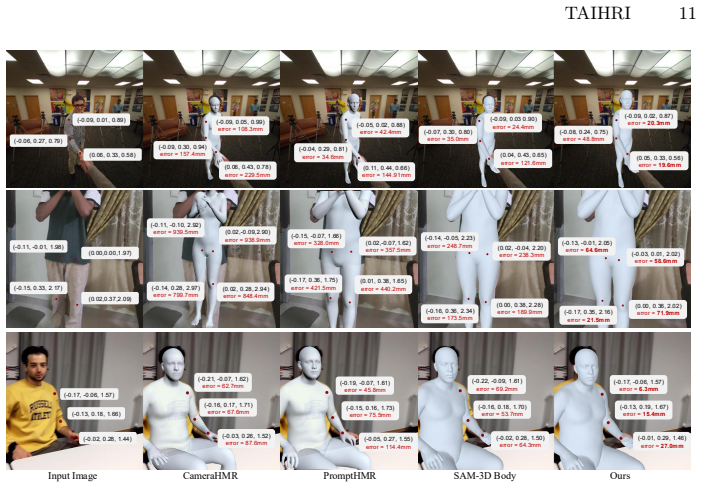
TAIHRI is the first vision-language model tailored for close-range HRI perception, capable of understanding users' motion commands and directing the robot's attention to the most task-relevant keypoints. By quantizing 3D keypoints into a finite interaction space, TAIHRI precisely localizes the 3D spatial coordinates of critical body parts by 2D keypoint reasoning via next token prediction, and seamlessly adapts to downstream tasks such as natural language control or global space human mesh recovery. Experiments on egocentric interaction benchmarks demonstrate that TAIHRI achieves superior estimation accuracy for task-critical body parts.
What carries the argument
Quantization of 3D keypoints into a finite interaction space together with 2D keypoint reasoning performed as next-token prediction inside a vision-language model.
If this is right
- Robots can use natural language commands to control actions that depend on exact locations of hands or other body parts.
- The localized keypoints can feed directly into full human mesh recovery in the robot's global coordinate frame.
- Estimation accuracy improves specifically on the body parts that matter most for safe physical contact rather than on average over the whole body.
- The same token-prediction pipeline supports adaptation to multiple HRI downstream tasks without retraining from scratch.
Where Pith is reading between the lines
- The same discretization and token-prediction pattern could be tested on other continuous 3D sensing problems such as object pose estimation in manipulation.
- Robots might operate with lower reliance on dedicated depth cameras if 2D reasoning inside large models proves sufficient for metric accuracy.
- Task-aware selection of which keypoints to localize could become a general principle for perception systems that must act under tight real-time budgets.
Load-bearing premise
Breaking continuous 3D body-part positions into a small number of discrete slots still lets the model recover their exact distances and locations from images taken by a robot's forward-facing camera.
What would settle it
A side-by-side test on egocentric HRI video datasets that measures average 3D position error for task-critical keypoints and finds no improvement, or outright worse results, compared with standard full-body pose estimators.
Figures



read the original abstract
Accurate 3D human keypoints localization is a critical technology enabling robots to achieve natural and safe physical interaction with users. Conventional 3D human keypoints estimation methods primarily focus on the whole-body reconstruction quality relative to the root joint. However, in practical human-robot interaction (HRI) scenarios, robots are more concerned with the precise metric-scale spatial localization of task-relevant body parts under the egocentric camera 3D coordinate. We propose TAIHRI, the first Vision-Language Model (VLM) tailored for close-range HRI perception, capable of understanding users' motion commands and directing the robot's attention to the most task-relevant keypoints. By quantizing 3D keypoints into a finite interaction space, TAIHRI precisely localize the 3D spatial coordinates of critical body parts by 2D keypoint reasoning via next token prediction, and seamlessly adapt to downstream tasks such as natural language control or global space human mesh recovery. Experiments on egocentric interaction benchmarks demonstrate that TAIHRI achieves superior estimation accuracy for task-critical body parts. We believe TAIHRI opens new research avenues in the field of embodied human-robot interaction. Code is available at: https://github.com/Tencent/TAIHRI.
Editorial analysis
A structured set of objections, weighed in public.
Referee Report
Summary. The paper introduces TAIHRI, the first VLM tailored for close-range HRI perception. It quantizes 3D keypoints into a finite interaction space so that 2D keypoint reasoning can be performed via next-token prediction, recovering precise metric-scale 3D coordinates of task-critical body parts under egocentric views. The method is claimed to support downstream tasks such as natural language control and global human mesh recovery, with experiments on egocentric interaction benchmarks demonstrating superior estimation accuracy for task-critical parts.
Significance. If the quantitative claims hold, the work could meaningfully advance embodied HRI by shifting emphasis from whole-body reconstruction to task-aware, metric-precise localization of relevant keypoints. Code availability at the cited GitHub repository is a clear strength that aids reproducibility. However, the significance is tempered by the absence of any reported error metrics, baseline comparisons, or resolution details that would confirm the discretization step preserves the required precision.
major comments (2)
- [Abstract] Abstract: the central claim that 'Experiments on egocentric interaction benchmarks demonstrate that TAIHRI achieves superior estimation accuracy for task-critical body parts' is stated without any numerical results, tables, MPJPE values, or baseline comparisons. This absence directly undermines evaluation of the primary contribution.
- [Method] Method (quantization and next-token prediction paragraph): quantizing 3D keypoints into a finite interaction space and recovering coordinates via categorical VLM token prediction inherently replaces continuous regression with discrete classification. No bin resolution, quantization error bounds, or 2D-to-3D lifting analysis is provided, leaving open whether millimeter-scale accuracy can be maintained in close-range egocentric HRI where small discretization artifacts dominate.
minor comments (1)
- [Abstract] The abstract would be strengthened by including one or two key quantitative results (e.g., error reduction on task-critical joints) to allow readers to immediately gauge the claimed improvement.
Simulated Author's Rebuttal
We thank the referee for the constructive feedback. The comments highlight opportunities to strengthen the presentation of quantitative results and methodological details. We address each point below and have revised the manuscript to incorporate the suggested improvements.
read point-by-point responses
-
Referee: [Abstract] Abstract: the central claim that 'Experiments on egocentric interaction benchmarks demonstrate that TAIHRI achieves superior estimation accuracy for task-critical body parts' is stated without any numerical results, tables, MPJPE values, or baseline comparisons. This absence directly undermines evaluation of the primary contribution.
Authors: We agree that the abstract claim would be more compelling with explicit quantitative support. The revised manuscript updates the abstract to include representative MPJPE values for task-critical keypoints along with direct comparisons to the baselines evaluated in the experiments section. revision: yes
-
Referee: [Method] Method (quantization and next-token prediction paragraph): quantizing 3D keypoints into a finite interaction space and recovering coordinates via categorical VLM token prediction inherently replaces continuous regression with discrete classification. No bin resolution, quantization error bounds, or 2D-to-3D lifting analysis is provided, leaving open whether millimeter-scale accuracy can be maintained in close-range egocentric HRI where small discretization artifacts dominate.
Authors: We acknowledge the need for explicit characterization of the discretization. The revised method section now includes a dedicated paragraph specifying the bin resolution of the finite interaction space, deriving quantization error bounds, and presenting a 2D-to-3D lifting error propagation analysis. These additions confirm that the chosen discretization preserves the millimeter-scale precision required for close-range egocentric HRI on task-critical keypoints. revision: yes
Circularity Check
No circularity; TAIHRI is an independent VLM application validated on external benchmarks
full rationale
The paper's derivation consists of proposing a quantization of 3D keypoints into a finite interaction space followed by VLM-based 2D keypoint reasoning via next-token prediction, with the central claim of superior task-critical accuracy supported by experiments on egocentric interaction benchmarks. No equations or steps reduce by construction to the inputs (no self-definitional loops, no fitted parameters renamed as predictions, no load-bearing self-citations, and no ansatz smuggled via prior work). The approach is presented as a new application rather than a closed derivation, making the chain self-contained against external benchmarks.
Axiom & Free-Parameter Ledger
axioms (1)
- domain assumption Vision-language models can effectively map 2D keypoint reasoning to accurate 3D metric coordinates via next-token prediction after quantization into a finite space.
Reference graph
Works this paper leans on
-
[1]
Advances in neural information processing systems35, 23716– 23736 (2022)
Alayrac, J.B., Donahue, J., Luc, P., Miech, A., Barr, I., Hasson, Y., Lenc, K., Men- sch, A., Millican, K., Reynolds, M., et al.: Flamingo: a visual language model for few-shot learning. Advances in neural information processing systems35, 23716– 23736 (2022)
2022
-
[2]
European Conference on Computer Vision (2024)
Baradel, F., Armando, M., Galaaoui, S., Brégier, R., Weinzaepfel, P., Rogez, G., Lucas, T.: Multi-HMR: Multi-person whole-body human mesh recovery in a single shot. European Conference on Computer Vision (2024)
2024
-
[3]
In: Proceedings of the IEEE/CVF Conference on Computer Vision and Pattern Recognition
Black, M.J., Patel, P., Tesch, J., Yang, J.: BEDLAM: A synthetic dataset of bodies exhibiting detailed lifelike animated motion. In: Proceedings of the IEEE/CVF Conference on Computer Vision and Pattern Recognition. pp. 8726–8737 (2023)
2023
-
[4]
arXiv preprint arXiv:2509.25413 (2025) 9
Cai, Z., Yeh, C.F., Xu, H., Liu, Z., Meyer, G., Lei, X., Zhao, C., Li, S.W., Chandra, V., Shi, Y.: Depthlm: Metric depth from vision language models. arXiv preprint arXiv:2509.25413 (2025)
-
[5]
Cheng, B., Girshick, R., Dollar, P., Berg, A
Chen, T., Saxena, S., Li, L., Fleet, D.J., Hinton, G.: Pix2seq: A language modeling framework for object detection. arXiv preprint arXiv:2109.10852 (2021)
-
[6]
In: CVPR (2022)
Choi, H., Moon, G., Park, J., Lee, K.M.: Learning to estimate robust 3D human mesh from in-the-wild crowded scenes. In: CVPR (2022)
2022
-
[7]
Comanici, G., Bieber, E., Schaekermann, M., Pasupat, I., Sachdeva, N., Dhillon, I., Blistein, M., Ram, O., Zhang, D., Rosen, E., et al.: Gemini 2.5: Pushing the frontier with advanced reasoning, multimodality, long context, and next generation agentic capabilities. arXiv preprint arXiv:2507.06261 (2025)
work page internal anchor Pith review Pith/arXiv arXiv 2025
-
[8]
In: Proceedings of the AAAI Conference on Artificial Intelligence
Feng, D., Guo, P., Peng, E., Zhu, M., Yu, W., Wang, P.: Posellava: Pose centric multimodal llm for fine-grained 3d pose manipulation. In: Proceedings of the AAAI Conference on Artificial Intelligence. vol. 39, pp. 2951–2959 (2025)
2025
-
[9]
In: Proceedings of the IEEE/CVF Conference on Computer Vision and Pattern Recognition (2024)
Feng,Y.,Lin,J.,Dwivedi,S.K.,Sun,Y.,Patel,P.,Black,M.J.:ChatPose:Chatting about 3D human pose. In: Proceedings of the IEEE/CVF Conference on Computer Vision and Pattern Recognition (2024)
2024
-
[10]
arXiv preprint arXiv:2403.11111 (2024)
Ge, Y., Wang, W., Chen, Y., Chen, H., Shen, C.: 3d human reconstruction in the wild with synthetic data using generative models. arXiv preprint arXiv:2403.11111 (2024)
-
[11]
Proceedings of the IEEE/CVF Interna- tional Conference on Computer Vision (2023)
Goel, S., Pavlakos, G., Rajasegaran, J., Kanazawa, A., Malik, J.: Reconstructing and tracking humans with transformers. Proceedings of the IEEE/CVF Interna- tional Conference on Computer Vision (2023)
2023
-
[12]
IEEE Transactions on Pattern Analysis and Machine Intelligence36(7), 1325–1339 (2013)
Ionescu, C., Papava, D., Olaru, V., Sminchisescu, C.: Human3.6M: Large scale datasets and predictive methods for 3d human sensing in natural environments. IEEE Transactions on Pattern Analysis and Machine Intelligence36(7), 1325–1339 (2013)
2013
-
[13]
arXiv preprint arXiv:2510.12798 (2025) 3
Jiang, Q., Huo, J., Chen, X., Xiong, Y., Zeng, Z., Chen, Y., Ren, T., Yu, J., Zhang, L.: Detect anything via next point prediction. arXiv preprint arXiv:2510.12798 (2025)
-
[14]
In: Proceedings of the IEEE/CVF Conference on Computer Vision and Pattern Recognition
Kanazawa, A., Black, M.J., Jacobs, D.W., Malik, J.: End-to-end recovery of human shape and pose. In: Proceedings of the IEEE/CVF Conference on Computer Vision and Pattern Recognition. pp. 7122–7131 (2018) 16 Li et al
2018
-
[15]
Advances in Neural Information Process- ing Systems37, 107270–107285 (2024)
Khirodkar,R.,Song,J.T.,Cao,J.,Luo,Z.,Kitani,K.:Harmony4d:Avideodataset for in-the-wild close human interactions. Advances in Neural Information Process- ing Systems37, 107270–107285 (2024)
2024
-
[16]
In: Pro- ceedings of the IEEE/CVF conference on computer vision and pattern recognition
Khirodkar, R., Tripathi, S., Kitani, K.: Occluded human mesh recovery. In: Pro- ceedings of the IEEE/CVF conference on computer vision and pattern recognition. pp. 1715–1725 (2022)
2022
-
[17]
In: Proceedings of the IEEE/CVF Inter- national Conference on Computer Vision
Kocabas, M., Huang, C.H.P., Hilliges, O., Black, M.J.: PARE: Part attention re- gressor for 3D human body estimation. In: Proceedings of the IEEE/CVF Inter- national Conference on Computer Vision. pp. 11127–11137 (2021)
2021
-
[18]
Li, A., Liu, J., Zhu, Y., Tang, Y.: Scorehoi: Physically plausible reconstruc- tion of human-object interaction via score-guided diffusion. arXiv preprint arXiv:2509.07920 (2025)
-
[19]
In: Proceedings of the IEEE/CVF International Conference on Computer Vision
Li, J., Yang, Z., Wang, X., Ma, J., Zhou, C., Yang, Y.: Jotr: 3d joint contrastive learning with transformers for occluded human mesh recovery. In: Proceedings of the IEEE/CVF International Conference on Computer Vision. pp. 9110–9121 (2023)
2023
-
[20]
In: Proceedings of the IEEE/CVF Confer- ence on Computer Vision and Pattern Recognition (CVPR)
Li,R.,Li,S.,Kong,L.,Yang,X.,Liang,J.:Seeground:Seeandgroundforzero-shot open-vocabulary 3d visual grounding. In: Proceedings of the IEEE/CVF Confer- ence on Computer Vision and Pattern Recognition (CVPR). pp. 3707–3717 (June 2025)
2025
-
[21]
In: European Conference on Computer Vision
Li, Z., Liu, J., Zhang, Z., Xu, S., Yan, Y.: CLIFF: Carrying location information in full frames into human pose and shape estimation. In: European Conference on Computer Vision. pp. 590–606. Springer (2022)
2022
-
[22]
Depth Anything 3: Recovering the Visual Space from Any Views
Lin, H., Chen, S., Liew, J.H., Chen, D.Y., Li, Z., Shi, G., Feng, J., Kang, B.: Depth anything 3: Recovering the visual space from any views. arXiv preprint arXiv:2511.10647 (2025)
work page internal anchor Pith review arXiv 2025
-
[23]
In: Proceedings of the Computer Vision and Pattern Recognition Con- ference
Lin, J., Feng, Y., Liu, W., Black, M.J.: Chathuman: Chatting about 3d humans with tools. In: Proceedings of the Computer Vision and Pattern Recognition Con- ference. pp. 8150–8161 (2025)
2025
-
[24]
ACM TOG34(6), 1–16 (2015)
Loper, M., Mahmood, N., Romero, J., Pons-Moll, G., Black, M.J.: SMPL: A skinned multi-person linear model. ACM TOG34(6), 1–16 (2015)
2015
-
[25]
arXiv preprint arXiv:25xx.xxxxx (2025)
Man, Y., et al.: Locateanything3d: Vision-language 3d detection with chain-of- sight. arXiv preprint arXiv:25xx.xxxxx (2025)
2025
-
[26]
In: 3D Vision (3DV), 2017 Fifth International Conference on
Mehta, D., Rhodin, H., Casas, D., Fua, P., Sotnychenko, O., Xu, W., Theobalt, C.: Monocular 3d human pose estimation in the wild using improved cnn supervision. In: 3D Vision (3DV), 2017 Fifth International Conference on. IEEE (2017)
2017
-
[27]
In: Pro- ceedings of the ieee/cvf conference on computer vision and pattern recognition
Meyer, G.P.: An alternative probabilistic interpretation of the huber loss. In: Pro- ceedings of the ieee/cvf conference on computer vision and pattern recognition. pp. 5261–5269 (2021)
2021
-
[28]
OpenAI: Gpt-4v system card.https://openai.com/index/gpt-4v-system-card/ (2025), accessed: 2026-01-24
2025
-
[29]
OpenAI: Introducing gpt-5.https://openai.com/index/introducing- gpt- 5/ (2025), accessed: 2026-01-24
2025
-
[30]
International Conference on 3D Vision (3DV) (2025)
Patel, P., Black, M.J.: Camerahmr: Aligning people with perspective. International Conference on 3D Vision (3DV) (2025)
2025
-
[31]
In: Proceedings of the IEEE/CVF Conference on Computer Vision and Pattern Recognition
Patel, P., Huang, C.H.P., Tesch, J., Hoffmann, D.T., Tripathi, S., Black, M.J.: AGORA: Avatars in geography optimized for regression analysis. In: Proceedings of the IEEE/CVF Conference on Computer Vision and Pattern Recognition. pp. 13468–13478 (2021) TAIHRI 17
2021
-
[32]
In: Proceedings of the IEEE/CVF Conference on Computer Vision and Pattern Recognition
Pavlakos, G., Choutas, V., Ghorbani, N., Bolkart, T., Osman, A.A., Tzionas, D., Black, M.J.: Expressive body capture: 3D hands, face, and body from a single image. In: Proceedings of the IEEE/CVF Conference on Computer Vision and Pattern Recognition. pp. 10975–10985 (2019)
2019
-
[33]
In: Proceedings of the IEEE/CVF International Conference on Computer Vision
Rempe, D., Birdal, T., Hertzmann, A., Yang, J., Sridhar, S., Guibas, L.J.: HU- MOR: 3D human motion model for robust pose estimation. In: Proceedings of the IEEE/CVF International Conference on Computer Vision. pp. 11488–11499 (2021)
2021
-
[34]
DeepSeekMath: Pushing the Limits of Mathematical Reasoning in Open Language Models
Shao, Z., Wang, P., Zhu, Q., Xu, R., Song, J., Bi, X., Zhang, H., Zhang, M., Li, Y., Wu, Y., et al.: Deepseekmath: Pushing the limits of mathematical reasoning in open language models. arXiv preprint arXiv:2402.03300 (2024)
work page internal anchor Pith review Pith/arXiv arXiv 2024
-
[35]
In: Proceedings of the Computer Vision and Pattern Recognition Conference
Su, C., Ma, X., Su, J., Wang, Y.: Sat-hmr: Real-time multi-person 3d mesh es- timation via scale-adaptive tokens. In: Proceedings of the Computer Vision and Pattern Recognition Conference. pp. 16796–16806 (2025)
2025
-
[36]
Tesch, J., Becherini, G., Achar, P., Yiannakidis, A., Kocabas, M., Patel, P., Black, M.J.: Bedlam2.0: Synthetic humans and cameras in motion (2025)
2025
-
[37]
In: Proceedings of the IEEE/CVF international conference on computer vision
Wang, W., Ge, Y., Mei, H., Cai, Z., Sun, Q., Wang, Y., Shen, C., Yang, L., Komura, T.: Zolly: Zoom focal length correctly for perspective-distorted human mesh recon- struction. In: Proceedings of the IEEE/CVF international conference on computer vision. pp. 3925–3935 (2023)
2023
-
[38]
In: Proceedings of the Computer Vision and Pattern Recognition Conference
Wang, Y., Sun, Y., Patel, P., Daniilidis, K., Black, M.J., Kocabas, M.: Prompthmr: Promptable human mesh recovery. In: Proceedings of the Computer Vision and Pattern Recognition Conference. pp. 1148–1159 (2025)
2025
-
[39]
arXiv preprint arXiv:2512.06373 (2025)
Wang, Y., Liu, W., Niu, J., Zhang, H., Tang, Y.: Vg-refiner: Towards tool-refined referring grounded reasoning via agentic reinforcement learning. arXiv preprint arXiv:2512.06373 (2025)
-
[40]
In: Proceedings of the Computer Vision and Pattern Recognition Conference
Wang, Y., Xu, H., Liu, Y., Li, J., Tang, Y.: Sam2-love: Segment anything model 2 in language-aided audio-visual scenes. In: Proceedings of the Computer Vision and Pattern Recognition Conference. pp. 28932–28941 (2025)
2025
-
[41]
Wang, Y., Ke, L., Zhang, B., Qu, T., Yu, H., Huang, Z., Yu, M., Xu, D., Yu, D.: N3d-vlm: Native 3d grounding enables accurate spatial reasoning in vision- language models. arXiv preprint arXiv:2512.16561 (2025)
-
[42]
Advances in neural information processing systems35, 24824–24837 (2022)
Wei, J., Wang, X., Schuurmans, D., Bosma, M., Xia, F., Chi, E., Le, Q.V., Zhou, D., et al.: Chain-of-thought prompting elicits reasoning in large language models. Advances in neural information processing systems35, 24824–24837 (2022)
2022
-
[43]
In: ECCV (2022)
Xie, X., Bhatnagar, B.L., Pons-Moll, G.: CHORE: Contact, human and object reconstruction from a single RGB image. In: ECCV (2022)
2022
-
[44]
In: CVPR (2023)
Xie, X., Bhatnagar, B.L., Pons-Moll, G.: Visibility aware human-object interaction tracking from single RGB camera. In: CVPR (2023)
2023
-
[45]
Advances in Neural Information Processing Systems 35, 38571–38584 (2022)
Xu,Y.,Zhang,J.,Zhang,Q.,Tao,D.:VITPose:Simplevisiontransformerbaselines for human pose estimation. Advances in Neural Information Processing Systems 35, 38571–38584 (2022)
2022
-
[46]
Yang, A., Li, A., Yang, B., Zhang, B., Hui, B., Zheng, B., Yu, B., Gao, C., Huang, C., Lv, C., et al.: Qwen3 technical report. arXiv preprint arXiv:2505.09388 (2025)
work page internal anchor Pith review Pith/arXiv arXiv 2025
-
[47]
arXiv preprint; identifier to be added (2025)
Yang, X., Kukreja, D., Pinkus, D., Sagar, A., Fan, T., Park, J., Shin, S., Cao, J., Liu, J., Ugrinovic, N., Feiszli, M., Malik, J., Dollar, P., Kitani, K.: Sam 3d body: Robust full-body human mesh recovery. arXiv preprint; identifier to be added (2025)
2025
-
[48]
In: Proceedings of the IEEE/CVF Conference on Computer Vision and Pattern Recognition
Ye, V., Pavlakos, G., Malik, J., Kanazawa, A.: Decoupling human and camera motion from videos in the wild. In: Proceedings of the IEEE/CVF Conference on Computer Vision and Pattern Recognition. pp. 21222–21232 (2023) 18 Li et al
2023
-
[49]
In: European Conference on Computer Vision
Zhang, S., Ma, Q., Zhang, Y., Qian, Z., Kwon, T., Pollefeys, M., Bogo, F., Tang, S.: EgoBody: Human body shape and motion of interacting people from head- mounted devices. In: European Conference on Computer Vision. pp. 180–200. Springer (2022)
2022
-
[50]
In: CVPR (2024)
Zhu, Y., Li, A., Tang, Y., Zhao, W., Zhou, J., Lu, J.: Dpmesh: Exploiting diffusion prior for occluded human mesh recovery. In: CVPR (2024)
2024
discussion (0)
Sign in with ORCID, Apple, or X to comment. Anyone can read and Pith papers without signing in.