Recognition: unknown
Generative AI Agent Empowered Power Allocation for HAP Propulsion and Communication Systems
Pith reviewed 2026-05-10 16:56 UTC · model grok-4.3
The pith
Generative AI agent builds accurate propulsion power model for HAPs by capturing hull-propeller interference, allowing better energy split with communication systems.
A machine-rendered reading of the paper's core claim, the machinery that carries it, and where it could break.
Core claim
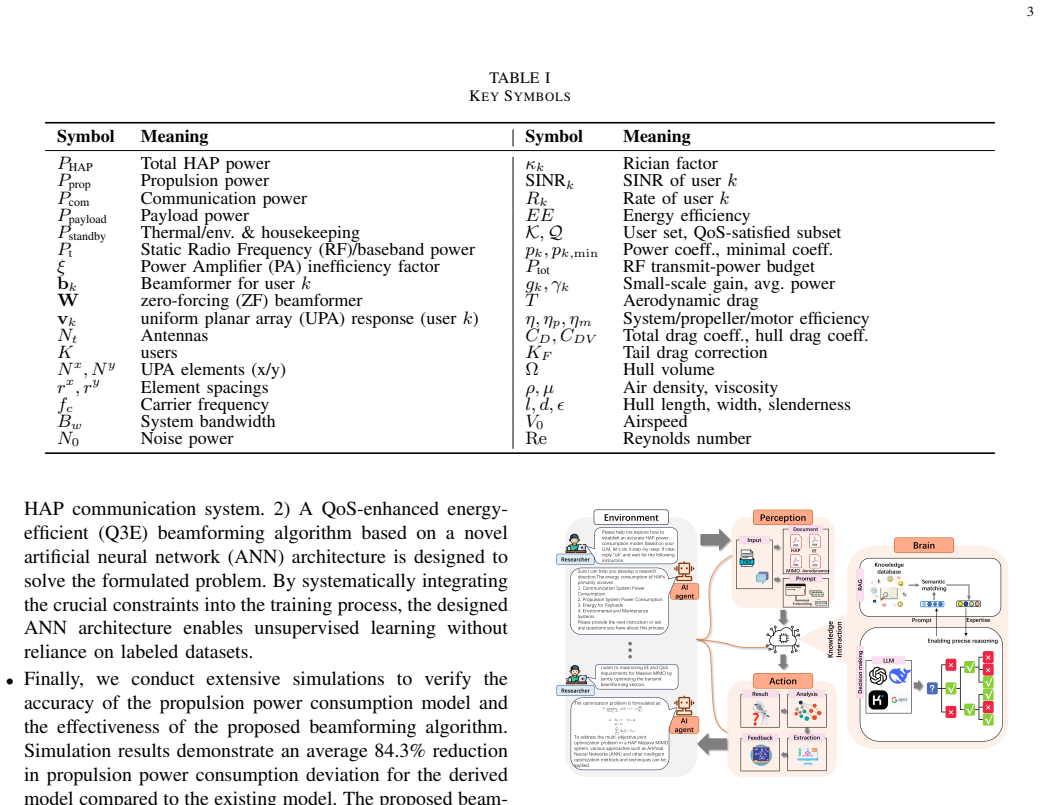
By interacting with the generative AI agent, an accurate propulsion power consumption model is developed that takes into account the aerodynamic interference between the HAP's hull and the propeller. Assisted by the AI agent, a HAP beamforming problem is formulated to improve user QoS and enhance the energy efficiency of the HAP communication system, solved by the proposed QoS-enhanced energy-efficient (Q3E) beamforming algorithm.
What carries the argument
Interactive generative AI agent that derives the propulsion model accounting for hull-propeller interference and assists in formulating the beamforming problem.
If this is right
- The accurate propulsion model prevents over-allocation of power to flight and frees more energy for communications.
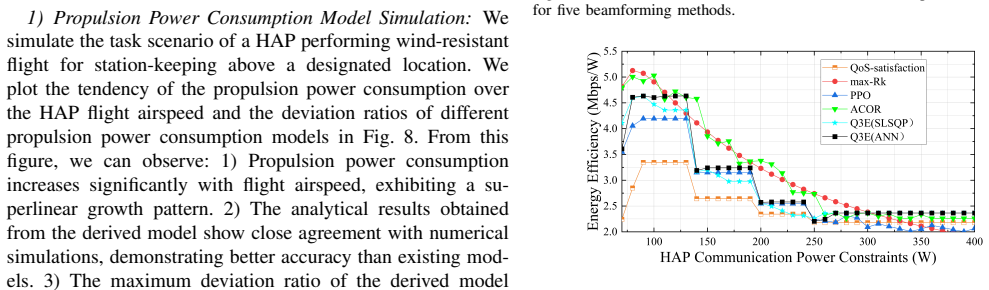
- The Q3E beamforming algorithm improves both user quality of service and system energy efficiency compared with standard approaches.
- Better power budgeting reduces the chance of degraded beamforming performance caused by misestimated propulsion demands.
Where Pith is reading between the lines
- The same AI-assisted modeling approach could extend to other energy-constrained aerial systems such as drones operating in urban environments.
- Real-time updates to the propulsion model during flight could further adapt beamforming to changing wind or payload conditions.
- Integration with satellite or terrestrial networks might use the shared power model to coordinate energy use across multiple platforms.
Load-bearing premise
The generative AI agent reliably captures the coupled interactions among aerodynamics, propulsion efficiency, and communication QoS without overfitting to limited simulation scenarios.
What would settle it
Flight tests of a physical HAP that measure actual propulsion power under different speeds and loads, then compare those measurements directly against the AI-derived model predictions.
Figures



read the original abstract
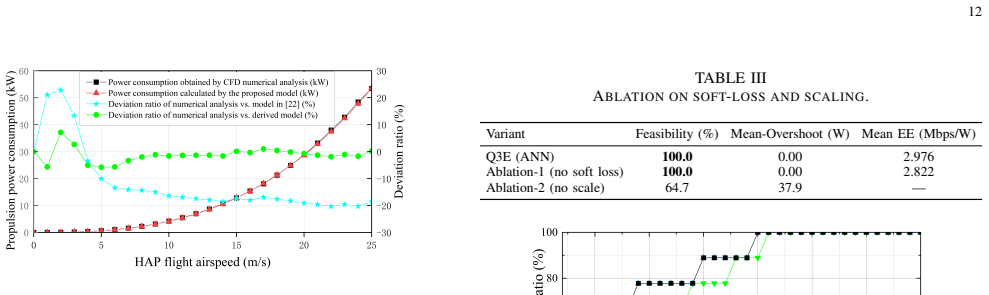
High altitude platforms (HAPs) are emerging as a key enabler for 6G coverage, yet limited energy must be split between propulsion and communications. Most prior HAP studies ignore propulsion power or rely on surrogates that miss hull-propeller interference, leading to misestimated communication power budgets and degraded beamforming. More importantly, HAP power allocation is intrinsically a multi-system, multidisciplinary problem in which aerodynamics, propulsion-system efficiency, and communication-system performance (quality of service (QoS) and energy efficiency (EE)) are tightly coupled.To address these challenges, this paper designs an interactive generative artificial intelligence (AI)-empowered HAP power allocation agent.By interacting with the AI agent, we develop an accurate propulsion power consumption model that takes into account the aerodynamic interference between the HAP's hull and the propeller. Assisted by the AI agent, we further formulate a HAP beamforming problem to improve user QoS and enhance the EE of the HAP communication system.This paper also proposes a QoS-enhanced energy-efficient (Q3E) beamforming algorithm to solve the formulated problem.Simulation results demonstrate the accuracy of the propulsion-power model and the effectiveness of the Q3E algorithm.
Editorial analysis
A structured set of objections, weighed in public.
Referee Report
Summary. The paper claims that an interactive generative AI agent can be used to derive an accurate propulsion power consumption model for high-altitude platforms (HAPs) that incorporates aerodynamic interference between the hull and propeller. This model enables formulation of a beamforming optimization problem balancing user QoS and system energy efficiency (EE); the authors propose a QoS-enhanced energy-efficient (Q3E) beamforming algorithm to solve the problem and report that simulations confirm both the model's accuracy and the algorithm's effectiveness.
Significance. If the AI-derived propulsion model is shown to be physically grounded and the Q3E algorithm delivers measurable EE gains while meeting QoS targets, the work would advance integrated multidisciplinary optimization for energy-limited HAPs in 6G networks, addressing a common simplification in prior studies that either neglect propulsion power or use overly coarse surrogates.
major comments (2)
- [Abstract] Abstract: The central claim that 'simulation results demonstrate the accuracy of the propulsion-power model' is load-bearing for the paper's contribution on multidisciplinary power allocation, yet the abstract supplies no quantitative metrics (e.g., RMSE, R², or percentage error), baselines, error bars, or comparisons to independent references such as blade-element momentum theory with interference corrections or CFD data for HAP geometries.
- [Simulation results] Simulation results (as described): The validation of the hull-propeller interference term appears confined to internal, self-consistent scenarios without reported external physical benchmarks; this directly affects the credibility of the claimed tight coupling between aerodynamics, propulsion efficiency, and communication QoS/EE that justifies the Q3E algorithm.
minor comments (1)
- [Abstract] The abstract would be strengthened by including at least one key quantitative result (e.g., EE improvement percentage or model error) to allow readers to gauge the magnitude of the claimed gains.
Simulated Author's Rebuttal
We thank the referee for the constructive and insightful comments on our manuscript. We agree that strengthening the quantitative validation of the propulsion power model is important for supporting the paper's claims on multidisciplinary HAP power allocation. We have revised the abstract and simulation sections to address these points directly while preserving the core contribution of the generative AI agent and the Q3E algorithm.
read point-by-point responses
-
Referee: [Abstract] Abstract: The central claim that 'simulation results demonstrate the accuracy of the propulsion-power model' is load-bearing for the paper's contribution on multidisciplinary power allocation, yet the abstract supplies no quantitative metrics (e.g., RMSE, R², or percentage error), baselines, error bars, or comparisons to independent references such as blade-element momentum theory with interference corrections or CFD data for HAP geometries.
Authors: We agree that the abstract should include quantitative support for the accuracy claim. In the revised manuscript, we have updated the abstract to report the root-mean-square error (RMSE) and R² values obtained from the AI-derived model against blade-element momentum theory with interference corrections. Error bars have been added to the corresponding simulation figures, and the abstract now explicitly references these metrics along with the percentage error relative to the theoretical baseline. revision: yes
-
Referee: [Simulation results] Simulation results (as described): The validation of the hull-propeller interference term appears confined to internal, self-consistent scenarios without reported external physical benchmarks; this directly affects the credibility of the claimed tight coupling between aerodynamics, propulsion efficiency, and communication QoS/EE that justifies the Q3E algorithm.
Authors: We acknowledge the importance of external benchmarks for credibility. The revised simulation section now includes explicit comparisons of the interference term to independent literature references on HAP aerodynamics, reporting percentage errors and consistency with blade-element momentum theory. While original CFD simulations for the exact HAP geometry were not feasible within the scope of this work due to resource limitations, the generative AI agent was prompted to incorporate established interference corrections from the literature; we have added a limitations paragraph clarifying this and strengthened the discussion of how the model enables the observed QoS-EE trade-off in the Q3E algorithm. revision: partial
Circularity Check
No circularity detected; derivation self-contained
full rationale
The abstract and available text describe developing a propulsion model via AI-agent interaction and a Q3E beamforming algorithm, with accuracy shown via simulations. No equations, fitted parameters, or derivations are provided that reduce by construction to self-defined inputs. No self-citations, uniqueness theorems, or ansatzes are quoted as load-bearing. Per rules, internal simulation validation alone does not trigger circularity without explicit reduction (e.g., Eq. X = input by definition). The chain remains independent of the target claims.
Axiom & Free-Parameter Ledger
Reference graph
Works this paper leans on
-
[1]
Enhancing next-generation urban connectivity: Is the integrated HAPS-terrestrial network a solution?
A. A. Shamsabadi, A. Yadav, and H. Yanikomeroglu, “Enhancing next-generation urban connectivity: Is the integrated HAPS-terrestrial network a solution?”IEEE Commun. Lett., vol. 28, no. 5, pp. 1112– 1116, May 2024
2024
-
[2]
Space-air-ground integrated wireless networks for 6G: Basics, key technologies, and future trends,
Y . Xiao, Z. Ye, M. Wu, H. Li, M. Xiao, M.-S. Alouini, A. Al- Hourani, and S. Cioni, “Space-air-ground integrated wireless networks for 6G: Basics, key technologies, and future trends,”IEEE J. Sel. Areas Commun., vol. 42, no. 12, pp. 3327–3354, Dec. 2024
2024
-
[3]
X. Cao, X. Su, P. Yang, Y . Gao, D. O. Wu, and T. Q. S. Quek, “Survey on near-space information networks: Channel modeling, networking, and transmission perspectives,”IEEE Commun. Surveys Tuts., early access, Mar 10, 2025, DOI:10.1109/COMST.2025.3549523
-
[4]
Toward RIS-enhanced inte- grated terrestrial/non-terrestrial connectivity in 6G,
P. Ramezani, B. Lyu, and A. Jamalipour, “Toward RIS-enhanced inte- grated terrestrial/non-terrestrial connectivity in 6G,”IEEE Netw., vol. 37, no. 3, pp. 178–185, May 2023
2023
-
[5]
Near-space communications: The last piece of 6G space–air–ground–sea integrated network puzzle,
H. Liu, T. Qin, null, T. Mao, K. Ying, Z. Wan, L. Qiao, R. Na, Z. Li, C. Hu, Y . Mei, T. Li, G. Wen, L. Chen, Z. Wu, R. Liu, G. Chen, S. Wang, and D. Zheng, “Near-space communications: The last piece of 6G space–air–ground–sea integrated network puzzle,”Space Sci. Technol., vol. 4, p. 0176, Aug. 2024
2024
-
[6]
Survey on HA2G and A2A channel measurement and modeling for airborne maneuvering networks,
P. An, S. Yang, J. Sun, J. Li, P. Yang, and X. Cao, “Survey on HA2G and A2A channel measurement and modeling for airborne maneuvering networks,”Chin. J. Aeronaut., p. 104036, early access, Dec. 24, 2025, DOI:10.1016/j.cja.2025.104036
-
[7]
Deep joint semantic coding and beamforming for near-space airship- borne massive MIMO network,
M. Wu, Z. Gao, Z. Wang, D. Niyato, G. K. Karagiannidis, and S. Chen, “Deep joint semantic coding and beamforming for near-space airship- borne massive MIMO network,”IEEE J. Sel. Areas Commun., vol. 43, no. 1, pp. 260–278, Jan. 2025
2025
-
[8]
Reliability and delay analysis of 3-dimensional networks with multi-connectivity: Satellite, HAPs, and cellular communications,
F. Salehi, M. Ozger, and C. Cavdar, “Reliability and delay analysis of 3-dimensional networks with multi-connectivity: Satellite, HAPs, and cellular communications,”IEEE Trans. Netw. Serv. Manage., vol. 21, no. 1, pp. 437–450, Feb. 2024
2024
-
[9]
Joint optimization of caching, computing, and trajectory planning in aerial mobile edge computing networks: An MADDPG approach,
H. Sun, Y . Zhou, H. Zhang, L. Ale, H. Dai, and N. Zhang, “Joint optimization of caching, computing, and trajectory planning in aerial mobile edge computing networks: An MADDPG approach,”IEEE Internet Things J., vol. 11, no. 24, pp. 40 996–41 007, Dec. 2024
2024
-
[10]
Robust multiuser beamforming for IRS-enhanced near-space downlink communications coexisting with satellite system,
S. Xu, J. Liu, T. K. Rodrigues, and N. Kato, “Robust multiuser beamforming for IRS-enhanced near-space downlink communications coexisting with satellite system,”IEEE Internet Things J., vol. 9, pp. 14 900–14 912, Aug. 2022
2022
-
[11]
Joint user association and beam- forming in integrated satellite-HAPS-ground networks,
S. Liu, H. Dahrouj, and M.-S. Alouini, “Joint user association and beam- forming in integrated satellite-HAPS-ground networks,”IEEE Trans. Veh. Technol., vol. 73, no. 4, pp. 5162–5178, Apr. 2024
2024
-
[12]
Uplink multiple access with semi-grant-free transmission in inte- grated satellite-aerial-terrestrial networks,
H. Kong, M. Lin, L. Han, W.-P. Zhu, Z. Ding, and M.-S. Alouini, “Uplink multiple access with semi-grant-free transmission in inte- grated satellite-aerial-terrestrial networks,”IEEE J. Sel. Areas Commun., vol. 41, pp. 1723–1736, Jan. 2023
2023
-
[13]
Energy efficiency maximization in RIS-assisted SWIPT networks with RSMA: A PPO-based approach,
R. Zhang, K. Xiong, Y . Lu, P. Fan, D. W. K. Ng, and K. B. Letaief, “Energy efficiency maximization in RIS-assisted SWIPT networks with RSMA: A PPO-based approach,”IEEE J. Sel. Areas Commun., vol. 41, no. 5, pp. 1413–1430, May 2023
2023
-
[14]
Power allocation and performance evaluation for NOMA-aided in- tegrated satellite-HAP-terrestrial networks under practical limitations,
K. Guo, H. Shuai, K. An, F. Zhou, T. A. Tsiftsis, X. Li, and M. Wu, “Power allocation and performance evaluation for NOMA-aided in- tegrated satellite-HAP-terrestrial networks under practical limitations,” IEEE Internet Things J., vol. 11, no. 7, pp. 13 002–13 017, Apr. 2024
2024
-
[15]
Generative AI-powered aerial access networks: Recent studies and future outlook,
T.-H. Nguyen, T. K. Nguyen, V . N. Quoc Bao, H. Park, and L. Park, “Generative AI-powered aerial access networks: Recent studies and future outlook,” in2024 15th International Conference on Information and Communication Technology Convergence (ICTC), Oct. 2024, pp. 529–533
2024
-
[16]
AI-based mobility-aware energy efficient resource allocation and trajectory design for NFV enabled aerial networks,
M. Pourghasemian, M. R. Abedi, S. S. Hosseini, N. Mokari, M. R. Javan, and E. A. Jorswieck, “AI-based mobility-aware energy efficient resource allocation and trajectory design for NFV enabled aerial networks,”IEEE Trans. Green Commun. Networking, vol. 7, no. 1, pp. 281–297, Mar. 2023
2023
-
[17]
Spatial path analysis for high-altitude solar-powered airship with maximum net energy,
W. Zhu, B. Zhang, L. Zhang, Y . Xu, and K. Yang, “Spatial path analysis for high-altitude solar-powered airship with maximum net energy,” Aerosp. Sci. Technol., vol. 117, p. 106922, Oct. 2021
2021
-
[18]
Multidisciplinary design of high altitude airship based on solar energy optimization,
L. Zhang, W. Zhu, H. Du, and M. Lv, “Multidisciplinary design of high altitude airship based on solar energy optimization,”Aerosp. Sci. Technol., vol. 110, p. 106440, Mar. 2021
2021
-
[19]
High-altitude airship propulsion system optimal design and experiment based on energy balance,
W. Dongchen, S. Bifeng, J. Jun, and W. Haifeng, “High-altitude airship propulsion system optimal design and experiment based on energy balance,”Proc. Inst. Mech. Eng., Part G: J. Aerosp. Eng., vol. 237, pp. 3 – 16, Jan. 2023
2023
-
[20]
A novel multi- fidelity optimization framework for high-altitude propellers,
N. Mourousias, B. G. Marinus, and M. C. Runacres, “A novel multi- fidelity optimization framework for high-altitude propellers,”Aerosp. Sci. Technol., vol. 153, p. 109407, Oct. 2024
2024
-
[21]
Uncertainty quantifica- tion study of the aerodynamic performance of high-altitude propellers,
N. Mourousias, A. Garc ´ıa-Guti´errez, A. Malim, D. Dom ´ınguez Fern´andez, B. G. Marinus, and M. C. Runacres, “Uncertainty quantifica- tion study of the aerodynamic performance of high-altitude propellers,” Aerosp. Sci. Technol., vol. 133, p. 108108, Feb. 2023
2023
-
[22]
A rule-based online energy management strategy for long-endurance stratospheric airships,
K. Song, Z. Li, Y . Zhang, X. Wang, G. Xu, and H. Zhang, “A rule-based online energy management strategy for long-endurance stratospheric airships,”Aerosp. Sci. Technol., vol. 151, p. 109266, May 2024
2024
-
[23]
Least-to-Most Prompting Enables Complex Reasoning in Large Language Models
D. Zhou, N. Sch ¨arli, L. Hou, J. Wei, N. Scales, X. Wang, D. Schu- urmans, C. Cui, O. Bousquet, Q. Le, and E. Chi, “Least-to-most prompting enables complex reasoning in large language models,” 2023, arXiv:2205.10625
work page internal anchor Pith review arXiv 2023
-
[24]
Empowering biomedical discov- ery with AI agents,
S. Gao, A. Fang, Y . Huang, V . Giunchiglia, A. Noori, J. R. Schwarz, Y . Ektefaie, J. Kondic, and M. Zitnik, “Empowering biomedical discov- ery with AI agents,”Cell, vol. 187, no. 22, pp. 6125–6151, Oct. 2024
2024
-
[25]
Making network configuration human-friendly,
C. Wang, M. Scazzariello, A. Farshin, D. Kostic, and M. Chiesa, “Mak- ing network configuration human friendly,” 2023,arXiv:2309.06342
-
[26]
Autohma-llm: Efficient task coordination and execution in heterogeneous multi-agent systems using hybrid large language models,
T. Yang, P. Feng, Q. Guo, J. Zhang, X. Zhang, J. Ning, X. Wang, and Z. Mao, “Autohma-llm: Efficient task coordination and execution in heterogeneous multi-agent systems using hybrid large language models,” IEEE Trans. Cognit. Commun. Networking, vol. 11, no. 2, pp. 987–998, Apr. 2025
2025
-
[27]
Managing linux servers with LLM-based AI agents: An empirical evaluation with GPT4,
C. Cao, F. Wang, L. Lindley, and Z. Wang, “Managing linux servers with LLM-based AI agents: An empirical evaluation with GPT4,”Mach. Learn. Appl., vol. 17, p. 100570, Sep. 2024
2024
-
[28]
Interactive AI with retrieval-augmented generation for next generation networking,
R. Zhang, H. Du, Y . Liu, D. Niyato, J. Kang, S. Sun, X. Shen, and H. V . Poor, “Interactive AI with retrieval-augmented generation for next generation networking,”IEEE Netw., pp. 1–1, Nov. 2024. 14
2024
-
[29]
The Rise and Potential of Large Language Model Based Agents: A Survey
Z. Xi, W. Chen, X. Guo, W. He, Y . Ding, B. Hong, M. Zhang, J. Wang, S. Jin, E. Zhou, R. Zheng, X. Fan, X. Wang, L. Xiong, Y . Zhou, W. Wang, C. Jiang, Y . Zou, X. Liu, Z. Yin, S. Dou, R. Weng, W. Cheng, Q. Zhang, W. Qin, Y . Zheng, X. Qiu, X. Huang, and T. Gui, “The rise and potential of large language model based agents: A survey,” 2023, arXiv:2309.07864
work page internal anchor Pith review arXiv 2023
-
[30]
A figure of merit based computational heat transfer method for aerothermal analysis of airborne electronics system lru,
M. H. Noor, A. Sarosh, U. Riaz, M. Adnan, and O. A. A. Awan, “A figure of merit based computational heat transfer method for aerothermal analysis of airborne electronics system lru,” in2022 19th International Bhurban Conference on Applied Sciences and Technology (IBCAST), Aug. 2022, pp. 70–75
2022
-
[31]
A non-stationary 3-D wideband channel model for intelligent reflecting surface-assisted HAP-MIMO communication systems,
Z. Lian, Y . Su, Y . Wang, and L. Jiang, “A non-stationary 3-D wideband channel model for intelligent reflecting surface-assisted HAP-MIMO communication systems,”IEEE Trans. Veh. Technol., vol. 71, no. 2, pp. 1109–1123, Feb. 2022
2022
-
[32]
MIMO- NOMA enabled sectorized cylindrical massive antenna array for HAPS with spatially correlated channels,
R. Shafie, M. J. Omidi, O. Abbasi, and H. Yanikomeroglu, “MIMO- NOMA enabled sectorized cylindrical massive antenna array for HAPS with spatially correlated channels,”IEEE Trans. Wireless Commun., vol. 23, no. 10, pp. 15 155–15 168, Oct. 2024
2024
-
[33]
Integration of los MIMO RF and optical links via HAPS for high-capacity satellite feeder links,
S. H. Hariq and R. Iyer Seshadri, “Integration of los MIMO RF and optical links via HAPS for high-capacity satellite feeder links,” inProc. IEEE 100th Veh. Technol. Conf. (VTC2024-Fall), Oct. 2024, pp. 1–5
2024
-
[34]
Data-driven deep learning based hybrid beamforming for aerial massive MIMO-OFDM systems with implicit CSI,
Z. Gao, M. Wu, C. Hu, F. Gao, G. Wen, D. Zheng, and J. Zhang, “Data-driven deep learning based hybrid beamforming for aerial massive MIMO-OFDM systems with implicit CSI,”IEEE J. Sel. Areas Commun., vol. 40, no. 10, pp. 2894–2913, Oct. 2022
2022
-
[35]
QoS-aware precoding in downlink massive MIMO LEO satellite communications,
Y . Huang, L. You, C. G. Tsinos, W. Wang, and X. Gao, “QoS-aware precoding in downlink massive MIMO LEO satellite communications,” IEEE Commun. Lett., vol. 27, pp. 1560–1564, Jan. 2023
2023
-
[36]
Beam squint-aware integrated sensing and communications for hybrid massive MIMO LEO satellite systems,
L. You, X. Qiang, C. G. Tsinos, F. Liu, W. Wang, X. Gao, and B. Ot- tersten, “Beam squint-aware integrated sensing and communications for hybrid massive MIMO LEO satellite systems,”IEEE J. Sel. Areas Commun., vol. 40, no. 10, pp. 2994–3009, Oct. 2022
2022
-
[37]
Uxnb-enabled cell-free massive MIMO with HAPS-assisted sub-THz backhauling,
O. Abbasi and H. Yanikomeroglu, “Uxnb-enabled cell-free massive MIMO with HAPS-assisted sub-THz backhauling,”IEEE Trans. Veh. Technol., vol. 73, no. 5, pp. 6937–6953, May 2024
2024
-
[38]
A survey of recent advances in optimization methods for wireless communications,
Y .-F. Liu, T.-H. Chang, M. Hong, Z. Wu, A. Man-Cho So, E. A. Jorswieck, and W. Yu, “A survey of recent advances in optimization methods for wireless communications,”IEEE J. Sel. Areas Commun., vol. 42, no. 11, pp. 2992–3031, Nov. 2024
2024
-
[39]
Beamforming design using UE positions and 3D terrain-building in HAPS system,
Z. Li, S. Yang, Y . Yin, M. Bouazizi, and T. Ohtsuki, “Beamforming design using UE positions and 3D terrain-building in HAPS system,” in Proc. IEEE 100th Veh. Technol. Conf. (VTC2024-Fall), Oct. 2024, pp. 1–7
2024
-
[40]
Hemispherical mas- sive MIMO architecture for high-altitude platform station (HAPS),
O. Abbasi, H. Yanikomeroglu, and G. Kaddoum, “Hemispherical mas- sive MIMO architecture for high-altitude platform station (HAPS),” in Proc. IEEE Wireless Commun. Netw. Conf. (WCNC), Apr. 2024, pp. 1–6
2024
-
[41]
Energy sustainability in dense radio access networks via high altitude platform stations,
M. Salamatmoghadasi, A. Mehrabian, and H. Yanikomeroglus, “Energy sustainability in dense radio access networks via high altitude platform stations,”IEEE Networking Lett., vol. 6, no. 1, pp. 21–25, Mar. 2024
2024
-
[42]
Stratospheric wind field feature extraction and energy management for hybrid electric solar airship with deep reinforcement learning,
Y . Liu, K. Sun, and M. Lv, “Stratospheric wind field feature extraction and energy management for hybrid electric solar airship with deep reinforcement learning,”Sustainable Energy Technol. Assess., vol. 71, p. 103993, Nov. 2024
2024
-
[43]
High-altitude airship variable-pitch propeller performance analysis at multiple altitudes,
W. Dongchen, S. Bifeng, J. Jun, and X. Dong, “High-altitude airship variable-pitch propeller performance analysis at multiple altitudes,” Proc. Inst. Mech. Eng., Part G: J. Aerosp. Eng., vol. 237, pp. 2961– 2973, Apr. 2023
2023
-
[44]
Station-keeping HAPS mission through optimal sprint and drift trajectories,
A. Delgado, D. Dom ´ınguez, J. Gonzalo, and A. Escapa, “Station-keeping HAPS mission through optimal sprint and drift trajectories,”Aerosp. Sci. Technol., vol. 152, p. 109365, Sep. 2024
2024
-
[45]
Stratospheric airship trajectory planning in wind field using deep reinforcement learning,
L. Qi, X. Yang, F. Bai, X. Deng, and Y . Pan, “Stratospheric airship trajectory planning in wind field using deep reinforcement learning,” Adv. Space Res., vol. 75, no. 1, pp. 620–634, Jan. 2025
2025
-
[46]
Conceptual design and feasibility study of winged hybrid airship,
A. Gangadhar, M. Manikandan, D. Rajaram, and D. Mavris, “Conceptual design and feasibility study of winged hybrid airship,”Aerospace, vol. 9, no. 1, Dec. 2022
2022
-
[47]
S. F. Hoerner,Fluid-Dynamic Drag: Practical Information on Aerody- namic Drag and Hydrodynamic Resistance. Brick Town, New Jersey: Hoerner Fluid Dynamics, 1965
1965
-
[48]
Estimation of volumetric drag coefficient of two-dimensional body of revolution,
M. I. Alam and R. S. Pant, “Estimation of volumetric drag coefficient of two-dimensional body of revolution,”Journal of Aircraft, vol. 56, no. 5, pp. 2080–2082, 2019
2080
-
[49]
A comparative study of conventional and tri-lobed stratospheric airships,
M. Manikandan and R. S. Pant, “A comparative study of conventional and tri-lobed stratospheric airships,”The Aeronautical Journal, vol. 125, no. 1290, pp. 1434–1466, Aug. 2021
2021
-
[50]
Assessment of the effectiveness of stall delay and tip loss corrections for the simulation of small propeller performance with virtual blade model,
L. S. Diehl and J. G. Coelho, “Assessment of the effectiveness of stall delay and tip loss corrections for the simulation of small propeller performance with virtual blade model,”Eur. J. Mech. B. Fluids, vol. 105, pp. 34–43, May 2024
2024
-
[51]
A function improving tip loss correction of blade-element momentum theory for wind turbines,
W. Z. S. Wei Zhong, Tongguang Wang and W. J. Zhu, “A function improving tip loss correction of blade-element momentum theory for wind turbines,”Int. J. Sustainable Energy, vol. 43, no. 1, p. 2352794, Dec. 2024
2024
-
[52]
Lexicographic multi-objective mpc for constrained nonlinear systems with changing objective prioritization,
D. He, H. Li, and H. Du, “Lexicographic multi-objective mpc for constrained nonlinear systems with changing objective prioritization,” Automatica, vol. 125, p. 109433, Mar. 2021
2021
-
[53]
S. Yang, P. An, P. Yang, X. Cao, D. Oliver Wu, and T. Q. S. Quek, “Adaptive subarray segmentation: A new paradigm of spatial non- stationary near-field channel estimation for xl-mimo systems,”IEEE Trans. Commun., vol. 74, pp. 2220–2234, early access, Dec. 15, 2026, DOI:10.1109/TCOMM.2025.3644475
-
[54]
HAPS-based interference suppression through null broadening with directivity control in space-air-ground integrated net- works,
Y . Kawamoto, A. Matsushita, S. Verma, N. Kato, K. Kaneko, A. Sata, and M. Hangai, “HAPS-based interference suppression through null broadening with directivity control in space-air-ground integrated net- works,”IEEE Trans. Veh. Technol., vol. 72, no. 12, pp. 16 098–16 107, Dec. 2023
2023
-
[55]
Movable cell- free massive mimo for high-speed train communications: A ppo-based antenna position optimization,
J. Dai, Y . Liu, J. Zheng, R. Zhang, J. Zhang, and B. Ai, “Movable cell- free massive mimo for high-speed train communications: A ppo-based antenna position optimization,” in2025 IEEE International Conference on Communications Workshops (ICC Workshops), Jun. 2025, pp. 38–43
2025
-
[56]
Multi-UA V-aided power-up and data collection: Multi-agent DQL with genetic algorithm approach,
V . That, S. Muy, and J.-R. Lee, “Multi-UA V-aided power-up and data collection: Multi-agent DQL with genetic algorithm approach,”Expert Syst. Appl., vol. 297, p. 129401, Feb. 2026
2026
-
[57]
Cellular network from the sky: Toward people-centered smart communities,
B. E. Y . Belmekki, A. J. Aljohani, S. A. Althubaity, A. A. Harthi, K. Bean, A. Aijaz, and M.-S. Alouini, “Cellular network from the sky: Toward people-centered smart communities,”IEEE Open J. Commun. Soc., vol. 5, pp. 1916–1936, Mar. 2024
1916
discussion (0)
Sign in with ORCID, Apple, or X to comment. Anyone can read and Pith papers without signing in.