Recognition: 2 theorem links
· Lean TheoremSatQNet: Satellite-assisted Quantum Network Entanglement Routing Using Directed Line Graph Neural Networks
Pith reviewed 2026-05-10 17:50 UTC · model grok-4.3
The pith
SatQNet routes entanglements in satellite quantum networks by performing local message passing on directed edge embeddings in a line graph neural network.
A machine-rendered reading of the paper's core claim, the machinery that carries it, and where it could break.
Core claim
SatQNet is a decentralized reinforcement-learning router whose policy network is an edge-centric directed line graph neural network. The network performs local message passing over directed edge embeddings, so each repeater can form an up-to-date view of its neighborhood without waiting for global topology broadcasts. The learned policy selects which short-range entanglements to request, yielding measurably higher end-to-end fidelity than existing methods on both synthetic and real topologies and without retraining on the target topology.
What carries the argument
Edge-centric directed line graph neural network that performs local message passing on directed edge embeddings to produce per-repeater routing decisions.
If this is right
- Routing decisions can be made with only local neighbor information, removing the requirement for low-latency global topology updates.
- The same trained model can be deployed on new network layouts without retraining.
- Performance remains superior to heuristics across both random and realistic backbone graphs.
- Decentralized operation reduces exposure to control-plane delays in highly dynamic satellite segments.
Where Pith is reading between the lines
- Similar local edge-centric representations could be useful in other time-varying quantum networks, such as those using moving drones or atmospheric links.
- The approach suggests that global optimality is not required when the goal is merely high-fidelity rather than perfect routing.
- Because the line-graph embedding focuses on edges rather than nodes, it may scale better to networks whose degree distribution is heavy-tailed.
Load-bearing premise
Local exchanges of directed edge messages are enough to capture the information needed for high-fidelity routing even when links appear and disappear stochastically and satellites keep moving.
What would settle it
A simulation in which SatQNet’s fidelity falls below that of a global-knowledge baseline once satellite motion or link-failure rates exceed the training distribution, or in which performance collapses on a previously unseen topology.
Figures


read the original abstract
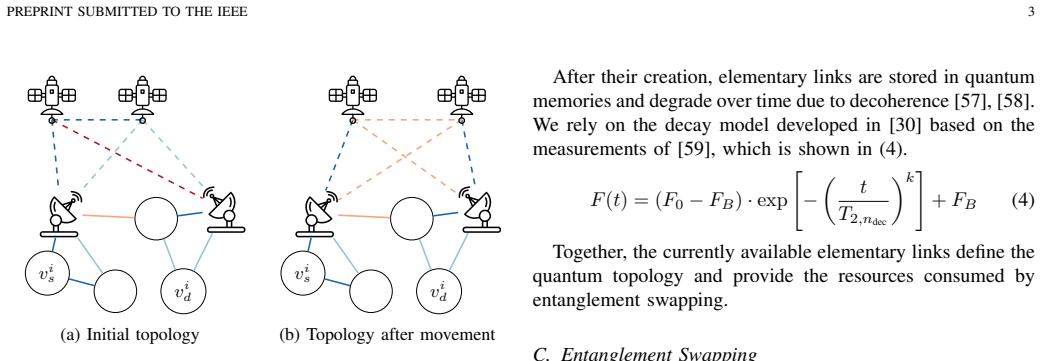
Quantum networks are expected to become a key enabler for interconnecting quantum devices. In contrast to classical communication networks, however, information transfer in quantum networks is usually restricted to short distances due to physical constraints of entanglement distribution. Satellites can extend entanglement distribution over long distances, but routing in such networks is challenging because satellite motion and stochastic link generation create a highly dynamic quantum topology. Existing routing methods often rely on global topology information that quickly becomes outdated due to delays in the classical control plane, while decentralized methods typically act on incomplete local information. We propose SatQNet, a reinforcement learning approach for entanglement routing in satellite-assisted quantum networks that can be decentralized at runtime. Its key innovation is an edge-centric directed line graph neural network that performs local message passing on directed edge embeddings, enabling it to better capture link properties in high-degree and time-varying topologies. By exchanging messages with neighboring repeaters, SatQNet learns a local graph representation at runtime that supports agents in establishing high-fidelity end-to-end entanglements. Trained on random graphs, SatQNet outperforms heuristic and learning-based approaches across diverse settings, including a real-world European backbone topology, and generalizes to unseen topologies without retraining.
Editorial analysis
A structured set of objections, weighed in public.
Referee Report
Summary. The manuscript introduces SatQNet, a reinforcement learning approach for entanglement routing in satellite-assisted quantum networks. It uses an edge-centric directed line graph neural network to perform local message passing on directed edge embeddings, enabling decentralized agents to establish high-fidelity end-to-end entanglements in topologies that vary due to satellite motion and stochastic link generation. The model is trained exclusively on random graphs and is reported to outperform heuristic and other learning-based baselines across multiple settings, including a real-world European backbone topology, while generalizing to unseen topologies without retraining.
Significance. If the performance and generalization results hold under rigorous scrutiny, the work would offer a practical decentralized alternative to global-topology routing methods that suffer from control-plane delays in dynamic quantum networks. The adaptation of directed line-graph GNNs to capture link-centric properties in high-degree, time-varying settings is a targeted technical contribution. The zero-shot generalization claim, if quantitatively supported, would be particularly valuable for deployment where retraining on every new topology is infeasible.
major comments (2)
- [Method and Experimental Evaluation] The central claim that local message passing on directed edge embeddings suffices for high-fidelity routing rests on the assumption that neighborhood information remains adequate despite continuous satellite-induced topology changes. The manuscript contains no quantitative characterization (e.g., message-passing depth, convergence iterations, or comparison to orbital periods and link lifetimes) of how quickly the GNN representation updates relative to the rate of topology variation; without this, the reported outperformance and generalization cannot be fully assessed.
- [Abstract and Results] The abstract and results sections assert that SatQNet outperforms baselines on the European backbone topology and generalizes without retraining, yet no specific numerical metrics (entanglement fidelity, success probability, latency), error bars, or ablation studies isolating the contribution of the directed line-graph component versus standard GNN or RL variants are referenced in the provided description. This absence makes the magnitude and robustness of the claimed gains difficult to evaluate.
minor comments (1)
- [Abstract] The abstract states performance claims without citing the corresponding figures or tables that contain the quantitative results.
Simulated Author's Rebuttal
We thank the referee for their thorough review and constructive feedback on our manuscript. We address each of the major comments below, indicating where revisions will be made to strengthen the paper.
read point-by-point responses
-
Referee: [Method and Experimental Evaluation] The central claim that local message passing on directed edge embeddings suffices for high-fidelity routing rests on the assumption that neighborhood information remains adequate despite continuous satellite-induced topology changes. The manuscript contains no quantitative characterization (e.g., message-passing depth, convergence iterations, or comparison to orbital periods and link lifetimes) of how quickly the GNN representation updates relative to the rate of topology variation; without this, the reported outperformance and generalization cannot be fully assessed.
Authors: We agree that providing a quantitative characterization of the message-passing dynamics relative to topology variation would enhance the assessment of our claims. The current manuscript specifies the use of a 2-layer GNN but does not explicitly compare convergence times to orbital periods or link lifetimes. In the revised manuscript, we will add this analysis, including measurements of convergence iterations and their relation to the timescales of satellite motion and stochastic link generation in our model. This will be included in the experimental evaluation section. revision: yes
-
Referee: [Abstract and Results] The abstract and results sections assert that SatQNet outperforms baselines on the European backbone topology and generalizes without retraining, yet no specific numerical metrics (entanglement fidelity, success probability, latency), error bars, or ablation studies isolating the contribution of the directed line-graph component versus standard GNN or RL variants are referenced in the provided description. This absence makes the magnitude and robustness of the claimed gains difficult to evaluate.
Authors: The referee's summary appears to be based on the high-level overview rather than the detailed results. The manuscript's results section does report specific performance metrics, including improvements in entanglement fidelity and success probability on the European topology, along with error bars from repeated experiments, and demonstrates generalization to unseen topologies. However, we acknowledge that the abstract is concise and lacks explicit numerical references, and that dedicated ablations for the directed line-graph component are not included. We will revise the abstract to reference key quantitative results and add ablation studies comparing to standard GNN and RL variants in the revised manuscript. revision: partial
Circularity Check
No circularity; empirical RL results rest on simulation benchmarks, not self-referential derivations
full rationale
The paper presents SatQNet as a reinforcement learning framework with an edge-centric directed line graph neural network for decentralized entanglement routing. Central claims of outperformance over heuristics and generalization to unseen topologies (including real-world European backbone) are grounded in reported training on random graphs and empirical evaluation across settings. No mathematical derivations, equations, or parameter fittings are described that reduce performance metrics to inputs by construction. No load-bearing self-citations, uniqueness theorems, or ansatzes imported from prior author work appear in the provided text. The method is falsifiable via external simulation and does not rely on renaming known results or self-definitional loops. This is a standard empirical ML application with independent content.
Axiom & Free-Parameter Ledger
Lean theorems connected to this paper
-
IndisputableMonolith/Foundation/AbsoluteFloorClosure.leanreality_from_one_distinction unclear?
unclearRelation between the paper passage and the cited Recognition theorem.
Its key innovation is an edge-centric directed line graph neural network that performs local message passing on directed edge embeddings
-
IndisputableMonolith/Cost/FunctionalEquation.leanwashburn_uniqueness_aczel unclear?
unclearRelation between the paper passage and the cited Recognition theorem.
The objective is to maximize the quality of the resulting end-to-end entanglement, measured primarily through its fidelity
What do these tags mean?
- matches
- The paper's claim is directly supported by a theorem in the formal canon.
- supports
- The theorem supports part of the paper's argument, but the paper may add assumptions or extra steps.
- extends
- The paper goes beyond the formal theorem; the theorem is a base layer rather than the whole result.
- uses
- The paper appears to rely on the theorem as machinery.
- contradicts
- The paper's claim conflicts with a theorem or certificate in the canon.
- unclear
- Pith found a possible connection, but the passage is too broad, indirect, or ambiguous to say the theorem truly supports the claim.
Reference graph
Works this paper leans on
-
[1]
Entanglement-Assisted Quantum Networks: Mechanics, Enabling Technologies, Challenges, and Research Directions,
Z. Li, K. Xue, J. Li, L. Chenet al., “Entanglement-Assisted Quantum Networks: Mechanics, Enabling Technologies, Challenges, and Research Directions,”Communications Surveys & Tutorials, vol. 25, no. 4, pp. 2133–2189, 2023
2023
-
[2]
Quantum Internet—Applications, Functionalities, Enabling Technologies, Chal- lenges, and Research Directions,
A. Singh, K. Dev, H. Siljak, H. D. Joshi, and M. Magarini, “Quantum Internet—Applications, Functionalities, Enabling Technologies, Chal- lenges, and Research Directions,”Communications Surveys & Tutorials, vol. 23, no. 4, pp. 2218–2247, 2021
2021
-
[3]
Building a large-scale and wide-area quantum Internet based on an OSI-alike model,
Z. Li, K. Xue, J. Li, N. Yuet al., “Building a large-scale and wide-area quantum Internet based on an OSI-alike model,”China Communications, vol. 18, no. 10, pp. 1–14, 2021
2021
-
[4]
Navigation ranging scheme based on microwave-optical entanglement prepared by electro- opto-mechanical converters,
J. Luo, D. Wu, Q. Miao, C. Yang, and T. Wei, “Navigation ranging scheme based on microwave-optical entanglement prepared by electro- opto-mechanical converters,”IEEE Photonics Journal, vol. 12, no. 2, pp. 1–15, 2020
2020
-
[5]
A quantum network of clocks,
P. K ´om´ar, E. M. Kessler, M. Bishof, L. Jianget al., “A quantum network of clocks,”Nature Physics, vol. 10, no. 8, p. 582–587, Jun. 2014
2014
-
[6]
Quantum repeaters: From quantum networks to the quantum internet,
K. Azuma, S. Economou, D. Elkouss, P. Hilaireet al., “Quantum repeaters: From quantum networks to the quantum internet,”Reviews of Modern Physics, vol. 95, 12 2023
2023
-
[7]
Quantum internet: An approach towards global communication,
N. Sandilya and A. K. Sharma, “Quantum internet: An approach towards global communication,” inInternational Conference on Reliability, In- focom Technologies and Optimization (ICRITO), 2021, pp. 1–5
2021
-
[8]
Quantum internet protocol stack: a comprehensive survey,
J. Illiano, M. Caleffi, A. Manzalini, and A. S. Cacciapuoti, “Quantum internet protocol stack: a comprehensive survey,”Computer Networks, p. 109092, 2022
2022
-
[9]
Physics-informed quantum communication networks: A vision toward the quantum internet,
M. Chehimi and W. Saad, “Physics-informed quantum communication networks: A vision toward the quantum internet,”Network, vol. 36, no. 5, pp. 32–38, 2022
2022
-
[10]
“Event-ready- detectors
M. Zukowski, A. Zeilinger, M. Horne, and A. Ekert, ““Event-ready- detectors” Bell experiment via entanglement swapping,”Physical Review Letters, vol. 71, pp. 4287–4290, 01 1994
1994
-
[11]
Quantum satellite communications,
S. Biswas, R. Bassoli, J. N ¨otzel, C. Deppeet al., “Quantum satellite communications,” inA Roadmap to Future Space Connectivity: Satellite and Interplanetary Networks. Springer, 2023, pp. 85–104
2023
-
[12]
Concurrent Entanglement Routing for Quantum Networks: Model and Designs,
S. Shi and C. Qian, “Concurrent Entanglement Routing for Quantum Networks: Model and Designs,” inSIGCOMM. ACM, 2020, p. 62–75
2020
-
[13]
Multi-Entanglement Routing Design over Quantum Networks,
Y . Zeng, J. Zhang, J. Liu, Z. Liu, and Y . Yang, “Multi-Entanglement Routing Design over Quantum Networks,” inInternational Conference on Computer Communications (INFOCOM). IEEE, 2022, pp. 510–519
2022
-
[14]
Analysis of Multipartite Entan- glement Distribution Using a Central Quantum-Network Node,
G. Avis, F. Rozpedek, and S. Wehner, “Analysis of Multipartite Entan- glement Distribution Using a Central Quantum-Network Node,”Physical Review A, vol. 107, p. 012609, Jan. 2023
2023
-
[15]
Multipartite Entanglement in Quantum Networks Using Subgraph Complementations,
A. Sen, K. Goodenough, and D. Towsley, “Multipartite Entanglement in Quantum Networks Using Subgraph Complementations,” inInter- national Conference on Quantum Computing and Engineering (QCE). IEEE, Sep. 2023, pp. 252–253
2023
-
[16]
Satellite Quantum Communications : Fundamental Bounds and Practical Security,
S. Pirandola, “Satellite Quantum Communications : Fundamental Bounds and Practical Security,”Physical Review Research, vol. 3, 05 2021
2021
-
[17]
Entanglement Distribution in Satellite-Based Dynamic Quantum Networks,
A. Chang, Y . Wan, G. Xue, and A. Sen, “Entanglement Distribution in Satellite-Based Dynamic Quantum Networks,”Network, vol. 38, no. 1, pp. 79–86, 2024
2024
-
[18]
Light- matter entanglement over 50 km of optical fibre,
V . Krutyanskiy, M. Meraner, J. Schupp, V . Krcmarskyet al., “Light- matter entanglement over 50 km of optical fibre,”npj Quantum Infor- mation, vol. 5, no. 1, Aug. 2019
2019
-
[19]
Entanglement of two quantum memories via fibres over dozens of kilometres,
Y . Yu, F. Ma, X.-Y . Luo, B. Jinget al., “Entanglement of two quantum memories via fibres over dozens of kilometres,”Nature, vol. 578, no. 7794, p. 240–245, Feb. 2020
2020
-
[20]
Polarization tracking for quantum satellite communications,
G. Wang, D. Shen, G. Chen, K. Pham, and E. Blasch, “Polarization tracking for quantum satellite communications,” inSensors and Systems for Space Applications VII, K. D. Pham and J. L. Cox, Eds., vol. 9085, International Society for Optics and Photonics. SPIE, 2014, p. 90850T
2014
-
[21]
Experimental Satellite Quantum Communications,
G. Vallone, D. Bacco, D. Dequal, S. Gaiarinet al., “Experimental Satellite Quantum Communications,”Physical Review Letters, vol. 115, 06 2014
2014
-
[22]
Sub-ns timing accuracy for satellite quantum communications,
C. Agnesi, L. Calderaro, D. Dequal, F. Vedovatoet al., “Sub-ns timing accuracy for satellite quantum communications,”Journal of the Optical Society of America B, vol. 36, p. B59, 01 2019
2019
-
[23]
Temporal Modes of Light in Satellite-to-Earth Quantum Communications,
Z. Wang, R. Malaney, and R. Aguinaldo, “Temporal Modes of Light in Satellite-to-Earth Quantum Communications,”Communications Letters, vol. 26, pp. 311–315, 02 2022
2022
-
[24]
Long-distance quantum communication with entangled photons using satellites,
M. Aspelmeyer, T. Jennewein, M. Pfennigbauer, W. Leeb, and A. Zeilinger, “Long-distance quantum communication with entangled photons using satellites,”Journal of Selected Topics in Quantum Elec- tronics, vol. 9, no. 6, p. 1263786, 2003
2003
-
[25]
Fidelity-Guaranteed Entanglement Routing in Quantum Networks,
J. Li, M. Wang, K. Xue, R. Liet al., “Fidelity-Guaranteed Entanglement Routing in Quantum Networks,”Transactions on Communications, vol. PP, pp. 1–1, 10 2022
2022
-
[26]
Adaptive Entan- glement Routing for Quantum Networks with Cutoff,
J. Xiong, Q. Zhang, A. Gatto, F. Musumeciet al., “Adaptive Entan- glement Routing for Quantum Networks with Cutoff,” inInternational Conference on Network and Service Management (CNSM). IEEE, 2023, pp. 1–5
2023
-
[27]
Distributed routing in a quantum internet,
K. Chakraborty, F. Rozpedek, A. Dahlberg, and S. Wehner, “Distributed Routing in a Quantum Internet,” 2019. [Online]. Available: https://arxiv.org/abs/1907.11630 PREPRINT SUBMITTED TO THE IEEE 13
-
[28]
DQRA: Deep Quantum Routing Agent for Entanglement Routing in Quantum Networks,
L. Le and T. N. Nguyen, “DQRA: Deep Quantum Routing Agent for Entanglement Routing in Quantum Networks,”Transactions on Quantum Engineering, vol. 3, pp. 1–12, 2022
2022
-
[29]
qRL: Reinforcement Learning Routing for Quantum Entanglement Networks,
D. Abreu and A. Abel ´em, “qRL: Reinforcement Learning Routing for Quantum Entanglement Networks,” inSymposium on Computers and Communications (ISCC). IEEE, 2024, pp. 1–6
2024
-
[30]
RELiQ: Scalable En- tanglement Routing via Reinforcement Learning in Quantum Networks,
T. Meuser, J. Weil, A. Lahiri, and M. Paraschiv, “RELiQ: Scalable En- tanglement Routing via Reinforcement Learning in Quantum Networks,” Transactions on Communications, pp. 1–16, 2025
2025
-
[31]
Learning and Generating Distributed Routing Protocols Using Graph-Based Deep Learning,
F. Geyer and G. Carle, “Learning and Generating Distributed Routing Protocols Using Graph-Based Deep Learning,” inWorkshop on Big Data Analytics and Machine Learning for Data Communication Networks (Big-DAMA). ACM, 2018, p. 40–45
2018
-
[32]
Towards Generalizability of Multi-Agent Reinforcement Learning in Graphs with Recurrent Message Passing,
J. Weil, Z. Bao, O. Abboud, and T. Meuser, “Towards Generalizability of Multi-Agent Reinforcement Learning in Graphs with Recurrent Message Passing,” inInternational Conference on Autonomous Agents and Multiagent Systems (AAMAS). IFAAMAS, 2024, p. 1919–1927
2024
-
[33]
Multipath Concurrent Entanglement Routing in Quantum Networks Based on Virtual Circuit,
L. Zhang, S.-X. Ye, Q. Liu, and H. Chen, “Multipath Concurrent Entanglement Routing in Quantum Networks Based on Virtual Circuit,” inInternational Conference on Advances in Computer Technology, Information Science and Communications (CTISC). IEEE, Apr. 2022, pp. 1–5
2022
-
[34]
Quantum network routing and local complementation,
F. Hahn, A. Pappa, and J. Eisert, “Quantum network routing and local complementation,”npj Quantum Information, vol. 5, p. 76, 2019
2019
-
[35]
Optimal entanglement distribution policies in homogeneous repeater chains with cutoffs,
´A. G. I ˜nesta, G. Vardoyan, L. Scavuzzoet al., “Optimal entanglement distribution policies in homogeneous repeater chains with cutoffs,”npj Quantum Information, vol. 9, p. 46, 2023
2023
-
[36]
Multiparty entanglement routing in quantum networks,
V . Mannalath and A. Pathak, “Multiparty entanglement routing in quantum networks,”Physical Review A, vol. 108, 12 2023
2023
-
[37]
Multi-User Entanglement Distribution in Quantum Networks Using Multipath Routing,
E. Sutcliffe and A. Beghelli, “Multi-User Entanglement Distribution in Quantum Networks Using Multipath Routing,”Transactions on Quan- tum Engineering, vol. PP, pp. 1–16, 01 2023
2023
-
[38]
Routing Entangle- ment in the Quantum Internet,
M. Pant, H. Krovi, D. Towsley, L. Tassiulaset al., “Routing Entangle- ment in the Quantum Internet,”npj Quantum Information, vol. 5, no. 1, pp. 1–9, Mar. 2019
2019
-
[39]
A Multiple-Entanglement Routing Framework for Quantum Networks,
T. N. Nguyen, K. J. Ambarani, L. Le, I. Djordjevic, and Z.-L. Zhang, “A Multiple-Entanglement Routing Framework for Quantum Networks,” Jul. 2022. [Online]. Available: http://arxiv.org/abs/2207.11817
-
[40]
Effective Routing Design for Remote Entanglement Generation on Quantum Networks,
C. Li, T. Li, Y .-X. Liu, and P. Cappellaro, “Effective Routing Design for Remote Entanglement Generation on Quantum Networks,”npj Quantum Information, vol. 7, no. 1, pp. 1–12, Jan. 2021
2021
-
[41]
Entan- glement Purification on Quantum Networks,
M. Victora, S. Tserkis, S. Krastanov, A. S. de la Cerdaet al., “Entan- glement Purification on Quantum Networks,”Physical Review Research, vol. 5, p. 033171, Sep. 2023
2023
-
[42]
En- tanglement routing over networks with time multiplexed repeaters,
E. A. Van Milligen, E. Jacobson, A. Patil, G. Vardoyanet al., “En- tanglement routing over networks with time multiplexed repeaters,” inInternational Conference on Quantum Computing and Engineering (QCE), vol. 01. IEEE, 2025, pp. 1170–1178
2025
-
[43]
A Quantum Overlay Network for Efficient Entanglement Distribution,
S. Pouryousef, N. K. Panigrahy, and D. Towsley, “A Quantum Overlay Network for Efficient Entanglement Distribution,” inInternational Con- ference on Computer Communications (INFOCOM). IEEE, 2023, pp. 1–10
2023
-
[44]
Short- cuts to quantum network routing,
E. Schoute, L. Mancinska, T. Islam, I. Kerenidis, and S. Wehner, “Shortcuts to Quantum Network Routing,” Oct. 2016. [Online]. Available: http://arxiv.org/abs/1610.05238
-
[45]
Mapping Graph State Orbits Under Local Complementation,
J. C. Adcock, S. Morley-Short, A. Dahlberg, and J. W. Silverstone, “Mapping Graph State Orbits Under Local Complementation,”Quantum, vol. 4, p. 305, Aug. 2020
2020
-
[46]
Optimal Remote Entanglement Distribution,
W. Dai, T. Peng, and M. Z. Win, “Optimal Remote Entanglement Distribution,”Journal on Selected Areas in Communications, vol. 38, no. 3, pp. 540–556, 2020
2020
-
[47]
Fendi: Toward high-fidelity entan- glement distribution in the quantum internet,
H. Gu, Z. Li, R. Yu, X. Wanget al., “Fendi: Toward high-fidelity entan- glement distribution in the quantum internet,”IEEE/ACM Transactions on Networking, vol. 32, no. 6, pp. 5033–5048, 2024
2024
-
[48]
Satellite-based quantum information networks: use cases, architecture, and roadmap,
L. De Forges de Parny, O. Alibart, J. Debaud, S. Gressaniet al., “Satellite-based quantum information networks: use cases, architecture, and roadmap,”Communications Physics, vol. 6, p. 12, 01 2023
2023
-
[49]
Exploring the boundaries of quantum mechanics: advances in satellite quantum communications,
C. Agnesi, F. Vedovato, M. Schiavon, D. Dequalet al., “Exploring the boundaries of quantum mechanics: advances in satellite quantum communications,”Philosophical Transactions of the Royal Society A: Mathematical, Physical and Engineering Sciences, vol. 376, no. 2123, p. 20170461, 05 2018
2018
-
[50]
QuESat: Satellite-Assisted Quantum Internet for Global-Scale Entanglement Distribution,
H. Gu, R. Yu, Z. Li, X. Wang, and G. Xue, “QuESat: Satellite-Assisted Quantum Internet for Global-Scale Entanglement Distribution,” inIn- ternational Conference on Computer Communications (INFOCOM). IEEE, 2025, pp. 1–10
2025
-
[51]
Optimal Entanglement Distribution Problem in Satellite-Based Quantum Networks,
X. Wei, J. Liu, L. Fan, Y . Guoet al., “Optimal Entanglement Distribution Problem in Satellite-Based Quantum Networks,”Network, vol. 39, no. 1, pp. 97–103, 2025
2025
-
[52]
Efficient and quantum-secure authenticated key exchange scheme for mobile satellite communication networks,
D. Mishra, P. Rewal, and K. Pursharthi, “Efficient and quantum-secure authenticated key exchange scheme for mobile satellite communication networks,”International Journal of Satellite Communications and Net- working, vol. 42, 04 2024
2024
-
[53]
Packet routing in dynamically changing networks: a reinforcement learning approach,
J. A. Boyan and M. L. Littman, “Packet routing in dynamically changing networks: a reinforcement learning approach,” inAdvances in Neural In- formation Processing Systems (NeurIPS). Morgan Kaufmann Publishers Inc., 1993, p. 671–678
1993
-
[54]
Deep reinforcement learning meets graph neural networks: Exploring a routing optimization use case,
P. Almasan, J. Su ´arez-Varela, K. Rusek, P. Barlet-Ros, and A. Cabellos- Aparicio, “Deep reinforcement learning meets graph neural networks: Exploring a routing optimization use case,”Computer Communications, vol. 196, pp. 184–194, 2022
2022
-
[55]
Distributed Online Service Coordination Using Deep Reinforcement Learning,
S. Schneider, H. Qarawlus, and H. Karl, “Distributed Online Service Coordination Using Deep Reinforcement Learning,” inInternational Conference on Distributed Computing Systems (ICDCS). IEEE, 2021, pp. 539–549
2021
-
[56]
RouteNet: Leveraging Graph Neural Networks for Network Modeling and Optimization in SDN,
K. Rusek, J. Su ´arez-Varela, P. Almasan, P. Barlet-Ros, and A. Cabellos- Aparicio, “RouteNet: Leveraging Graph Neural Networks for Network Modeling and Optimization in SDN,”Journal on Selected Areas in Communications, vol. 38, no. 10, pp. 2260–2270, 2020
2020
-
[57]
M. A. Nielsen and I. L. Chuang,Quantum Computation and Quantum Information, 10th ed. Cambridge University Press, 2010
2010
-
[58]
Breuer and F
H.-P. Breuer and F. Petruccione,The Theory of Open Quantum Systems. Oxford University Press, 2002
2002
-
[59]
Robust multi- qubit quantum network node with integrated error detection,
P.-J. Stas, Y . Q. Huan, B. Machielse, E. N. Knallet al., “Robust multi- qubit quantum network node with integrated error detection,”Science, vol. 378, no. 6619, pp. 557–560, 2022
2022
-
[60]
Ex- perimental Entanglement Swapping: Entangling Photons That Never Interacted,
J.-W. Pan, D. Bouwmeester, H. Weinfurter, and A. Zeilinger, “Ex- perimental Entanglement Swapping: Entangling Photons That Never Interacted,”Physical Review Letters, vol. 80, no. 18, pp. 3891–3894, 1998
1998
-
[61]
Entanglement swapping over 100 km optical fiber with independent entangled photon- pair sources,
Q.-C. Sun, Y .-F. Jiang, Y .-L. Mao, L. Youet al., “Entanglement swapping over 100 km optical fiber with independent entangled photon- pair sources,”Optica, vol. 4, p. 1214, 10 2017
2017
-
[62]
A. Javadi-Abhari, M. Treinish, K. Krsulich, C. J. Woodet al., “Quantum computing with Qiskit,” 2024. [Online]. Available: https: //arxiv.org/abs/2405.08810
work page internal anchor Pith review arXiv 2024
-
[63]
Satellite-to-ground quantum key distribution,
S.-K. Liao, W.-Q. Cai, W.-Y . Liu, L. Zhanget al., “Satellite-to-ground quantum key distribution,”Nature, vol. 549, pp. 43–47, 2017
2017
-
[64]
Micius quantum experi- ments in space,
C.-Y . Lu, Y . Cao, C.-Z. Peng, and J.-W. Pan, “Micius quantum experi- ments in space,”Reviews of Modern Physics, vol. 94, p. 035001, 2022
2022
-
[65]
Optical communication in space: chal- lenges and mitigation techniques,
H. Kaushal and G. Kaddoum, “Optical communication in space: chal- lenges and mitigation techniques,”Communications Surveys & Tutorials, vol. 19, no. 1, pp. 57–96, 2017
2017
-
[66]
Outage capacity optimization for free-space optical links with pointing errors,
A. A. Farid and S. Hranilovic, “Outage capacity optimization for free-space optical links with pointing errors,”Journal of Lightwave Technology, vol. 25, no. 7, pp. 1702–1710, 2007
2007
-
[67]
Spooky action at a global distance: analysis of space-based entangle- ment distribution for the quantum internet,
S. Khatri, A. J. Brady, R. A. Desporte, M. P. Bart, and J. P. Dowling, “Spooky action at a global distance: analysis of space-based entangle- ment distribution for the quantum internet,”npj Quantum Information, vol. 7, p. 4, 2021
2021
-
[68]
Line Graph Neural Networks for Link Prediction,
L. Cai, J. Li, J. Wang, and S. Ji, “Line Graph Neural Networks for Link Prediction,”Transactions on Pattern Analysis and Machine Intelligence, pp. 1–1, 2021
2021
-
[69]
Towards principled graph transformers,
L. M ¨uller, D. Kusuma, B. Bonet, and C. Morris, “Towards principled graph transformers,” inAdvances in Neural Information Processing Systems (NeurIPS). Curran Associates Inc., 2024
2024
-
[70]
Improving Graph Neural Networks by Learning Continuous Edge Directions,
S. H. Pahng and S. Hormoz, “Improving Graph Neural Networks by Learning Continuous Edge Directions,” inInternational Conference on Learning Representations (ICLR). OpenReview, 2025
2025
-
[71]
Reinforcement Learning with Non- Markovian Rewards,
M. Gaon and R. Brafman, “Reinforcement Learning with Non- Markovian Rewards,”AAAI Conference on Artificial Intelligence, vol. 34, no. 04, pp. 3980–3987, Apr. 2020
2020
-
[72]
Efficient Reinforcement Learning in Probabilistic Reward Machines,
X. Lin and X. Zhang, “Efficient Reinforcement Learning in Probabilistic Reward Machines,”AAAI Conference on Artificial Intelligence, vol. 39, no. 18, pp. 18 728–18 736, Apr. 2025
2025
-
[73]
Human-level control through deep reinforcement learning,
V . Mnih, K. Kavukcuoglu, D. Silver, A. A. Rusuet al., “Human-level control through deep reinforcement learning,”Nature, vol. 518, no. 7540, pp. 529–533, 2015
2015
-
[74]
Permutation Tests for Studying Classifier Performance,
M. Ojala and G. C. Garriga, “Permutation Tests for Studying Classifier Performance,”Journal of Machine Learning Research, vol. 11, no. 62, pp. 1833–1863, 2010
2010
-
[75]
Hastie, R
T. Hastie, R. Tibshirani, and J. Friedman,The Elements of Statistical Learning: Data Mining, Inference, and Prediction. Springer, 2009
2009
discussion (0)
Sign in with ORCID, Apple, or X to comment. Anyone can read and Pith papers without signing in.