Recognition: unknown
P\'olya's shire theorem for a class of functions with essential singularities
Pith reviewed 2026-05-10 16:39 UTC · model grok-4.3
The pith
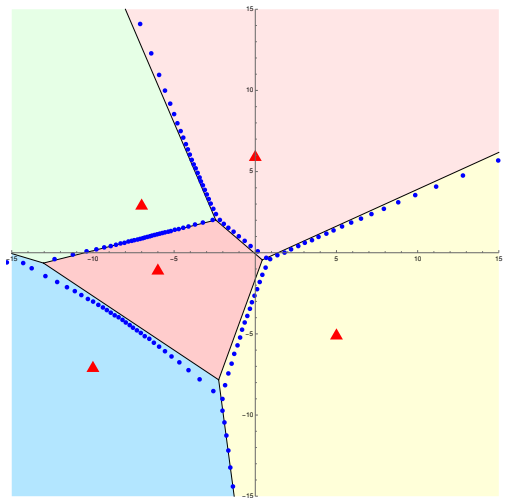
The zeros of high-order derivatives of rational functions times exponentials of rationals converge in distribution to the Voronoi diagram of the singularities.
A machine-rendered reading of the paper's core claim, the machinery that carries it, and where it could break.
Core claim
For f(z) = P(z)/Q(z) exp(S(z)/T(z)) with P, Q, S, T polynomials satisfying the stated coprimality and non-constancy conditions, the nth derivative contains a polynomial factor B_n whose zeros are analyzed via the Voronoi partition of the plane induced by the singular set Z(T) union Z(Q). Inside each open cell the factor B_n admits a uniform asymptotic description: classical Darboux expansions when the cell borders a pole of the rational prefactor, and a parameter-uniform Wright expansion involving m+1 saddle contributions when the cell borders a pole of S/T of order m. These descriptions imply an L1 convergence theorem for the normalized zero-counting measures of the derivatives, with the L1
What carries the argument
The Voronoi diagram of the singular set Z(T) union Z(Q), which determines the dominant singularity in each cell and thereby selects the appropriate asymptotic regime (Darboux or multi-saddle Wright) for the polynomial factor B_n in the nth derivative.
Where Pith is reading between the lines
- The appearance of Marchenko-Pastur and generalized Laguerre laws in the local models at simple poles indicates a link between derivative zero statistics and free probability or random-matrix ensembles.
- The same Voronoi-partition technique may apply to wider classes of functions whose singularities are isolated but not necessarily of rational-exponential type.
- Numerical verification of the L1 convergence for moderate n on concrete examples with two or three singularities would provide an immediate test of the global measure result.
Load-bearing premise
The function must be exactly of the form P/Q times exp(S/T) for polynomials satisfying the coprimality conditions and with T non-constant.
What would settle it
For the explicit example f(z) = exp(1/z), compute the zeros of the 200th derivative numerically and check whether they accumulate exclusively at the origin (the sole essential singularity) or spread elsewhere in the plane.
Figures

read the original abstract
We study the zero asymptotics of successive derivatives of $$f(z)=\frac{P(z)}{Q(z)}\exp\!\left(\frac{S(z)}{T(z)}\right),$$ where $P,Q,S,T\in\mathbb{C}[z]$, $\gcd(P,Q)=\gcd(S,T)=1$, and $T$ is nonconstant. The $n$th derivative carries a polynomial factor $B_n$, and our main result gives uniform asymptotics for $B_n$ on compact subsets of each open Voronoi cell of the singular set $Z(T)\cup Z(Q)$: classical Darboux asymptotics on cells attached to poles of $P/Q$, and a parameter-uniform Wright expansion with $m+1$ saddle contributions on cells attached to a pole of $S/T$ of order $m$. These local results yield an $L^1$ convergence theorem for the normalized zero-counting measures, whose limit is supported on the Voronoi diagram together with atoms at the essential singularities. We also study the reduced local model at an essential singularity: for simple poles it gives generalized Laguerre polynomials and the Marchenko--Pastur law, while for higher-order poles it gives a Laguerre-type Sheffer sequence that is $m$-orthogonal.
Editorial analysis
A structured set of objections, weighed in public.
Referee Report
Summary. The paper extends Pólya's shire theorem to the class of functions f(z) = P(z)/Q(z) exp(S(z)/T(z)) with P, Q, S, T polynomials satisfying the stated gcd conditions and T nonconstant. The nth derivative of f contains a polynomial factor B_n whose zeros are studied. The main result establishes uniform asymptotics for B_n on compact subsets of the open Voronoi cells determined by the finite singular set Z(T) ∪ Z(Q): classical Darboux asymptotics in cells adjacent to poles of P/Q, and parameter-uniform Wright expansions involving m+1 saddle points in cells adjacent to a pole of S/T of order m. These local expansions are patched to obtain an L¹ convergence theorem for the normalized zero-counting measures of B_n, with the limiting measure supported on the Voronoi diagram together with atoms at the essential singularities. Reduced local models at simple poles recover generalized Laguerre polynomials and the Marchenko–Pastur law; higher-order poles yield m-orthogonal Sheffer sequences of Laguerre type.
Significance. If the claimed uniform asymptotics and L¹ convergence hold, the work provides a coherent geometric extension of Pólya-type results to meromorphic functions with essential singularities. The Voronoi-cell partitioning unifies Darboux and saddle-point analyses, while the explicit recovery of classical orthogonal polynomials and random-matrix laws in the local models adds concrete value. The parameter-uniform Wright expansions and the patching argument for global measure convergence constitute the central technical contributions.
minor comments (2)
- [Abstract] Abstract: the phrase 'parameter-uniform Wright expansion with m+1 saddle contributions' would benefit from a parenthetical reference to the precise form of the expansion (e.g., the scaling of the saddles or the Airy-type transition) to orient readers before the full statement in §3.
- [§2.3] §2.3 (or wherever the Voronoi diagram is defined): the boundary between adjacent cells is stated to have measure zero, but a brief remark on whether the limiting measure charges the diagram itself (beyond the atoms at essential singularities) would clarify the support statement in the L¹ convergence theorem.
Simulated Author's Rebuttal
We thank the referee for the positive assessment of our manuscript and the recommendation for minor revision. The referee's summary accurately reflects the scope and main results of the work.
Circularity Check
No significant circularity; derivation relies on standard analytic techniques
full rationale
The paper derives uniform asymptotics for the polynomial factor B_n by partitioning the plane into Voronoi cells of the finite singular set Z(T) ∪ Z(Q) and applying classical Darboux asymptotics in pole cells together with parameter-uniform Wright expansions (with explicit saddle-point contributions) in essential-singularity cells. These local approximations are then patched to obtain L¹ convergence of the normalized zero-counting measures. All steps invoke standard complex-analytic tools (Darboux method, saddle-point analysis, Voronoi geometry) whose validity does not depend on the target result or on any fitted parameters internal to the paper. No self-definitional loop, fitted-input prediction, or load-bearing self-citation appears in the argument chain.
Axiom & Free-Parameter Ledger
axioms (2)
- standard math Standard saddle-point and Darboux asymptotic methods apply uniformly on the stated compact subsets of Voronoi cells.
- domain assumption The function f is meromorphic except at the essential singularities determined by T.
Reference graph
Works this paper leans on
-
[1]
Bøgvad and C
R. Bøgvad and C. Hägg,A refinement for rational functions of Pólya’s method to construct Voronoi diagrams, J. Math. Anal. Appl.452(2017), no. 1, 312–334. 1, 2
2017
- [2]
-
[3]
S. Chen, R. Feng, and M. F. Singer,Parallel Telescoping and Parameterized Picard–Vessiot Theory, Proceedings of ISSAC 2014, ACM, New York, 2014, pp. 137–144. 2
2014
-
[4]
J. G. Clunie and A. Edrei,Zeros of successive derivatives of analytic functions having a single essential singularity II, J. Anal. Math.56(1991), 141–185. 1, 2
1991
-
[5]
Deift,Orthogonal Polynomials and Random Matrices: a Riemann–Hilbert Approach, Courant Lecture Notes in Mathematics3, Amer
P. Deift,Orthogonal Polynomials and Random Matrices: a Riemann–Hilbert Approach, Courant Lecture Notes in Mathematics3, Amer. Math. Soc., Providence, RI, 1999. 24
1999
-
[6]
Edrei,On the zeros of successive derivatives of analytic functions having a single essential sin- gularity, in: Entire and Meromorphic Functions, World Scientific, Singapore, 1987
A. Edrei,On the zeros of successive derivatives of analytic functions having a single essential sin- gularity, in: Entire and Meromorphic Functions, World Scientific, Singapore, 1987. 2
1987
-
[7]
Edrei and G
A. Edrei and G. R. MacLane,On the zeros of the derivatives of entire functions, Proc. Amer. Math. Soc.8(1957), 702–706. 1
1957
-
[8]
A. S. Fokas, A. R. Its, and A. V. Kitaev,The isomonodromy approach to matrix models in 2D quantum gravity, Comm. Math. Phys.147(1992), no. 2, 395–430. 24
1992
-
[9]
R. M. Gethner,On the zeros of the derivatives of some entire functions of finite order, Proc. Edin- burgh Math. Soc.28(1985), 381–407. 1 29
1985
-
[10]
R. M. Gethner,Zeros of the successive derivatives of Hadamard gap series in the unit disk, Michigan Math. J.36(1989), 403–414. 1
1989
-
[11]
Hägg,The asymptotic zero-counting measure of iterated derivatives of a class of meromorphic functions, Ark
C. Hägg,The asymptotic zero-counting measure of iterated derivatives of a class of meromorphic functions, Ark. Mat.57(2019), no. 1, 107–120. 1, 2
2019
-
[12]
Johansson, M
F. Johansson, M. Kauers, and M. Mezzarobba,Finding Hyperexponential Solutions of Linear ODEs by Numerical Evaluation, Proceedings of ISSAC 2013, ACM, New York, 2013, pp. 201–208. 2
2013
-
[13]
Keo,Generalization of Pólya’s theorem for Voronoi diagram construction, Master’s thesis, Royal University of Phnom Penh, 2021
V. Keo,Generalization of Pólya’s theorem for Voronoi diagram construction, Master’s thesis, Royal University of Phnom Penh, 2021. 1
2021
-
[14]
Pólya,Über die Nullstellen sukzessiver Derivierten, Math
G. Pólya,Über die Nullstellen sukzessiver Derivierten, Math. Z.12(1922), 36–60. 1, 2
1922
-
[15]
Pólya,On the zeros of the derivatives of a function and its analytic character, Bull
G. Pólya,On the zeros of the derivatives of a function and its analytic character, Bull. Amer. Math. Soc.49(1943), 178–191. 1, 2
1943
-
[16]
Pólya and N
G. Pólya and N. Wiener,On the oscillation of the derivatives of a periodic function, Trans. Amer. Math. Soc.52(1942), 249–256. 1
1942
-
[17]
Pólya,On the zeros of successive derivatives—an example, J
G. Pólya,On the zeros of successive derivatives—an example, J. Analyse Math.30(1976), 452–455. 1
1976
-
[18]
C. L. Prather and J. K. Shaw,Zeros of successive derivatives of functions analytic in a neighbourhood of a single pole, Michigan Math. J.29(1982), 111–119. 1
1982
-
[19]
C. L. Prather and J. K. Shaw,A shire theorem for functions with algebraic singularities, Internat. J. Math. Math. Sci.5(1982), no. 4, 691–706. 1, 2
1982
-
[20]
Ransford,Potential Theory in the Complex Plane, Cambridge University Press, Cambridge, 1995
T. Ransford,Potential Theory in the Complex Plane, Cambridge University Press, Cambridge, 1995. 4, 26
1995
-
[21]
R. M. Gethner,A Pólya “shire” theorem for entire functions, Ph.D. thesis, University of Wisconsin– Madison, 1982. 1
1982
-
[22]
M. F. Singer,Introduction to the Galois Theory of Linear Differential Equations, London Mathe- matical Society Lecture Note Series 328, Cambridge University Press, 2006. 2
2006
-
[23]
M. F. Singer,Liouvillian Solutions of Differential Equations, Pacific J. Math.150(1991), no. 2, 353–365. 2
1991
-
[24]
Van Assche, J
W. Van Assche, J. S. Geronimo, and A. B. J. Kuijlaars,Riemann–Hilbert problems for multiple orthogonal polynomials, in: Special Functions 2000 (J. Bustoz et al., eds.), NATO Sci. Ser. II Math. Phys. Chem.30, Kluwer, Dordrecht, 2001, pp. 23–59. 24
2000
-
[25]
Varma and F
S. Varma and F. Taşdelen,On a different kind ofd-orthogonal polynomials that generalize the Laguerre polynomials, Mathematica Aeterna2(2012), no. 6, 561–572. 18, 19
2012
-
[26]
Weiss,Pólya’s shire theorem for automorphic functions, Geom
M. Weiss,Pólya’s shire theorem for automorphic functions, Geom. Dedicata100(2003), 85–92. 1
2003
-
[27]
E. M. Wright,On the coefficients of power series having exponential singularities, J. London Math. Soc.8(1933), no. 1, 71–79. 10
1933
-
[28]
E. M. Wright,On the coefficients of power series having exponential singularities (second paper), J. London Math. Soc.24(1949), no. 4, 304–309. 10 30
1949
discussion (0)
Sign in with ORCID, Apple, or X to comment. Anyone can read and Pith papers without signing in.