Recognition: unknown
TME-PSR: Time-aware, Multi-interest, and Explanation Personalization for Sequential Recommendation
Pith reviewed 2026-05-10 16:33 UTC · model grok-4.3
The pith
The TME-PSR model improves sequential recommendations by personalizing time preferences, multiple interests, and explanation alignments through specialized encoders and weighting.
A machine-rendered reading of the paper's core claim, the machinery that carries it, and where it could break.
Core claim
TME-PSR integrates Time-aware personalization, Multi-interest personalization, and Explanation personalization for Personalized Sequential Recommendation by using a dual-view gated time encoder to capture personalized temporal rhythms, a lightweight multihead Linear Recurrent Unit architecture for fine-grained sub-interest modeling with improved efficiency, and a dynamic dual-branch mutual information weighting mechanism to achieve personalized alignment between recommendations and explanations.
What carries the argument
Dual-view gated time encoder combined with multihead Linear Recurrent Unit and dynamic dual-branch mutual information weighting mechanism, which together enable the three forms of personalization in sequential recommendations.
If this is right
- Recommendation accuracy increases consistently on real-world datasets.
- Explanation quality improves through better personalized alignment.
- Computational cost is reduced compared to existing approaches.
- Users benefit from recommendations that align with their individual temporal rhythms and sub-interests.
Where Pith is reading between the lines
- The approach could be adapted to incorporate additional personalization dimensions like location or social context.
- Efficiency gains may support online learning where the model updates with new user interactions in real time.
- Joint optimization of accuracy and explanation might lead to higher user trust and retention in recommendation platforms.
- Similar dual-branch mechanisms could apply to other alignment tasks in machine learning beyond recommendations.
Load-bearing premise
The dual-view gated time encoder, multihead Linear Recurrent Unit, and dynamic dual-branch mutual information weighting mechanism reliably capture personalized temporal rhythms, fine-grained sub-interests, and recommendation-explanation alignment without needing post-hoc tuning.
What would settle it
A direct test would be to evaluate the model on a held-out real-world dataset and check whether accuracy, explanation quality, and computational cost show the claimed improvements; failure to do so would falsify the central claim.
Figures




read the original abstract
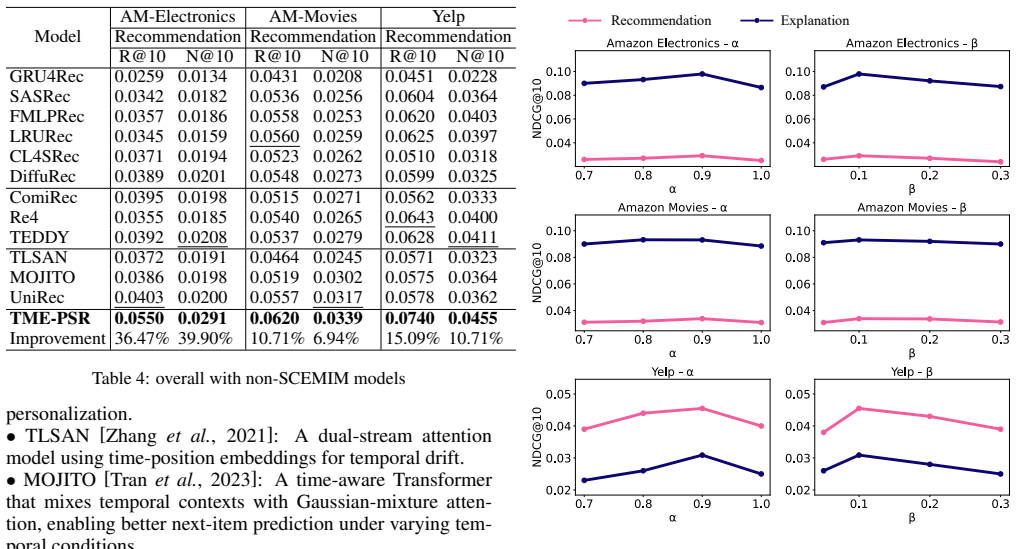
In this paper, we propose a sequential recommendation model that integrates Time-aware personalization, Multi-interest personalization, and Explanation personalization for Personalized Sequential Recommendation (TME-PSR). That is, we consider the differences across different users in temporal rhythm preference, multiple fine-grained latent interests, and the personalized semantic alignment between recommendations and explanations. Specifically, the proposed TME-PSR model employs a dual-view gated time encoder to capture personalized temporal rhythms, a lightweight multihead Linear Recurrent Unit architecture that enables fine-grained sub-interest modeling with improved efficiency, and a dynamic dual-branch mutual information weighting mechanism to achieve personalized alignment between recommendations and explanations. Extensive experiments on real-world datasets demonstrate that our method consistently improves recommendation accuracy and explanation quality, at a lower computational cost.
Editorial analysis
A structured set of objections, weighed in public.
Referee Report
Summary. The paper proposes TME-PSR, a sequential recommendation model that integrates time-aware personalization (via a dual-view gated time encoder), multi-interest personalization (via a lightweight multihead Linear Recurrent Unit), and explanation personalization (via a dynamic dual-branch mutual information weighting mechanism). It claims these components jointly deliver consistent gains in recommendation accuracy and explanation quality at reduced computational cost, supported by experiments on real-world datasets with ablations, standard sequential splits, and efficiency metrics.
Significance. If the results hold, the work advances sequential recommendation by jointly modeling user-specific temporal rhythms, fine-grained sub-interests, and rec-explanation alignment in an efficient architecture. Credit is given to the ablation tables that directly attribute gains to each component and the use of standard evaluation protocols, which strengthens reproducibility and supports the central claim on the reported evidence. The stress-test concern about potential circularity in the MI weighting does not appear to land, as the loss formulations and dynamic weighting are presented as non-circular with the evaluation metrics.
minor comments (3)
- Abstract: the claim of 'consistent improvements' and 'lower computational cost' would benefit from one or two key quantitative highlights (e.g., average NDCG gain or runtime reduction) to improve standalone readability, even though the full text supplies the details.
- §4 (experimental setup): while standard sequential splits are used, explicit details on handling of users/items with short histories or the exact exclusion rules for validation/test sets would further support the personalization claims.
- Figure 1: the dual-view gated time encoder diagram is clear but would be improved by adding tensor dimension annotations on the data flow arrows between the time encoder, LRU, and MI weighting branches.
Simulated Author's Rebuttal
We thank the referee for the positive review and recommendation of minor revision. The assessment correctly identifies the core contributions of TME-PSR in jointly addressing user-specific temporal rhythms via the dual-view gated time encoder, fine-grained interests through the multihead LRU, and personalized rec-explanation alignment via the dynamic dual-branch MI weighting. We appreciate the recognition of the ablation studies, standard sequential splits, and efficiency metrics that support the claims. No specific major comments were raised in the report.
Circularity Check
No significant circularity in derivation chain
full rationale
The paper defines three architectural modules (dual-view gated time encoder, multihead LRU, dynamic dual-branch MI weighting) and validates their joint contribution via ablation tables, efficiency metrics, and accuracy/explanation gains on standard temporal splits of multiple real-world datasets. No equation reduces a reported prediction to a fitted input by construction, no self-citation supplies a uniqueness theorem that forbids alternatives, and the mutual-information weighting term is an explicit trainable component whose alignment effect is measured separately from the training objective on held-out data. The central claims therefore rest on independent empirical evidence rather than definitional equivalence.
Axiom & Free-Parameter Ledger
free parameters (2)
- dual-branch mutual information weights
- gating parameters in dual-view time encoder
axioms (2)
- domain assumption The dual-view gated time encoder captures personalized temporal rhythms
- domain assumption Multihead Linear Recurrent Units enable fine-grained sub-interest modeling
Reference graph
Works this paper leans on
-
[1]
Controllable multi-interest framework for recommendation
[Cenet al., 2020 ] Yukuo Cen, Jianwei Zhang, Xu Zou, Chang Zhou, Hongxia Yang, and Jie Tang. Controllable multi-interest framework for recommendation. InPro- ceedings of the 26th ACM SIGKDD international confer- ence, pages 2942–2951,
2020
-
[2]
User-aware multi-interest learning for can- didate matching in recommenders
[Chaiet al., 2022 ] Zheng Chai, Zhihong Chen, Chenliang Li, Rong Xiao, Houyi Li, Jiawei Wu, Jingxu Chen, and Haihong Tang. User-aware multi-interest learning for can- didate matching in recommenders. InProceedings of the 45th SIGIR conference on research and development in in- formation retrieval, pages 1326–1335,
2022
-
[3]
Sequence-aware factorization machines for tempo- ral predictive analytics
[Chenet al., 2020 ] Tong Chen, Hongzhi Yin, Quoc Viet Hung Nguyen, Wen-Chih Peng, Xue Li, and Xiaofang Zhou. Sequence-aware factorization machines for tempo- ral predictive analytics. In2020 IEEE 36th ICDE, pages 1405–1416,
2020
-
[4]
[Chenet al., 2021 ] Gaode Chen, Xinghua Zhang, Yanyan Zhao, Cong Xue, and Ji Xiang. Exploring periodicity and interactivity in multi-interest framework for sequen- tial recommendation.arXiv preprint arXiv:2106.04415,
-
[5]
Probabilistic masked attention networks for explainable sequential recommen- dation
[Chenet al., 2023 ] Huiyuan Chen, Kaixiong Zhou, Zhimeng Jiang, Chin-Chia Michael Yeh, Xiaoting Li, Menghai Pan, Yan Zheng, Xia Hu, and Hao Yang. Probabilistic masked attention networks for explainable sequential recommen- dation. InIJCAI, pages 2068–2076,
2023
-
[6]
Empirical evalua- tion of gated recurrent neural networks on sequence mod- eling.arXiv: Neural and Evolutionary Computing, Dec
[Chunget al., 2014 ] Jun-Young Chung, Caglar Gulcehre, Kyunghyun Cho, and Yoshua Bengio. Empirical evalua- tion of gated recurrent neural networks on sequence mod- eling.arXiv: Neural and Evolutionary Computing, Dec
2014
-
[7]
Reinforced kgs reasoning for explainable sequential rec- ommendation.World Wide Web, 25(2):631–654,
[Cuiet al., 2022 ] Zhihong Cui, Hongxu Chen, Lizhen Cui, Shijun Liu, Xueyan Liu, Guandong Xu, and Hongzhi Yin. Reinforced kgs reasoning for explainable sequential rec- ommendation.World Wide Web, 25(2):631–654,
2022
-
[8]
Recode: Modeling repeat consump- tion with neural ode
[Daiet al., 2024 ] Sunhao Dai, Changle Qu, Sirui Chen, Xiao Zhang, and Jun Xu. Recode: Modeling repeat consump- tion with neural ode. InProceedings of the 47th Interna- tional ACM SIGIR Conference on Research and Develop- ment in Information Retrieval, pages 2599–2603,
2024
-
[9]
Uniform sequence better: Time interval aware data augmentation for sequential rec- ommendation
[Danget al., 2023 ] Yizhou Dang, Enneng Yang, Guibing Guo, Linying Jiang, Xingwei Wang, Xiaoxiao Xu, Qinghui Sun, and Hong Liu. Uniform sequence better: Time interval aware data augmentation for sequential rec- ommendation. InProceedings of the AAAI conference on artificial intelligence, pages 4225–4232,
2023
-
[10]
A survey on feature weighting based k-means algorithms.Journal of Classification, 33(2):210–242,
[De Amorim, 2016] Renato Cordeiro De Amorim. A survey on feature weighting based k-means algorithms.Journal of Classification, 33(2):210–242,
2016
-
[11]
Transformers4rec: Bridging the gap between nlp and sequential/session-based recommenda- tion
[de Souza Pereira Moreiraet al., 2021 ] Gabriel de Souza Pereira Moreira, Sara Rabhi, Jeong Min Lee, Ronay Ak, and Even Oldridge. Transformers4rec: Bridging the gap between nlp and sequential/session-based recommenda- tion. InProceedings of the 15th ACM conference on recommender systems, pages 143–153,
2021
-
[12]
Time weight col- laborative filtering
[Ding and Li, 2005] Yi Ding and Xue Li. Time weight col- laborative filtering. InProceedings of the 14th ACM inter- national conference on Information and knowledge man- agement, pages 485–492,
2005
-
[13]
Leveraging two types of global graph for sequential fashion recommendation
[Dinget al., 2021 ] Yujuan Ding, Yunshan Ma, Wai Keung Wong, and Tat-Seng Chua. Leveraging two types of global graph for sequential fashion recommendation. InProceed- ings of the 2021 international conference on multimedia retrieval, pages 73–81,
2021
-
[14]
Sequential user-based recurrent neural net- work recommendations
[Donkerset al., 2017 ] Tim Donkers, Benedikt Loepp, and J¨urgen Ziegler. Sequential user-based recurrent neural net- work recommendations. InProceedings of the eleventh ACM conference on recommender systems, pages 152– 160,
2017
-
[15]
Disentangled multi- interest representation learning for sequential recommen- dation
[Duet al., 2024 ] Yingpeng Du, Ziyan Wang, Zhu Sun, Yin- ing Ma, Hongzhi Liu, and Jie Zhang. Disentangled multi- interest representation learning for sequential recommen- dation. InProceedings of the 30th ACM SIGKDD Confer- ence, pages 677–688,
2024
-
[16]
Path language modeling over knowledge graphsfor ex- plainable recommendation
[Genget al., 2022a ] Shijie Geng, Zuohui Fu, Juntao Tan, Yingqiang Ge, Gerard De Melo, and Yongfeng Zhang. Path language modeling over knowledge graphsfor ex- plainable recommendation. InProceedings of the ACM web conference 2022, pages 946–955,
2022
-
[17]
Parsrec: Explainable personalized attention-fused recurrent sequential recom- mendation using session partial actions
[Gholamiet al., 2022 ] Ehsan Gholami, Mohammad Mo- tamedi, and Ashwin Aravindakshan. Parsrec: Explainable personalized attention-fused recurrent sequential recom- mendation using session partial actions. InProceedings of the 28th ACM SIGKDD Conference, pages 454–464,
2022
-
[18]
Recurrent neural networks with top-k gains for session-based recommendations
[Hidasi and Karatzoglou, 2018] Bal´azs Hidasi and Alexan- dros Karatzoglou. Recurrent neural networks with top-k gains for session-based recommendations. InProceedings of the 27th ACM International Conference on Information and Knowledge Management, Oct
2018
-
[19]
Session-based Recommendations with Recurrent Neural Networks
[Hidasiet al., 2015 ] Bal´azs Hidasi, Alexandros Karat- zoglou, Linas Baltrunas, and Domonkos Tikk. Session- based recommendations with recurrent neural networks. arXiv preprint arXiv:1511.06939,
work page internal anchor Pith review arXiv 2015
-
[20]
To- wards universal sequence representation learning for rec- ommender systems
[Houet al., 2022 ] Yupeng Hou, Shanlei Mu, WayneXin Zhao, Yaliang Li, Bolin Ding, and Ji-Rong Wen. To- wards universal sequence representation learning for rec- ommender systems. Jun
2022
-
[21]
Explainable interaction-driven user modeling over knowl- edge graph for sequential recommendation
[Huanget al., 2019 ] Xiaowen Huang, Quan Fang, Sheng- sheng Qian, Jitao Sang, Yan Li, and Changsheng Xu. Explainable interaction-driven user modeling over knowl- edge graph for sequential recommendation. Inproceedings of the 27th ACM international conference on multimedia, pages 548–556,
2019
-
[22]
Cumulated gain-based evaluation of ir techniques.ACM Transactions on Information Systems (TOIS), 20(4):422–446,
[J¨arvelin and Kek¨al¨ainen, 2002] Kalervo J ¨arvelin and Jaana Kek¨al¨ainen. Cumulated gain-based evaluation of ir techniques.ACM Transactions on Information Systems (TOIS), 20(4):422–446,
2002
-
[23]
Genrec: Large language model for generative recommen- dation
[Jiet al., 2024 ] Jianchao Ji, Zelong Li, Shuyuan Xu, Wenyue Hua, Yingqiang Ge, Juntao Tan, and Yongfeng Zhang. Genrec: Large language model for generative recommen- dation. InEuropean Conference on Information Retrieval, pages 494–502. Springer,
2024
-
[24]
Trimlp: A founda- tional mlp-like architecture for sequential recommenda- tion.ACM Transactions on Information Systems, 42(6):1– 34,
[Jianget al., 2024 ] Yiheng Jiang, Yuanbo Xu, Yongjian Yang, Funing Yang, Pengyang Wang, Chaozhuo Li, Fuzhen Zhuang, and Hui Xiong. Trimlp: A founda- tional mlp-like architecture for sequential recommenda- tion.ACM Transactions on Information Systems, 42(6):1– 34,
2024
-
[25]
Self-attentive sequential recommendation
[Kang and McAuley, 2018] Wang-Cheng Kang and Julian McAuley. Self-attentive sequential recommendation. In2018 IEEE international conference on data mining (ICDM), pages 197–206. IEEE,
2018
-
[26]
Multi-interest net- work with dynamic routing for recommendation at tmall
[Liet al., 2019 ] Chao Li, Zhiyuan Liu, Mengmeng Wu, Yuchi Xu, Huan Zhao, Pipei Huang, Guoliang Kang, Qi- wei Chen, Wei Li, and Dik Lun Lee. Multi-interest net- work with dynamic routing for recommendation at tmall. InProceedings of the 28th ACM international conference on information and knowledge management, pages 2615– 2623,
2019
-
[27]
Time interval aware self-attention for sequen- tial recommendation
[Liet al., 2020 ] Jiacheng Li, Yujie Wang, and Julian McAuley. Time interval aware self-attention for sequen- tial recommendation. InProceedings of the 13th interna- tional conference on web search and data mining, pages 322–330,
2020
-
[28]
Ex- tra: Explanation ranking datasets for explainable recom- mendation
[Liet al., 2021 ] Lei Li, Yongfeng Zhang, and Li Chen. Ex- tra: Explanation ranking datasets for explainable recom- mendation. InProceedings of the 44th International ACM SIGIR conference on Research and Development in Infor- mation Retrieval, pages 2463–2469,
2021
-
[29]
[Liet al., 2023c ] Xinhang Li, Chong Chen, Xiangyu Zhao, Yong Zhang, and Chunxiao Xing. E4srec: An elegant effective efficient extensible solution of large language models for sequential recommendation.arXiv preprint arXiv:2312.02443,
-
[30]
Disentangle interest trend and diversity for sequential recommendation.Information Processing & Management, 61(3):103619,
[Liet al., 2024 ] Zihao Li, Yunfan Xie, Wei Emma Zhang, Pengfei Wang, Lixin Zou, Fei Li, Xiangyang Luo, and Chenliang Li. Disentangle interest trend and diversity for sequential recommendation.Information Processing & Management, 61(3):103619,
2024
-
[31]
K-plet recurrent neural networks for sequen- tial recommendation
[Linet al., 2018 ] Xiang Lin, Shuzi Niu, Yiqiao Wang, and Yucheng Li. K-plet recurrent neural networks for sequen- tial recommendation. InThe 41st International ACM SI- GIR Conference on Research and Development in Infor- mation Retrieval, page 1057–1060, Jun
2018
-
[32]
Sparse at- tentive memory network for click-through rate prediction with long sequences
[Linet al., 2022 ] Qianying Lin, Wen-Ji Zhou, Yanshi Wang, Qing Da, Qing-Guo Chen, and Bing Wang. Sparse at- tentive memory network for click-through rate prediction with long sequences. Aug
2022
-
[33]
Llmemb: Large language model can be a good embedding generator for sequential recommenda- tion
[Liuet al., 2025 ] Qidong Liu, Xian Wu, Wanyu Wang, Yejing Wang, Yuanshao Zhu, Xiangyu Zhao, Feng Tian, and Yefeng Zheng. Llmemb: Large language model can be a good embedding generator for sequential recommenda- tion. InProceedings of the AAAI Conference on Artificial Intelligence, volume 39, pages 12183–12191,
2025
-
[34]
Learning global and multi-granularity lo- cal representation with mlp for sequential recommenda- tion.ACM Transactions on Knowledge Discovery from Data, 18(4):1–15,
[Longet al., 2024 ] Chao Long, Huanhuan Yuan, Junhua Fang, Xuefeng Xian, Guanfeng Liu, Victor S Sheng, and Pengpeng Zhao. Learning global and multi-granularity lo- cal representation with mlp for sequential recommenda- tion.ACM Transactions on Knowledge Discovery from Data, 18(4):1–15,
2024
-
[35]
[Maaten and Hinton, 2008] Laurensvander Maaten and Ge- offreyE. Hinton. Visualizing data using t-sne.Journal of Machine Learning Research, Jan
2008
-
[36]
Resurrecting recurrent neural networks for long sequences
[Orvietoet al., 2023 ] Antonio Orvieto, Samuel L Smith, Al- bert Gu, Anushan Fernando, Caglar Gulcehre, Razvan Pascanu, and Soham De. Resurrecting recurrent neural networks for long sequences. InInternational Conference on Machine Learning, pages 26670–26698. PMLR,
2023
-
[37]
Modeling sequences as star graphs to address over-smoothing in self-attentive sequential recommendation.ACM Transactions on Knowledge Discovery from Data, 18(8):1–24,
[Penget al., 2024 ] Bo Peng, Ziqi Chen, Srinivasan Parthasarathy, and Xia Ning. Modeling sequences as star graphs to address over-smoothing in self-attentive sequential recommendation.ACM Transactions on Knowledge Discovery from Data, 18(8):1–24,
2024
-
[38]
Practice on long sequential user behav- ior modeling for click-through rate prediction
[Piet al., 2019 ] Qi Pi, Weijie Bian, Guorui Zhou, Xiaoqiang Zhu, and Kun Gai. Practice on long sequential user behav- ior modeling for click-through rate prediction. InProceed- ings of the 25th ACM SIGKDD International Conference, Jul
2019
-
[39]
User behavior retrieval for click-through rate prediction
[Qinet al., 2020 ] Jiarui Qin, Weinan Zhang, Xin Wu, Jiarui Jin, Yuchen Fang, and Yong Yu. User behavior retrieval for click-through rate prediction. InProceedings of the 43rd International ACM SIGIR Conference on Research and Development in Information Retrieval, Jul
2020
-
[40]
Intent contrastive learning with cross subsequences for se- quential recommendation
[Qinet al., 2024 ] Xiuyuan Qin, Huanhuan Yuan, Pengpeng Zhao, Guanfeng Liu, Fuzhen Zhuang, and Victor S Sheng. Intent contrastive learning with cross subsequences for se- quential recommendation. InProceedings of the 17th ACM international conference on web search and data mining, pages 548–556,
2024
-
[41]
Contrastive learning for representation de- generation problem in sequential recommendation
[Qiuet al., 2022 ] Ruihong Qiu, Zi Huang, Hongzhi Yin, and Zijian Wang. Contrastive learning for representation de- generation problem in sequential recommendation. InPro- ceedings of the fifteenth ACM international conference on web search and data mining, pages 813–823,
2022
-
[42]
Recommender systems with generative re- trieval.Advances in Neural Information Processing Sys- tems, 36:10299–10315,
[Rajputet al., 2023 ] Shashank Rajput, Nikhil Mehta, An- ima Singh, Raghunandan Hulikal Keshavan, Trung Vu, Lukasz Heldt, Lichan Hong, Yi Tay, Vinh Tran, Jonah Samost, et al. Recommender systems with generative re- trieval.Advances in Neural Information Processing Sys- tems, 36:10299–10315,
2023
-
[43]
Pairwise interaction tensor fac- torization for personalized tag recommendation
[Rendle and Schmidt-Thieme, 2010] Steffen Rendle and Lars Schmidt-Thieme. Pairwise interaction tensor fac- torization for personalized tag recommendation. In Proceedings of the third ACM international conference on Web search and data mining, pages 81–90,
2010
-
[44]
Factorizing personal- ized markov chains for next-basket recommendation
[Rendleet al., 2010 ] Steffen Rendle, Christoph Freuden- thaler, and Lars Schmidt-Thieme. Factorizing personal- ized markov chains for next-basket recommendation. In Proceedings of the 19th international conference on World wide web, pages 811–820,
2010
-
[45]
Rtisr: a review-driven time interval- aware sequential recommendation method.Journal of Big Data, 10(1):32,
[Shiet al., 2023 ] Xiaoyu Shi, Quanliang Liu, Yanan Bai, and Mingsheng Shang. Rtisr: a review-driven time interval- aware sequential recommendation method.Journal of Big Data, 10(1):32,
2023
-
[46]
Bert4rec: Se- quential recommendation with bidirectional encoder rep- resentations from transformer
[Sunet al., 2019 ] Fei Sun, Jun Liu, Jian Wu, Changhua Pei, Xiao Lin, Wenwu Ou, and Peng Jiang. Bert4rec: Se- quential recommendation with bidirectional encoder rep- resentations from transformer. InProceedings of the 28th ACM international conference on information and knowl- edge management, pages 1441–1450,
2019
-
[47]
Person- alized top-n sequential recommendation via convolutional sequence embedding
[Tang and Wang, 2018] Jiaxi Tang and Ke Wang. Person- alized top-n sequential recommendation via convolutional sequence embedding. InProceedings of the eleventh ACM international conference on web search and data mining, pages 565–573,
2018
-
[48]
Attention mix- tures for time-aware sequential recommendation
[Tranet al., 2023 ] Viet Anh Tran, Guillaume Salha-Galvan, Bruno Sguerra, and Romain Hennequin. Attention mix- tures for time-aware sequential recommendation. InPro- ceedings of the 46th SIGIR conference, pages 1821–1826,
2023
-
[49]
Missrec: Pre-training and transferring multi-modal interest-aware sequence representation for recommendation
[Wanget al., 2023 ] Jinpeng Wang, Ziyun Zeng, Yunxiao Wang, Yuting Wang, Xingyu Lu, Tianxiang Li, Jun Yuan, Rui Zhang, Hai-Tao Zheng, and Shu-Tao Xia. Missrec: Pre-training and transferring multi-modal interest-aware sequence representation for recommendation. InProceed- ings of the 31st ACM International Conference on Multi- media, pages 6548–6557,
2023
-
[50]
Eager: Two-stream generative recommender with behavior-semantic collaboration
[Wanget al., 2024 ] Ye Wang, Jiahao Xun, Minjie Hong, Jieming Zhu, Tao Jin, Wang Lin, Haoyuan Li, Linjun Li, Yan Xia, Zhou Zhao, et al. Eager: Two-stream generative recommender with behavior-semantic collaboration. In Proceedings of the 30th ACM SIGKDD Conference, pages 3245–3254,
2024
-
[51]
Diff4rec: Sequential recommendation with curriculum- scheduled diffusion augmentation
[Wuet al., 2023 ] Zihao Wu, Xin Wang, Hong Chen, Kaidong Li, Yi Han, Lifeng Sun, and Wenwu Zhu. Diff4rec: Sequential recommendation with curriculum- scheduled diffusion augmentation. InProceedings of the 31st ACM international conference on multimedia, pages 9329–9335,
2023
-
[52]
Multi-behavior sequential recommendation with temporal graph transformer.IEEE Transactions on Knowl- edge and Data Engineering, 35(6):6099–6112,
[Xiaet al., 2022 ] Lianghao Xia, Chao Huang, Yong Xu, and Jian Pei. Multi-behavior sequential recommendation with temporal graph transformer.IEEE Transactions on Knowl- edge and Data Engineering, 35(6):6099–6112,
2022
-
[53]
Reinforce- ment knowledge graph reasoning for explainable recom- mendation
[Xianet al., 2019 ] Yikun Xian, Zuohui Fu, Shan Muthukr- ishnan, Gerard De Melo, and Yongfeng Zhang. Reinforce- ment knowledge graph reasoning for explainable recom- mendation. InProceedings of the 42nd international ACM SIGIR conference on research and development in infor- mation retrieval, pages 285–294,
2019
-
[54]
Contrastive learning for sequential recommendation
[Xieet al., 2022 ] Xu Xie, Fei Sun, Zhaoyang Liu, Shiwen Wu, Jinyang Gao, Jiandong Zhang, Bolin Ding, and Bin Cui. Contrastive learning for sequential recommendation. In2022 IEEE 38th international conference on data engi- neering (ICDE), pages 1259–1273. IEEE,
2022
-
[55]
Rethinking multi-interest learning for candidate matching in recommender systems
[Xieet al., 2023 ] Yueqi Xie, Jingqi Gao, Peilin Zhou, Qichen Ye, Yining Hua, Jae Boum Kim, Fangzhao Wu, and Sunghun Kim. Rethinking multi-interest learning for candidate matching in recommender systems. InProceed- ings of the 17th ACM conference on recommender systems, pages 283–293,
2023
-
[56]
Temporal collab- orative filtering with bayesian probabilistic tensor factor- ization
[Xionget al., 2010 ] Liang Xiong, Xi Chen, Tzu-Kuo Huang, Jeff Schneider, and Jaime G Carbonell. Temporal collab- orative filtering with bayesian probabilistic tensor factor- ization. InProceedings of the 2010 SIAM international conference on data mining, pages 211–222. SIAM,
2010
-
[57]
Gfe: General knowledge enhanced framework for ex- plainable sequential recommendation.Knowledge-Based Systems, 230:107375,
[Yanget al., 2021 ] Zuoxi Yang, Shoubin Dong, and Jinlong Hu. Gfe: General knowledge enhanced framework for ex- plainable sequential recommendation.Knowledge-Based Systems, 230:107375,
2021
-
[58]
Gener- ate what you prefer: Reshaping sequential recommenda- tion via guided diffusion.Advances in Neural Information Processing Systems, 36:24247–24261,
[Yanget al., 2023 ] Zhengyi Yang, Jiancan Wu, Zhicai Wang, Xiang Wang, Yancheng Yuan, and Xiangnan He. Gener- ate what you prefer: Reshaping sequential recommenda- tion via guided diffusion.Advances in Neural Information Processing Systems, 36:24247–24261,
2023
-
[59]
Adaptive user mod- eling with long and short-term preferences for personal- ized recommendation
[Yuet al., 2019 ] Zeping Yu, Jianxun Lian, Ahmad Mah- moody, Gongshen Liu, and Xing Xie. Adaptive user mod- eling with long and short-term preferences for personal- ized recommendation. InIJCAI, volume 7, pages 4213– 4219,
2019
-
[60]
Sequential recommendation with collaborative ex- planation via mutual information maximization
[Yuet al., 2024 ] Yi Yu, Kazunari Sugiyama, and Adam Ja- towt. Sequential recommendation with collaborative ex- planation via mutual information maximization. InPro- ceedings of the 47th International ACM SIGIR Conference on Research and Development in Information Retrieval, pages 1062–1072,
2024
-
[61]
A simple convolutional generative network for next item rec- ommendation
[Yuanet al., 2019 ] Fajie Yuan, Alexandros Karatzoglou, Ioannis Arapakis, Joemon M Jose, and Xiangnan He. A simple convolutional generative network for next item rec- ommendation. InProceedings of the twelfth ACM interna- tional conference on web search and data mining, pages 582–590,
2019
-
[62]
Linear recurrent units for sequential recommendation
[Yueet al., 2024 ] Zhenrui Yue, Yueqi Wang, Zhankui He, Huimin Zeng, Julian McAuley, and Dong Wang. Linear recurrent units for sequential recommendation. InPro- ceedings of the 17th ACM international conference on web search and data mining, pages 930–938,
2024
-
[63]
Tlsan: Time-aware long-and short-term at- tention network for next-item recommendation.Neuro- computing, 441:179–191,
[Zhanget al., 2021 ] Jianqing Zhang, Dongjing Wang, and Dongjin Yu. Tlsan: Time-aware long-and short-term at- tention network for next-item recommendation.Neuro- computing, 441:179–191,
2021
-
[64]
Re4: Learning to re-contrast, re-attend, re- construct for multi-interest recommendation
[Zhanget al., 2022 ] Shengyu Zhang, Lingxiao Yang, Dong Yao, Yujie Lu, Fuli Feng, Zhou Zhao, Tat-Seng Chua, and Fei Wu. Re4: Learning to re-contrast, re-attend, re- construct for multi-interest recommendation. InProceed- ings of the ACM web conference 2022, pages 2216–2226,
2022
-
[65]
Temporal graph con- trastive learning for sequential recommendation
[Zhanget al., 2024 ] Shengzhe Zhang, Liyi Chen, Chao Wang, Shuangli Li, and Hui Xiong. Temporal graph con- trastive learning for sequential recommendation. InPro- ceedings of the AAAI conference on artificial intelligence, volume 38, pages 9359–9367,
2024
-
[66]
Dis- entangling long and short-term interests for recommenda- tion
[Zhenget al., 2022 ] Yu Zheng, Chen Gao, Jianxin Chang, Yanan Niu, Yang Song, Depeng Jin, and Yong Li. Dis- entangling long and short-term interests for recommenda- tion. InProceedings of the ACM web conference 2022, pages 2256–2267,
2022
-
[67]
Filter-enhanced mlp is all you need for se- quential recommendation
[Zhouet al., 2022 ] Kun Zhou, Hui Yu, Wayne Xin Zhao, and Ji-Rong Wen. Filter-enhanced mlp is all you need for se- quential recommendation. InProceedings of the ACM web conference 2022, pages 2388–2399,
2022
-
[68]
Early models used Markov chains [Rendleet al., 2010 ] to model sequen- tial data
A Additional Related Work Sequential recommendation predicts a user’s next interac- tion by modeling their historical behaviors. Early models used Markov chains [Rendleet al., 2010 ] to model sequen- tial data. Early studies adopted CNN [Chenet al., 2022b; Tang and Wang, 2018; Yuanet al., 2019 ] and RNN meth- ods [Donkerset al., 2017; Hidasiet al., 2015; ...
2010
-
[69]
We ignore constant factors and linear- time terms due to normalization/residual wiring and do not account for additional FFN/projection costs here
[Yueet al., 2024 ] for a sequence of lengthn. We ignore constant factors and linear- time terms due to normalization/residual wiring and do not account for additional FFN/projection costs here. Then, the time complexity of serially computing all heads isO(H· log(n)·(d/H)
2024
discussion (0)
Sign in with ORCID, Apple, or X to comment. Anyone can read and Pith papers without signing in.