Recognition: unknown
Threshold Top-Quark Pair-Production: Cross Sections and Key Uncertainties
Pith reviewed 2026-05-10 16:50 UTC · model grok-4.3
The pith
Non-relativistic QCD predicts an excess of 4.15 pb in top-quark pair production near threshold at the 13 TeV LHC.
A machine-rendered reading of the paper's core claim, the machinery that carries it, and where it could break.
Core claim
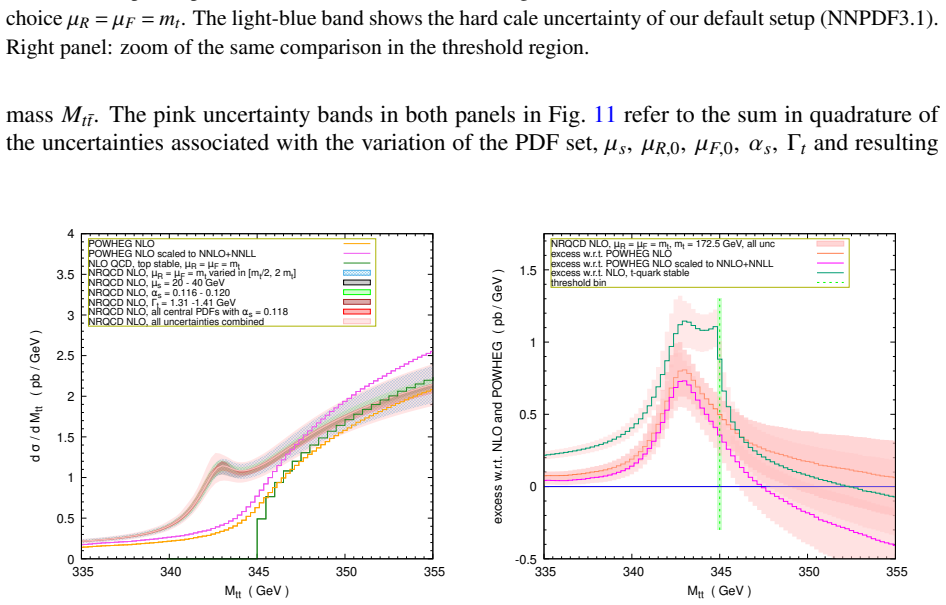
In the non-relativistic QCD framework, top-quark pair production near threshold receives additional contributions from color-singlet and octet Green's functions that describe quasi-bound toponium states. At 13 TeV center-of-mass energy the integral of the invariant-mass distribution from 340 to 350 GeV equals 11.67 pb with asymmetric uncertainties of +1.43 pb and -1.47 pb. Subtracting the POWHEG-BOX prediction yields an excess of 4.15 pb carrying the same uncertainty envelope.
What carries the argument
The non-relativistic QCD framework with color-singlet and octet Green's functions, which models the threshold enhancement from quasi-bound toponium formation beyond fixed-order QCD.
If this is right
- LHC analyses can directly search for the predicted 4.15 pb excess in the top-pair invariant-mass spectrum near 345 GeV.
- Uncertainties in the prediction are comparable in size to those in standard fixed-order calculations but arise from different sources including Green's functions.
- The excess size scales with variations in the top-quark mass and the strong coupling constant.
- Implications for ATLAS and CMS top-pair measurements near threshold can be quantified using the reported numbers.
Where Pith is reading between the lines
- Confirmation of the excess would open a route to study toponium-like states in hadron collisions rather than only in electron-positron machines.
- The same Green's function approach could be adapted to predict threshold enhancements in other heavy-quark systems such as bottom-quark pairs.
- Improved experimental resolution in the invariant-mass spectrum would allow separation of the threshold peak from the smooth continuum background.
- Reducing the uncertainty on the top-quark mass would shrink the dominant theoretical error and sharpen the predicted excess.
Load-bearing premise
The non-relativistic QCD framework together with the modeling of color-singlet and octet Green's functions correctly captures the formation of quasi-bound toponium near threshold.
What would settle it
A high-precision measurement of the top-quark pair invariant-mass distribution at the LHC that finds the 340-350 GeV integral outside the reported 11.67 +1.43/-1.47 pb range or shows no excess above the POWHEG-BOX result.
Figures




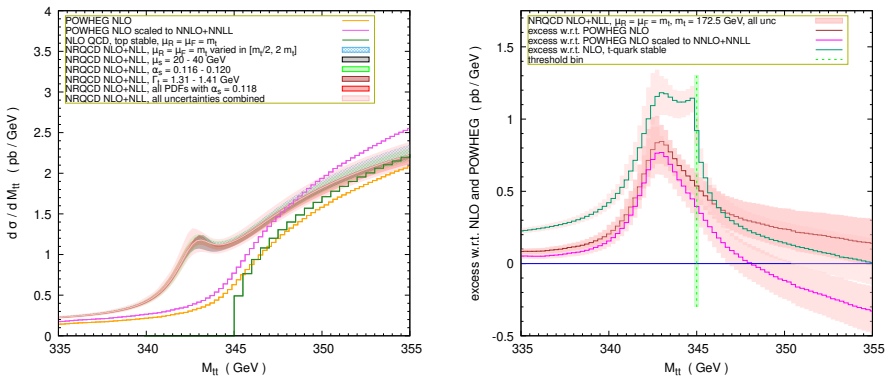


read the original abstract
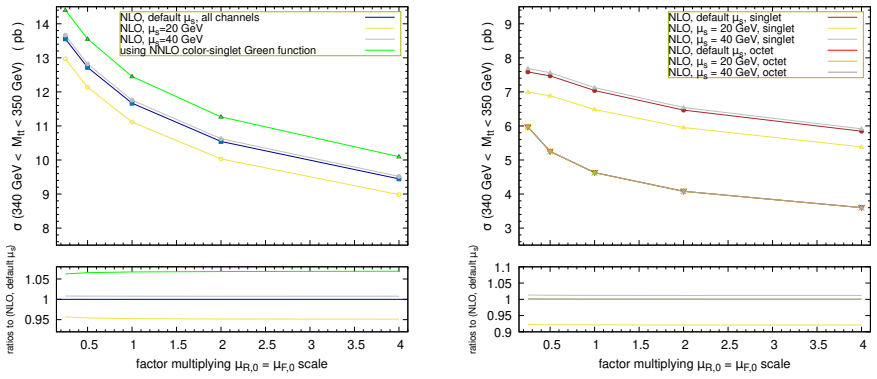
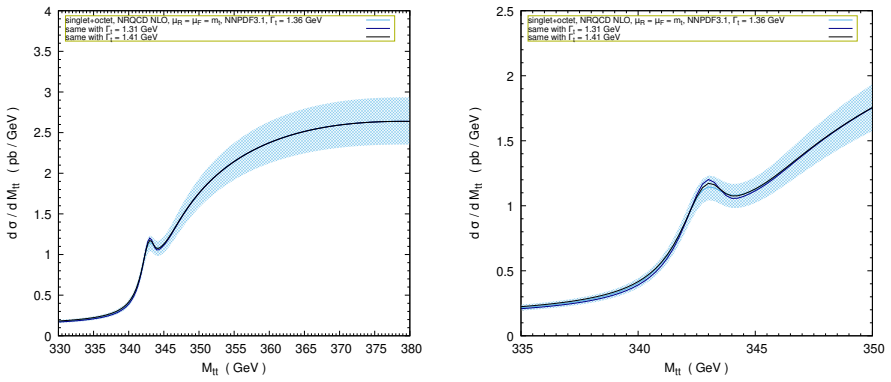
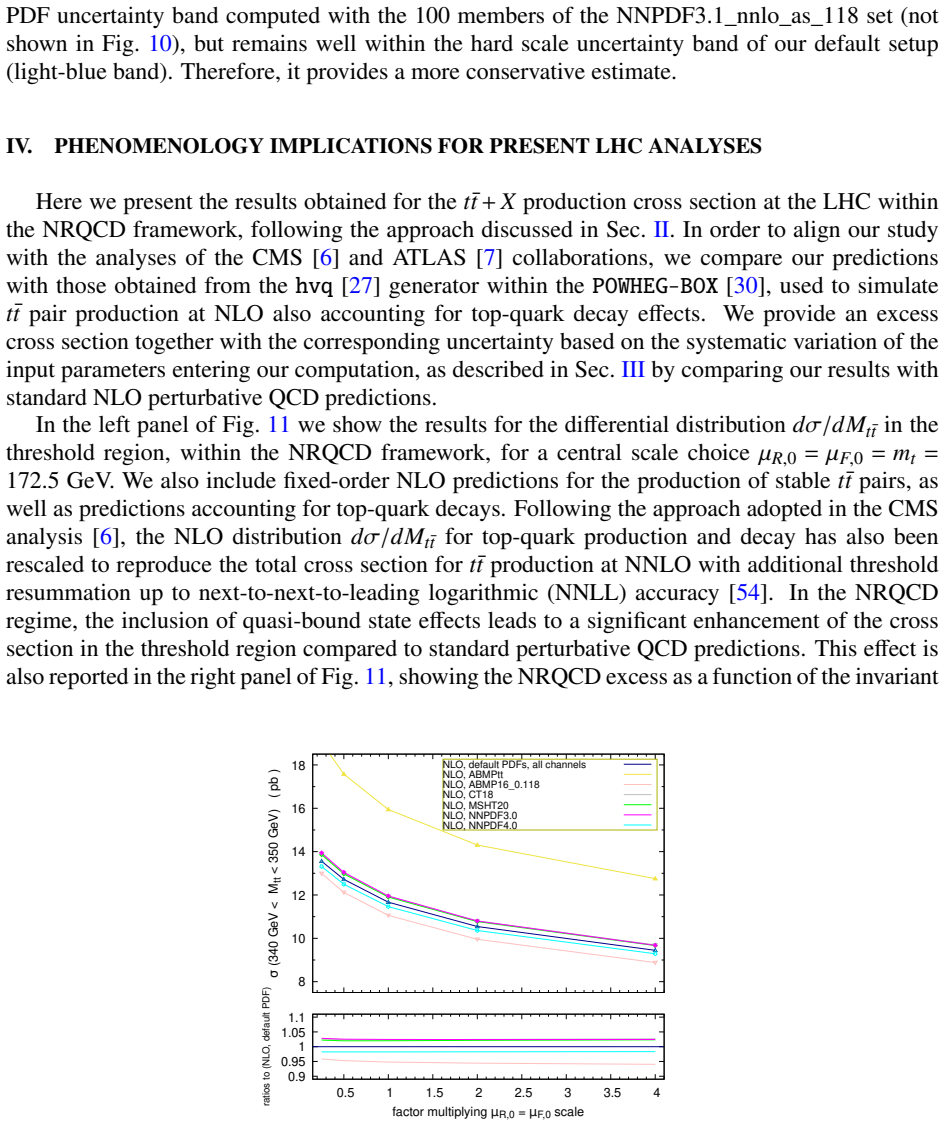
We study theoretical uncertainties in predicting top-quark pair-production near threshold at the LHC using the non-relativistic QCD framework. We include variations in the top-quark mass and width, the strong coupling $\alpha_s$, renormalization and factorization scales, and parton distribution functions, as well as uncertainties from the color-singlet and octet Green's functions that describe quasi-bound toponium formation. These uncertainties are compared with those from standard fixed-order QCD predictions, and implications for ATLAS and CMS analyses are discussed. For the LHC at 13 TeV center-of-mass energy, the integral of the top-quark pair invariant-mass distribution from 340 to 350 GeV is 11.67 pb with ${}^{+1.43}_{-1.47}$ pb uncertainty. The corresponding excess after subtracting the POWHEG-BOX result is 4.15 pb with the same uncertainties.
Editorial analysis
A structured set of objections, weighed in public.
Referee Report
Summary. The manuscript studies theoretical uncertainties in top-quark pair production near threshold at the LHC within the non-relativistic QCD (NRQCD) framework. It incorporates variations of the top-quark mass and width, α_s, renormalization and factorization scales, PDFs, and uncertainties arising from color-singlet and octet Green's functions that model quasi-bound toponium formation. The central results are the integrated cross section of 11.67 pb (+1.43/-1.47 pb) over the 340–350 GeV invariant-mass window at 13 TeV and the 4.15 pb excess obtained after subtracting the POWHEG-BOX prediction; implications for ATLAS and CMS analyses are discussed.
Significance. If the Green's-function uncertainty procedure is shown to be robust, the work would provide a concrete, numerically explicit estimate of threshold enhancements that could inform LHC measurements and help quantify the difference between NRQCD and standard fixed-order/MC tools. The explicit comparison to POWHEG-BOX and the inclusion of multiple standard uncertainty sources constitute a useful benchmark for the community.
major comments (1)
- [Abstract] Abstract: the quoted uncertainty band of +1.43/-1.47 pb is stated to arise in part from variations of the color-singlet and octet Green's functions, yet the manuscript provides no explicit description of the variation procedure (ranges, correlation assumptions, or independent treatment of binding potential and width smearing). Without this, it is not possible to verify that the band exhausts plausible non-perturbative or higher-order relativistic corrections to the threshold Green's function, which directly affects the reliability of both the 11.67 pb central value and the 4.15 pb excess.
minor comments (1)
- [Abstract] The abstract refers to implications for ATLAS and CMS but does not cite specific experimental papers or analyses that have already examined the threshold region.
Simulated Author's Rebuttal
We thank the referee for the careful reading of the manuscript and the constructive comment on the need for greater transparency in the Green's function uncertainty procedure. We address the point below and will revise the manuscript to include the requested details.
read point-by-point responses
-
Referee: [Abstract] Abstract: the quoted uncertainty band of +1.43/-1.47 pb is stated to arise in part from variations of the color-singlet and octet Green's functions, yet the manuscript provides no explicit description of the variation procedure (ranges, correlation assumptions, or independent treatment of binding potential and width smearing). Without this, it is not possible to verify that the band exhausts plausible non-perturbative or higher-order relativistic corrections to the threshold Green's function, which directly affects the reliability of both the 11.67 pb central value and the 4.15 pb excess.
Authors: We agree that the current manuscript does not provide a sufficiently explicit account of the Green's function variation procedure. In the revised version we will insert a dedicated paragraph (likely in Section 3 or a new subsection of the results) that specifies: (i) the numerical ranges adopted for the binding-potential parameters in both singlet and octet channels, (ii) the independent smearing applied to the top-quark width, (iii) the correlation assumptions used when combining singlet and octet contributions, and (iv) the quadrature or envelope prescription employed to obtain the final asymmetric uncertainty. This addition will allow readers to reproduce and assess the robustness of the quoted band and the 4.15 pb excess relative to POWHEG-BOX. revision: yes
Circularity Check
No circularity in NRQCD threshold cross-section computation
full rationale
The paper computes the near-threshold top-pair invariant-mass integral directly within the NRQCD framework by evaluating the Green's functions with explicit variations of input parameters (top mass, width, α_s, scales, PDFs) and separate uncertainty bands from color-singlet/octet Green's functions. The quoted 11.67 pb central value and ±1.43/1.47 pb band are outputs of this forward calculation, not quantities defined by or fitted to the uncertainty parameters themselves. The excess relative to POWHEG-BOX is an external subtraction, not an internal redefinition. No equation reduces the reported result to its own inputs by construction, no self-citation supplies a load-bearing uniqueness theorem, and no ansatz is smuggled via prior work. The derivation therefore remains self-contained against external benchmarks.
Axiom & Free-Parameter Ledger
free parameters (2)
- renormalization and factorization scales
- top-quark mass and width
axioms (1)
- domain assumption Non-relativistic QCD framework is valid for describing top-quark pair production near threshold
Reference graph
Works this paper leans on
-
[1]
thehvqgenerator withinPOWHEG-BOXat NLO in the NW A)
Compute base-line predictions based on perturbative QCD expansion •Use a parton-level event generator to simulatet ¯tproduction, also accounting for top- quark decay effects (e.g. thehvqgenerator withinPOWHEG-BOXat NLO in the NW A). •These predictions serve as the“pQCD”baselineσ pQCD
-
[2]
•Evaluate the cross sectionσ NRQCD fort ¯t+Xproduction, accounting for the resumma- tion of quasi-bound state effects within the NRQCD framework (see Eq
Compute the NRQCD prediction •Ensure that the calculation uses the sameM t¯t binning and kinematic settings adopted forσ pQCD. •Evaluate the cross sectionσ NRQCD fort ¯t+Xproduction, accounting for the resumma- tion of quasi-bound state effects within the NRQCD framework (see Eq. (3) for the NLO NRQCD expression)
-
[3]
•Compute the cross section enhancementσ excess as the difference betweenσNRQCD and σpQCD
Determine the excess •Ensure that the perturbative orders are consistent on both sides (neither ad-hoc rescal- ing, nor reweighting etc.). •Compute the cross section enhancementσ excess as the difference betweenσNRQCD and σpQCD. We are now able to isolate the cross section enhancement by integrating numerically Eq. (1) within the peak region corresponding...
-
[4]
Rept.1115(2025) 116 [2403.01313]
CMS collaboration,Review of top quark mass measurements in CMS,Phys. Rept.1115(2025) 116 [2403.01313]
-
[5]
K. Agashe et al.,Report of the Topical Group on Top quark physics and heavy flavor production for Snowmass 2021,2209.11267
-
[6]
Fadin, V .A
V .S. Fadin, V .A. Khoze and T. Sjostrand,On the Threshold Behavior of Heavy Top Production,Z. Phys. C48(1990) 613
1990
-
[7]
Fadin and V .A
V .S. Fadin and V .A. Khoze,Production of a pair of t¯t quarks near threshold,Sov. J. Nucl. Phys.53 (1991) 692
1991
-
[8]
Top - anti-top pair production close to threshold: Synopsi s of recent NNLO results,
A.H. Hoang et al.,Top - anti-top pair production close to threshold: Synopsis of recent NNLO results,Eur. Phys. J. direct2(2000) 3 [hep-ph/0001286]
work page internal anchor Pith review arXiv 2000
- [9]
-
[10]
ATLAS collaboration,Observation of a cross-section enhancement near the t ¯t production threshold in √s=13TeV pp collisions with the ATLAS detector,2601.11780
work page internal anchor Pith review arXiv
- [11]
- [12]
-
[13]
On the threshold behaviour of heavy top production,
T. Sjöstrand,On the threshold behaviour of heavy top production,PoSQCDEX2025(2026) 002 [2510.04590]
- [14]
-
[15]
J. Piclum and C. Schwinn,Soft-gluon and Coulomb corrections to hadronic top-quark pair production beyond NNLO,JHEP03(2018) 164 [1801.05788]
- [16]
-
[17]
M. Beneke, Y . Kiyo, P. Marquard, A. Penin, J. Piclum and M. Steinhauser, Next-to-Next-to-Next-to-Leading Order QCD Prediction for the Top Antitop S -Wave Pair Production Cross Section Near Threshold in e+e− Annihilation,Phys. Rev. Lett.115(2015) 192001 [1506.06864]
- [18]
-
[19]
Bound-state Effe cts on Top Quark Production at Hadron Colliders,
K. Hagiwara, Y . Sumino and H. Yokoya,Bound-state Effects on Top Quark Production at Hadron Colliders,Phys. Lett. B666(2008) 71 [0804.1014]
-
[20]
Top-quark pair production near threshold at LHC,
Y . Kiyo, J.H. Kühn, S. Moch, M. Steinhauser and P. Uwer,Top-quark pair production near threshold at LHC,Eur. Phys. J. C60(2009) 375 [0812.0919]
-
[21]
Bound-state effects on kinematical distributions of top quarks at hadron colliders
Y . Sumino and H. Yokoya,Bound-state effects on kinematical distributions of top quarks at hadron colliders,JHEP09(2010) 034 [1007.0075]
work page Pith review arXiv 2010
-
[22]
F. Maltoni, C. Severi, S. Tentori and E. Vryonidou,Quantum detection of new physics in top-quark pair production at the LHC,JHEP03(2024) 099 [2401.08751]
-
[23]
Updated predictions for toponium productio n at the LHC,
M.V . Garzelli, G. Limatola, S.O. Moch, M. Steinhauser and O. Zenaiev,Updated predictions for toponium production at the LHC,Phys. Lett. B866(2025) 139532 [2412.16685]
- [24]
- [25]
-
[26]
Top-pair production at the LHC through NNLO QCD and NLO EW
M. Czakon, D. Heymes, A. Mitov, D. Pagani, I. Tsinikos and M. Zaro,Top-pair production at the LHC through NNLO QCD and NLO EW,JHEP10(2017) 186 [1705.04105]
work page Pith review arXiv 2017
-
[27]
M.L. Czakon et al.,Top quark pair production at complete NLO accuracy with NNLO+NNLL’ corrections in QCD,Chin. Phys. C44(2020) 083104 [1901.08281]
- [28]
-
[29]
127(2021) no.6, 062001 [arXiv:2012.14267 [hep-ph]]
J. Mazzitelli, P.F. Monni, P. Nason, E. Re, M. Wiesemann and G. Zanderighi, Next-to-Next-to-Leading Order Event Generation for Top-Quark Pair Production,Phys. Rev. Lett. 127(2021) 062001 [2012.14267]
-
[30]
A Positive-Weight Next-to-Leading-Order Monte Carlo for Heavy Flavour Hadroproduction
S. Frixione, P. Nason and G. Ridolfi,A Positive-weight next-to-leading-order Monte Carlo for heavy flavour hadroproduction,JHEP09(2007) 126 [0707.3088]
work page Pith review arXiv 2007
-
[31]
A New Method for Combining NLO QCD with Shower Monte Carlo Algorithms
P. Nason,A New method for combining NLO QCD with shower Monte Carlo algorithms,JHEP11 (2004) 040 [hep-ph/0409146]
work page internal anchor Pith review arXiv 2004
-
[32]
Matching NLO QCD computations with Parton Shower simulations: the POWHEG method
S. Frixione, P. Nason and C. Oleari,Matching NLO QCD computations with Parton Shower simulations: the POWHEG method,JHEP11(2007) 070 [0709.2092]
work page internal anchor Pith review arXiv 2007
-
[33]
A general framework for implementing NLO calculations in shower Monte Carlo programs: the POWHEG BOX
S. Alioli, P. Nason, C. Oleari and E. Re,A general framework for implementing NLO calculations in shower Monte Carlo programs: the POWHEG BOX,JHEP06(2010) 043 [1002.2581]
work page internal anchor Pith review arXiv 2010
-
[34]
S. Frixione, E. Laenen, P. Motylinski and B.R. Webber,Angular correlations of lepton pairs from vector boson and top quark decays in Monte Carlo simulations,JHEP04(2007) 081 [hep-ph/0702198]
-
[35]
P. Artoisenet, R. Frederix, O. Mattelaer and R. Rietkerk,Automatic spin-entangled decays of heavy resonances in Monte Carlo simulations,JHEP03(2013) 015 [1212.3460]
-
[36]
J. Alwall, R. Frederix, S. Frixione, V . Hirschi, F. Maltoni, O. Mattelaer et al.,The automated computation of tree-level and next-to-leading order differential cross sections, and their matching to parton shower simulations,JHEP07(2014) 079 [1405.0301]. 22
work page internal anchor Pith review arXiv 2014
- [37]
-
[38]
G. Bevilacqua, M. Czakon, A. van Hameren, C.G. Papadopoulos and M. Worek,Complete off-shell effects in top quark pair hadroproduction with leptonic decay at next-to-leading order,JHEP02 (2011) 083 [1012.4230]
- [39]
- [40]
- [41]
-
[42]
L. Buonocore, M. Grazzini, S. Kallweit, J.M. Lindert and C. Savoini,Towards NNLO QCD predictions for off-shell top-quark pair production and decays,JHEP10(2025) 195 [2507.11410]
-
[43]
M.V . Garzelli, J. Mazzitelli, S.O. Moch and O. Zenaiev,Top-quark pole mass extraction at NNLO accuracy, from total, single- and double-differential cross sections for tt+X production at the LHC, JHEP05(2024) 321 [2311.05509]
-
[44]
J.H. Kühn and E. Mirkes,QCD corrections to toponium production at hadron colliders,Phys. Rev. D 48(1993) 179 [hep-ph/9301204]
-
[45]
A. Petrelli, M. Cacciari, M. Greco, F. Maltoni and M.L. Mangano,NLO production and decay of quarkonium,Nucl. Phys. B514(1998) 245 [hep-ph/9707223]
-
[46]
NNPDF collaboration,Parton distributions from high-precision collider data,Eur. Phys. J. C77 (2017) 663 [1706.00428]
work page internal anchor Pith review Pith/arXiv arXiv 2017
- [47]
-
[48]
Parton Distribution Functions, $\alpha_s$ and Heavy-Quark Masses for LHC Run II
S. Alekhin, J. Blümlein, S. Moch and R. Placakyte,Parton distribution functions,α s, and heavy-quark masses for LHC Run II,Phys. Rev. D96(2017) 014011 [1701.05838]
work page Pith review arXiv 2017
-
[49]
T.-J. Hou et al.,New CTEQ global analysis of quantum chromodynamics with high-precision data from the LHC,Phys. Rev. D103(2021) 014013 [1912.10053]
- [50]
-
[51]
NNPDF collaboration,Parton distributions for the LHC Run II,JHEP04(2015) 040 [1410.8849]
work page Pith review arXiv 2015
- [52]
-
[53]
S. Alekhin, M.V . Garzelli, S.O. Moch and O. Zenaiev,NNLO PDFs driven by top-quark data,Eur. Phys. J. C85(2025) 162 [2407.00545]
- [54]
-
[55]
ParticleDataGroupcollaboration,Review of particle physics,Phys. Rev. D110(2024) 030001
2024
- [56]
-
[57]
Top++: a program for the calculation of the top-pair cross-section at hadron colliders
M. Czakon and A. Mitov,Top++: A Program for the Calculation of the Top-Pair Cross-Section at Hadron Colliders,Comput. Phys. Commun.185(2014) 2930 [1112.5675]
work page Pith review arXiv 2014
-
[58]
Towards a Common t¯t Monte-Carlo Sample for ATLAS and CMS
ATLAS, CMS collaboration, “Towards a Common t¯t Monte-Carlo Sample for ATLAS and CMS.” ATL-PHYS-PUB-2021-016, CMS NOTE-2021/005, 2021. 23
2021
discussion (0)
Sign in with ORCID, Apple, or X to comment. Anyone can read and Pith papers without signing in.