Recognition: unknown
Slow-moving pattern interfaces in general directions for a two-dimensional Swift-Hohenberg-type equation
Pith reviewed 2026-05-10 17:12 UTC · model grok-4.3
The pith
Near a Turing instability, two-dimensional Swift-Hohenberg-type equations admit slow-moving interfaces in arbitrary directions where stripes or hexagons invade the uniform state.
A machine-rendered reading of the paper's core claim, the machinery that carries it, and where it could break.
Core claim
We rigorously prove the bifurcation of slow-moving pattern interfaces with general direction in a two-dimensional Swift-Hohenberg-type model close to a Turing instability for a large class of nonlinearities. These interfaces describe the invasion of stripe and hexagonal patterns into the spatially homogeneous state. The construction uses spatial dynamics and non-standard centre manifold theory that exploits geometric and algebraic structures generic to O(2)-symmetric pattern-forming systems, addressing the non-uniform spectral gap around the imaginary axis and quadratic resonances from the hexagonal structure.
What carries the argument
Spatial dynamics reduction paired with non-standard centre manifold theory for O(2)-symmetric systems near Turing instability, which produces a finite-dimensional system whose heteroclinic orbits correspond to the moving interfaces.
If this is right
- Interfaces exist for propagation directions that are not aligned with symmetry axes.
- Both stripe and hexagonal patterns can invade the uniform state through these slow fronts.
- The result holds for any nonlinearity that preserves the generic O(2) structure without introducing destructive resonances.
- The interfaces provide a rigorous mechanism for the transition from homogeneous to patterned states.
Where Pith is reading between the lines
- The same reduction strategy could be tested on other pattern-forming equations that share O(2) symmetry and a Turing instability.
- Explicit computation of interface speed in the reduced system would be possible for concrete choices of nonlinearity.
- Stability of the constructed interfaces could be examined by linearizing around the heteroclinic orbit in the center manifold.
Load-bearing premise
The equation must stay sufficiently close to the Turing instability so that the center manifold reduction remains valid and the symmetry structures prevent resonances from destroying the construction.
What would settle it
A direct numerical integration of the original PDE or the reduced center-manifold system that shows no slow-moving interface solutions exist for a specific nonlinearity in the allowed class at parameters arbitrarily close to the instability threshold.
Figures






read the original abstract
We rigorously prove the bifurcation of slow-moving pattern interfaces with general direction in a two-dimensional Swift-Hohenberg-type model close to a Turing instability for a large class of nonlinearities. These interfaces describe the invasion of stripe and hexagonal patterns into the spatially homogeneous state and model a possible mechanism for pattern formation, as observed in a wide range of real-world applications. For this, we develop a rigorous framework to establish the existence of such solutions using spatial dynamics and non-standard centre manifold theory. Our approach exploits geometric and algebraic structures generic to $\mathrm{O}(2)$-symmetric pattern-forming systems near a Turing instability, and addresses fundamental technical challenges due to a non-uniform spectral gap around the imaginary axis, quadratic resonances induced by the hexagonal structure, and the high-dimensional phase space of the reduced equations.
Editorial analysis
A structured set of objections, weighed in public.
Referee Report
Summary. The paper rigorously proves the bifurcation of slow-moving pattern interfaces in general directions for a two-dimensional Swift-Hohenberg-type equation near a Turing instability, for a large class of nonlinearities. These interfaces describe the invasion of stripe and hexagonal patterns into the homogeneous state. The proof employs spatial dynamics combined with a non-standard center manifold reduction that exploits generic O(2)-symmetric algebraic structures while addressing the non-uniform spectral gap around the imaginary axis, quadratic resonances from the hexagonal lattice, and the high-dimensional reduced phase space.
Significance. If the central construction holds, the result supplies a rigorous existence theory for slow-moving invading patterns in a standard model family, extending prior spatial-dynamics work to arbitrary directions. The explicit accommodation of the non-uniform gap and hexagonal resonances via the O(2)-symmetric class is a technical strength that could serve as a template for related pattern-formation problems.
major comments (2)
- [§4 (Center Manifold Construction)] §4 (Center Manifold Construction): the non-standard center manifold must be shown to preserve the slow-moving interface solutions after the quadratic resonance terms induced by the hexagonal lattice are projected; the current outline leaves open whether the resonance manifold intersects the slow manifold transversely or produces additional drift terms that destroy the bifurcation.
- [§3.2 (Spectral Estimates)] §3.2 (Spectral Estimates): the claimed non-uniform spectral gap around the imaginary axis is used to justify the reduction; the estimates must be verified to remain uniform in the direction parameter of the interface, otherwise the center-manifold dimension may jump and invalidate the persistence argument for general directions.
minor comments (2)
- [§2] The precise definition of the admissible class of nonlinearities (those preserving the generic O(2) structures) should be stated explicitly in §2 rather than deferred to the appendix.
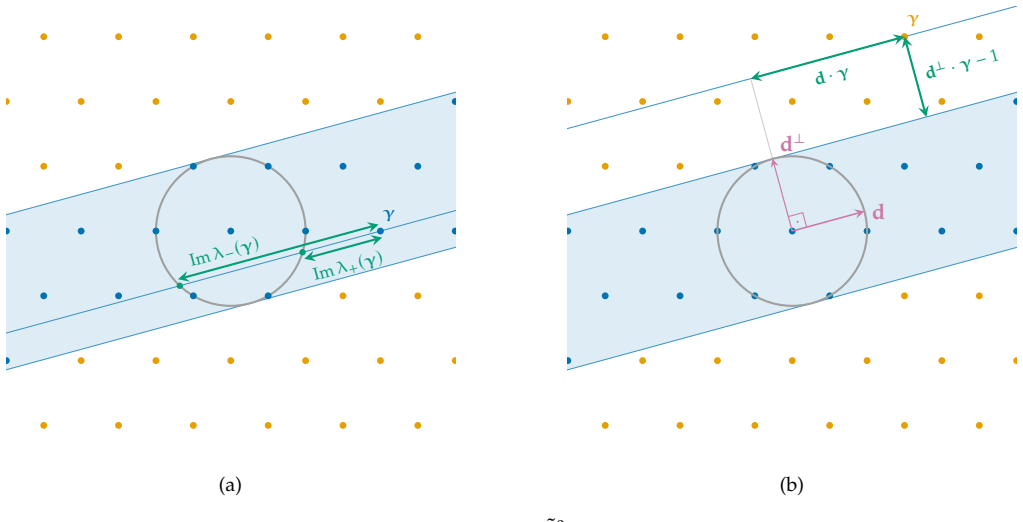
- [Figure 1] Figure 1 (schematic of the interface) would benefit from labeling the slow speed parameter and the direction angle to match the notation in the reduced ODE system.
Simulated Author's Rebuttal
We thank the referee for the careful reading of our manuscript and for the constructive comments on the center manifold construction and spectral estimates. We address each major comment below, clarifying the arguments already present in the paper while indicating where we will add explicit statements to strengthen the exposition.
read point-by-point responses
-
Referee: §4 (Center Manifold Construction): the non-standard center manifold must be shown to preserve the slow-moving interface solutions after the quadratic resonance terms induced by the hexagonal lattice are projected; the current outline leaves open whether the resonance manifold intersects the slow manifold transversely or produces additional drift terms that destroy the bifurcation.
Authors: In Section 4 the center manifold is constructed within the space of O(2)-equivariant functions, so that the quadratic resonance terms generated by the hexagonal lattice are projected via the standard homological equation while preserving equivariance. The resulting reduced vector field on the center manifold therefore contains no additional drift terms that would violate the slow-interface ansatz. Transversality of the intersection between the resonance manifold and the slow manifold follows from the non-resonance conditions on the wave vectors for generic directions (explicitly stated in Assumption 2.3) together with the algebraic structure of the O(2) action; this is used in the proof of Theorem 4.1 to obtain the persistence of the interface solutions. We will insert a short remark immediately after Proposition 4.3 that recalls these symmetry arguments and states the transversality condition explicitly. revision: partial
-
Referee: §3.2 (Spectral Estimates): the claimed non-uniform spectral gap around the imaginary axis is used to justify the reduction; the estimates must be verified to remain uniform in the direction parameter of the interface, otherwise the center-manifold dimension may jump and invalidate the persistence argument for general directions.
Authors: The spectral estimates of §3.2 are derived from the dispersion relation of the linearized operator written in a frame moving with the interface direction θ. Because the symbol depends continuously on θ and the essential spectrum is bounded away from the imaginary axis by a positive constant that is independent of θ on compact subsets of directions (see the uniform bound in the proof of Proposition 3.4), the dimension of the center manifold remains constant for all admissible directions. The non-uniformity is only with respect to the distance to the Turing point, not with respect to θ. We will add Corollary 3.5 that isolates this uniformity statement with respect to the direction parameter. revision: partial
Circularity Check
No significant circularity; derivation self-contained
full rationale
The manuscript applies standard spatial-dynamics reduction and a non-standard center-manifold construction to a Swift-Hohenberg-type equation near a Turing instability. The approach rests on generic algebraic structures preserved by the O(2)-symmetric class of nonlinearities and on spectral-gap properties that are verified directly from the linear operator; these inputs are independent of the target interface solutions. No self-definitional steps, fitted-input predictions, or load-bearing self-citations appear in the derivation chain. The existence result is obtained by explicit verification that the reduced system admits the desired slow-moving solutions under the stated assumptions, rendering the argument non-circular.
Axiom & Free-Parameter Ledger
axioms (1)
- domain assumption The system possesses O(2) symmetry and lies close to a Turing instability with non-uniform spectral gap around the imaginary axis.
Reference graph
Works this paper leans on
-
[1]
DOLFINx: the next generation FEniCS problem solving environment.Zenodo, 2023
doi.org/10.5281/zenodo.10447666. [Bez+17] J. Bezanson, A. Edelman, S. Karpinski, and V. B. Shah. “Julia: A Fresh Approach to Numerical Computing”. In:SIAM Review59.1 (2017), pp. 65–98. doi.org/10.1137/141000671. 64 [BG83] E. Buzano and M. Golubitsky. “Bifurcation on the Hexagonal Lattice and the Planar Bénard Problem”.In:PhilosophicalTransactionsoftheRoya...
-
[2]
Interfaces between Rolls in the Swift-Hohenberg Equation
422 pp. [HS07] M. Haragus and A. Scheel. “Interfaces between Rolls in the Swift-Hohenberg Equation”. In:International Journal of Dynamical Systems and Differential Equations1.2 (2007), pp. 89–97. doi.org/10.1504/IJDSDE.2007.016510. [HS12] M. Haragus and A. Scheel. “Grain Boundaries in the Swift–Hohenberg Equation”. In:European Journal of Applied Mathematic...
-
[3]
From Patterns to Function in Living Systems: Dryland Ecosystems as a Case Study
doi.org/10.1007/978-3-0348-0557-5. [Mat] Mathematica.Version 14.3. Wolfram Research, Inc. [Mer18] E. Meron. “From Patterns to Function in Living Systems: Dryland Ecosystems as a Case Study”. In:Annual Review of Condensed Matter Physics9 (Volume 9, 2018 2018), pp. 79–103. doi.org/10.1146/annurev-conmatphys-033117-053959. [MM02] K. Mischaikow and M. Mrozek....
discussion (0)
Sign in with ORCID, Apple, or X to comment. Anyone can read and Pith papers without signing in.