Recognition: unknown
On Worst-Case Optimal Polynomial Intersection
Pith reviewed 2026-05-10 15:49 UTC · model grok-4.3
The pith
Solutions to worst-case Optimal Polynomial Intersection can asymptotically beat the semicircle law from Decoded Quantum Interferometry over prime fields.
A machine-rendered reading of the paper's core claim, the machinery that carries it, and where it could break.
Core claim
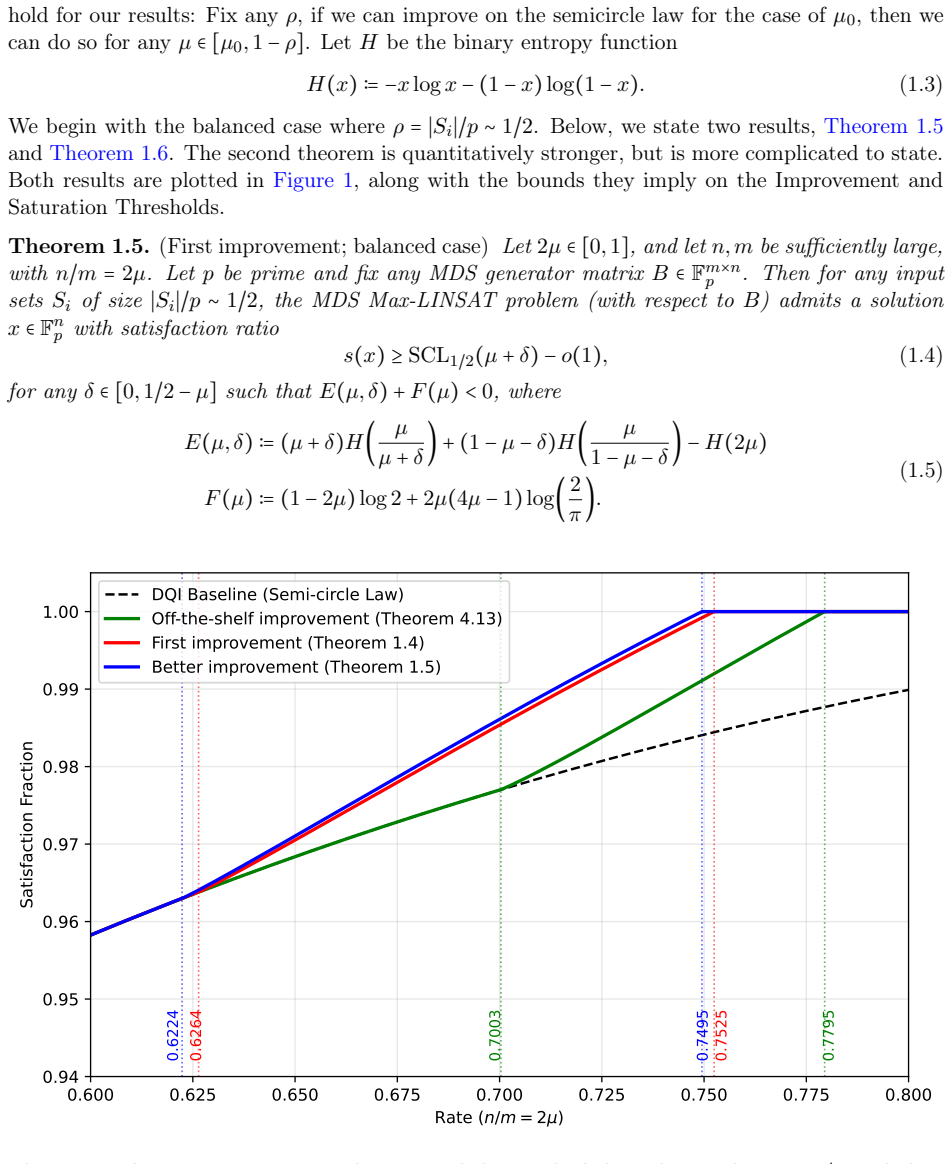
In this work, we show that there are better solutions for worst-case OPI instances over prime fields. In particular, DQI and the semicircle law are not optimal. For example, when the lists S_i have size ρp for ρ∼1/2, our results imply the existence of a solution that asymptotically beats the semicircle law whenever n/m≥0.6225, and we show that an asymptotically perfect solution exists whenever n/m≥0.7496. Our results generalize to Max-LINSAT problems derived from any Maximum Distance Separable (MDS) code, and to any ρ∈(0,1). The key insight is a connection to local leakage resilience of secret sharing schemes.
What carries the argument
The reduction from OPI to the local leakage resilience of secret sharing schemes, which is used to prove the existence of improved solutions.
If this is right
- Existence of solutions beating the semicircle law for n/m ≥ 0.6225 when ρ ≈ 1/2.
- Asymptotically perfect solutions for n/m ≥ 0.7496 when ρ ≈ 1/2.
- Improved solutions for any ρ in (0,1) and for Max-LINSAT from MDS codes.
- Several re-proofs of the existence of semicircle law solutions along the way.
Where Pith is reading between the lines
- This suggests potential for classical algorithms to achieve better performance by drawing on leakage resilience techniques.
- May have implications for designing better secret sharing schemes with local leakage resilience properties.
- Could be extended to other quantum algorithms or interference-based methods in coding theory problems.
Load-bearing premise
The reduction mapping OPI instances to local leakage resilience questions in secret sharing is valid and preserves the asymptotic parameters over prime fields.
What would settle it
An explicit construction of an OPI instance with n/m = 0.7 and ρ = 0.5 where the maximum number of intersections is no larger than the semicircle law prediction, or a proof that the leakage resilience bound does not apply to the corresponding secret sharing scheme.
Figures


read the original abstract
The Optimal Polynomial Intersection (OPI) problem is the following: Given sets $S_1, \ldots, S_m \subseteq \mathbb{F}$ and evaluation points $a_1, \ldots, a_m \in \mathbb{F}$, find a polynomial $Q \in \mathbb{F}[x]$ of degree less than $n$ so that $Q(a_i) \in S_i$ for as many $i \in \{1, 2, \ldots, m\}$ as possible. Decoded Quantum Interferometry (DQI) is a quantum algorithm that efficiently returns good solutions to the problem, even on worst-case instances (Jordan et. al., 2025). The quality of the solutions returned follows a semicircle law, which outperforms known efficient classical algorithms. But does DQI obtain the best possible solutions? That is, are there solutions better than the semicircle law for worst-case OPI instances? Surprisingly, before this work, the best existential results coincide with (and follow from) the best algorithmic results. In this work, we show that there are better solutions for worst-case OPI instances over prime fields. In particular, DQI and the semicircle law are not optimal. For example, when the lists $S_i$ have size $\rho p$ for $\rho \sim 1/2$, our results imply the existence of a solution that asymptotically beats the semicircle law whenever $n/m \geq 0.6225$, and we show that an asymptotically perfect solution exists whenever $n/m \geq 0.7496$. Our results generalize to Max-LINSAT problems derived from any Maximum Distance Separable (MDS) code, and to any $\rho \in (0,1)$. The key insight to our improvement is a connection to local leakage resilience of secret sharing schemes. Along the way, we recover several re-proofs of the existence of solutions achieving the semicircle law.
Editorial analysis
A structured set of objections, weighed in public.
Referee Report
Summary. The paper claims to improve upon the existential bounds for worst-case Optimal Polynomial Intersection (OPI) instances over prime fields. By linking OPI to local leakage resilience properties of secret sharing schemes based on Maximum Distance Separable (MDS) codes, it demonstrates the existence of solutions that asymptotically outperform the semicircle law achieved by Decoded Quantum Interferometry (DQI) for parameters such as n/m ≥ 0.6225 when list sizes are approximately half the field size, and asymptotically perfect solutions for n/m ≥ 0.7496. The results extend to Max-LINSAT problems derived from any MDS code and arbitrary ρ in (0,1), while also providing alternative proofs for the semicircle law.
Significance. This result, if the reduction is rigorously established, is significant because it separates the best possible solutions from the performance of known efficient algorithms like DQI, showing that the semicircle law is not the optimal existential bound. The novel connection between combinatorial optimization problems and leakage resilience in cryptography provides a new tool for analyzing such problems and may inspire further cross-disciplinary work. Additionally, the re-derivation of the semicircle law existence results using this framework adds to the robustness of the findings. The specific numerical improvements for ρ ≈ 1/2 highlight practical relevance for certain regimes.
major comments (2)
- The central improvement rests on the reduction from OPI existence to local leakage resilience of MDS-based secret sharing schemes. The abstract asserts that this yields the specific thresholds 0.6225 and 0.7496, but without an explicit parameter translation (how leakage rate and field size p map to the fraction of satisfied lists and the critical n/m ratio), it is impossible to confirm the thresholds follow directly without extra loss factors or p → ∞ assumptions.
- Abstract: the claim that 'DQI and the semicircle law are not optimal' and the recovery of semicircle-law existence results are load-bearing for the paper's contribution, yet the abstract supplies no proof sketches, error terms, or derivations showing how the leakage-resilience bounds translate into the stated OPI solution quality.
minor comments (2)
- The notation ρ and p (list size as fraction of field) should be defined at first use and related explicitly to the OPI input parameters for clarity.
- The generalization statement to 'any ρ ∈ (0,1)' and 'any MDS code' would benefit from a brief remark on whether the numerical thresholds change with ρ or remain uniform.
Simulated Author's Rebuttal
We thank the referee for their careful reading and for recognizing the significance of the connection between worst-case OPI and local leakage resilience of MDS-based secret sharing. We address the two major comments below point by point.
read point-by-point responses
-
Referee: The central improvement rests on the reduction from OPI existence to local leakage resilience of MDS-based secret sharing schemes. The abstract asserts that this yields the specific thresholds 0.6225 and 0.7496, but without an explicit parameter translation (how leakage rate and field size p map to the fraction of satisfied lists and the critical n/m ratio), it is impossible to confirm the thresholds follow directly without extra loss factors or p → ∞ assumptions.
Authors: The manuscript contains the requested explicit translation. Section 3 establishes the reduction (Theorem 3.1) showing that an OPI instance with list-size fraction ρ and rate k = n/m is equivalent to the local leakage resilience of an MDS code of the same rate against leakage rate τ = 1 − (fraction of satisfied lists). Section 4 then specializes to Reed-Solomon codes and derives the numerical thresholds by taking the large-field limit p → ∞ while holding ρ fixed; the mapping is direct and incurs no multiplicative loss factors. Finite-p error terms are stated explicitly and vanish as p grows. We will add one sentence to the abstract clarifying that the stated thresholds are asymptotic (p → ∞) and directing readers to Sections 3–4 for the parameter correspondence. revision: partial
-
Referee: Abstract: the claim that 'DQI and the semicircle law are not optimal' and the recovery of semicircle-law existence results are load-bearing for the paper's contribution, yet the abstract supplies no proof sketches, error terms, or derivations showing how the leakage-resilience bounds translate into the stated OPI solution quality.
Authors: We agree the abstract is concise. The body supplies the missing elements: the leakage-resilience bounds for general MDS codes are taken from the literature (with explicit error terms for finite p), the translation to OPI solution quality is given by the equivalence in Theorem 3.1 together with the asymptotic analysis in Section 5, and the semicircle law is recovered by substituting the known leakage resilience of Reed-Solomon codes. We will revise the abstract to include a single high-level sentence sketching this chain of implications while preserving its length. revision: partial
Circularity Check
No significant circularity; central claims derive from external leakage-resilience connection
full rationale
The paper establishes improved existential bounds for OPI by mapping to local leakage resilience of MDS-based secret sharing schemes, an independent external notion whose parameters (leakage rate, field size) are not defined in terms of the semicircle law or OPI solution quality. The abstract explicitly states that the semicircle-law existence results are recovered as re-proofs along the way rather than presupposed, and the numerical thresholds (0.6225, 0.7496) are presented as consequences of the new mapping rather than fitted inputs or self-definitional quantities. No equation or step in the given text reduces a claimed prediction to a parameter fitted from the same data or to a self-citation whose content is itself unverified within the paper. The derivation therefore remains self-contained against external benchmarks.
Axiom & Free-Parameter Ledger
Forward citations
Cited by 1 Pith paper
-
Regev's reduction as a candidate quantum algorithm for the discrete logarithm problem in finite abelian groups
Regev's reduction on Cheng-Wan DLOG instances does not yield an efficient quantum algorithm for discrete log because decoders fall short of the threshold and the Pretty Good Measurement is inefficient.
Reference graph
Works this paper leans on
-
[1]
Arcs in finite projective spaces.EMS Surveys in Mathematical Sciences, 6(1):133–172, 2020
9, 10, 12, 14, 33, 34, 35 [BL20] Simeon Ball and Michel Lavrauw. Arcs in finite projective spaces.EMS Surveys in Mathematical Sciences, 6(1):133–172, 2020. 17 43 [BN00] Daniel Bleichenbacher and Phong Q Nguyen. Noisy polynomial interpolation and noisy chinese remaindering. InInternational conference on the theory and applications of cryptographic techniqu...
-
[2]
arXiv preprint arXiv:2510.10967 , year=
Springer, 2025. 10, 13 [KK23] Ohad Klein and Ilan Komargodski. New bounds on the local leakage resilience of Shamir’ssecretsharingscheme. InAnnual International Cryptology Conference, pages 139–170. Springer, 2023. 10, 13 [KSG+25] Tanuj Khattar, Noah Shutty, Craig Gidney, Adam Zalcman, Noureldin Yosri, Dmitri Maslov, Ryan Babbush, and Stephen P Jordan. Ve...
-
[3]
Im- proved bound on the local leakage-resilience of Shamir’s secret sharing
2, 11 44 [MNPCW22] Hemanta K Maji, Hai H Nguyen, Anat Paskin-Cherniavsky, and Mingyuan Wang. Im- proved bound on the local leakage-resilience of Shamir’s secret sharing. In2022 IEEE International Symposium on Information Theory (ISIT), pages 2678–2683. IEEE,
-
[4]
Con- structing locally leakage-resilient linear secret-sharing schemes
9, 10, 12, 13, 14, 33, 34, 35 [MPCSW21] Hemanta K Maji, Anat Paskin-Cherniavsky, Tom Suad, and Mingyuan Wang. Con- structing locally leakage-resilient linear secret-sharing schemes. InAnnual Interna- tional Cryptology Conference, pages 779–808. Springer, 2021. 9, 10, 12, 14, 33, 34, 35 [Ngu24] Hai H Nguyen. Towards breaking the half-barrier of local leaka...
2021
-
[5]
10, 12 [NP99] Moni Naor and Benny Pinkas. Oblivious transfer and polynomial evaluation. In Proceedings of the thirty-first annual ACM symposium on Theory of computing, pages 245–254, 1999. 1, 13 [NS20] Jesper Buus Nielsen and Mark Simkin. Lower bounds for leakage-resilient secret shar- ing. InAnnual International Conference on the Theory and Applications ...
-
[6]
Two theorems on list decoding
2, 11 [RU10] Atri Rudra and Steve Uurtamo. Two theorems on list decoding. InInternational Workshop on Randomization and Approximation Techniques in Computer Science, pages 696–709. Springer, 2010. 15, 16 [Sha79] Adi Shamir. How to share a secret.Communications of the ACM, 22(11):612–613,
2010
-
[7]
An upper bound on the covering radius as a function of the dual distance.IEEE transactions on information theory, 36(6):1472–1474, 2002
9 [Tie02] AA Tietavainen. An upper bound on the covering radius as a function of the dual distance.IEEE transactions on information theory, 36(6):1472–1474, 2002. 2, 11 [TYB18] Itzhak Tamo, Min Ye, and Alexander Barg. The repair problem for Reed–Solomon codes: Optimal repair of single and multiple erasures with almost optimal node size. IEEE Transactions ...
2002
discussion (0)
Sign in with ORCID, Apple, or X to comment. Anyone can read and Pith papers without signing in.