Recognition: no theorem link
WearBCI Dataset: Understanding and Benchmarking Real-World Wearable Brain-Computer Interfaces Signals
Pith reviewed 2026-05-14 22:18 UTC · model grok-4.3
The pith
WearBCI supplies the first synchronized EEG, IMU and video recordings from 36 people performing body movements, walking and navigation to measure motion artifacts in wearable brain-computer interfaces.
A machine-rendered reading of the paper's core claim, the machinery that carries it, and where it could break.
Core claim
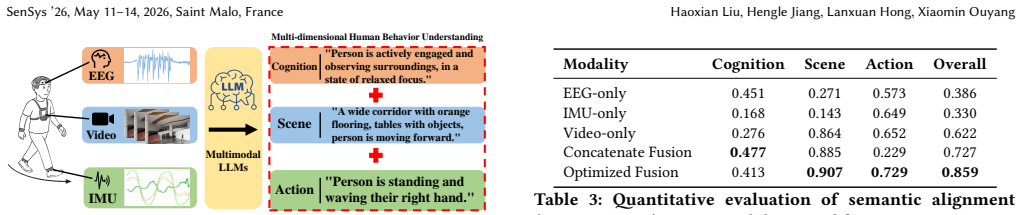
We introduce WearBCI, the first dataset that comprehensively evaluates wearable BCI signals under different motion dynamics with synchronized multimodal recordings (EEG, IMU, and egocentric video), and systematic benchmark evaluations for studying impacts of motion artifact. Data were collected from 36 participants across body movements, walking, and navigation. Analysis shows clear degradation from motion artifacts, and benchmarks of enhancement techniques plus two case studies on cross-modal cleaning and behavior understanding provide concrete baselines for real-world deployment.
What carries the argument
The WearBCI dataset itself, built from synchronized EEG, IMU and egocentric video streams captured during controlled motion tasks, serves as the central object that enables direct measurement and mitigation of motion artifacts.
If this is right
- Motion artifacts produce measurable, systematic degradation in wearable EEG across walking and navigation tasks.
- Existing enhancement methods can be directly compared on a common motion-rich dataset.
- IMU and video streams supply useful auxiliary information for cross-modal EEG cleaning.
- Combined multimodal recordings support extraction of multi-dimensional human behavior features.
Where Pith is reading between the lines
- Future wearable BCI systems could incorporate real-time IMU-based artifact prediction trained on this dataset.
- The dataset structure invites extension to other biosignals such as EMG or PPG collected under identical motion protocols.
- Standardized motion benchmarks like those introduced here may become required reporting items for any new wearable BCI paper.
Load-bearing premise
The chosen motion conditions and participant pool capture enough of the diversity found in everyday wearable BCI use.
What would settle it
Re-running the same enhancement benchmarks on a fresh cohort recorded in fully uncontrolled outdoor settings and finding no measurable artifact difference or no improvement from the benchmark methods would falsify the dataset's claimed utility.
Figures






read the original abstract
Brain-computer interfaces (BCIs) have opened new platforms for human-computer interaction, medical diagnostics, and neurorehabilitation. Wearable BCI systems, which typically employ non-invasive electrodes for portable monitoring, hold great promise for real-world applications, but also face significant challenges of signal quality degradation caused by motion artifacts and environmental interferences. Most existing wearable BCI datasets are collected under stationary or controlled lab settings, limiting their utility for evaluating performance under body movement. To bridge this gap, we introduce WearBCI, the first dataset that comprehensively evaluates wearable BCI signals under different motion dynamics with synchronized multimodal recordings (EEG, IMU, and egocentric video), and systematic benchmark evaluations for studying impacts of motion artifact. Specifically, we collect data from 36 participants across different motion dynamics, including body movements, walking, and navigation. This dataset includes synchronized electroencephalography (EEG), inertial measurement unit (IMU) data, and egocentric video recordings. We analyze the collected wearable EEG signals to understand the impact of motion artifacts across different conditions, and benchmark representative EEG signal enhancement techniques on our dataset. Furthermore, we explore two new case studies: cross-modal EEG signal enhancement and multi-dimension human behavior understanding. These findings offer valuable insights into real-world wearable BCI deployment and new applications.
Editorial analysis
A structured set of objections, weighed in public.
Referee Report
Summary. The paper introduces the WearBCI dataset collected from 36 participants under varied motion dynamics (body movements, walking, navigation), featuring synchronized EEG, IMU, and egocentric video recordings. It analyzes motion artifact impacts, benchmarks representative EEG enhancement techniques, and presents case studies on cross-modal EEG enhancement and multi-dimension human behavior understanding.
Significance. If the dataset is released with full documentation and the benchmarks prove reproducible, this work provides a valuable resource for real-world wearable BCI research by addressing the gap in motion-contaminated data, enabling better evaluation of artifact mitigation and new multimodal applications.
major comments (2)
- Data Collection section: the protocol for participant selection, exact task durations, and synchronization of EEG/IMU/video streams lacks quantitative details (e.g., sampling rates, alignment methods, or artifact quantification metrics), which is load-bearing for claims of comprehensive real-world evaluation and replicability.
- Benchmarking section: the selection of 'representative' EEG enhancement techniques is not compared against a broader set of current SOTA methods or justified with ablation studies; this weakens the systematic benchmark claims without additional validation metrics or statistical controls.
minor comments (2)
- Abstract: the phrase 'systematic benchmark evaluations' should specify the exact metrics (e.g., SNR, correlation) used to assess enhancement performance.
- Introduction: expand citations to prior wearable BCI datasets to better contextualize the novelty of the multimodal synchronization.
Simulated Author's Rebuttal
We thank the referee for their positive assessment of the WearBCI dataset and their recommendation for minor revision. The comments highlight important areas for improving replicability and benchmark rigor, which we address below.
read point-by-point responses
-
Referee: Data Collection section: the protocol for participant selection, exact task durations, and synchronization of EEG/IMU/video streams lacks quantitative details (e.g., sampling rates, alignment methods, or artifact quantification metrics), which is load-bearing for claims of comprehensive real-world evaluation and replicability.
Authors: We agree that these quantitative details are essential for replicability and will expand the Data Collection section accordingly. The revised version will specify participant selection criteria (healthy adults aged 18-40 with no neurological or psychiatric history, screened via questionnaire), exact task durations (e.g., 4 minutes per body-movement condition, 6 minutes for walking, 8 minutes for navigation), sampling rates (EEG at 250 Hz, IMU at 100 Hz, video at 30 fps), and synchronization methods (hardware trigger pulses aligned via shared clock and post-hoc timestamp matching with <5 ms error). We will also add artifact quantification via pre/post power spectral density ratios in the 0.5-40 Hz band across conditions. revision: yes
-
Referee: Benchmarking section: the selection of 'representative' EEG enhancement techniques is not compared against a broader set of current SOTA methods or justified with ablation studies; this weakens the systematic benchmark claims without additional validation metrics or statistical controls.
Authors: We acknowledge that the benchmarking section would benefit from explicit justification and expanded validation. We selected the three techniques (ICA, wavelet denoising, adaptive filtering) as they represent the most commonly deployed approaches in wearable BCI literature for their balance of effectiveness and low computational cost on edge devices. In revision we will add a dedicated justification paragraph citing recent surveys, include results from two additional SOTA methods (a CNN-based denoiser and a recent attention-based model), report ablation on key hyperparameters, and apply statistical controls (repeated-measures ANOVA with Bonferroni correction and effect sizes) to all comparisons. revision: yes
Circularity Check
No significant circularity: dataset introduction with no derivation chain
full rationale
The paper introduces the WearBCI dataset by collecting synchronized EEG, IMU, and egocentric video from 36 participants under motion conditions (body movements, walking, navigation) and applies existing benchmark EEG enhancement techniques. No equations, fitted parameters, predictions, or uniqueness theorems are present. The central claim rests on the empirical data collection and standard analysis of motion artifacts, which does not reduce to any self-referential input or self-citation chain. This matches the expected non-circular outcome for a dataset paper.
Axiom & Free-Parameter Ledger
Reference graph
Works this paper leans on
-
[1]
[n. d.]. Cyton Biosensing Board (8-channels) — shop.openbci.com. https://shop. openbci.com/products/cyton-biosensing-board-8-channel . ([n. d.]). [Accessed 23-06-2025]
work page 2025
-
[2]
Khald Ali I Aboalayon, Miad Faezipour, Wafaa S Almuhammadi, and Saeid Moslehpour. 2016. Sleep stage classification using EEG signal analysis: a com- prehensive survey and new investigation. Entropy 18, 9 (2016), 272
work page 2016
-
[3]
Sheikh Farhana Binte Ahmed, Md Ruhul Amin, and Md Kafiul Islam. 2024. Mo- tion artifact contaminated multichannel EEG dataset. Data in brief 57 (2024), 110994
work page 2024
-
[4]
Maryam Alimardani and Kazuo Hiraki. 2020. Passive brain-computer interfaces for enhanced human-robot interaction. Frontiers in Robotics and AI 7 (2020), 125
work page 2020
-
[5]
Pasquale Arpaia, Luigi Duraccio, Nicola Moccaldi, and Silvia Rossi. 2020. Wear- able brain–computer interface instrumentation for robot-based rehabilitation by augmented reality. IEEE Transactions on instrumentation and measurement 69, 9 (2020), 6362–6371
work page 2020
-
[6]
Víctor Asanza, Leandro L Lorente-Leyva, Diego H Peluffo-Ordóñez, Daniel Mon- toya, and Kleber Gonzalez. 2023. MILimbEEG: A dataset of EEG signals related to upper and lower limb execution of motor and motor imagery tasks. Data in Brief 50 (2023), 109540
work page 2023
-
[7]
C Babiloni, X Arakaki, H Azami, K Bennys, K Blinowska, L Bonanni, A Bujan, MC Carrillo, A Cichocki, J de Frutos-Lucas, et al. 2021. Measures of resting state EEG rhythms for clinical trials in Alzheimer’s disease: recommendations of an expert panel. Alzheimers Dement. 17 (9), 1528–1553. (2021)
work page 2021
-
[8]
Joan Belo, Maureen Clerc, and Daniele Schön. 2021. EEG-based auditory atten- tion detection and its possible future applications for passive BCI. Frontiers in computer science 3 (2021), 661178
work page 2021
-
[9]
Clemens Brunner, Robert Leeb, Gernot Müller-Putz, Alois Schlögl, and Gert Pfurtscheller. 2008. BCI Competition 2008–Graz data set A. Institute for knowl- edge discovery (laboratory of brain-computer interfaces), Graz University of Tech- nology 16, 1-6 (2008), 1
work page 2008
-
[10]
Raymundo Cassani, Mar Estarellas, Rodrigo San-Martin, Francisco J Fraga, and Tiago H Falk. 2018. Systematic review on resting-state EEG for Alzheimer’s disease diagnosis and progression assessment. Disease markers 2018, 1 (2018), 5174815
work page 2018
-
[11]
Yu Mike Chi, Tzyy-Ping Jung, and Gert Cauwenberghs. 2010. Dry-contact and noncontact biopotential electrodes: Methodological review. IEEE reviews in biomedical engineering 3 (2010), 106–119
work page 2010
-
[12]
Stefanie Enriquez-Geppert, René J Huster, and Christoph S Herrmann. 2017. EEG-neurofeedback as a tool to modulate cognition and behavior: a review tu- torial. Frontiers in human neuroscience 11 (2017), 51
work page 2017
-
[13]
Maria Laura Ferster, Giulia Da Poian, Kiran Menachery, Simon J Schreiner, Car- oline Lustenberger, Angelina Maric, Reto Huber, Christian R Baumann, and Wal- ter Karlen. 2022. Benchmarking real-time algorithms for in-phase auditory stim- ulation of low amplitude slow waves with wearable EEG devices during sleep. IEEE Transactions on Biomedical Engineering ...
work page 2022
-
[14]
Patrique Fiedler, Paulo Pedrosa, Stefan Griebel, Carlos Fonseca, Filipe Vaz, Eko Supriyanto, F Zanow, and J Haueisen. 2015. Novel multipin electrode cap system for dry electroencephalography. Brain topography 28 (2015), 647–656
work page 2015
-
[15]
Haiyun Huang, Jie Chen, Jun Xiao, Di Chen, Jun Zhang, Jiahui Pan, and Yuan- qing Li. 2024. Real-Time Attention Regulation and Cognitive Monitoring Using a Wearable EEG-based BCI. IEEE Transactions on Biomedical Engineering (2024)
work page 2024
-
[16]
Xiaoyang Huang, Chang Li, Aiping Liu, Ruobing Qian, and Xun Chen. 2024. EEGDfus: a conditional diffusion model for fine-grained EEG denoising. IEEE Journal of Biomedical and Health Informatics (2024)
work page 2024
-
[17]
Wonse Jo, Ruiqi Wang, Go-Eum Cha, Su Sun, Revanth Krishna Senthilkumaran, Daniel Foti, and Byung-Cheol Min. 2024. MOCAS: A multimodal dataset for ob- jective cognitive workload assessment on simultaneous tasks. IEEE Transactions on Affective Computing (2024)
work page 2024
-
[18]
Evelyn Karikari and Konstantin A Koshechkin. 2023. Review on brain-computer interface technologies in healthcare. Biophysical reviews 15, 5 (2023), 1351–1358
work page 2023
-
[19]
Byung Hyung Kim and Sungho Jo. 2015. Real-time motion artifact detection and removal for ambulatory BCI. In The 3rd International Winter Conference on Brain-Computer Interface. ieee, 1–4
work page 2015
-
[20]
Abhay Koushik, Judith Amores, and Pattie Maes. 2019. Real-time Smartphone- based Sleep Staging using 1-Channel EEG. In 2019 IEEE 16th International Con- ference on Wearable and Implantable Body Sensor Networks (BSN) . IEEE, 1–4
work page 2019
-
[21]
Velu Prabhakar Kumaravel, Victor Kartsch, Simone Benatti, Giorgio Vallortigara, Elisabetta Farella, and Marco Buiatti. 2021. Efficient artifact removal from low- density wearable EEG using artifacts subspace reconstruction. In 2021 43rd an- nual international conference of the IEEE engineering in medicine & biology society (EMBC). IEEE, 333–336
work page 2021
-
[22]
Ioulietta Lazarou, Spiros Nikolopoulos, Panagiotis C Petrantonakis, Ioannis Kompatsiaris, and Magda Tsolaki. 2018. EEG-based brain–computer interfaces for communication and rehabilitation of people with motor impairment: a novel approach of the 21 st Century. Frontiers in human neuroscience 12 (2018), 14
work page 2018
-
[23]
Robert Leeb, Clemens Brunner, G Müller-Putz, A Schlögl, and GJGUOT Pfurtscheller. 2008. BCI Competition 2008–Graz data set B. Graz University of Technology, Austria 16 (2008), 1–6
work page 2008
-
[24]
Kyle E Mathewson, Tyler JL Harrison, and Sayeed AD Kizuk. 2017. High and dry? Comparing active dry EEG electrodes to active and passive wet electrodes. Psychophysiology 54, 1 (2017), 74–82
work page 2017
-
[25]
Aleksandar Miladinović, Miloš Ajčević, Pierpaolo Busan, Joanna Jarmolowska, Giulia Silveri, Manuela Deodato, Susanna Mezzarobba, Piero Paolo Battaglini, and Agostino Accardo. 2020. Evaluation of Motor Imagery-Based BCI methods in neurorehabilitation of Parkinson’s Disease patients. In2020 42nd Annual Inter- national Conference of the IEEE Engineering in M...
work page 2020
-
[26]
Juan Abdon Miranda-Correa, Mojtaba Khomami Abadi, Nicu Sebe, and Ioannis Patras. 2018. Amigos: A dataset for affect, personality and mood research on individuals and groups. IEEE transactions on affective computing 12, 2 (2018), 479–493
work page 2018
-
[27]
Mo H. Modarres, Jonathan E. Elliott, Kristianna B. Weymann, Dennis Pleshakov, Donald L. Bliwise, and Miranda M. Lim. 2022. Validation of Visually Identified Muscle Potentials during Human Sleep Using High Frequency/Low Frequency Spectral Power Ratios. Sensors 22, 1 (2022), 55. https://doi.org/10.3390/s22010055
-
[28]
Ernst Niedermeyer and FH Lopes da Silva. 2005. Electroencephalography: basic principles, clinical applications, and related fields. Lippincott Williams & Wilkins
work page 2005
-
[29]
Mostafa Orban, Mahmoud Elsamanty, Kai Guo, Senhao Zhang, and Hongbo Yang. 2022. A review of brain activity and EEG-based brain–computer inter- faces for rehabilitation application. Bioengineering 9, 12 (2022), 768
work page 2022
-
[30]
Xiaomin Ouyang, Xian Shuai, Yang Li, Li Pan, Xifan Zhang, Heming Fu, Sitong Cheng, Xinyan Wang, Shihua Cao, Jiang Xin, et al. 2024. ADMarker: A Multi-Modal Federated Learning System for Monitoring Digital Biomarkers of Alzheimer’s Disease. In Proceedings of the 30th Annual International Conference on Mobile Computing and Networking . 404–419
work page 2024
-
[31]
Luca Pion-Tonachini, Ken Kreutz-Delgado, and Scott Makeig. 2019. ICLabel: An automated electroencephalographic independent component classifier, dataset, and website. NeuroImage 198 (2019), 181–197
work page 2019
-
[32]
Xiaorong Pu, Peng Yi, Kecheng Chen, Zhaoqi Ma, Di Zhao, and Yazhou Ren. 2022. EEGDnet: Fusing non-local and local self-similarity for EEG signal denoising with transformer. Computers in Biology and Medicine 151 (2022), 106248
work page 2022
-
[33]
Zhun Qin, Yao Xu, Xiaokang Shu, Lei Hua, Xinjun Sheng, and Xiangyang Zhu
-
[34]
In 2019 9th International IEEE/EMBS Conference on Neural Engineering (NER)
econhand: A wearable brain-computer interface system for stroke reha- bilitation. In 2019 9th International IEEE/EMBS Conference on Neural Engineering (NER). IEEE, 734–737
work page 2019
-
[35]
Rajesh PN Rao. 2013. Brain-computer interfacing: an introduction . Cambridge University Press
work page 2013
-
[36]
Elena Ratti, Shani Waninger, Chris Berka, Giulio Ruffini, and Ajay Verma. 2017. Comparison of medical and consumer wireless EEG systems for use in clinical trials. Frontiers in human neuroscience 11 (2017), 398
work page 2017
-
[37]
Stanisław Saganowski, Joanna Komoszyńska, Maciej Behnke, Bartosz Perz, Do- minika Kunc, Bartłomiej Klich, Łukasz D Kaczmarek, and Przemysław Kazienko
-
[38]
Scientific data 9, 1 (2022), 158
Emognition dataset: emotion recognition with self-reports, facial expres- sions, and physiology using wearables. Scientific data 9, 1 (2022), 158
work page 2022
-
[39]
F Sayegh, F Fadhli, F Karam, M BoAbbas, F Mahmeed, JA Korbane, S Alkork, and T Beyrouthy. 2017. A wearable rehabilitation device for paralysis. In 2017 2nd International Conference on Bio-engineering for Smart Technologies (BioSMART) . IEEE, 1–4
work page 2017
-
[40]
Daehyun Seok, Seokhwan Lee, Minju Kim, Joonhyuk Cho, and Chulwoo Kim
-
[41]
Frontiers in Electronics 2 (2021), 685513
Motion artifact removal techniques for wearable EEG and PPG sensor systems. Frontiers in Electronics 2 (2021), 685513
work page 2021
-
[42]
Anke Snoek, Anne-Marie Brouwer, Ivo V Stuldreher, Pim Haselager, and Dorothee Horstkötter. 2025. Wearables for tracking mental state in the class- room: ethical considerations from the literature and high school students. Fron- tiers in Neuroergonomics 6 (2025), 1536781
work page 2025
-
[43]
David Steyrl, Gunther Krausz, Karl Koschutnig, Günter Edlinger, and Gernot R. Müller-Putz. 2018. Online Reduction of Artifacts in EEG of Simultaneous EEG- fMRI Using Reference Layer Adaptive Filtering (RLAF). Brain Topography 31 (2018), 129–149. https://doi.org/10.1007/s10548-017-0606-7
-
[44]
Xiaoming Tao, Dingcheng Gao, Wenqi Zhang, Tianqi Liu, Bing Du, Shanghang Zhang, and Yanjun Qin. 2024. A multimodal physiological dataset for driving behaviour analysis. Scientific data 11, 1 (2024), 378
work page 2024
-
[45]
Pieter Van Mierlo, Margarita Papadopoulou, Evelien Carrette, Paul Boon, Ste- faan Vandenberghe, Kristl Vonck, and Daniele Marinazzo. 2014. Functional brain connectivity from EEG in epilepsy: Seizure prediction and epileptogenic focus localization. Progress in neurobiology 121 (2014), 19–35
work page 2014
-
[46]
Lasitha S Vidyaratne and Khan M Iftekharuddin. 2017. Real-time epileptic seizure detection using EEG. IEEE Transactions on Neural Systems and Reha- bilitation Engineering 25, 11 (2017), 2146–2156
work page 2017
-
[47]
Su Yang, Jose Miguel Sanchez Bornot, Kongfatt Wong-Lin, and Girijesh Prasad
-
[48]
IEEE Transactions on Biomedical Engineering 66, 10 (2019), 2924–2935
M/EEG-based bio-markers to predict the MCI and Alzheimer’s disease: a review from the ML perspective. IEEE Transactions on Biomedical Engineering 66, 10 (2019), 2924–2935. 7 SenSys ’26, May 11–14, 2026, Saint Malo, France Haoxian Liu, Hengle Jiang, Lanxuan Hong, Xiaomin Ouyang
work page 2019
-
[49]
Jin Yin, Aiping Liu, Chang Li, Ruobing Qian, and Xun Chen. 2023. A GAN guided parallel CNN and transformer network for EEG denoising. IEEE Jour- nal of Biomedical and Health Informatics (2023)
work page 2023
-
[50]
Thorsten Oliver Zander, Moritz Lehne, Klas Ihme, Sabine Jatzev, Joao Correia, Christian Kothe, Bernd Picht, and Femke Nijboer. 2011. A dry EEG-system for scientific research and brain–computer interfaces. Frontiers in neuroscience 5 (2011), 53
work page 2011
-
[51]
Haoming Zhang, Mingqi Zhao, Chen Wei, Dante Mantini, Zherui Li, and Quany- ing Liu. 2021. EEGdenoiseNet: a benchmark dataset for deep learning solu- tions of EEG denoising. Journal of Neural Engineering 18, 5 (2021). https: //doi.org/10.1088/1741-2552/ac2bf8
-
[52]
Jiayan Zhang, Junshi Li, Zhe Huang, Dong Huang, Huaiqiang Yu, and Zhihong Li. 2023. Recent progress in wearable brain–computer interface (BCI) devices based on electroencephalogram (EEG) for medical applications: a review. Health data science 3 (2023), 0096
work page 2023
-
[53]
Tianyi Zhang, Varsha Kishore, Felix Wu, Kilian Q Weinberger, and Yoav Artzi. 2019. Bertscore: Evaluating text generation with bert. arXiv preprint arXiv:1904.09675 (2019). 8
work page internal anchor Pith review Pith/arXiv arXiv 2019
discussion (0)
Sign in with ORCID, Apple, or X to comment. Anyone can read and Pith papers without signing in.