Recognition: 2 theorem links
· Lean TheoremNeuroPath: Practically Adopting Motor Imagery Decoding through EEG Signals
Pith reviewed 2026-05-14 22:17 UTC · model grok-4.3
The pith
NeuroPath introduces a unified neural architecture for motor imagery EEG decoding that adapts to varying electrode numbers and placements while improving robustness on noisy consumer-grade signals.
A machine-rendered reading of the paper's core claim, the machinery that carries it, and where it could break.
Core claim
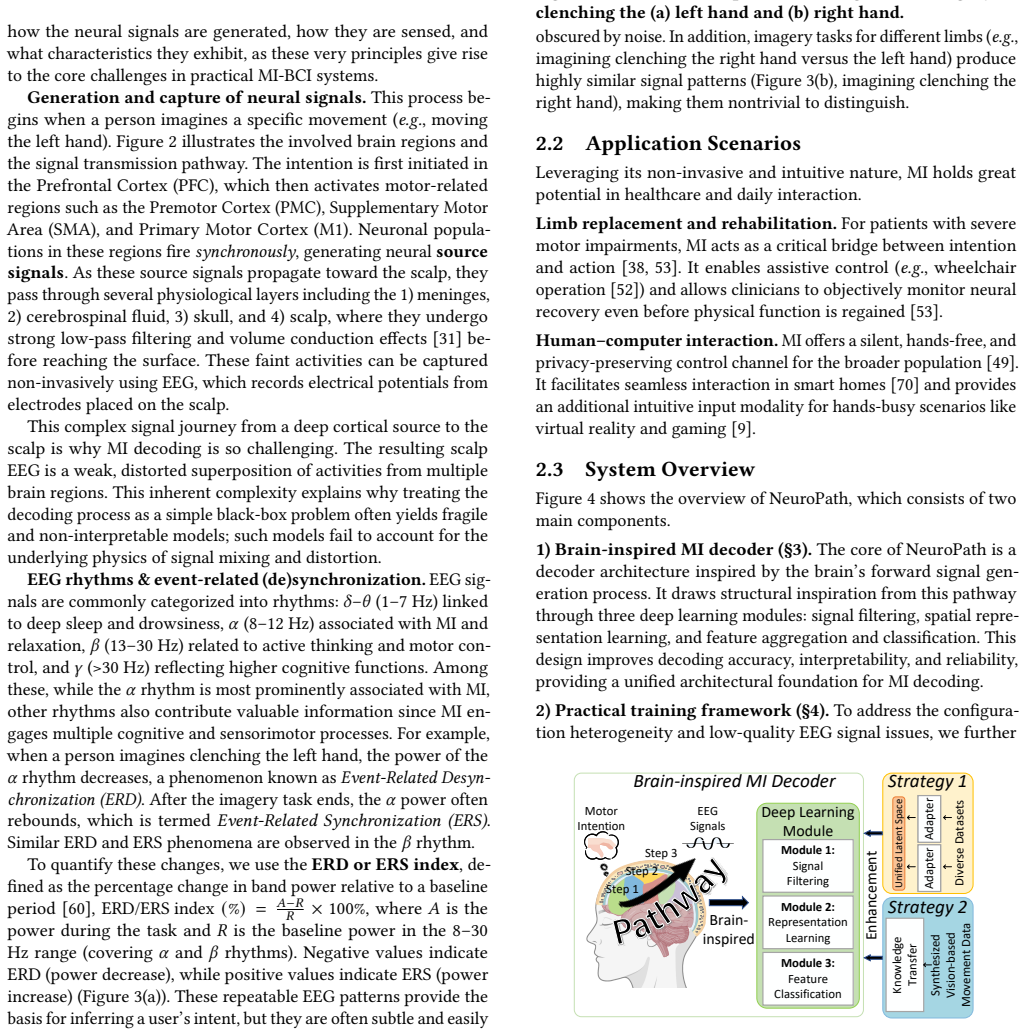
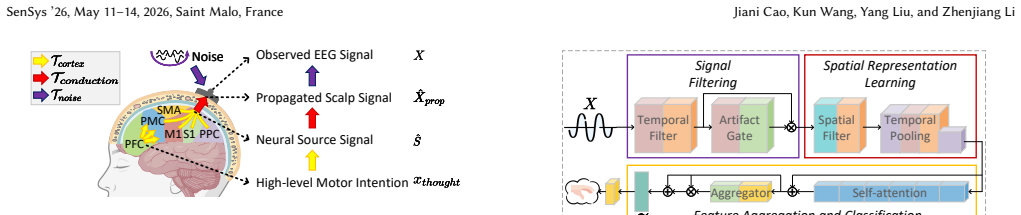
NeuroPath employs a deep neural architecture with specialized modules for signal filtering, spatial representation learning via a spatially aware graph adapter, and feature classification. This design supports unified decoding across motor imagery tasks, accommodates different electrode numbers and placements, and uses multimodal auxiliary training to refine EEG representations and maintain performance under low-SNR conditions typical of consumer-grade hardware.
What carries the argument
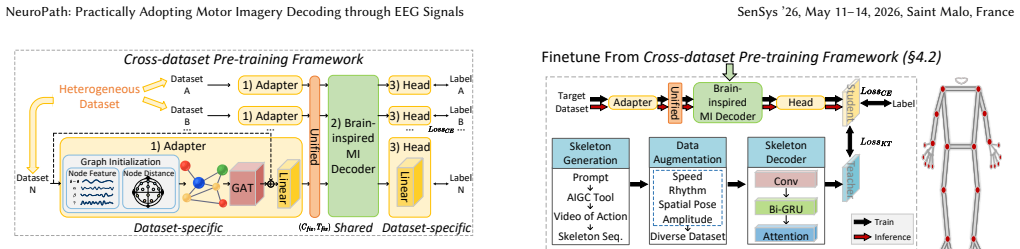
The spatially aware graph adapter that accommodates arbitrary electrode numbers and placements, paired with multimodal auxiliary training to refine representations under noise.
If this is right
- One model can be trained jointly on multiple datasets to acquire more robust features rather than training separate models in isolation.
- BCI devices can be deployed with flexible sensor arrangements instead of requiring identical electrode placements.
- Decoding remains reliable even when using lower-quality signals from affordable consumer EEG headsets.
- Applications such as prosthetic control and rehabilitation become more feasible because performance does not collapse under real-world noise levels.
Where Pith is reading between the lines
- Adapter-style modules could transfer to other biosignal domains where sensor placement varies across users or devices.
- Combining the auxiliary training with additional modalities beyond those tested may yield further gains in low-signal settings.
- Field studies with uncontrolled head movements and electrode shifts would reveal how well the claimed robustness holds outside laboratory conditions.
Load-bearing premise
A graph-based adapter can handle any change in electrode count or position while preserving high decoding accuracy across datasets.
What would settle it
A controlled test applying NeuroPath to a new electrode layout or count unseen during training and measuring whether accuracy falls below that of fixed-configuration baselines on the same data.
Figures






read the original abstract
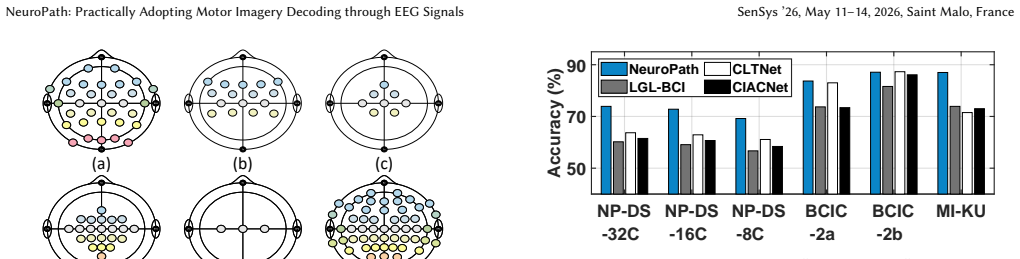
Motor Imagery (MI) is an emerging Brain-Computer Interface (BCI) paradigm where a person imagines body movements without physical action. By decoding scalp-recorded electroencephalography (EEG) signals, BCIs establish direct communication to control external devices, offering significant potential in prosthetics, rehabilitation, and human-computer interaction. However, existing solutions remain difficult to deploy. (i) Most employ independent, opaque models for each MI task, lacking a unified architectural foundation. Consequently, these models are trained in isolation, failing to learn robust representations from diverse datasets, resulting in modest performance. (ii) They primarily adopt fixed sensor deployment, whereas real-world setups vary in electrode number and placement, causing models to fail across configurations. (iii) Performance degrades sharply under low-SNR conditions typical of consumer-grade EEG. To address these challenges, we present NeuroPath, a neural architecture for robust MI decoding. NeuroPath takes inspiration from the brain's signal pathway from cortex to scalp, utilizing a deep neural architecture with specialized modules for signal filtering, spatial representation learning, and feature classification, enabling unified decoding. To handle varying electrode configurations, we introduce a spatially aware graph adapter accommodating different electrode numbers and placements. To enhance robustness under low-SNR conditions, NeuroPath incorporates multimodal auxiliary training to refine EEG representations and stabilize performance on noisy real-world data. Evaluations on three consumer-grade and three medical-grade public datasets demonstrate that NeuroPath achieves superior performance.
Editorial analysis
A structured set of objections, weighed in public.
Referee Report
Summary. The paper introduces NeuroPath, a unified deep neural architecture for motor imagery (MI) decoding from EEG signals, inspired by brain signal pathways from cortex to scalp. It consists of specialized modules for signal filtering, spatial representation learning via a spatially aware graph adapter, and feature classification. The graph adapter is designed to handle arbitrary variations in electrode number and placement, while multimodal auxiliary training aims to improve robustness under low-SNR conditions typical of consumer-grade devices. Evaluations on three consumer-grade and three medical-grade public datasets are reported to show superior performance over existing methods.
Significance. If the central claims hold, NeuroPath would represent a meaningful step toward practical BCI deployment by offering a single architecture that generalizes across hardware configurations and noisy data, reducing the need for per-task or per-device retraining. The use of public datasets supports reproducibility, though the absence of released code or parameter-free derivations limits immediate impact.
major comments (2)
- [Abstract and Evaluation] Abstract and Evaluation sections: The claim that the spatially aware graph adapter accommodates arbitrary electrode numbers and placements is central to the practical adoption argument, yet the reported experiments appear to train and test only within each dataset's fixed montage. Without explicit cross-montage transfer results (e.g., training on a 10-20 system and testing on a custom consumer layout), the generalization performance remains unverified and the unified-architecture advantage is not load-bearing.
- [Abstract] Abstract: The multimodal auxiliary training strategy is presented as key to robustness under low-SNR consumer-grade conditions, but no ablation isolating its contribution on the consumer-grade subsets is described. This leaves open whether the reported gains stem from the auxiliary loss or from other factors, weakening the evidence for the low-SNR improvement claim.
minor comments (2)
- [Methods] Clarify the exact graph construction and adapter parameterization in the methods section to allow independent reproduction of the spatial adaptation mechanism.
- [Evaluation] Include statistical significance tests (e.g., paired t-tests or Wilcoxon) across the six datasets rather than raw accuracy comparisons alone.
Simulated Author's Rebuttal
We thank the referee for the constructive feedback. We address each major comment below and have revised the manuscript to strengthen the evidence supporting NeuroPath's claims.
read point-by-point responses
-
Referee: [Abstract and Evaluation] Abstract and Evaluation sections: The claim that the spatially aware graph adapter accommodates arbitrary electrode numbers and placements is central to the practical adoption argument, yet the reported experiments appear to train and test only within each dataset's fixed montage. Without explicit cross-montage transfer results (e.g., training on a 10-20 system and testing on a custom consumer layout), the generalization performance remains unverified and the unified-architecture advantage is not load-bearing.
Authors: We agree that explicit cross-montage transfer experiments would provide stronger verification of the adapter's flexibility. In the revised manuscript, we have added cross-dataset transfer results: the model is trained on a medical-grade dataset using the standard 10-20 montage and evaluated on consumer-grade datasets with differing electrode counts and placements. These experiments show that the spatially aware graph adapter maintains performance across configurations, supporting the unified architecture's practical value. The Abstract and Evaluation sections have been updated to report these findings. revision: yes
-
Referee: [Abstract] Abstract: The multimodal auxiliary training strategy is presented as key to robustness under low-SNR consumer-grade conditions, but no ablation isolating its contribution on the consumer-grade subsets is described. This leaves open whether the reported gains stem from the auxiliary loss or from other factors, weakening the evidence for the low-SNR improvement claim.
Authors: We acknowledge the value of an explicit ablation. The revised manuscript now includes an ablation study isolating the multimodal auxiliary training on the three consumer-grade datasets. Removing the auxiliary loss results in a clear performance degradation under low-SNR conditions, confirming its contribution to robustness. The Abstract has been updated to reference this evidence. revision: yes
Circularity Check
No circularity: empirical architecture evaluated on public datasets
full rationale
The paper proposes NeuroPath as an empirical neural architecture for motor imagery decoding, with a spatially aware graph adapter and multimodal auxiliary training. All central claims rest on performance evaluations across six public datasets rather than any mathematical derivation chain, fitted parameters renamed as predictions, or load-bearing self-citations. No equations or first-principles results are presented that reduce to the inputs by construction; the architecture choices are justified by observed improvements on fixed-montage benchmarks, leaving the derivation self-contained against external data.
Axiom & Free-Parameter Ledger
free parameters (2)
- Module-specific neural network weights
- Graph adapter parameters
axioms (2)
- domain assumption Motor imagery can be decoded from scalp EEG signals
- ad hoc to paper Brain signal pathways from cortex to scalp can be approximated by a deep neural architecture with specialized modules
invented entities (2)
-
Spatially aware graph adapter
no independent evidence
-
Multimodal auxiliary training strategy
no independent evidence
Lean theorems connected to this paper
-
IndisputableMonolith/Foundation/RealityFromDistinction.leanreality_from_one_distinction unclearcross-modality knowledge transfer... skeleton decoder as teacher... KL divergence loss
Reference graph
Works this paper leans on
-
[1]
[n. d.]. Battery Historian. https://developer.android.com/topic/performance/ power/setup-battery-historian/
-
[2]
[n. d.]. EEG 10-10 system. https://commons.wikimedia.org/wiki/File:EEG_10- 10_system_with_additional_information.svg/
-
[3]
[n. d.]. Emotiv products. https://www.emotiv.com/products/flex-saline?srsltid= AfmBOopC0wju9qU8U_cPRGRJkVSQ07aduezXB4eKQkwS8ZhJqy1bv5CR/
-
[4]
[n. d.]. Google MediaPipe. https://ai.google.dev/edge/mediapipe/solutions/ guide/
-
[5]
[n. d.]. vivago.ai. https://vivago.ai/home/
-
[6]
Hamdi Altaheri, Ghulam Muhammad, and Mansour Alsulaiman. 2022. Physics- informed attention temporal convolutional network for EEG-based motor im- agery classification.IEEE transactions on industrial informatics(2022)
work page 2022
-
[7]
Hamdi Altaheri, Ghulam Muhammad, Mansour Alsulaiman, Syed Umar Amin, Ghadir Ali Altuwaijri, Wadood Abdul, Mohamed A Bencherif, and Mohammed Faisal. 2023. Deep learning techniques for classification of electroencephalogram (EEG) motor imagery (MI) signals: A review.Neural Computing and Applications (2023)
work page 2023
-
[8]
Sion An, Soopil Kim, Philip Chikontwe, and Sang Hyun Park. 2023. Dual attention relation network with fine-tuning for few-shot EEG motor imagery classification. IEEE Transactions on Neural Networks and Learning Systems(2023)
work page 2023
-
[9]
Pasquale Arpaia, Antonio Esposito, Enza Galasso, Fortuna Galdieri, Angela Natal- izio, Marco Parvis, Michael Sommeling, and Mattia Volpe. 2024. Endless runner game in virtual reality controlled by a self-paced brain-computer interface based on EEG and motor imagery. InInternational Conference on Extended Reality
work page 2024
-
[10]
Maedeh Azadi Moghadam and Ali Maleki. 2023. Fatigue factors and fatigue indices in SSVEP-based brain-computer interfaces: a systematic review and meta- analysis.Frontiers in Human Neuroscience(2023)
work page 2023
-
[11]
2020.Neuroscience: Exploring the brain, enhanced edition: Exploring the brain
Mark Bear, Barry Connors, and Michael A Paradiso. 2020.Neuroscience: Exploring the brain, enhanced edition: Exploring the brain
work page 2020
-
[12]
Clemens Brunner, Robert Leeb, Gernot Müller-Putz, Alois Schlögl, and Gert Pfurtscheller. 2008. BCI Competition 2008–Graz data set A.Institute for knowledge discovery, Graz University of Technology, Austria(2008)
work page 2008
-
[13]
Kayla-Jade Butkow, Ting Dang, Andrea Ferlini, Dong Ma, Yang Liu, and Cecilia Mascolo. 2024. An evaluation of heart rate monitoring with in-ear microphones under motion.Pervasive and Mobile Computing(2024)
work page 2024
-
[14]
Jiani Cao, Jiesong Chen, Chengdong Lin, Yang Liu, Kun Wang, and Zhenjiang Li
-
[15]
Practical gaze tracking on any surface with your phone.IEEE Transactions on Mobile Computing(2024)
work page 2024
-
[16]
Jiani Cao, Chengdong Lin, Yang Liu, and Zhenjiang Li. 2022. Gaze tracking on any surface with your phone. InProc. of ACM SenSys
work page 2022
-
[17]
Jiani Cao, Yang Liu, Lixiang Han, and Zhenjiang Li. 2024. Finger tracking using wrist-worn EMG sensors.IEEE Transactions on Mobile Computing(2024)
work page 2024
-
[18]
Tao Chen, Yongjie Yang, Xiaoran Fan, Xiuzhen Guo, Jie Xiong, and Longfei Shangguan. 2024. Exploring the feasibility of remote cardiac auscultation using earphones. InProc. of ACM MobiCom
work page 2024
-
[19]
Alexandre Défossez, Charlotte Caucheteux, Jérémy Rapin, Ori Kabeli, and Jean- Rémi King. 2023. Decoding speech perception from non-invasive brain recordings. Nature Machine Intelligence(2023)
work page 2023
-
[20]
Yidan Ding, Chalisa Udompanyawit, Yisha Zhang, and Bin He. 2025. EEG-based brain-computer interface enables real-time robotic hand control at individual finger level.Nature Communications16, 1 (2025), 1–20
work page 2025
-
[21]
Bradley J Edelman, Shuailei Zhang, Gerwin Schalk, Peter Brunner, Gernot Müller- Putz, Cuntai Guan, and Bin He. 2024. Non-invasive brain-computer interfaces: state of the art and trends.IEEE reviews in biomedical engineering(2024)
work page 2024
-
[22]
He Gu, Tingwei Chen, Xiao Ma, Mengyuan Zhang, Yan Sun, and Jian Zhao. 2025. Cltnet: a hybrid deep learning model for motor imagery classification.Brain Sciences(2025)
work page 2025
-
[23]
Ning Guo, Xiaojun Wang, Dehao Duanmu, Xin Huang, Xiaodong Li, Yunli Fan, Hailan Li, Yongquan Liu, Eric Hiu Kwong Yeung, Michael Kai Tsun To, et al
-
[24]
SSVEP-based brain computer interface controlled soft robotic glove for post-stroke hand function rehabilitation.IEEE transactions on neural systems and rehabilitation engineering(2022)
work page 2022
-
[25]
Christoph S Herrmann and Robert T Knight. 2001. Mechanisms of human attention: event-related potentials and oscillations.Neuroscience & Biobehavioral Reviews(2001)
work page 2001
-
[26]
Ningning Hou, Yifeng Wang, Xianjin Xia, Shiming Yu, Yuanqing Zheng, and Tao Gu. 2025. Molora: Intelligent mobile antenna system for enhanced lora reception in urban environments. InProc. of ACM SenSys
work page 2025
-
[27]
Ningning Hou, Xianjin Xia, Yifeng Wang, and Yuanqing Zheng. 2024. One shot for all: Quick and accurate data aggregation for LPWANs.IEEE/ACM Transactions on Networking(2024)
work page 2024
-
[28]
Changshuo Hu, Thivya Kandappu, Yang Liu, Cecilia Mascolo, and Dong Ma. 2024. BreathPro: Monitoring breathing mode during running with earables.Proc. of the ACM on Interactive, Mobile, Wearable and Ubiquitous Technologies(2024)
work page 2024
-
[29]
Md Kafiul Islam and Amir Rastegarnia. 2023. Recent advances in EEG (non- invasive) based BCI applications.Frontiers in Computational Neuroscience(2023)
work page 2023
-
[30]
Sijie Ji, Yaxiong Xie, and Mo Li. 2022. SiFall: Practical online fall detection with RF sensing. InProc. of ACM SenSys
work page 2022
-
[31]
Sijie Ji, Xuanye Zhang, Yuanqing Zheng, and Mo Li. 2023. Construct 3d hand skeleton with commercial wifi. InProc. of ACM SenSys
work page 2023
-
[32]
Aimin Jiang, Jing Shang, Xiaofeng Liu, Yibin Tang, Hon Keung Kwan, and Yanping Zhu. 2020. Efficient CSP algorithm with spatio-temporal filtering for motor imagery classification.IEEE Transactions on Neural Systems and Rehabilitation Engineering(2020)
work page 2020
-
[33]
2000.Principles of neural science
Eric R Kandel, James H Schwartz, Thomas M Jessell, Steven Siegelbaum, A James Hudspeth, Sarah Mack, et al. 2000.Principles of neural science
work page 2000
-
[34]
Vernon J Lawhern, Amelia J Solon, Nicholas R Waytowich, Stephen M Gordon, Chou P Hung, and Brent J Lance. 2018. EEGNet: a compact convolutional neural network for EEG-based brain–computer interfaces.Journal of neural engineering (2018)
work page 2018
-
[35]
Florent Lebon, Christian Collet, and Aymeric Guillot. 2010. Benefits of motor imagery training on muscle strength.The Journal of Strength & Conditioning Research(2010)
work page 2010
-
[36]
Min-Ho Lee, O-Yeon Kwon, Yong-Jeong Kim, Hong-Kyung Kim, Young-Eun Lee, John Williamson, Siamac Fazli, and Seong-Whan Lee. 2019. EEG dataset and OpenBMI toolbox for three BCI paradigms: An investigation into BCI illiteracy. GigaScience(2019)
work page 2019
-
[37]
Robert Leeb, Clemens Brunner, G Müller-Putz, A Schlögl, and GJGUOT Pfurtscheller. 2008. BCI Competition 2008–Graz data set B.Institute for knowledge discovery, Graz University of Technology, Austria(2008)
work page 2008
-
[38]
Bohao Li, Tianshuo Cheng, and Zexuan Guo. 2021. A review of EEG acquisition, processing and application. InJournal of Physics: Conference Series
work page 2021
-
[39]
Xin Li, Yinghui He, and Jun Luo. 2025.µCeiver-Fi: Exploiting Spectrum Re- sources of Multi-link Receiver for Fine-Granularity Wi-Fi Sensing. InProc. of ACM MobiCom
work page 2025
-
[40]
Wenzhe Liao, Jiahao Li, Xuesong Zhang, and Chen Li. 2023. Motor imagery brain– computer interface rehabilitation system enhances upper limb performance and improves brain activity in stroke patients: A clinical study.Frontiers in Human Neuroscience(2023)
work page 2023
-
[41]
Wenzhe Liao, Zipeng Miao, Shuaibo Liang, Linyan Zhang, and Chen Li. 2025. A composite improved attention convolutional network for motor imagery EEG classification.Frontiers in Neuroscience(2025)
work page 2025
-
[42]
Yang Liu, Kayla-Jade Butkow, Jake Stuchbury-Wass, Adam Pullin, Dong Ma, and Cecilia Mascolo. 2025. Respear: Earable-based robust respiratory rate monitoring. InIEEE PerCom
work page 2025
-
[43]
Yang Liu, Qiang Yang, Kayla-Jade Butkow, Jake Stuchbury-Wass, Dong Ma, and Cecilia Mascolo. 2025. EarMeter: Continuous Respiration Volume Monitoring with Earables.Proc. of the ACM on Interactive, Mobile, Wearable and Ubiquitous Technologies(2025)
work page 2025
-
[44]
Fabien Lotte, Josef Faller, Christoph Guger, Yann Renard, Gert Pfurtscheller, Anatole Lécuyer, and Robert Leeb. 2012. Combining BCI with virtual reality: towards new applications and improved BCI. InTowards practical brain-computer interfaces: Bridging the gap from research to real-world applications
work page 2012
-
[45]
Fabien Lotte and Cuntai Guan. 2010. Regularizing common spatial patterns to improve BCI designs: unified theory and new algorithms.IEEE Transactions on biomedical Engineering(2010)
work page 2010
-
[46]
Jianchao Lu, Yuzhe Tian, Yang Zhang, Quan Z Sheng, and Xi Zheng. 2025. LGL- BCI: A Motor-Imagery-Based Brain-Computer Interface with Geometric Learning. Proc. of the ACM on Interactive, Mobile, Wearable and Ubiquitous Technologies (2025)
work page 2025
-
[47]
Silvia Marchesotti, Michela Bassolino, Andrea Serino, Hannes Bleuler, and Olaf Blanke. 2016. Quantifying the role of motor imagery in brain-machine interfaces. Scientific reports(2016)
work page 2016
-
[48]
Nishant Mehrotra, Divyanshu Pandey, Akarsh Prabhakara, Yawen Liu, Swarun Kumar, and Ashutosh Sabharwal. 2024. Hydra: Exploiting multi-bounce scattering for beyond-field-of-view mmwave radar. InProc. of ACM MobiCom
work page 2024
-
[49]
Jörn Munzert, Britta Lorey, and Karen Zentgraf. 2009. Cognitive motor processes: the role of motor imagery in the study of motor representations.Brain research reviews(2009)
work page 2009
-
[50]
Jingping Nie, Yuang Fan, Ziyi Xuan, Minghui Zhao, Runxi Wan, Matthias Preindl, and Xiaofan Jiang. 2025. SoundTrack: A Contactless Mobile Solution for Real- time Running Metric Estimation for Treadmill Running in the Wild.Proc. of the ACM on Interactive, Mobile, Wearable and Ubiquitous Technologies(2025)
work page 2025
-
[51]
Chukwuemeka Nwagu, Alaa AlSlaity, and Rita Orji. 2023. EEG-based brain- computer interactions in immersive virtual and augmented reality: A systematic review.Proc. of the ACM on Human-Computer Interaction(2023)
work page 2023
-
[52]
Jinhui Ouyang, Mingzhu Wu, Xinglin Li, Hanhui Deng, Zhanpeng Jin, and Di Wu
-
[53]
NeuroBCI: multi-brain to multi-robot interaction through EEG-adaptive neural networks and semantic communications.IEEE Transactions on Mobile Computing(2024)
work page 2024
-
[54]
Xiaomin Ouyang, Xian Shuai, Yang Li, Li Pan, Xifan Zhang, Heming Fu, Sitong Cheng, Xinyan Wang, Shihua Cao, Jiang Xin, et al . 2024. ADMarker: A Multi-Modal Federated Learning System for Monitoring Digital Biomarkers of Alzheimer’s Disease. InProc. of ACM MobiCom. SenSys ’26, May 11–14, 2026, Saint Malo, France Jiani Cao, Kun Wang, Yang Liu, and Zhenjiang Li
work page 2024
-
[55]
Arrigo Palumbo, Vera Gramigna, Barbara Calabrese, and Nicola Ielpo. 2021. Motor-imagery EEG-based BCIs in wheelchair movement and control: A system- atic literature review.Sensors(2021)
work page 2021
-
[56]
Elodie Saruco, Arnaud Saimpont, Franck Di Rienzo, Benjamin De Witte, Isabelle Laroyenne, Fanny Matéo, Marion Lapenderie, Sarah Goutte Solard, Isabelle Perre- tant, Charlotte Frenot, et al. 2024. Towards efficient motor imagery interventions after lower-limb amputation.Journal of NeuroEngineering and Rehabilitation (2024)
work page 2024
-
[57]
Robin Tibor Schirrmeister, Jost Tobias Springenberg, Lukas Dominique Josef Fiederer, Martin Glasstetter, Katharina Eggensperger, Michael Tangermann, Frank Hutter, Wolfram Burgard, and Tonio Ball. 2017. Deep learning with convolutional neural networks for EEG decoding and visualization.Human brain mapping (2017)
work page 2017
-
[58]
Corina Schuster, Roger Hilfiker, Oliver Amft, Anne Scheidhauer, Brian Andrews, Jenny Butler, Udo Kischka, and Thierry Ettlin. 2011. Best practice for motor imagery: a systematic literature review on motor imagery training elements in five different disciplines.BMC medicine(2011)
work page 2011
-
[59]
Leming Shen, Qiang Yang, Kaiyan Cui, Yuanqing Zheng, Xiao-Yong Wei, Jian- wei Liu, and Jinsong Han. 2024. Fedconv: A learning-on-model paradigm for heterogeneous federated clients. InProc. of ACM MobiSys
work page 2024
-
[60]
Leming Shen, Qiang Yang, Xinyu Huang, Zijing Ma, and Yuanqing Zheng. 2025. Gpiot: Tailoring small language models for iot program synthesis and develop- ment. InProc. of ACM SenSys
work page 2025
-
[61]
Ana Solodkin, Petr Hlustik, E Elinor Chen, and Steven L Small. 2004. Fine modulation in network activation during motor execution and motor imagery. Cerebral cortex(2004)
work page 2004
-
[62]
Wing-kin Tam, Tong Wu, Qi Zhao, Edward Keefer, and Zhi Yang. 2019. Human motor decoding from neural signals: a review.BMC Biomedical Engineering (2019)
work page 2019
-
[63]
Zhichuan Tang, Shouqian Sun, Sanyuan Zhang, Yumiao Chen, Chao Li, and Shi Chen. 2016. A brain-machine interface based on ERD/ERS for an upper-limb exoskeleton control.Sensors(2016)
work page 2016
-
[64]
Kaido Värbu, Naveed Muhammad, and Yar Muhammad. 2022. Past, present, and future of EEG-based BCI applications.Sensors(2022)
work page 2022
-
[65]
Kun Wang, Jiani Cao, Zimu Zhou, and Zhenjiang Li. 2024. Swapnet: Efficient swapping for dnn inference on edge ai devices beyond the memory budget.IEEE Transactions on Mobile Computing(2024)
work page 2024
-
[66]
Kun Wang, Zimu Zhou, and Zhenjiang Li. 2024. LATTE: Layer algorithm-aware training time estimation for heterogeneous federated learning. InProc. of ACM MobiCom
work page 2024
-
[67]
Di Wu, Jinhui Ouyang, Ningyi Dai, Mingzhu Wu, Haodan Tan, Hanhui Deng, Yongmei Fan, Dakuo Wang, and Zhanpeng Jin. 2022. DeepBrain: Enabling fine- grained brain-robot interaction through human-centered learning of coarse EEG signals from low-cost devices.Proc. of the ACM on Interactive, Mobile, Wearable and Ubiquitous Technologies(2022)
work page 2022
-
[68]
Qiang Yang, Yang Liu, Jake Stuchbury-Wass, Mathias Ciliberto, Tobias Röddiger, Kayla-Jade Butkow, Adam Luke Pullin, Emeli Panariti, Dong Ma, and Cecilia Mas- colo. 2025. HearForce: Force Estimation for Manual Toothbrushing with Earables. Proc. of the ACM on Interactive, Mobile, Wearable and Ubiquitous Technologies (2025)
work page 2025
-
[69]
Shiming Yu, Xianjin Xia, Ningning Hou, Yuanqing Zheng, and Tao Gu. 2024. Revolutionizing lora gateway with xgate: Scalable concurrent transmission across massive logical channels. InProc. of ACM MobiCom
work page 2024
-
[70]
Jonghyuk Yun, Kyoosik Lee, Kichang Lee, Bangjie Sun, Jaeho Jeon, Jeonggil Ko, Inseok Hwang, and Jun Han. 2024. PowDew: Detecting Counterfeit Powdered Food Products using a Commodity Smartphone. InProc. of ACM MobiSys
work page 2024
-
[71]
Xiang Zhang, Lina Yao, Quan Z Sheng, Salil S Kanhere, Tao Gu, and Dalin Zhang
-
[72]
Converting your thoughts to texts: Enabling brain typing via deep feature learning of eeg signals. InIEEE PerCom
-
[73]
Wei Zhao, Xiaolu Jiang, Baocan Zhang, Shixiao Xiao, and Sujun Weng. 2024. CTNet: a convolutional transformer network for EEG-based motor imagery classification.Scientific reports(2024)
work page 2024
-
[74]
Wei Zhuang, Yixian Shen, Lu Li, Chunming Gao, and Dong Dai. 2020. A brain- computer interface system for smart home control based on single trial motor imagery EEG.International Journal of Sensor Networks(2020)
work page 2020
discussion (0)
Sign in with ORCID, Apple, or X to comment. Anyone can read and Pith papers without signing in.