Recognition: 2 theorem links
· Lean TheoremOrthogonal Quadratic Complements for Vision Transformer Feed-Forward Networks
Pith reviewed 2026-05-10 18:57 UTC · model grok-4.3
The pith
Projecting low-rank quadratic auxiliary branches onto the orthogonal complement of the main representation in vision transformer feed-forward networks improves classification accuracy on CIFAR-100 and TinyImageNet.
A machine-rendered reading of the paper's core claim, the machinery that carries it, and where it could break.
Core claim
Orthogonal Quadratic Complements construct a low-rank quadratic auxiliary branch and explicitly project it onto the orthogonal complement of the main branch before injection, so that the auxiliary features contribute only information not already captured by the dominant hidden representation.
What carries the argument
The orthogonal projection of the low-rank quadratic auxiliary branch onto the complement of the main hidden representation, which enforces non-redundant information contribution.
Load-bearing premise
That forcing the quadratic auxiliary features to lie in the orthogonal complement of the main representation will guarantee they add genuinely useful new information that improves class separation and geometry without unintended side effects.
What would settle it
Removing the orthogonal projection step and checking whether the reported accuracy gains on CIFAR-100 and TinyImageNet disappear while the measured overlap between auxiliary and main representations rises above near-zero.
Figures


read the original abstract
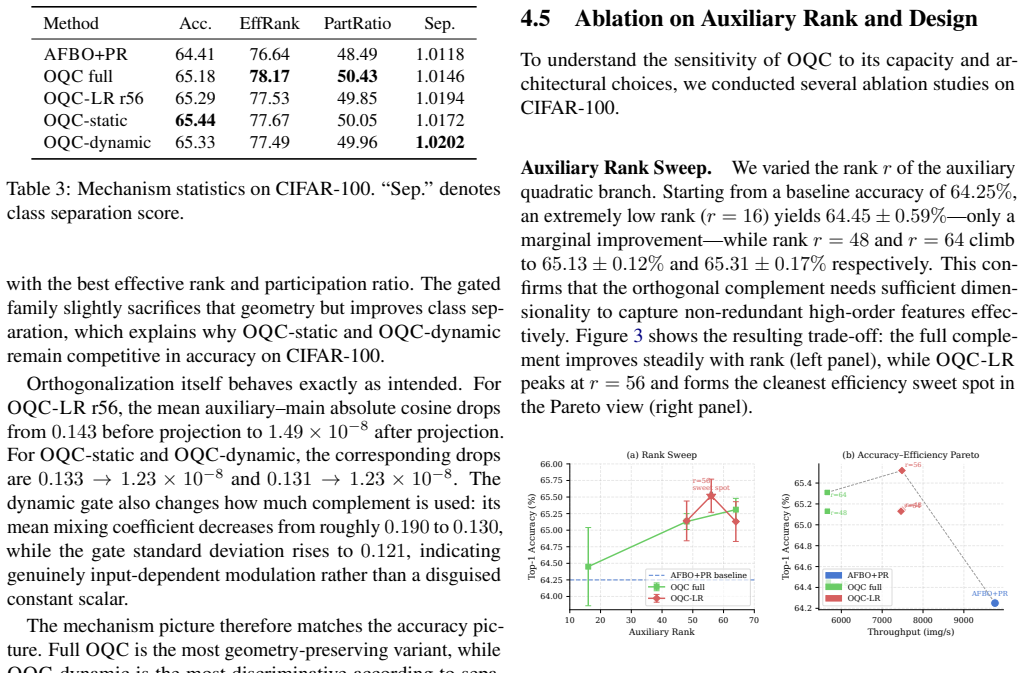
Recent bilinear feed-forward replacements for vision transformers can substantially improve accuracy, but they often conflate two effects: stronger second-order interactions and increased redundancy relative to the main branch. We study a complementary design principle in which auxiliary quadratic features contribute only information not already captured by the dominant hidden representation. To this end, we propose Orthogonal Quadratic Complements (OQC), which construct a low-rank quadratic auxiliary branch and explicitly project it onto the orthogonal complement of the main branch before injection. We further study an efficient low-rank realization (OQC-LR) and gated extensions (OQC-static and OQC-dynamic). Under a parameter-matched Deep-ViT and CIFAR-100 protocol with a fixed penultimate residual readout, full OQC improves an AFBO baseline from 64.25 +/- 0.22 to 65.59 +/- 0.22, while OQC-LR reaches 65.52 +/- 0.25 with a substantially better speed-accuracy tradeoff. On TinyImageNet, the gated extension OQC-dynamic achieves 51.88 +/- 0.32, improving the baseline (50.45 +/- 0.21) by 1.43 points and outperforming all ungated variants. Mechanism analyses show near-zero post-projection auxiliary-main overlap together with improved representation geometry and class separation. The full family, including both ungated and gated variants, generalizes consistently across both datasets.
Editorial analysis
A structured set of objections, weighed in public.
Referee Report
Summary. The paper proposes Orthogonal Quadratic Complements (OQC) for vision transformer feed-forward networks. It constructs a low-rank quadratic auxiliary branch that is explicitly projected onto the orthogonal complement of the main hidden representation before injection, with the goal of adding only novel information and avoiding redundancy. Variants include an efficient low-rank realization (OQC-LR) and gated extensions (OQC-static, OQC-dynamic). Under a parameter-matched Deep-ViT protocol, full OQC improves an AFBO baseline from 64.25 ± 0.22 to 65.59 ± 0.22 on CIFAR-100; OQC-dynamic reaches 51.88 ± 0.32 (vs. baseline 50.45 ± 0.21) on TinyImageNet. Mechanism analyses report near-zero post-projection overlap together with improved representation geometry and class separation. The family generalizes across both datasets.
Significance. If the orthogonality mechanism is causally responsible for the gains, the work supplies a clean design principle for reducing redundancy when augmenting ViT FFNs with second-order terms. The modest but consistent accuracy deltas, the favorable speed-accuracy tradeoff of OQC-LR, and the explicit mechanism measurements (overlap, geometry) are strengths. The approach could influence future bilinear or quadratic FFN replacements in vision transformers.
major comments (2)
- [Experiments] Experiments section: the reported accuracy improvements (1.34 points on CIFAR-100, 1.43 on TinyImageNet) are measured only against the AFBO baseline and other OQC variants. No ablation compares the full OQC (with explicit orthogonal projection) against an otherwise identical quadratic auxiliary branch added without the projection step. This control is required to isolate whether the orthogonality itself, rather than added capacity or quadratic interactions, produces the observed gains in class separation and geometry.
- [Mechanism analyses] Mechanism analyses: the paper shows near-zero post-projection auxiliary-main overlap and improved geometry metrics, but these are correlational. Without a direct comparison of representation quality (or downstream accuracy) between the projected and non-projected quadratic branches, the claim that the orthogonal complement step is what “guarantees it contributes only genuinely new information” remains unverified.
minor comments (2)
- [Abstract] The abstract and experimental protocol description should explicitly state the total parameter count for the AFBO baseline and each OQC variant to confirm the “parameter-matched” claim.
- [Method] Notation for the projection operator and the low-rank factorization (OQC-LR) could be introduced earlier and used consistently in the method and analysis sections.
Simulated Author's Rebuttal
We thank the referee for the constructive and insightful comments. We agree that the suggested ablation is necessary to more rigorously isolate the causal contribution of the orthogonal projection and will add the requested experiments in the revised manuscript.
read point-by-point responses
-
Referee: [Experiments] Experiments section: the reported accuracy improvements (1.34 points on CIFAR-100, 1.43 on TinyImageNet) are measured only against the AFBO baseline and other OQC variants. No ablation compares the full OQC (with explicit orthogonal projection) against an otherwise identical quadratic auxiliary branch added without the projection step. This control is required to isolate whether the orthogonality itself, rather than added capacity or quadratic interactions, produces the observed gains in class separation and geometry.
Authors: We agree that a direct ablation isolating the orthogonal projection step is required to substantiate the claim that orthogonality, rather than quadratic capacity alone, drives the gains. In the revised manuscript we will add this control experiment: an otherwise identical low-rank quadratic auxiliary branch injected without the orthogonal complement projection, trained under the exact same parameter-matched Deep-ViT protocol on both CIFAR-100 and TinyImageNet. We will report accuracy, post-injection overlap, and the same geometry/class-separation metrics for both variants so that the incremental benefit of the projection can be quantified directly. revision: yes
-
Referee: [Mechanism analyses] Mechanism analyses: the paper shows near-zero post-projection auxiliary-main overlap and improved geometry metrics, but these are correlational. Without a direct comparison of representation quality (or downstream accuracy) between the projected and non-projected quadratic branches, the claim that the orthogonal complement step is what “guarantees it contributes only genuinely new information” remains unverified.
Authors: We acknowledge that the current mechanism results are correlational and that a head-to-head comparison is needed to verify causality. The new ablation described above will directly address this by providing representation-quality and accuracy metrics for the projected versus non-projected branches. These results will be added to the mechanism-analyses section, allowing us to test whether the orthogonal projection is what produces the near-zero overlap and improved geometry. revision: yes
Circularity Check
No circularity: empirical gains measured against explicit baselines
full rationale
The paper defines OQC by constructing a low-rank quadratic branch and explicitly projecting it onto the orthogonal complement of the main representation before injection. Reported results are direct accuracy measurements (e.g., +1.34 points on CIFAR-100, +1.43 on TinyImageNet) under parameter-matched protocols against named baselines such as AFBO. Mechanism analyses confirm near-zero post-projection overlap, but these are verification of the enforced construction rather than load-bearing derivations. No equations reduce the accuracy deltas to fitted parameters renamed as predictions, no self-citations justify uniqueness theorems, and no ansatz is smuggled via prior work. The derivation chain is self-contained as an architectural proposal validated externally.
Axiom & Free-Parameter Ledger
free parameters (1)
- low-rank dimension
axioms (1)
- domain assumption Orthogonal projection removes all overlapping information between auxiliary quadratic features and the main branch representation
Lean theorems connected to this paper
-
IndisputableMonolith/Foundation/AlexanderDuality.leanalexander_duality_circle_linking unclearmechanism analyses show near-zero post-projection auxiliary–main overlap together with improved representation geometry and class separation
Reference graph
Works this paper leans on
-
[1]
Gomez, Łukasz Kaiser, and Illia Polosukhin
Ashish Vaswani, Noam Shazeer, Niki Parmar, Jakob Uszkoreit, Llion Jones, Aidan N. Gomez, Łukasz Kaiser, and Illia Polosukhin. Attention Is All You Need. In Advances in Neural Information Processing Systems (NeurIPS), 2017. 6
2017
-
[2]
An Image is Worth 16x16 Words: Transformers for Image Recognition at Scale
Alexey Dosovitskiy, Lucas Beyer, Alexander Kolesnikov, Dirk Weissenborn, Xiaohua Zhai, Thomas Unterthiner, Mostafa Dehghani, Matthias Minderer, Georg Heigold, Sylvain Gelly, Jakob Uszkoreit, and Neil Houlsby. An Image is Worth 16x16 Words: Transformers for Image Recognition at Scale. InInternational Conference on Learning Representations (ICLR), 2021
2021
-
[3]
Training Data-Efficient Image Transformers & Distilla- tion Through Attention
Hugo Touvron, Matthieu Cord, Matthijs Douze, Fran- cisco Massa, Alexandre Sablayrolles, and Hervé Jégou. Training Data-Efficient Image Transformers & Distilla- tion Through Attention. InProceedings of the 38th Inter- national Conference on Machine Learning (ICML), vol- ume 139 ofProceedings of Machine Learning Research, pages 10347–10357, 2021
2021
-
[4]
Swin Transformer: Hierarchical Vision Transformer Using Shifted Windows
Ze Liu, Yutong Lin, Yue Cao, Han Hu, Yixuan Wei, Zheng Zhang, Stephen Lin, and Baining Guo. Swin Transformer: Hierarchical Vision Transformer Using Shifted Windows. InProceedings of the IEEE/CVF International Confer- ence on Computer Vision (ICCV), pages 10012–10022, 2021
2021
-
[5]
GLU Variants Improve Transformer
Noam Shazeer. GLU Variants Improve Transformer. arXiv preprint arXiv:2002.05202, 2020
work page internal anchor Pith review Pith/arXiv arXiv 2002
-
[6]
Asymmetric Factorized Bilinear Operation for Vision Transformer
Junjie Wu, Qilong Wang, Jiangtao Xie, Pengfei Zhu, and Qinghua Hu. Asymmetric Factorized Bilinear Operation for Vision Transformer. InInternational Conference on Learning Representations (ICLR), 2025. 7
2025
discussion (0)
Sign in with ORCID, Apple, or X to comment. Anyone can read and Pith papers without signing in.