Recognition: unknown
ConfigSpec: Profiling-Based Configuration Selection for Distributed Edge--Cloud Speculative LLM Serving
Pith reviewed 2026-05-10 16:51 UTC · model grok-4.3
The pith
Profiling reveals conflicting optima for goodput, cost, and energy in edge-cloud speculative LLM serving.
A machine-rendered reading of the paper's core claim, the machinery that carries it, and where it could break.
Core claim
Across three edge platforms and two LLM families, goodput is maximised by the smallest, fastest draft model at device-dependent speculative lengths (K*=2-10). Both cost and energy efficiency converge to K=2 due to a dominant bonus-token effect, with cost favouring the largest drafter for its high acceptance rate and energy favouring the smallest for its low power draw. These conflicts confirm that no single fixed configuration can simultaneously optimise all objectives.
What carries the argument
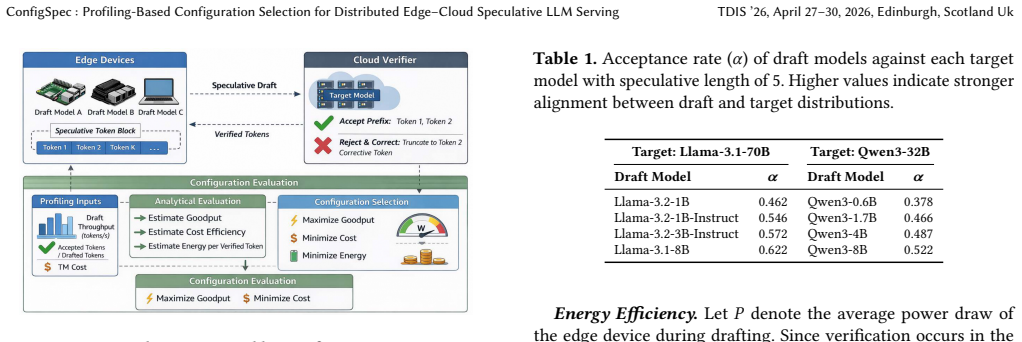
ConfigSpec profiling framework that measures drafting throughput, acceptance rate, and power on target edge devices to compute goodput, verification cost efficiency, and energy efficiency across configuration choices.
If this is right
- Goodput is maximised by the smallest, fastest draft model at device-dependent speculative lengths between 2 and 10.
- Cost efficiency converges to speculative length 2 and favours the largest drafter due to higher acceptance rates.
- Energy efficiency converges to speculative length 2 and favours the smallest drafter due to lower power draw.
- No single fixed configuration optimises goodput, cost, and energy efficiency together in distributed speculative LLM serving.
Where Pith is reading between the lines
- Runtime adaptation that switches configurations based on observed workload could exploit the identified conflicts more effectively than static selection.
- The bonus-token effect implies that small gains in acceptance rate can outweigh differences in base model size for efficiency metrics.
- Extending the profiling to capture network latency between edge and cloud would allow tighter bounds on achievable efficiency gains.
- Similar trade-offs are likely to appear in other disaggregated inference pipelines that separate lightweight and heavyweight components.
Load-bearing premise
The profiled metrics for drafting throughput, acceptance rate, and power, along with the derived models for goodput, cost, and energy efficiency, accurately predict real-world performance without unmodeled factors such as network latency variability or dynamic workload changes.
What would settle it
Measure actual goodput, cost, and energy for a fixed configuration chosen without the profiling step and compare the results against the framework's predictions; large discrepancies would indicate the models miss key factors.
Figures


read the original abstract
Speculative decoding enables collaborative Large Language Model (LLM) inference across cloud and edge by separating lightweight token drafting from heavyweight verification. While prior systems show performance and cost benefits, practical deployment requires navigating a large configuration space spanning draft model variants, quantisation levels, speculative lengths, and heterogeneous edge devices. This paper presents ConfigSpec, a configurationselection framework for distributed speculative LLM serving. ConfigSpec profiles edge devices and draft-target alignment, and models drafting throughput, acceptance rate, and power to evaluate goodput, verification cost efficiency, and energy efficiency across the joint configuration space. Our analysis across three edge platforms and two LLM families reveals structurally conflicting optima. Firstly, goodput is maximised by the smallest, fastest draft model at device-dependent speculative lengths (K*=2-10). Secondly, both cost and energy efficiency converge to K=2 due to a dominant bonus-token effect-with cost favouring the largest drafter for its high acceptance rate and energy favouring the smallest for its low power draw. These conflicts confirm that no single fixed configuration can simultaneously optimise all objectives, underscoring the need for profiling-based configuration selection in disaggregated edge-cloud LLM inference.
Editorial analysis
A structured set of objections, weighed in public.
Referee Report
Summary. The manuscript introduces ConfigSpec, a profiling-based configuration selection framework for distributed speculative LLM serving across edge and cloud. It profiles edge devices to derive models of drafting throughput, acceptance rate, and power consumption, which are used to evaluate goodput, verification cost efficiency, and energy efficiency over the joint space of draft model variants, quantization levels, and speculative lengths K. Analysis across three edge platforms and two LLM families identifies structurally conflicting optima: goodput is maximized by the smallest/fastest drafter at device-dependent K* (2-10), while cost and energy efficiency both converge to K=2 (cost favoring largest drafter due to acceptance rate, energy favoring smallest due to power draw). The conclusion is that no single fixed configuration optimizes all objectives simultaneously.
Significance. If the profiled models are representative, the result is significant for practical deployment of speculative decoding in heterogeneous edge-cloud systems, as it provides empirical evidence of inherent trade-offs and motivates adaptive, profiling-driven selection over static configurations. The breadth of the evaluation across multiple platforms and model families is a clear strength, offering concrete guidance for system designers.
major comments (1)
- [§5] §5 (Evaluation): The central claim of structurally conflicting optima for goodput versus cost/energy rests on the accuracy of the derived efficiency models in predicting real distributed performance. However, the models do not incorporate network latency variability between edge and cloud or dynamic workload changes, which is load-bearing for the practical validity of the identified optima and the conclusion that profiling is required.
minor comments (3)
- [§4] The 'bonus-token effect' is referenced as dominant for the K=2 convergence but is not formally defined or derived with explicit equations in the modeling section; adding this would improve clarity.
- [Figures] Figure legends and captions (e.g., those showing K* and efficiency curves) should more explicitly label the three edge platforms and two LLM families to aid interpretation of the cross-platform results.
- The manuscript would benefit from a brief discussion of how ConfigSpec's profiling overhead compares to inference time in a production serving loop.
Simulated Author's Rebuttal
We thank the referee for the constructive review and for recognizing the significance of our findings on conflicting optima in distributed speculative LLM serving. We address the major comment point-by-point below.
read point-by-point responses
-
Referee: [§5] §5 (Evaluation): The central claim of structurally conflicting optima for goodput versus cost/energy rests on the accuracy of the derived efficiency models in predicting real distributed performance. However, the models do not incorporate network latency variability between edge and cloud or dynamic workload changes, which is load-bearing for the practical validity of the identified optima and the conclusion that profiling is required.
Authors: We thank the referee for this important observation. Our efficiency models are derived directly from profiling runs executed in the actual distributed edge-cloud testbed; consequently, the measured drafting throughput, acceptance rates, and power draw already embed the network latencies observed during those sessions. The models therefore predict performance under the real conditions captured in profiling rather than idealized zero-latency assumptions. We agree, however, that the current formulation does not explicitly parameterize network latency variability (e.g., congestion-induced fluctuations) or dynamic workload shifts, both of which could influence the location of the reported optima in highly variable production settings. In the revised manuscript we will add a dedicated limitations subsection to §5 that (i) states these modeling assumptions explicitly and (ii) presents a sensitivity study in which we inject controlled network delays and re-evaluate the goodput/cost/energy surfaces. This addition will clarify the scope of our claims while reinforcing the practical value of profiling-based selection. revision: partial
Circularity Check
No significant circularity detected
full rationale
The paper derives its central claims through direct empirical profiling of edge devices to obtain measurements of drafting throughput, acceptance rate, and power draw across draft-model variants, quantization levels, and speculative lengths K. These raw profiled quantities are then combined via standard speculative-decoding formulas to compute the three efficiency metrics (goodput, cost efficiency, energy efficiency). The reported structural conflicts among optima follow immediately from comparing the resulting values; no equation reduces an output to its own fitted inputs by construction, no parameter is presented as a prediction after being fitted to the target quantity, and no load-bearing premise rests on a self-citation chain. The derivation chain therefore remains self-contained and externally falsifiable against the profiled data.
Axiom & Free-Parameter Ledger
Reference graph
Works this paper leans on
-
[1]
Charlie Chen, Sebastian Borgeaud, Geoffrey Irving, Jean-Baptiste Lespiau, Lau- rent Sifre, and John Jumper. 2023. Accelerating large language model decoding with speculative sampling.arXiv preprint arXiv:2302.01318(2023)
work page internal anchor Pith review arXiv 2023
-
[2]
Mengzhao Chen, Wenqi Shao, Peng Xu, Jiahao Wang, Peng Gao, Kaipeng Zhang, and Ping Luo. 2025. Efficientqat: Efficient quantization-aware training for large language models. InProceedings of the 63rd Annual Meeting of the Association for Computational Linguistics (Volume 1: Long Papers). 10081–10100
2025
-
[3]
Mike Conover, Matt Hayes, Ankit Mathur, Jianwei Xie, Jun Wan, Sam Shah, Ali Ghodsi, Patrick Wendell, Matei Zaharia, and Reynold Xin. 2023.Free Dolly: Introducing the World’s First Truly Open Instruction- Tuned LLM.https://www.databricks.com/blog/2023/04/12/dolly-first-open- commercially-viable-instruction-tuned-llm
2023
-
[4]
Fireworks AI. 2025. Pricing – Fireworks AI.https://fireworks.ai/pricing. Server- less tier: $0.90 / 1M tokens for models >16B parameters. Accessed: 2025-07-15
2025
-
[5]
Elias Frantar and Dan Alistarh. 2023. Sparsegpt: Massive language models can be accurately pruned in one-shot. InInternational Conference on Machine Learning. PMLR, 10323–10337
2023
-
[6]
Groq. 2025. GroqCloud On-Demand Pricing.https://groq.com/pricing. Qwen3- 32B: $0.29 / 1M input tokens, $0.59 / 1M output tokens. Accessed: 2025-07-15
2025
-
[7]
Chengzhuo Han, Tingting Yang, Zhengqi Cui, and Xin Sun. 2025. A privacy- preserving and trustworthy inference framework for LLM-IoT integration via hierarchical federated collaborative computing.IEEE Internet of Things Journal (2025)
2025
-
[8]
Yaniv Leviathan, Matan Kalman, and Yossi Matias. 2023. Fast inference from transformers via speculative decoding. InInternational Conference on Machine Learning. PMLR, Honolulu, Hawaii, USA, 19274–19286
2023
-
[9]
Hui Li, Xiuhua Li, Qilin Fan, Qiang He, Xiaofei Wang, and Victor CM Leung. 2025. Adaptive model partitioning and pruning for collaborative DNN inference in mobile edge-cloud computing networks.IEEE Transactions on Mobile Computing (2025)
2025
-
[10]
Xiangchen Li, Jiakun Fan, Qingyuan Wang, Dimitrios Spatharakis, Saeid Ghafouri, Hans Vandierendonck, Deepu John, Bo Ji, Ali R Butt, and Dimitrios S Nikolopou- los. 2026. WISP: Waste-and Interference-Suppressed Distributed Speculative LLM Serving at the Edge via Dynamic Drafting and SLO-Aware Batching.arXiv preprint arXiv:2601.11652(2026)
work page internal anchor Pith review Pith/arXiv arXiv 2026
-
[11]
Xiangchen Li, Dimitrios Spatharakis, Saeid Ghafouri, Jiakun Fan, Hans Vandieren- donck, Deepu John, Bo Ji, and Dimitrios S Nikolopoulos. 2025. Sled: A speculative llm decoding framework for efficient edge serving. InProceedings of the Tenth ACM/IEEE Symposium on Edge Computing. 1–8
2025
-
[12]
Xupeng Miao, Gabriele Oliaro, Zhihao Zhang, Xinhao Cheng, Zeyu Wang, Rae Ying Yee Wong, Zhuoming Chen, Daiyaan Arfeen, Reyna Abhyankar, and Zhi- hao Jia. 2023. Specinfer: Accelerating generative llm serving with speculative inference and token tree verification.arXiv preprint arXiv:2305.097811, 2 (2023), 4
-
[13]
Ranajoy Sadhukhan, Jian Chen, Zhuoming Chen, Vashisth Tiwari, Ruihang Lai, Jinyuan Shi, Ian En-Hsu Yen, Avner May, Tianqi Chen, and Beidi Chen. 2024. Mag- icDec: Breaking the Latency-Throughput Tradeoff for Long Context Generation with Speculative Decoding. InInternational Conference on Learning Representa- tions
2024
-
[14]
Chunlin Tian, Xinpeng Qin, Kahou Tam, Li Li, Zijian Wang, Yuanzhe Zhao, Minglei Zhang, and Chengzhong Xu. 2025. CLONE: customizing LLMs for efficient latency-aware inference at the edge. InProceedings of the 2025 USENIX Conference on Usenix Annual Technical Conference(Boston, MA, USA)(USENIX ATC ’25). USENIX Association, USA, Article 34, 23 pages
2025
-
[15]
Guangxuan Xiao, Ji Lin, Mickael Seznec, Hao Wu, Julien Demouth, and Song Han. 2023. Smoothquant: Accurate and efficient post-training quantization for large language models. InInternational Conference on Machine Learning. PMLR, 38087–38099
2023
-
[16]
Daliang Xu, Wangsong Yin, Hao Zhang, Xin Jin, Ying Zhang, Shiyun Wei, Meng- wei Xu, and Xuanzhe Liu. 2024. Edgellm: Fast on-device llm inference with speculative decoding.IEEE Transactions on Mobile Computing24, 4 (2024), 3256– 3273
2024
-
[17]
Zhongzhi Yu, Zheng Wang, Yuhan Li, Ruijie Gao, Xiaoya Zhou, Sreenidhi Reddy Bommu, Yang Zhao, and Yingyan Lin. 2024. Edge-llm: Enabling efficient large language model adaptation on edge devices via unified compression and adaptive layer voting. InProceedings of the 61st ACM/IEEE Design Automation Conference. 1–6
2024
-
[18]
Mingjin Zhang, Xiaoming Shen, Jiannong Cao, Zeyang Cui, and Shan Jiang. 2024. EdgeShard: Efficient LLM inference via collaborative edge computing.IEEE Internet of Things Journal(2024)
2024
discussion (0)
Sign in with ORCID, Apple, or X to comment. Anyone can read and Pith papers without signing in.