Recognition: unknown
Magnetic field alignment with dense cores in the transition between cloud and core scales
Pith reviewed 2026-05-10 16:27 UTC · model grok-4.3
The pith
Magnetic fields lose coherent alignment when moving from cloud scales to dense core scales in star-forming regions.
A machine-rendered reading of the paper's core claim, the machinery that carries it, and where it could break.
Core claim
Using BISTRO survey dust polarization data, a catalog of 79 cores across 14 regions shows the core-scale magnetic field has higher standard deviation in orientation than the cloud-scale field. Alignment between the two scales changes strongly from region to region. The core-scale field, core major axis, and core velocity gradient exhibit random relative orientations, matching earlier cloud-scale findings. The results indicate a clear change in magnetic field properties across the cloud-to-core transition and suggest magnetic fields do not dominate dense core evolution on core scales.
What carries the argument
Statistical comparison of magnetic field orientations traced by dust polarization, measured separately at cloud scales and at averaged core scales, including their relation to core shapes and velocity gradients.
If this is right
- Star formation models must incorporate processes that scramble magnetic field coherence between cloud and core scales.
- Dense core shapes and internal motions can develop independently of the large-scale magnetic field direction.
- Turbulence or gravity likely become the leading influences on core evolution once scales drop below the cloud regime.
- The transition zone itself is where any magnetic regulation of core formation weakens or ends.
Where Pith is reading between the lines
- Observations at still higher resolution could pinpoint the exact spatial scale where the field disorder begins.
- Simulations with varying initial field strengths and turbulence levels could test whether the observed randomization is a generic outcome.
- If the field truly loses influence, then core mass and angular momentum distributions should match predictions from non-magnetic collapse models.
- Similar scale-dependent field changes might appear in other tracers such as Zeeman splitting or molecular line polarization.
Load-bearing premise
Dust polarization reliably maps the plane-of-sky magnetic field direction at both scales with little contamination from grain alignment variations or line-of-sight confusion.
What would settle it
A new polarization map of the same regions at core resolution that finds statistically significant preferred alignment between core-scale and cloud-scale field orientations across most regions.
Figures




read the original abstract
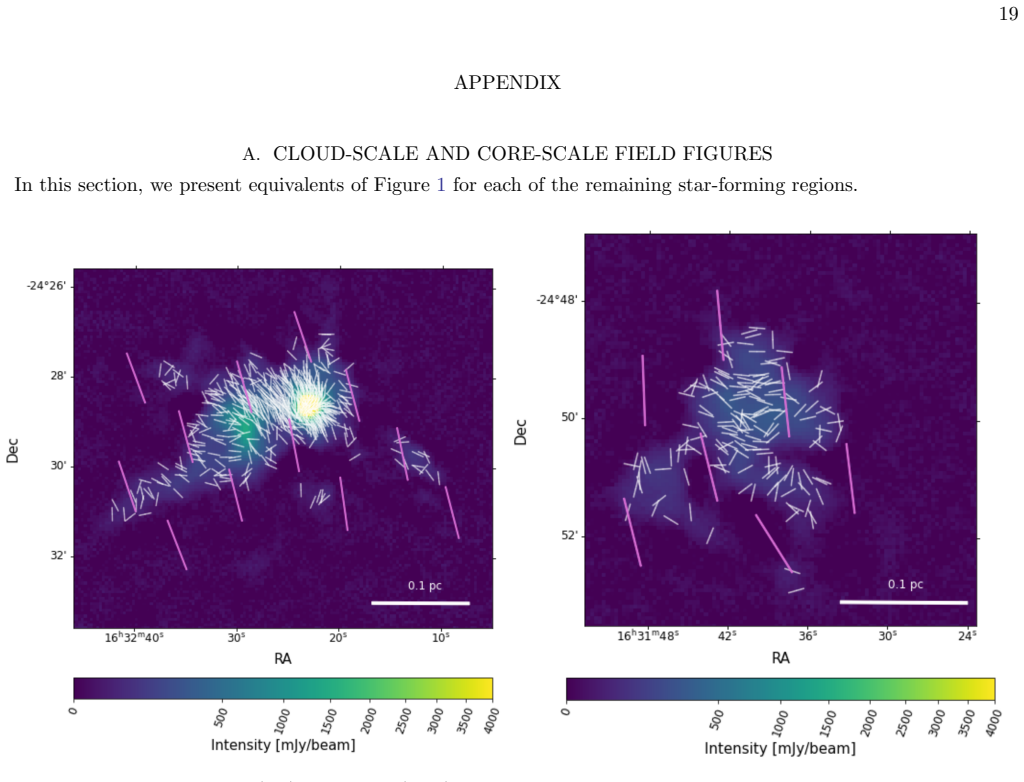
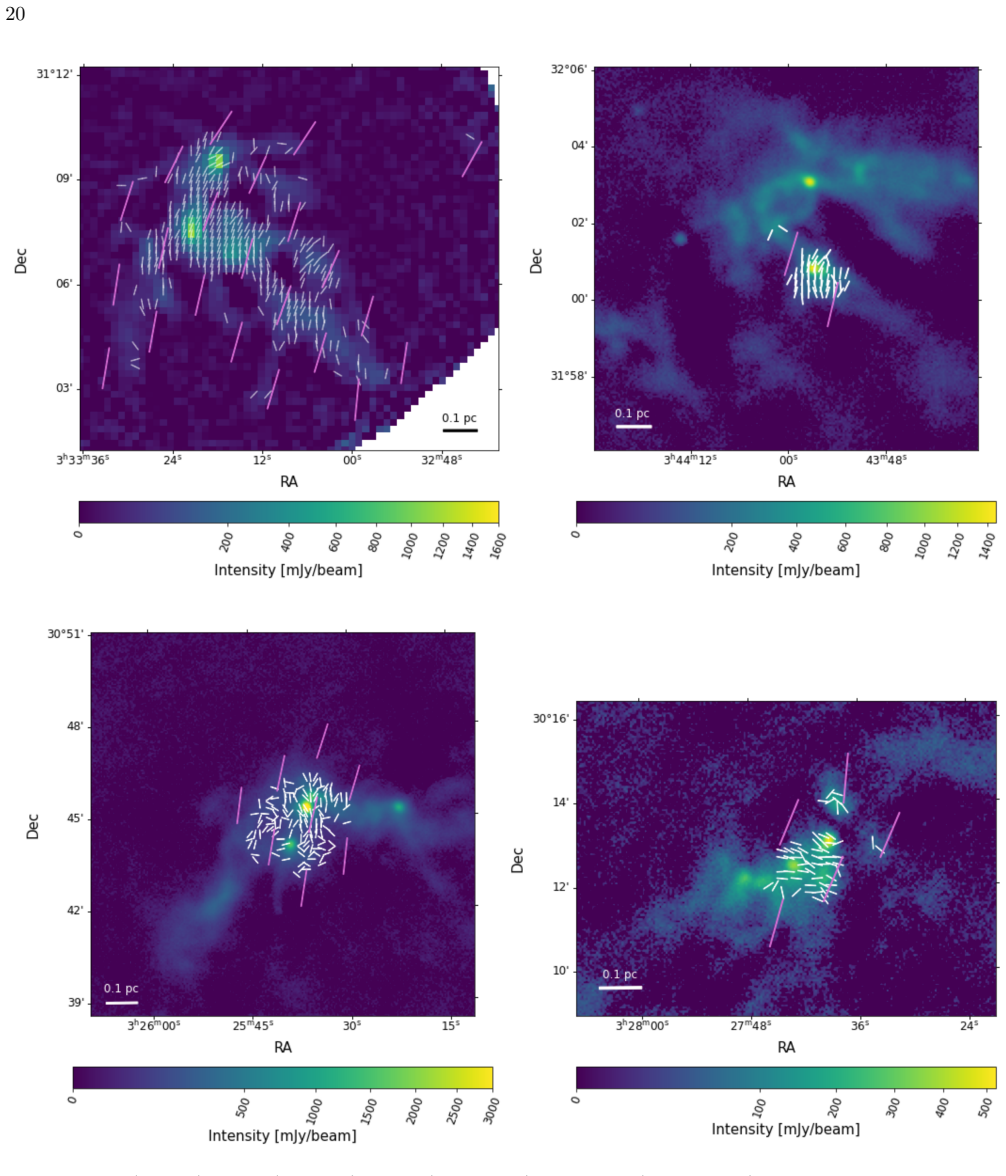
In a magnetically-dominated model of star formation, we expect to see alignments between the magnetic field orientation of star-forming dense cores and the cloud-scale magnetic field. Pandhi et al. (2023) showed instead, however, that the orientation of cores and their angular momentum vectors appear random with respect to the larger-scale magnetic field, implying that magnetic fields may play a diminished role in core formation and evolution. Here, we use higher-resolution dust polarization data from the B-Fields In Star-forming Region Observations (BISTRO) survey on the James Clerk Maxwell Telescope (JCMT) to investigate the change in the magnetic field orientation from cloud scales to core scales, and reassess any correlations between core-scale magnetic fields, core orientations and core velocity gradients. We produce a catalog of 79 cores over 14 star-forming regions with averaged core-scale magnetic field orientations. We find that the core-scale magnetic field is more disordered compared to the cloud-scale field, as measured by an increased standard deviation in the magnetic field vector orientations. Alignment between the core-scale and cloud-scale field varies greatly between regions. Our results are consistent with random alignments between the core-scale magnetic field, core orientation, and core velocity gradient, in agreement with the results by Pandhi et al. (2023) for the cloud-scale field. We conclude that there is a clear change in the magnetic field in the transition from cloud- to core-scales. Our results suggest that the magnetic field may not play a dominant role in the evolution of dense cores on core scales.
Editorial analysis
A structured set of objections, weighed in public.
Referee Report
Summary. The paper catalogs 79 dense cores across 14 star-forming regions using higher-resolution BISTRO JCMT dust polarization data, derives averaged core-scale magnetic field orientations, and compares them statistically to cloud-scale fields from Pandhi et al. (2023). It reports greater disorder (increased standard deviation) at core scales, variable region-to-region alignment with cloud-scale fields, and random (uncorrelated) alignments between core-scale fields, core orientations, and velocity gradients, concluding a clear transition from cloud to core scales in which magnetic fields do not play a dominant role in core evolution.
Significance. If the measurements prove robust, this work supplies direct observational evidence for a scale-dependent shift in magnetic field behavior during star formation, extending Pandhi et al. (2023) by bridging cloud and core regimes with higher-resolution data. The result would constrain theoretical models by indicating that turbulence or other non-magnetic processes likely dominate core evolution, while still allowing magnetic influence at larger scales.
major comments (2)
- [§3 (Methods, core identification and averaging)] §3 (Methods, core identification and averaging): The core identification thresholds and magnetic-field averaging window are treated as free parameters without reported sensitivity tests or robustness checks. Because the central claim of increased disorder rests on the measured standard deviation of orientations, unquantified dependence on these choices weakens the support for a physical transition rather than a methodological artifact.
- [§4 (Results and comparison to Pandhi et al.)] §4 (Results and comparison to Pandhi et al.): No quantitative test is presented for scale-dependent changes in grain alignment efficiency, polarization fraction thresholds, or line-of-sight confusion between the BISTRO JCMT core-scale data and the cloud-scale data. This is load-bearing for the 'clear change' and 'not dominant role' conclusions, as differential contamination could artificially inflate the reported standard deviation and apparent randomness without reflecting intrinsic magnetic-field evolution.
minor comments (3)
- [Abstract] The abstract states the catalog contains 79 cores over 14 regions but does not name the regions; adding this list would improve reproducibility.
- [Figures] Figure captions and legends should explicitly define how magnetic-field position angles and their uncertainties are computed and displayed, including any averaging or weighting applied.
- [§4] A brief statement on the statistical test used to establish 'random alignments' (e.g., p-value threshold or correlation coefficient) would clarify the strength of the null result.
Simulated Author's Rebuttal
We thank the referee for their thoughtful and constructive report, which has helped us improve the clarity and robustness of our analysis. We address each major comment below and have revised the manuscript to incorporate additional tests and discussions where feasible.
read point-by-point responses
-
Referee: §3 (Methods, core identification and averaging): The core identification thresholds and magnetic-field averaging window are treated as free parameters without reported sensitivity tests or robustness checks. Because the central claim of increased disorder rests on the measured standard deviation of orientations, unquantified dependence on these choices weakens the support for a physical transition rather than a methodological artifact.
Authors: We acknowledge that the original manuscript did not include explicit sensitivity tests for these choices. In the revised version, we have added a dedicated subsection in §3 describing robustness checks in which we varied the core identification thresholds (minimum pixel count, signal-to-noise ratio, and density contrast) and the magnetic-field averaging window size (from 1 to 3 beam widths). These tests confirm that the reported increase in standard deviation of core-scale field orientations remains statistically significant and consistent across reasonable parameter ranges. The results are summarized in the main text and detailed in a new Appendix A. This addition directly addresses the concern that the observed disorder could be a methodological artifact. revision: yes
-
Referee: §4 (Results and comparison to Pandhi et al.): No quantitative test is presented for scale-dependent changes in grain alignment efficiency, polarization fraction thresholds, or line-of-sight confusion between the BISTRO JCMT core-scale data and the cloud-scale data. This is load-bearing for the 'clear change' and 'not dominant role' conclusions, as differential contamination could artificially inflate the reported standard deviation and apparent randomness without reflecting intrinsic magnetic-field evolution.
Authors: We agree that quantitative assessment of these effects would strengthen the interpretation. A full quantitative model of grain alignment efficiency differences would require detailed simulations and additional multi-wavelength data beyond the scope of this work; we have therefore added a qualitative discussion in §4 explaining our polarization fraction thresholds (chosen to match prior BISTRO analyses for reliable detections) and arguing that the higher resolution of the JCMT data reduces line-of-sight confusion relative to the cloud-scale measurements. We also note that any residual confusion would tend to randomize rather than systematically increase the observed disorder. These revisions support our conclusions while acknowledging the limitations of the current dataset. revision: partial
Circularity Check
Minor self-citation to prior observational results; no circular reduction
full rationale
The paper's central claims derive from direct measurements of dust polarization angles in new BISTRO JCMT data, yielding a catalog of 79 cores and statistical quantities such as the standard deviation of core-scale magnetic field orientations. These are compared to cloud-scale orientations reported in Pandhi et al. (2023). The self-citation supplies the baseline for detecting a scale-dependent change but does not define the core-scale quantities or force the conclusion by construction. No parameters are fitted such that predictions reduce to inputs, no ansatzes are smuggled, and no uniqueness theorems are invoked. The analysis is self-contained against the observational dataset.
Axiom & Free-Parameter Ledger
free parameters (1)
- core identification thresholds and averaging window
axioms (2)
- domain assumption Dust polarization reliably traces the plane-of-sky magnetic field orientation at both cloud and core scales
- domain assumption Core orientations and velocity gradients can be measured independently of the magnetic field data
Reference graph
Works this paper leans on
-
[1]
2025, arXiv e-prints, arXiv:2501.13931, 10.48550/arXiv.2501.13931
Alves , J., Lombardi , M., & Lada , C. 2025, arXiv e-prints, arXiv:2501.13931, 10.48550/arXiv.2501.13931
-
[2]
Anderson, T. W., & Darling, D. A. 1954, Journal of the American Statistical Association, 49, 765, 10.1080/01621459.1954.10501232
-
[3]
G., Lazarian , A., & Vaillancourt , J
Andersson , B. G., Lazarian , A., & Vaillancourt , J. E. 2015, , 53, 501, 10.1146/annurev-astro-082214-122414
-
[4]
2010, , 518, L102, 10.1051/0004-6361/201014666
Andr \'e , P., Men'shchikov , A., Bontemps , S., et al. 2010, , 518, L102, 10.1051/0004-6361/201014666
-
[5]
Arce-Tord , C., Louvet , F., Cortes , P. C., et al. 2020, , 640, A111, 10.1051/0004-6361/202038024
-
[6]
Astropy Collaboration , Robitaille , T. P., Tollerud , E. J., et al. 2013, , 558, A33, 10.1051/0004-6361/201322068
-
[7]
The Astronomical Journal , author =
Astropy Collaboration , Price-Whelan , A. M., Sip o cz , B. M., et al. 2018, , 156, 123, 10.3847/1538-3881/aabc4f
-
[8]
Astropy Collaboration , Price-Whelan , A. M., Lim , P. L., et al. 2022, , 935, 167, 10.3847/1538-4357/ac7c74
work page internal anchor Pith review doi:10.3847/1538-4357/ac7c74 2022
-
[9]
Ballesteros-Paredes , J., Klessen , R. S., Mac Low , M. M., & Vazquez-Semadeni , E. 2007, in Protostars and Planets V, ed. B. Reipurth , D. Jewitt , & K. Keil , 63, 10.48550/arXiv.astro-ph/0603357
-
[10]
2011, in Astronomical Society of the Pacific Conference Series, Vol
Bastien , P., Bissonnette , E., Simon , A., et al. 2011, in Astronomical Society of the Pacific Conference Series, Vol. 449, Astronomical Polarimetry 2008: Science from Small to Large Telescopes, ed. P. Bastien , N. Manset , D. P. Clemens , & N. St-Louis , 68
2011
-
[11]
2000, , 540, L103, 10.1086/312885
Basu , S. 2000, , 540, L103, 10.1086/312885
-
[12]
Be s li \'c , I., Coud \'e , S., Lis , D. C., et al. 2024, , 684, A212, 10.1051/0004-6361/202348376
-
[13]
2000, , 543, 822, 10.1086/317122
Burkert , A., & Bodenheimer , P. 2000, , 543, 822, 10.1086/317122
-
[14]
Chapin , E. L., Berry , D. S., Gibb , A. G., et al. 2013, , 430, 2545, 10.1093/mnras/stt052
-
[15]
Chen , C.-Y., King , P. K., & Li , Z.-Y. 2016, , 829, 84, 10.3847/0004-637X/829/2/84
-
[16]
Chen , C.-Y., & Ostriker , E. C. 2018, , 865, 34, 10.3847/1538-4357/aad905
-
[17]
Chen , C.-Y., Behrens , E. A., Washington , J. E., et al. 2020, , 494, 1971, 10.1093/mnras/staa835
-
[18]
C.-Y., Di Francesco , J., Friesen , R
Chen , M. C.-Y., Di Francesco , J., Friesen , R. K., et al. 2024, , 977, 135, 10.3847/1538-4357/ad88e8
-
[19]
2019, , 877, 88, 10.3847/1538-4357/ab1b23
Coud \'e , S., Bastien , P., Houde , M., et al. 2019, , 877, 88, 10.3847/1538-4357/ab1b23
-
[20]
Crutcher , R. M. 1999, , 520, 706, 10.1086/307483
-
[21]
M., Wandelt , B., Heiles , C., Falgarone , E., & Troland , T
Crutcher , R. M., Wandelt , B., Heiles , C., Falgarone , E., & Troland , T. H. 2010, , 725, 466, 10.1088/0004-637X/725/1/466
-
[22]
T., Friberg , P., Jenness , T., et al
Dempsey , J. T., Friberg , P., Jenness , T., et al. 2013, , 430, 2534, 10.1093/mnras/stt090
-
[23]
Doi , Y., Hasegawa , T., Furuya , R. S., et al. 2020, , 899, 28, 10.3847/1538-4357/aba1e2
-
[24]
Eswaraiah , C., Li , D., Furuya , R. S., et al. 2021, , 912, L27, 10.3847/2041-8213/abeb1c
-
[25]
Fissel , L. M., Ade , P. A. R., Angil \`e , F. E., et al. 2016, , 824, 134, 10.3847/0004-637X/824/2/134
-
[26]
2016, in Society of Photo-Optical Instrumentation Engineers (SPIE) Conference Series, Vol
Friberg , P., Bastien , P., Berry , D., et al. 2016, in Society of Photo-Optical Instrumentation Engineers (SPIE) Conference Series, Vol. 9914, Millimeter, Submillimeter, and Far-Infrared Detectors and Instrumentation for Astronomy VIII, ed. W. S. Holland & J. Zmuidzinas , 991403, 10.1117/12.2231943
-
[27]
Friesen , R. K., Pineda , J. E., co-PIs , et al. 2017, , 843, 63, 10.3847/1538-4357/aa6d58
-
[28]
Girart , J. M., Rao , R., & Marrone , D. P. 2006, Science, 313, 812, 10.1126/science.1129093
-
[29]
Greaves , J. S., Holland , W. S., Jenness , T., et al. 2003, , 340, 353, 10.1046/j.1365-8711.2003.06230.x
-
[30]
2021, , 913, 85, 10.3847/1538-4357/abf3c4
Hwang , J., Kim , J., Pattle , K., et al. 2021, , 913, 85, 10.3847/1538-4357/abf3c4
-
[31]
2024, , 686, A202, 10.1051/0004-6361/202449182
Jiao , W., Wang , K., Xu , F., Wang , C., & Beuther , H. 2024, , 686, A202, 10.1051/0004-6361/202449182
-
[32]
Kauffmann , J., Bertoldi , F., Bourke , T. L., Evans , II, N. J., & Lee , C. W. 2008, , 487, 993, 10.1051/0004-6361:200809481
-
[33]
Klotz, J. 1967, Journal of the American Statistical Association, 62, 932, 10.1080/01621459.1967.10500904
-
[34]
Kolmogorov, A. N. 1933, Foundations of the Theory of Probability
1933
-
[35]
2020, , 635, A34, 10.1051/0004-6361/201834753
K \"o nyves , V., Andr \'e , P., Arzoumanian , D., et al. 2020, , 635, A34, 10.1051/0004-6361/201834753
-
[36]
2020, , 893, 73, 10.3847/1538-4357/ab7eac
Kuznetsova , A., Hartmann , L., & Heitsch , F. 2020, , 893, 73, 10.3847/1538-4357/ab7eac
-
[37]
Kwon , J., Tamura , M., Hough , J. H., et al. 2015, , 220, 17, 10.1088/0067-0049/220/1/17
-
[38]
2018, , 859, 4, 10.3847/1538-4357/aabd82
Kwon , J., Doi , Y., Tamura , M., et al. 2018, , 859, 4, 10.3847/1538-4357/aabd82
-
[39]
2020, , 638, A74, 10.1051/0004-6361/201936442
Ladjelate , B., Andr \'e , P., K \"o nyves , V., et al. 2020, , 638, A74, 10.1051/0004-6361/201936442
-
[40]
2007, , 106, 225, 10.1016/j.jqsrt.2007.01.038
Lazarian , A. 2007, , 106, 225, 10.1016/j.jqsrt.2007.01.038
-
[41]
Lazarian , A., & Hoang , T. 2007, , 378, 910, 10.1111/j.1365-2966.2007.11817.x
-
[42]
Lee , J. W. Y., Hull , C. L. H., & Offner , S. S. R. 2017, , 834, 201, 10.3847/1538-4357/834/2/201
-
[43]
Li , H.-B., Yuen , K. H., Otto , F., et al. 2015, , 520, 518, 10.1038/nature14291
-
[44]
2019, , 877, 43, 10.3847/1538-4357/ab0958
Liu , J., Qiu , K., Berry , D., et al. 2019, , 877, 43, 10.3847/1538-4357/ab0958
-
[45]
Matthews , B. C., McPhee , C. A., Fissel , L. M., & Curran , R. L. 2009, , 182, 143, 10.1088/0067-0049/182/1/143
-
[46]
Matthews , B. C., & Wilson , C. D. 2002, , 571, 356, 10.1086/339915
-
[47]
2021, , 654, A78, 10.1051/0004-6361/202141533
Men'shchikov , A. 2021, , 654, A78, 10.1051/0004-6361/202141533
-
[48]
2012, , 542, A81, 10.1051/0004-6361/201218797
Men'shchikov , A., Andr \'e , P., Didelon , P., et al. 2012, , 542, A81, 10.1051/0004-6361/201218797
-
[49]
1956, MNRAS, 116, 503, 10.1093/MNRAS/116.5.503
Mestel , L., & Spitzer , Jr., L. 1956, , 116, 503, 10.1093/mnras/116.5.503
-
[50]
Mouschovias , T. C. 1976, , 207, 141, 10.1086/154478
-
[51]
Myers , P. C., & Benson , P. J. 1983, , 266, 309, 10.1086/160780
-
[52]
Ortiz-Le \'o n , G. N., Loinard , L., Dzib , S. A., et al. 2018, , 869, L33, 10.3847/2041-8213/aaf6ad
-
[53]
Pandhi , A., Friesen , R. K., Fissel , L., et al. 2023, , 525, 364, 10.1093/mnras/stad2283
-
[54]
Frontiers in Astronomy and Space Sciences , keywords =
Pattle , K., & Fissel , L. 2019, Frontiers in Astronomy and Space Sciences, 6, 15, 10.3389/fspas.2019.00015
-
[55]
2023, ASPC, 534, 193, 10.48550/ARXIV.2203.11179
Pattle , K., Fissel , L., Tahani , M., Liu , T., & Ntormousi , E. 2023, in Astronomical Society of the Pacific Conference Series, Vol. 534, Protostars and Planets VII, ed. S. Inutsuka , Y. Aikawa , T. Muto , K. Tomida , & M. Tamura , 193, 10.48550/arXiv.2203.11179
-
[56]
2017, , 846, 122, 10.3847/1538-4357/aa80e5
Pattle , K., Ward-Thompson , D., Berry , D., et al. 2017, , 846, 122, 10.3847/1538-4357/aa80e5
-
[57]
2021, , 907, 88, 10.3847/1538-4357/abcc6c
Pattle , K., Lai , S.-P., Di Francesco , J., et al. 2021, , 907, 88, 10.3847/1538-4357/abcc6c
-
[58]
2025, , 543, 3547, 10.1093/mnras/staf1549
Pattle , K., Di Francesco , J., Hatchell , J., et al. 2025, , 543, 3547, 10.1093/mnras/staf1549
-
[59]
2021, , 645, A55, 10.1051/0004-6361/201936534
Pezzuto , S., Benedettini , M., Di Francesco , J., et al. 2021, , 645, A55, 10.1051/0004-6361/201936534
-
[60]
Pillai , T. G. S., Clemens , D. P., Reissl , S., et al. 2020, Nature Astronomy, 4, 1195, 10.1038/s41550-020-1172-6
-
[61]
Pineda , J. E., Friesen , R. K., (co-PIs) , et al. 2026, , 282, 18, 10.3847/1538-4365/ae11b1
-
[62]
Planck Collaboration , Ade , P. A. R., Aghanim , N., et al. 2015, , 576, A104, 10.1051/0004-6361/201424082
-
[63]
---. 2016, , 586, A138, 10.1051/0004-6361/201525896
-
[64]
Poidevin , F., Bastien , P., & Matthews , B. C. 2010, , 716, 893, 10.1088/0004-637X/716/2/893
-
[65]
Qiu , K., Zhang , Q., Menten , K. M., et al. 2014, , 794, L18, 10.1088/2041-8205/794/1/L18
-
[66]
Sadavoy , S. I., Myers , P. C., Stephens , I. W., et al. 2018, , 869, 115, 10.3847/1538-4357/aaef81
-
[67]
1988, , 230, 321, 10.1093/mnras/230.2321
Sato , S., Tamura , M., Nagata , T., et al. 1988, , 230, 321, 10.1093/mnras/230.2321
-
[68]
Sharma , E., Gopinathan , M., Soam , A., Lee , C. W., & Seshadri , T. R. 2022, , 517, 1138, 10.1093/mnras/stac2487
-
[69]
2025, , 994, 56, 10.3847/1538-4357/ae03a9
Sharma , E., Pattle , K., Li , D., et al. 2025, , 994, 56, 10.3847/1538-4357/ae03a9
-
[70]
1948, The Annals of Mathematical Statistics, 19, 279
Smirnov , N. 1948, The Annals of Mathematical Statistics, 19, 279
1948
-
[71]
2018, , 861, 65, 10.3847/1538-4357/aac4a6
Soam , A., Pattle , K., Ward-Thompson , D., et al. 2018, , 861, 65, 10.3847/1538-4357/aac4a6
-
[72]
Soler , J. D. 2019, , 629, A96, 10.1051/0004-6361/201935779
-
[73]
Strittmatter , P. A. 1966, , 132, 359, 10.1093/mnras/132.2.359
-
[74]
Tahani , M., Plume , R., Brown , J. C., & Kainulainen , J. 2018, , 614, A100, 10.1051/0004-6361/201732219
-
[75]
Tahani , M., Bastien , P., Furuya , R. S., et al. 2023, , 944, 139, 10.3847/1538-4357/acac81
-
[76]
2025, , 696, A35, 10.1051/0004-6361/202453265
Tritsis , A., Basu , S., & Federrath , C. 2025, , 696, A35, 10.1051/0004-6361/202453265
-
[77]
2023, in Astronomical Society of the Pacific Conference Series, Vol
Tsukamoto , Y., Maury , A., Commercon , B., et al. 2023, in Astronomical Society of the Pacific Conference Series, Vol. 534, Protostars and Planets VII, ed. S. Inutsuka , Y. Aikawa , T. Muto , K. Tomida , & M. Tamura , 317, 10.48550/arXiv.2209.13765
-
[78]
Virtanen, P., Gommers, R., Oliphant, T. E., et al. 2020, Nature Methods, 17, 261, 10.1038/s41592-019-0686-2
-
[79]
2007, , 119, 855, 10.1086/521277
Ward-Thompson , D., Di Francesco , J., Hatchell , J., et al. 2007, , 119, 855, 10.1086/521277
-
[80]
2017, , 842, 66, 10.3847/1538-4357/aa70a0
Ward-Thompson , D., Pattle , K., Bastien , P., et al. 2017, , 842, 66, 10.3847/1538-4357/aa70a0
discussion (0)
Sign in with ORCID, Apple, or X to comment. Anyone can read and Pith papers without signing in.